
Hill Cipher Developed by the mathematician Lester Hill
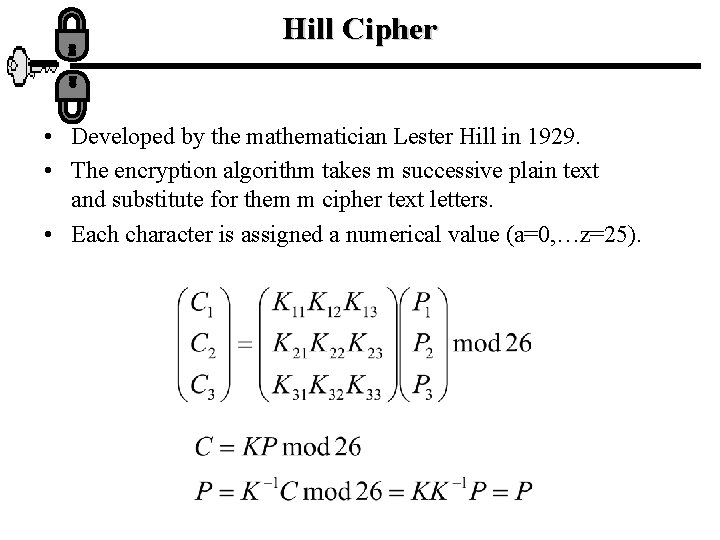
Hill Cipher • Developed by the mathematician Lester Hill in 1929. • The encryption algorithm takes m successive plain text and substitute for them m cipher text letters. • Each character is assigned a numerical value (a=0, …z=25).

Polyalphabetic Ciphers • Another approach to improving security is to use multiple cipher alphabets • Called polyalphabetic substitution ciphers • Makes cryptanalysis harder with more alphabets to guess and flatter frequency distribution • Use a key to select which alphabet is used for each letter of the message • Use each alphabet in turn • Repeat from start after end of key is reached 2

One-Time Pad • A truly random key as long as the message is used, the cipher will be secure • Called a One-Time pad • Is unbreakable since ciphertext bears no statistical relationship to the plaintext • Since for any plaintext & any ciphertext there exists a key mapping one to other • Can only use the key once though 3
Continue… • Have problem of safe distribution of key • There is a practical problem making large quantities of random keys. 4
Transposition Ciphers • Now consider classical transposition or permutation ciphers • These hide the message by rearranging the letter order • Without altering the actual letters used • Can recognise these since have the same frequency distribution as the original text 5
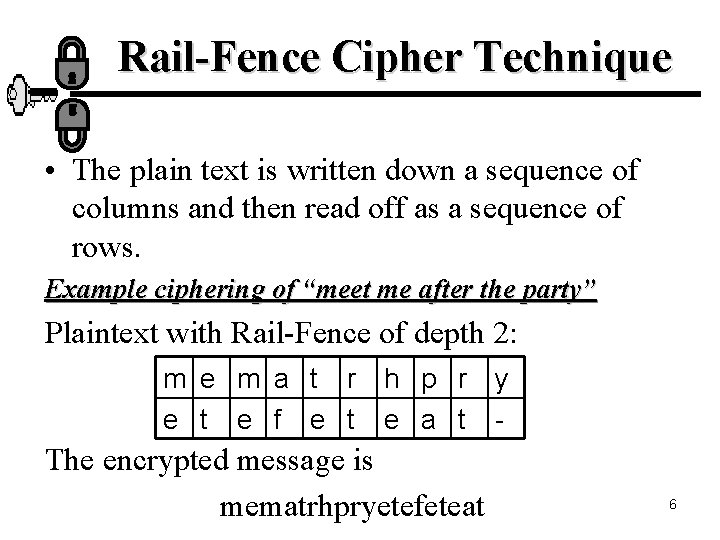
Rail-Fence Cipher Technique • The plain text is written down a sequence of columns and then read off as a sequence of rows. Example ciphering of “meet me after the party” Plaintext with Rail-Fence of depth 2: m e m a t r h p r y e t e f e t e a t - The encrypted message is mematrhpryetefeteat 6
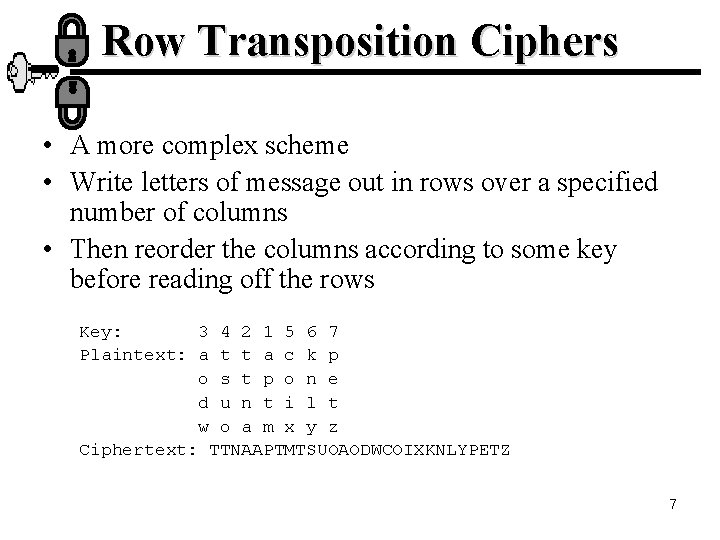
Row Transposition Ciphers • A more complex scheme • Write letters of message out in rows over a specified number of columns • Then reorder the columns according to some key before reading off the rows Key: 3 4 2 1 5 6 7 Plaintext: a t t a c k p o s t p o n e d u n t i l t w o a m x y z Ciphertext: TTNAAPTMTSUOAODWCOIXKNLYPETZ 7
Product Ciphers • Ciphers using substitutions or transpositions are not secure because of language characteristics • Hence consider using several ciphers in succession to make harder, but: – two substitutions make a more complex substitution – two transpositions make more complex transposition – but a substitution followed by a transposition makes a new much harder cipher • This is bridge from classical to modern ciphers 8
Rotor Machines • Before modern ciphers, rotor machines were most common product cipher • Were widely used in WW 2 – German Enigma, Allied Hagelin, Japanese Purple • Implemented a very complex, varying substitution cipher • Used a series of cylinders, each giving one substitution, which rotated and changed after each letter was encrypted • With 3 cylinders have 263=17576 alphabets 9

Rotor Machines 10
Steganography • Steganography, is a term derived from the Greek words steganos, which means covered and graphia which means writing • An alternative to encryption • Hides existence of message – using only a subset of letters/words in a longer message marked in some way – using invisible ink – hiding in LSB in graphic image or sound file • Has drawbacks – high overhead to hide relatively few info bits 11
- Slides: 11