
Highway Traffic and Safety Analyses Lecture 6 Traffic

- Slides: 25
Highway Traffic and Safety Analyses Lecture 6: Traffic Volume Variability and Studies Purdue University School of Civil Engineering West Lafayette
Lecture Outline • • • Definitions Volumes variability Estimation of AADT Design volume Counting techniques Types of volume studies
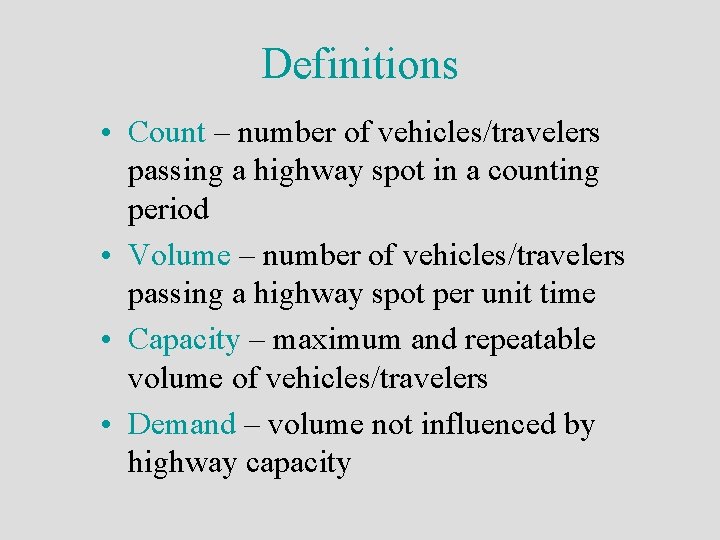
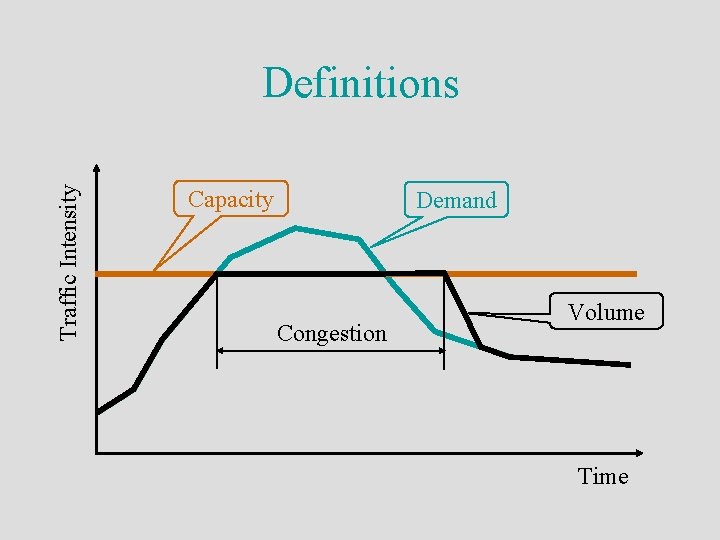
Definitions • Count – number of vehicles/travelers passing a highway spot in a counting period • Volume – number of vehicles/travelers passing a highway spot per unit time • Capacity – maximum and repeatable volume of vehicles/travelers • Demand – volume not influenced by highway capacity
Traffic Intensity Definitions Capacity Demand Congestion Volume Time
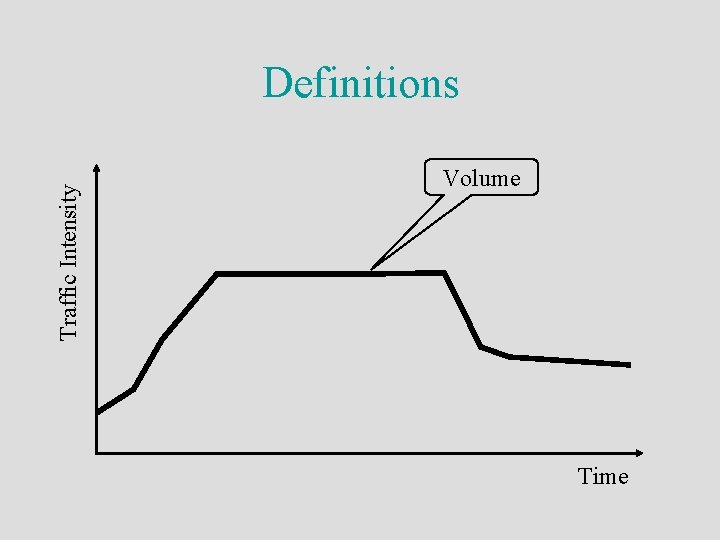
Traffic Intensity Definitions Volume Time
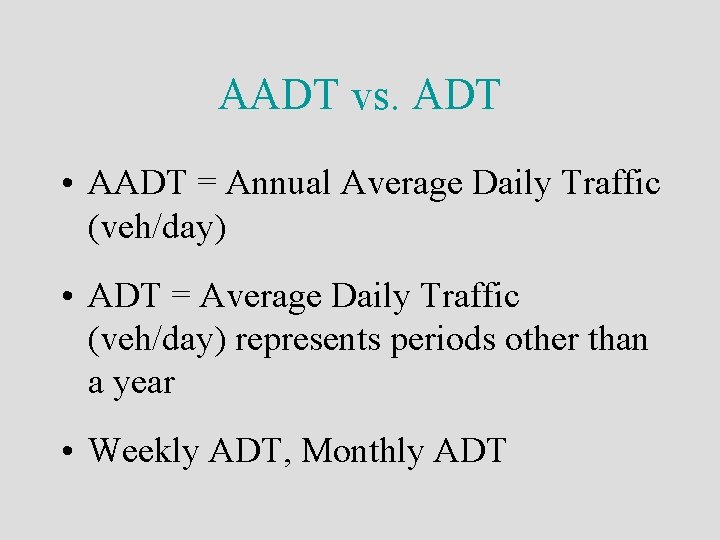
AADT vs. ADT • AADT = Annual Average Daily Traffic (veh/day) • ADT = Average Daily Traffic (veh/day) represents periods other than a year • Weekly ADT, Monthly ADT
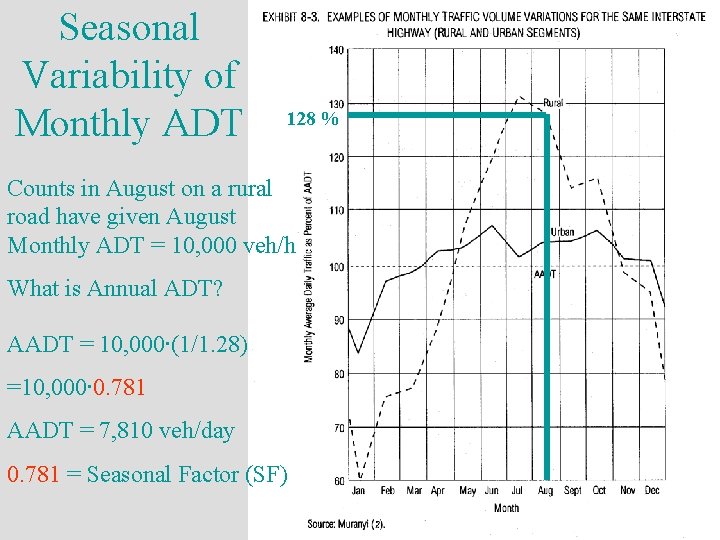
Seasonal Variability of Monthly ADT 128 % Counts in August on a rural road have given August Monthly ADT = 10, 000 veh/h What is Annual ADT? AADT = 10, 000∙(1/1. 28) =10, 000∙ 0. 781 AADT = 7, 810 veh/day 0. 781 = Seasonal Factor (SF)
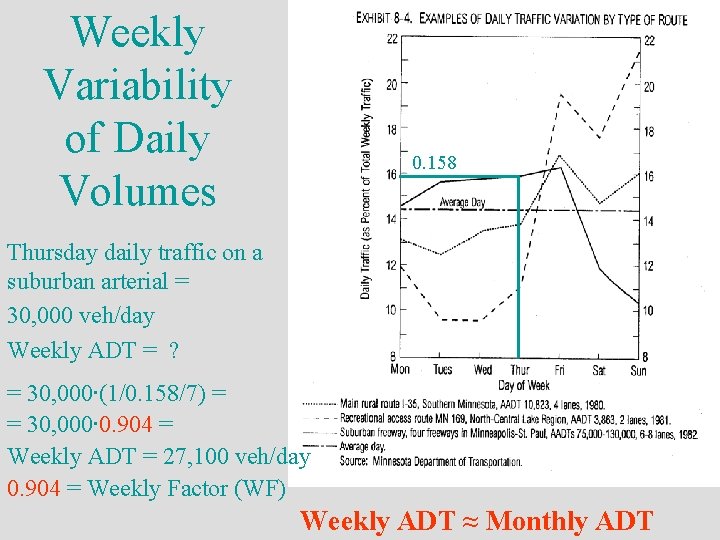
Weekly Variability of Daily Volumes 0. 158 Thursday daily traffic on a suburban arterial = 30, 000 veh/day Weekly ADT = ? = 30, 000∙(1/0. 158/7) = = 30, 000∙ 0. 904 = Weekly ADT = 27, 100 veh/day 0. 904 = Weekly Factor (WF) Weekly ADT ≈ Monthly ADT
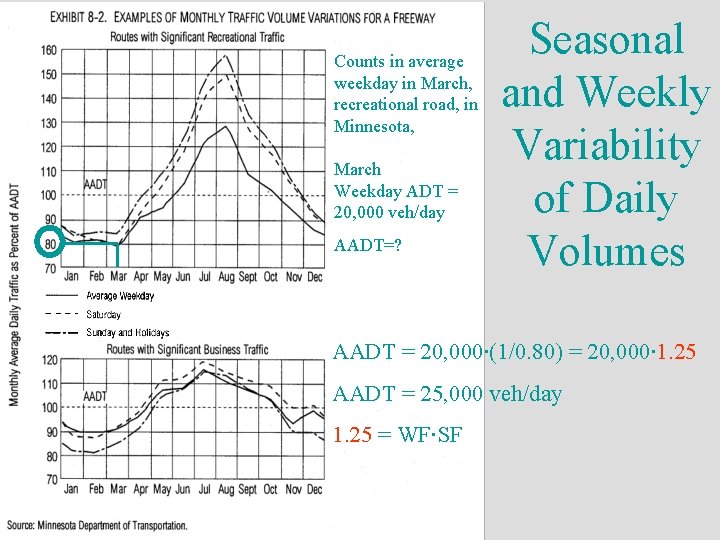
Counts in average weekday in March, recreational road, in Minnesota, March Weekday ADT = 20, 000 veh/day AADT=? Seasonal and Weekly Variability of Daily Volumes AADT = 20, 000∙(1/0. 80) = 20, 000∙ 1. 25 AADT = 25, 000 veh/day 1. 25 = WF∙SF
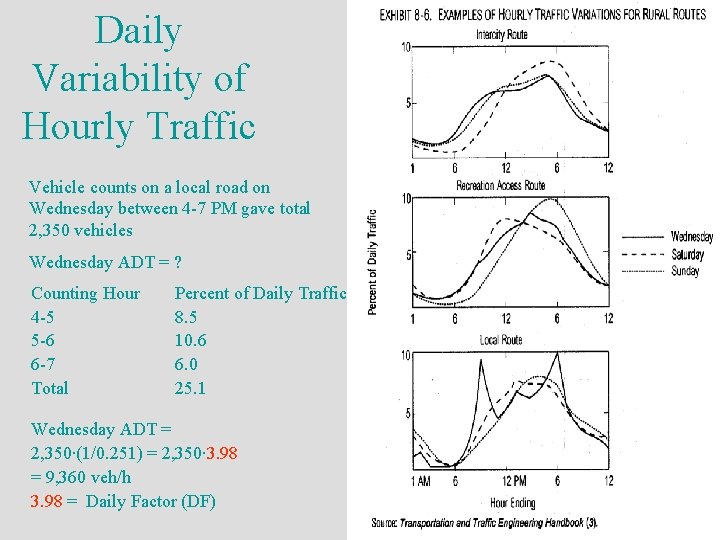
Daily Variability of Hourly Traffic Vehicle counts on a local road on Wednesday between 4 -7 PM gave total 2, 350 vehicles Wednesday ADT = ? Counting Hour 4 -5 5 -6 6 -7 Total Percent of Daily Traffic 8. 5 10. 6 6. 0 25. 1 Wednesday ADT = 2, 350∙(1/0. 251) = 2, 350∙ 3. 98 = 9, 360 veh/h 3. 98 = Daily Factor (DF)
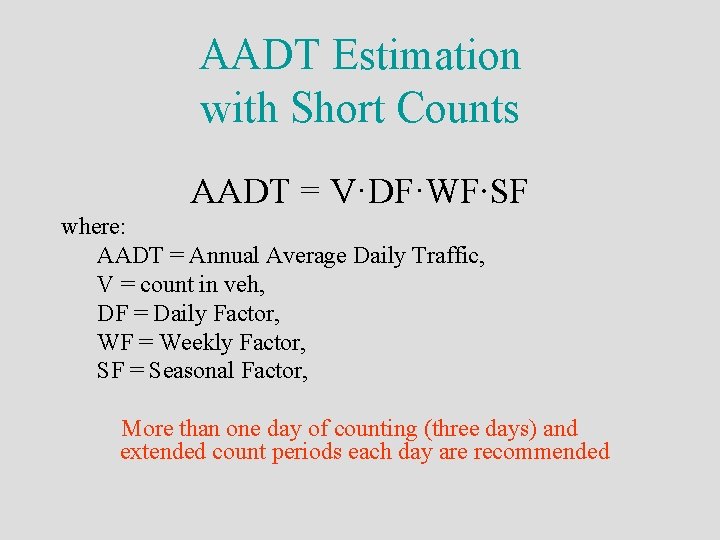
AADT Estimation with Short Counts AADT = V·DF·WF∙SF where: AADT = Annual Average Daily Traffic, V = count in veh, DF = Daily Factor, WF = Weekly Factor, SF = Seasonal Factor, More than one day of counting (three days) and extended count periods each day are recommended
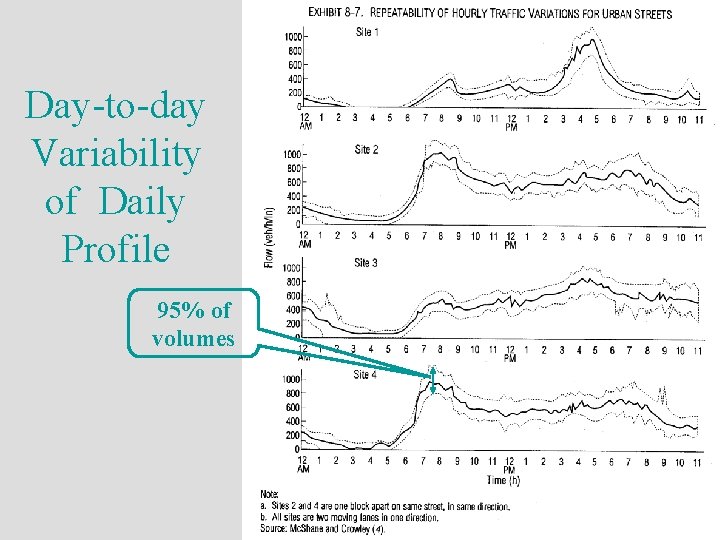
Day-to-day Variability of Daily Profile 95% of volumes
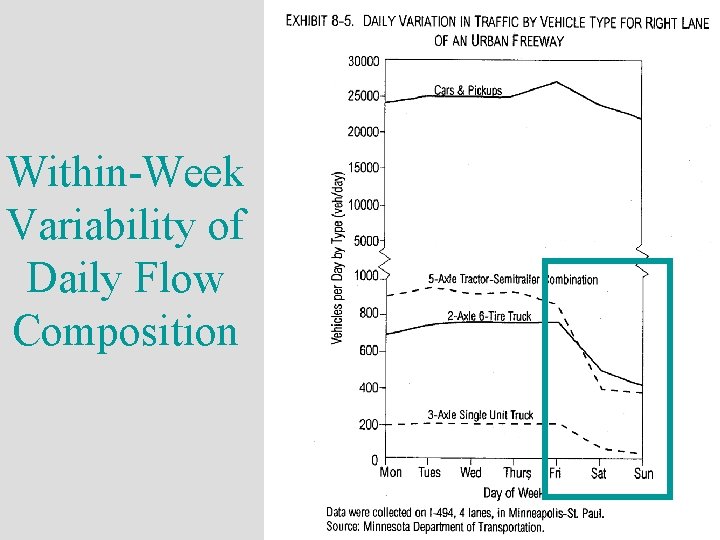
Within-Week Variability of Daily Flow Composition
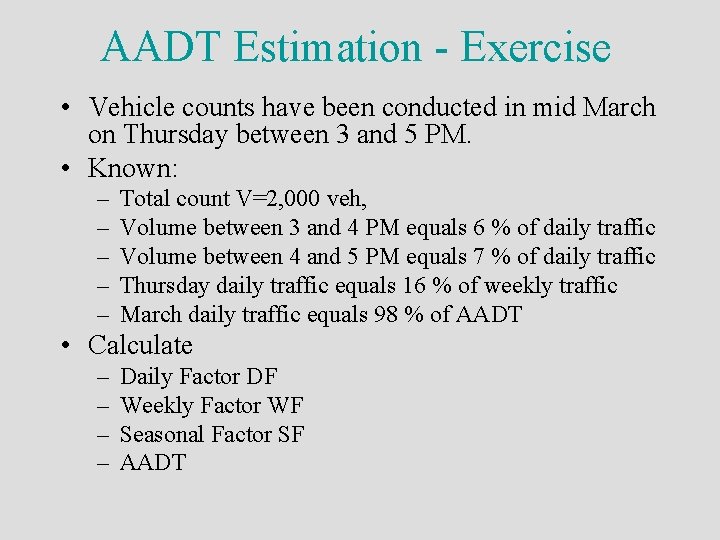
AADT Estimation - Exercise • Vehicle counts have been conducted in mid March on Thursday between 3 and 5 PM. • Known: – – – Total count V=2, 000 veh, Volume between 3 and 4 PM equals 6 % of daily traffic Volume between 4 and 5 PM equals 7 % of daily traffic Thursday daily traffic equals 16 % of weekly traffic March daily traffic equals 98 % of AADT • Calculate – – Daily Factor DF Weekly Factor WF Seasonal Factor SF AADT
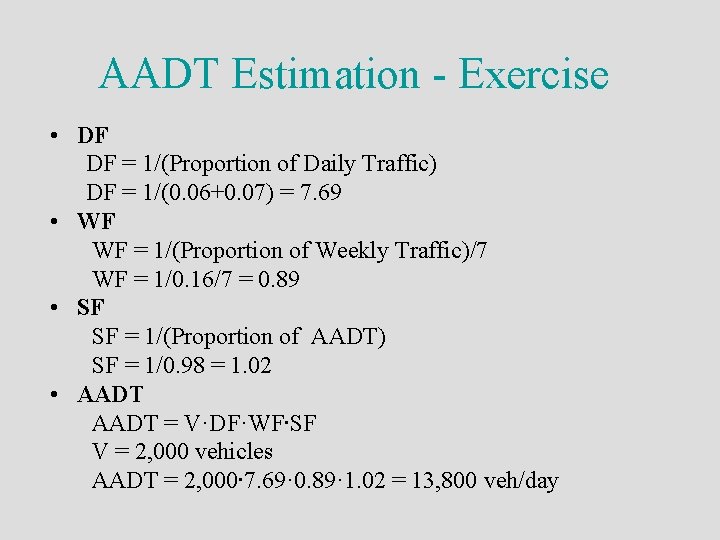
AADT Estimation - Exercise • DF DF = 1/(Proportion of Daily Traffic) DF = 1/(0. 06+0. 07) = 7. 69 • WF WF = 1/(Proportion of Weekly Traffic)/7 WF = 1/0. 16/7 = 0. 89 • SF SF = 1/(Proportion of AADT) SF = 1/0. 98 = 1. 02 • AADT = V·DF·WF∙SF V = 2, 000 vehicles AADT = 2, 000∙ 7. 69· 0. 89· 1. 02 = 13, 800 veh/day
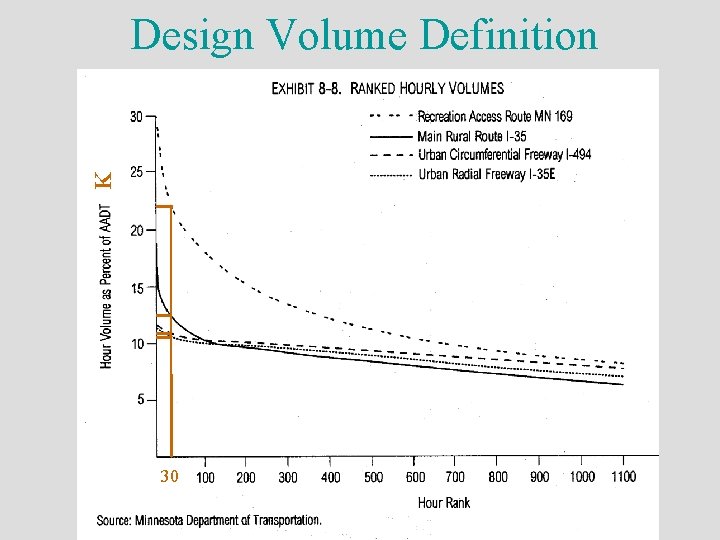
K Design Volume Definition 30
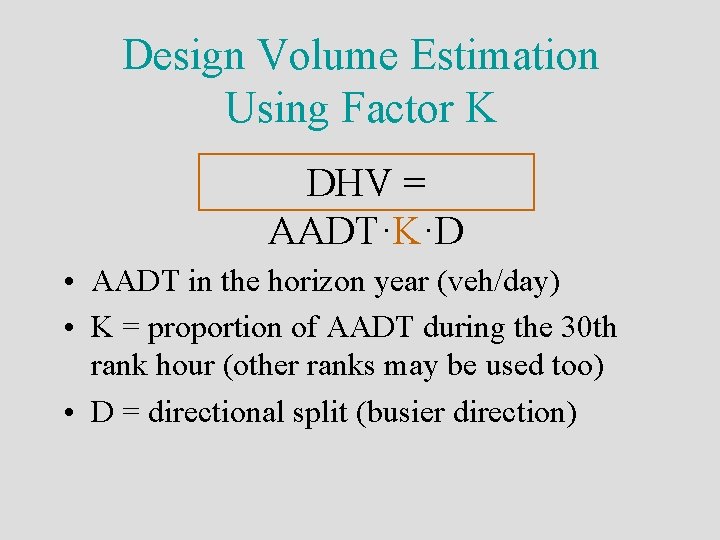
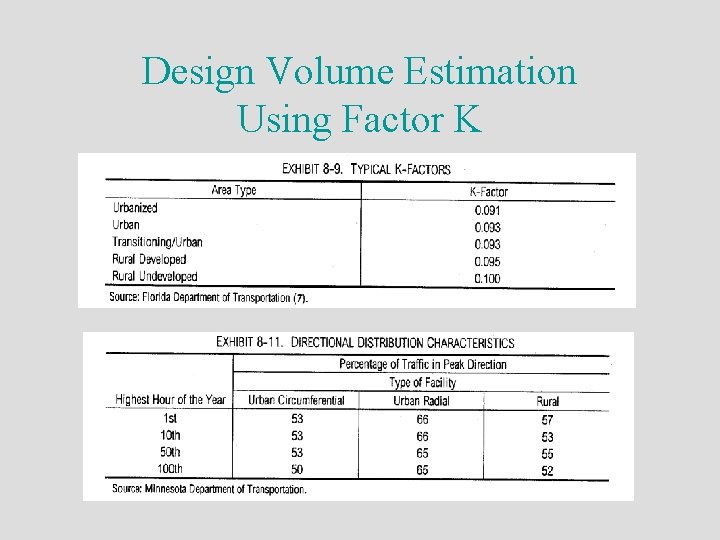
Design Volume Estimation Using Factor K DHV = AADT·K·D • AADT in the horizon year (veh/day) • K = proportion of AADT during the 30 th rank hour (other ranks may be used too) • D = directional split (busier direction)
Design Volume Estimation Using Factor K
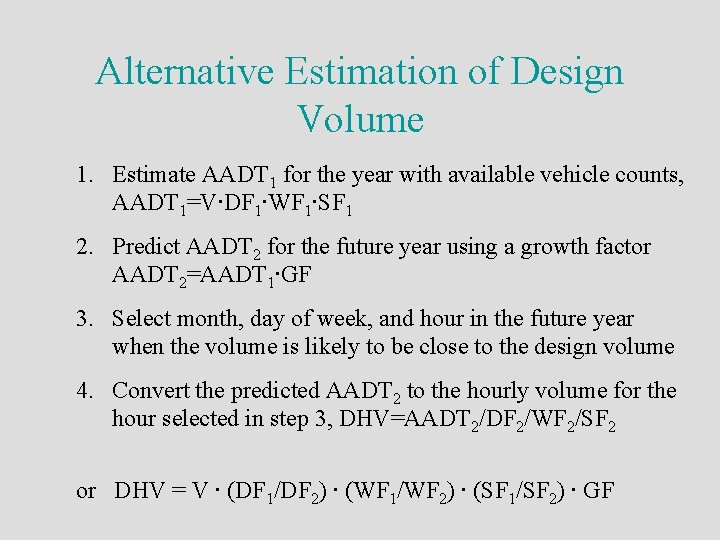
Alternative Estimation of Design Volume 1. Estimate AADT 1 for the year with available vehicle counts, AADT 1=V∙DF 1∙WF 1∙SF 1 2. Predict AADT 2 for the future year using a growth factor AADT 2=AADT 1∙GF 3. Select month, day of week, and hour in the future year when the volume is likely to be close to the design volume 4. Convert the predicted AADT 2 to the hourly volume for the hour selected in step 3, DHV=AADT 2/DF 2/WF 2/SF 2 or DHV = V ∙ (DF 1/DF 2) ∙ (WF 1/WF 2) ∙ (SF 1/SF 2) ∙ GF
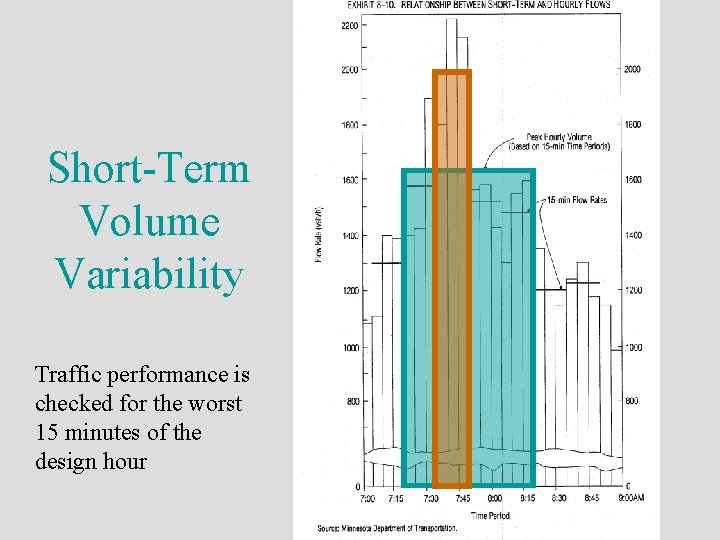
Short-Term Volume Variability Traffic performance is checked for the worst 15 minutes of the design hour
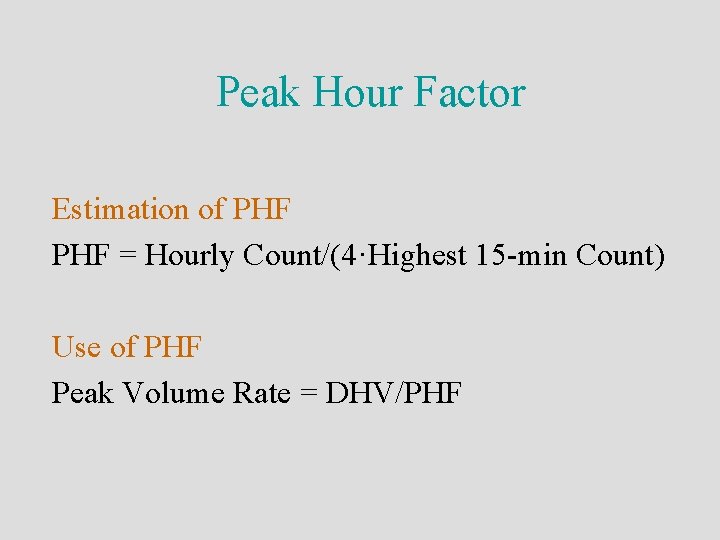
Peak Hour Factor Estimation of PHF = Hourly Count/(4·Highest 15 -min Count) Use of PHF Peak Volume Rate = DHV/PHF
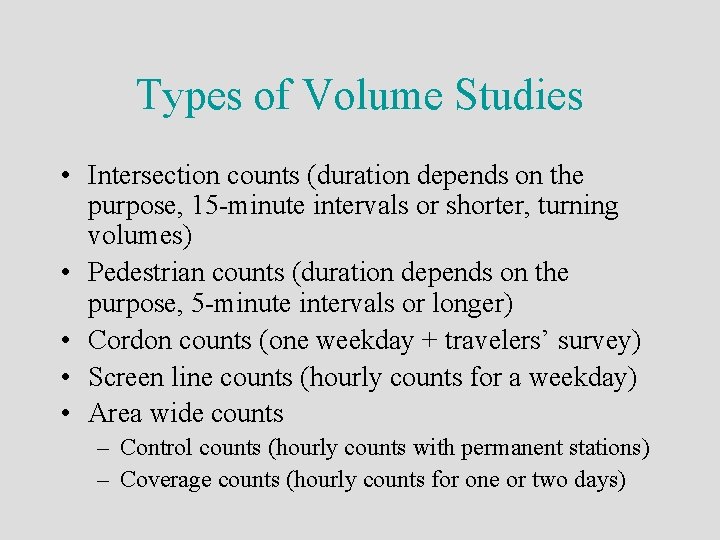
Types of Volume Studies • Intersection counts (duration depends on the purpose, 15 -minute intervals or shorter, turning volumes) • Pedestrian counts (duration depends on the purpose, 5 -minute intervals or longer) • Cordon counts (one weekday + travelers’ survey) • Screen line counts (hourly counts for a weekday) • Area wide counts – Control counts (hourly counts with permanent stations) – Coverage counts (hourly counts for one or two days)
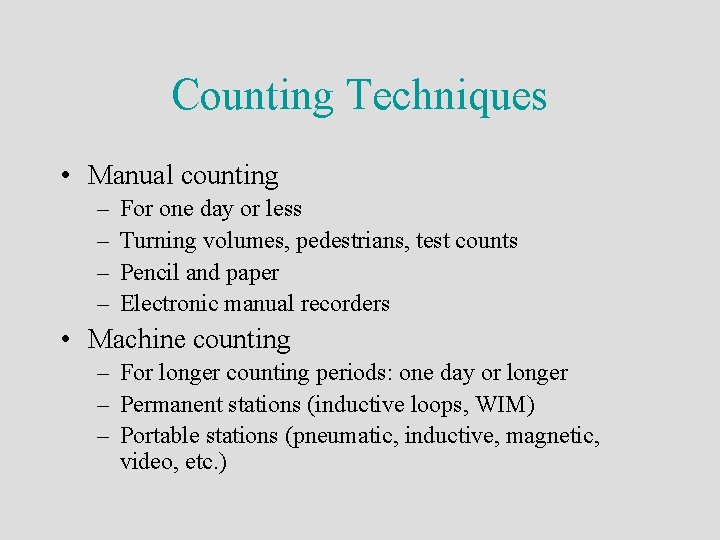
Counting Techniques • Manual counting – – For one day or less Turning volumes, pedestrians, test counts Pencil and paper Electronic manual recorders • Machine counting – For longer counting periods: one day or longer – Permanent stations (inductive loops, WIM) – Portable stations (pneumatic, inductive, magnetic, video, etc. )
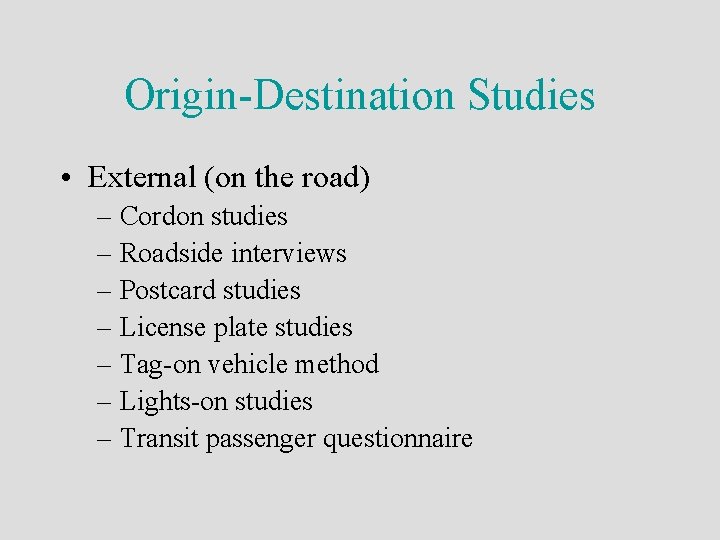
Origin-Destination Studies • External (on the road) – Cordon studies – Roadside interviews – Postcard studies – License plate studies – Tag-on vehicle method – Lights-on studies – Transit passenger questionnaire
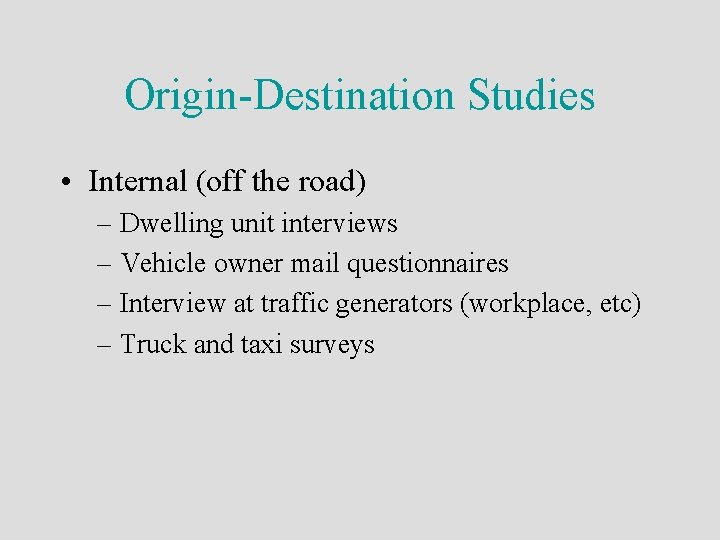
Origin-Destination Studies • Internal (off the road) – Dwelling unit interviews – Vehicle owner mail questionnaires – Interview at traffic generators (workplace, etc) – Truck and taxi surveys