
Hightemperature Radiolysis of Modified Lithium Orthosilicate Pebbles with
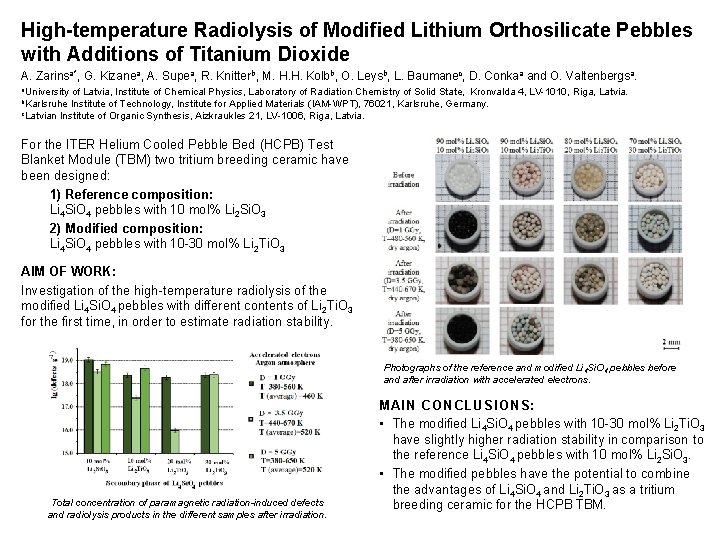
High-temperature Radiolysis of Modified Lithium Orthosilicate Pebbles with Additions of Titanium Dioxide A. Zarinsa*, G. Kizanea, A. Supea, R. Knitterb, M. H. H. Kolbb, O. Leysb, L. Baumanec, D. Conkaa and O. Valtenbergsa. a. University of Latvia, Institute of Chemical Physics, Laboratory of Radiation Chemistry of Solid State, Kronvalda 4, LV-1010, Riga, Latvia. Institute of Technology, Institute for Applied Materials (IAM-WPT), 76021, Karlsruhe, Germany. c. Latvian Institute of Organic Synthesis, Aizkraukles 21, LV-1006, Riga, Latvia. b. Karlsruhe For the ITER Helium Cooled Pebble Bed (HCPB) Test Blanket Module (TBM) two tritium breeding ceramic have been designed: 1) Reference composition: Li 4 Si. O 4 pebbles with 10 mol% Li 2 Si. O 3 2) Modified composition: Li 4 Si. O 4 pebbles with 10 -30 mol% Li 2 Ti. O 3 AIM OF WORK: Investigation of the high-temperature radiolysis of the modified Li 4 Si. O 4 pebbles with different contents of Li 2 Ti. O 3 for the first time, in order to estimate radiation stability. Photographs of the reference and modified Li 4 Si. O 4 pebbles before and after irradiation with accelerated electrons. Total concentration of paramagnetic radiation-induced defects and radiolysis products in the different samples after irradiation. MAIN CONCLUSIONS: • The modified Li 4 Si. O 4 pebbles with 10 -30 mol% Li 2 Ti. O 3 have slightly higher radiation stability in comparison to the reference Li 4 Si. O 4 pebbles with 10 mol% Li 2 Si. O 3. • The modified pebbles have the potential to combine the advantages of Li 4 Si. O 4 and Li 2 Ti. O 3 as a tritium breeding ceramic for the HCPB TBM.
- Slides: 1