
HighResolution Panoramas Using Image Mosaicing Stanford University EE

- Slides: 21
High-Resolution Panoramas Using Image Mosaicing Stanford University EE 368 Project Spring 2000 Laurent Meunier and Moritz Borgmann © 2000 Laurent Meunier and Moritz Borgmann
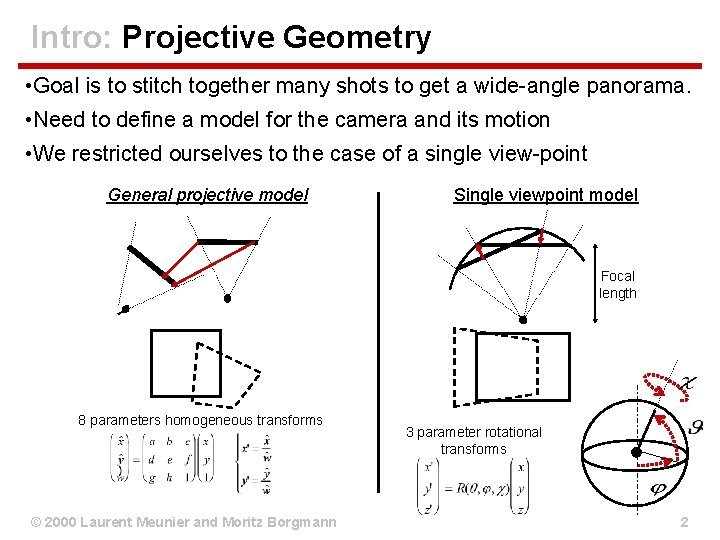
Intro: Projective Geometry • Goal is to stitch together many shots to get a wide-angle panorama. • Need to define a model for the camera and its motion • We restricted ourselves to the case of a single view-point General projective model Single viewpoint model Focal length 8 parameters homogeneous transforms © 2000 Laurent Meunier and Moritz Borgmann 3 parameter rotational transforms 2
Registration © 2000 Laurent Meunier and Moritz Borgmann
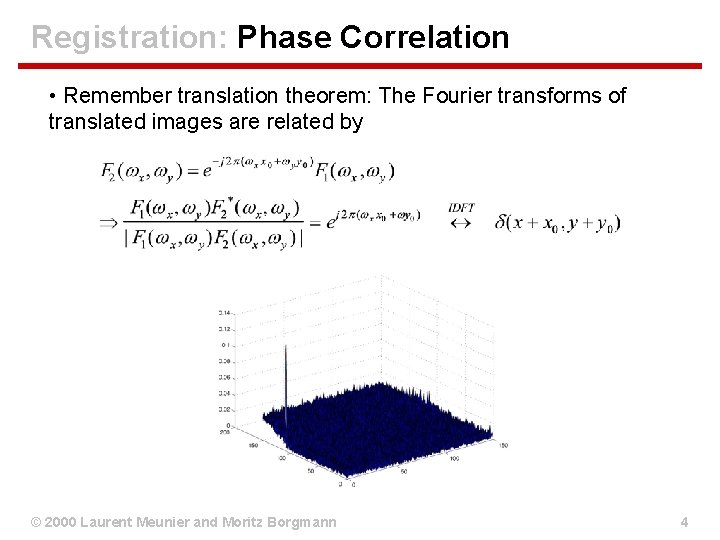
Registration: Phase Correlation • Remember translation theorem: The Fourier transforms of translated images are related by © 2000 Laurent Meunier and Moritz Borgmann 4
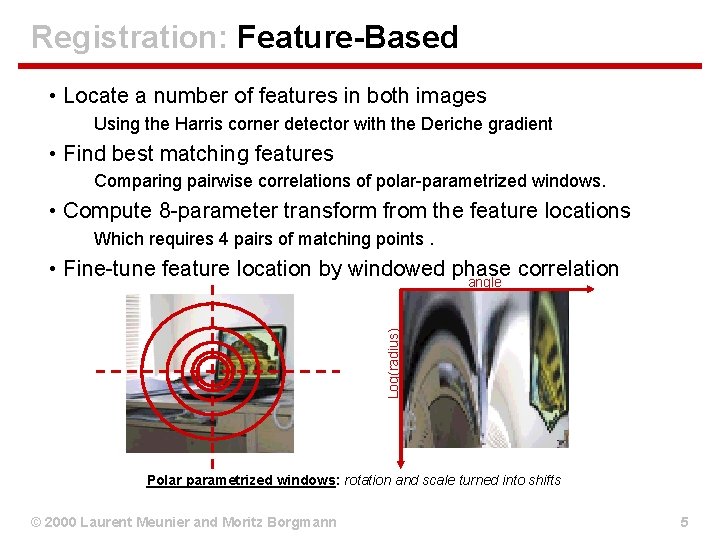
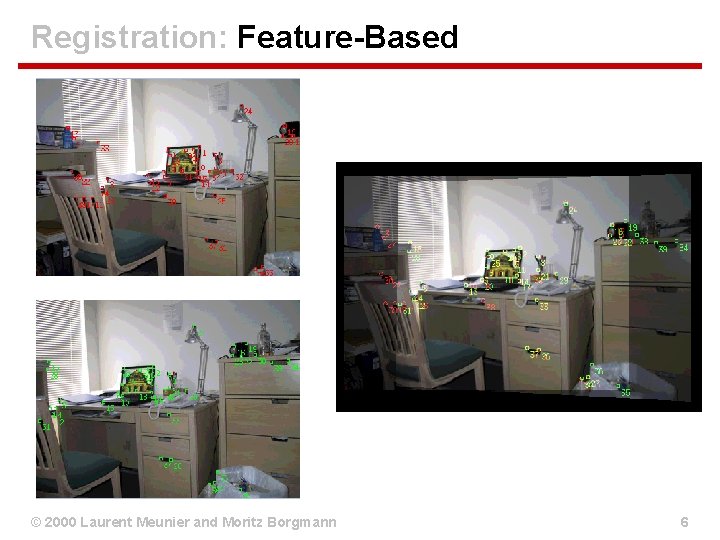
Registration: Feature-Based • Locate a number of features in both images Using the Harris corner detector with the Deriche gradient • Find best matching features Comparing pairwise correlations of polar-parametrized windows. • Compute 8 -parameter transform from the feature locations Which requires 4 pairs of matching points. • Fine-tune feature location by windowed phase correlation Log(radius) angle Polar parametrized windows: rotation and scale turned into shifts © 2000 Laurent Meunier and Moritz Borgmann 5
Registration: Feature-Based © 2000 Laurent Meunier and Moritz Borgmann 6
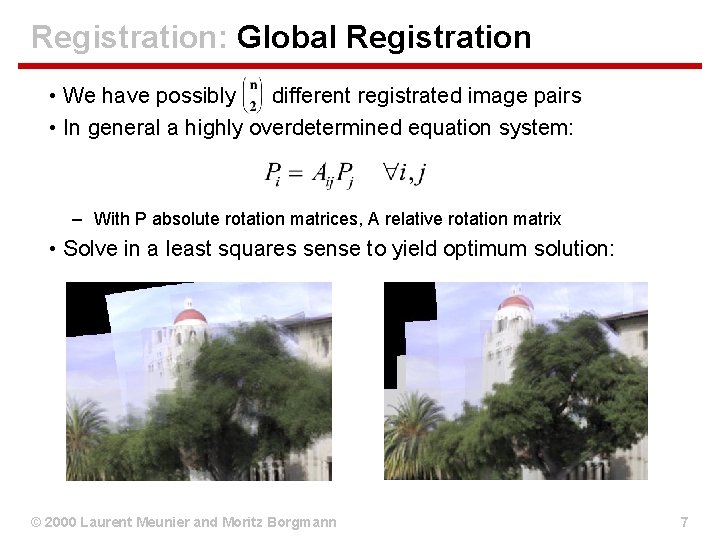
Registration: Global Registration • We have possibly different registrated image pairs • In general a highly overdetermined equation system: – With P absolute rotation matrices, A relative rotation matrix • Solve in a least squares sense to yield optimum solution: © 2000 Laurent Meunier and Moritz Borgmann 7
Composing © 2000 Laurent Meunier and Moritz Borgmann
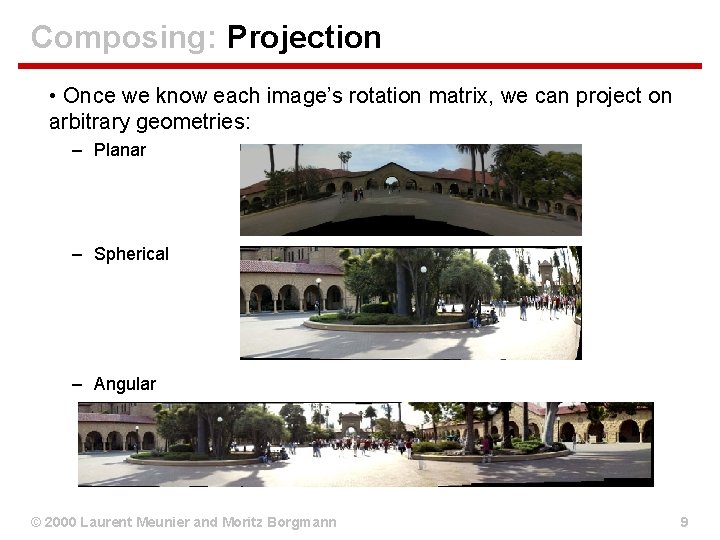
Composing: Projection • Once we know each image’s rotation matrix, we can project on arbitrary geometries: – Planar – Spherical – Angular © 2000 Laurent Meunier and Moritz Borgmann 9
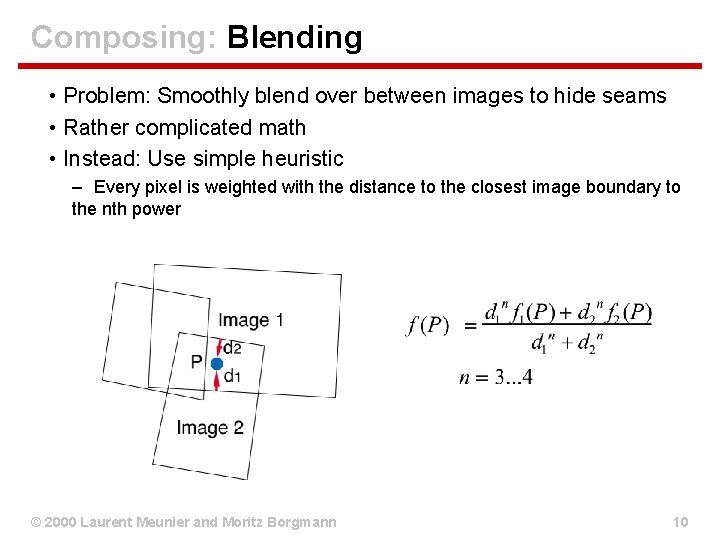
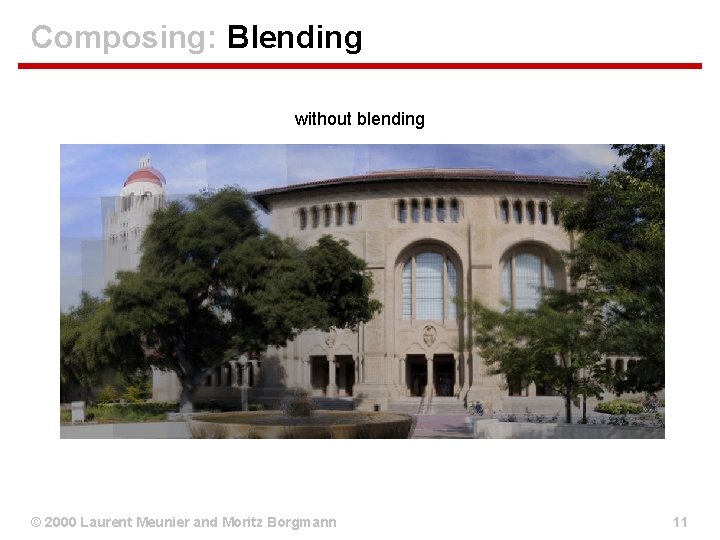
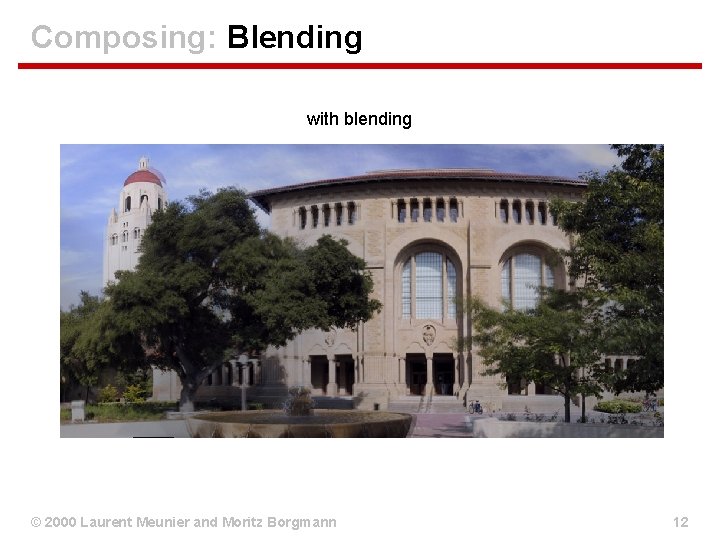
Composing: Blending • Problem: Smoothly blend over between images to hide seams • Rather complicated math • Instead: Use simple heuristic – Every pixel is weighted with the distance to the closest image boundary to the nth power © 2000 Laurent Meunier and Moritz Borgmann 10
Composing: Blending without blending © 2000 Laurent Meunier and Moritz Borgmann 11
Composing: Blending with blending © 2000 Laurent Meunier and Moritz Borgmann 12
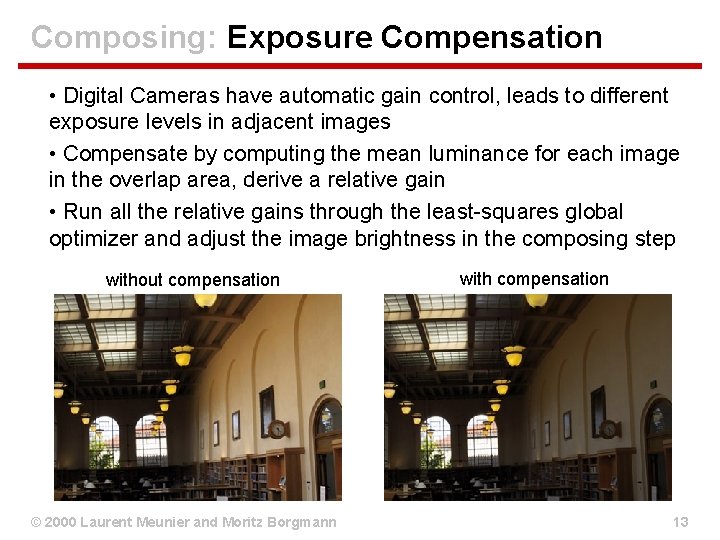
Composing: Exposure Compensation • Digital Cameras have automatic gain control, leads to different exposure levels in adjacent images • Compensate by computing the mean luminance for each image in the overlap area, derive a relative gain • Run all the relative gains through the least-squares global optimizer and adjust the image brightness in the composing step without compensation © 2000 Laurent Meunier and Moritz Borgmann with compensation 13
Examples © 2000 Laurent Meunier and Moritz Borgmann
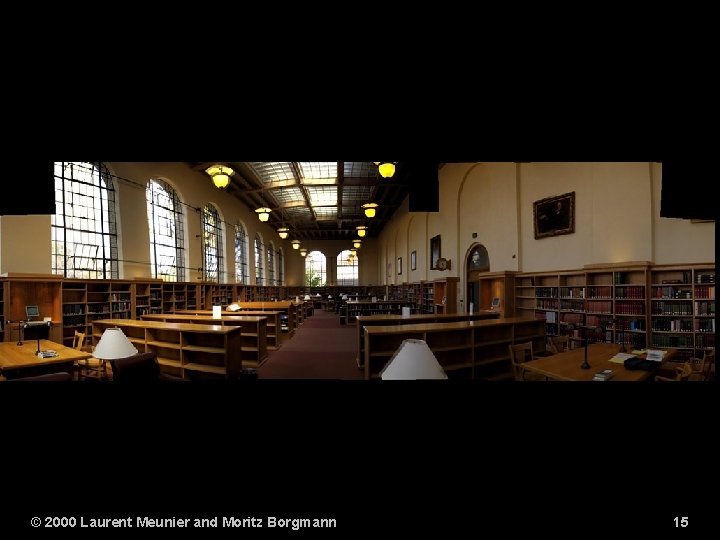
© 2000 Laurent Meunier and Moritz Borgmann 15
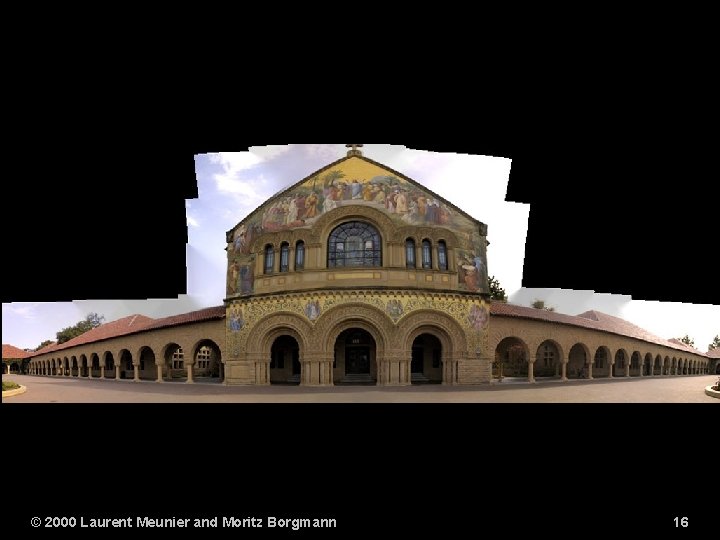
© 2000 Laurent Meunier and Moritz Borgmann 16
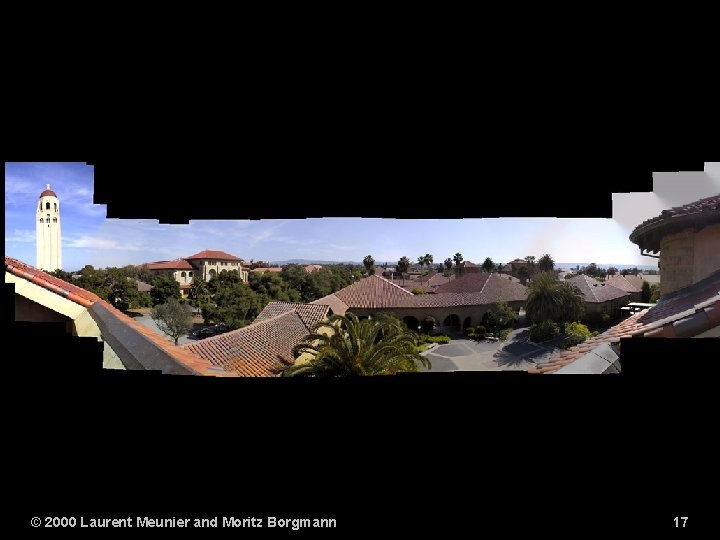
© 2000 Laurent Meunier and Moritz Borgmann 17
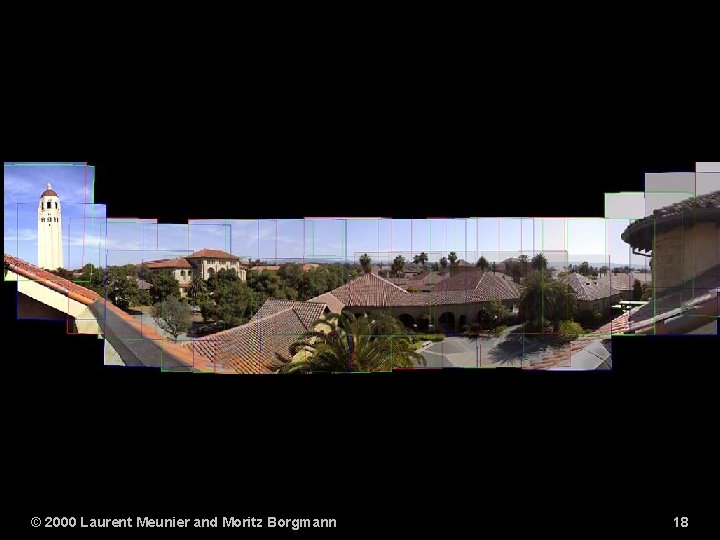
© 2000 Laurent Meunier and Moritz Borgmann 18
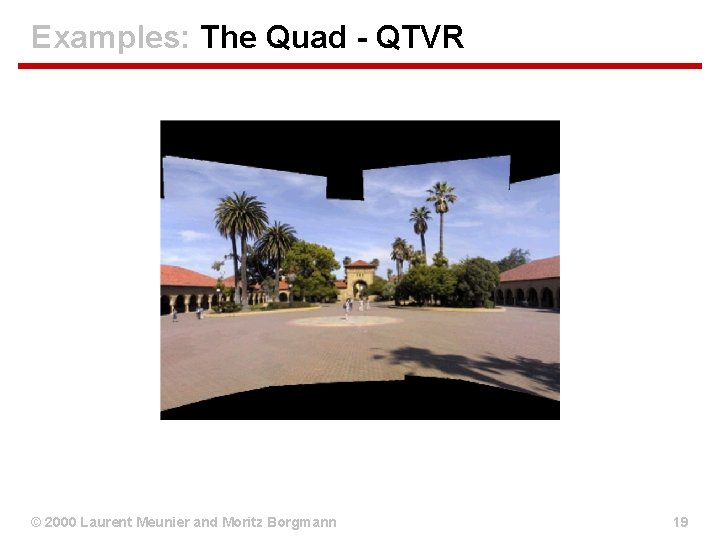
Examples: The Quad - QTVR © 2000 Laurent Meunier and Moritz Borgmann 19
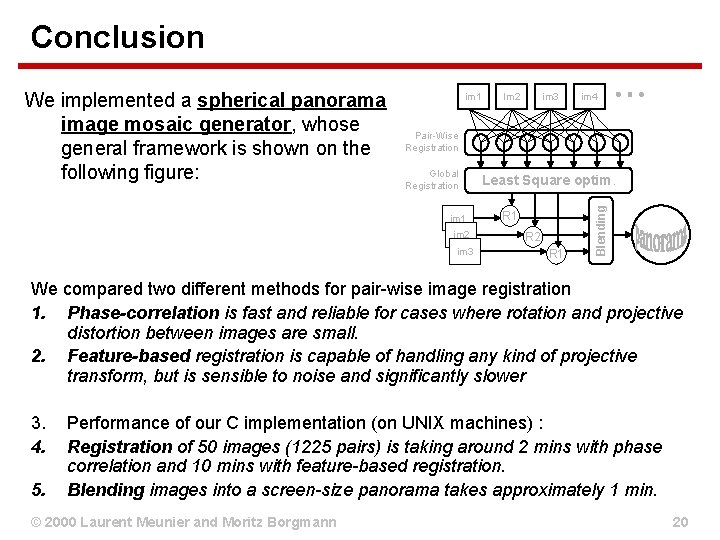
Conclusion im 1 Im 2 im 3 im 4 Pair-Wise Registration Global Registration im 1 im 2 im 3 Least Square optim. R 1 R 2 R 1 Blending We implemented a spherical panorama image mosaic generator, whose general framework is shown on the following figure: We compared two different methods for pair-wise image registration 1. Phase-correlation is fast and reliable for cases where rotation and projective distortion between images are small. 2. Feature-based registration is capable of handling any kind of projective transform, but is sensible to noise and significantly slower 3. 4. 5. Performance of our C implementation (on UNIX machines) : Registration of 50 images (1225 pairs) is taking around 2 mins with phase correlation and 10 mins with feature-based registration. Blending images into a screen-size panorama takes approximately 1 min. © 2000 Laurent Meunier and Moritz Borgmann 20
The End Thank You Q&A Laurent Meunier - lmeunier@stanford. edu Moritz Borgmann - moriborg@stanford. edu © 2000 Laurent Meunier and Moritz Borgmann 21