
HighPressure H 2 Validation Testing of SAE Performance
- Slides: 24
High-Pressure H 2: Validation Testing of SAE Performance Based System Level Standards NHA Hydrogen Conference Long Beach, CA Robert Burgess, NREL FCV Safety WG Member May 4, 2010 NREL is a national laboratory of the U. S. Department of Energy Office of Energy Efficiency and Renewable Energy operated by the Alliance for Sustainable Energy, LLC
Thanks to SAE FCV Safety Working Group Presentation materials provided by following working group members: Glenn Scheffler, Committee Chair (Consultant) Christine Sloane, (Consultant) Jake De. Vaal (Ballard Power Systems Inc) Gery Kissel (General Motors) Michael Veenstra (Ford Motor Company) Tommy Chang and Naoki Kinoshita (Honda) Matt Mc. Clory (Toyota Motor Engr And Mfg North America) Hajime Fukumoto (Japan Automobile Research Institute) Marcel Halberstadt (MLH Consulting) Jesse Schneider (Consultant) Livio Gambone (Powertech Labs) Mark Mc. Dougal (Powertech Labs) Caroline Michaels (SAE) National Renewable Energy Laboratory Innovation for Our Energy Future
SAE FCV (Fuel Cell Vehicle) Activities § § Objective § Address real-world system safety while providing flexibility for rapid advances in technology § Provide technical basis for regulatory requirements Documents published: § § § § SAE J 1766 Post-crash electrical safety SAE J 2578 Fuel cell vehicle safety SAE J 2579 Vehicular hydrogen systems (TIR) SAE J 2600 GH 2 refueling connection devices SAE J 2601 Fueling protocols for GH 2 SAE J 2615 -2617 Performance testing protocols SAE J 2719 GH 2 quality guidelines SAE J 2760 Hydrogen system terminology (TIR) National Renewable Energy Laboratory Innovation for Our Energy Future
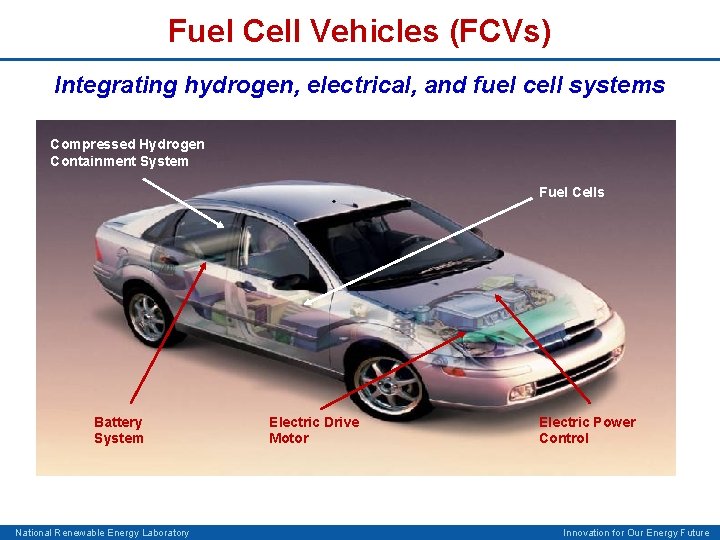
Fuel Cell Vehicles (FCVs) Integrating hydrogen, electrical, and fuel cell systems Compressed Hydrogen Containment System Fuel Cells Battery System National Renewable Energy Laboratory Electric Drive Motor Electric Power Control Innovation for Our Energy Future
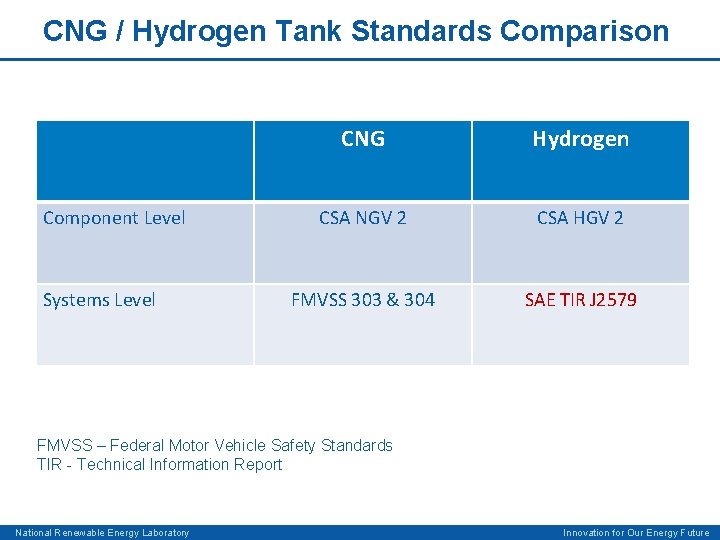
CNG / Hydrogen Tank Standards Comparison Component Level Systems Level CNG Hydrogen CSA NGV 2 CSA HGV 2 FMVSS 303 & 304 SAE TIR J 2579 FMVSS – Federal Motor Vehicle Safety Standards TIR - Technical Information Report National Renewable Energy Laboratory Innovation for Our Energy Future
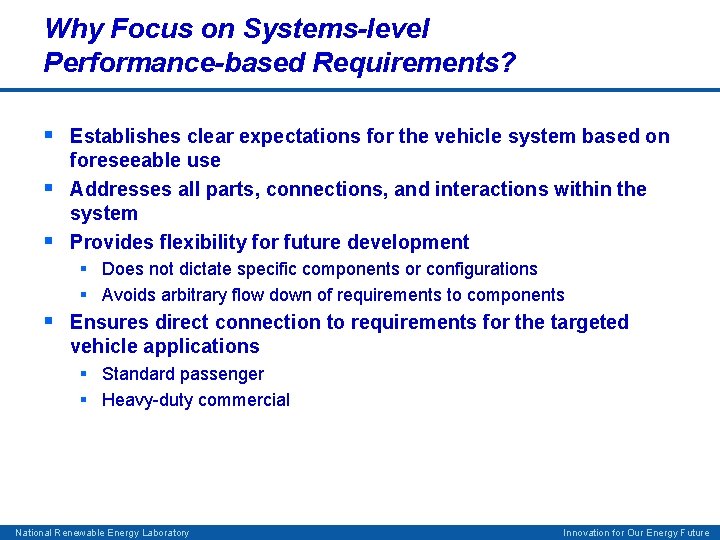
Why Focus on Systems-level Performance-based Requirements? on Systems-level § § § Establishes clear expectations for the vehicle system based on foreseeable use Addresses all parts, connections, and interactions within the system Provides flexibility for future development § Does not dictate specific components or configurations § Avoids arbitrary flow down of requirements to components § Ensures direct connection to requirements for the targeted vehicle applications § Standard passenger § Heavy-duty commercial National Renewable Energy Laboratory Innovation for Our Energy Future
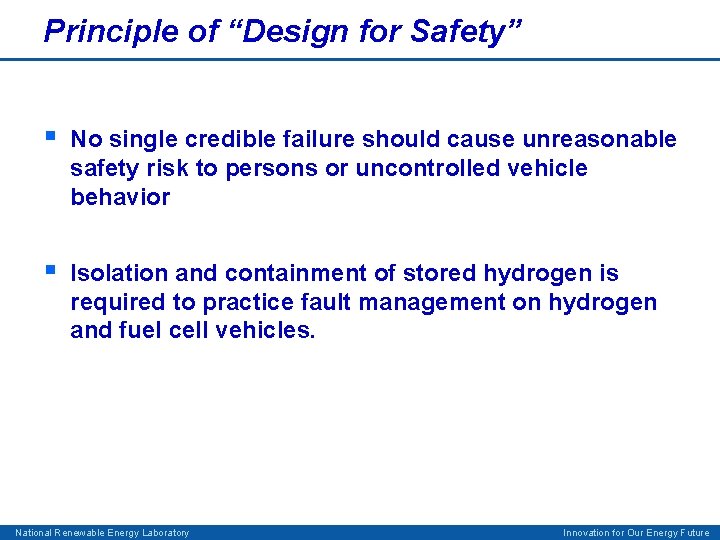
Principle of “Design for Safety” § No single credible failure should cause unreasonable safety risk to persons or uncontrolled vehicle behavior § Isolation and containment of stored hydrogen is required to practice fault management on hydrogen and fuel cell vehicles. National Renewable Energy Laboratory Innovation for Our Energy Future
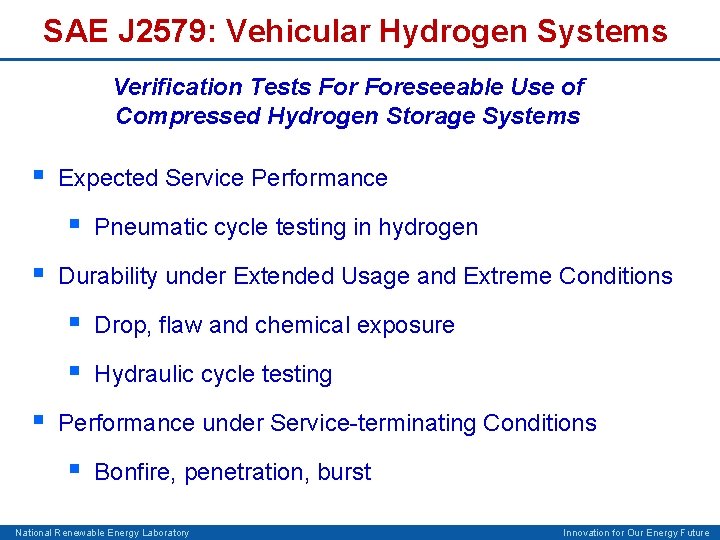
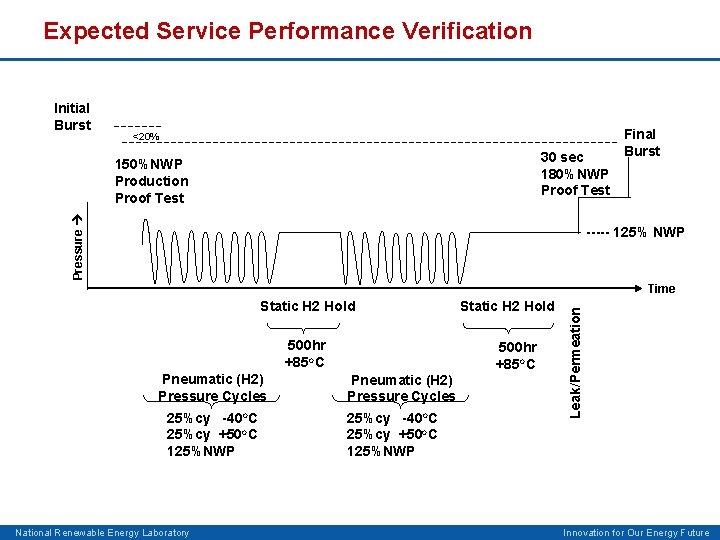
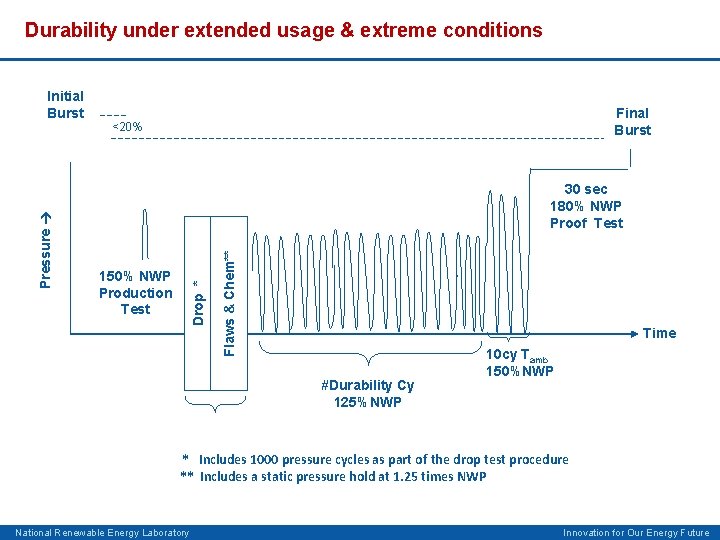
SAE J 2579: Vehicular Hydrogen Systems Verification Tests Foreseeable Use of Compressed Hydrogen Storage Systems § Expected Service Performance § § § Pneumatic cycle testing in hydrogen Durability under Extended Usage and Extreme Conditions § Drop, flaw and chemical exposure § Hydraulic cycle testing Performance under Service-terminating Conditions § Bonfire, penetration, burst National Renewable Energy Laboratory Innovation for Our Energy Future
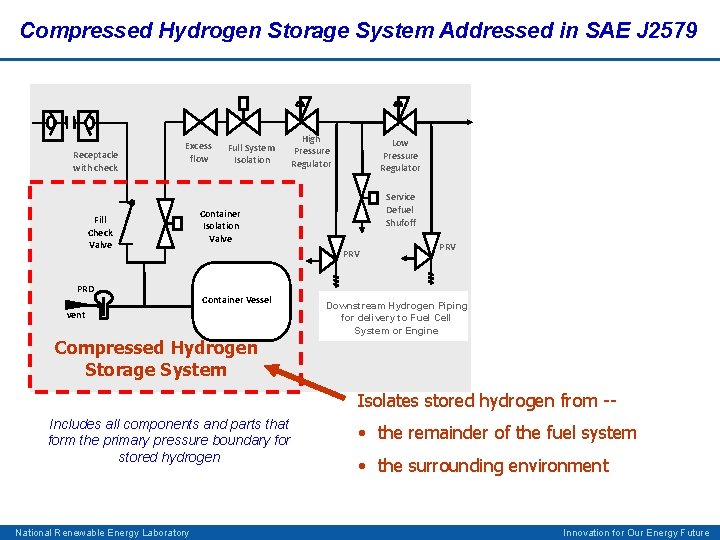
Compressed Hydrogen Storage System Addressed in SAE J 2579 Receptacle with check Excess flow Fill Check Valve PRD Full System Isolation High Pressure Regulator Low Pressure Regulator Service Defuel Shufoff Container Isolation Valve PRV Container Vessel vent PRV Downstream Hydrogen Piping for delivery to Fuel Cell System or Engine Compressed Hydrogen Storage System Isolates stored hydrogen from -Includes all components and parts that form the primary pressure boundary for stored hydrogen National Renewable Energy Laboratory • the remainder of the fuel system • the surrounding environment Innovation for Our Energy Future
Expected Service Performance Verification Initial Burst <20% 30 sec 180%NWP Proof Test Pressure 150%NWP Production Proof Test Final Burst ----- 125% NWP Static H 2 Hold 500 hr +85 o. C Pneumatic (H 2) Pressure Cycles 25%cy -40 o. C 25%cy +50 o. C 125%NWP National Renewable Energy Laboratory Static H 2 Hold 500 hr +85 o. C Pneumatic (H 2) Pressure Cycles 25%cy -40 o. C 25%cy +50 o. C 125%NWP Leak/Permeation Time Innovation for Our Energy Future
Durability under extended usage & extreme conditions Final Burst <20% 150% NWP Production Test Flaws & Chem** 30 sec 180% NWP Proof Test Drop * Pressure Initial Burst Time #Durability Cy 125%NWP 10 cy Tamb 150%NWP * Includes 1000 pressure cycles as part of the drop test procedure ** Includes a static pressure hold at 1. 25 times NWP National Renewable Energy Laboratory Innovation for Our Energy Future
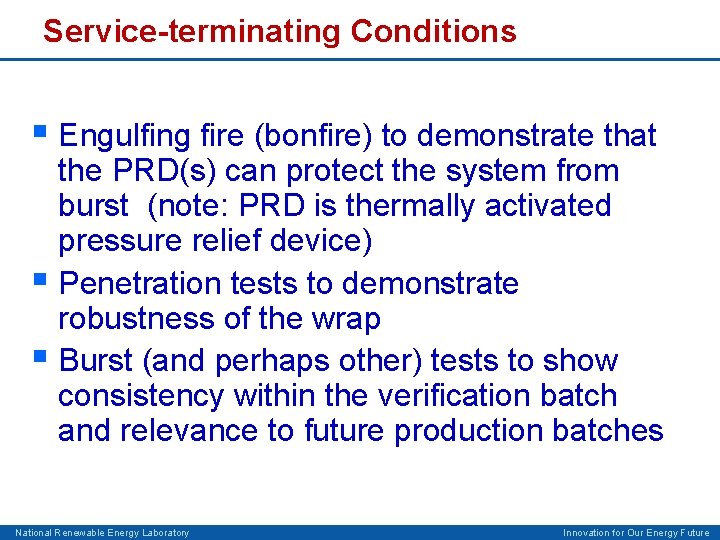
Service-terminating Conditions § Engulfing fire (bonfire) to demonstrate that the PRD(s) can protect the system from burst (note: PRD is thermally activated pressure relief device) § Penetration tests to demonstrate robustness of the wrap § Burst (and perhaps other) tests to show consistency within the verification batch and relevance to future production batches National Renewable Energy Laboratory Innovation for Our Energy Future
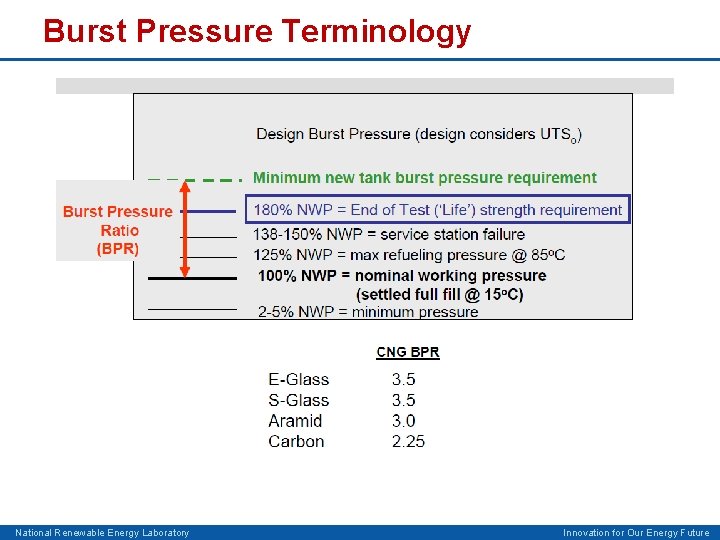
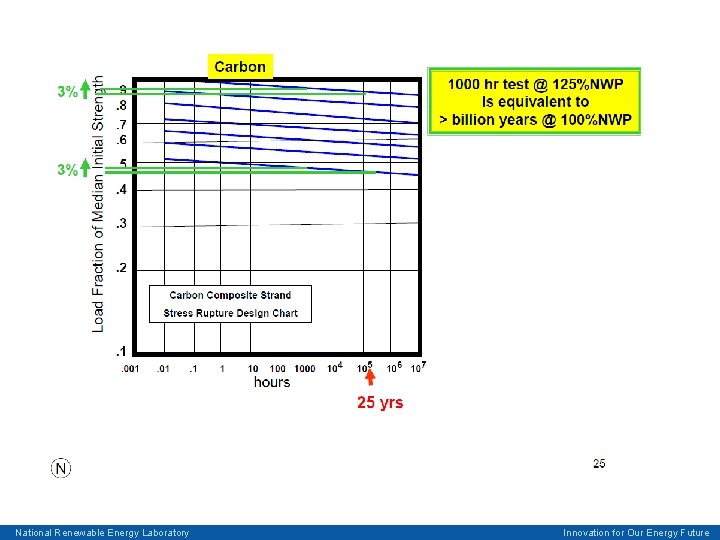
Burst Pressure Terminology National Renewable Energy Laboratory Innovation for Our Energy Future
National Renewable Energy Laboratory Innovation for Our Energy Future
National Renewable Energy Laboratory Innovation for Our Energy Future
National Renewable Energy Laboratory Innovation for Our Energy Future
National Renewable Energy Laboratory Innovation for Our Energy Future
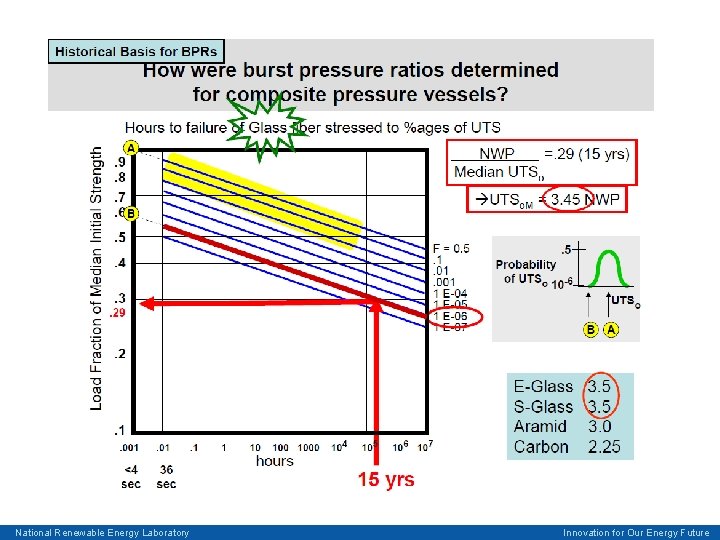
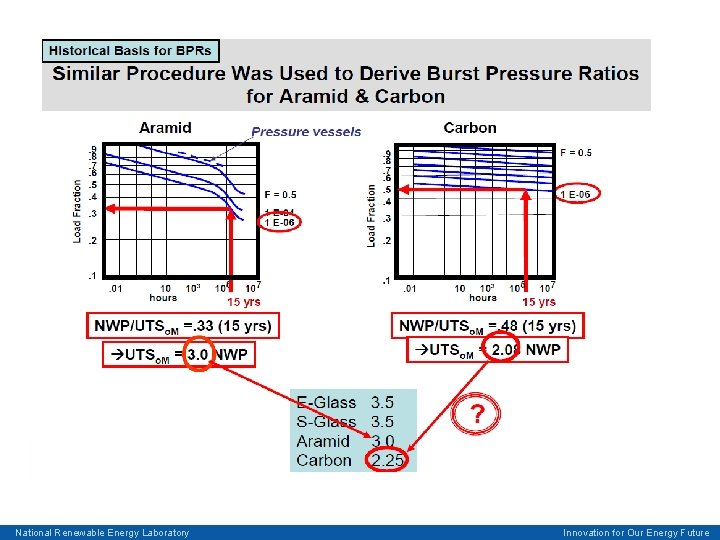
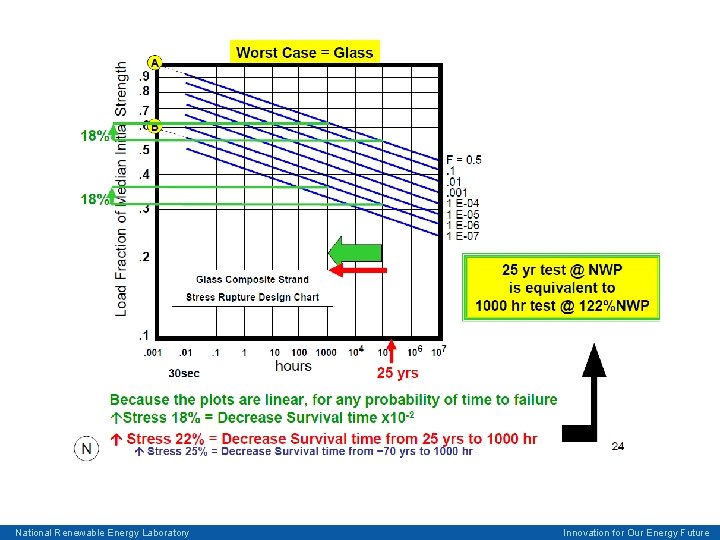
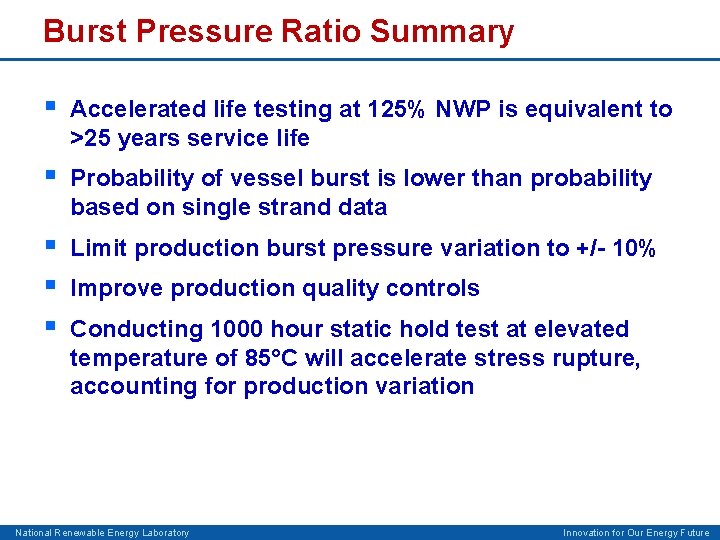
Burst Pressure Ratio Summary § Accelerated life testing at 125% NWP is equivalent to >25 years service life § Probability of vessel burst is lower than probability based on single strand data § § § Limit production burst pressure variation to +/- 10% Improve production quality controls Conducting 1000 hour static hold test at elevated temperature of 85°C will accelerate stress rupture, accounting for production variation National Renewable Energy Laboratory Innovation for Our Energy Future
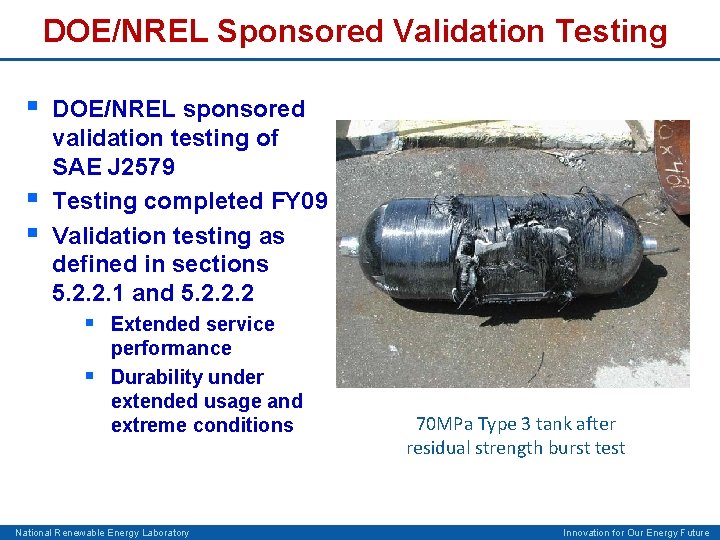
DOE/NREL Sponsored Validation Testing § § § DOE/NREL sponsored validation testing of SAE J 2579 Testing completed FY 09 Validation testing as defined in sections 5. 2. 2. 1 and 5. 2. 2. 2 § § Extended service performance Durability under extended usage and extreme conditions National Renewable Energy Laboratory 70 MPa Type 3 tank after residual strength burst test Innovation for Our Energy Future
Validation Testing Conclusions § SAE J 2579 test sequences are feasible. Ø State-of-the-art Type 3 and 4 tanks have passed both sequences. Ø Sequential nature of Expected Service Performance tests increases verification time from 8 weeks with CNG-type protocols to 12 weeks. Ø Durability performance test time is about 1 week. § Demonstrated that a Type 3 CNG tank that has failed in the field would also fail the test protocol National Renewable Energy Laboratory Innovation for Our Energy Future
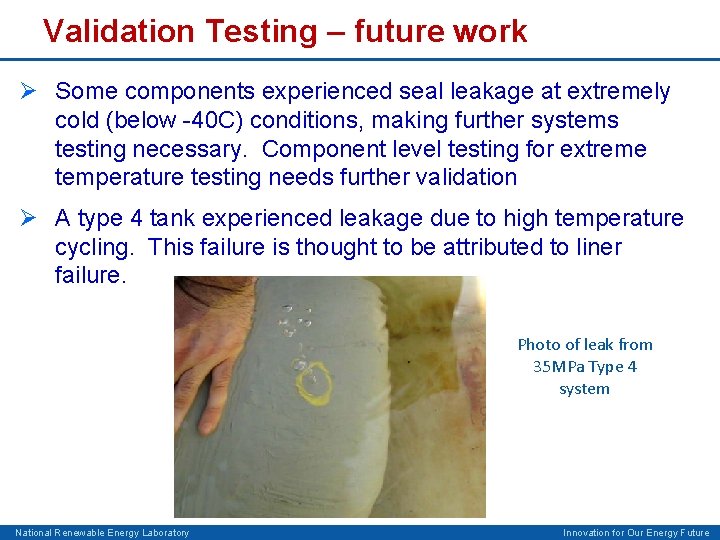
Validation Testing – future work Ø Some components experienced seal leakage at extremely cold (below -40 C) conditions, making further systems testing necessary. Component level testing for extreme temperature testing needs further validation Ø A type 4 tank experienced leakage due to high temperature cycling. This failure is thought to be attributed to liner failure. Photo of leak from 35 MPa Type 4 system National Renewable Energy Laboratory Innovation for Our Energy Future
SAE J 2579 Status/Plan STATUS § Test sequences in original issue of J 2579 verified Ø Minor re-wordings identified to prevent misunderstandings Ø Local leak test added to identify point sources § Revision of SAE TIR J 2579 published in January 2009 Ø Reference-able document for system-level requirements Ø Appropriate guidance for system design and installation PLAN § Identify improvements Ø Develop options for reduced or decoupled testing Ø New localized fire requirements and methods § Revise and re-ballot as a Recommended Practice or a Standard Ø Include findings and results of activities conducted in 2007 -2010 Ø Provide a basis for national and global requirements National Renewable Energy Laboratory Innovation for Our Energy Future
The White Sands Test Facility (WSTF) 2009 Composite Pressure Vessel and Structure Summit is an annual meeting where government agencies, industry, and academia are invited to discuss current fiber-reinforced composite (FRC) technology as it relates to composite pressure vessels and structures. § 2009 Summit § Single strand data not applicable to COPV structure § Thirty years old data § Collaborative test program – data-data NREL is a national laboratory of the U. S. Department of Energy Office of Energy Efficiency and Renewable Energy operated by the Alliance for Sustainable Energy, LLC
Summary § SAE is developing vehicle and systems-level, performance-based standards based on best available knowledge § Cooperating with other organizations to verify current standards and develop new capabilities § § § DOE-funded verification testing of methodologies Japan Automobile Research Institute (JARI) CSA America NASA WSTF Overall objective § FCVs to be used without restriction (garages, tunnels etc. ) § Facilitate rapid advances by the industry § Provide technical basis for national & international requirements National Renewable Energy Laboratory Innovation for Our Energy Future