
HighPerformance Gate Sizing with a Signoff Timer Andrew


- Slides: 34
High-Performance Gate Sizing with a Signoff Timer Andrew B. Kahng*, Seokhyeong Kang*, Hyein Lee*, Igor L. Markov+ and Pankit Thapar+ UC San Diego* University of Michigan+
Outline • Gate Sizing in VLSI Design • Previous Work • Challenges in Gate Sizing • High-Performance Gate Sizing with a Signoff Timer • Overall Flow • Experimental Results • Conclusions and Future Work 2
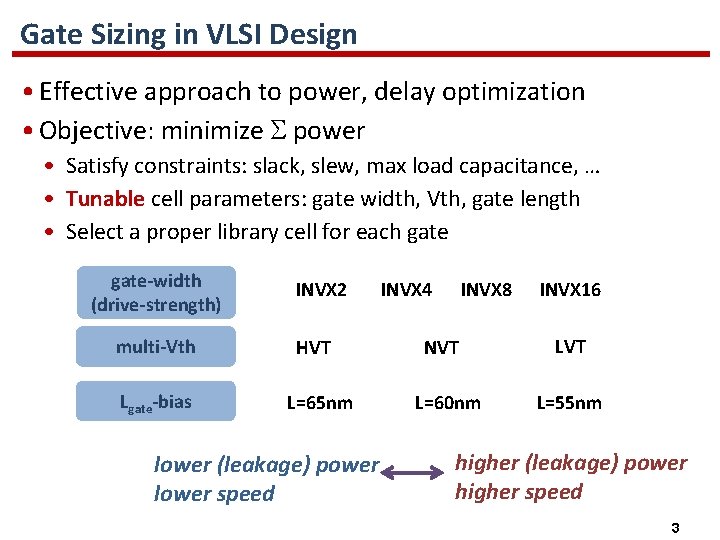
Gate Sizing in VLSI Design • Effective approach to power, delay optimization • Objective: minimize power • Satisfy constraints: slack, slew, max load capacitance, … • Tunable cell parameters: gate width, Vth, gate length • Select a proper library cell for each gate-width (drive-strength) multi-Vth Lgate-bias INVX 2 HVT L=65 nm lower (leakage) power lower speed INVX 4 INVX 8 NVT L=60 nm INVX 16 LVT L=55 nm higher (leakage) power higher speed 3
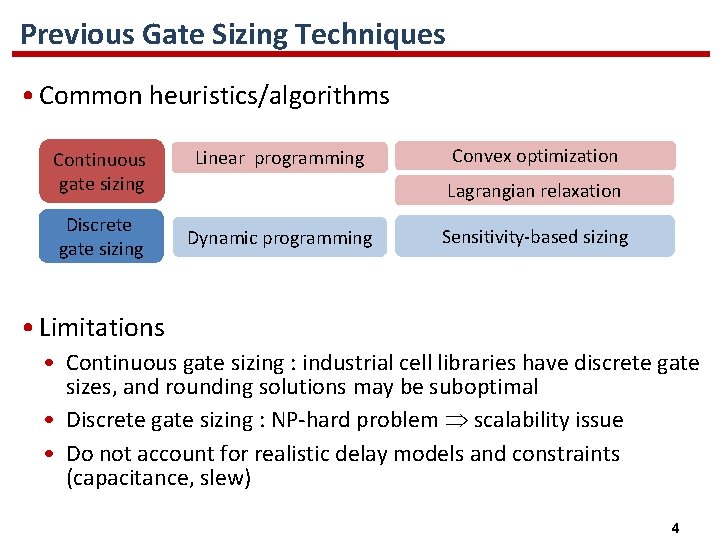
Previous Gate Sizing Techniques • Common heuristics/algorithms Continuous gate sizing Discrete gate sizing Linear programming Convex optimization Lagrangian relaxation Dynamic programming Sensitivity-based sizing • Limitations • Continuous gate sizing : industrial cell libraries have discrete gate sizes, and rounding solutions may be suboptimal • Discrete gate sizing : NP-hard problem scalability issue • Do not account for realistic delay models and constraints (capacitance, slew) 4
Previous Work • Our work extends Trident 1. 0 [Hu et al. Proc. ICCAD 2012] • Produced strongest results on ISPD 2012 benchmarks as of ICCAD 2012 • Metaheuristic optimization with importance sampling and sensitivity-guided search • Limitation: no interconnect delay calculation ⇒ Unrealistic assumption 5
Outline • Gate Sizing in VLSI Design • Previous Work • Challenges in Gate Sizing • Issue 1: Interconnect delay • Issue 2: Inaccurate internal timer • Issue 3: Critical paths • High-Performance Gate Sizing with a Signoff Timer • Overall Flow • Experimental Results • Conclusions and Future Work 6
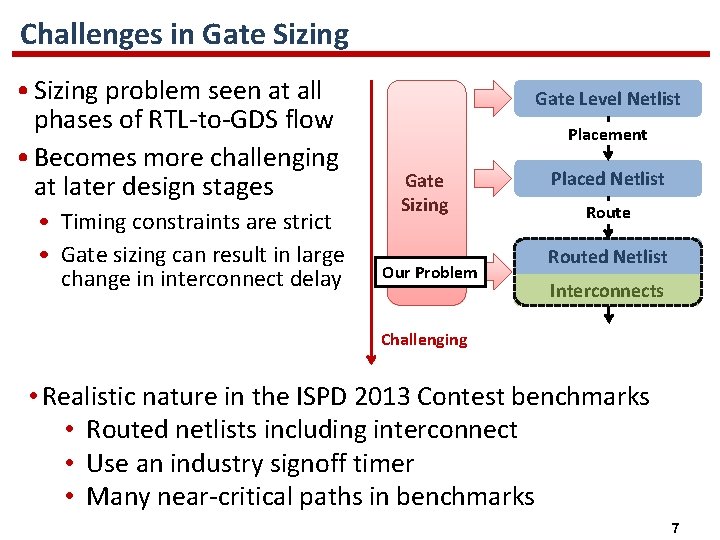
Challenges in Gate Sizing • Sizing problem seen at all phases of RTL-to-GDS flow • Becomes more challenging at later design stages • Timing constraints are strict • Gate sizing can result in large change in interconnect delay Gate Level Netlist Placement Gate Sizing Our Problem Placed Netlist Routed Netlist Interconnects Challenging • Realistic nature in the ISPD 2013 Contest benchmarks • Routed netlists including interconnect • Use an industry signoff timer • Many near-critical paths in benchmarks 7
Issue 1: Interconnect Delay/Slew • Gate sizing affects up/downstream gates/nets delay Slew change Pin capacitance change • Slew degradation from interconnects makes delay worse ⇒ Impact of gate sizing becomes larger with interconnects ⇒ Careful gate sizing is needed 8
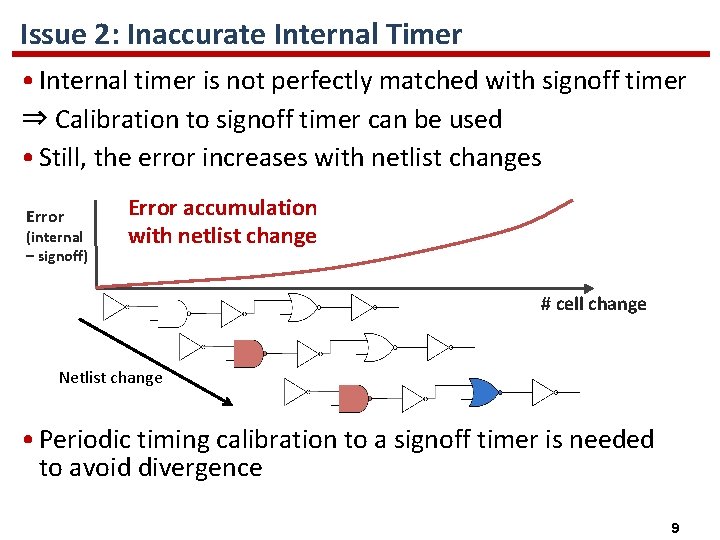
Issue 2: Inaccurate Internal Timer • Internal timer is not perfectly matched with signoff timer ⇒ Calibration to signoff timer can be used • Still, the error increases with netlist changes Error (internal – signoff) Error accumulation with netlist change # cell change Netlist change • Periodic timing calibration to a signoff timer is needed to avoid divergence 9
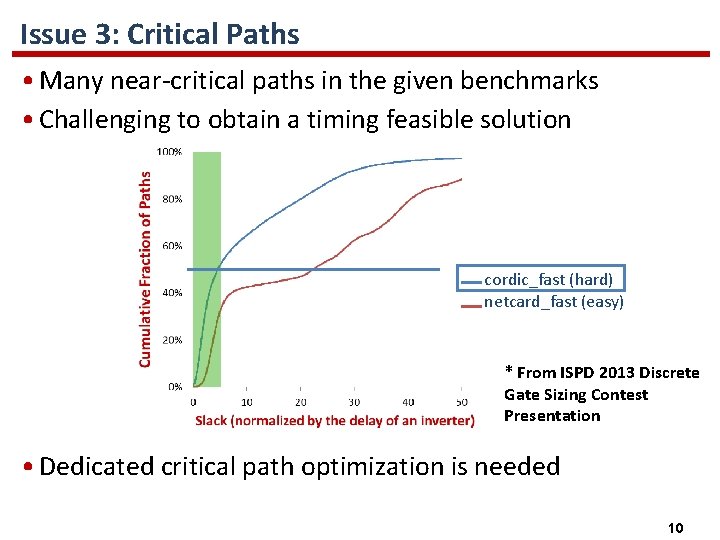
Issue 3: Critical Paths • Many near-critical paths in the given benchmarks • Challenging to obtain a timing feasible solution cordic_fast (hard) netcard_fast (easy) * From ISPD 2013 Discrete Gate Sizing Contest Presentation • Dedicated critical path optimization is needed 10
Outline • Gate Sizing in VLSI Design • Previous Work • Challenges in Gate Sizing • High-Performance Gate Sizing with a Signoff Timer • • Internal Timer with Interconnect Timing Models Calibration to a Signoff Timer Critical Path Optimization Sensitivity Functions • Overall Flow • Experimental Results • Conclusions and Future Works 11
1. Internal Timer with Interconnect Timing Models • Internal timer is essential to estimate delay changes during gate sizing • Requirements for an internal timer • Able to calculate interconnect delay/slew • Fast enough for move-based optimization • Accurate enough to track signoff timer • Our approach: use best-performing models for interconnect delay/slew from previous work 12
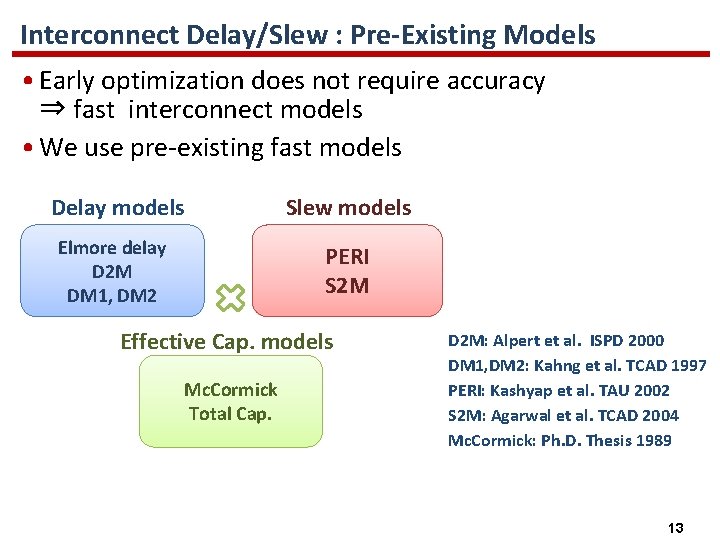
Interconnect Delay/Slew : Pre-Existing Models • Early optimization does not require accuracy ⇒ fast interconnect models • We use pre-existing fast models Delay models Slew models Elmore delay D 2 M DM 1, DM 2 PERI S 2 M Effective Cap. models Mc. Cormick Total Cap. D 2 M: Alpert et al. ISPD 2000 DM 1, DM 2: Kahng et al. TCAD 1997 PERI: Kashyap et al. TAU 2002 S 2 M: Agarwal et al. TCAD 2004 Mc. Cormick: Ph. D. Thesis 1989 13
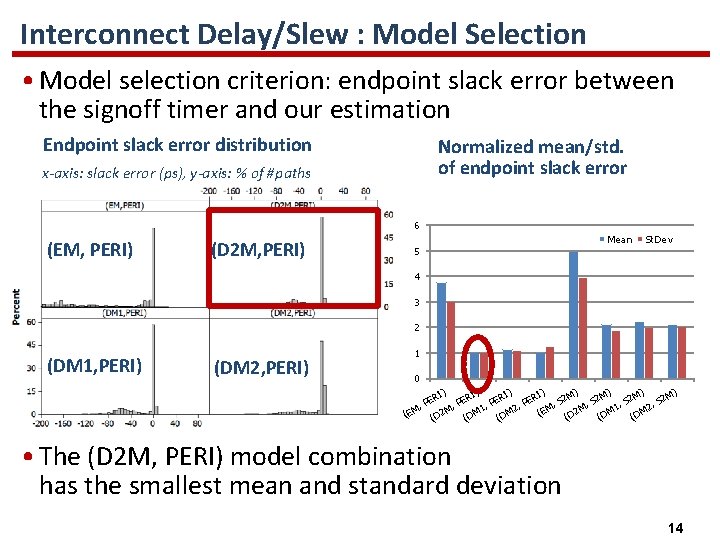
Interconnect Delay/Slew : Model Selection • Model selection criterion: endpoint slack error between the signoff timer and our estimation Endpoint slack error distribution Normalized mean/std. of endpoint slack error x-axis: slack error (ps), y-axis: % of #paths 6 (EM, PERI) (D 2 M, PERI) Mean 5 St. Dev 4 3 2 (DM 1, PERI) (DM 2, PERI) 1 0 E , P (EM ) RI 2 (D M E , P ) RI M (D 1 E , P ) RI I) M (D 2 ER , P M) ) 2 M 2 M 2 M S S S , , , M 1 M 2 2 M (D (D (D 2 , S (EM • The (D 2 M, PERI) model combination has the smallest mean and standard deviation 14
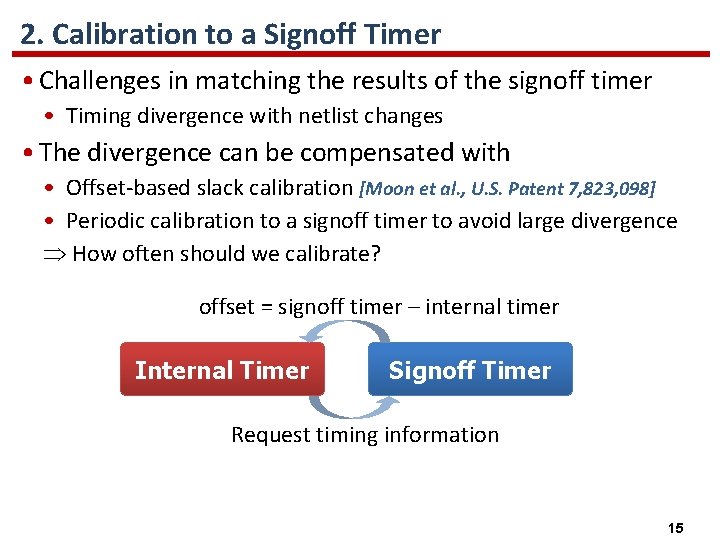
2. Calibration to a Signoff Timer • Challenges in matching the results of the signoff timer • Timing divergence with netlist changes • The divergence can be compensated with • Offset-based slack calibration [Moon et al. , U. S. Patent 7, 823, 098] • Periodic calibration to a signoff timer to avoid large divergence How often should we calibrate? offset = signoff timer – internal timer Internal Timer Signoff Timer Request timing information 15
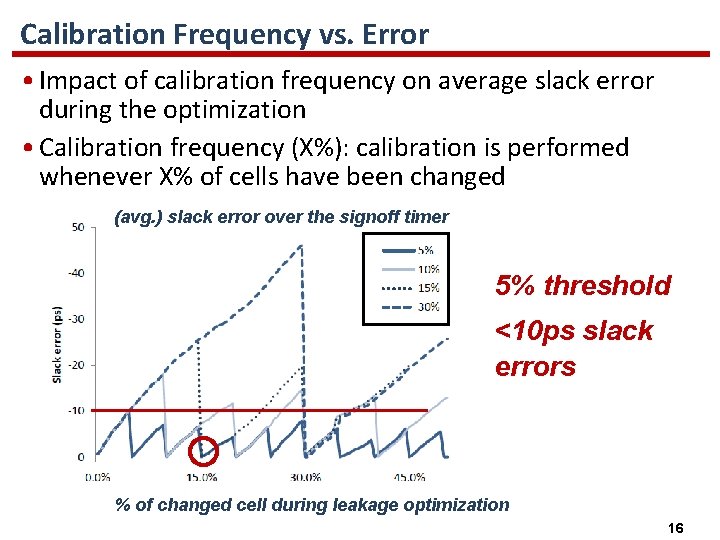
Calibration Frequency vs. Error • Impact of calibration frequency on average slack error during the optimization • Calibration frequency (X%): calibration is performed whenever X% of cells have been changed (avg. ) slack error over the signoff timer 5% threshold <10 ps slack errors % of changed cell during leakage optimization 16
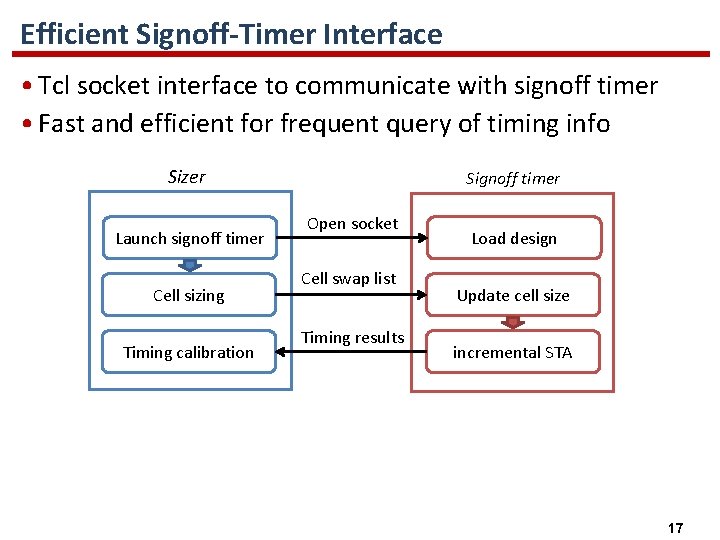
Efficient Signoff-Timer Interface • Tcl socket interface to communicate with signoff timer • Fast and efficient for frequent query of timing info Sizer Launch signoff timer Cell sizing Timing calibration Signoff timer Open socket Cell swap list Timing results Load design Update cell size incremental STA 17
3. Critical Path Optimization • For a design having many near-critical paths, dedicated optimization is needed • Critical path optimization: optimize cells on the timing critical paths (critical cells) to reduce WNS* • Method 1 : Downsizing fanouts • Method 2 : Peephole optimization * WNS: Worst Negative Slack 18
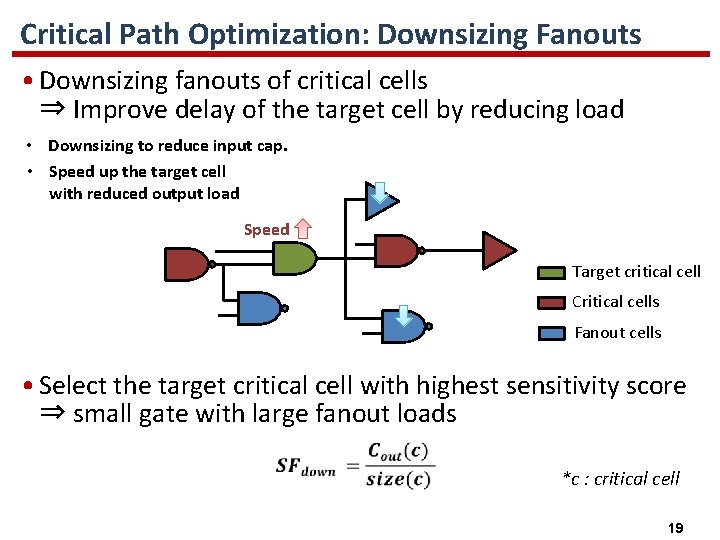
Critical Path Optimization: Downsizing Fanouts • Downsizing fanouts of critical cells ⇒ Improve delay of the target cell by reducing load • Downsizing to reduce input cap. • Speed up the target cell with reduced output load Speed Target critical cell Critical cells Fanout cells • Select the target critical cell with highest sensitivity score ⇒ small gate with large fanout loads *c : critical cell 19
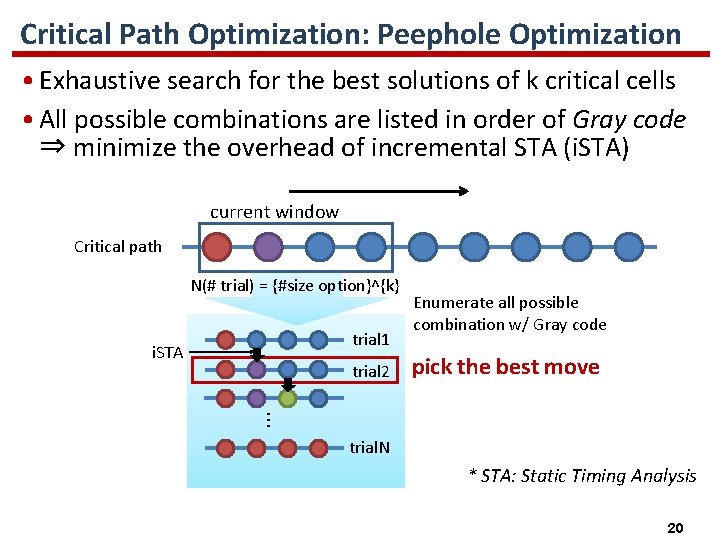
Critical Path Optimization: Peephole Optimization • Exhaustive search for the best solutions of k critical cells • All possible combinations are listed in order of Gray code ⇒ minimize the overhead of incremental STA (i. STA) current window Critical path N(# trial) = {#size option}^{k} trial 1 i. STA trial 2 Enumerate all possible combination w/ Gray code pick the best move . . . trial. N * STA: Static Timing Analysis 20
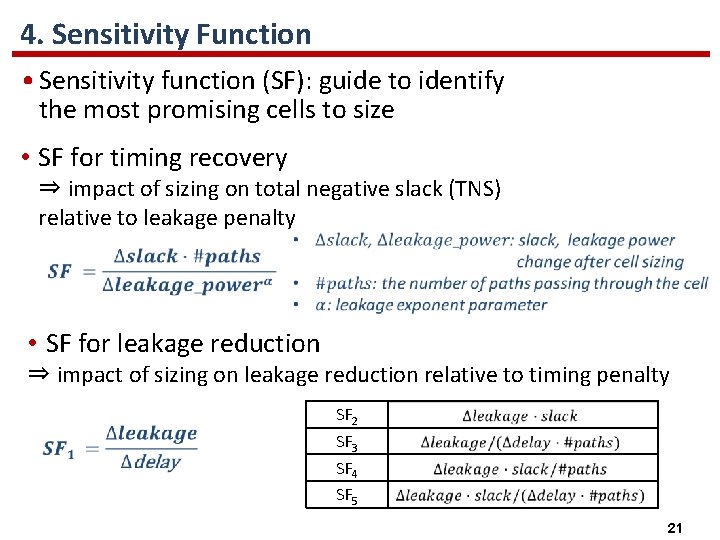
4. Sensitivity Function • Sensitivity function (SF): guide to identify the most promising cells to size • SF for timing recovery ⇒ impact of sizing on total negative slack (TNS) relative to leakage penalty • SF for leakage reduction ⇒ impact of sizing on leakage reduction relative to timing penalty SF 2 SF 3 SF 4 SF 5 21
Outline • Gate Sizing in VLSI Design • Previous Work • Challenges in Gate Sizing • High-Performance Gate Sizing with a Signoff Timer • Overall Flow • Global Timing Recovery • Power Reduction with Feasible Timing • Experimental Results • Conclusions and Future Work 22
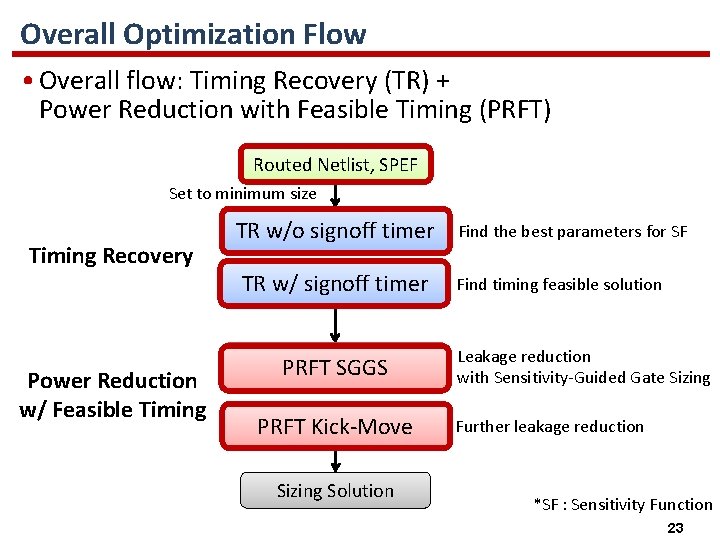
Overall Optimization Flow • Overall flow: Timing Recovery (TR) + Power Reduction with Feasible Timing (PRFT) Routed Netlist, SPEF Set to minimum size Timing Recovery Power Reduction w/ Feasible Timing TR w/o signoff timer TR w/ signoff timer PRFT SGGS PRFT Kick-Move Sizing Solution Find the best parameters for SF Find timing feasible solution Leakage reduction with Sensitivity-Guided Gate Sizing Further leakage reduction *SF : Sensitivity Function 23
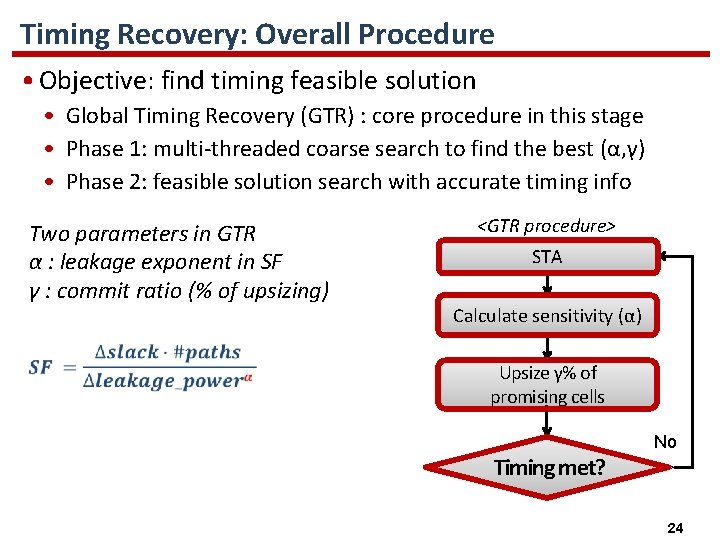
Timing Recovery: Overall Procedure • Objective: find timing feasible solution • Global Timing Recovery (GTR) : core procedure in this stage • Phase 1: multi-threaded coarse search to find the best (α, γ) • Phase 2: feasible solution search with accurate timing info Two parameters in GTR α : leakage exponent in SF γ : commit ratio (% of upsizing) <GTR procedure> STA Calculate sensitivity (α) Upsize γ% of promising cells No Timing met? 24
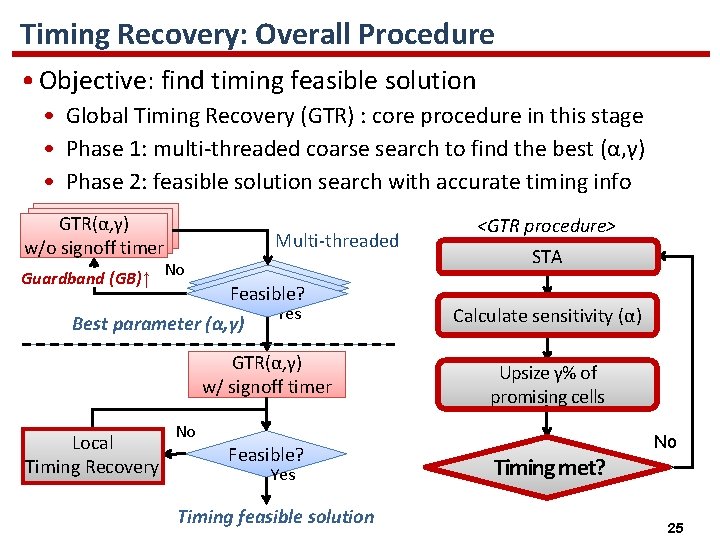
Timing Recovery: Overall Procedure • Objective: find timing feasible solution • Global Timing Recovery (GTR) : core procedure in this stage • Phase 1: multi-threaded coarse search to find the best (α, γ) • Phase 2: feasible solution search with accurate timing info GTR(α, γ) w/o signoff timer Multi-threaded Guardband (GB)↑ No Feasible? Yes Best parameter (α, γ) GTR(α, γ) w/ signoff timer Local Timing Recovery <GTR procedure> STA Calculate sensitivity (α) Upsize γ% of promising cells No Feasible? Yes Timing feasible solution No Timing met? 25
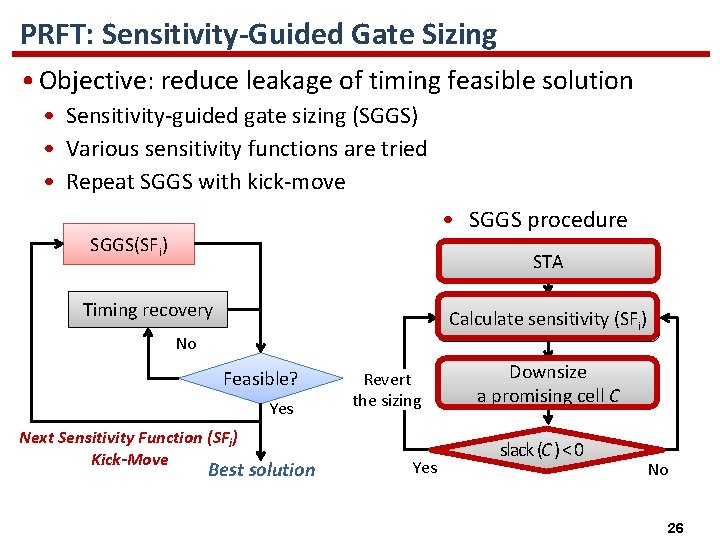
PRFT: Sensitivity-Guided Gate Sizing • Objective: reduce leakage of timing feasible solution • Sensitivity-guided gate sizing (SGGS) • Various sensitivity functions are tried • Repeat SGGS with kick-move • SGGS procedure SGGS(SFi) STA Timing recovery Calculate sensitivity (SFi) No Feasible? Yes Next Sensitivity Function (SFi) Kick-Move Best solution Revert the sizing Yes Downsize a promising cell C slack (C ) < 0 No 26
Outline • Gate Sizing in VLSI Design • Previous Work • Challenges in Gate Sizing • High-Performance Gate Sizing with a Signoff Timer • Overall Flow • Experimental Results • Conclusions and Future Work 27
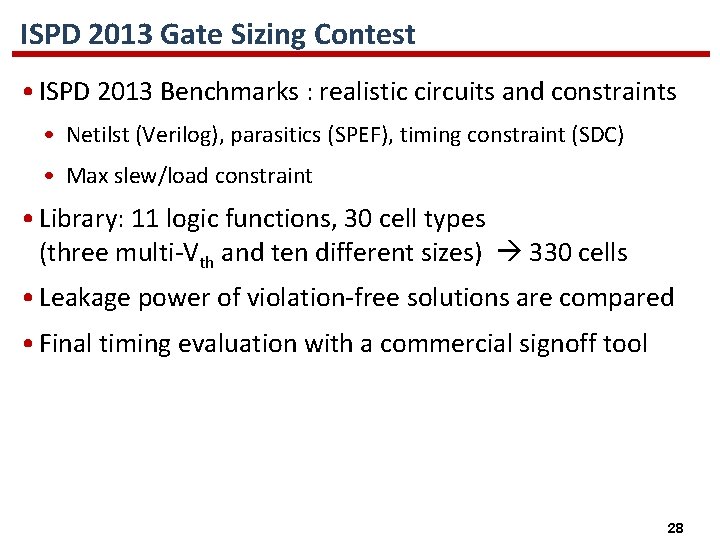
ISPD 2013 Gate Sizing Contest • ISPD 2013 Benchmarks : realistic circuits and constraints • Netilst (Verilog), parasitics (SPEF), timing constraint (SDC) • Max slew/load constraint • Library: 11 logic functions, 30 cell types (three multi-Vth and ten different sizes) 330 cells • Leakage power of violation-free solutions are compared • Final timing evaluation with a commercial signoff tool 28
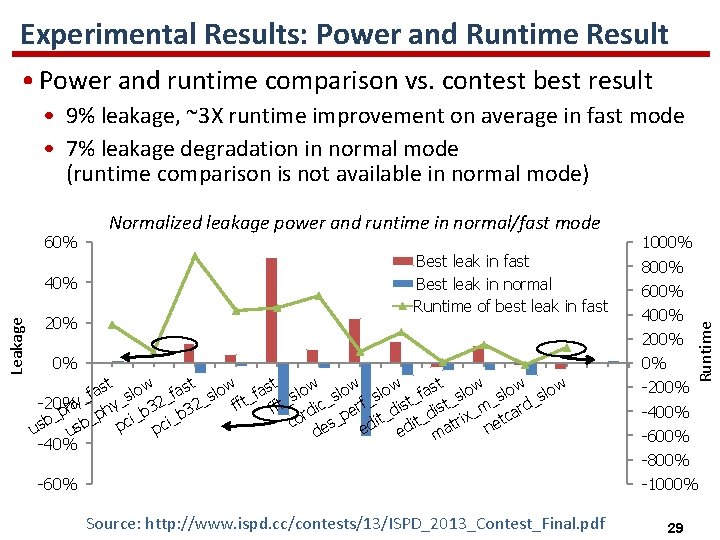
Experimental Results: Power and Runtime Result • Power and runtime comparison vs. contest best result • 9% leakage, ~3 X runtime improvement on average in fast mode • 7% leakage degradation in normal mode (runtime comparison is not available in normal mode) Leakage 40% 20% Best leak in fast Best leak in normal Runtime of best leak in fast 1000% 800% 600% 400% 200% 0% 0% st low fast low low a f y_ hy_s 32_s fft_s ic_s rf_s ist_s m_s rd_s -20% h p b ord s_pe dit_d trix_ etca b_ sb_p pci_ ci_b c s n u e p u ed ma de -40% -60% -200% Runtime 60% Normalized leakage power and runtime in normal/fast mode -400% -600% -800% -1000% Source: http: //www. ispd. cc/contests/13/ISPD_2013_Contest_Final. pdf 29
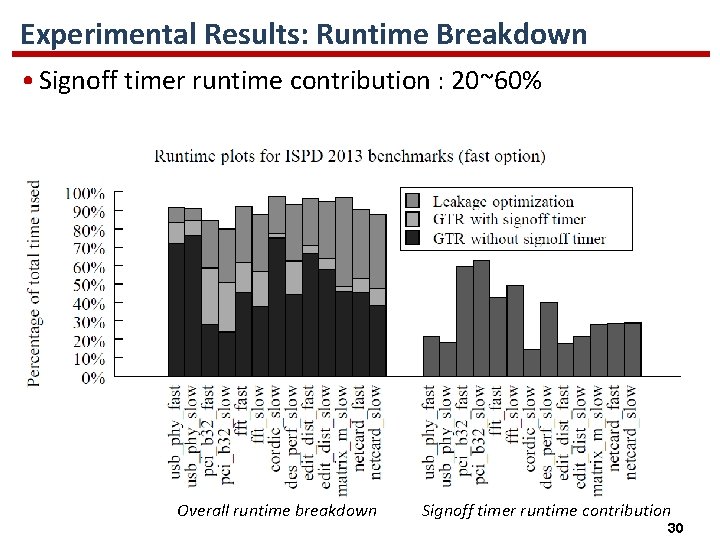
Experimental Results: Runtime Breakdown • Signoff timer runtime contribution : 20~60% Overall runtime breakdown Signoff timer runtime contribution 30
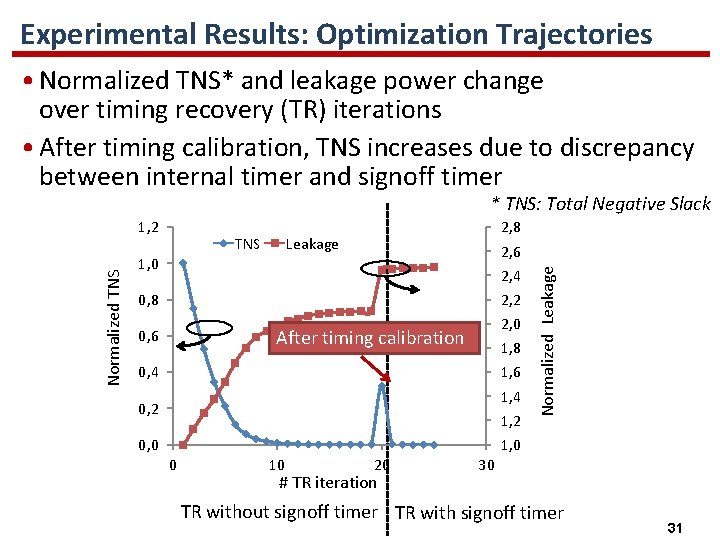
Experimental Results: Optimization Trajectories • Normalized TNS* and leakage power change over timing recovery (TR) iterations • After timing calibration, TNS increases due to discrepancy between internal timer and signoff timer * TNS: Total Negative Slack TNS 2, 8 Leakage 2, 6 1, 0 2, 4 0, 8 2, 2 2, 0 After timing calibration 0, 6 1, 8 0, 4 1, 6 1, 4 0, 2 1, 2 0, 0 Normalized Leakage Normalized TNS 1, 2 1, 0 0 10 20 # TR iteration 30 TR without signoff timer TR with signoff timer 31
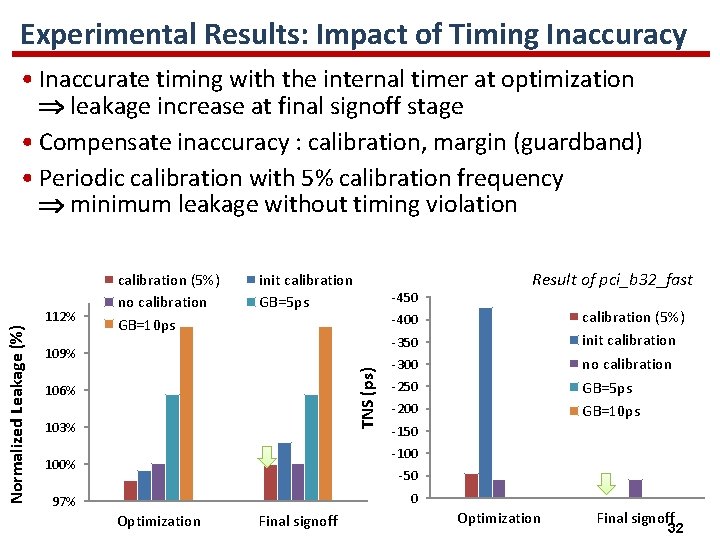
Experimental Results: Impact of Timing Inaccuracy • Inaccurate timing with the internal timer at optimization leakage increase at final signoff stage • Compensate inaccuracy : calibration, margin (guardband) • Periodic calibration with 5% calibration frequency minimum leakage without timing violation init calibration GB=5 ps -450 Result of pci_b 32_fast calibration (5%) init calibration no calibration GB=5 ps GB=10 ps -400 -350 109% TNS (ps) Normalized Leakage (%) 112% calibration (5%) no calibration GB=10 ps 106% 103% -300 -250 -200 -150 -100 100% -50 0 97% Optimization Final signoff 32
Conclusions and Future Work • Trident 2. 0: high-performance gate sizing • Fast interconnect models with reasonable accuracy for an efficient internal timer • Calibration to a signoff timer with an interface to improve timing accuracy • Dedicated critical path optimization with heuristics • ISPD 2013 gate sizing contest • Trident 2. 0 took 2 nd and 1 st places in two contest categories, respectively • Future work • See if Lagrangian relaxation helps • Additional industry benchmarks 33
Thank you!