
Highly Superior Autobiographical Memory HSAM l Parts 1
Highly Superior Autobiographical Memory “HSAM” l Parts 1 and 2 l http: //www. youtube. com/watch? v=o. He. E Q 85 m 79 I (13: 37) l http: //www. youtube. com/watch? v=en 23 b Cvp-Fw (12: 38) l http: //www. youtube. com/watch? v=A 0 mv 26 sz. Jk (update 7: 46)
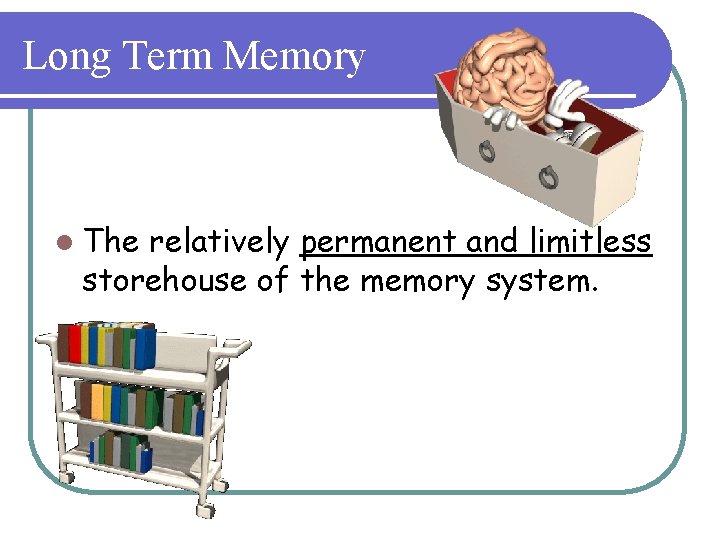
Long Term Memory l The relatively permanent and limitless storehouse of the memory system.
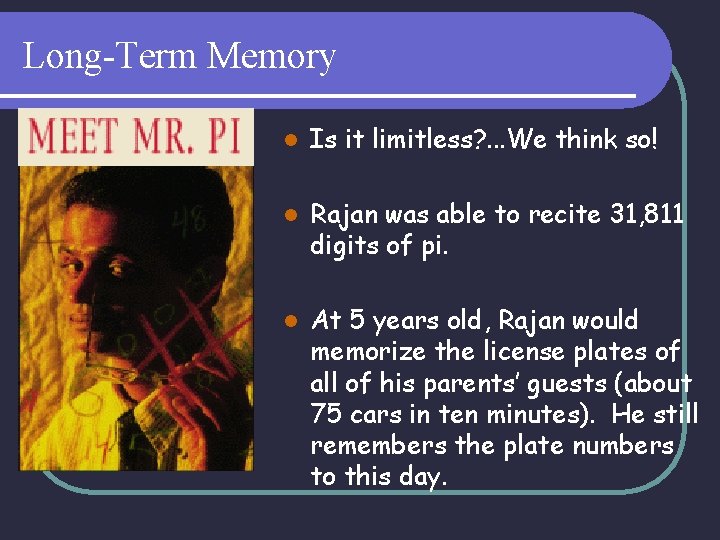
Long-Term Memory l Is it limitless? . . . We think so! l Rajan was able to recite 31, 811 digits of pi. l At 5 years old, Rajan would memorize the license plates of all of his parents’ guests (about 75 cars in ten minutes). He still remembers the plate numbers to this day.
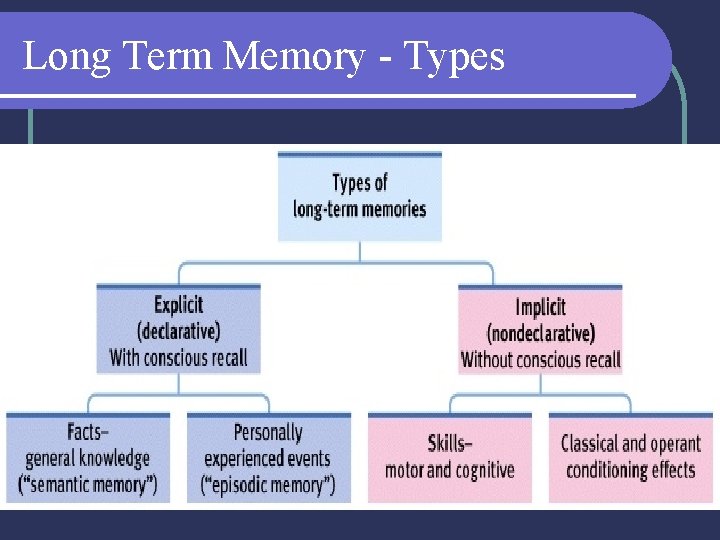
Long Term Memory - Types
Memory Retrieval l Reconstructive Memory l l Leads to incorrect memories Process of piecing together memories by fitting them into a meaningful plan or organization We fill in gaps with assumptions because we are uncomfortable with the gaps. Once we've done this, distinguishing what actually happened from what we filled in is almost impossible. Schema-a cognitive system which helps us organize and make sense of information.
The Rumor Chain – reconstructive memory activity l Errors in each successive telling of the story are usually predictable: Leveling – The tendency to simplify the material. Non-distinct details are left out. l Sharpening – Different individuals will highlight or over emphasize different details based on their prior experience and personal expectations. l l l They will correctly remember odd/very specific details that others probably would have forgotten. Assimilation – Details of the story will be changed to fit the subjects own background knowledge and expectations; schemas.
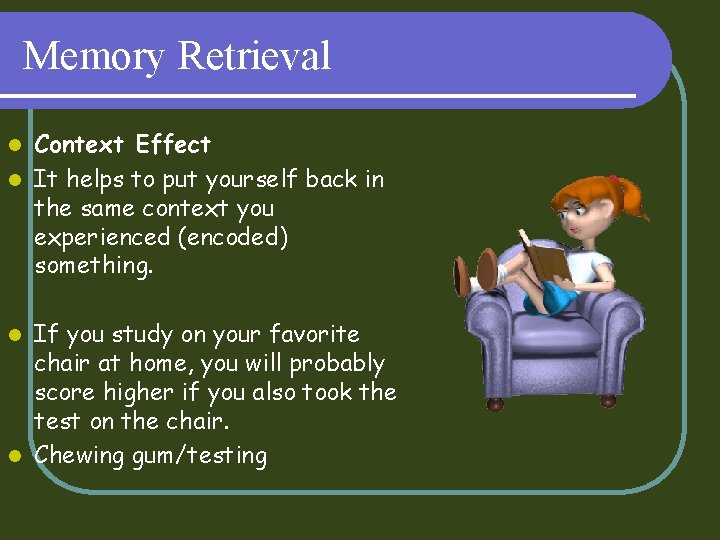
Memory Retrieval Context Effect l It helps to put yourself back in the same context you experienced (encoded) something. l If you study on your favorite chair at home, you will probably score higher if you also took the test on the chair. l Chewing gum/testing l
Memory Retrieval l Déjà Vu: eerie sense that you have experienced something before. l Is déjà vu really a glitch in your memory? l Current situation cues past experiences that are very similar to the present oneyour mind gets confused. Hemisphere delay
Types of Forgetting l Why can’t I remember? Encoding failure l Storage Decay l Retrieval Failure l Motivated forgetting l l l Repression Amnesia Infantile l Anterograde l Retrograde l
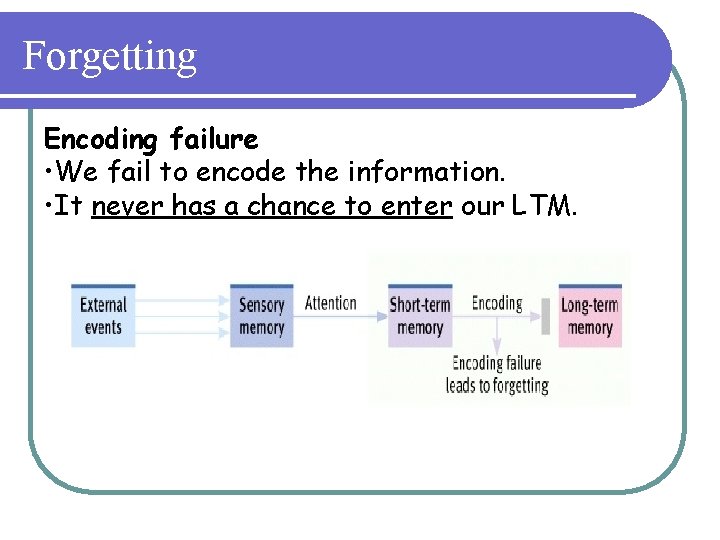
Forgetting Encoding failure • We fail to encode the information. • It never has a chance to enter our LTM.
Storage Decay l Even if we encode something well, we can forget it. l Without rehearsal, we forget things over time. “Use it or lose it. ”
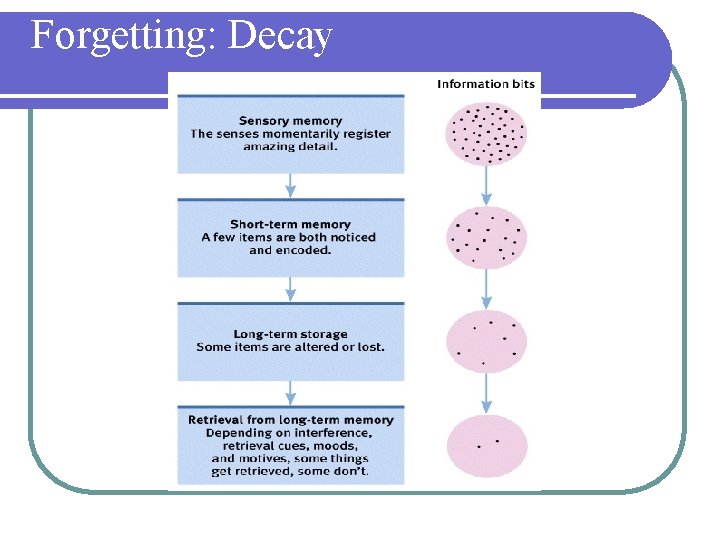
Forgetting: Decay
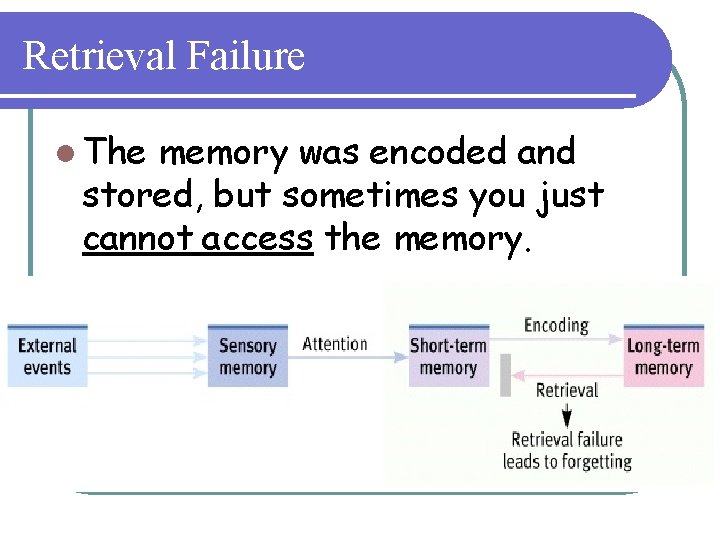
Retrieval Failure l The memory was encoded and stored, but sometimes you just cannot access the memory.
Motivated Forgetting Why does is exist? One explanation is REPRESSION: l psychoanalytic theory l defense mechanism that banishes anxietyarousing thoughts, feelings and memories from consciousness
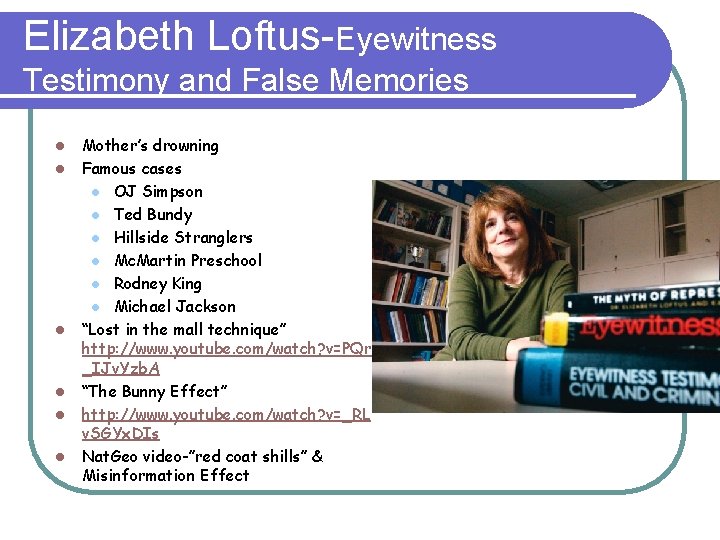
Elizabeth Loftus-Eyewitness Testimony and False Memories l l l Mother’s drowning Famous cases l OJ Simpson l Ted Bundy l Hillside Stranglers l Mc. Martin Preschool l Rodney King l Michael Jackson “Lost in the mall technique” http: //www. youtube. com/watch? v=PQr _IJv. Yzb. A “The Bunny Effect” http: //www. youtube. com/watch? v=_RL v. SGYx. DIs Nat. Geo video-”red coat shills” & Misinformation Effect
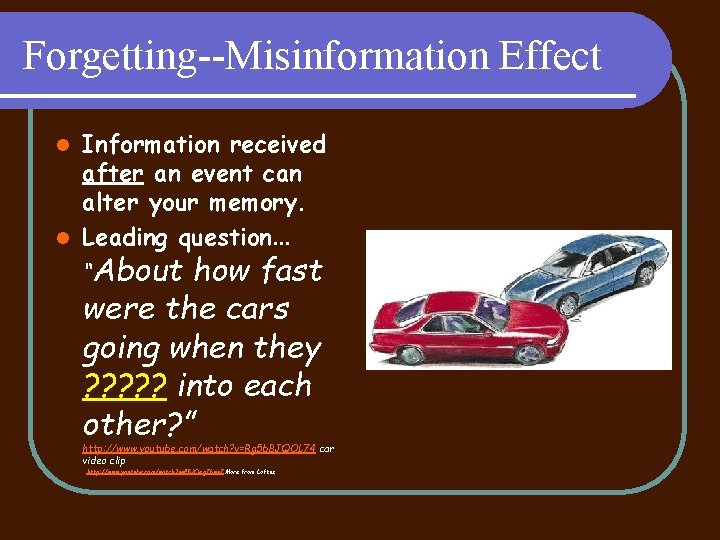
Forgetting--Misinformation Effect Information received after an event can alter your memory. l Leading question. . . l “About how fast were the cars going when they ? ? ? into each other? ” http: //www. youtube. com/watch? v=Rg 5 b. BJQOL 74 car video clip http: //www. youtube. com/watch? v=PB 2 Oeg. I 6 wv. I More from Loftus
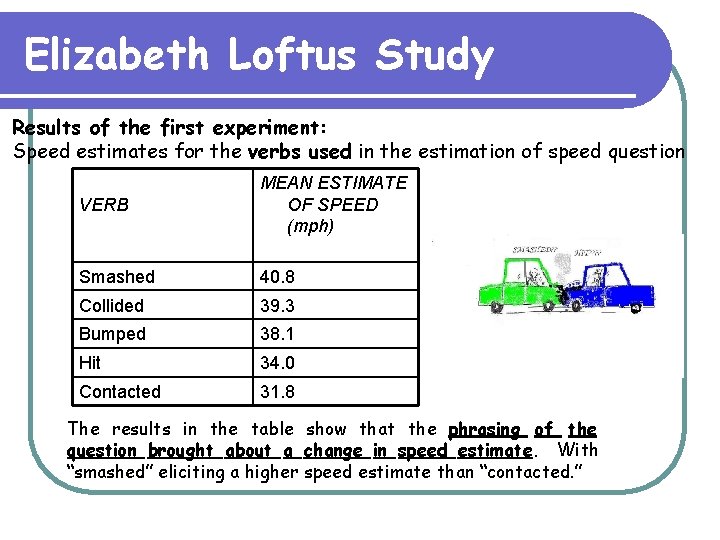
Elizabeth Loftus Study Results of the first experiment: Speed estimates for the verbs used in the estimation of speed question VERB MEAN ESTIMATE OF SPEED (mph) Smashed 40. 8 Collided 39. 3 Bumped 38. 1 Hit 34. 0 Contacted 31. 8 The results in the table show that the phrasing of the question brought about a change in speed estimate. With “smashed” eliciting a higher speed estimate than “contacted. ”
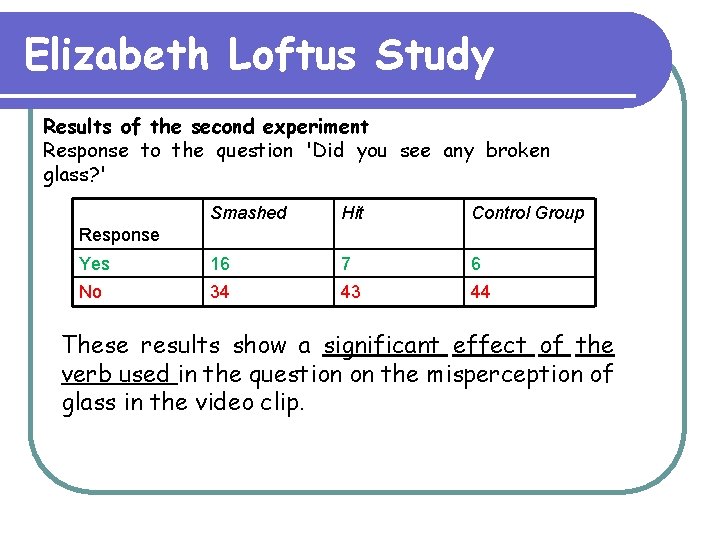
Elizabeth Loftus Study Results of the second experiment Response to the question 'Did you see any broken glass? ' Smashed Hit Control Group Yes 16 7 6 No 34 43 44 Response These results show a significant effect of the verb used in the question on the misperception of glass in the video clip.
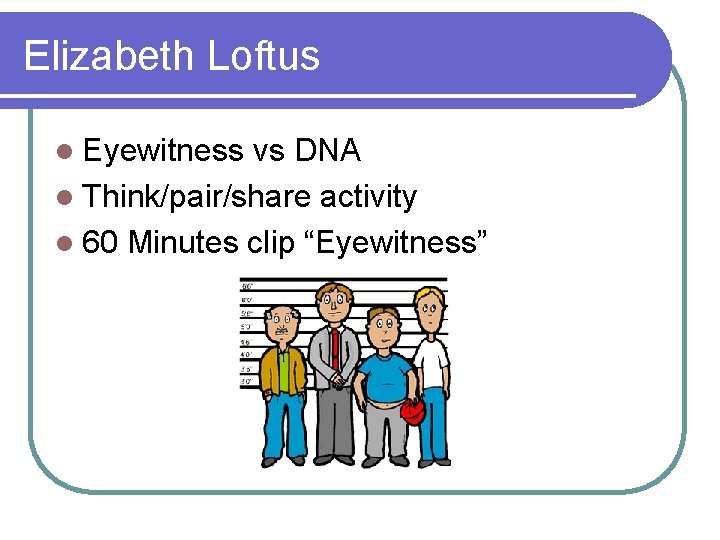
Elizabeth Loftus l Eyewitness vs DNA l Think/pair/share activity l 60 Minutes clip “Eyewitness”
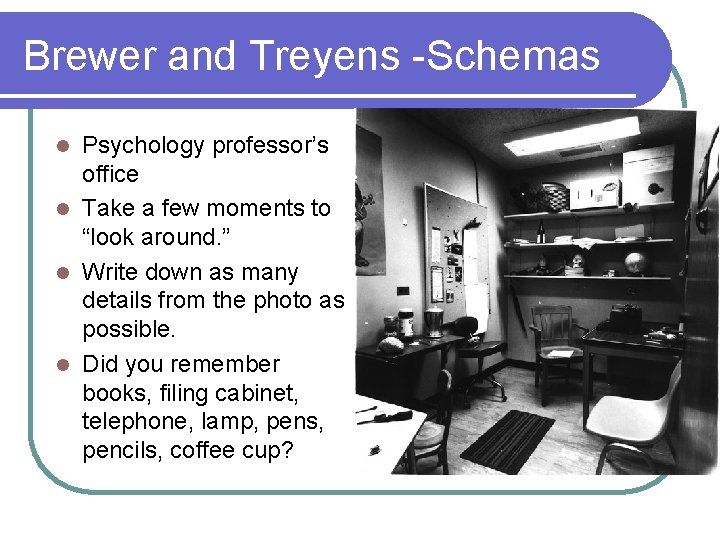
Brewer and Treyens -Schemas Psychology professor’s office l Take a few moments to “look around. ” l Write down as many details from the photo as possible. l Did you remember books, filing cabinet, telephone, lamp, pens, pencils, coffee cup? l
- Slides: 21