
Highlights on femtoscopy in ee and hp collisions
- Slides: 16
Highlights on femtoscopy in e+e- and hp collisions Csörgő, Tamás Department of Physics, Harvard University, Cambridge, MA MTA KFKI RMKI, Budapest Femtoscopy Applications: Shape analysis leading to a femtoscopic movie Core-halo model
Kopylov, Podgoretskii, Lednicky G. Goldhaber, S. Goldhaber, W-Y. Lee and A. Pais (GGLP) : – explain a HBT like effect in p+p reactions at Kopylov, Podgoretskii, Dubna school – Start to use correlations as a tool to measure sizes • G. I. Kopylov: Like particle correlations as a tool. . . – Phys. Lett. B 50, 474 (1974) – Interference of particles emitted by moving sources • G. I. Kopylov, M. I. Podgoretsky – Yad. Fiz. 18: 656 -666 (1973) – Yano, Koonin, Podgoretsky (YKP) parametrization – Non-identical particle interferometry: effects of fsi • Sequence of particle emission in principle can be obtained • R. Lednicky, Ljuboshitz
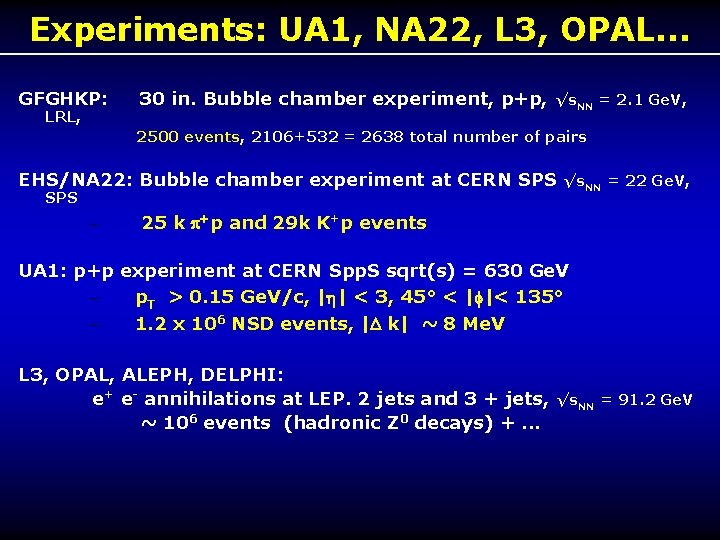
Experiments: UA 1, NA 22, L 3, OPAL. . . GFGHKP: LRL, 30 in. Bubble chamber experiment, p+p, √s. NN = 2. 1 Ge. V, 2500 events, 2106+532 = 2638 total number of pairs EHS/NA 22: Bubble chamber experiment at CERN SPS √s. NN = 22 Ge. V, SPS – 25 k p and 29 k K+p events UA 1: p+p experiment at CERN Spp. S sqrt(s) = 630 Ge. V – p. T > 0. 15 Ge. V/c, | | < 3, 45° < | |< 135° – 1. 2 x 10⁶ NSD events, | k| ~ 8 Me. V L 3, OPAL, ALEPH, DELPHI: e+ e- annihilations at LEP. 2 jets and 3 + jets, √s. NN = 91. 2 Ge. V ~ 106 events (hadronic Z 0 decays) +. . .
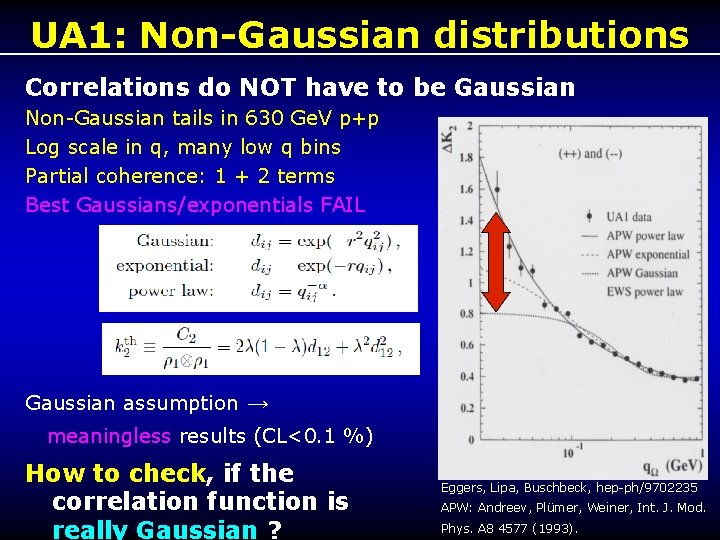
UA 1: Non-Gaussian distributions Correlations do NOT have to be Gaussian Non-Gaussian tails in 630 Ge. V p+p Log scale in q, many low q bins Partial coherence: 1 + 2 terms Best Gaussians/exponentials FAIL Gaussian assumption → meaningless results (CL<0. 1 %) How to check, if the correlation function is really Gaussian ? Eggers, Lipa, Buschbeck, hep-ph/9702235 APW: Andreev, Plümer, Weiner, Int. J. Mod. Phys. A 8 4577 (1993).
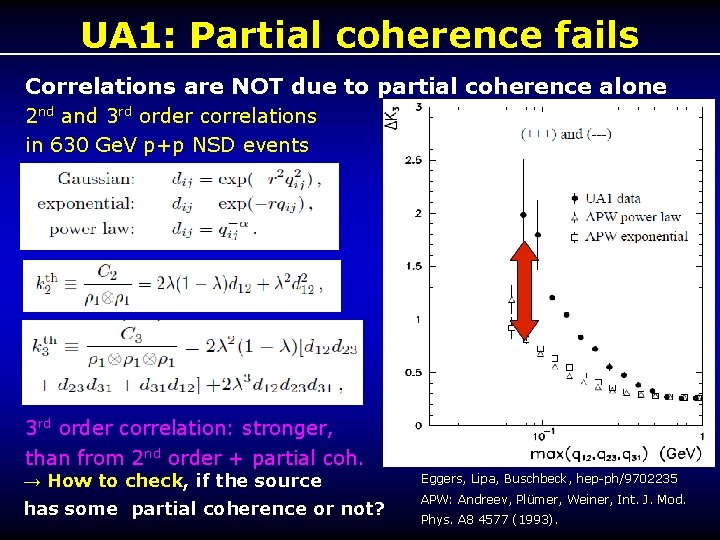
UA 1: Partial coherence fails Correlations are NOT due to partial coherence alone 2 nd and 3 rd order correlations in 630 Ge. V p+p NSD events 3 rd order correlation: stronger, than from 2 nd order + partial coh. → How to check, if the source Eggers, Lipa, Buschbeck, hep-ph/9702235 has some partial coherence or not? APW: Andreev, Plümer, Weiner, Int. J. Mod. Phys. A 8 4577 (1993).
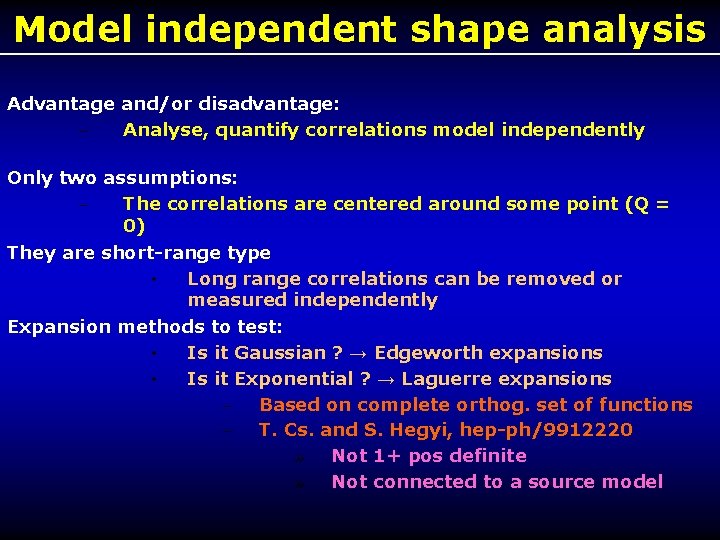
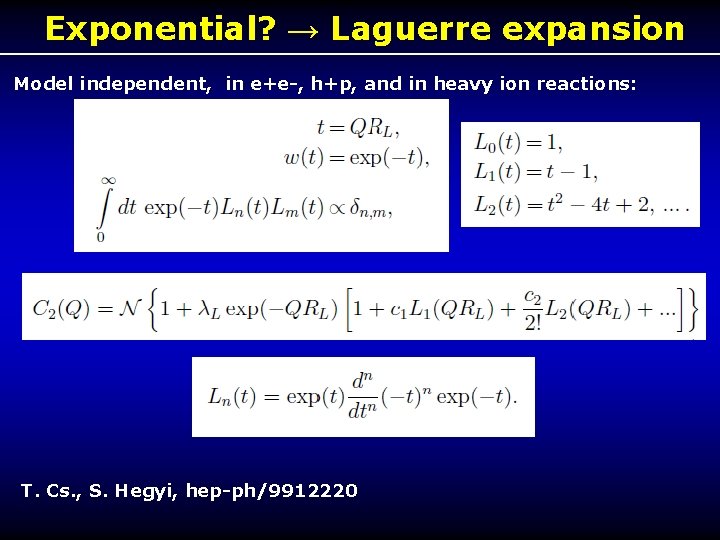
Model independent shape analysis Advantage and/or disadvantage: – Analyse, quantify correlations model independently Only two assumptions: – The correlations are centered around some point (Q = 0) They are short-range type • Long range correlations can be removed or measured independently Expansion methods to test: • Is it Gaussian ? → Edgeworth expansions • Is it Exponential ? → Laguerre expansions – Based on complete orthog. set of functions – T. Cs. and S. Hegyi, hep-ph/9912220 » Not 1+ pos definite » Not connected to a source model
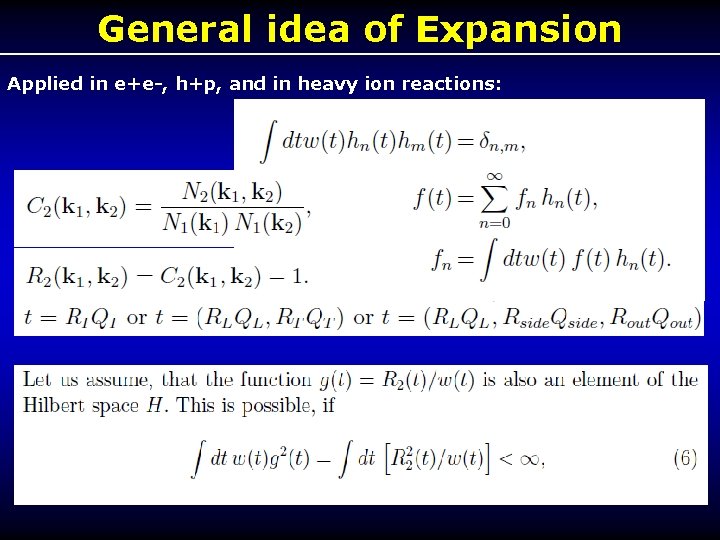
General idea of Expansion Applied in e+e-, h+p, and in heavy ion reactions:
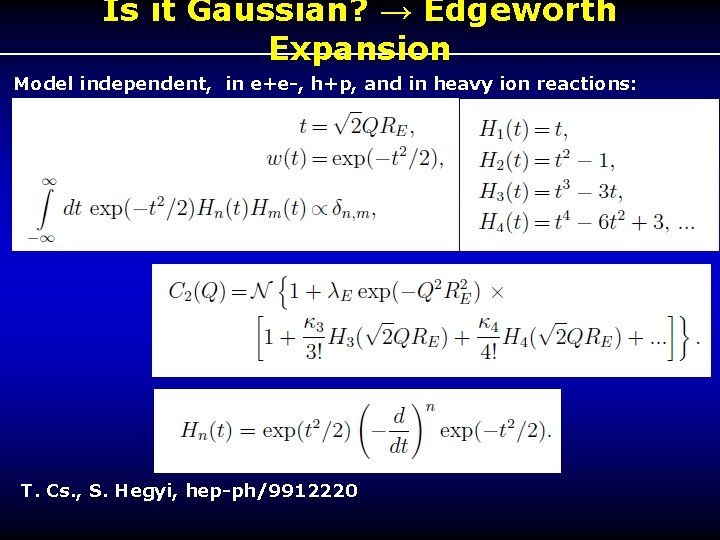
Is it Gaussian? → Edgeworth Expansion Model independent, in e+e-, h+p, and in heavy ion reactions: T. Cs. , S. Hegyi, hep-ph/9912220
Exponential? → Laguerre expansion Model independent, in e+e-, h+p, and in heavy ion reactions: T. Cs. , S. Hegyi, hep-ph/9912220
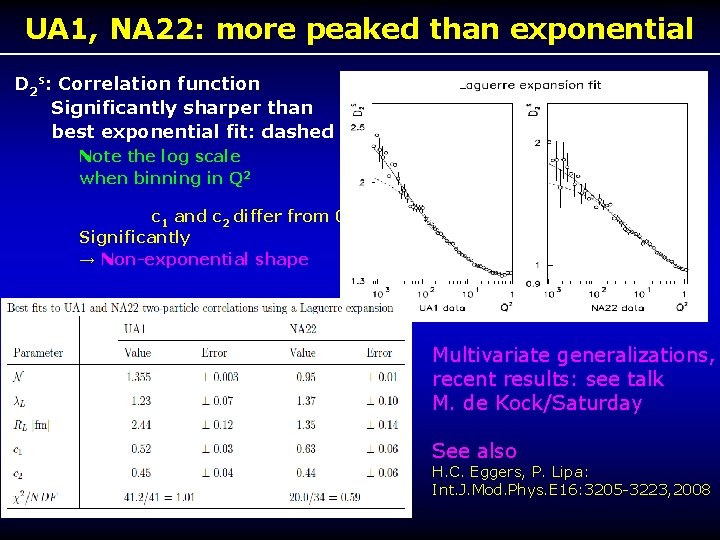
UA 1, NA 22: more peaked than exponential D 2 s: Correlation function Significantly sharper than best exponential fit: dashed Note the log scale when binning in Q 2 c 1 and c 2 differ from 0 Significantly → Non-exponential shape Multivariate generalizations, recent results: see talk M. de Kock/Saturday See also H. C. Eggers, P. Lipa: Int. J. Mod. Phys. E 16: 3205 -3223, 2008
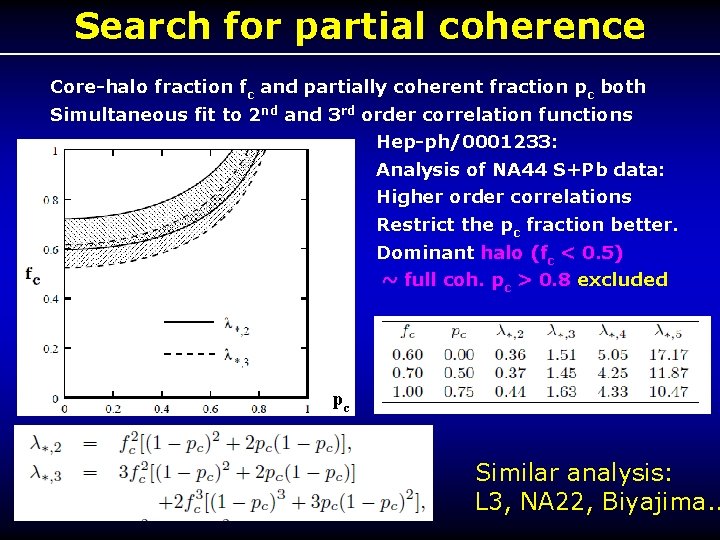
Search for partial coherence Core-halo fraction fc and partially coherent fraction pc both Simultaneous fit to 2 nd and 3 rd order correlation functions Hep-ph/0001233: Analysis of NA 44 S+Pb data: Higher order correlations Restrict the pc fraction better. Dominant halo (fc < 0. 5) ~ full coh. pc > 0. 8 excluded pc Similar analysis: L 3, NA 22, Biyajima. .
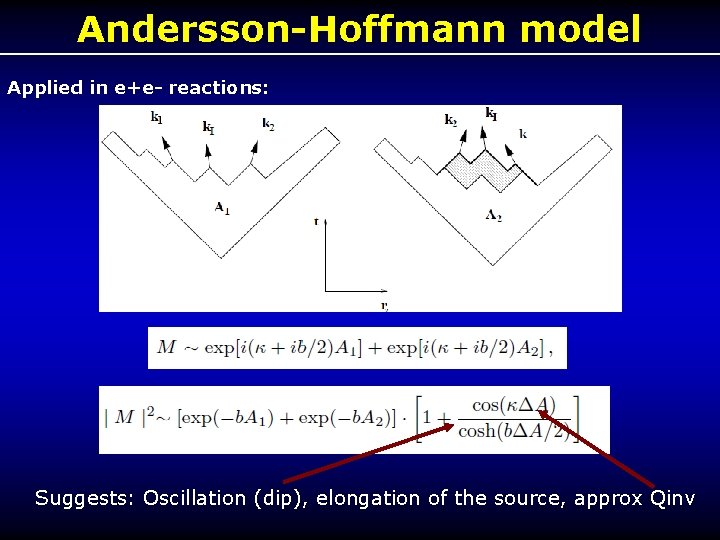
Andersson-Hoffmann model Applied in e+e- reactions: Suggests: Oscillation (dip), elongation of the source, approx Qinv
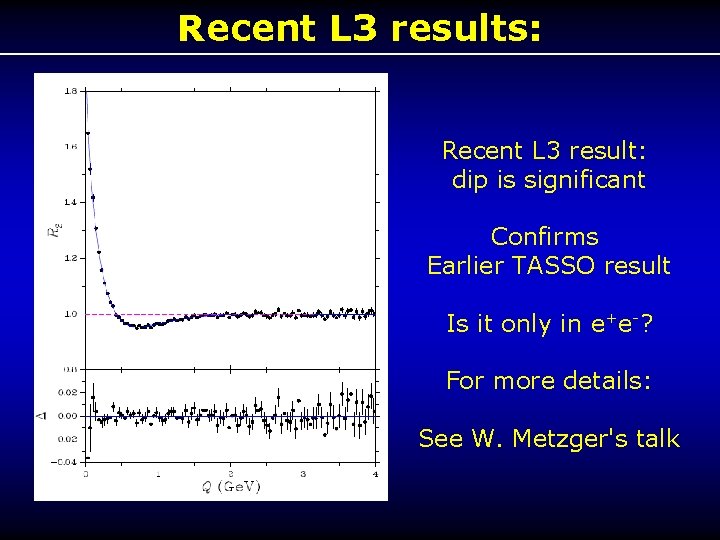
Recent L 3 results: Recent L 3 result: dip is significant Confirms Earlier TASSO result Is it only in e+e-? For more details: See W. Metzger's talk
Several interesting similarities • • Multiplicity dependence: – R decreases, increases with decreasing dn/d Transverse mass dependence – R decreases with increasing m or mt Correlations are apparently non-Gaussian – But in 3 d it is difficult to see the peak Even for 1 + pos def forms oscillations – If the source has a binary structure In e+e- collisions, a space-time movie can be – Recorded → not yet possible in h+p, AA Expanding, non-thermal rings in e+e. Expanding rings of fire seen in h+p reactions Long, boomerang like shape seen in h+p and e+e-
Interesting new directions Azimuthally sensitive HBT (STAR, PHENIX) Source imaging (PHENIX, STAR) Multiparticle correlations (STAR, PHENIX) Non-identical correlations (STAR) Rapidity dependent HBT (PHOBOS) Photon HBT (STAR, PHENIX) Non-Gaussian form (L 3, PHENIX, STAR, ALICE, CMS) – S. Hegyi, T. Cs. , W. A. Zajc, L 3, STAR, . . . Pion lasers – S. Pratt, Q. H. Zhang, T. Cs, J. Zimányi, Yu. Sinyukov. . . Mass-modification, squeezing – M. Asakawa, T. Cs. , M. Gyulassy, Y. Hama, S. Pad. . .
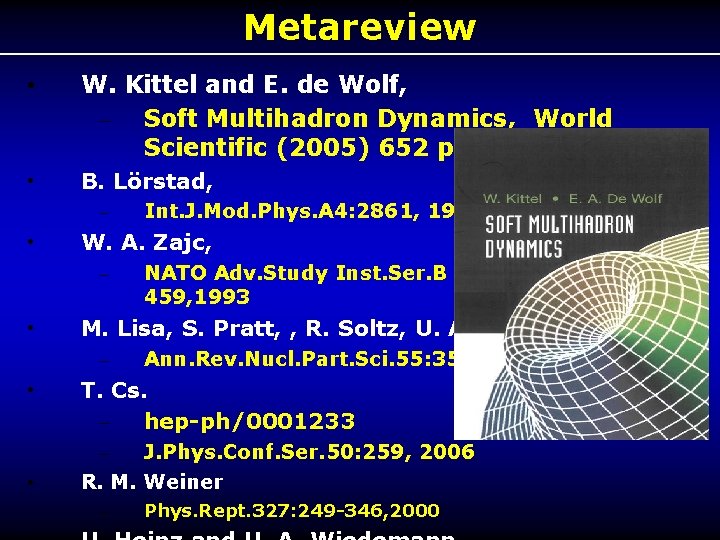
Metareview • W. Kittel and E. de Wolf, – Soft Multihadron Dynamics, World Scientific (2005) 652 p • B. Lörstad, – • W. A. Zajc, – • • NATO Adv. Study Inst. Ser. B Phys. 303: 435459, 1993 M. Lisa, S. Pratt, , R. Soltz, U. A. Wiedemann – • Int. J. Mod. Phys. A 4: 2861, 1989 Ann. Rev. Nucl. Part. Sci. 55: 357 -402, 2005 T. Cs. – hep-ph/0001233 – J. Phys. Conf. Ser. 50: 259, 2006 R. M. Weiner – Phys. Rept. 327: 249 -346, 2000