
Highlights from the May 2016 Occupational Employment Statistics
- Slides: 21
Highlights from the May 2016 Occupational Employment Statistics data Audrey Watson Economist Occupational Employment Statistics June 6, 2017 1 — U. S. BUREAU OF LABOR STATISTICS • bls. gov
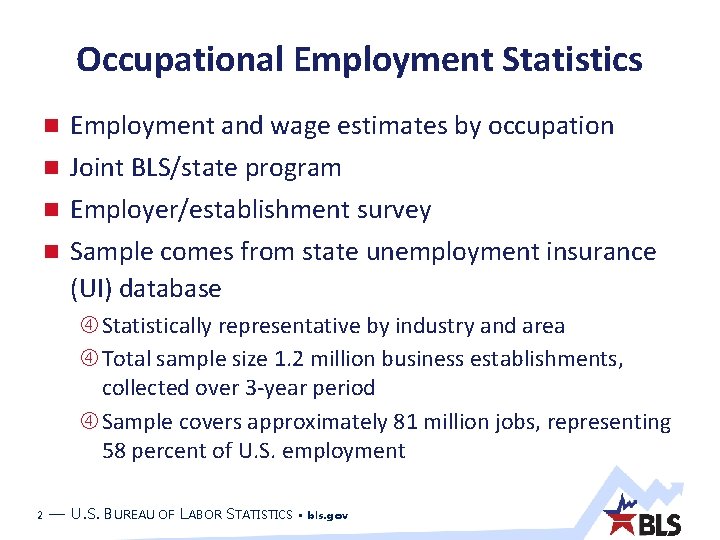
Occupational Employment Statistics Employment and wage estimates by occupation Joint BLS/state program Employer/establishment survey Sample comes from state unemployment insurance (UI) database Statistically representative by industry and area Total sample size 1. 2 million business establishments, collected over 3 -year period Sample covers approximately 81 million jobs, representing 58 percent of U. S. employment 2 — U. S. BUREAU OF LABOR STATISTICS • bls. gov
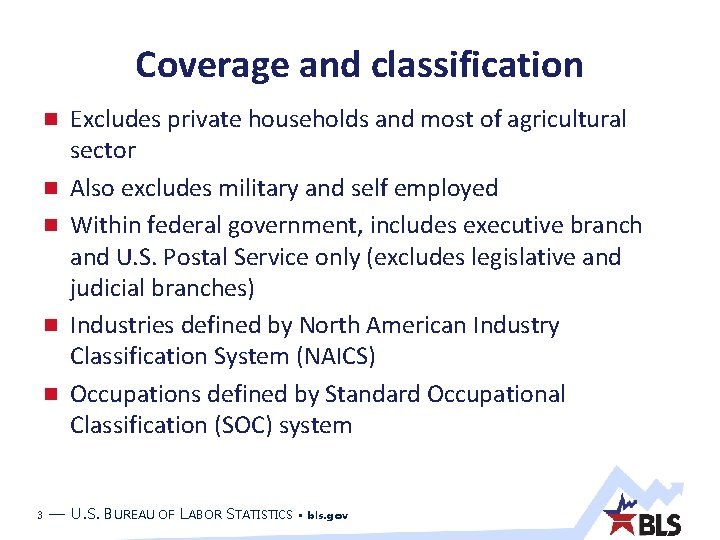
Coverage and classification 3 Excludes private households and most of agricultural sector Also excludes military and self employed Within federal government, includes executive branch and U. S. Postal Service only (excludes legislative and judicial branches) Industries defined by North American Industry Classification System (NAICS) Occupations defined by Standard Occupational Classification (SOC) system — U. S. BUREAU OF LABOR STATISTICS • bls. gov
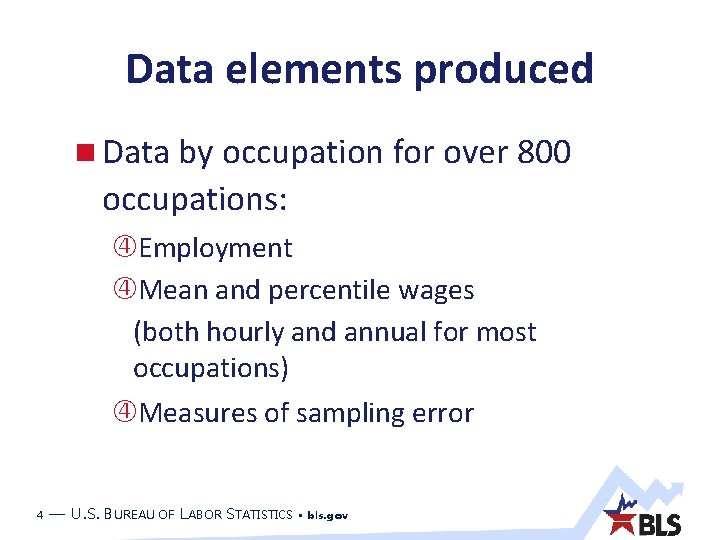
Data elements produced Data by occupation for over 800 occupations: Employment Mean and percentile wages (both hourly and annual for most occupations) Measures of sampling error 4 — U. S. BUREAU OF LABOR STATISTICS • bls. gov
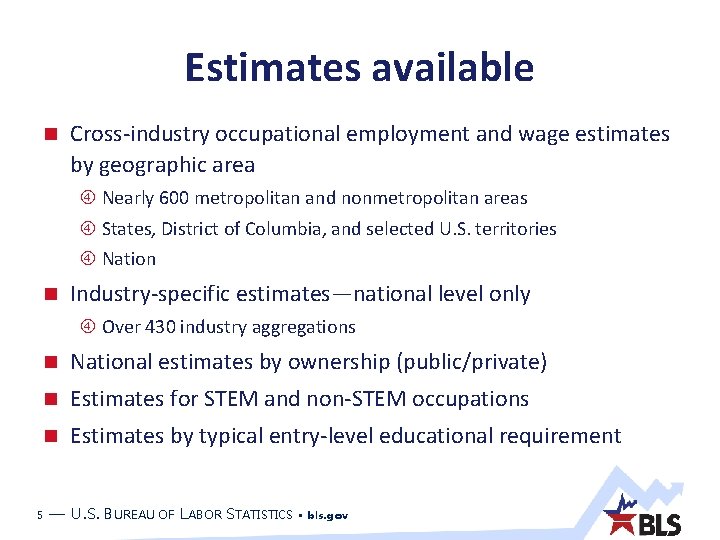
Estimates available Cross-industry occupational employment and wage estimates by geographic area Nearly 600 metropolitan and nonmetropolitan areas States, District of Columbia, and selected U. S. territories Nation Industry-specific estimates—national level only Over 430 industry aggregations 5 National estimates by ownership (public/private) Estimates for STEM and non-STEM occupations Estimates by typical entry-level educational requirement — U. S. BUREAU OF LABOR STATISTICS • bls. gov
DOL uses of OES data Within BLS: Occupational employment projections Occupational Outlook Handbook Occupational injury and illness incidence rates Employment Cost Index 6 Foreign Labor Certification Service Contract Act Career. One. Stop O*NET Employment Standards Administration — U. S. BUREAU OF LABOR STATISTICS • bls. gov
State uses of OES data Assisting employers: By improving the alignment of education and training with the needs of business In helping to build a skilled workforce to meet hiring demands In making business location decisions In selecting wage/pay scales relative to local competitive levels Assisting career counselors with reemployment and job placement for students, job seekers, and dislocated workers Assisting economic development with labor supply for business recruitment 7 — U. S. BUREAU OF LABOR STATISTICS • bls. gov
Other users of OES data 8 Federal government: Center for Medicare and Medicaid Services, President’s Pay Agent, Bureau of Economic Analysis Private sector/individuals: Human resources professionals, students, job seekers, guidance and career counselors, academic researchers, media — U. S. BUREAU OF LABOR STATISTICS • bls. gov
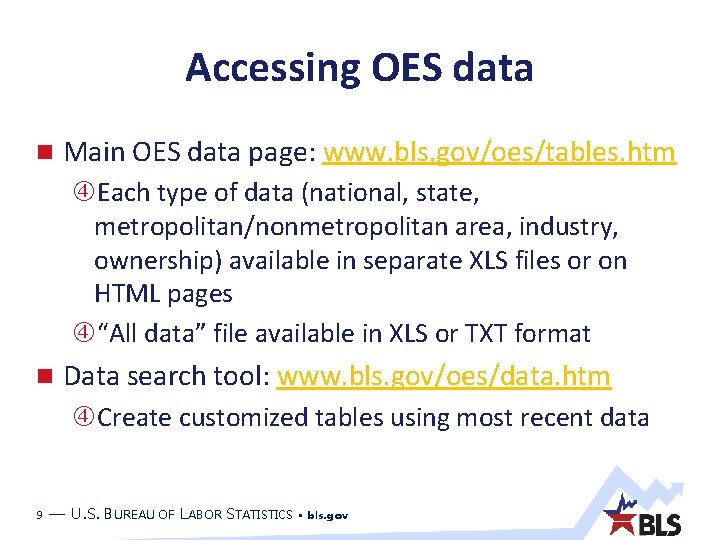
Accessing OES data Main OES data page: www. bls. gov/oes/tables. htm Each type of data (national, state, metropolitan/nonmetropolitan area, industry, ownership) available in separate XLS files or on HTML pages “All data” file available in XLS or TXT format Data search tool: www. bls. gov/oes/data. htm Create customized tables using most recent data 9 — U. S. BUREAU OF LABOR STATISTICS • bls. gov
Highlights from the May 2016 OES data 10 — U. S. BUREAU OF LABOR STATISTICS • bls. gov
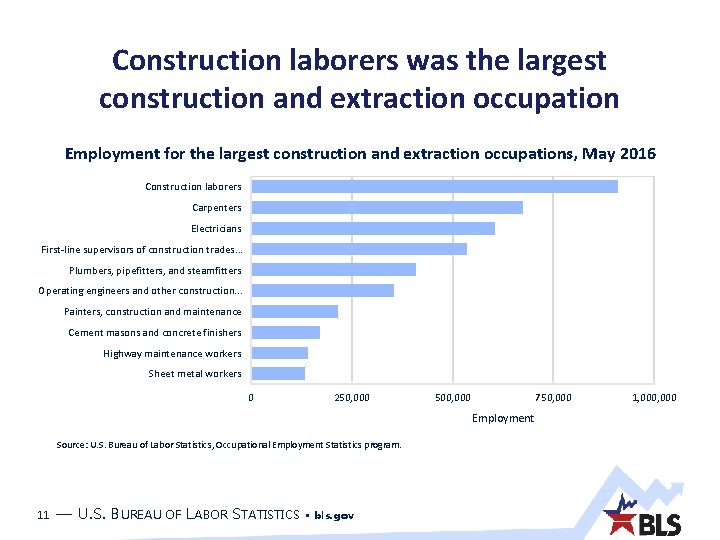
Construction laborers was the largest construction and extraction occupation Employment for the largest construction and extraction occupations, May 2016 Construction laborers Carpenters Electricians First-line supervisors of construction trades. . . Plumbers, pipefitters, and steamfitters Operating engineers and other construction. . . Painters, construction and maintenance Cement masons and concrete finishers Highway maintenance workers Sheet metal workers 0 250, 000 500, 000 750, 000 Employment Source: U. S. Bureau of Labor Statistics, Occupational Employment Statistics program. 11 — U. S. BUREAU OF LABOR STATISTICS • bls. gov 1, 000
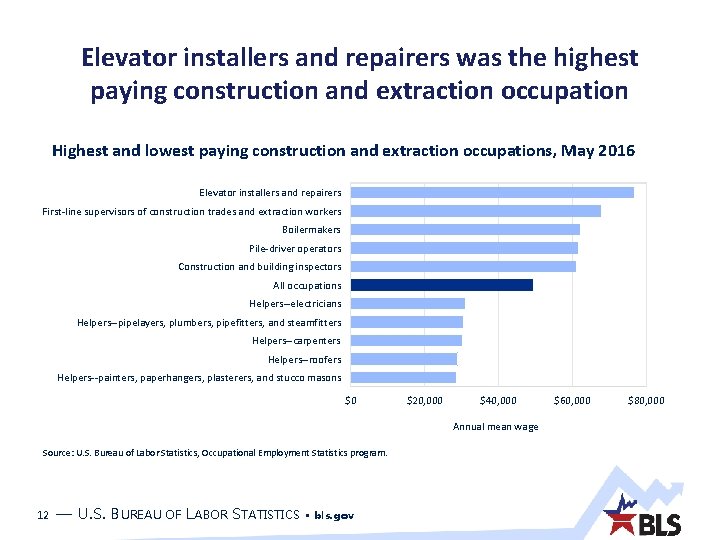
Elevator installers and repairers was the highest paying construction and extraction occupation Highest and lowest paying construction and extraction occupations, May 2016 Elevator installers and repairers First-line supervisors of construction trades and extraction workers Boilermakers Pile-driver operators Construction and building inspectors All occupations Helpers--electricians Helpers--pipelayers, plumbers, pipefitters, and steamfitters Helpers--carpenters Helpers--roofers Helpers--painters, paperhangers, plasterers, and stucco masons $0 $20, 000 $40, 000 Annual mean wage Source: U. S. Bureau of Labor Statistics, Occupational Employment Statistics program. 12 — U. S. BUREAU OF LABOR STATISTICS • bls. gov $60, 000 $80, 000
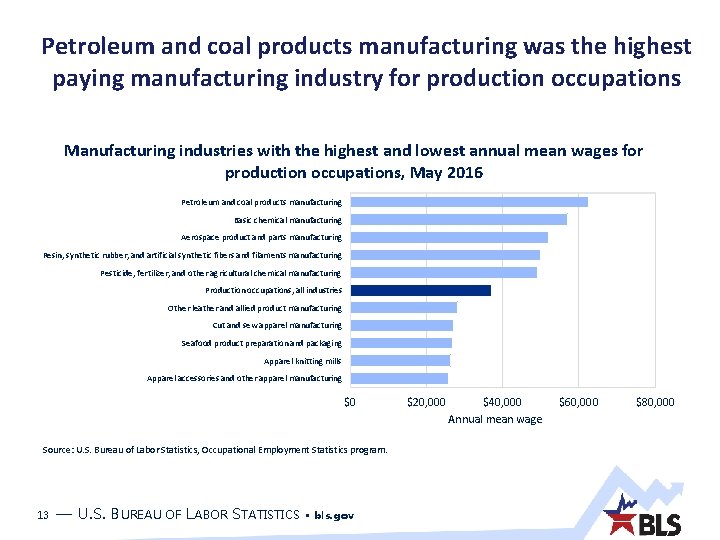
Petroleum and coal products manufacturing was the highest paying manufacturing industry for production occupations Manufacturing industries with the highest and lowest annual mean wages for production occupations, May 2016 Petroleum and coal products manufacturing Basic chemical manufacturing Aerospace product and parts manufacturing Resin, synthetic rubber, and artificial synthetic fibers and filaments manufacturing Pesticide, fertilizer, and other agricultural chemical manufacturing Production occupations, all industries Other leather and allied product manufacturing Cut and sew apparel manufacturing Seafood product preparation and packaging Apparel knitting mills Apparel accessories and other apparel manufacturing $0 Source: U. S. Bureau of Labor Statistics, Occupational Employment Statistics program. 13 — U. S. BUREAU OF LABOR STATISTICS • bls. gov $20, 000 $40, 000 Annual mean wage $60, 000 $80, 000
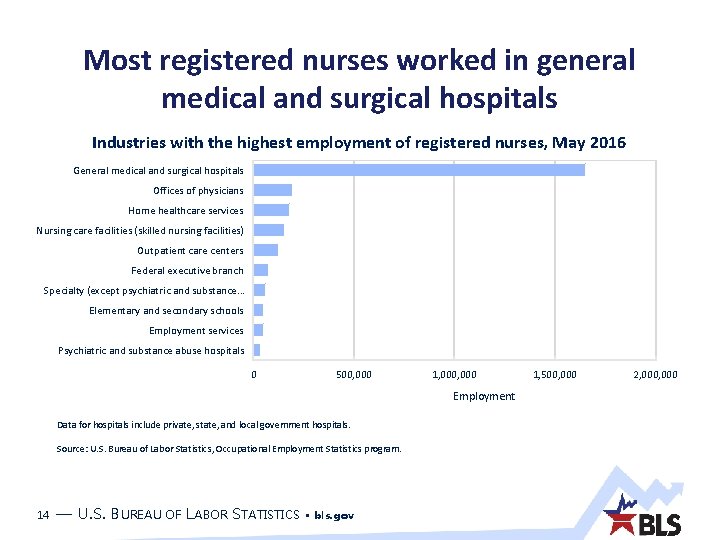
Most registered nurses worked in general medical and surgical hospitals Industries with the highest employment of registered nurses, May 2016 General medical and surgical hospitals Offices of physicians Home healthcare services Nursing care facilities (skilled nursing facilities) Outpatient care centers Federal executive branch Specialty (except psychiatric and substance. . . Elementary and secondary schools Employment services Psychiatric and substance abuse hospitals 0 500, 000 1, 000 Employment Data for hospitals include private, state, and local government hospitals. Source: U. S. Bureau of Labor Statistics, Occupational Employment Statistics program. 14 — U. S. BUREAU OF LABOR STATISTICS • bls. gov 1, 500, 000 2, 000
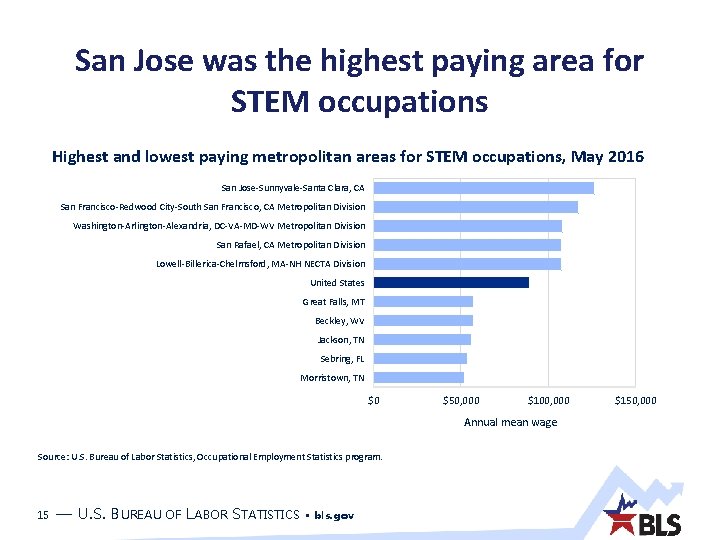
San Jose was the highest paying area for STEM occupations Highest and lowest paying metropolitan areas for STEM occupations, May 2016 San Jose-Sunnyvale-Santa Clara, CA San Francisco-Redwood City-South San Francisco, CA Metropolitan Division Washington-Arlington-Alexandria, DC-VA-MD-WV Metropolitan Division San Rafael, CA Metropolitan Division Lowell-Billerica-Chelmsford, MA-NH NECTA Division United States Great Falls, MT Beckley, WV Jackson, TN Sebring, FL Morristown, TN $0 $50, 000 $100, 000 Annual mean wage Source: U. S. Bureau of Labor Statistics, Occupational Employment Statistics program. 15 — U. S. BUREAU OF LABOR STATISTICS • bls. gov $150, 000
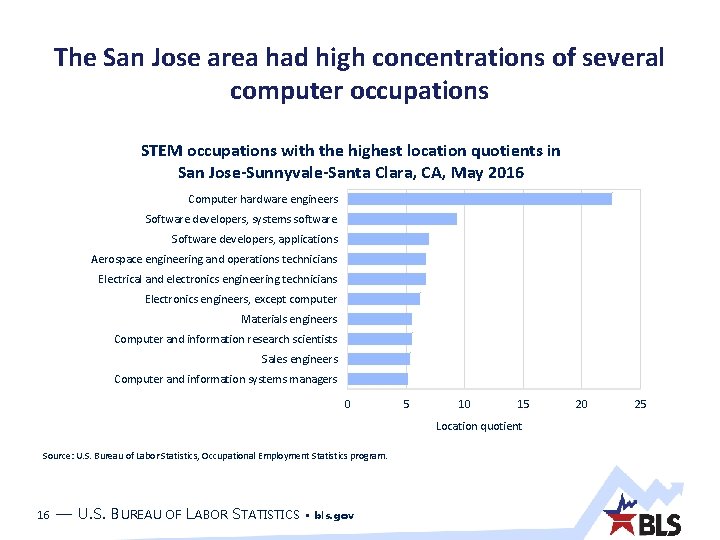
The San Jose area had high concentrations of several computer occupations STEM occupations with the highest location quotients in San Jose-Sunnyvale-Santa Clara, CA, May 2016 Computer hardware engineers Software developers, systems software Software developers, applications Aerospace engineering and operations technicians Electrical and electronics engineering technicians Electronics engineers, except computer Materials engineers Computer and information research scientists Sales engineers Computer and information systems managers 0 5 10 15 Location quotient Source: U. S. Bureau of Labor Statistics, Occupational Employment Statistics program. 16 — U. S. BUREAU OF LABOR STATISTICS • bls. gov 20 25
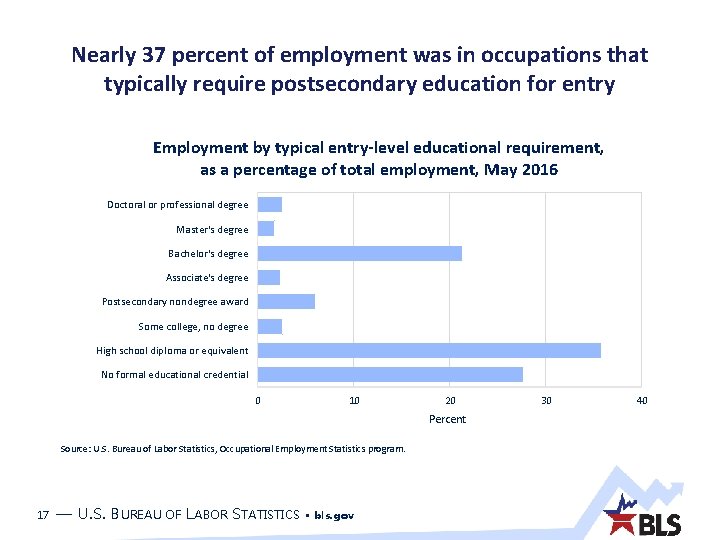
Nearly 37 percent of employment was in occupations that typically require postsecondary education for entry Employment by typical entry-level educational requirement, as a percentage of total employment, May 2016 Doctoral or professional degree Master's degree Bachelor's degree Associate's degree Postsecondary nondegree award Some college, no degree High school diploma or equivalent No formal educational credential 0 10 20 Percent Source: U. S. Bureau of Labor Statistics, Occupational Employment Statistics program. 17 — U. S. BUREAU OF LABOR STATISTICS • bls. gov 30 40
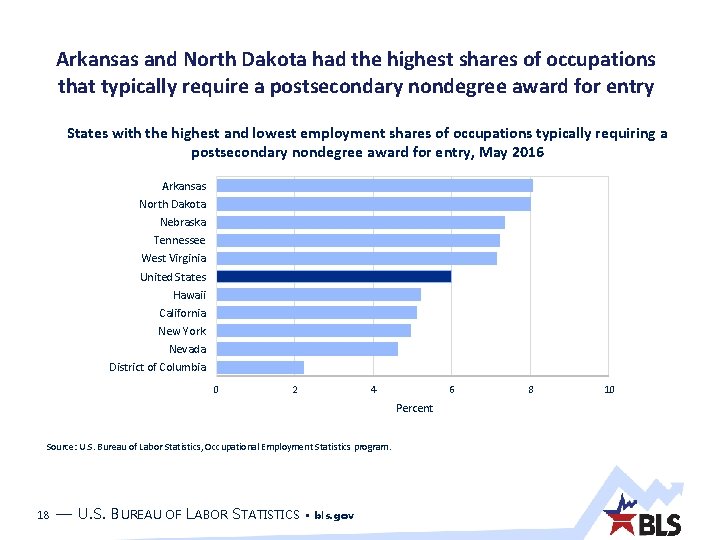
Arkansas and North Dakota had the highest shares of occupations that typically require a postsecondary nondegree award for entry States with the highest and lowest employment shares of occupations typically requiring a postsecondary nondegree award for entry, May 2016 Arkansas North Dakota Nebraska Tennessee West Virginia United States Hawaii California New York Nevada District of Columbia 0 2 4 6 Percent Source: U. S. Bureau of Labor Statistics, Occupational Employment Statistics program. 18 — U. S. BUREAU OF LABOR STATISTICS • bls. gov 8 10
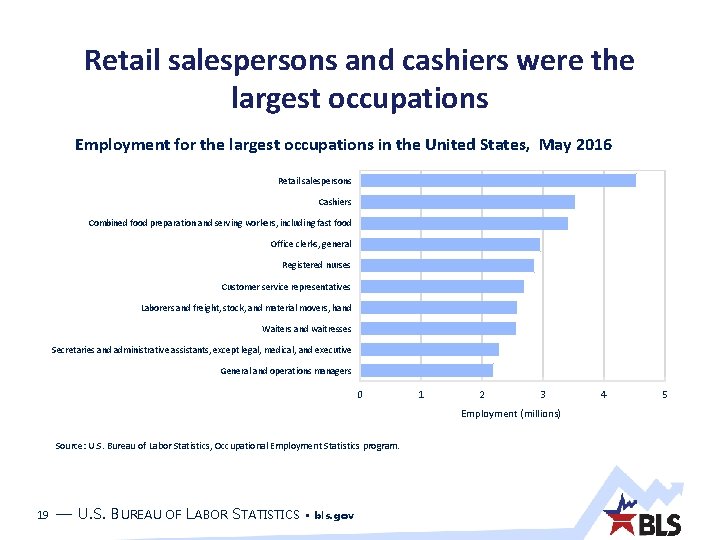
Retail salespersons and cashiers were the largest occupations Employment for the largest occupations in the United States, May 2016 Retail salespersons Cashiers Combined food preparation and serving workers, including fast food Office clerks, general Registered nurses Customer service representatives Laborers and freight, stock, and material movers, hand Waiters and waitresses Secretaries and administrative assistants, except legal, medical, and executive General and operations managers 0 1 2 3 Employment (millions) Source: U. S. Bureau of Labor Statistics, Occupational Employment Statistics program. 19 — U. S. BUREAU OF LABOR STATISTICS • bls. gov 4 5
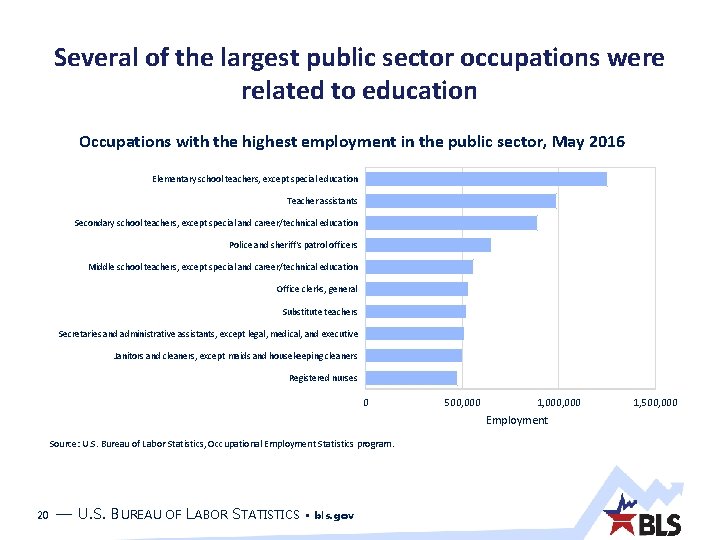
Several of the largest public sector occupations were related to education Occupations with the highest employment in the public sector, May 2016 Elementary school teachers, except special education Teacher assistants Secondary school teachers, except special and career/technical education Police and sheriff's patrol officers Middle school teachers, except special and career/technical education Office clerks, general Substitute teachers Secretaries and administrative assistants, except legal, medical, and executive Janitors and cleaners, except maids and housekeeping cleaners Registered nurses 0 500, 000 1, 000 Employment Source: U. S. Bureau of Labor Statistics, Occupational Employment Statistics program. 20 — U. S. BUREAU OF LABOR STATISTICS • bls. gov 1, 500, 000
Contact Information Audrey Watson Economist Occupational Employment Statistics www. bls. gov/oes 202 -691 -5693 watson. audrey@bls. gov 21 — U. S. BUREAU OF LABOR STATISTICS • bls. gov