
Highlights Examples of U S Involvement in International
- Slides: 5
Highlights: Examples of U. S. Involvement in International Conflicts SS. 7. C. 4. 3 Describe examples of how the United States has dealt with international conflicts.
War Powers and the President The United States Constitution divides war powers between Congress and the President. Article I, Section 8 of the U. S. Constitution grants Congress the power to declare war, control war funding, raise and support the armed forces, and affirms the “Power…to make all Laws which shall be necessary and proper for carrying into Execution…all other Powers vested by this Constitution in the Government of the United States, or in any Department or Officer thereof. ” Article II, Section 2 of the U. S. Constitution states that, “The President shall be commander in chief of the Army and Navy of the United States, and of the militia of the several states, when called into the actual service of the United States…” (see Benchmark 3. 3)
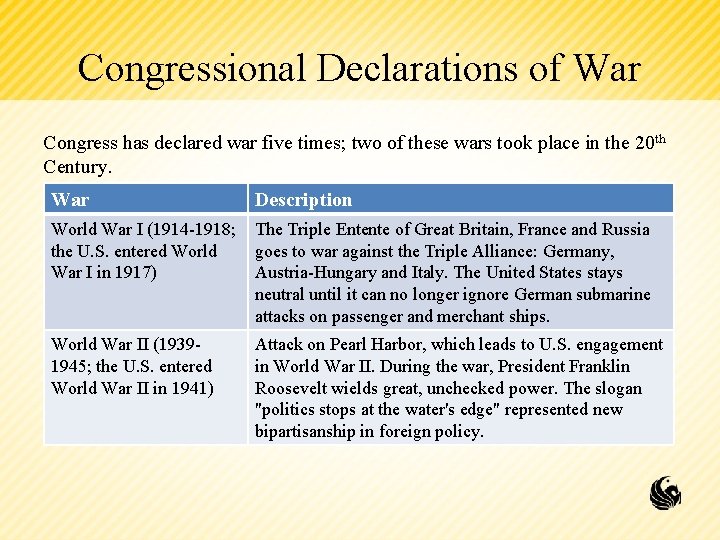
Congressional Declarations of War Congress has declared war five times; two of these wars took place in the 20 th Century. War Description World War I (1914 -1918; the U. S. entered World War I in 1917) The Triple Entente of Great Britain, France and Russia goes to war against the Triple Alliance: Germany, Austria-Hungary and Italy. The United States stays neutral until it can no longer ignore German submarine attacks on passenger and merchant ships. World War II (19391945; the U. S. entered World War II in 1941) Attack on Pearl Harbor, which leads to U. S. engagement in World War II. During the war, President Franklin Roosevelt wields great, unchecked power. The slogan "politics stops at the water's edge" represented new bipartisanship in foreign policy.
The President as Commander in Chief Presidents have often interpreted their role as Commander-in. Chief as allowing them to use the U. S. military to “…preserve, protect, and defend the Constitution of the United States, ” as stated in their Oath of Office. Presidents have used the U. S. military frequently without formal declarations of war from Congress. Some of the best known examples of the president acting as Commander-in-Chief without a formal declaration of war from Congress include the Korean War (1950 -1953), the Vietnam War (1964 -1975), Gulf War I (1990 -1991), and Gulf War II (2003 -present).
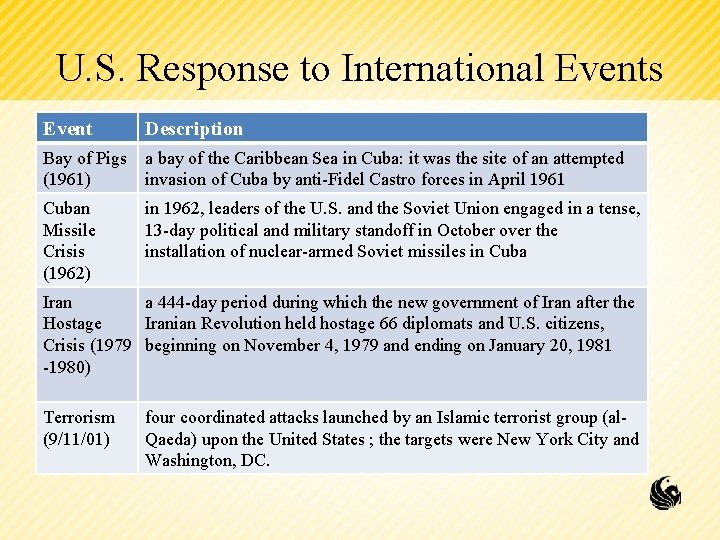
U. S. Response to International Events Event Description Bay of Pigs (1961) a bay of the Caribbean Sea in Cuba: it was the site of an attempted invasion of Cuba by anti-Fidel Castro forces in April 1961 Cuban Missile Crisis (1962) in 1962, leaders of the U. S. and the Soviet Union engaged in a tense, 13 -day political and military standoff in October over the installation of nuclear-armed Soviet missiles in Cuba Iran a 444 -day period during which the new government of Iran after the Hostage Iranian Revolution held hostage 66 diplomats and U. S. citizens, Crisis (1979 beginning on November 4, 1979 and ending on January 20, 1981 -1980) Terrorism (9/11/01) four coordinated attacks launched by an Islamic terrorist group (al. Qaeda) upon the United States ; the targets were New York City and Washington, DC.