
HighLeverage Practices Explicit Instruction HighLeverage Practice 16 Facilitator


- Slides: 43
High-Leverage Practices Explicit Instruction (High-Leverage Practice 16)
Facilitator Introductions
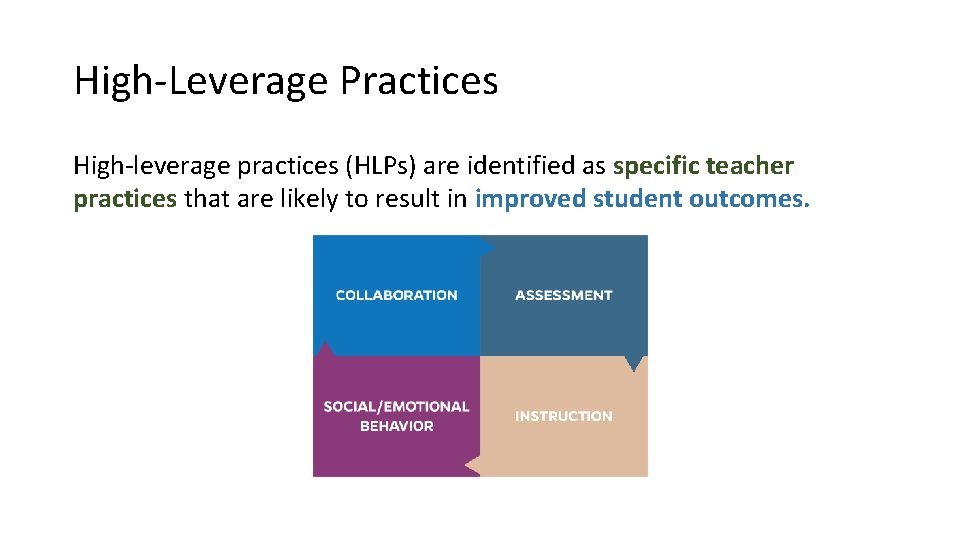
High-Leverage Practices High-leverage practices (HLPs) are identified as specific teacher practices that are likely to result in improved student outcomes.
High-Leverage Practice 16: Explicit Instruction Teachers make content, skills, and concepts explicit by showing and telling students what to do or think while solving problems, enacting strategies, completing tasks, and classifying concepts. Teachers use explicit instruction when students are learning new material and complex concepts and skills. They strategically choose examples and nonexamples and language to facilitate student understanding, anticipate common misconceptions, highlight essential content, and remove distracting information. They model and scaffold steps or processes needed to understand content and concepts, apply skills, and complete tasks successfully and independently.
Quick Share! When you hear the term explicit instruction, what comes to mind (e. g. , thought, opinion)?
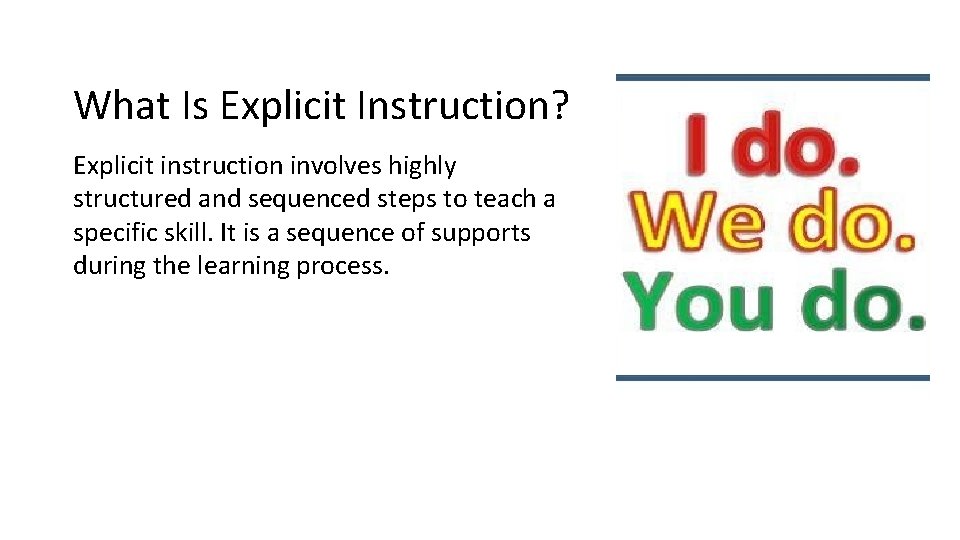
What Is Explicit Instruction? Explicit instruction involves highly structured and sequenced steps to teach a specific skill. It is a sequence of supports during the learning process.
Explicit Instruction Explained Anita Archer explains explicit instruction. https: //www. youtube. com/watch? v=i-q. Np. Ftcyn. I
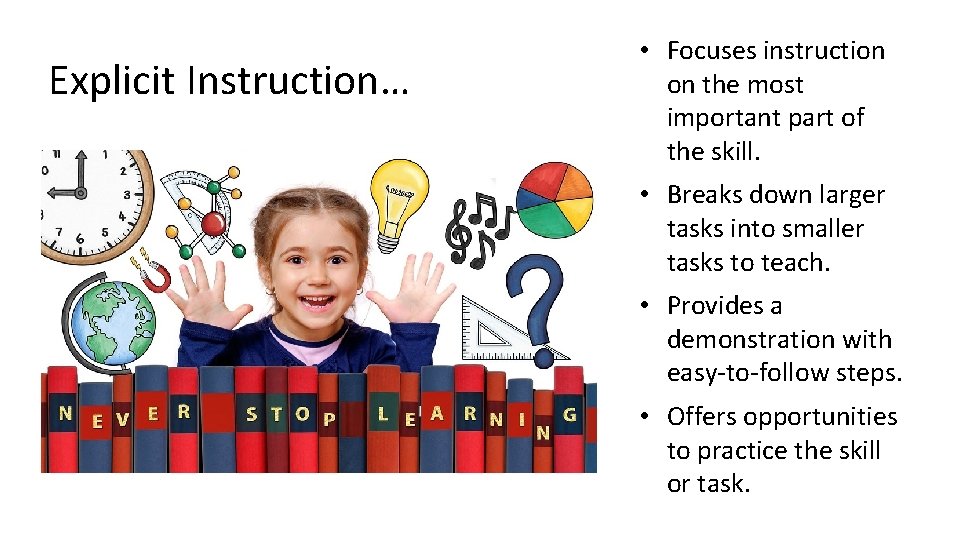
Explicit Instruction… • Focuses instruction on the most important part of the skill. • Breaks down larger tasks into smaller tasks to teach. • Provides a demonstration with easy-to-follow steps. How does Explicit Instruction Promote Learning? • Offers opportunities to practice the skill or task.
Group Work On a piece of divided piece of chart paper, make a list of what you think explicit instruction is and what it is not.
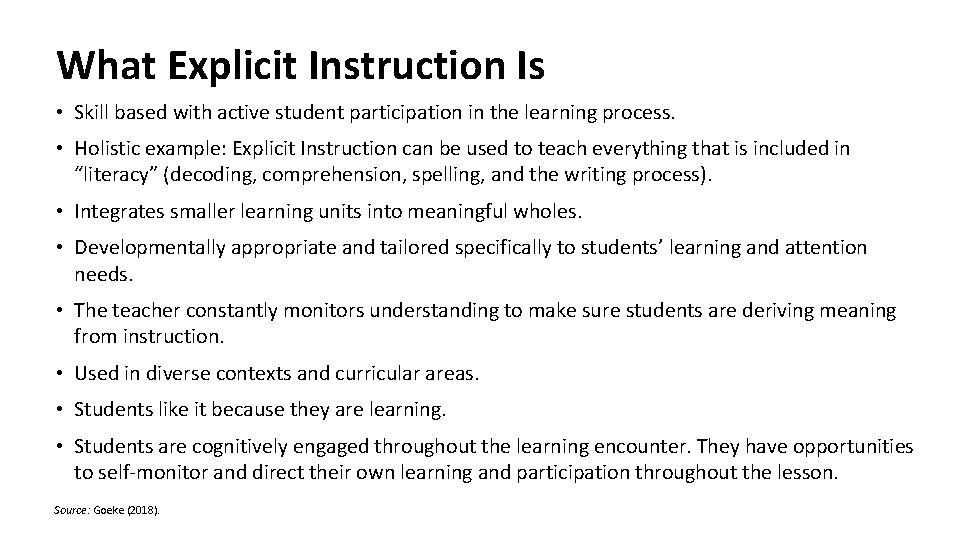
What Explicit Instruction Is • Skill based with active student participation in the learning process. • Holistic example: Explicit Instruction can be used to teach everything that is included in “literacy” (decoding, comprehension, spelling, and the writing process). • Integrates smaller learning units into meaningful wholes. • Developmentally appropriate and tailored specifically to students’ learning and attention needs. • The teacher constantly monitors understanding to make sure students are deriving meaning from instruction. • Used in diverse contexts and curricular areas. • Students like it because they are learning. • Students are cognitively engaged throughout the learning encounter. They have opportunities to self-monitor and direct their own learning and participation throughout the lesson. Source: Goeke (2018).
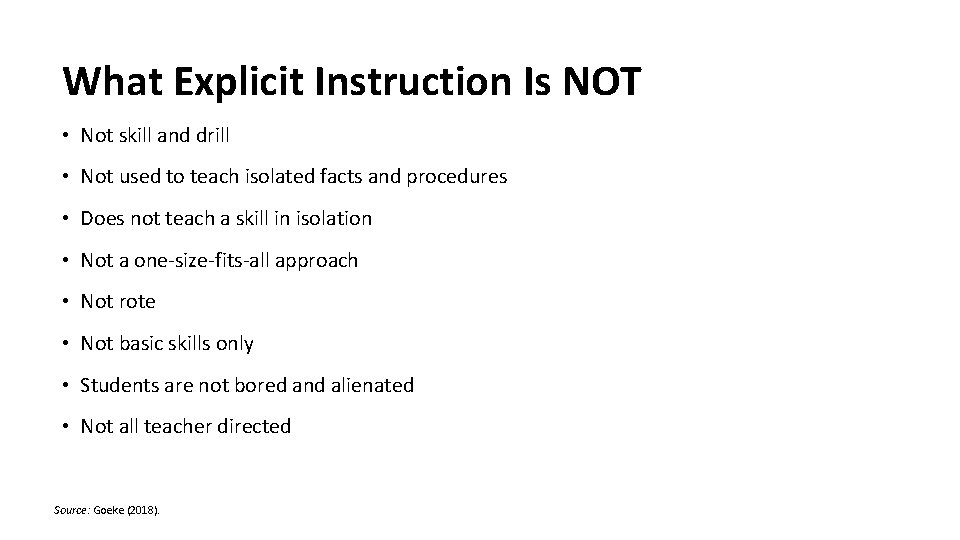
What Explicit Instruction Is NOT • Not skill and drill • Not used to teach isolated facts and procedures • Does not teach a skill in isolation • Not a one-size-fits-all approach • Not rote • Not basic skills only • Students are not bored and alienated • Not all teacher directed Source: Goeke (2018).
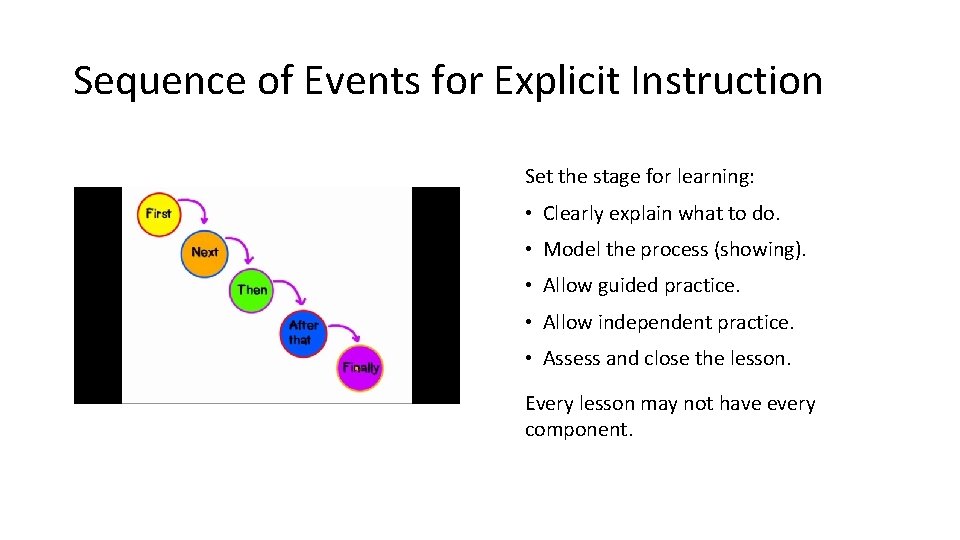
Sequence of Events for Explicit Instruction Set the stage for learning: • Clearly explain what to do. • Model the process (showing). • Allow guided practice. • Allow independent practice. • Assess and close the lesson. Every lesson may not have every component.
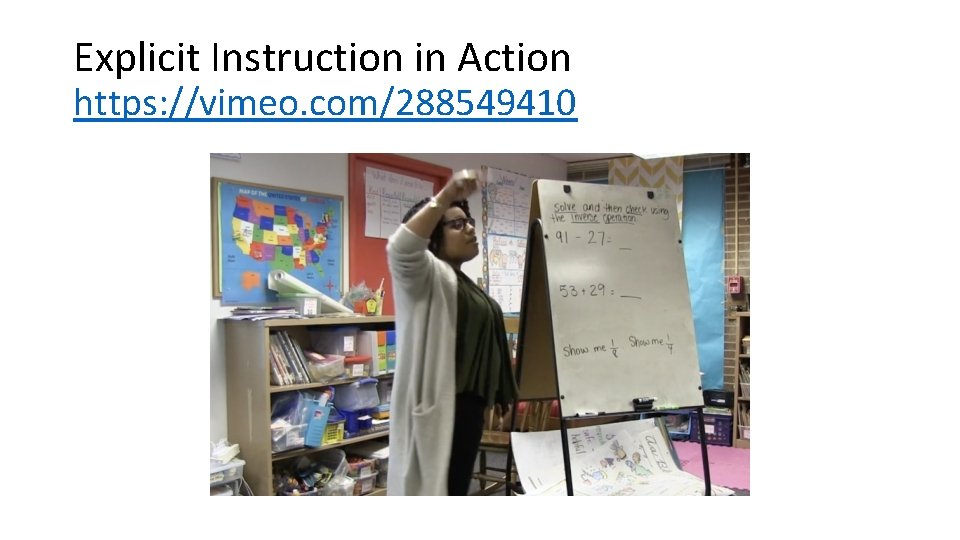
Explicit Instruction in Action https: //vimeo. com/288549410
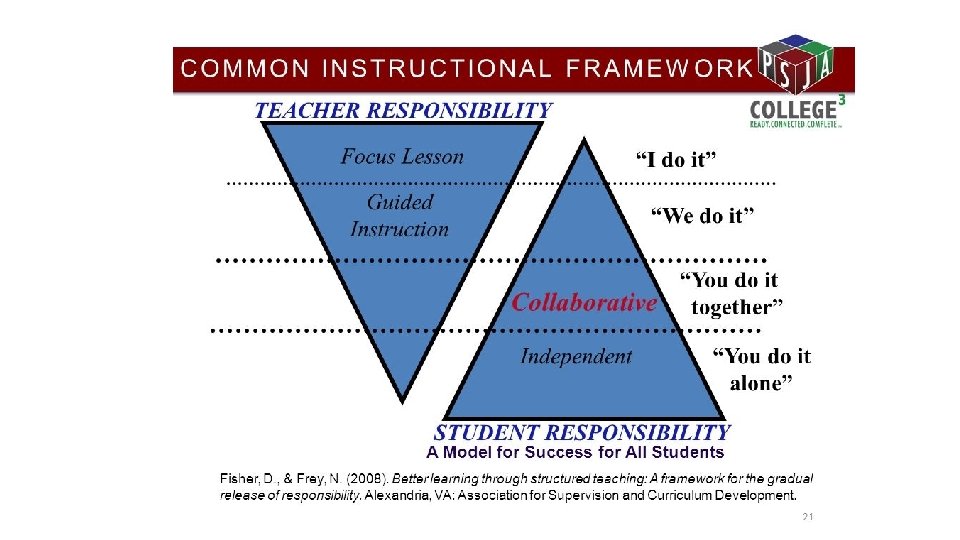
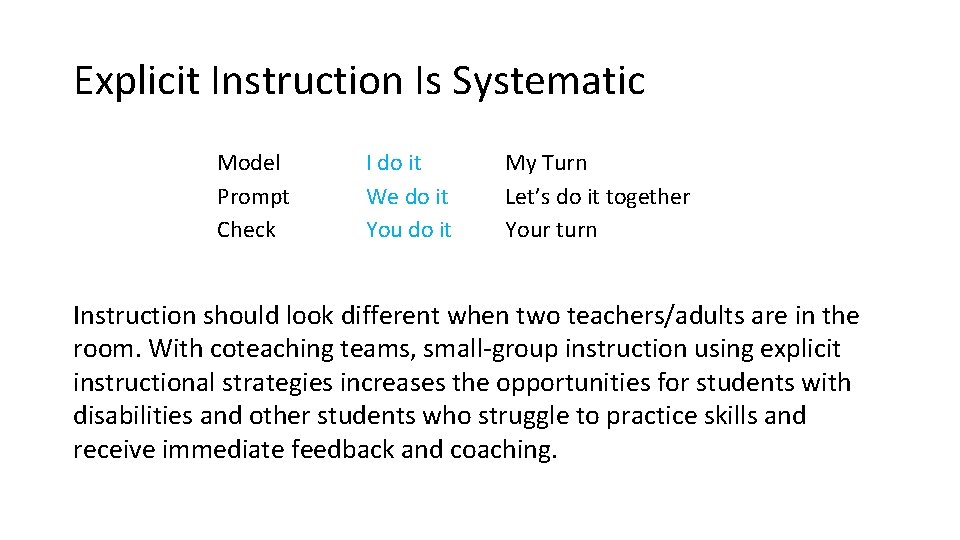
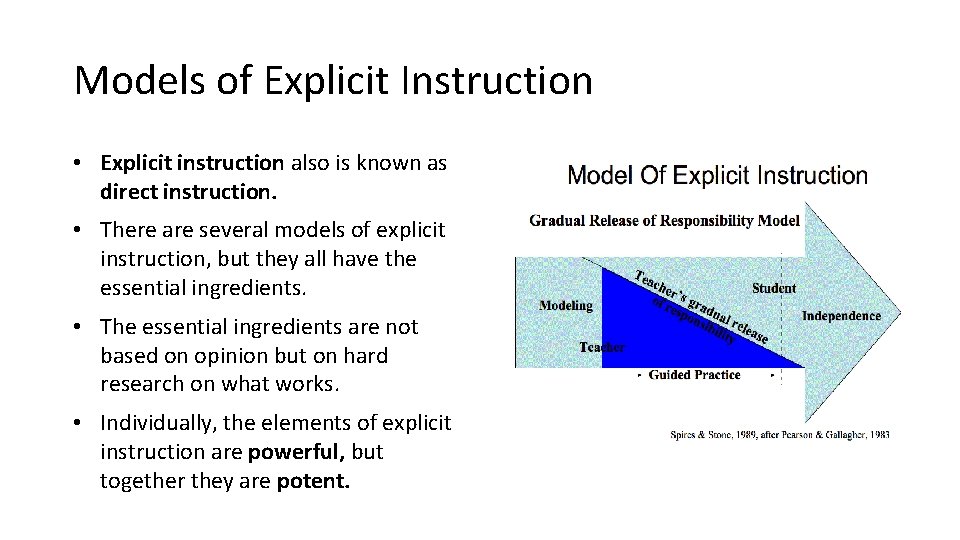
Explicit Instruction Is Systematic Model Prompt Check I do it We do it You do it My Turn Let’s do it together Your turn Instruction should look different when two teachers/adults are in the room. With coteaching teams, small-group instruction using explicit instructional strategies increases the opportunities for students with disabilities and other students who struggle to practice skills and receive immediate feedback and coaching.
I Do. . . We Do. . . You Do. . . Teaching Matters: Explicit Instruction
Elements of Explicit Instruction • Logical sequence • Targets students’ needs • Models and explains • Flexible cognitive strategy • Opportunities to practice • Corrective feedback • Motivation
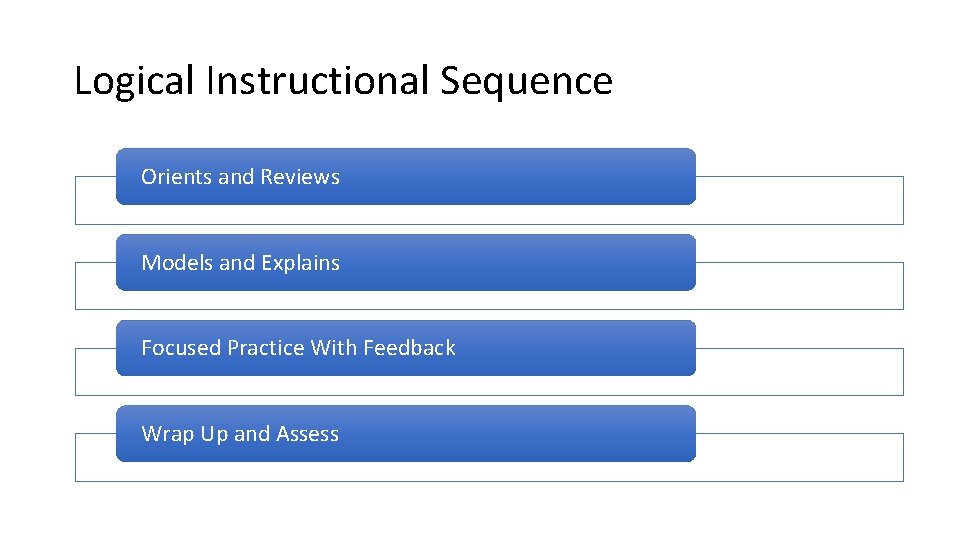
Logical Instructional Sequence Orients and Reviews Models and Explains Focused Practice With Feedback Wrap Up and Assess
Targets Their Needs Must be focused on the needs that students have as identified through assessment.
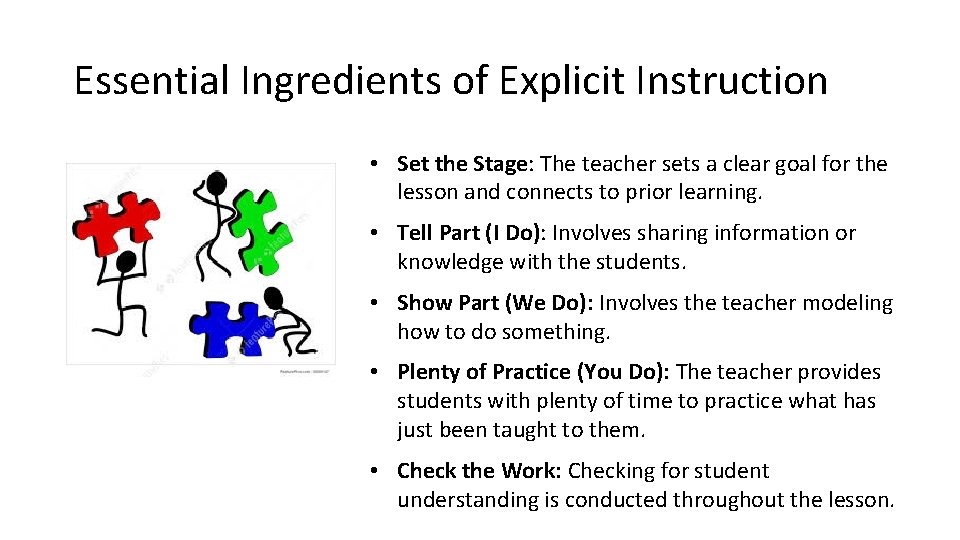
Essential Ingredients of Explicit Instruction • Set the Stage: The teacher sets a clear goal for the lesson and connects to prior learning. • Tell Part (I Do): Involves sharing information or knowledge with the students. • Show Part (We Do): Involves the teacher modeling how to do something. • Plenty of Practice (You Do): The teacher provides students with plenty of time to practice what has just been taught to them. • Check the Work: Checking for student understanding is conducted throughout the lesson.
Self-Reflection Rubric • Rate yourself using the explicit instruction rubric. • What do you think are some of your successes? • What do you think are some of your barriers?
High-Leverage Practice 16: Explicit Instruction https: //youtu. be/ESFVNzih. OZ 0 Source: Kennedy, Peeples, Romig, Mathews, & Rogers (2018).
Models of Explicit Instruction • Explicit instruction also is known as direct instruction. • There are several models of explicit instruction, but they all have the essential ingredients. • The essential ingredients are not based on opinion but on hard research on what works. • Individually, the elements of explicit instruction are powerful, but together they are potent.
The “I Do/Telling” Phase • This phase of the lesson involves the teacher telling students what they need to know. • This also is the time you teach a strategy to help students understand the information and make abstract concepts more concrete.
• Setting lesson goals is easy, is inexpensive, and has a massive effect on how well students do at school. • Lesson goals always explain what students need to understand what they must be able to do by the end of the lesson. See handout in folder.
The Anticipatory Set After the objective and before the direct instruction comes the anticipatory set. The anticipatory set is a short activity at the start of a lesson that focuses students’ attention and gets them ready and excited for the material you are about to present.
Check for Understanding Purpose: To assess student readiness to move forward with the modeling. How: Ask specific questions about the vocabulary and facts just discussed.
Modeling/Showing Part of Explicit Instruction • Modeling is the second part of the “I Do” phase. • Modeling is the visual (and oral) link between the explanation of facts and students’ guided application of what is being taught.
Strategy • Students need to use their knowledge in flexible ways to solve words. • Explicit strategies that help them do this are important. • Again—remember to model! Source: O’Connor (2014).
Opportunities to Practice • Students struggling to learn need many cohesive practice opportunities than students who are learning easily. • In a co-taught classroom, students have the opportunity to participate in more practice. • A higher frequency of tailored feedback should be provided by the teachers.
How Guided Practice Works • In the initial practice, students are given a few problems or steps in a skill that are aligned with what was modeled and structured like those on the independent practice. • The teacher should be watching the students perform by walking around the classroom—an informal assessment of student understanding. • This is the time that students can alert the teacher of any problems. • Not all students will tell the teacher that they do not understand. • The teacher will address student needs one-on-one and move students who are ready to go onto independent practice.
People Learn How to Do Something If They Have Practice and Feedback! It doesn’t matter what you are learning. • • • Ballroom dancing Balancing equations Reading Writing a paragraph Reading an X-ray Collaborating with classmates Source: O’Connor (2014). • • Baking cookies Throwing a spiral Speaking Mandarin Reading informational text • Using the periodic table
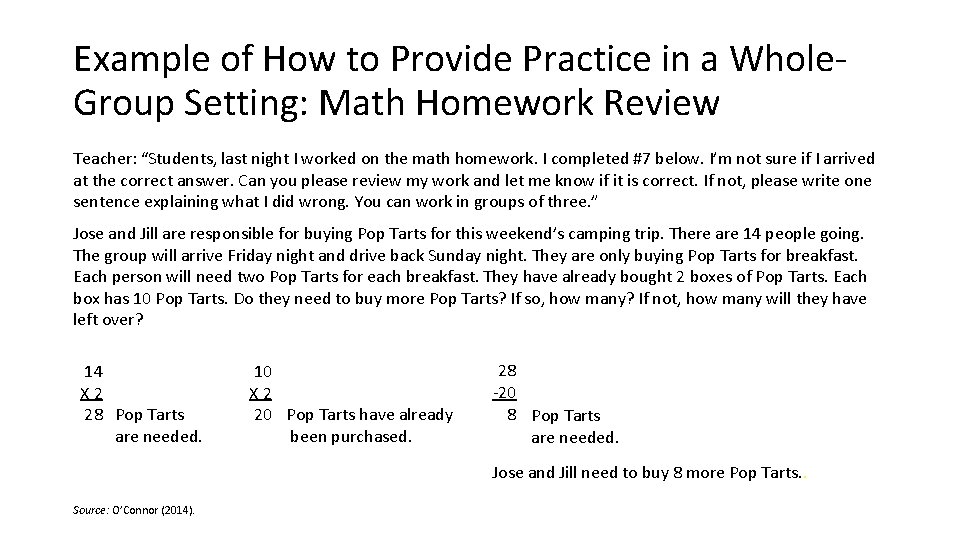
Example of How to Provide Practice in a Whole. Group Setting: Math Homework Review Teacher: “Students, last night I worked on the math homework. I completed #7 below. I’m not sure if I arrived at the correct answer. Can you please review my work and let me know if it is correct. If not, please write one sentence explaining what I did wrong. You can work in groups of three. ” Jose and Jill are responsible for buying Pop Tarts for this weekend’s camping trip. There are 14 people going. The group will arrive Friday night and drive back Sunday night. They are only buying Pop Tarts for breakfast. Each person will need two Pop Tarts for each breakfast. They have already bought 2 boxes of Pop Tarts. Each box has 10 Pop Tarts. Do they need to buy more Pop Tarts? If so, how many? If not, how many will they have left over? 14 X 2 28 Pop Tarts are needed. 10 X 2 20 Pop Tarts have already been purchased. 28 -20 8 Pop Tarts are needed. Jose and Jill need to buy 8 more Pop Tarts. . Source: O’Connor (2014).
How is this better than the teacher providing a review while students listen? How is this better than having one student come to the board to work out the problem?
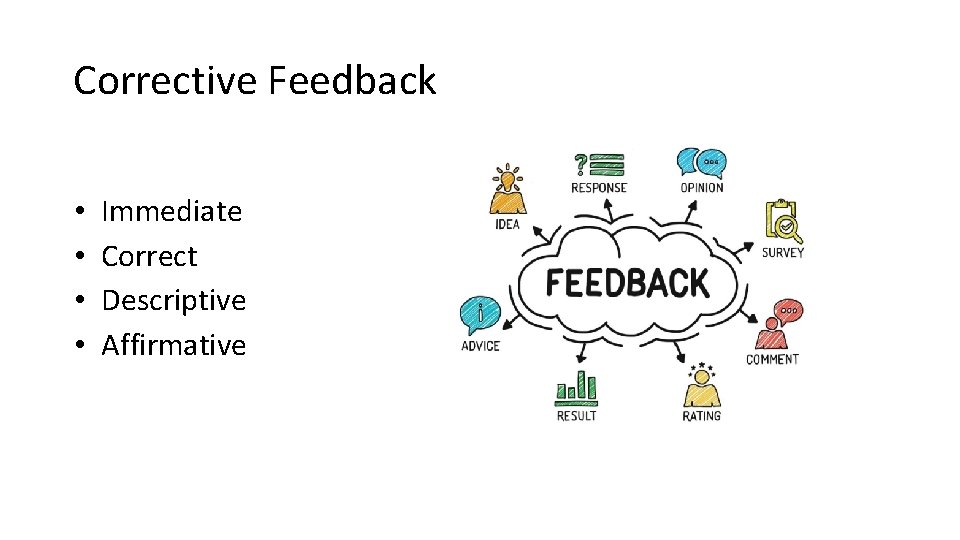
Corrective Feedback • • Immediate Correct Descriptive Affirmative
If You Were Preparing to Appear on Dancing With the Stars. . . What type of feedback would you want from your instructor?
Your Students Need the Same Thing • Feedback that is prompt • Feedback that lets them know exactly what they need to do differently • Provided in a safe environment and is encouraging
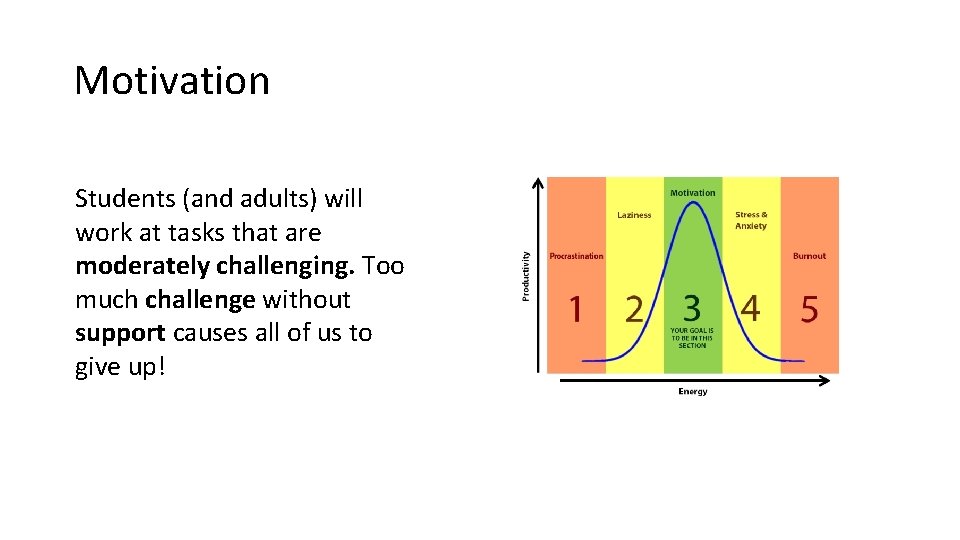
Motivation Students (and adults) will work at tasks that are moderately challenging. Too much challenge without support causes all of us to give up!
You Do… • Using the Explicit Instruction Planning Guide, review a lesson that you have planned for your classroom. • How can you change your current plans to use more explicit instruction for students in your classroom? • If you have a coteacher, how can using this planning guide in coplanning help you use more explicit instruction within your classroom?
References Fisher, D. , & Frey, N. (2008). Better learning through structured teaching. A framework for the gradual release of responsibility. Alexandria, VA: Association for Supervision and Curriculum Development. Goeke, J. L. (2008). Explicit instruction: A framework for meaningful direct teaching. Boston, MA: Pearson. Kennedy, M. J. , Peeples, K. N. , Romig, J. E. , Mathews, H. M. , Rodgers, W. J. (2018). High-leverage practice #16: Use explicit instruction. Retrieved from https: //highleveragepractices. org/701 -2/ O’Connor (2014). Spires & Stone (1989).
Authors The HLP Induction Professional Development Series was created by the following individuals: • • Wina Low, Karen Suddeth, and Karen Wyler, Georgia Department of Education Flavia Gordon-Gunter, Georgia Professional Standards Commission Lisa Hill, East Georgia Learning Resources System Jessica Simpson and Kristy Brown, Augusta University Stacy Arnold, Jefferson County Schools Michele Sherman, Columbia County Schools Meg Kamman and Amy Colpo, CEEDAR Center Melissa Driver, Da. Shaunda Patterson, Kate Zimmer, and Pam Wetherington, materials adapted from the Georgia’s High-Leverage Practices Webinar Series