
Highland Council An approach to supporting Neurodevelopmental Differences
- Slides: 15
Highland Council An approach to supporting Neurodevelopmental Differences Bernadette Cairns Principal Educational Psychologist
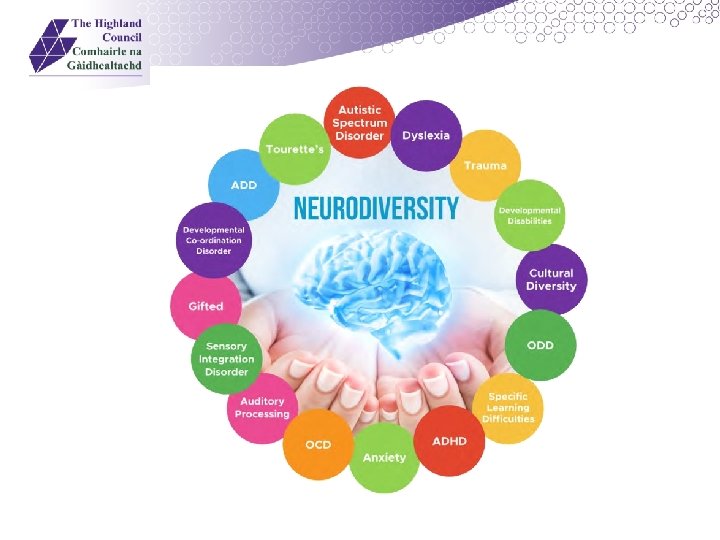
• Neurodevelopmental difficulties make up a significant number of the pupils with ASN. • Historically ASD assessments were completed by health – led by Comm Paeds and supported by SALT and CAMHS. Locality based. • EPs involved in assessment when already involved. Key role in supporting schools to provide information to the assessment team.
• 2017 -18 NHS Highland staff agreed to change to a neurodevelopmental service, led by CAMHS Manager. Central clinic in Inverness. • Seemed sensible at first, but Child Health Commissioner advised all children with ND needs should have an assessment (approx. 10% - 4646). • Referral rates for assessment increased, putting pressure on CAMHS and SALT in particular. Now waiting time is 18 mos+ • Pressure on EPs to contribute to assessment process by undertaking formal assessments to rule out LD (specifically WISC V and Vineland)
The Dilemma • How do we maintain an ethical stance in our practice (least intrusive intervention). • Need to maintain working relationship with CAMHS (and other services). • Support schools to know their pupils and to meet need • Be confident in the staged approach. • Build on what was already working • Need to provide an equitable service across the whole of Highland.
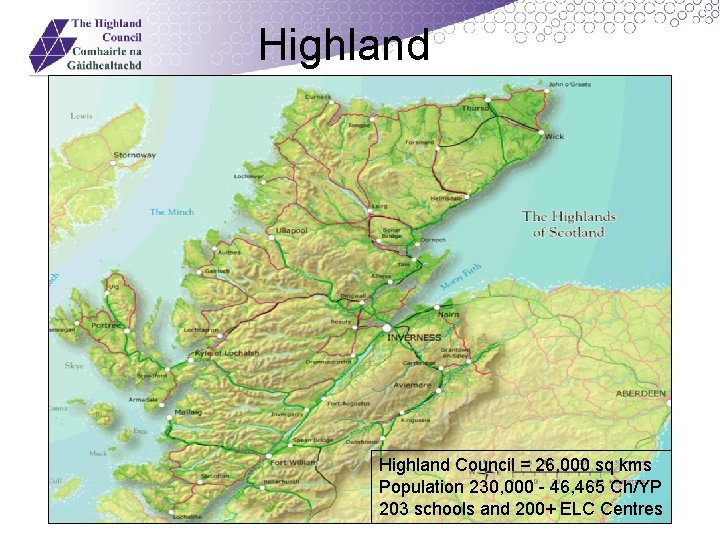
Highland Council = 26, 000 sq kms Population 230, 000 - 46, 465 Ch/YP 203 schools and 200+ ELC Centres
What was already working? • Specialist knowledge of neurodevelopmental differences in EPs and others. • Multi-agency team managed within the same HC ASN team, used to working together. • Multi-agency training team for ASD, considering creating training on ND Differences to support the ‘new’ approach. • Emerging Literacy includes a focus on executive function. • Training on ACE and LAC also raising awareness of neurodevelopmental issues.
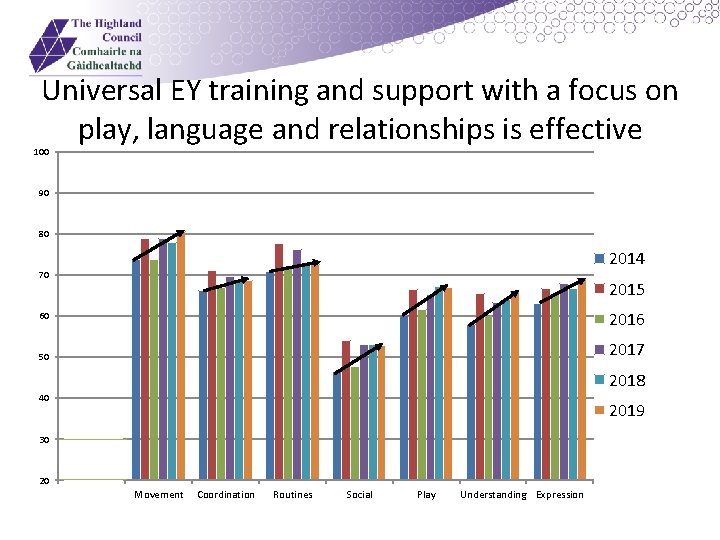
Universal EY training and support with a focus on play, language and relationships is effective 100 90 80 2014 70 2015 2016 60 2017 50 2018 40 2019 30 20 All Movement Coordination Routines Social Play Understanding Expression
Early intervention advice for parents and professionals is in place and used well https: //bumps 2 bairns. com/
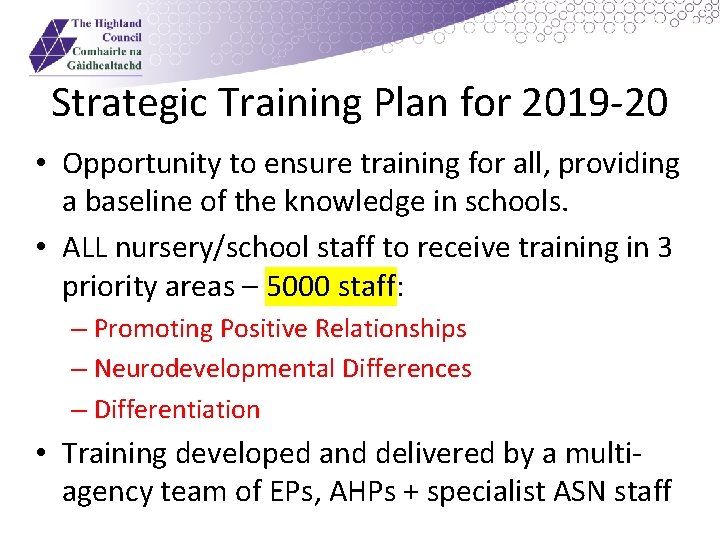
Strategic Training Plan for 2019 -20 • Opportunity to ensure training for all, providing a baseline of the knowledge in schools. • ALL nursery/school staff to receive training in 3 priority areas – 5000 staff: – Promoting Positive Relationships – Neurodevelopmental Differences – Differentiation • Training developed and delivered by a multiagency team of EPs, AHPs + specialist ASN staff
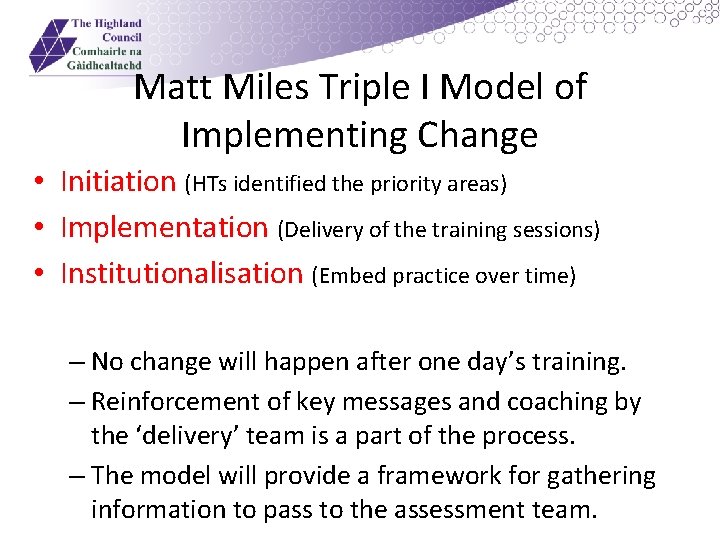
Matt Miles Triple I Model of Implementing Change • Initiation (HTs identified the priority areas) • Implementation (Delivery of the training sessions) • Institutionalisation (Embed practice over time) – No change will happen after one day’s training. – Reinforcement of key messages and coaching by the ‘delivery’ team is a part of the process. – The model will provide a framework for gathering information to pass to the assessment team.
Supporting Neuro-developmental Differences Awareness Level
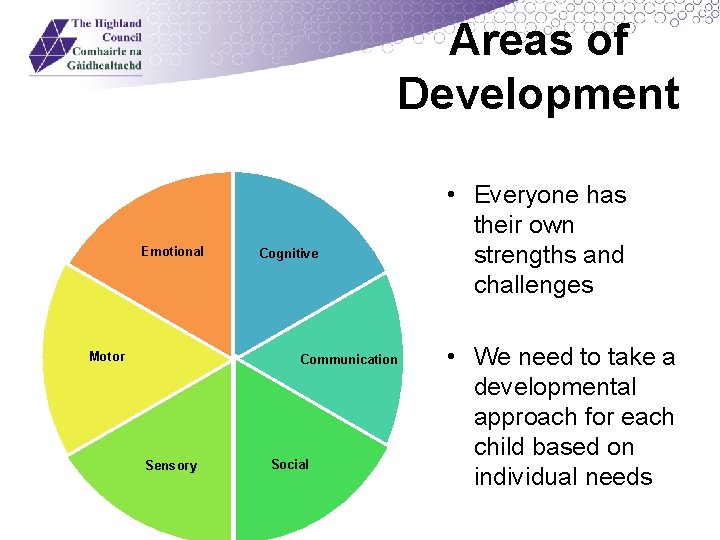
Areas of Development Emotional Motor Cognitive Communication Sensory Social • Everyone has their own strengths and challenges • We need to take a developmental approach for each child based on individual needs
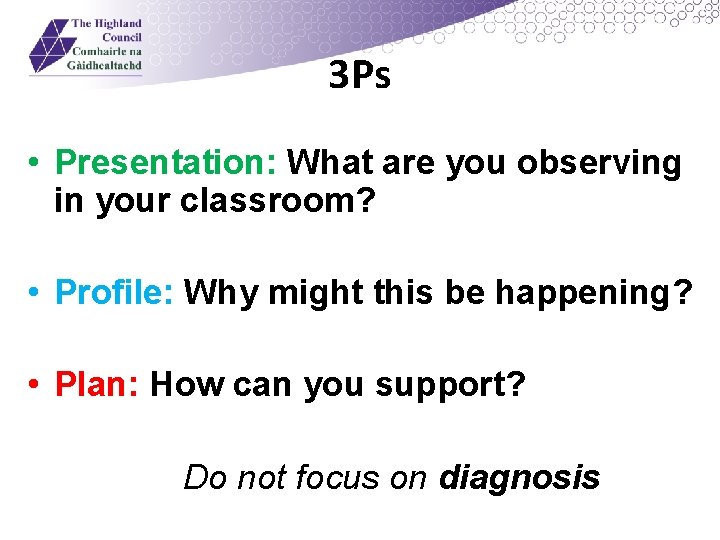
3 Ps • Presentation: What are you observing in your classroom? • Profile: Why might this be happening? • Plan: How can you support? Do not focus on diagnosis
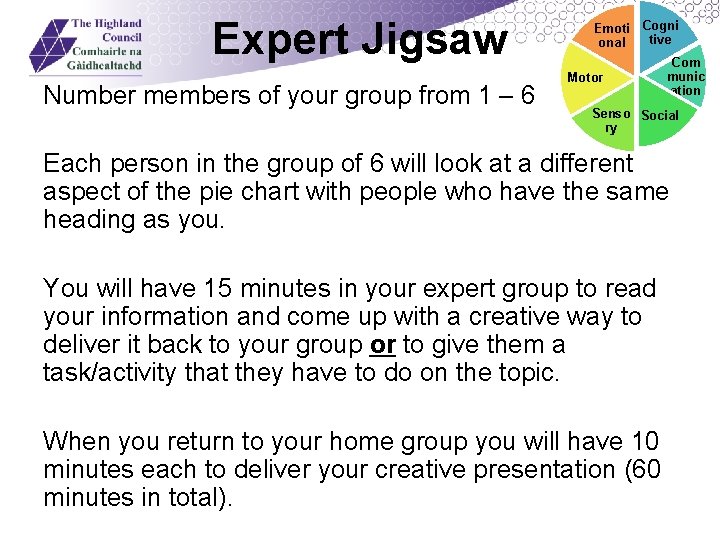
Expert Jigsaw Number members of your group from 1 – 6 Emoti Cogni tive onal Motor Com munic ation Senso Social ry Each person in the group of 6 will look at a different aspect of the pie chart with people who have the same heading as you. You will have 15 minutes in your expert group to read your information and come up with a creative way to deliver it back to your group or to give them a task/activity that they have to do on the topic. When you return to your home group you will have 10 minutes each to deliver your creative presentation (60 minutes in total).