
HigherLevel Cognitive Processes Chapter Eight Educational Psychology Developing
- Slides: 19
Higher-Level Cognitive Processes Chapter Eight Educational Psychology: Developing Learners 6 th edition Jeanne Ellis Ormrod
Cognitive Processes n The ideal classroom regularly encourages both lower-level and higher-level cognitive processes. n n Lower-level cognitive processes include using basic facts and skills. Higher-level cognitive processes are those in which people do something fairly complex with what they are learning. Jeanne Ellis Ormrod Educational Psychology: Developing Learners, sixth edition Copyright © 2008 by Pearson Education, Inc. Upper Saddle River, New Jersey 07458 All rights reserved.
Metacognition n The knowledge and beliefs about one’s own cognitive processes and one’s resulting attempts to regulate those cognitive processes to maximize learning and memory n The greater metacognitive awareness students have, the more likely they are to use effective strategies and have high achievement. Jeanne Ellis Ormrod Educational Psychology: Developing Learners, sixth edition Copyright © 2008 by Pearson Education, Inc. Upper Saddle River, New Jersey 07458 All rights reserved.
Metacognition n Metacognition includes planning, monitoring, and evaluating. n n n Jeanne Ellis Ormrod Educational Psychology: Developing Learners, sixth edition Reflecting on the nature of thinking and learning Knowing limits of one’s own skills Monitoring one’s own knowledge and comprehension to monitor whether information has been successfully learned Using effective learning strategies Planning a reasonable approach Copyright © 2008 by Pearson Education, Inc. Upper Saddle River, New Jersey 07458 All rights reserved.
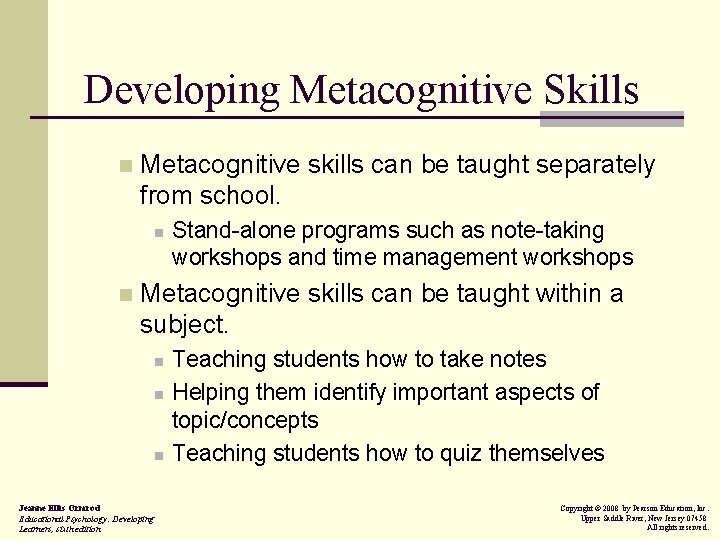
Developing Metacognitive Skills n Metacognitive skills can be taught separately from school. n n Stand-alone programs such as note-taking workshops and time management workshops Metacognitive skills can be taught within a subject. n n n Jeanne Ellis Ormrod Educational Psychology: Developing Learners, sixth edition Teaching students how to take notes Helping them identify important aspects of topic/concepts Teaching students how to quiz themselves Copyright © 2008 by Pearson Education, Inc. Upper Saddle River, New Jersey 07458 All rights reserved.
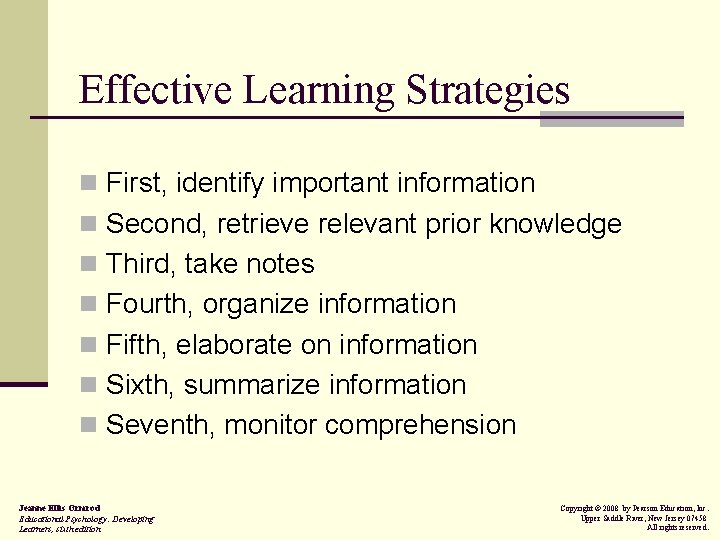
Effective Learning Strategies n First, identify important information n Second, retrieve relevant prior knowledge n Third, take notes n Fourth, organize information n Fifth, elaborate on information n Sixth, summarize information n Seventh, monitor comprehension Jeanne Ellis Ormrod Educational Psychology: Developing Learners, sixth edition Copyright © 2008 by Pearson Education, Inc. Upper Saddle River, New Jersey 07458 All rights reserved.
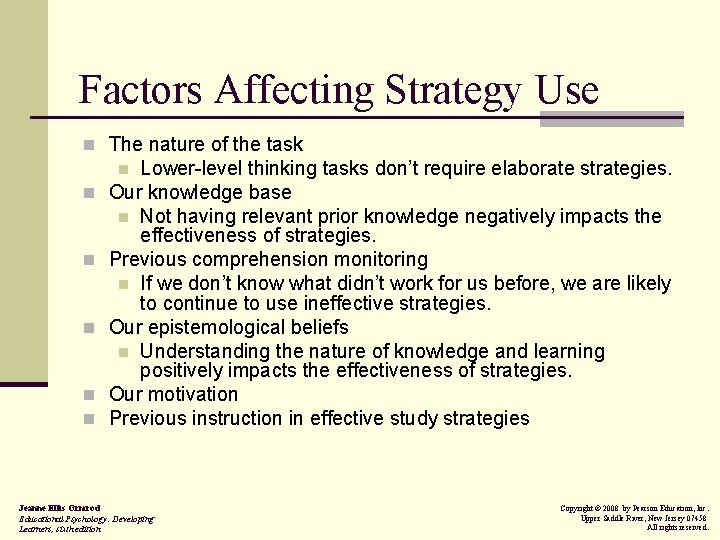
Factors Affecting Strategy Use n The nature of the task Lower-level thinking tasks don’t require elaborate strategies. Our knowledge base n Not having relevant prior knowledge negatively impacts the effectiveness of strategies. Previous comprehension monitoring n If we don’t know what didn’t work for us before, we are likely to continue to use ineffective strategies. Our epistemological beliefs n Understanding the nature of knowledge and learning positively impacts the effectiveness of strategies. Our motivation Previous instruction in effective study strategies n n n Jeanne Ellis Ormrod Educational Psychology: Developing Learners, sixth edition Copyright © 2008 by Pearson Education, Inc. Upper Saddle River, New Jersey 07458 All rights reserved.
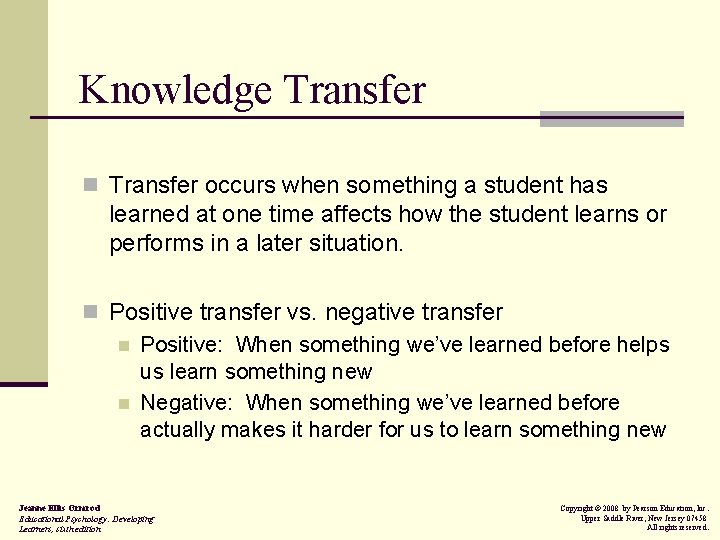
Knowledge Transfer n Transfer occurs when something a student has learned at one time affects how the student learns or performs in a later situation. n Positive transfer vs. negative transfer n Positive: When something we’ve learned before helps us learn something new n Negative: When something we’ve learned before actually makes it harder for us to learn something new Jeanne Ellis Ormrod Educational Psychology: Developing Learners, sixth edition Copyright © 2008 by Pearson Education, Inc. Upper Saddle River, New Jersey 07458 All rights reserved.
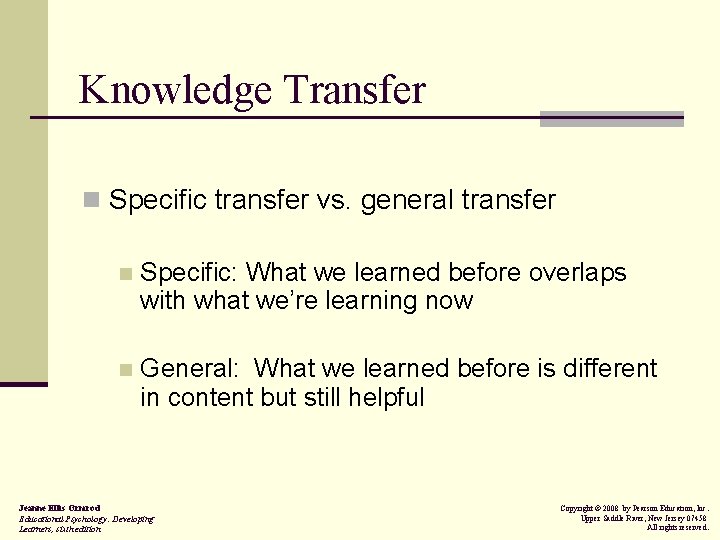
Knowledge Transfer n Specific transfer vs. general transfer n Specific: What we learned before overlaps with what we’re learning now n General: What we learned before is different in content but still helpful Jeanne Ellis Ormrod Educational Psychology: Developing Learners, sixth edition Copyright © 2008 by Pearson Education, Inc. Upper Saddle River, New Jersey 07458 All rights reserved.
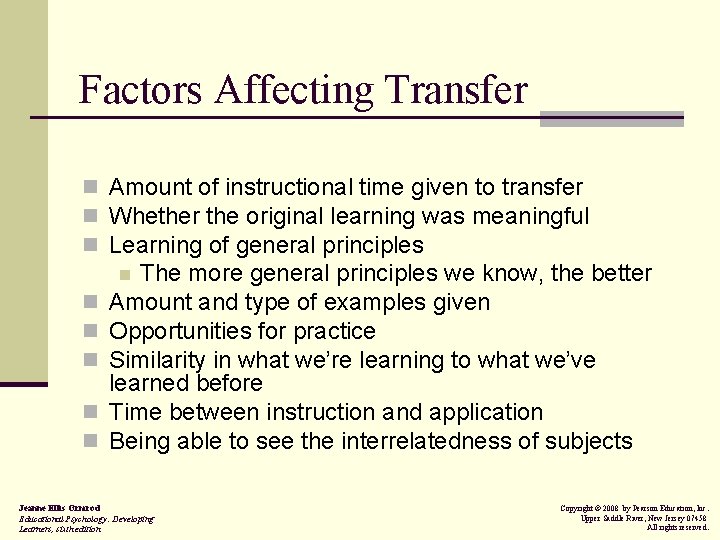
Factors Affecting Transfer n Amount of instructional time given to transfer n Whether the original learning was meaningful n Learning of general principles The more general principles we know, the better Amount and type of examples given Opportunities for practice Similarity in what we’re learning to what we’ve learned before Time between instruction and application Being able to see the interrelatedness of subjects n n n Jeanne Ellis Ormrod Educational Psychology: Developing Learners, sixth edition Copyright © 2008 by Pearson Education, Inc. Upper Saddle River, New Jersey 07458 All rights reserved.
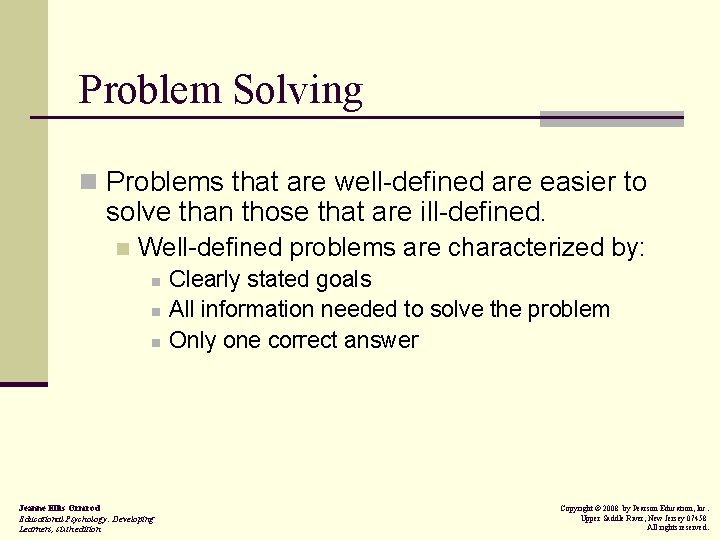
Problem Solving n Problems that are well-defined are easier to solve than those that are ill-defined. n Well-defined problems are characterized by: n n n Jeanne Ellis Ormrod Educational Psychology: Developing Learners, sixth edition Clearly stated goals All information needed to solve the problem Only one correct answer Copyright © 2008 by Pearson Education, Inc. Upper Saddle River, New Jersey 07458 All rights reserved.
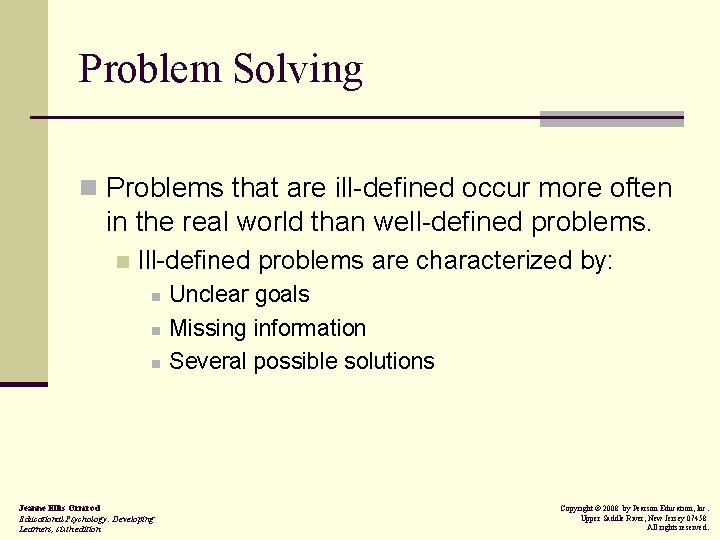
Problem Solving n Problems that are ill-defined occur more often in the real world than well-defined problems. n Ill-defined problems are characterized by: n n n Jeanne Ellis Ormrod Educational Psychology: Developing Learners, sixth edition Unclear goals Missing information Several possible solutions Copyright © 2008 by Pearson Education, Inc. Upper Saddle River, New Jersey 07458 All rights reserved.
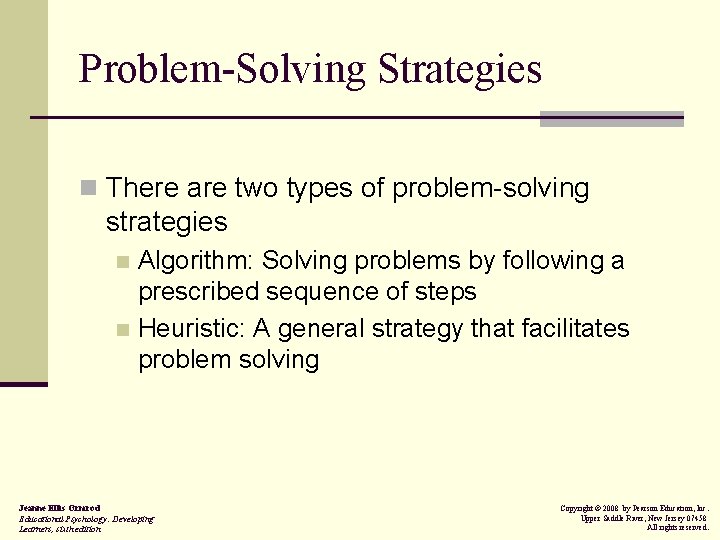
Problem-Solving Strategies n There are two types of problem-solving strategies Algorithm: Solving problems by following a prescribed sequence of steps n Heuristic: A general strategy that facilitates problem solving n Jeanne Ellis Ormrod Educational Psychology: Developing Learners, sixth edition Copyright © 2008 by Pearson Education, Inc. Upper Saddle River, New Jersey 07458 All rights reserved.
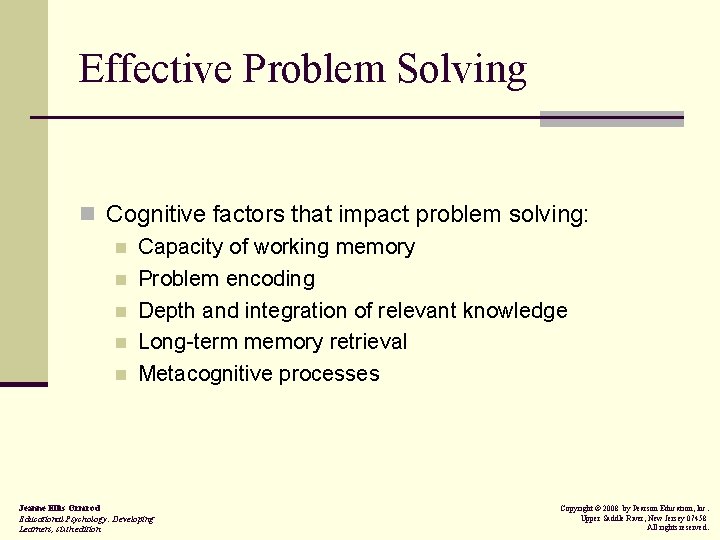
Effective Problem Solving n Cognitive factors that impact problem solving: n Capacity of working memory n Problem encoding n Depth and integration of relevant knowledge n Long-term memory retrieval n Metacognitive processes Jeanne Ellis Ormrod Educational Psychology: Developing Learners, sixth edition Copyright © 2008 by Pearson Education, Inc. Upper Saddle River, New Jersey 07458 All rights reserved.
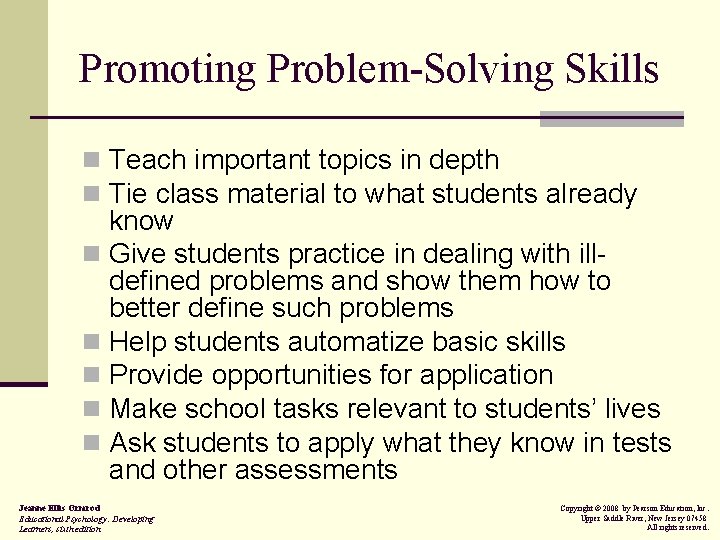
Promoting Problem-Solving Skills n Teach important topics in depth n Tie class material to what students already know n Give students practice in dealing with illdefined problems and show them how to better define such problems n Help students automatize basic skills n Provide opportunities for application n Make school tasks relevant to students’ lives n Ask students to apply what they know in tests and other assessments Jeanne Ellis Ormrod Educational Psychology: Developing Learners, sixth edition Copyright © 2008 by Pearson Education, Inc. Upper Saddle River, New Jersey 07458 All rights reserved.
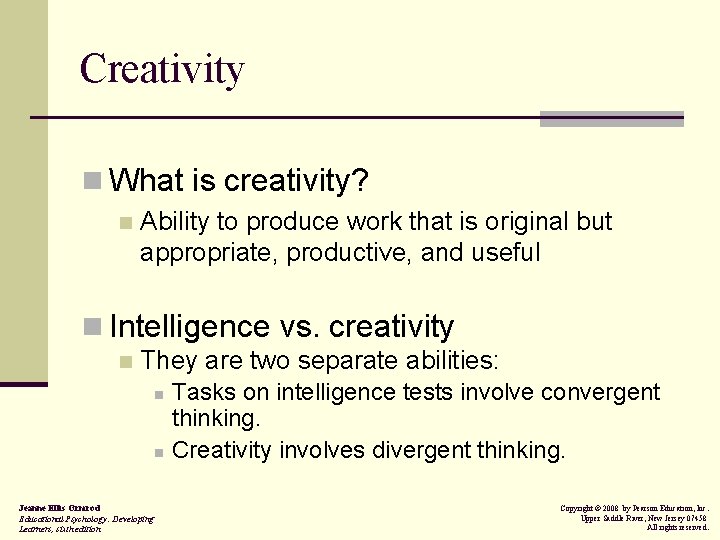
Creativity n What is creativity? n Ability to produce work that is original but appropriate, productive, and useful n Intelligence vs. creativity n They are two separate abilities: n n Jeanne Ellis Ormrod Educational Psychology: Developing Learners, sixth edition Tasks on intelligence tests involve convergent thinking. Creativity involves divergent thinking. Copyright © 2008 by Pearson Education, Inc. Upper Saddle River, New Jersey 07458 All rights reserved.
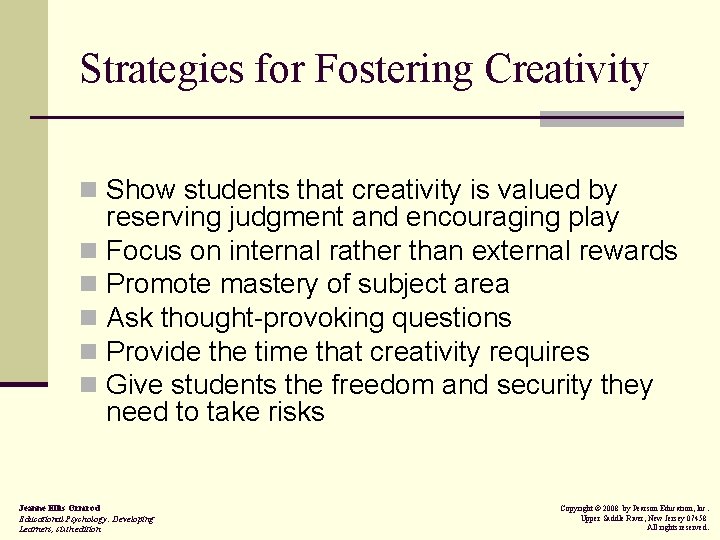
Strategies for Fostering Creativity n Show students that creativity is valued by reserving judgment and encouraging play n Focus on internal rather than external rewards n Promote mastery of subject area n Ask thought-provoking questions n Provide the time that creativity requires n Give students the freedom and security they need to take risks Jeanne Ellis Ormrod Educational Psychology: Developing Learners, sixth edition Copyright © 2008 by Pearson Education, Inc. Upper Saddle River, New Jersey 07458 All rights reserved.
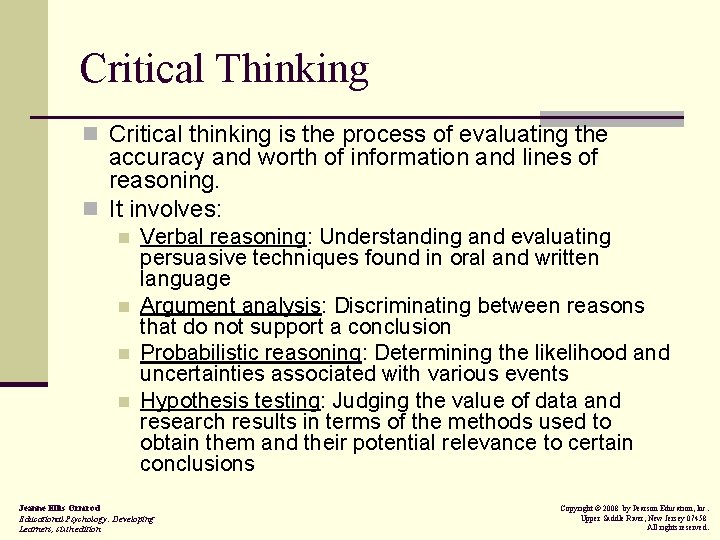
Critical Thinking n Critical thinking is the process of evaluating the accuracy and worth of information and lines of reasoning. n It involves: n n Verbal reasoning: Understanding and evaluating persuasive techniques found in oral and written language Argument analysis: Discriminating between reasons that do not support a conclusion Probabilistic reasoning: Determining the likelihood and uncertainties associated with various events Hypothesis testing: Judging the value of data and research results in terms of the methods used to obtain them and their potential relevance to certain conclusions Jeanne Ellis Ormrod Educational Psychology: Developing Learners, sixth edition Copyright © 2008 by Pearson Education, Inc. Upper Saddle River, New Jersey 07458 All rights reserved.
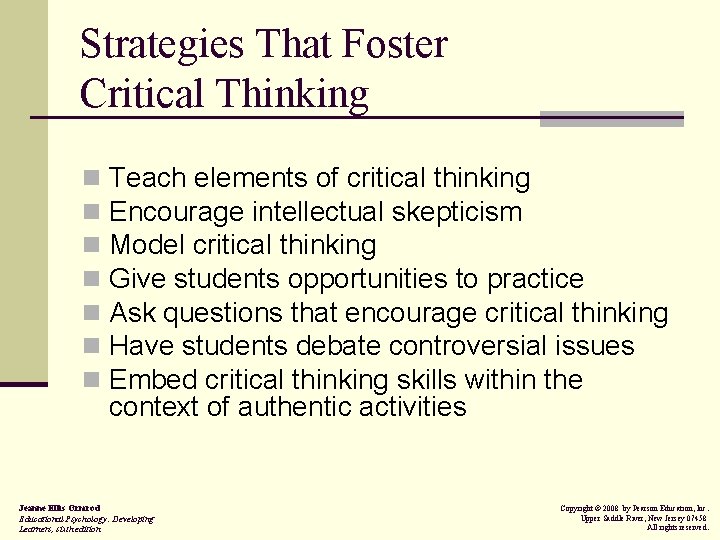
Strategies That Foster Critical Thinking n n n n Teach elements of critical thinking Encourage intellectual skepticism Model critical thinking Give students opportunities to practice Ask questions that encourage critical thinking Have students debate controversial issues Embed critical thinking skills within the context of authentic activities Jeanne Ellis Ormrod Educational Psychology: Developing Learners, sixth edition Copyright © 2008 by Pearson Education, Inc. Upper Saddle River, New Jersey 07458 All rights reserved.