
Higher Physics Conservation of Momentum and Kinetic Energy


- Slides: 23
Higher Physics
Conservation of Momentum and Kinetic Energy
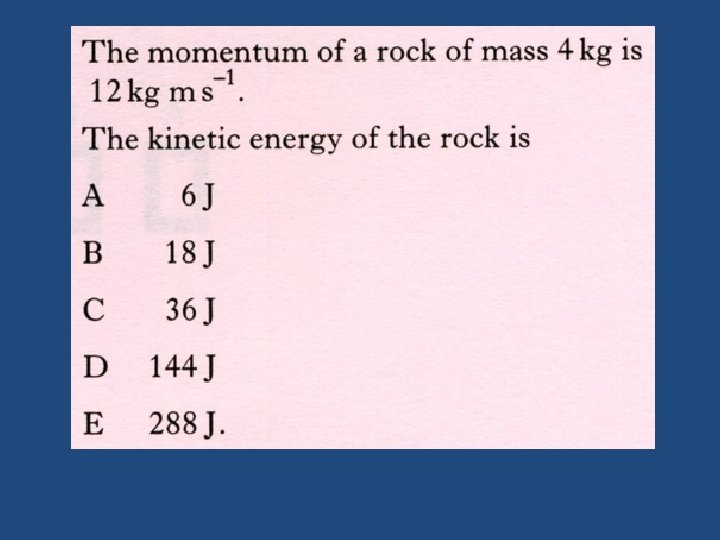
Momentum is a vector quantity and is the product of mass and velocity. Momentum = mass x velocity kg ms-1 The units of momentum are kgms-1. Momentum is sometimes given the symbol p. p = mv The direction of the momentum is the same as the velocity.
Solving Problems 1. Always make a sketch of the system before and after the collision or explosion. 2. Mark all masses and velocities (with direction!!) on the sketch. 3. You will need to allocate a positive direction for vector quantities – mark this also on the sketch. 4. Use the rule: total momentum before = total momentum after
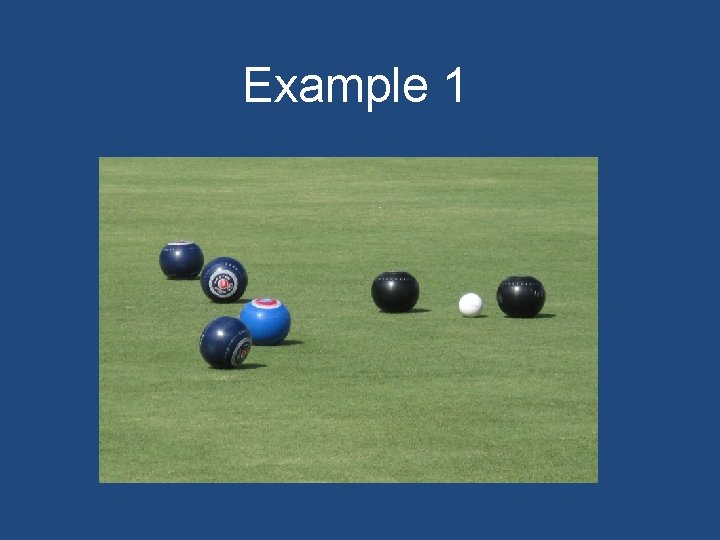
Example 1
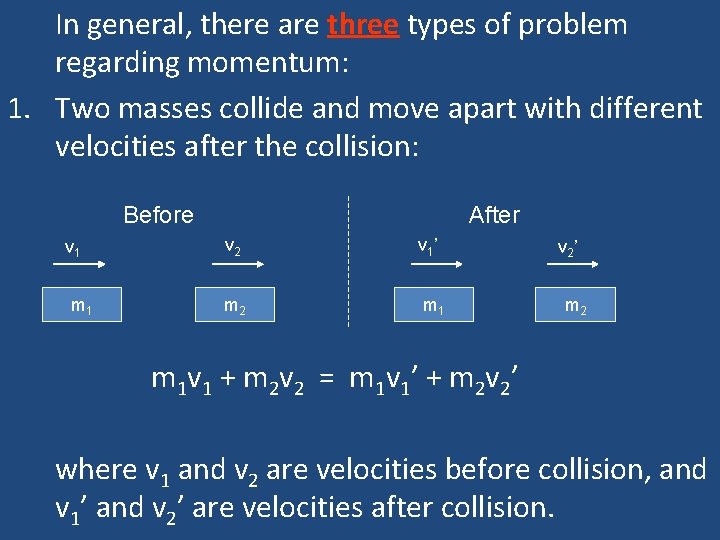
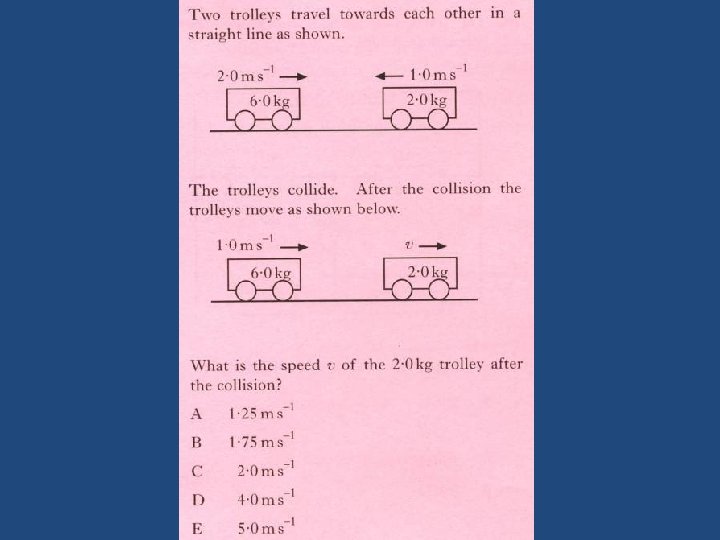
In general, there are three types of problem regarding momentum: 1. Two masses collide and move apart with different velocities after the collision: Before v 1 m 1 After v 2 v 1’ m 2 m 1 v 2’ m 2 m 1 v 1 + m 2 v 2 = m 1 v 1’ + m 2 v 2’ where v 1 and v 2 are velocities before collision, and v 1’ and v 2’ are velocities after collision.
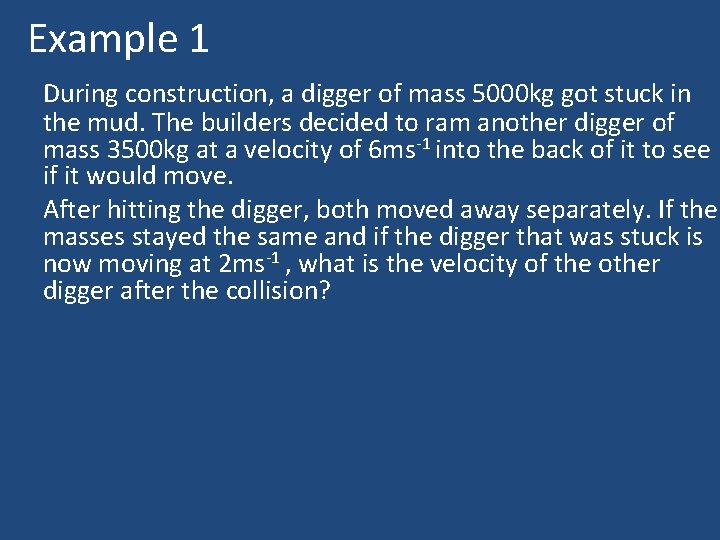
Example 1 During construction, a digger of mass 5000 kg got stuck in the mud. The builders decided to ram another digger of mass 3500 kg at a velocity of 6 ms-1 into the back of it to see if it would move. After hitting the digger, both moved away separately. If the masses stayed the same and if the digger that was stuck is now moving at 2 ms-1 , what is the velocity of the other digger after the collision?
Example 2
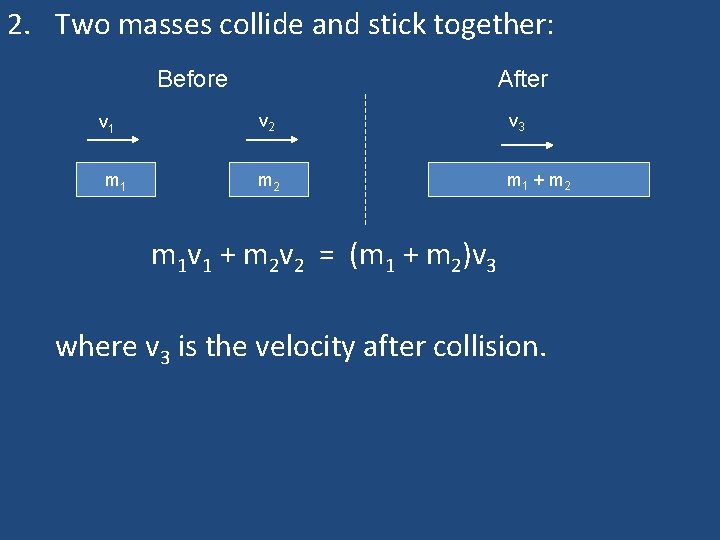
2. Two masses collide and stick together: Before v 1 m 1 After v 2 v 3 m 2 m 1 + m 2 m 1 v 1 + m 2 v 2 = (m 1 + m 2)v 3 where v 3 is the velocity after collision.
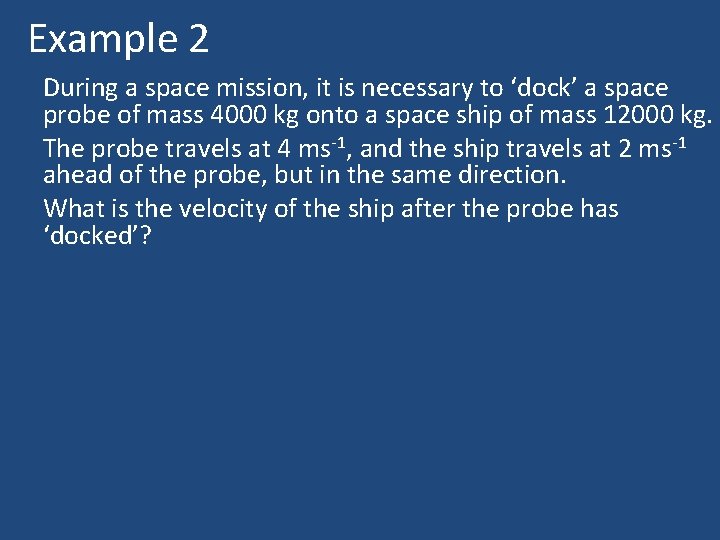
Example 2 During a space mission, it is necessary to ‘dock’ a space probe of mass 4000 kg onto a space ship of mass 12000 kg. The probe travels at 4 ms-1, and the ship travels at 2 ms-1 ahead of the probe, but in the same direction. What is the velocity of the ship after the probe has ‘docked’?
Example 3
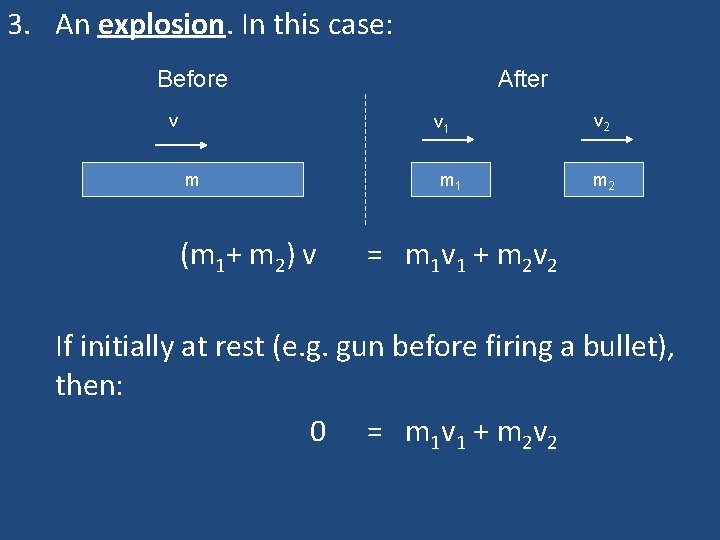
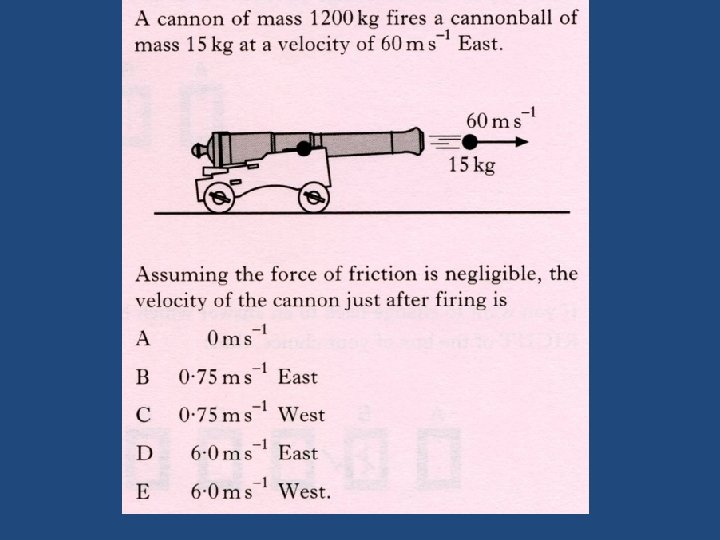
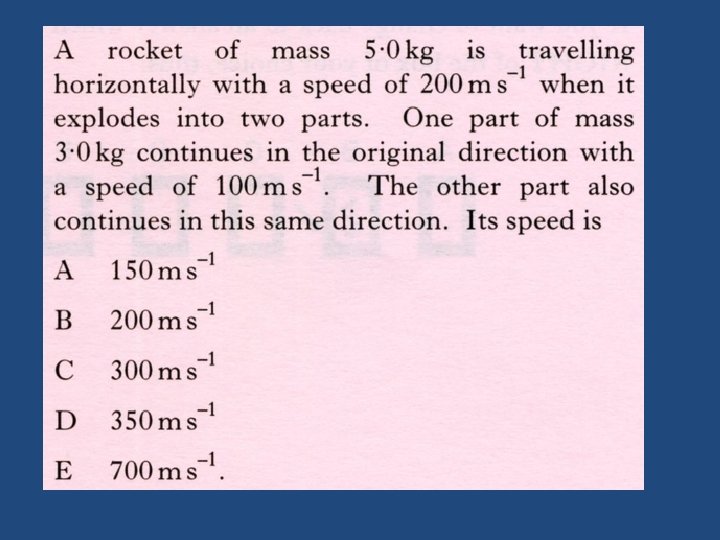
3. An explosion. In this case: Before v After v 1 m (m 1+ m 2) v m 1 v 2 m 2 = m 1 v 1 + m 2 v 2 If initially at rest (e. g. gun before firing a bullet), then: 0 = m 1 v 1 + m 2 v 2
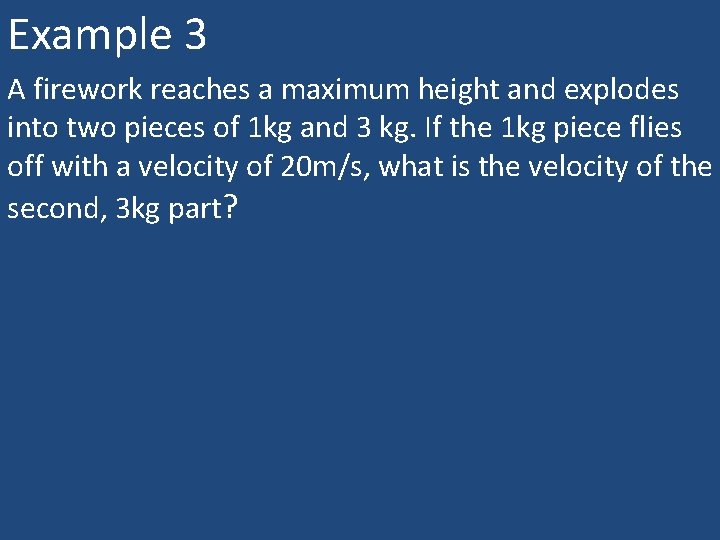
Example 3 A firework reaches a maximum height and explodes into two pieces of 1 kg and 3 kg. If the 1 kg piece flies off with a velocity of 20 m/s, what is the velocity of the second, 3 kg part?
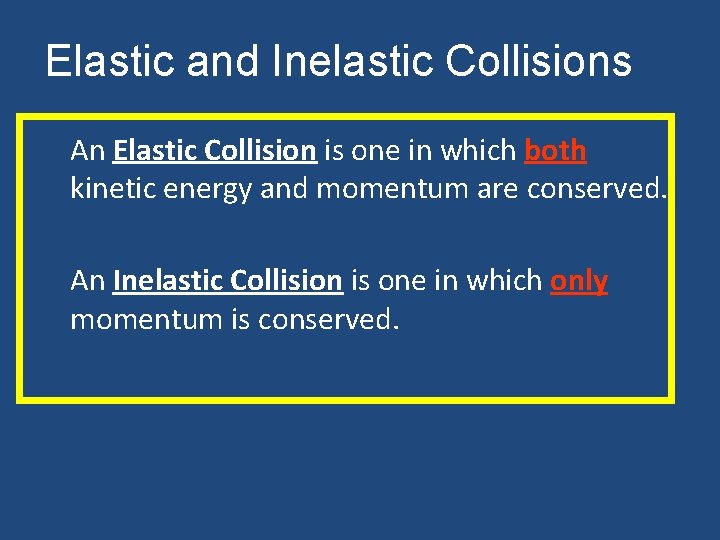
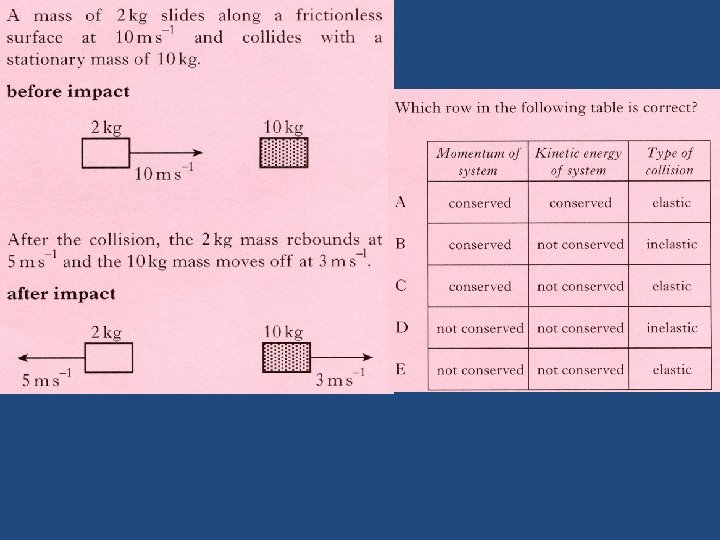
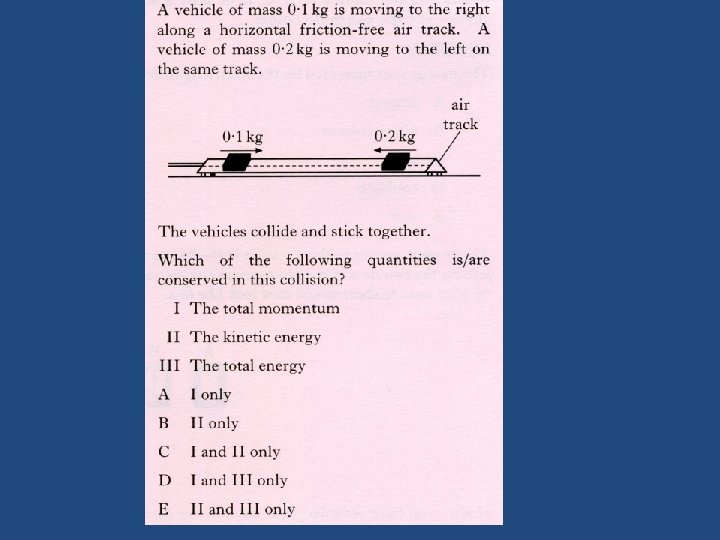
Elastic and Inelastic Collisions An Elastic Collision is one in which both kinetic energy and momentum are conserved. An Inelastic Collision is one in which only momentum is conserved.
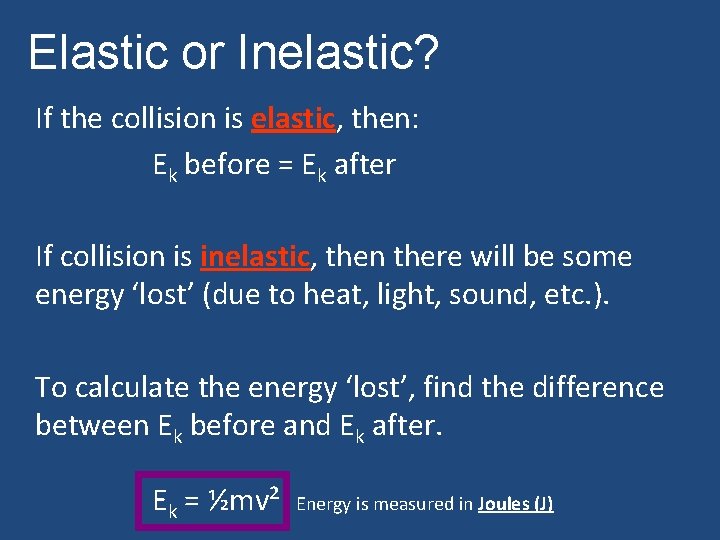
Elastic or Inelastic? If the collision is elastic, then: Ek before = Ek after If collision is inelastic, then there will be some energy ‘lost’ (due to heat, light, sound, etc. ). To calculate the energy ‘lost’, find the difference between Ek before and Ek after. Ek = ½mv² Energy is measured in Joules (J)
Elastic and Inelastic does not relate to whether the trolley sticks together or not.
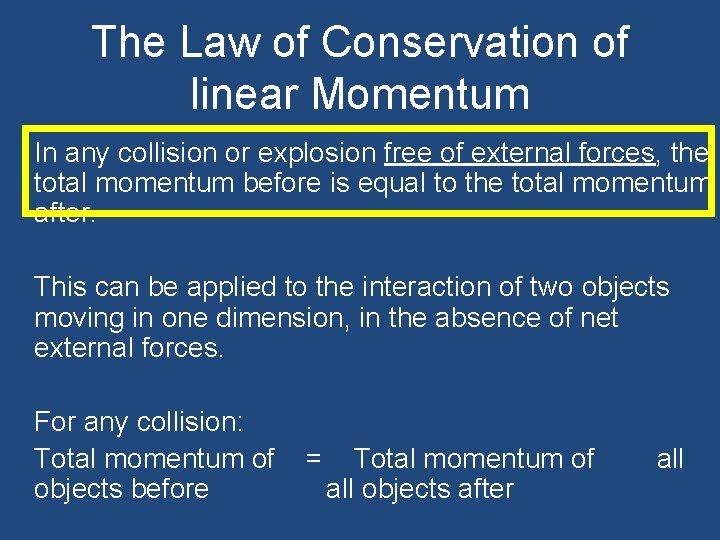
The Law of Conservation of linear Momentum In any collision or explosion free of external forces, the total momentum before is equal to the total momentum after. This can be applied to the interaction of two objects moving in one dimension, in the absence of net external forces. For any collision: Total momentum of objects before = Total momentum of all objects after all