
Higher Order Derivatives 1 8 OBJECTIVE Find derivatives
Higher Order Derivatives 1. 8 OBJECTIVE • Find derivatives of higher order. • Given a formula for distance, find velocity and acceleration. Copyright © 2016, 2012 Pearson Education, Inc. 1. 8 - 1
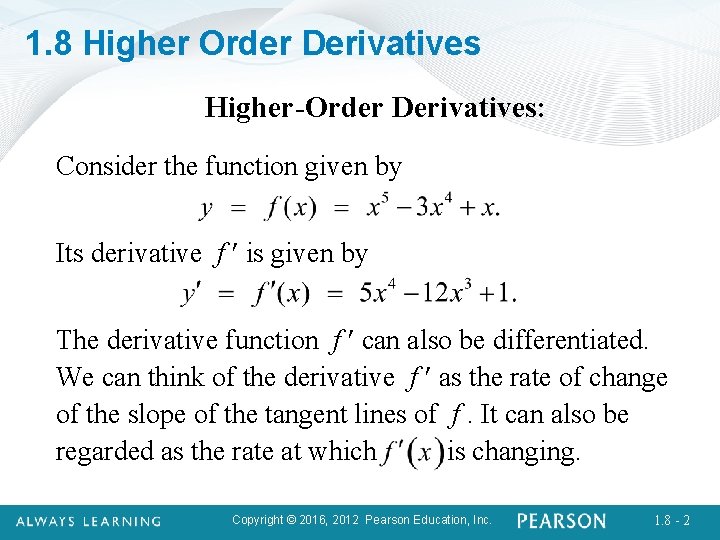
1. 8 Higher Order Derivatives Higher-Order Derivatives: Consider the function given by Its derivative f is given by The derivative function f can also be differentiated. We can think of the derivative f as the rate of change of the slope of the tangent lines of f. It can also be regarded as the rate at which is changing. Copyright © 2016, 2012 Pearson Education, Inc. 1. 8 - 2
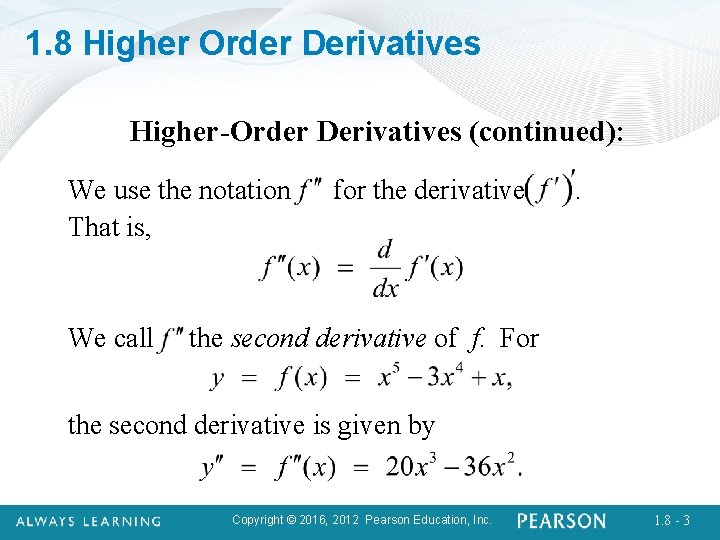
1. 8 Higher Order Derivatives Higher-Order Derivatives (continued): We use the notation for the derivative That is, . We call the second derivative of f. For the second derivative is given by Copyright © 2016, 2012 Pearson Education, Inc. 1. 8 - 3
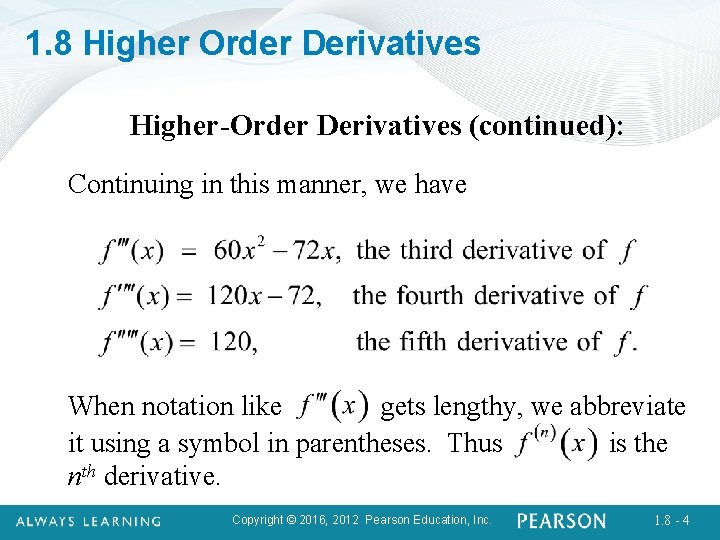
1. 8 Higher Order Derivatives Higher-Order Derivatives (continued): Continuing in this manner, we have When notation like gets lengthy, we abbreviate it using a symbol in parentheses. Thus is the nth derivative. Copyright © 2016, 2012 Pearson Education, Inc. 1. 8 - 4
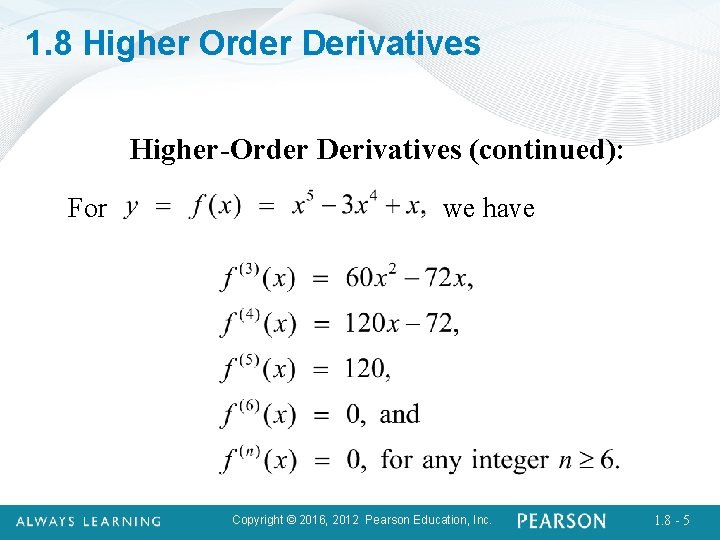
1. 8 Higher Order Derivatives Higher-Order Derivatives (continued): For we have Copyright © 2016, 2012 Pearson Education, Inc. 1. 8 - 5
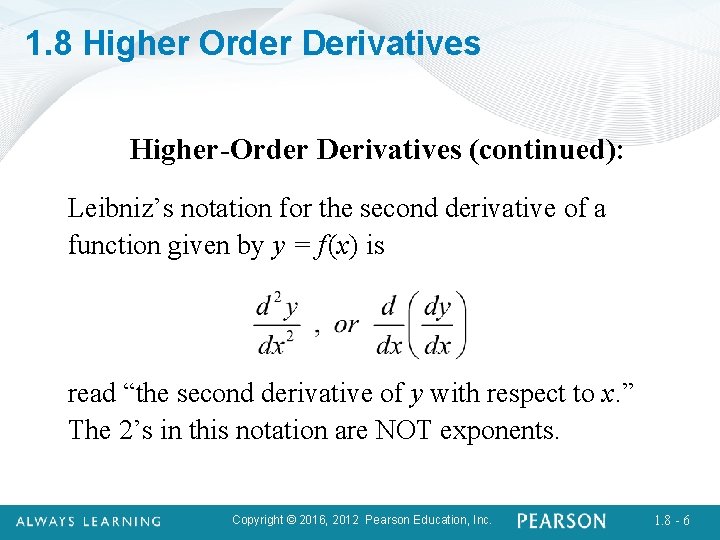
1. 8 Higher Order Derivatives Higher-Order Derivatives (continued): Leibniz’s notation for the second derivative of a function given by y = f (x) is read “the second derivative of y with respect to x. ” The 2’s in this notation are NOT exponents. Copyright © 2016, 2012 Pearson Education, Inc. 1. 8 - 6
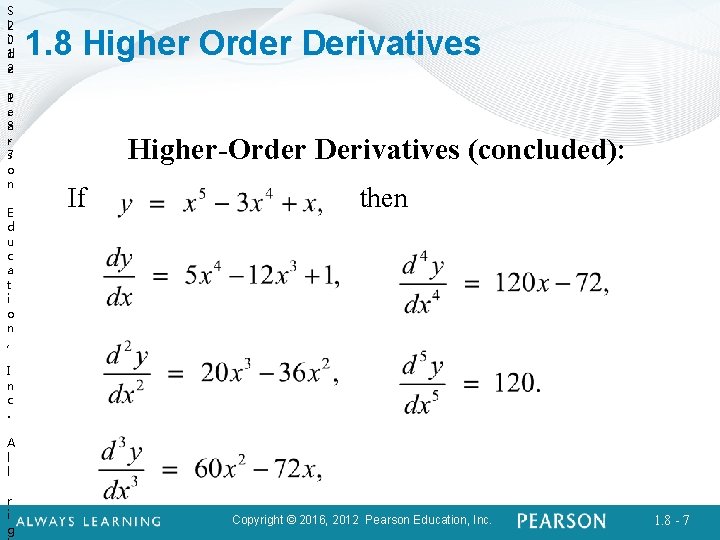
S l 2 i 0 1 d 2 e 1 P. e a 8 -r s 7 o n E d u c a t i o n , 1. 8 Higher Order Derivatives Higher-Order Derivatives (concluded): If then I n c. A l l r i g Copyright © 2016, 2012 Pearson Education, Inc. 1. 8 - 7

1. 8 Higher Order Derivatives Example 1: For find Copyright © 2016, 2012 Pearson Education, Inc. 1. 8 - 8
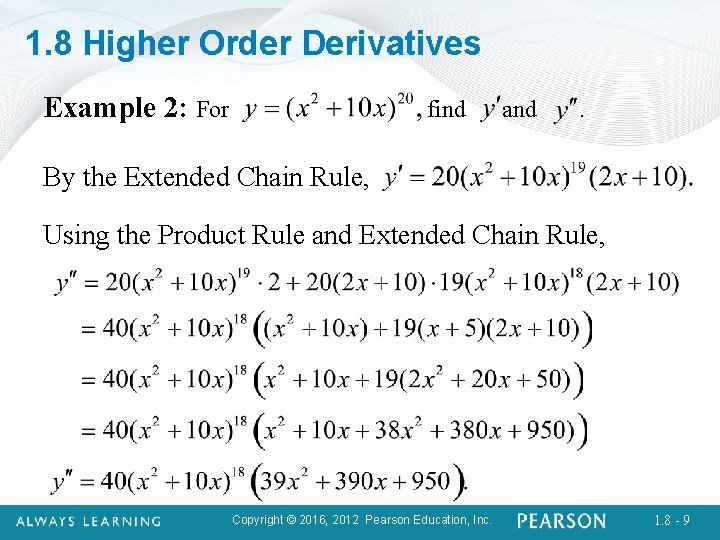
1. 8 Higher Order Derivatives Example 2: For find and . By the Extended Chain Rule, Using the Product Rule and Extended Chain Rule, Copyright © 2016, 2012 Pearson Education, Inc. 1. 8 - 9
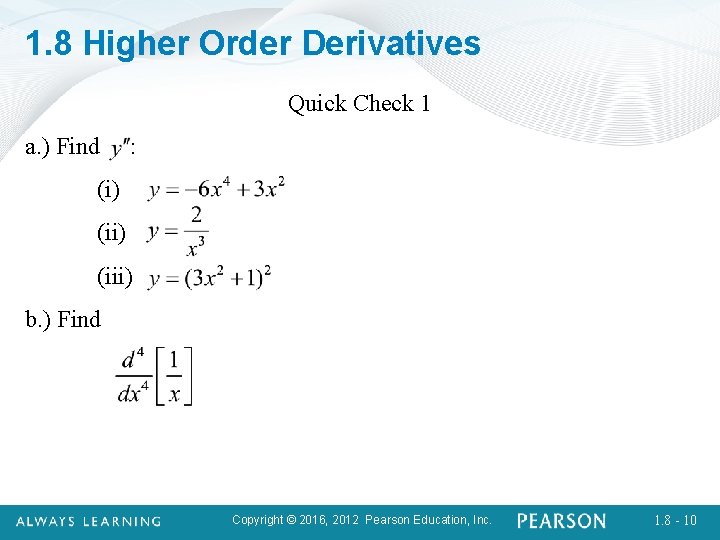
1. 8 Higher Order Derivatives Quick Check 1 a. ) Find : (i) (iii) b. ) Find Copyright © 2016, 2012 Pearson Education, Inc. 1. 8 - 10
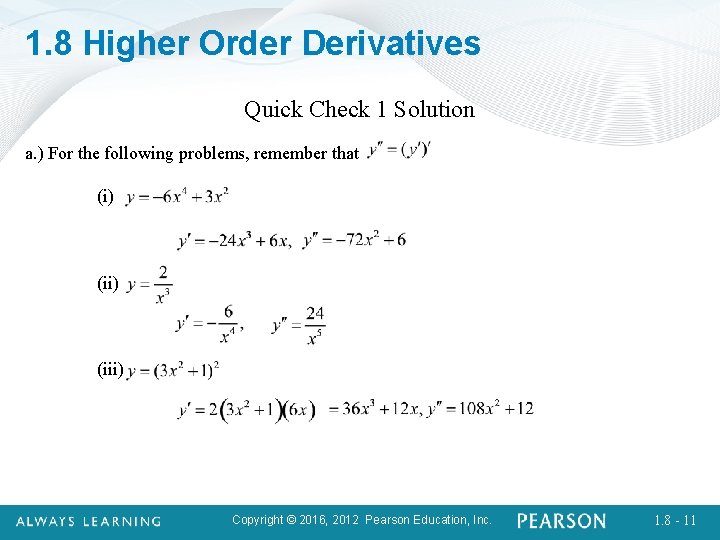
1. 8 Higher Order Derivatives Quick Check 1 Solution a. ) For the following problems, remember that (i) (iii) Copyright © 2016, 2012 Pearson Education, Inc. 1. 8 - 11
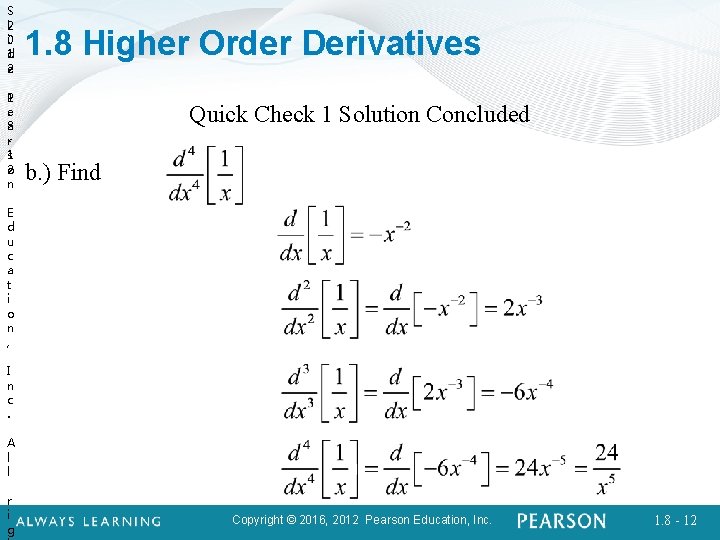
S l 2 i 0 1 d 2 e 1 P. e a 8 -r s 1 o 2 n 1. 8 Higher Order Derivatives Quick Check 1 Solution Concluded b. ) Find E d u c a t i o n , I n c. A l l r i g Copyright © 2016, 2012 Pearson Education, Inc. 1. 8 - 12
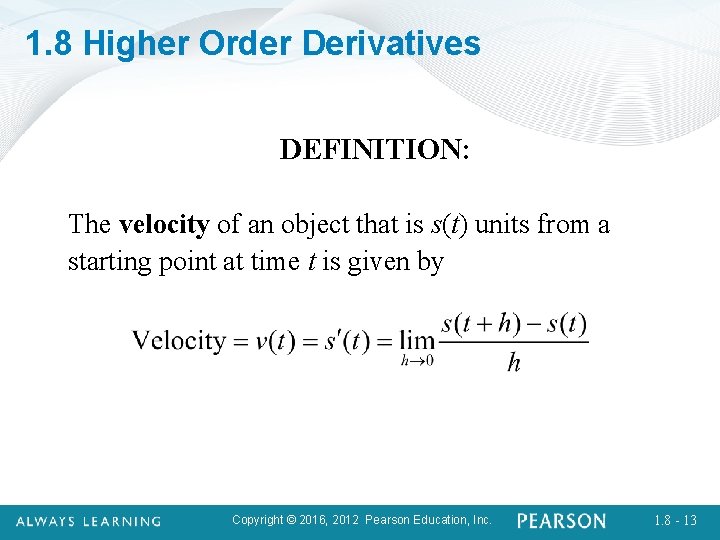
1. 8 Higher Order Derivatives DEFINITION: The velocity of an object that is s(t) units from a starting point at time t is given by Copyright © 2016, 2012 Pearson Education, Inc. 1. 8 - 13
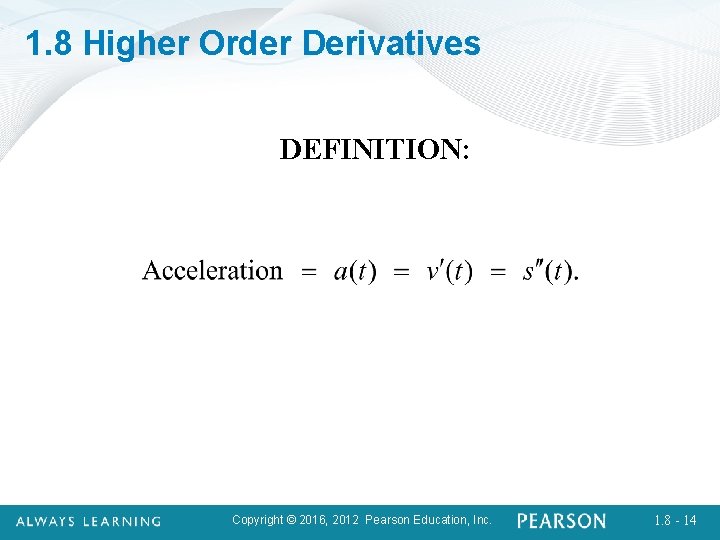
1. 8 Higher Order Derivatives DEFINITION: Copyright © 2016, 2012 Pearson Education, Inc. 1. 8 - 14
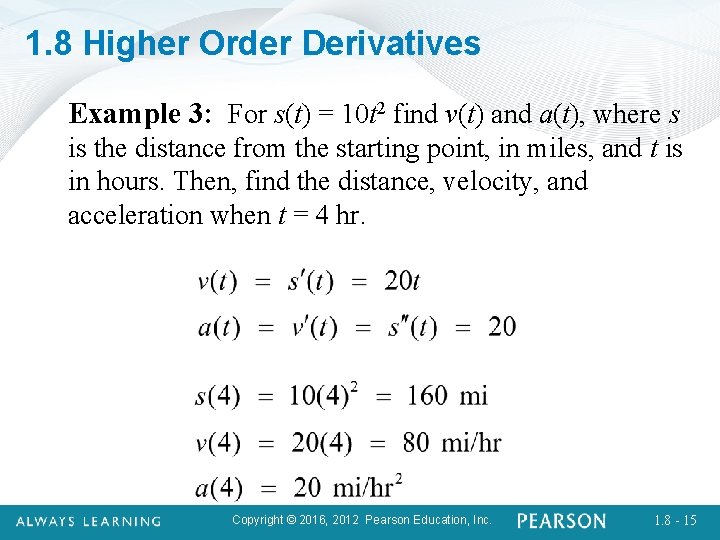
1. 8 Higher Order Derivatives Example 3: For s(t) = 10 t 2 find v(t) and a(t), where s is the distance from the starting point, in miles, and t is in hours. Then, find the distance, velocity, and acceleration when t = 4 hr. Copyright © 2016, 2012 Pearson Education, Inc. 1. 8 - 15
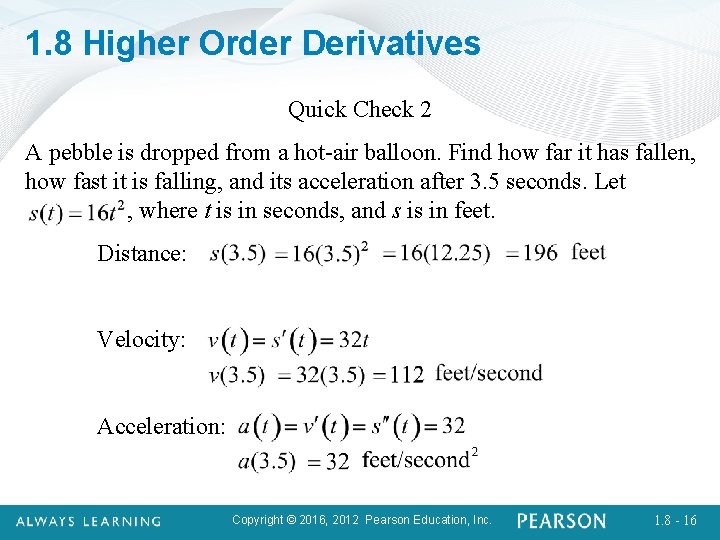
1. 8 Higher Order Derivatives Quick Check 2 A pebble is dropped from a hot-air balloon. Find how far it has fallen, how fast it is falling, and its acceleration after 3. 5 seconds. Let , where t is in seconds, and s is in feet. Distance: Velocity: Acceleration: Copyright © 2016, 2012 Pearson Education, Inc. 1. 8 - 16
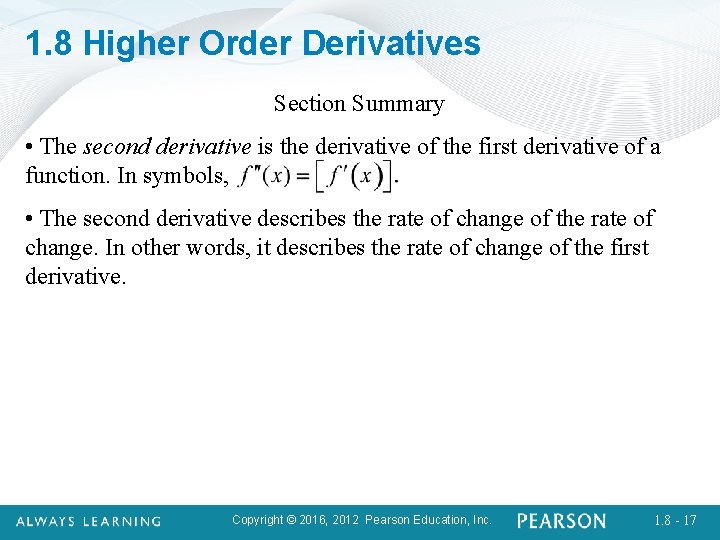
1. 8 Higher Order Derivatives Section Summary • The second derivative is the derivative of the first derivative of a function. In symbols, • The second derivative describes the rate of change of the rate of change. In other words, it describes the rate of change of the first derivative. Copyright © 2016, 2012 Pearson Education, Inc. 1. 8 - 17

1. 8 Higher Order Derivatives Section Summary Concluded • A real-life example of a second derivative is acceleration. If represents distance as a function of time of a moving object, then describes the speed (velocity) of the object. Any change in the speed of the object is acceleration: • The common notation for the nth derivative of a function is or Copyright © 2016, 2012 Pearson Education, Inc. 1. 8 - 18
- Slides: 18