
Higher Intermediate 1 4 Fluent 1 4 Project
- Slides: 28
Higher Intermediate 1 -4 & Fluent 1 -4 Project leader: Rachele Hilverding Team members: Neeyam Bhagee Matis baumy Nadine Daumoo
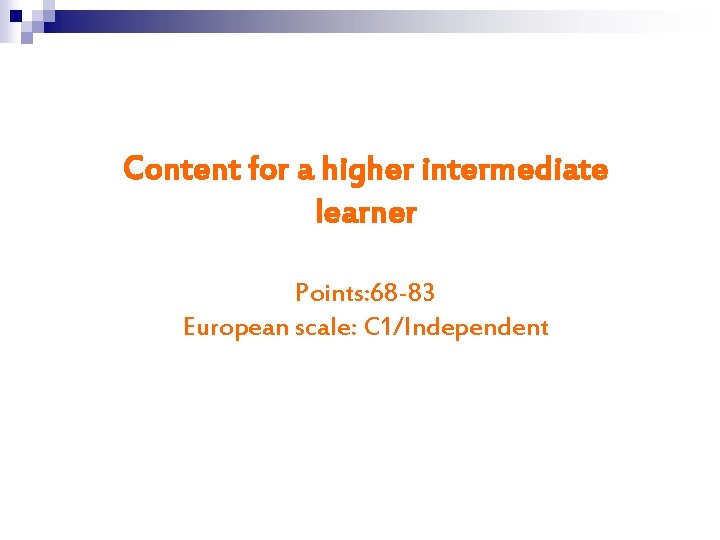
Content for a higher intermediate learner Points: 68 -83 European scale: C 1/Independent
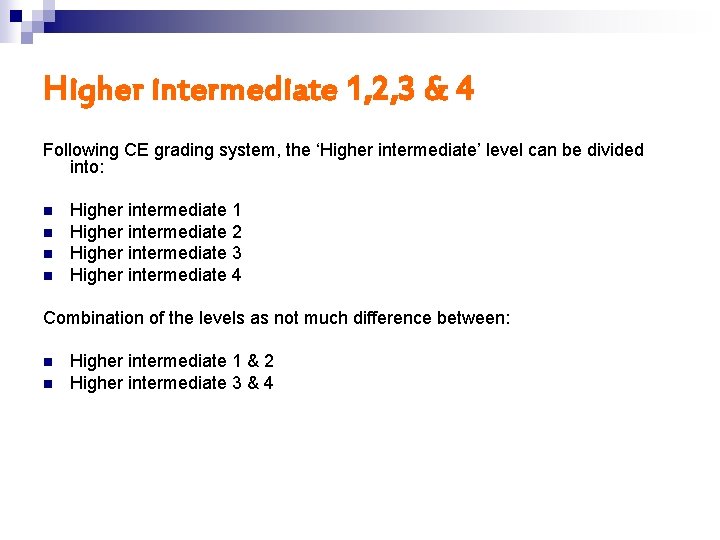
Higher intermediate 1, 2, 3 & 4 Following CE grading system, the ‘Higher intermediate’ level can be divided into: n n Higher intermediate 1 Higher intermediate 2 Higher intermediate 3 Higher intermediate 4 Combination of the levels as not much difference between: n n Higher intermediate 1 & 2 Higher intermediate 3 & 4
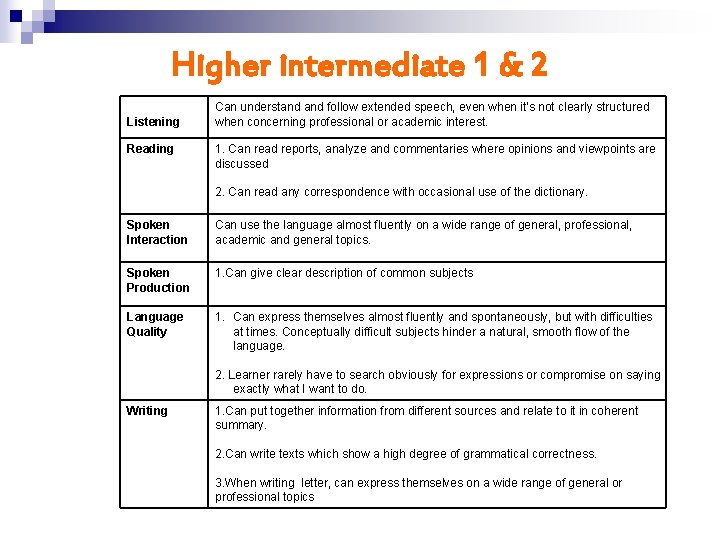
Higher intermediate 1 & 2 Listening Reading Can understand follow extended speech, even when it's not clearly structured when concerning professional or academic interest. 1. Can read reports, analyze and commentaries where opinions and viewpoints are discussed 2. Can read any correspondence with occasional use of the dictionary. Spoken Interaction Can use the language almost fluently on a wide range of general, professional, academic and general topics. Spoken Production 1. Can give clear description of common subjects Language Quality 1. Can express themselves almost fluently and spontaneously, but with difficulties at times. Conceptually difficult subjects hinder a natural, smooth flow of the language. 2. Learner rarely have to search obviously for expressions or compromise on saying exactly what I want to do. Writing 1. Can put together information from different sources and relate to it in coherent summary. 2. Can write texts which show a high degree of grammatical correctness. 3. When writing letter, can express themselves on a wide range of general or professional topics
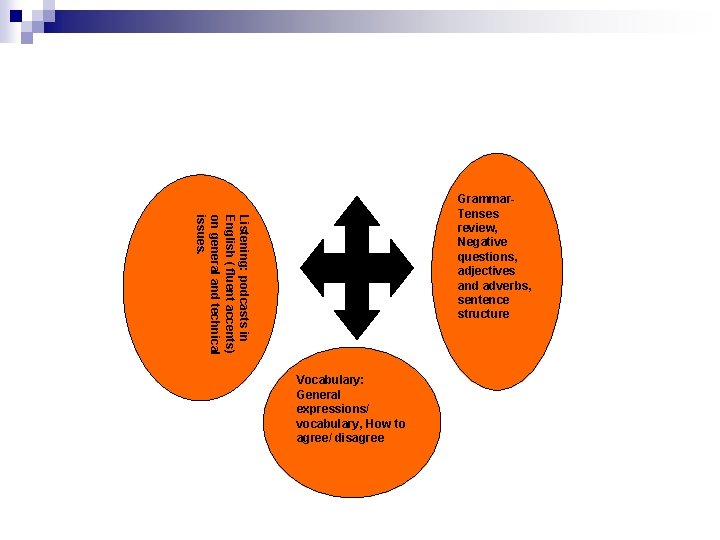
Listening: podcasts in English ( fluent accents) on general and technical issues. Grammar. Tenses review, Negative questions, adjectives and adverbs, sentence structure Vocabulary: General expressions/ vocabulary, How to agree/ disagree
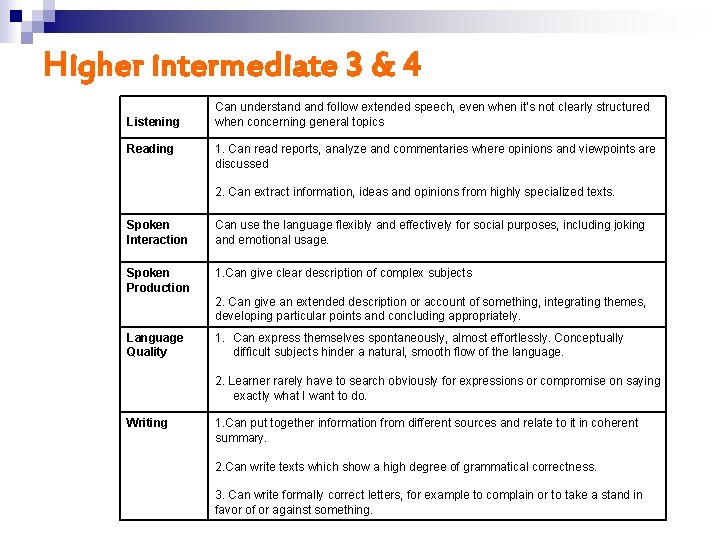
Higher intermediate 3 & 4 Listening Reading Can understand follow extended speech, even when it's not clearly structured when concerning general topics 1. Can read reports, analyze and commentaries where opinions and viewpoints are discussed 2. Can extract information, ideas and opinions from highly specialized texts. Spoken Interaction Can use the language flexibly and effectively for social purposes, including joking and emotional usage. Spoken Production 1. Can give clear description of complex subjects 2. Can give an extended description or account of something, integrating themes, developing particular points and concluding appropriately. Language Quality 1. Can express themselves spontaneously, almost effortlessly. Conceptually difficult subjects hinder a natural, smooth flow of the language. 2. Learner rarely have to search obviously for expressions or compromise on saying exactly what I want to do. Writing 1. Can put together information from different sources and relate to it in coherent summary. 2. Can write texts which show a high degree of grammatical correctness. 3. Can write formally correct letters, for example to complain or to take a stand in favor of or against something.
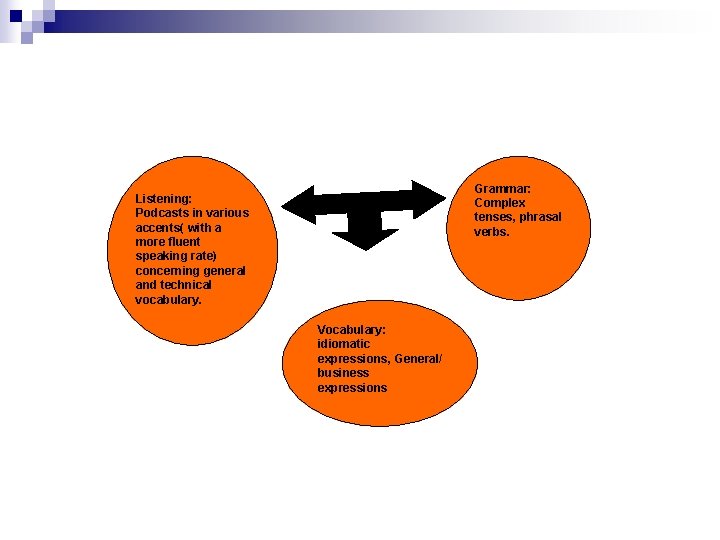
Grammar: Complex tenses, phrasal verbs. Listening: Podcasts in various accents( with a more fluent speaking rate) concerning general and technical vocabulary. Vocabulary: idiomatic expressions, General/ business expressions
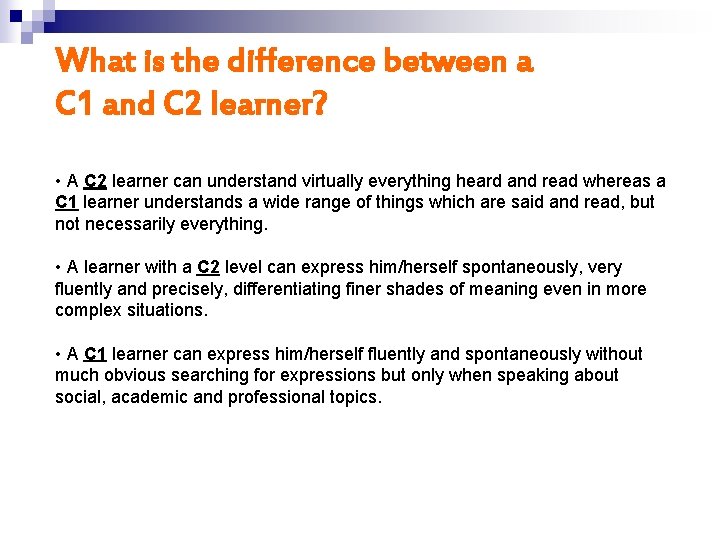
What is the difference between a C 1 and C 2 learner? • A C 2 learner can understand virtually everything heard and read whereas a C 1 learner understands a wide range of things which are said and read, but not necessarily everything. • A learner with a C 2 level can express him/herself spontaneously, very fluently and precisely, differentiating finer shades of meaning even in more complex situations. • A C 1 learner can express him/herself fluently and spontaneously without much obvious searching for expressions but only when speaking about social, academic and professional topics.
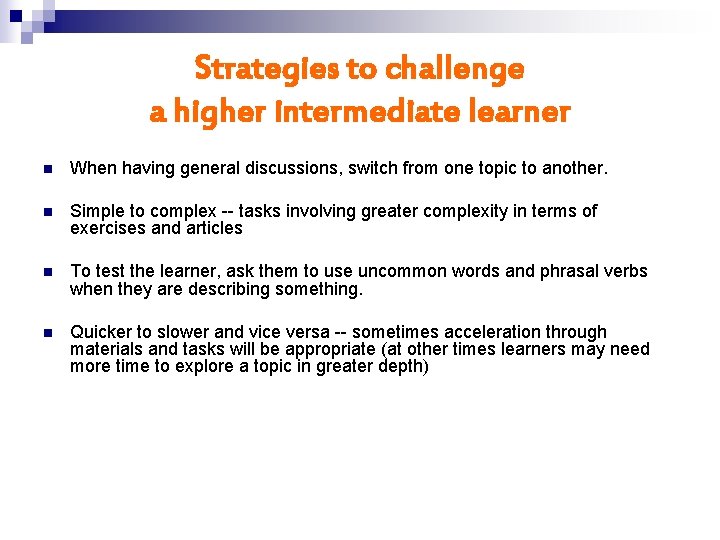
Strategies to challenge a higher intermediate learner n When having general discussions, switch from one topic to another. n Simple to complex -- tasks involving greater complexity in terms of exercises and articles n To test the learner, ask them to use uncommon words and phrasal verbs when they are describing something. n Quicker to slower and vice versa -- sometimes acceleration through materials and tasks will be appropriate (at other times learners may need more time to explore a topic in greater depth)
Content for a fluent learner Points: 84 - 100 points European scale: C 2/ Independent
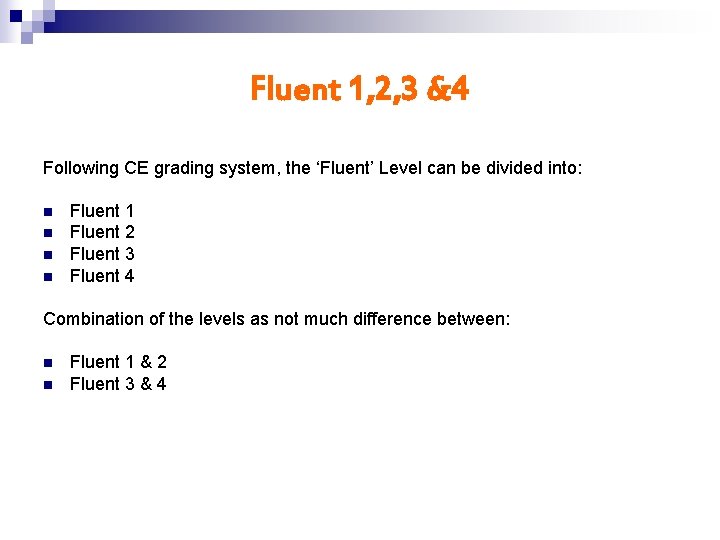
Fluent 1, 2, 3 &4 Following CE grading system, the ‘Fluent’ Level can be divided into: n n Fluent 1 Fluent 2 Fluent 3 Fluent 4 Combination of the levels as not much difference between: n n Fluent 1 & 2 Fluent 3 & 4
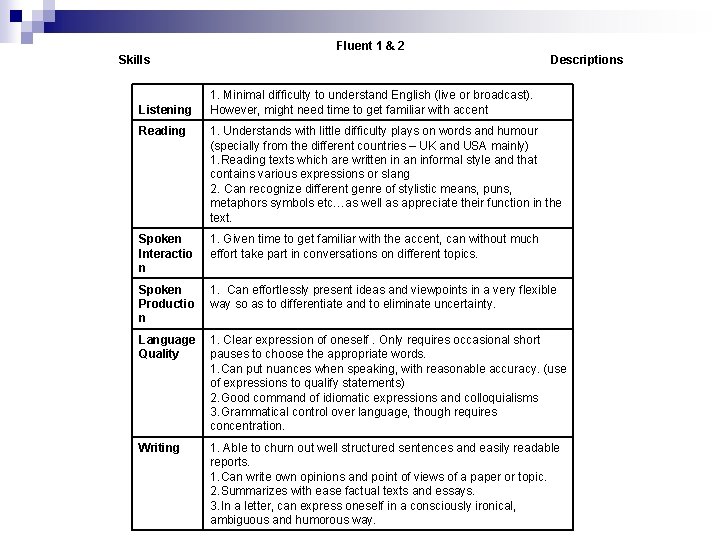
Fluent 1 & 2 Skills Listening Descriptions 1. Minimal difficulty to understand English (live or broadcast). However, might need time to get familiar with accent Reading 1. Understands with little difficulty plays on words and humour (specially from the different countries – UK and USA mainly) 1. Reading texts which are written in an informal style and that contains various expressions or slang 2. Can recognize different genre of stylistic means, puns, metaphors symbols etc…as well as appreciate their function in the text. Spoken Interactio n 1. Given time to get familiar with the accent, can without much effort take part in conversations on different topics. Spoken Productio n 1. Can effortlessly present ideas and viewpoints in a very flexible way so as to differentiate and to eliminate uncertainty. Language Quality 1. Clear expression of oneself. Only requires occasional short pauses to choose the appropriate words. 1. Can put nuances when speaking, with reasonable accuracy. (use of expressions to qualify statements) 2. Good command of idiomatic expressions and colloquialisms 3. Grammatical control over language, though requires concentration. Writing 1. Able to churn out well structured sentences and easily readable reports. 1. Can write own opinions and point of views of a paper or topic. 2. Summarizes with ease factual texts and essays. 3. In a letter, can express oneself in a consciously ironical, ambiguous and humorous way.
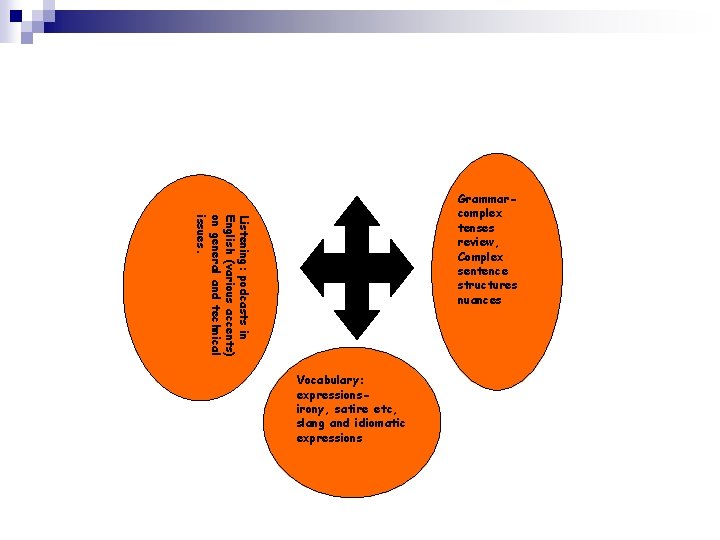
Listening: podcasts in English (various accents) on general and technical issues. Grammarcomplex tenses review, Complex sentence structures nuances Vocabulary: expressionsirony, satire etc, slang and idiomatic expressions
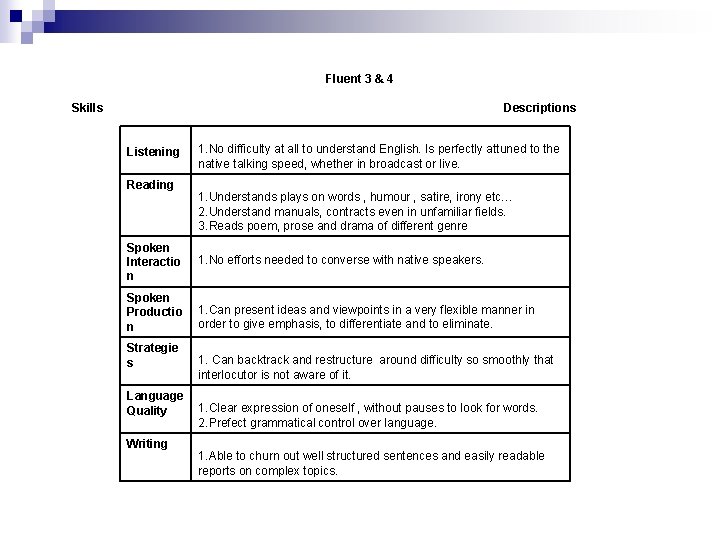
Fluent 3 & 4 Skills Descriptions Listening Reading 1. No difficulty at all to understand English. Is perfectly attuned to the native talking speed, whether in broadcast or live. 1. Understands plays on words , humour , satire, irony etc… 2. Understand manuals, contracts even in unfamiliar fields. 3. Reads poem, prose and drama of different genre Spoken Interactio n 1. No efforts needed to converse with native speakers. Spoken Productio n 1. Can present ideas and viewpoints in a very flexible manner in order to give emphasis, to differentiate and to eliminate. Strategie s Language Quality Writing 1. Can backtrack and restructure around difficulty so smoothly that interlocutor is not aware of it. 1. Clear expression of oneself , without pauses to look for words. 2. Prefect grammatical control over language. 1. Able to churn out well structured sentences and easily readable reports on complex topics.
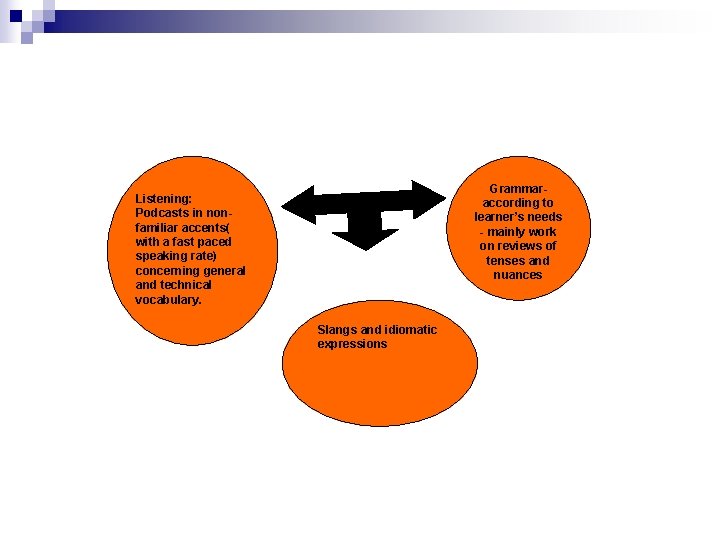
Grammaraccording to learner’s needs - mainly work on reviews of tenses and nuances Listening: Podcasts in nonfamiliar accents( with a fast paced speaking rate) concerning general and technical vocabulary. Slangs and idiomatic expressions
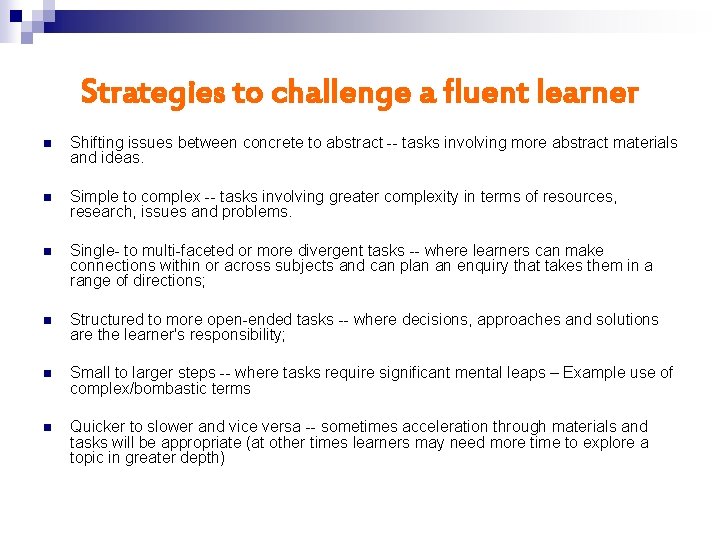
Strategies to challenge a fluent learner n Shifting issues between concrete to abstract -- tasks involving more abstract materials and ideas. n Simple to complex -- tasks involving greater complexity in terms of resources, research, issues and problems. n Single- to multi-faceted or more divergent tasks -- where learners can make connections within or across subjects and can plan an enquiry that takes them in a range of directions; n Structured to more open-ended tasks -- where decisions, approaches and solutions are the learner's responsibility; n Small to larger steps -- where tasks require significant mental leaps – Example use of complex/bombastic terms n Quicker to slower and vice versa -- sometimes acceleration through materials and tasks will be appropriate (at other times learners may need more time to explore a topic in greater depth)
Teaching Methods
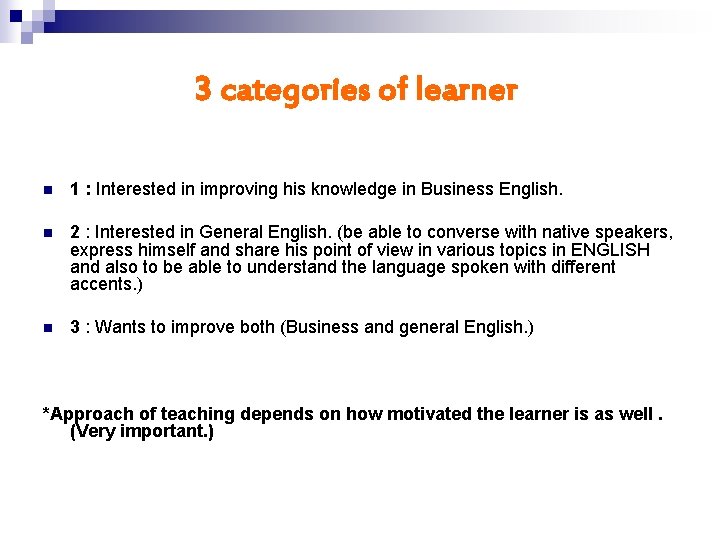
3 categories of learner n 1 : Interested in improving his knowledge in Business English. n 2 : Interested in General English. (be able to converse with native speakers, express himself and share his point of view in various topics in ENGLISH and also to be able to understand the language spoken with different accents. ) n 3 : Wants to improve both (Business and general English. ) *Approach of teaching depends on how motivated the learner is as well. (Very important. )
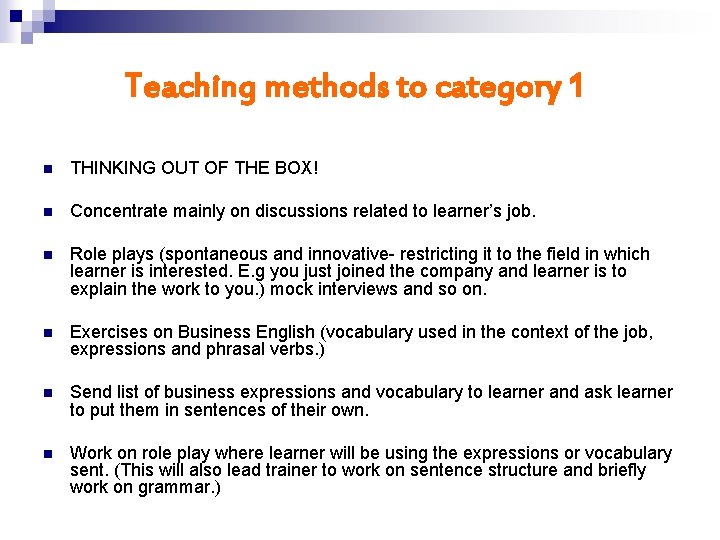
Teaching methods to category 1 n THINKING OUT OF THE BOX! n Concentrate mainly on discussions related to learner’s job. n Role plays (spontaneous and innovative- restricting it to the field in which learner is interested. E. g you just joined the company and learner is to explain the work to you. ) mock interviews and so on. n Exercises on Business English (vocabulary used in the context of the job, expressions and phrasal verbs. ) n Send list of business expressions and vocabulary to learner and ask learner to put them in sentences of their own. n Work on role play where learner will be using the expressions or vocabulary sent. (This will also lead trainer to work on sentence structure and briefly work on grammar. )
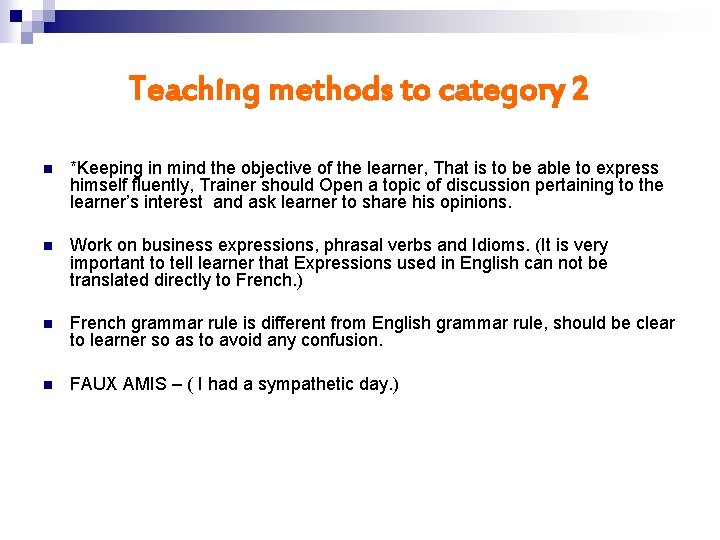
Teaching methods to category 2 n *Keeping in mind the objective of the learner, That is to be able to express himself fluently, Trainer should Open a topic of discussion pertaining to the learner’s interest and ask learner to share his opinions. n Work on business expressions, phrasal verbs and Idioms. (It is very important to tell learner that Expressions used in English can not be translated directly to French. ) n French grammar rule is different from English grammar rule, should be clear to learner so as to avoid any confusion. n FAUX AMIS – ( I had a sympathetic day. )
Teaching Methods to category 3: GENERAL plus BUSINESS. n Trainer should be very flexible in the approach here and should be able to successfully vary the lessons, working on both business and general English. n The goal of the learner is to be able to converse fluently in English when speaking of his work and about things in general as well. n Lessons directed to a learner in this category should be both, job specific and general. The aim is to help the learner to be able to converse with Native English speakers and also to foreign language speakers.
No grammar banging! Below are some points based on learner’s feedbacks and personal observation : n Communication is possible even when we make mistakes (after all we learn by the mistakes. ) n Understanding grammar rules doesn't mean that I can communicate. n There are many different styles of learning, some of which do not include "grammar banging". n Playing games is a great way to actually use the language - not just study it. n It is difficult to become fluent if the teacher interrupts me every 30 seconds to correct a grammar mistake. n Most importantly Grammar is boring!!!
Motivating learners
n Approach is patterned upon counseling techniques and adapting to the peculiar anxiety and threat as well as the personal and language problems a person encounters in learning a foreign language. Consequently the learner is not thought as a student (as in a conventional English classroom) but as a client. . . learner to be more apt. n The language – counseling (as we may call it) relationship begins with the learner’s linguistic confusion and conflict. The aim of the trainer here is first to communicate an empathy for the client’s threatened inadequate state and aid him linguistically. Then the trainer strives to enable him to arrive at his own increasingly independent language inadequacy. n This process is furthered by the trainers’ ability to establish a warm, understanding and accepting relationship.
Blended learning
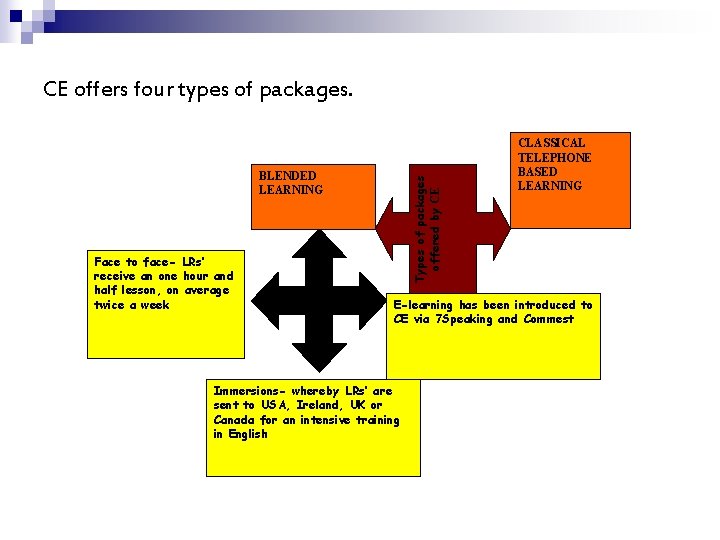
CE offers four types of packages. Face to face- LRs’ receive an one hour and half lesson, on average twice a week Types of packages offered by CE BLENDED LEARNING CLASSICAL TELEPHONE BASED LEARNING E-learning has been introduced to CE via 7 Speaking and Commest Immersions- whereby LRs’ are sent to USA, Ireland, UK or Canada for an intensive training in English
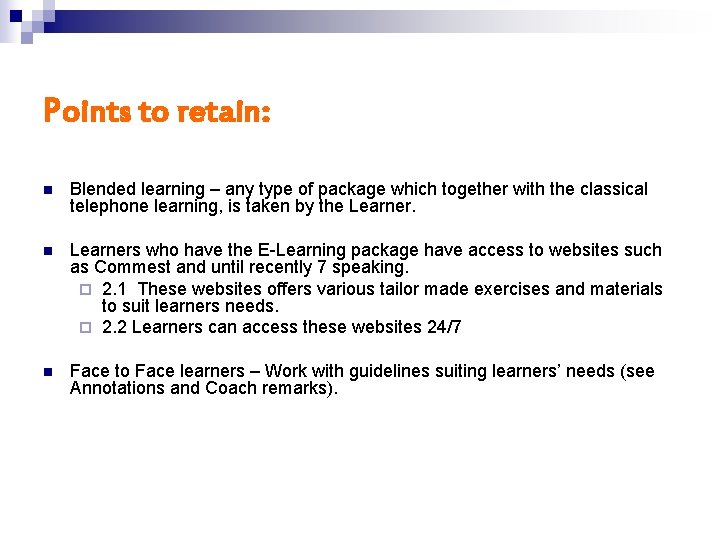
Points to retain: n Blended learning – any type of package which together with the classical telephone learning, is taken by the Learner. n Learners who have the E-Learning package have access to websites such as Commest and until recently 7 speaking. ¨ 2. 1 These websites offers various tailor made exercises and materials to suit learners needs. ¨ 2. 2 Learners can access these websites 24/7 n Face to Face learners – Work with guidelines suiting learners’ needs (see Annotations and Coach remarks).
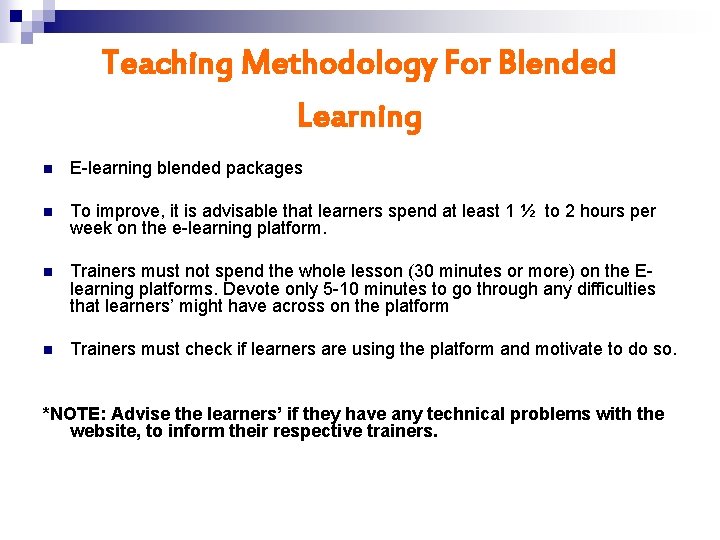
Teaching Methodology For Blended Learning n E-learning blended packages n To improve, it is advisable that learners spend at least 1 ½ to 2 hours per week on the e-learning platform. n Trainers must not spend the whole lesson (30 minutes or more) on the Elearning platforms. Devote only 5 -10 minutes to go through any difficulties that learners’ might have across on the platform n Trainers must check if learners are using the platform and motivate to do so. *NOTE: Advise the learners’ if they have any technical problems with the website, to inform their respective trainers.