
Higher Injection Pressure Is It Your Fault Skin
- Slides: 15
Higher Injection Pressure – Is It Your Fault, Skin Damage, Or Someone Else’s Well? Presented by: Ken Johnson Environmental Engineer (214) 665 -8473 Johnson. ken-e@epa. gov EPA Region 6 May 6, 2017
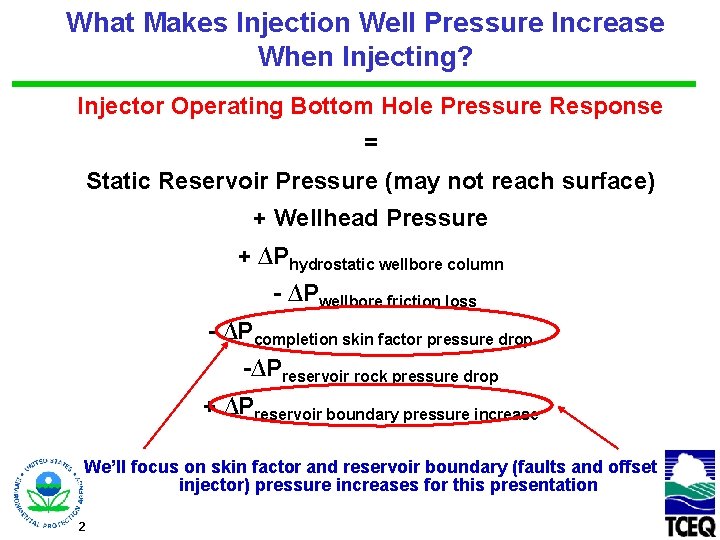
What Makes Injection Well Pressure Increase When Injecting? Injector Operating Bottom Hole Pressure Response = Static Reservoir Pressure (may not reach surface) + Wellhead Pressure + ∆Phydrostatic wellbore column - ∆Pwellbore friction loss - ∆Pcompletion skin factor pressure drop -∆Preservoir rock pressure drop + ∆Preservoir boundary pressure increase We’ll focus on skin factor and reservoir boundary (faults and offset injector) pressure increases for this presentation 2
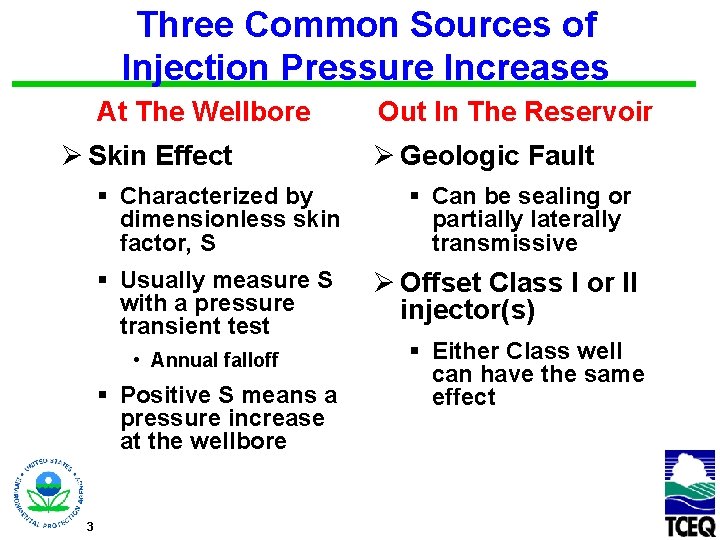
Three Common Sources of Injection Pressure Increases At The Wellbore Ø Skin Effect § Characterized by dimensionless skin factor, S § Usually measure S with a pressure transient test • Annual falloff § Positive S means a pressure increase at the wellbore 3 Out In The Reservoir Ø Geologic Fault § Can be sealing or partially laterally transmissive Ø Offset Class I or II injector(s) § Either Class well can have the same effect
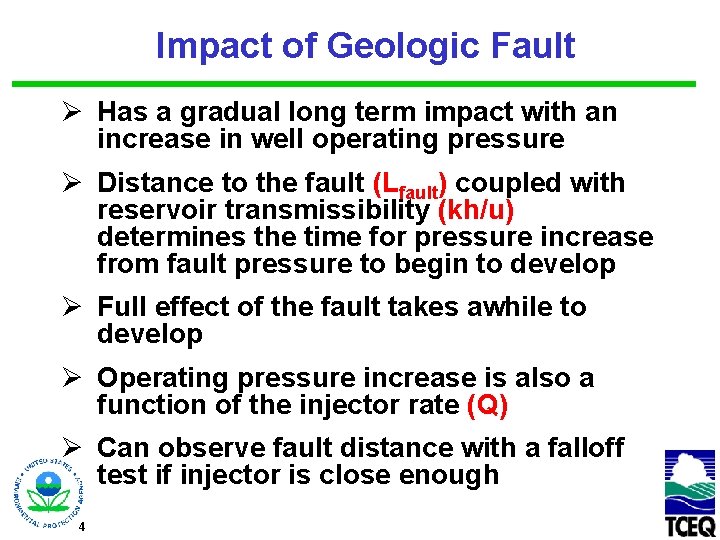
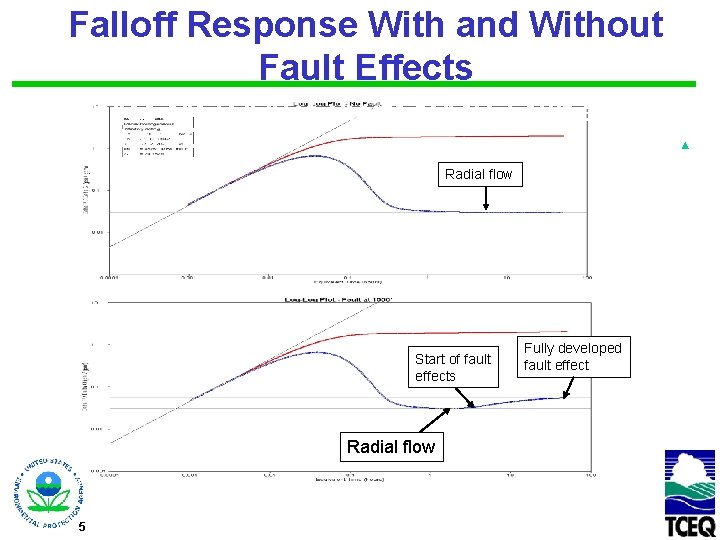
Impact of Geologic Fault Ø Has a gradual long term impact with an increase in well operating pressure Ø Distance to the fault (Lfault) coupled with reservoir transmissibility (kh/u) determines the time for pressure increase from fault pressure to begin to develop Ø Full effect of the fault takes awhile to develop Ø Operating pressure increase is also a function of the injector rate (Q) Ø Can observe fault distance with a falloff test if injector is close enough 4
Falloff Response With and Without Fault Effects Images are log plot charts for No Fault and Fault at 1000 ft. Radial flow Start of fault effects Radial flow 5 Fully developed fault effect
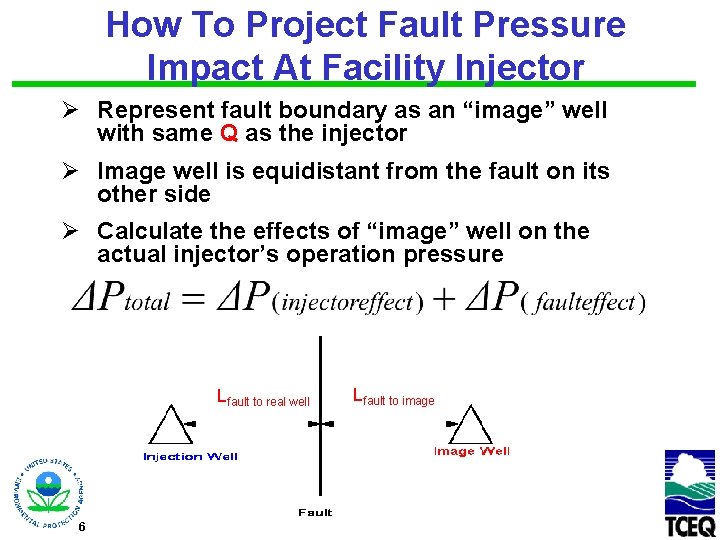
How To Project Fault Pressure Impact At Facility Injector Ø Represent fault boundary as an “image” well with same Q as the injector Ø Image well is equidistant from the fault on its other side Ø Calculate the effects of “image” well on the actual injector’s operation pressure Image is a graphic depiction of a formula for fault pressure. Lfault to real well 6 Lfault to image
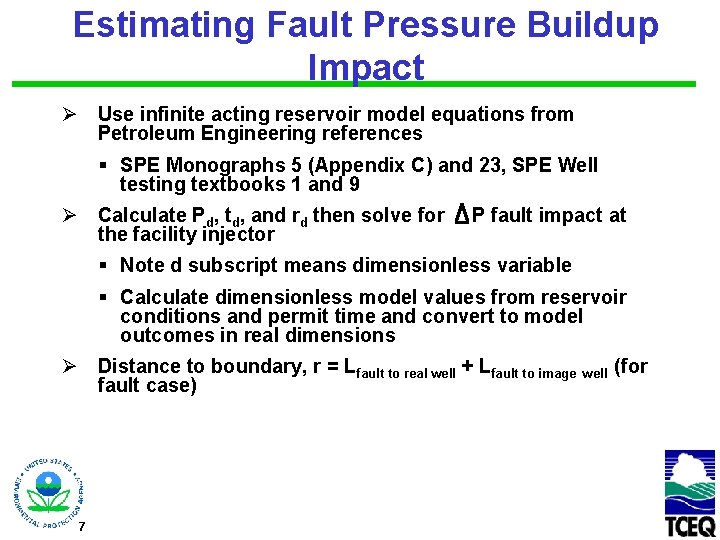
Estimating Fault Pressure Buildup Impact Ø Use infinite acting reservoir model equations from Petroleum Engineering references § SPE Monographs 5 (Appendix C) and 23, SPE Well testing textbooks 1 and 9 Ø Calculate Pd, td, and rd then solve for the facility injector P fault impact at § Note d subscript means dimensionless variable § Calculate dimensionless model values from reservoir conditions and permit time and convert to model outcomes in real dimensions Ø Distance to boundary, r = Lfault to real well + Lfault to image well (for fault case) 7
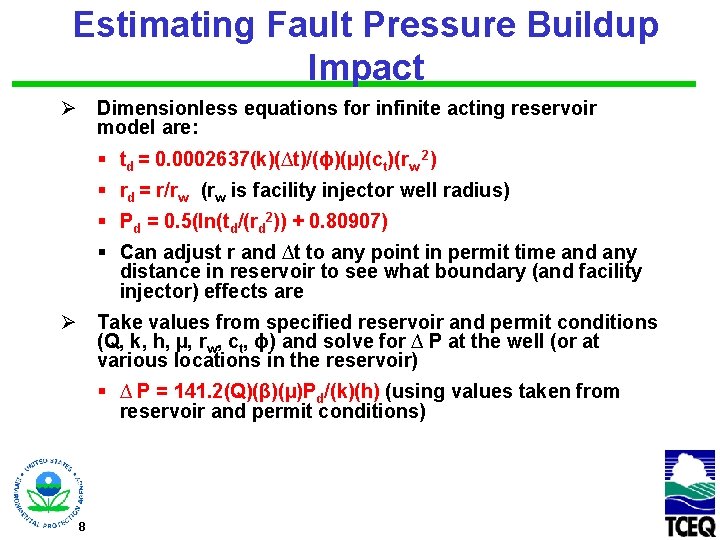
Estimating Fault Pressure Buildup Impact Ø Dimensionless equations for infinite acting reservoir model are: § td = 0. 0002637(k)(∆t)/(ɸ)(µ)(ct)(rw 2) § rd = r/rw (rw is facility injector well radius) § Pd = 0. 5(ln(td/(rd 2)) + 0. 80907) § Can adjust r and ∆t to any point in permit time and any distance in reservoir to see what boundary (and facility injector) effects are Ø Take values from specified reservoir and permit conditions (Q, k, h, µ, rw, ct, ɸ) and solve for ∆ P at the well (or at various locations in the reservoir) § ∆ P = 141. 2(Q)(β)(µ)Pd/(k)(h) (using values taken from reservoir and permit conditions) 8
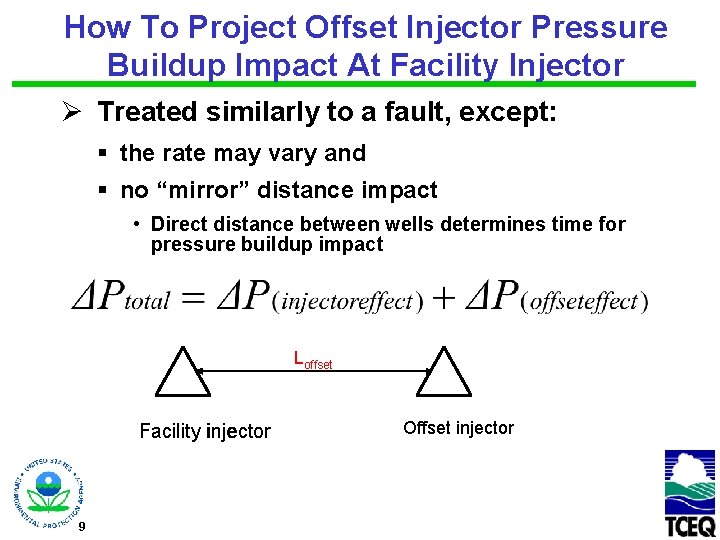
How To Project Offset Injector Pressure Buildup Impact At Facility Injector Ø Treated similarly to a fault, except: § the rate may vary and § no “mirror” distance impact • Direct distance between wells determines time for pressure buildup impact Loffset Facility injector 9 Offset injector and Offset injector Image is a graphic depiction of offset injector pressure buildup
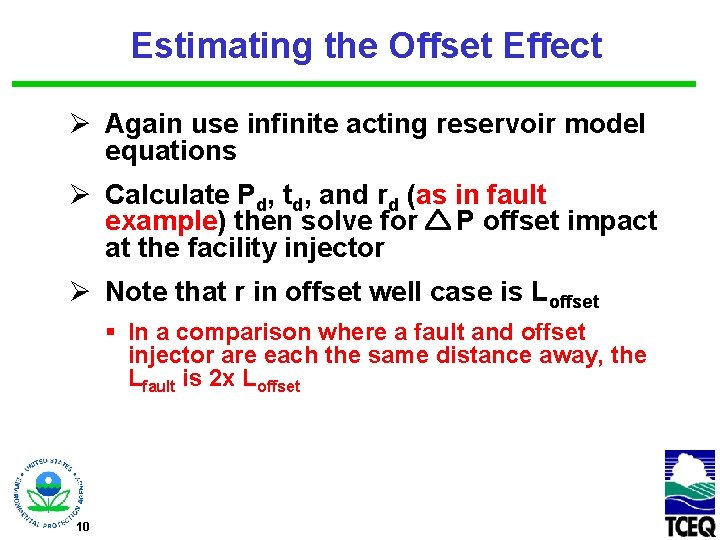
Estimating the Offset Effect Ø Again use infinite acting reservoir model equations Ø Calculate Pd, td, and rd (as in fault example) then solve for P offset impact at the facility injector Ø Note that r in offset well case is Loffset § In a comparison where a fault and offset injector are each the same distance away, the Lfault is 2 x Loffset 10
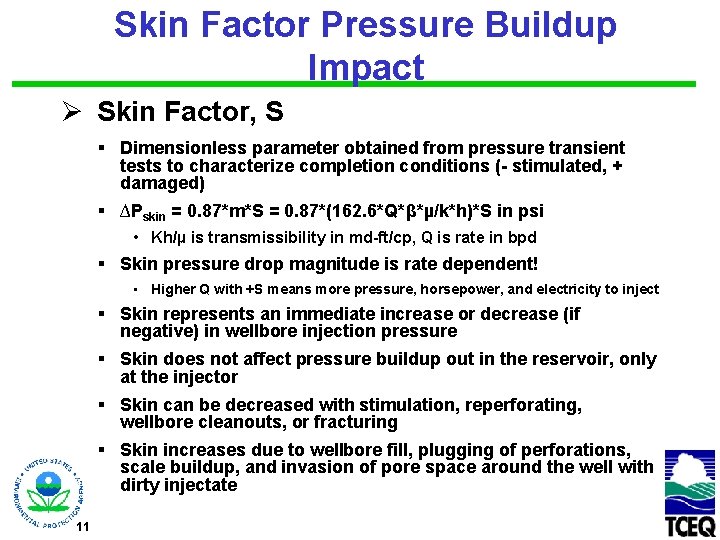
Skin Factor Pressure Buildup Impact Ø Skin Factor, S § Dimensionless parameter obtained from pressure transient tests to characterize completion conditions (- stimulated, + damaged) § ∆Pskin = 0. 87*m*S = 0. 87*(162. 6*Q*β*µ/k*h)*S in psi • Kh/µ is transmissibility in md-ft/cp, Q is rate in bpd § Skin pressure drop magnitude is rate dependent! • Higher Q with +S means more pressure, horsepower, and electricity to inject § Skin represents an immediate increase or decrease (if negative) in wellbore injection pressure § Skin does not affect pressure buildup out in the reservoir, only at the injector § Skin can be decreased with stimulation, reperforating, wellbore cleanouts, or fracturing § Skin increases due to wellbore fill, plugging of perforations, scale buildup, and invasion of pore space around the well with dirty injectate 11
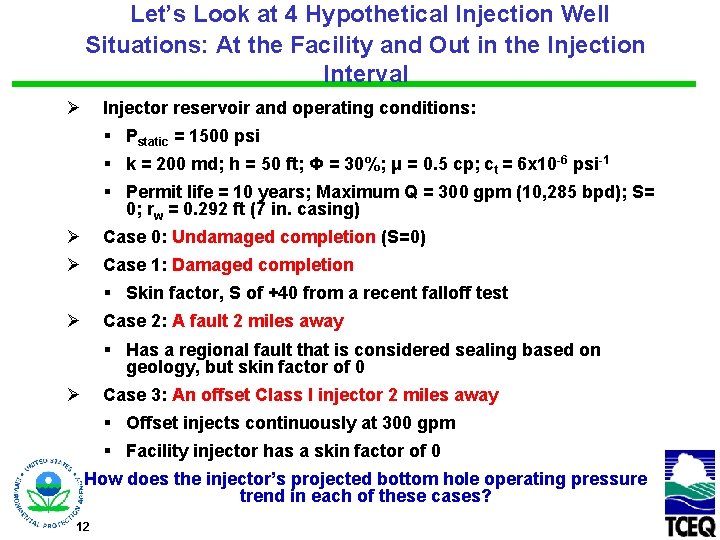
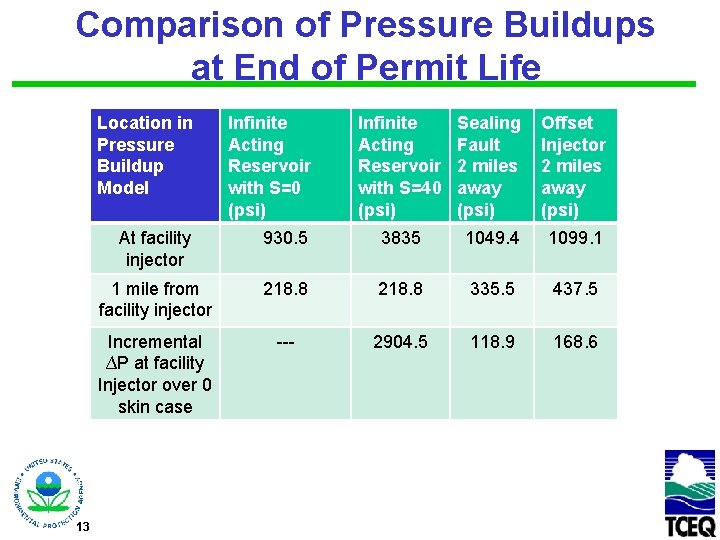
Let’s Look at 4 Hypothetical Injection Well Situations: At the Facility and Out in the Injection Interval Ø Injector reservoir and operating conditions: § Pstatic = 1500 psi § k = 200 md; h = 50 ft; Φ = 30%; μ = 0. 5 cp; ct = 6 x 10 -6 psi-1 § Permit life = 10 years; Maximum Q = 300 gpm (10, 285 bpd); S= 0; rw = 0. 292 ft (7 in. casing) Ø Case 0: Undamaged completion (S=0) Ø Case 1: Damaged completion § Skin factor, S of +40 from a recent falloff test Ø Case 2: A fault 2 miles away § Has a regional fault that is considered sealing based on geology, but skin factor of 0 Ø Case 3: An offset Class I injector 2 miles away § Offset injects continuously at 300 gpm § Facility injector has a skin factor of 0 How does the injector’s projected bottom hole operating pressure trend in each of these cases? 12
Comparison of Pressure Buildups at End of Permit Life Image is ina chart by Location Infiniteof pressure Infinite buildups Sealing Offset location Pressure Acting Fault Injector Buildup Model 13 Reservoir with S=0 (psi) Reservoir 2 miles with S=40 away (psi) 2 miles away (psi) At facility injector 930. 5 3835 1049. 4 1099. 1 1 mile from facility injector 218. 8 335. 5 437. 5 Incremental ∆P at facility Injector over 0 skin case --- 2904. 5 118. 9 168. 6
Key Points Ø An injection well’s bottom hole injection pressure is the net of several responses § Some are at the wellbore and others out in the reservoir Ø Reservoir components may take months, or years to impact a well’s injecting bottom hole pressure § Faults and offset wells are reservoir components § Depends on combination of reservoir and operating parameters § Skin impacts the injector wellbore only Ø Can use infinite acting reservoir model (IARM) equations to do a “basic” reservoir/injection capacity assessment for pressure buildup for permits and petitions § Some “what if” capability for various completion and reservoir boundary conditions Ø IARM equations available in petroleum engineering texts and suitable for calculator or spreadsheet applications 14
References Ø “Transient Well Testing, ” SPE Monograph 23, Medhat Kamal, 2009 Ø “Advances in Well Test Analysis, ” SPE Monograph 5, R. C. Earlougher Jr. , 1977 Ø “Well Testing, ” SPE Textbook Series Volume 1, John Lee, 1982 Ø “Pressure Transient Testing, ” SPE Textbook Series Volume 9, John Lee et al. , 2003 15