
Higher Human Biology Unit 3 Neurobiology Communication KEY
Higher Human Biology Unit 3 Neurobiology & Communication KEY AREA 4: Communication and Social Behaviour
Neurobiology & Communication Learning Intentions KEY AREA 4 – Communication & Social Behaviour a)Effect of infant attachment b)Effect of communication c)Effect of experience d)Effect of group behaviour
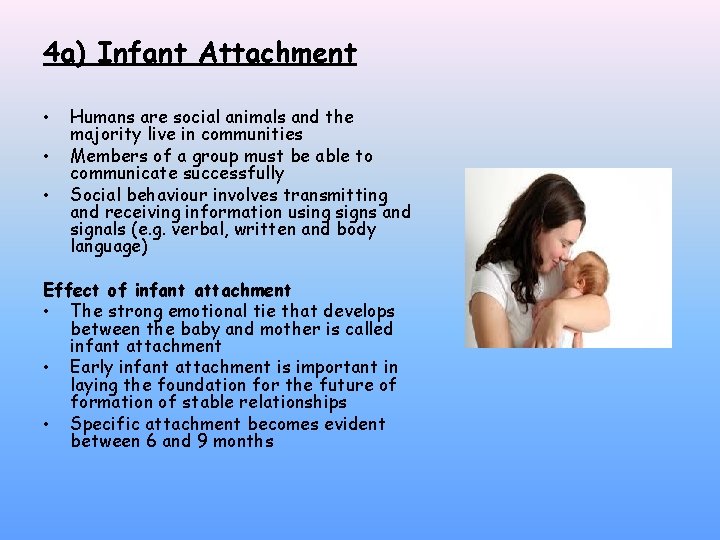
4 a) Infant Attachment • • • Humans are social animals and the majority live in communities Members of a group must be able to communicate successfully Social behaviour involves transmitting and receiving information using signs and signals (e. g. verbal, written and body language) Effect of infant attachment • The strong emotional tie that develops between the baby and mother is called infant attachment • Early infant attachment is important in laying the foundation for the future of formation of stable relationships • Specific attachment becomes evident between 6 and 9 months
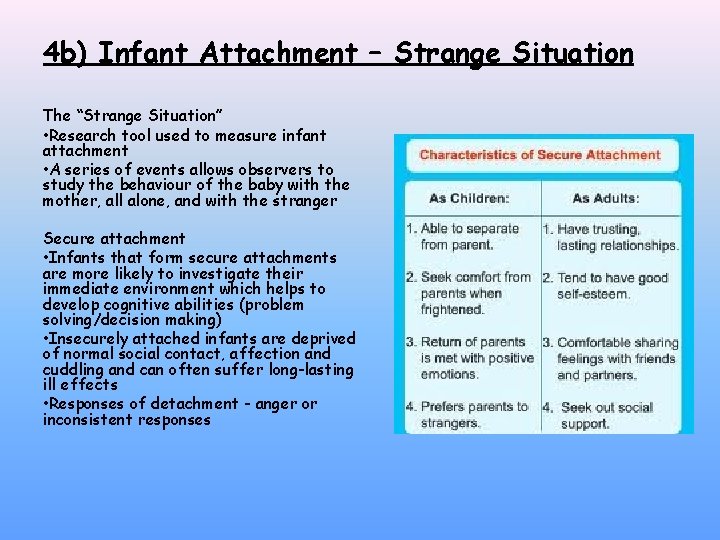
4 b) Infant Attachment – Strange Situation The “Strange Situation” • Research tool used to measure infant attachment • A series of events allows observers to study the behaviour of the baby with the mother, all alone, and with the stranger Secure attachment • Infants that form secure attachments are more likely to investigate their immediate environment which helps to develop cognitive abilities (problem solving/decision making) • Insecurely attached infants are deprived of normal social contact, affection and cuddling and can often suffer long-lasting ill effects • Responses of detachment - anger or inconsistent responses
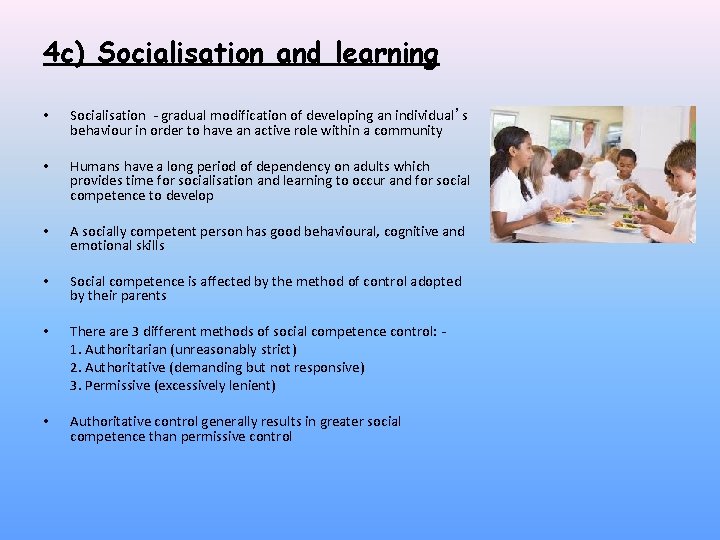
4 c) Socialisation and learning • Socialisation - gradual modification of developing an individual’s behaviour in order to have an active role within a community • Humans have a long period of dependency on adults which provides time for socialisation and learning to occur and for social competence to develop • A socially competent person has good behavioural, cognitive and emotional skills • Social competence is affected by the method of control adopted by their parents • There are 3 different methods of social competence control: 1. Authoritarian (unreasonably strict) 2. Authoritative (demanding but not responsive) 3. Permissive (excessively lenient) • Authoritative control generally results in greater social competence than permissive control
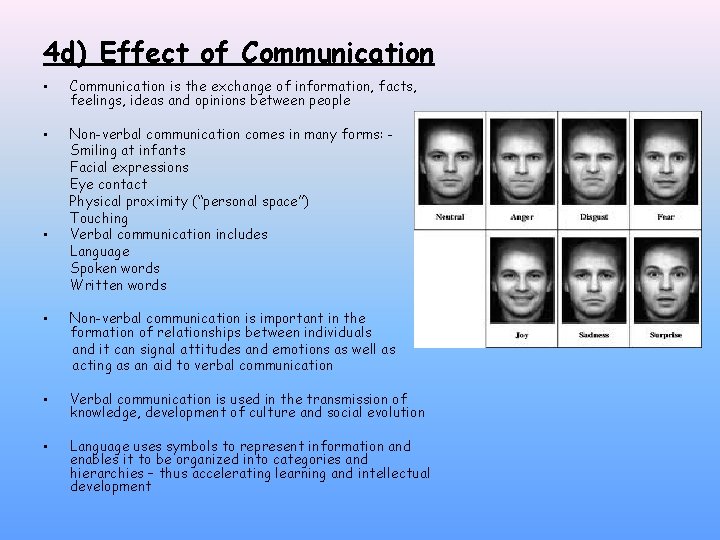
4 d) Effect of Communication • Communication is the exchange of information, facts, feelings, ideas and opinions between people • Non-verbal communication comes in many forms: Smiling at infants Facial expressions Eye contact Physical proximity (“personal space”) Touching Verbal communication includes Language Spoken words Written words • • Non-verbal communication is important in the formation of relationships between individuals and it can signal attitudes and emotions as well as acting as an aid to verbal communication • Verbal communication is used in the transmission of knowledge, development of culture and social evolution • Language uses symbols to represent information and enables it to be organized into categories and hierarchies – thus accelerating learning and intellectual development
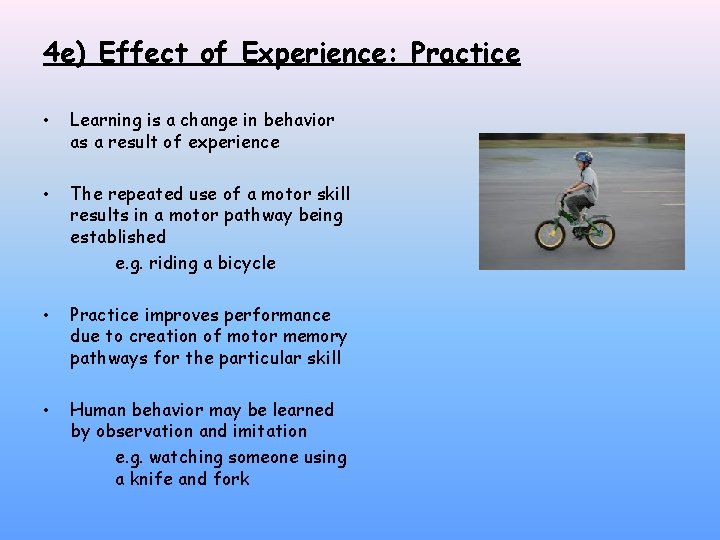
4 e) Effect of Experience: Practice • Learning is a change in behavior as a result of experience • The repeated use of a motor skill results in a motor pathway being established e. g. riding a bicycle • Practice improves performance due to creation of motor memory pathways for the particular skill • Human behavior may be learned by observation and imitation e. g. watching someone using a knife and fork
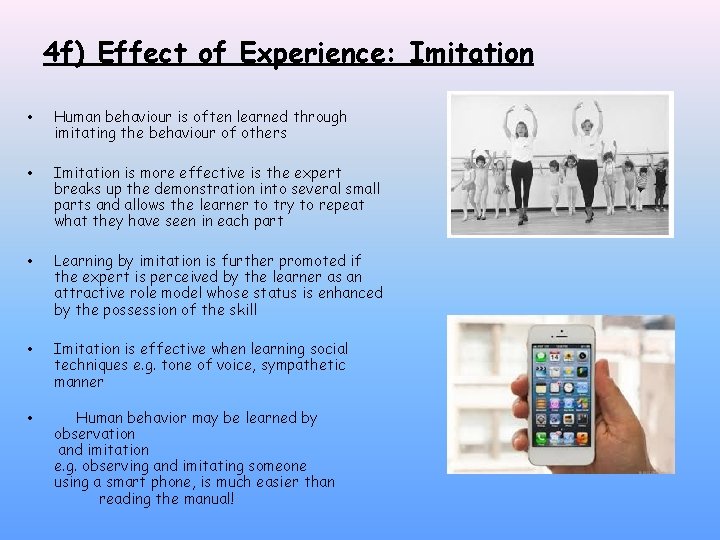
4 f) Effect of Experience: Imitation • Human behaviour is often learned through imitating the behaviour of others • Imitation is more effective is the expert breaks up the demonstration into several small parts and allows the learner to try to repeat what they have seen in each part • Learning by imitation is further promoted if the expert is perceived by the learner as an attractive role model whose status is enhanced by the possession of the skill • Imitation is effective when learning social techniques e. g. tone of voice, sympathetic manner • Human behavior may be learned by observation and imitation e. g. observing and imitating someone using a smart phone, is much easier than reading the manual!

4 g) Effect of Experience: Reinforcement • Reinforcement is when behavior patterns that have positive consequences for the individual so are likely to be repeated e. g. rat pulling lever to get food • Reinforcement is designed to make a person repeat a certain action. • It involves a reward being given when a desired behaviour is shown (e. g. sweets, money, praise. ) • This increases the chance that the behaviour will be repeated
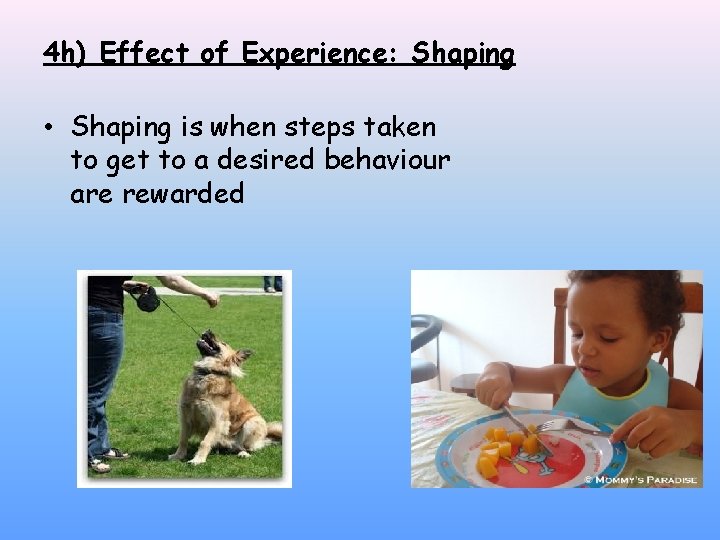
4 h) Effect of Experience: Shaping • Shaping is when steps taken to get to a desired behaviour are rewarded
4 i) Effect of Experience: Extinction happens when behaviour patterns are not rewarded and so the behaviour pattern eventually disappears
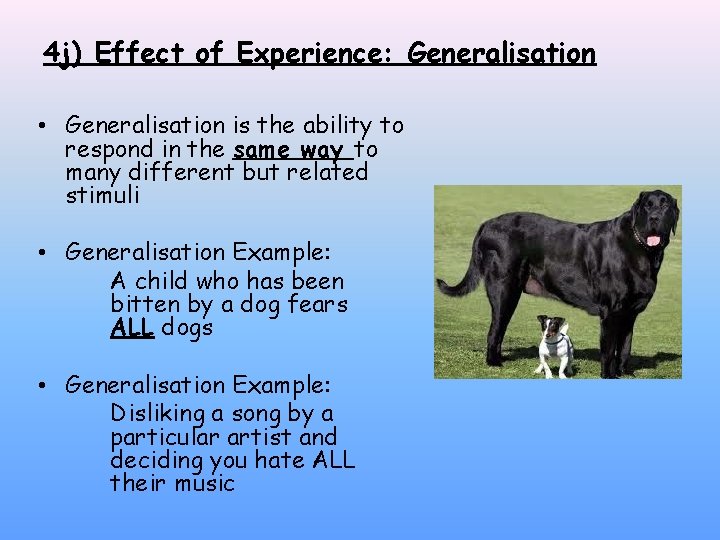
4 j) Effect of Experience: Generalisation • Generalisation is the ability to respond in the same way to many different but related stimuli • Generalisation Example: A child who has been bitten by a dog fears ALL dogs • Generalisation Example: Disliking a song by a particular artist and deciding you hate ALL their music
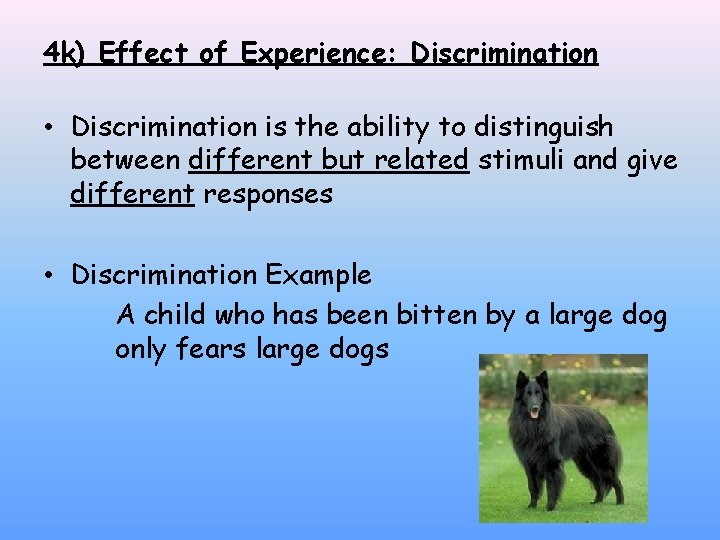
4 k) Effect of Experience: Discrimination • Discrimination is the ability to distinguish between different but related stimuli and give different responses • Discrimination Example A child who has been bitten by a large dog only fears large dogs
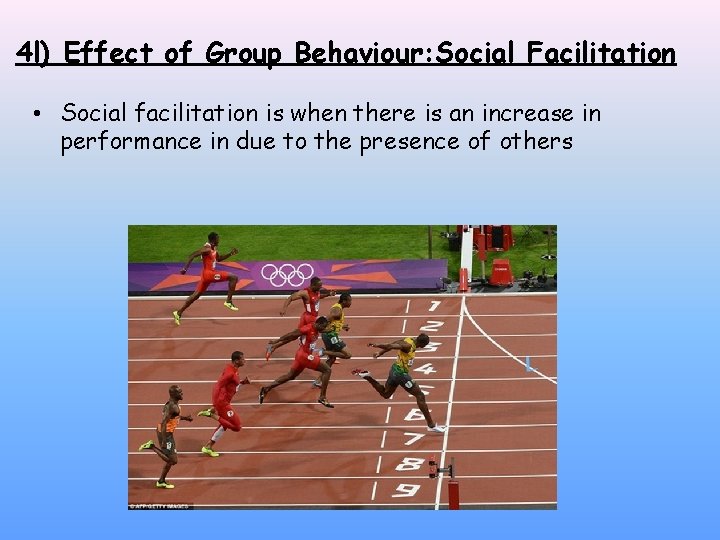
4 l) Effect of Group Behaviour: Social Facilitation • Social facilitation is when there is an increase in performance in due to the presence of others
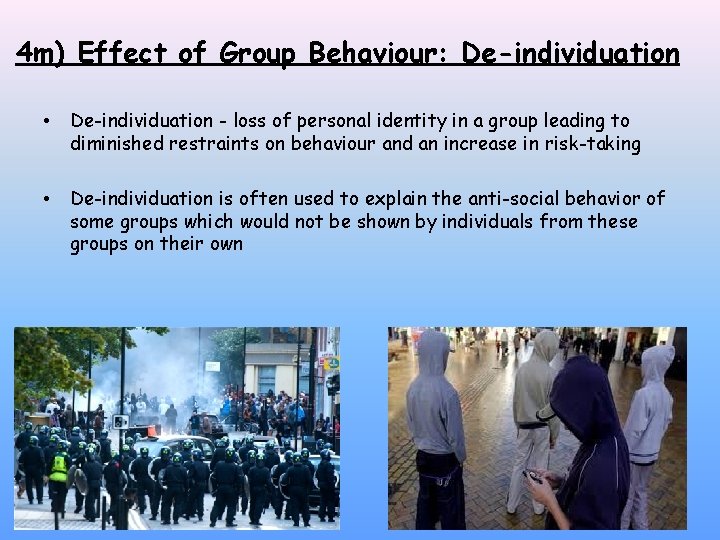
4 m) Effect of Group Behaviour: De-individuation • De-individuation - loss of personal identity in a group leading to diminished restraints on behaviour and an increase in risk-taking • De-individuation is often used to explain the anti-social behavior of some groups which would not be shown by individuals from these groups on their own
4 n) Effect of Group Behaviour: Internalisation • Internalisation is the changing of a belief because they listen to the views of others and are persuaded by their argument
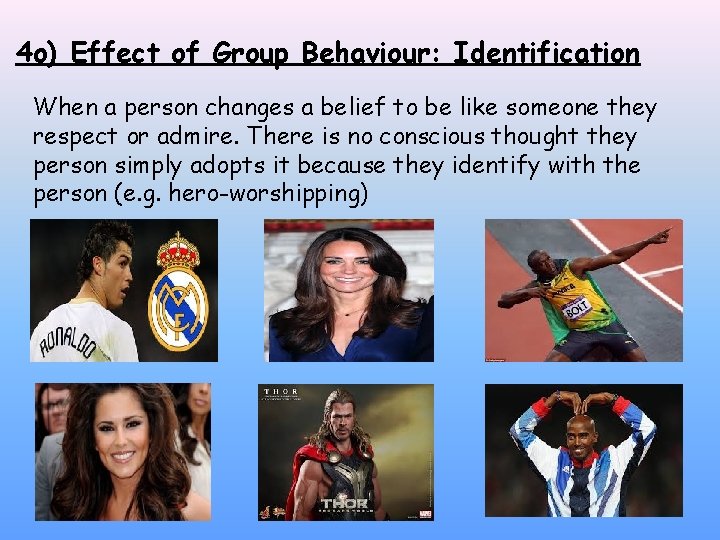
4 o) Effect of Group Behaviour: Identification When a person changes a belief to be like someone they respect or admire. There is no conscious thought they person simply adopts it because they identify with the person (e. g. hero-worshipping)
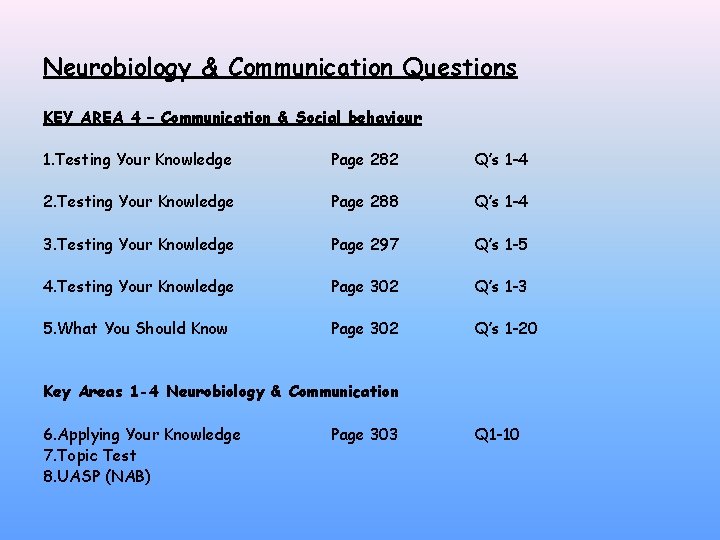
Neurobiology & Communication Questions KEY AREA 4 – Communication & Social behaviour 1. Testing Your Knowledge Page 282 Q’s 1 -4 2. Testing Your Knowledge Page 288 Q’s 1 -4 3. Testing Your Knowledge Page 297 Q’s 1 -5 4. Testing Your Knowledge Page 302 Q’s 1 -3 5. What You Should Know Page 302 Q’s 1 -20 Key Areas 1 -4 Neurobiology & Communication 6. Applying Your Knowledge 7. Topic Test 8. UASP (NAB) Page 303 Q 1 -10
- Slides: 18