
Higher Human Biology Unit 3 Neurobiology and Immunology

Higher Human Biology Unit 3 – Neurobiology and Immunology Section 19 - Memory https: //www. youtube. com/watch? v=c. Pi. DHXt. M 0 VA
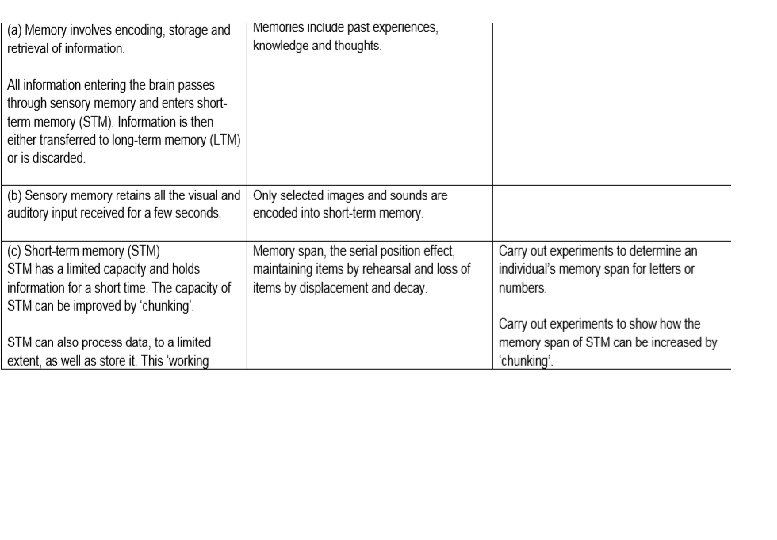
a) Memory We will be learning… • To state that memory includes past experiences, knowledge and thoughts. • To describe the process of encoding • To describe the process of memory storage and retrieval of information. • To explain that all information passes though sensory memory and enters the short term memory (STM). • Once information has passed through the short term memory it is either discarded or transferred to the longterm memory (LTM)
What is Memory • Memory is the capacity of the brain to store information, retain it and retrieve it as and when required. • The brain capture images of sights, sounds, smells, tactile sensations and emotions from any moment. • Memories include past experiences, knowledge and thoughts. They allow us to deal with current and future experiences based on the past memories. • All information which enters the brain passes through sensory memory and enters the short term memory (STM). • Information can then be transferred to the long term memory (LTM) or is discarded.
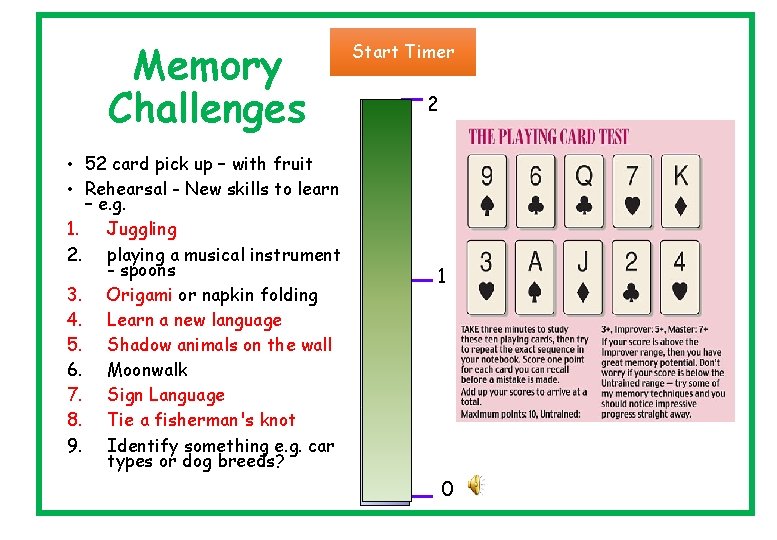
Memory Challenges • 52 card pick up – with fruit • Rehearsal - New skills to learn – e. g. 1. Juggling 2. playing a musical instrument - spoons 3. Origami or napkin folding 4. Learn a new language 5. Shadow animals on the wall 6. Moonwalk 7. Sign Language 8. Tie a fisherman's knot 9. Identify something e. g. car types or dog breeds? Start Timer 2 1 0
Receiving Information • Each of our sense organs continuously feeds impulses into the region of the cerebrum which relates to that particular sense. Each form of sensory information is processed separately: • Auditory - sounds • Visual – sight • Tactile – touch, taste, textures

Encoding • The quality of the memory depends on the attention given to the encoding of it. • Encoding is the conversion of one or more nerve impulses into a form that can be received and stored by the brain. This means that it can be retrieved from the STM or LTM at a later date. • Information can be encoded using: • shallow encoding, such as repetition, or • elaborative encoding, such as linking with previous memories, which is considered as a deeper form of encoding.

How do we Store Memories? A memorable event causes neurons to fire more frequently, making the experience more intense and increasing the likelihood that the event is encoded as a memory. Emotion tends to increase attention, and the emotional element of an event is processed on an unconscious pathway. The perceived sensations are decoded in the various sensory areas of the cortex, and then combined in the brain’s hippocampus into one single experience. The hippocampus is then responsible for analysing these inputs and ultimately deciding if they will be committed to long-term memory. It acts as a kind of sorting centre where the new sensations are compared and associated with previously recorded ones.

How do we Retrieve Memories Once information has been encoded and stored in memory, it must be retrieved in order to be used. There are four basic ways in which information can be pulled from long-term memory 1. Recall 2. Recollection 3. Recognition 4. Relearning https: //www. ted. com/talks/alex_gendler_why_elephants_never_forget https: //www. youtube. com/watch? v=J 0 Z_v. RYQ_Sg

Selective Sensory Memory • The brain is constantly receiving information from sense organs which transmits the information to the brain. • The brain has to select what information it stores or else it would become cluttered. • The brain must encode this chosen information into a form that it can process to store in the short term or for a longer term. • If this information is encoded and stored correctly then it can be retrieved later.
Memory Span - Information is either discarded or past to the LTM We often think of short-term memory as information newly-received from the senses, but it may include information recently retrieved from long-term memory or recent mental processing. We can call this extended form of short-term memory 'working memory'. Shortterm memory has a limited facility to store information which is known as the memory span.

b) Sensory Memory We will be learning… • To describe that sensory information retains all the visual and auditory input received for a few seconds. • Following this only selected images and sounds are encoded into short term memory.

Three Levels of Memory Level 1 Level 2 Level 3

Level 1 - Sensory Memory • Sensory memory retains all visual and auditory input but for a very short period of time e. g. 0. 5 s for visual stimuli and 2 s for auditory. • The brain selects relevant pieces of information to send to the short-term memory (STM)
Level 2 - Short Term Memory (STM) • Short term memory (STM) has a limited storage capacity or ‘memory span’ holding about seven items of information for roughly 30 seconds. During this time the retrieval of items is very accurate. • The information in the STM must be passed to the long term memory or it will be lost by: • displacement – the pushing out of ‘old’ information by new information • decay – the breakdown of a fragile ‘memory trace’ formed when a group of neurons briefly became activated. https: //www. youtube. com/watch? v=AKZf. FD 1 PWAs
c) Short-Term Memory (STM) We will be learning… • To state that short term memory has a limited capacity • To state that short term memory only holds information for a short period of time • To describe “chunking”, memory span, serial position effect, rehearsal, displacement and decay • To explain how the short term memory can perform simple cognitive tasks

Short Term Memory (STM) Chunking • ‘Chunking’ is the term given to the organisation of many pieces of information into smaller chunks of information. • e. g. the area code for Glasgow is 0141. Individually, this can be thought of as four pieces of information but chunking allows us reduce this to one piece of information. • Grouping many pieces of information into smaller chunks allows us to improve our short term memory span.
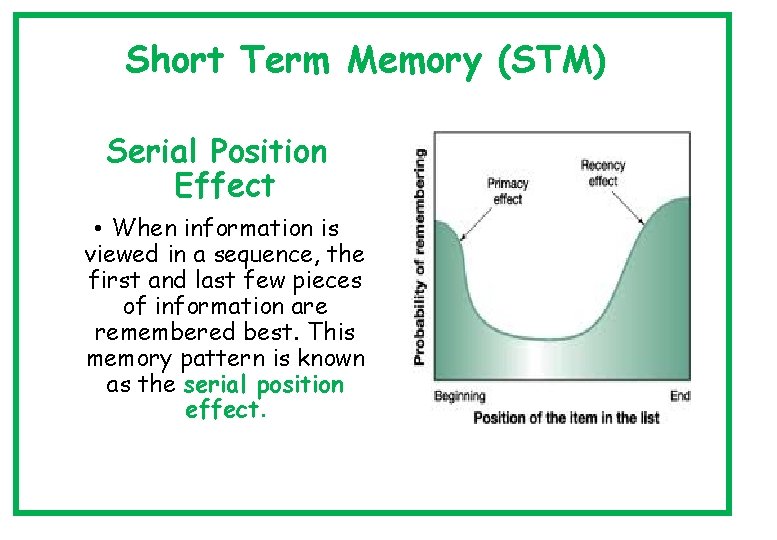
Short Term Memory (STM) Serial Position Effect • When information is viewed in a sequence, the first and last few pieces of information are remembered best. This memory pattern is known as the serial position effect.
Short Term Memory (STM) Serial Position Effect • The first few pieces of information are remembered as there has been enough time for rehearsal, and the information has been transferred to long term memory. • The middle pieces of information are quickly forgotten because the short term memory is crowded with information. • The last pieces of information are remembered because they have not yet been displaced from the STM.
Short Term Memory (STM) Serial Position Effect • Advertisers pay more for the first and last advert slots to take advantage of the serial position effect. • Jim Davidson’s generation game • http: //www. youtube. com/watch? v=Fm 5 yg. KN 4 PKs
Short Term Memory (STM) Rehearsal • Items can be maintained within the short term memory for longer periods of time through rehearsal. • Rehearsal involves repeating a piece of information many times, either silently or aloud. • This also helps to transfer this information to the long term memory (LTM).
Short Term Memory (STM) Working Memory • Working memory is an extension of the STM. • It allows us to actively process information while it is held in the STM and allows us to carry out simple cognitive tasks, such as counting. • e. g. allows you to picture your home and count the number of doors within.
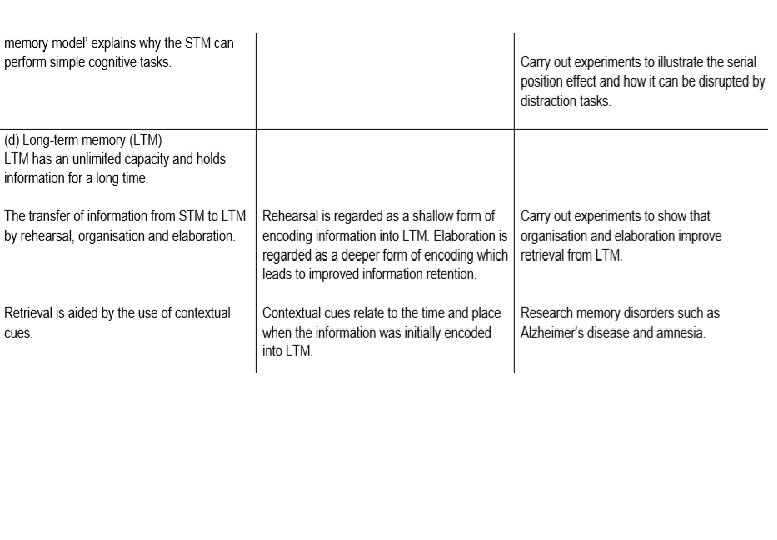
d) Long-term Memory (STM) We will be learning… • To state that long term memory has an unlimited capacity • To state that long term memory can hold information for a long time • To describe how information is transferred from the short term memory to the long term memory by rehearsal, organisation and elaboration • To state that retrieval is aided by the use of contextual cues

Level 3 - Long Term Memory (LTM) • The long term memory is thought to be able to hold an unlimited amount of information. • In order for information to be transferred from the STM to the LTM, information must be encoded (converted to a form that the brain can process and store). • During encoding the items are organised into categories such as skills, personal memories or facts.
Long Term Memory (LTM) • Information can be transferred to the LTM successfully by: • Rehearsal • Organisation • Elaboration of meaning
Long Term Memory (LTM) Rehearsal • Rehearsing a piece of information helps to extend the length of time it is retained within the STM. • Rehearsing also facilitates the transfer of information from the STM to the LTM. • Students who stop and repeat what they have just read helps commit the knowledge to their long term memory when compared with students who read continuously.
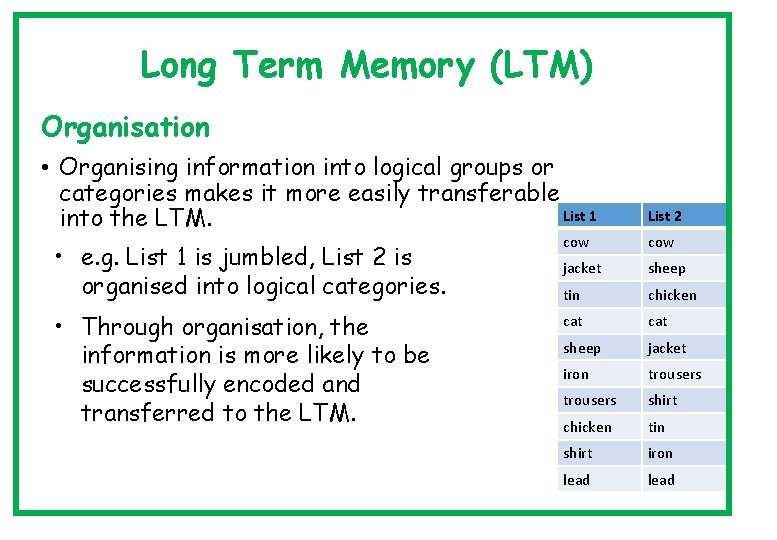
Long Term Memory (LTM) Organisation • Organising information into logical groups or categories makes it more easily transferable List 1 into the LTM. List 2 • e. g. List 1 is jumbled, List 2 is organised into logical categories. cow jacket sheep tin chicken • Through organisation, the information is more likely to be successfully encoded and transferred to the LTM. cat sheep jacket iron trousers shirt chicken tin shirt iron lead
Long Term Memory (LTM) Elaboration of Meaning • Elaboration allows us to make information easier to transfer and store in the LTM by building it into a bigger ‘story’. • For example, the name of a person is much more likely to be transferred to the LTM if it is associated with mental images, personality, experiences and smells, such as their perfume/aftershave.
Long term memory (LTM) • Information which is stored in the LTM should be able to be retrieved. • To aid retrieval, information is stored in categories e. g. family, holidays, etc. • Retrieval is also aided by ‘contextual cues’, these are signals or reminders relating to the conditions which were present at the time the memory encoded into the LTM. • The more elaborate and detailed the memory, the more easily it is retrieved.

Memory Overview • The link between the sensory, short term and long term memory is shown in the diagram below: Rehearsal level 2 level 1 sensory memory Selected info. ENCODED short term memory (STM) level 3 some info. transferred Retrieval most sensory images are short-lived and quickly forgotten many items forgotten “displaced ” long term memory (LTM)
Location of Memory in the Brain • Different types of memories are stored in different areas of the brain. Episodic and semantic memory – ‘remembering that…’ • Episodic memory is the recall of personal facts, experience and events. • Semantic memory is the recall of general knowledge, non-personal facts and concepts. • Both episodic and semantic memories are stored in the cerebral cortex such as the temporal lobes at the sides of the cerebrum
Location of Memory in the Brain Procedural memory – ‘remembering how to…’ • Procedural memory contains information on how to perform particular skills, such as motor skills (e. g. how to swim) and mental skills (e. g. how to read). These skills are recalled without conscious control. • Procedural memories are stored within the motor region of the cerebral cortex.
Location of Memory in the Brain Emotional memory • Emotional memories are formed as a result of positive or negative associations with particular stimuli. • Emotional memories involve links between the cerebral cortex and limbic system.
Location of Memory in the Brain Spatial memory • Spatial memory holds a record of our environment and its spatial orientation. • i. e. where the fridge is in your kitchen. • Spatial memory is stored within the limbic system.
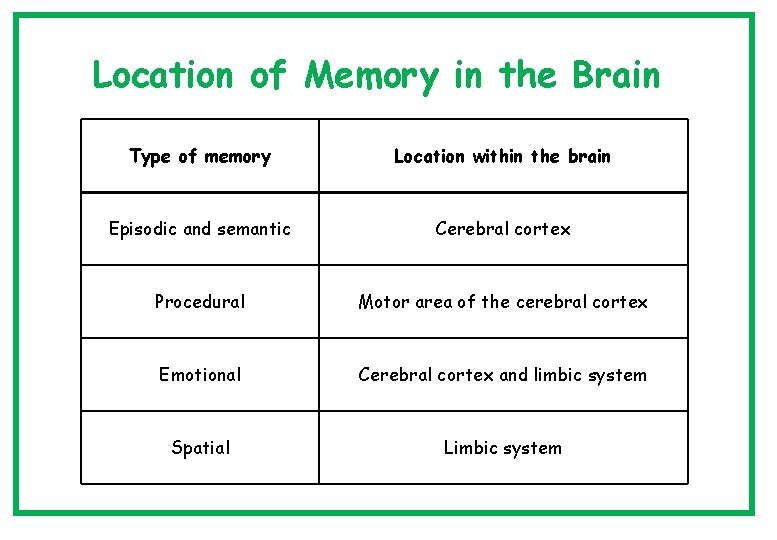
Location of Memory in the Brain Type of memory Location within the brain Episodic and semantic Cerebral cortex Procedural Motor area of the cerebral cortex Emotional Cerebral cortex and limbic system Spatial Limbic system
Questions 1. State what memory and what it includes 2. Describe how information entering the brain reaches long term memory (LTM). 3. Describe the features of the sensory memory. 4. Describe the span of the short term memory (STM). 5. Explain the serial position effect. 6. Describe how STM can be improved or maintained 7. State the two ways in which information is lost from the STM. 8. Describe the methods which aid transfer of information into the LTM. 9. Define the term ‘encoding’ & describe the different methods of encoding. 10. Describe how contextual cues aid memory retrieval. 11. State the locations of episodic, semantic, procedural, emotional and spatial memories within the brain.
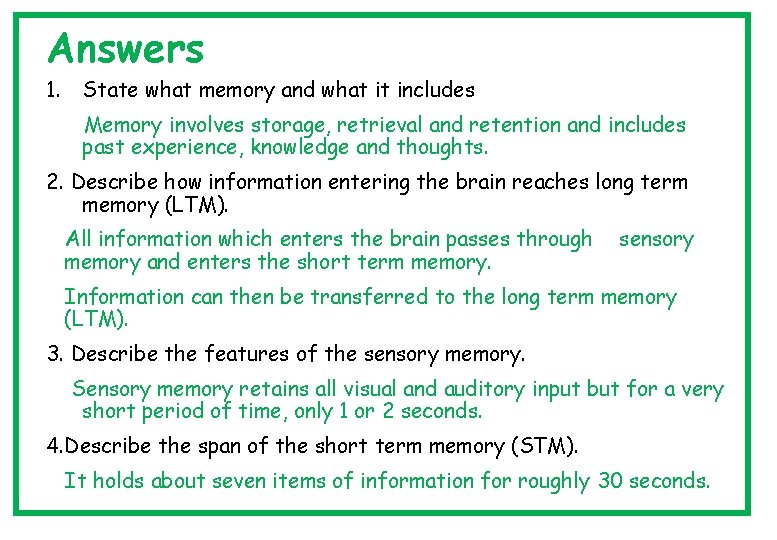
Answers 1. State what memory and what it includes Memory involves storage, retrieval and retention and includes past experience, knowledge and thoughts. 2. Describe how information entering the brain reaches long term memory (LTM). All information which enters the brain passes through memory and enters the short term memory. sensory Information can then be transferred to the long term memory (LTM). 3. Describe the features of the sensory memory. Sensory memory retains all visual and auditory input but for a very short period of time, only 1 or 2 seconds. 4. Describe the span of the short term memory (STM). It holds about seven items of information for roughly 30 seconds.
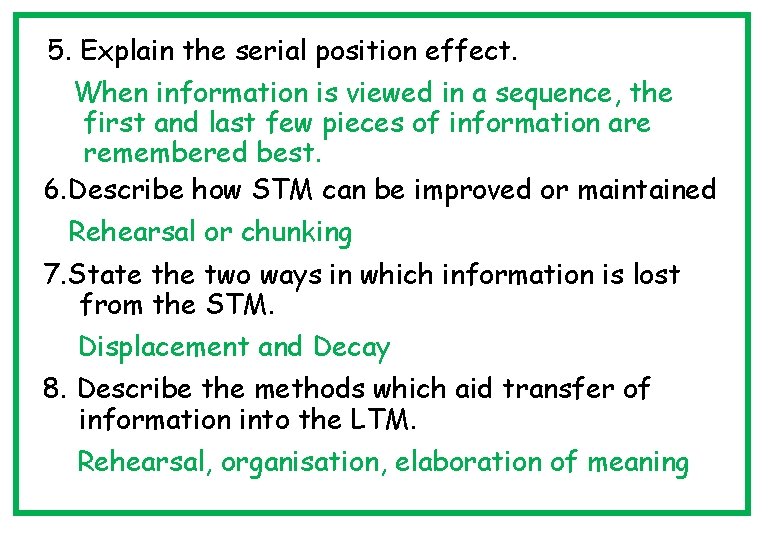
5. Explain the serial position effect. When information is viewed in a sequence, the first and last few pieces of information are remembered best. 6. Describe how STM can be improved or maintained Rehearsal or chunking 7. State the two ways in which information is lost from the STM. Displacement and Decay 8. Describe the methods which aid transfer of information into the LTM. Rehearsal, organisation, elaboration of meaning
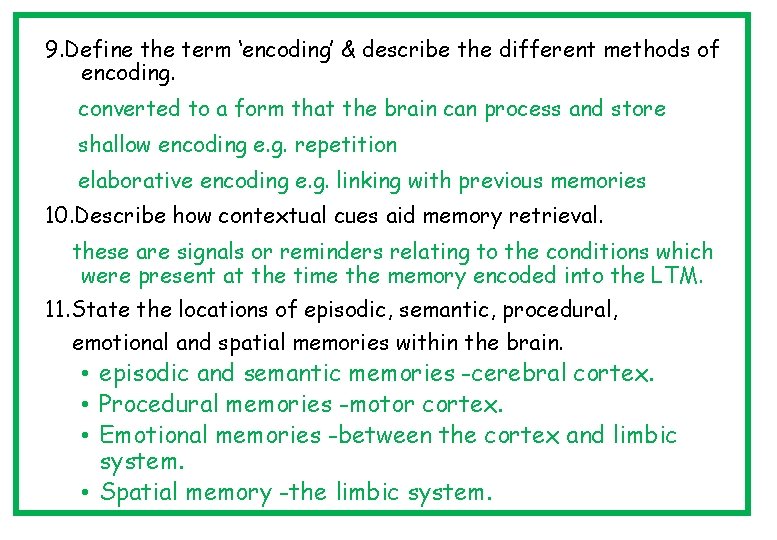
9. Define the term ‘encoding’ & describe the different methods of encoding. converted to a form that the brain can process and store shallow encoding e. g. repetition elaborative encoding e. g. linking with previous memories 10. Describe how contextual cues aid memory retrieval. these are signals or reminders relating to the conditions which were present at the time the memory encoded into the LTM. 11. State the locations of episodic, semantic, procedural, emotional and spatial memories within the brain. • episodic and semantic memories -cerebral cortex. • Procedural memories -motor cortex. • Emotional memories -between the cortex and limbic system. • Spatial memory -the limbic system.
a) Memory Now I can…. . • State that memory includes past experiences, knowledge and thoughts. • Describe the process of encoding • Describe the process of memory storage and retrieval of information. • Explain that all information passes though sensory memory and enters the short term memory (STM). • Explain that once information has passed through the short term memory it is either discarded or transferred to the long-term memory (LTM)
b) Sensory Memory Now I can…. . • Describe that sensory information retains all the visual and auditory input received for a few seconds. • State that following this only selected images and sounds are encoded into short term memory.
c) Short-term Memory (STM) Now I can…. . • State that short term memory has a limited capacity • State that short term memory only holds information for a short period of time • Describe “chunking”, memory span, serial position effect, rehearsal, displacement and decay • Explain how the short term memory can perform simple cognitive tasks
d) Long-term Memory (STM) Now I can…. . • State that long term memory has an unlimited capacity • State that long term memory can hold information for a long time • Describe how information is transferred from the short term memory to the long term memory by rehearsal, organisation and elaboration • State that retrieval is aided by the use of contextual cues
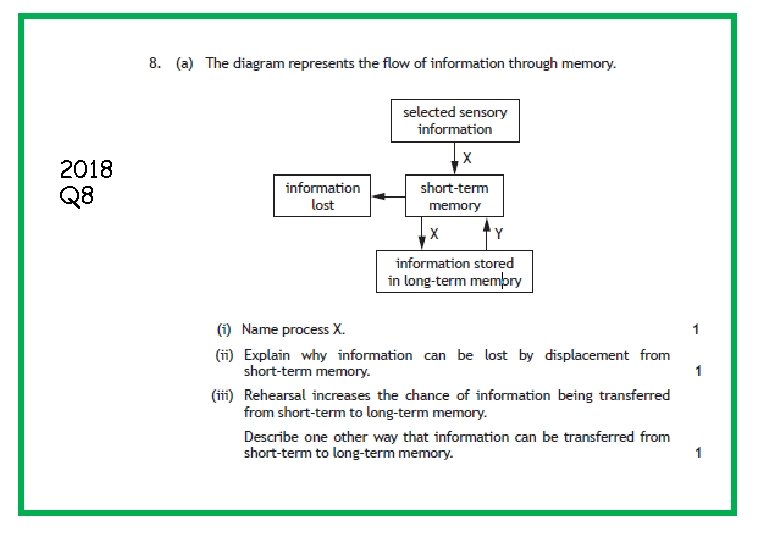
2018 Q 8
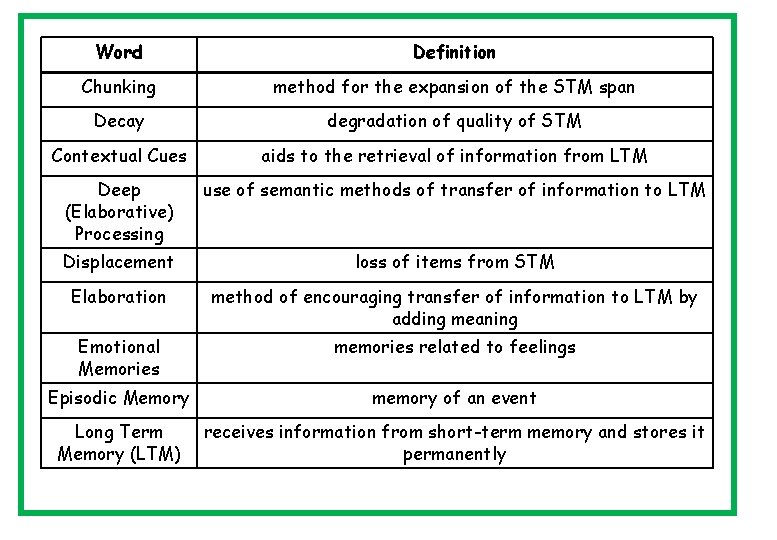
Word Definition Chunking method for the expansion of the STM span Decay degradation of quality of STM Contextual Cues aids to the retrieval of information from LTM Deep (Elaborative) Processing use of semantic methods of transfer of information to LTM Displacement loss of items from STM Elaboration method of encouraging transfer of information to LTM by adding meaning Emotional Memories memories related to feelings Episodic Memory memory of an event Long Term Memory (LTM) receives information from short-term memory and stores it permanently
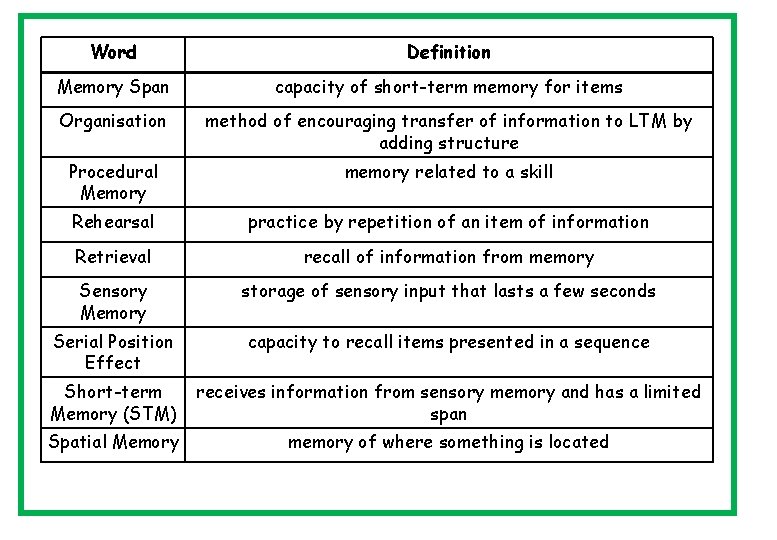
Word Definition Memory Span capacity of short-term memory for items Organisation method of encouraging transfer of information to LTM by adding structure Procedural Memory memory related to a skill Rehearsal practice by repetition of an item of information Retrieval recall of information from memory Sensory Memory storage of sensory input that lasts a few seconds Serial Position Effect capacity to recall items presented in a sequence Short-term Memory (STM) receives information from sensory memory and has a limited span Spatial Memory memory of where something is located
- Slides: 47