
Higher Education Offerings and Labour Market Trends 1

Higher Education Offerings and Labour Market Trends 1 st International Conference on Quality Assurance in Higher Education Quality in Higher Education: From Best Practice to Next Practice Accreditation Council of Trinidad and Tobago Port of Spain Trinidad and Tobago Franz Gertze CEO Namibia Qualifications Authority May 02, 2013
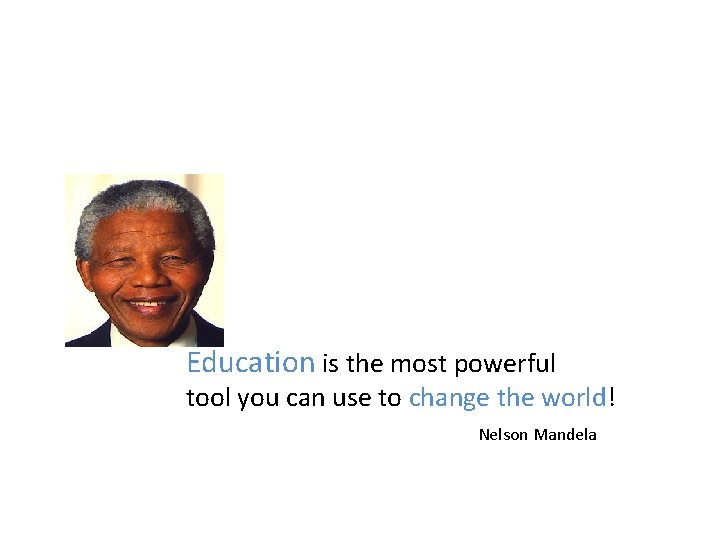
Education is the most powerful tool you can use to change the world! Nelson Mandela
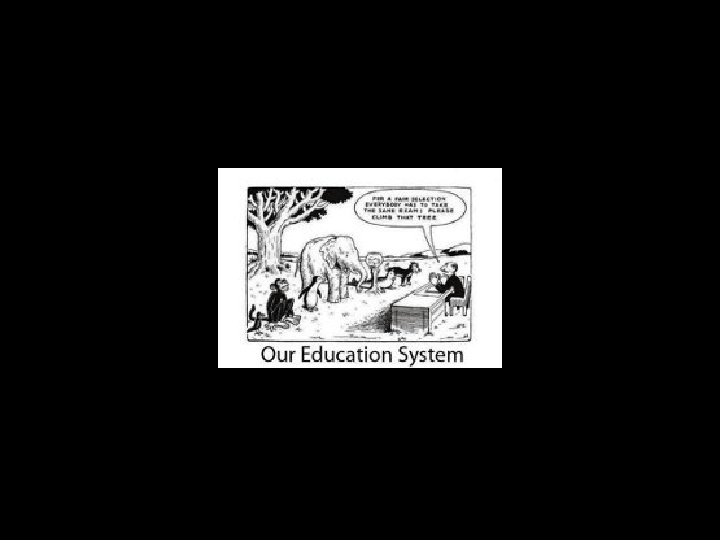
Whose life is it and who takes responsibility? Why do I learn? What do I learn? Who decides?
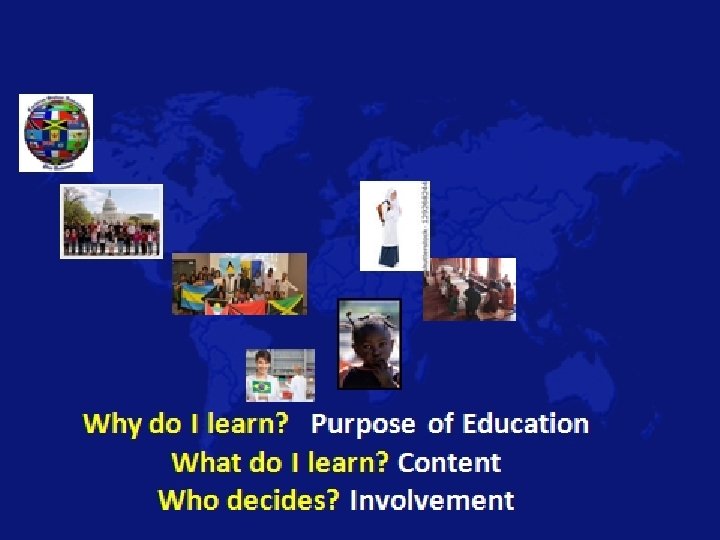
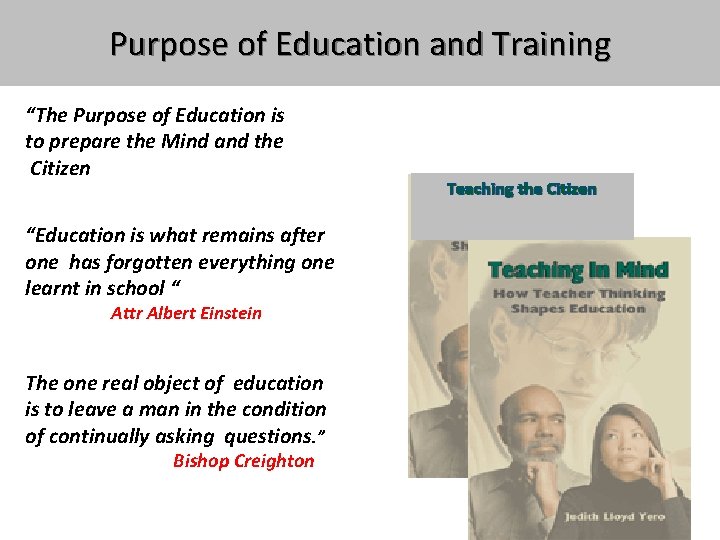
Purpose of Education and Training “The Purpose of Education is to prepare the Mind and the Citizen “Education is what remains after one has forgotten everything one learnt in school “ Attr Albert Einstein The one real object of education is to leave a man in the condition of continually asking questions. ” Bishop Creighton Teaching the Citizen
Purpose of Education and Training “The aim of education should be to teach us rather how to think, than what to think – rather to improve our minds, so as to enable us to think for ourselves, than to load the memory with the thoughts of other men. ” Bill Beattie Tom Peters reminds us, "What gets measured, gets done. " (STANDARDS) Regardless of the high sounding rhetoric about the development of the total learner, it is the content of Learning and the Assessments that largely drives education.
Knowledge Application is at the Cutting edge of Poverty Eradication No one ever enters higher education without considering the prospect of a job or prosperity No matter what global problem we are dreading, whether it is the elimination of poverty, whether it is solving environmental energy problems, ending wars, the solution – whatever it is – multiple solutions. . . will always include education as a component
Higher Education: Megatrends Globalisation • Free movement of goods and services including education and training GATTS • World Declaration on Higher Education for the 21 st Century (UNESCO) • Affects decisions that have to be made • Education and training responded by: • Differentiation • Privatisation • Consumerism • CBET / OBE • Internationalisation • Massification • Qualifications Frameworks • Quality Assurance
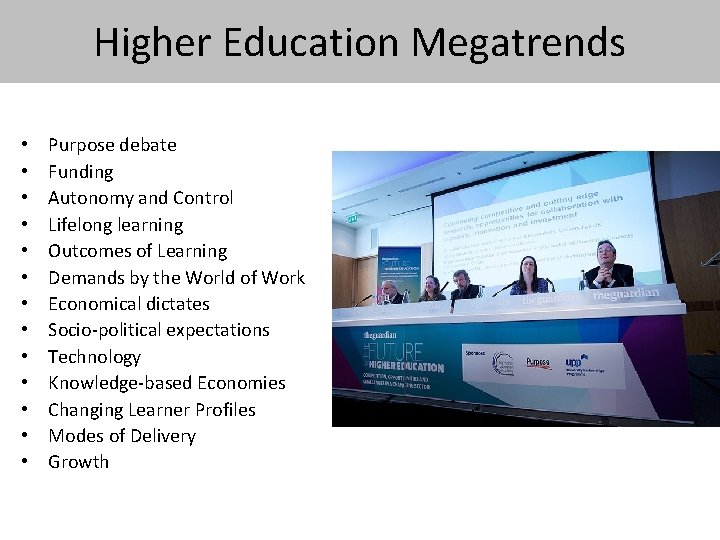
Higher Education Megatrends • • • • Purpose debate Funding Autonomy and Control Lifelong learning Outcomes of Learning Demands by the World of Work Economical dictates Socio-political expectations Technology Knowledge-based Economies Changing Learner Profiles Modes of Delivery Growth
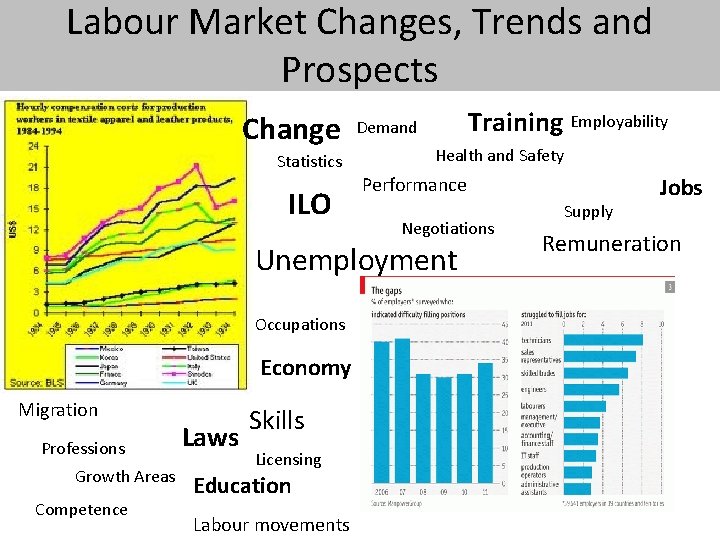
Labour Market Changes, Trends and Prospects Change Statistics ILO Training Employability Demand Health and Safety Performance Negotiations Unemployment Occupations Economy Migration Professions Growth Areas Competence Laws Skills Licensing Education Labour movements Supply Jobs Remuneration
Drivers of Industry & Occupational Change? • Technological change = making the improbable possible • Political change = market and labour mobility • Generational change = less conformist, more individualist • Business change = companies like ‘tents, not pyramids’* • Demographic change = more older workers • Life expectancy = impact on health costs • Innovation in education = making skills more accessible • CBET = Competent and Performing nationals Source: worldtocom. com futures network, 2004; *Acknowledgement to Peter Drucker, Management Challenges for the 21 st Century, 2003
Implications for the Labour Force • • • Demographics are changing Requirement for more skilled adult workers, working longer Key/generic/employability skills an increasing issue Currency of knowledge and skills is shortening Need to up-skill or re-skill 5 to 10 times in working life Earnings improve with learning ÄIndividuals compete (globally) on COMPETENCE, knowledge, attitude and skills
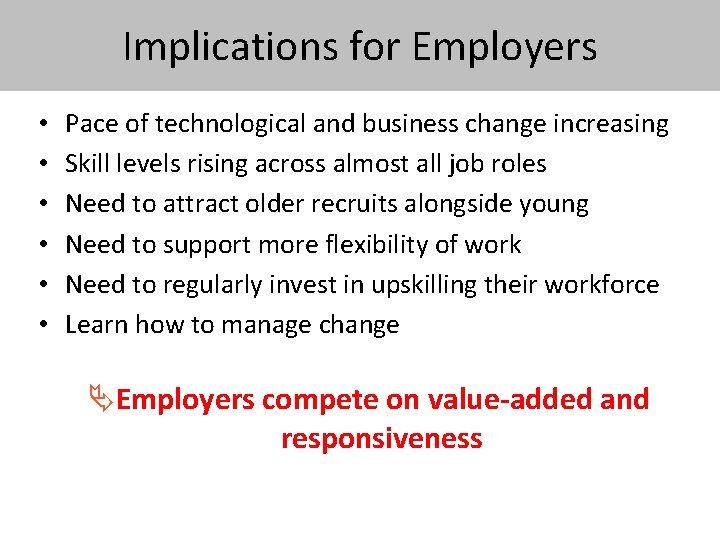
Implications for Employers • • • Pace of technological and business change increasing Skill levels rising across almost all job roles Need to attract older recruits alongside young Need to support more flexibility of work Need to regularly invest in upskilling their workforce Learn how to manage change ÄEmployers compete on value-added and responsiveness
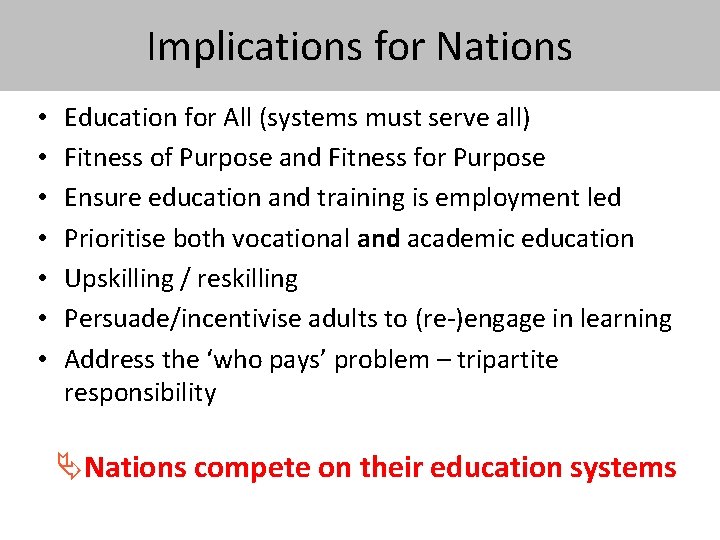
Implications for Nations • • Education for All (systems must serve all) Fitness of Purpose and Fitness for Purpose Ensure education and training is employment led Prioritise both vocational and academic education Upskilling / reskilling Persuade/incentivise adults to (re-)engage in learning Address the ‘who pays’ problem – tripartite responsibility ÄNations compete on their education systems
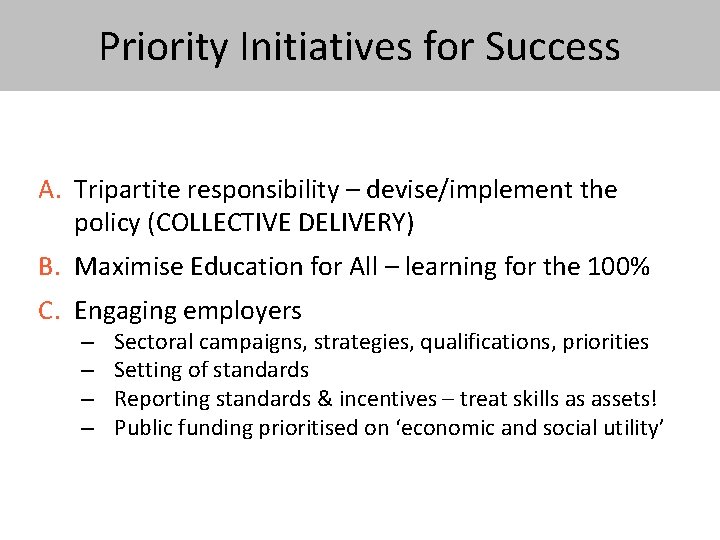
Priority Initiatives for Success A. Tripartite responsibility – devise/implement the policy (COLLECTIVE DELIVERY) B. Maximise Education for All – learning for the 100% C. Engaging employers – – Sectoral campaigns, strategies, qualifications, priorities Setting of standards Reporting standards & incentives – treat skills as assets! Public funding prioritised on ‘economic and social utility’
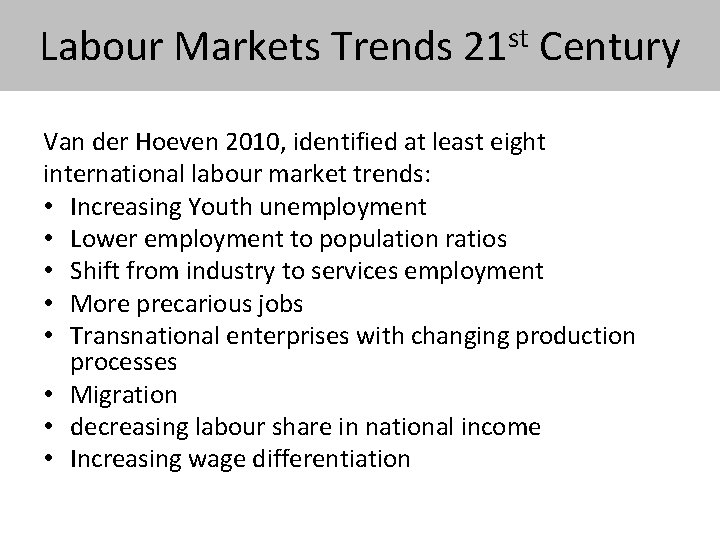
Labour Markets Trends 21 st Century Van der Hoeven 2010, identified at least eight international labour market trends: • Increasing Youth unemployment • Lower employment to population ratios • Shift from industry to services employment • More precarious jobs • Transnational enterprises with changing production processes • Migration • decreasing labour share in national income • Increasing wage differentiation
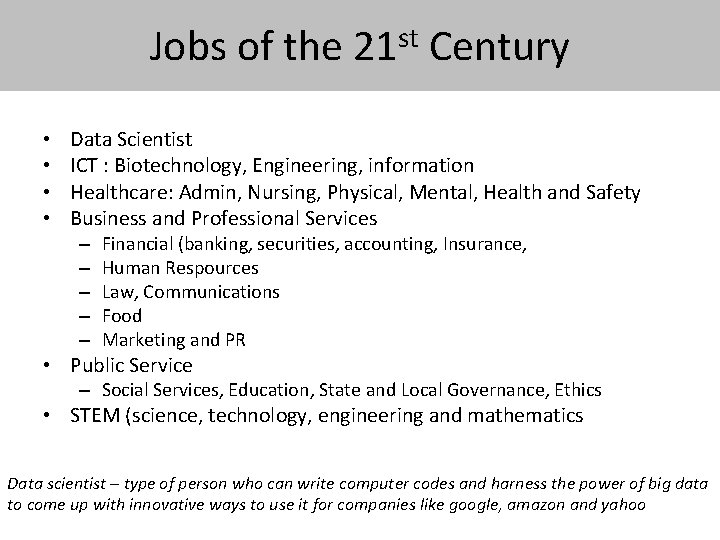
Jobs of the 21 st Century • • Data Scientist ICT : Biotechnology, Engineering, information Healthcare: Admin, Nursing, Physical, Mental, Health and Safety Business and Professional Services – – – Financial (banking, securities, accounting, Insurance, Human Respources Law, Communications Food Marketing and PR • Public Service – Social Services, Education, State and Local Governance, Ethics • STEM (science, technology, engineering and mathematics Data scientist – type of person who can write computer codes and harness the power of big data to come up with innovative ways to use it for companies like google, amazon and yahoo
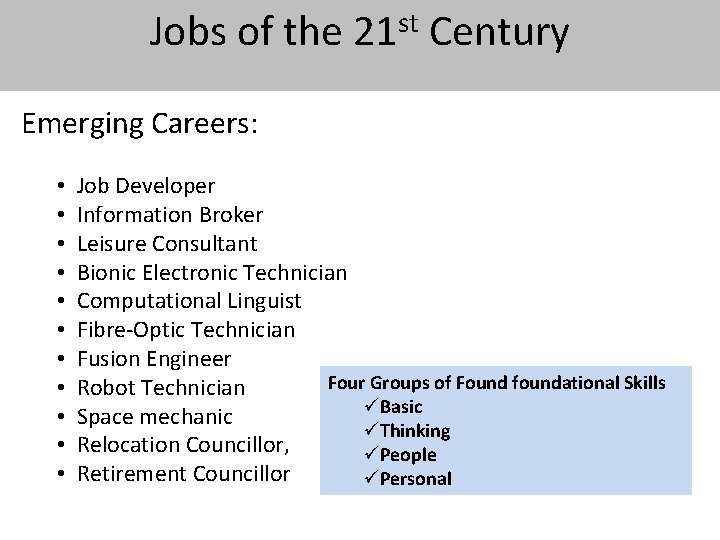
Jobs of the st 21 Century Emerging Careers: • • • Job Developer Information Broker Leisure Consultant Bionic Electronic Technician Computational Linguist Fibre-Optic Technician Fusion Engineer Four Groups of Found foundational Skills Robot Technician üBasic Space mechanic üThinking Relocation Councillor, üPeople Retirement Councillor üPersonal

Labour Market Changes, Trends and Prospects
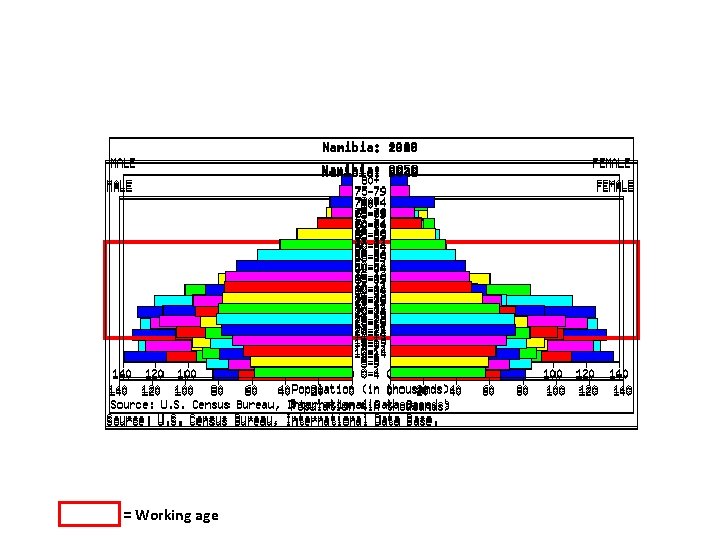
= Working age
Employment varies with education attainment: The higher the level of education, the lower the probability of unemployment
“A competitive society is one which achieves a dynamic equilibrium between wealth creation and social cohesion” Prof. Stephane Garelli, Editor, World Competitiveness Handbook, 1995
Labour Market Changes, Trends and Prospects Expectations • • Skills (Generic, Specific, Transferable) Competence Performance Attitude and Aptitude Knowledge Evolving Technology Employability
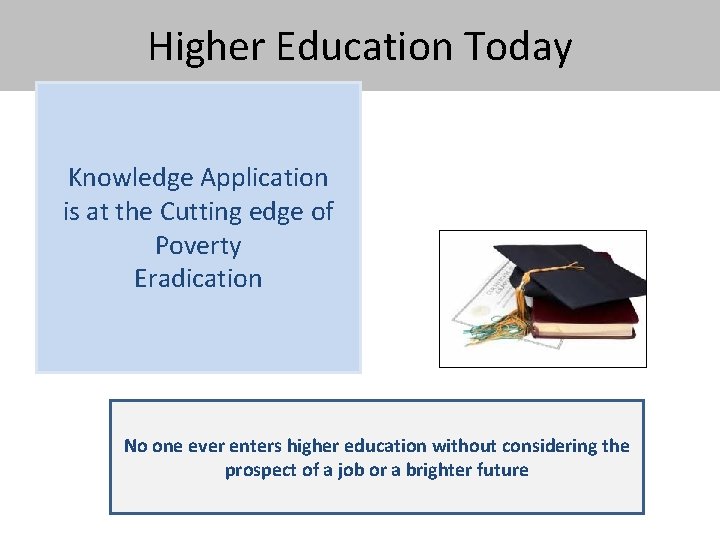
Higher Education Today Knowledge Application is at the Cutting edge of Poverty Eradication No one ever enters higher education without considering the prospect of a job or a brighter future

Employment Success Self-actualisation
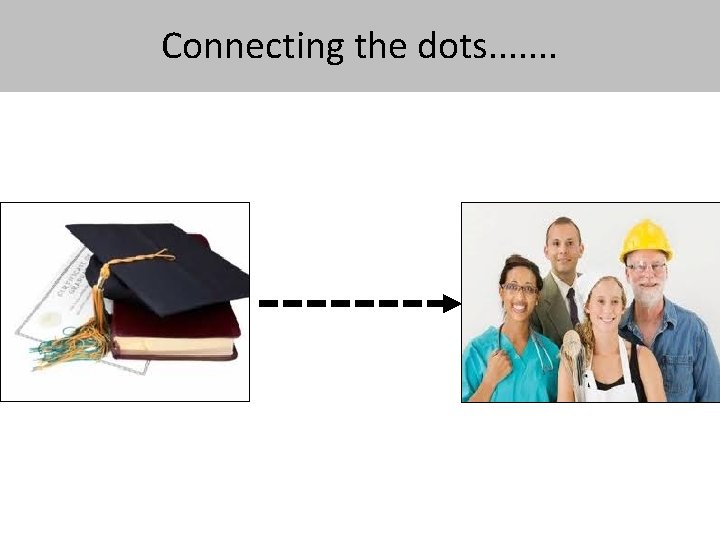
Connecting the dots. . . .

Connecting the dots. . . .
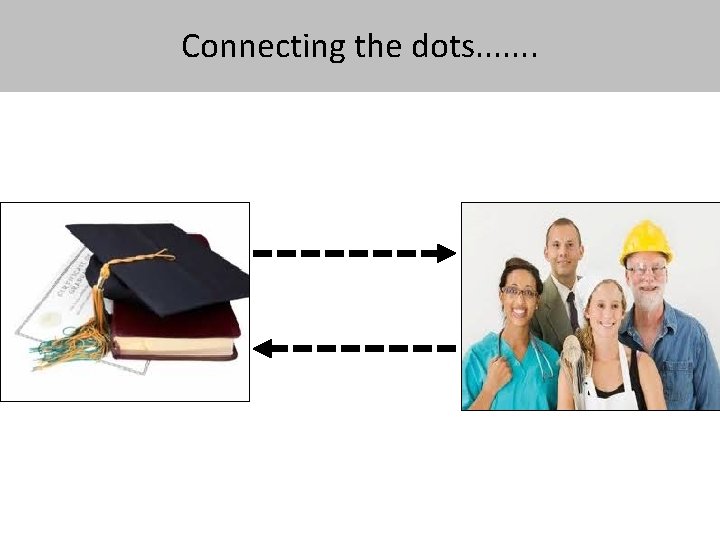
Connecting the dots. . . .
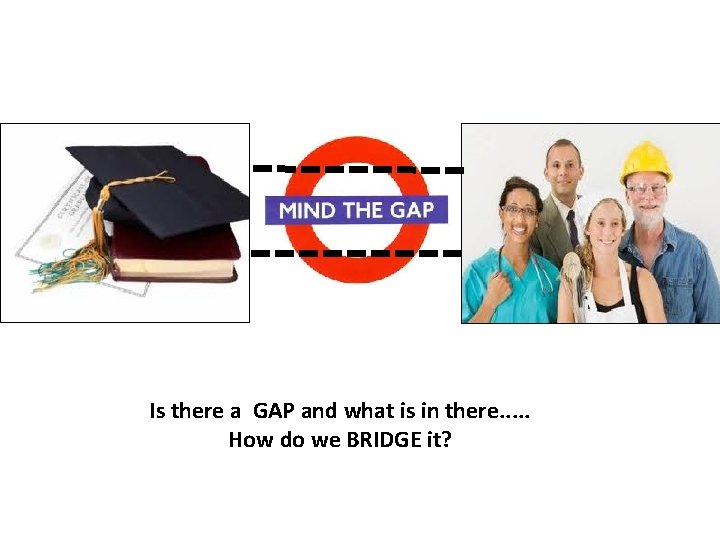
Is there a GAP and what is in there. . . How do we BRIDGE it?
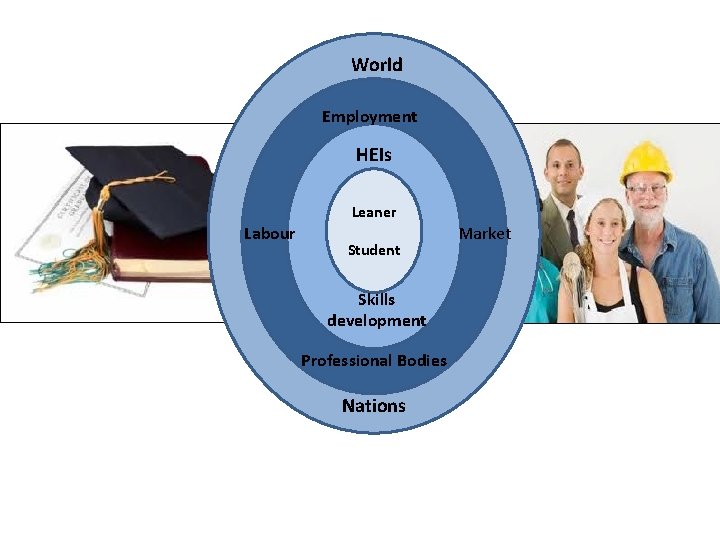
World Employment HEIs Leaner Labour Learner Employee Student Skills development Professional Bodies Nations Market
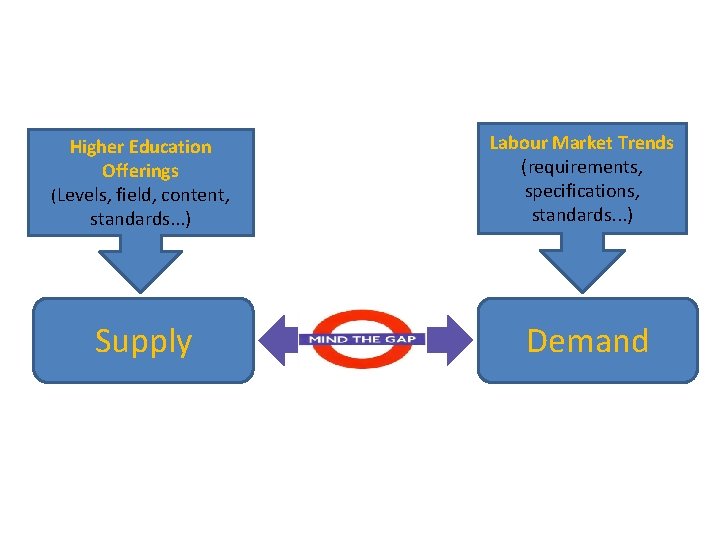
Higher Education Offerings (Levels, field, content, standards. . . ) Labour Market Trends (requirements, specifications, standards. . . ) Supply Demand
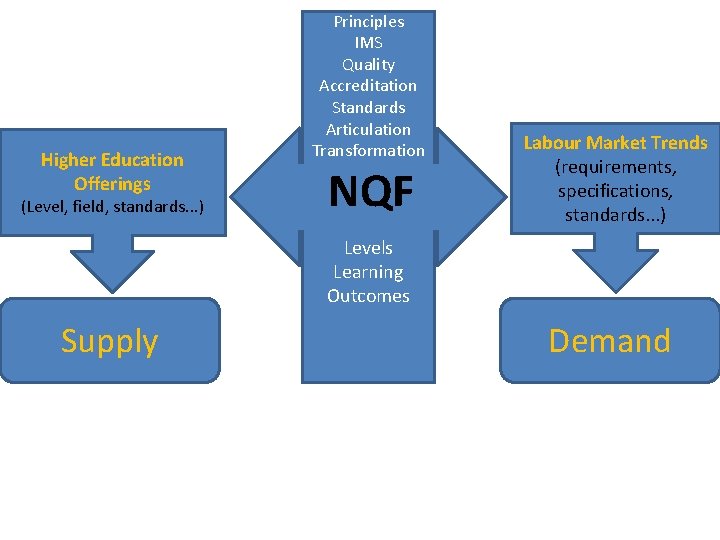
Higher Education Offerings (Level, field, standards. . . ) Principles IMS Quality Accreditation Standards Articulation Transformation NQF Labour Market Trends (requirements, specifications, standards. . . ) Levels Learning Outcomes Supply Demand
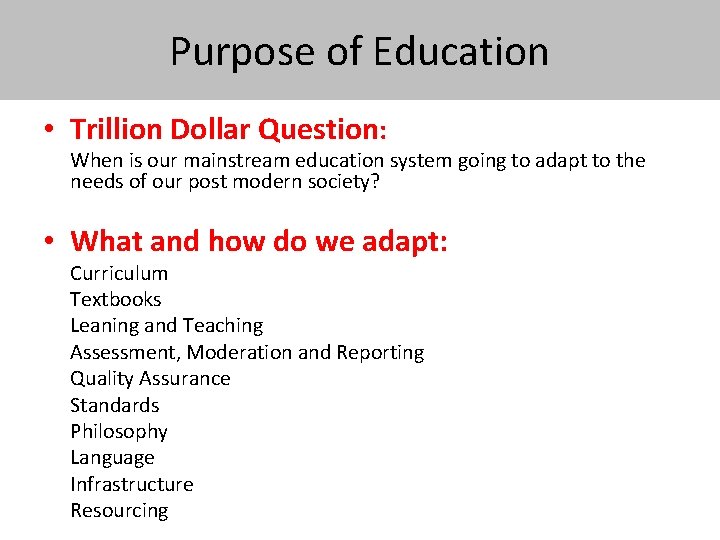
Purpose of Education • Trillion Dollar Question: When is our mainstream education system going to adapt to the needs of our post modern society? • What and how do we adapt: Curriculum Textbooks Leaning and Teaching Assessment, Moderation and Reporting Quality Assurance Standards Philosophy Language Infrastructure Resourcing

The Namibia Qualifications Authority: Mandate
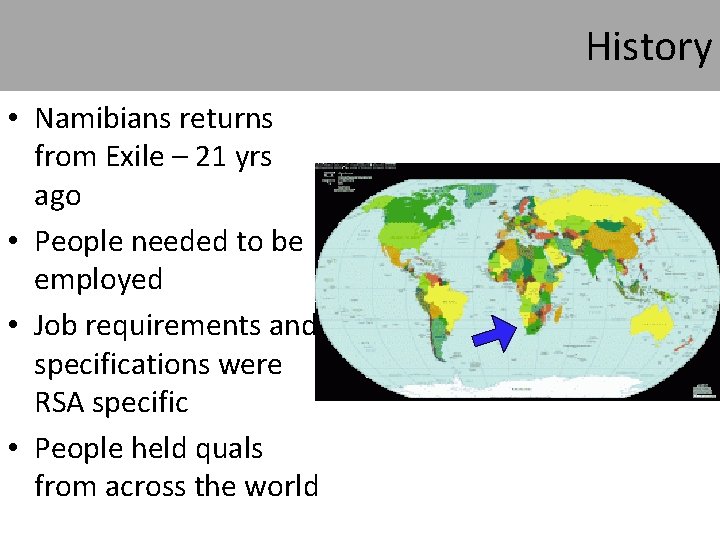
History • Namibians returns from Exile – 21 yrs ago • People needed to be employed • Job requirements and specifications were RSA specific • People held quals from across the world
History • common criteria for equivalence of all learning/awards • Criteria to be clear, fair, transparent, just, legal…. . A COMMON CURRENCY
History • ISSUES – – – – – Comparability Quality Relevance Responsiveness HRD Planning Productivity Justice Transparency Competence Articulation
NQA’s accountability • A body established by the Namibia Qualifications Authority Act ( Act 29 of 1996) • Statutory body and a State-Owned Enterprise • Governed by a Council of 36 members from key stakeholder areas • Serviced by a Secretariat
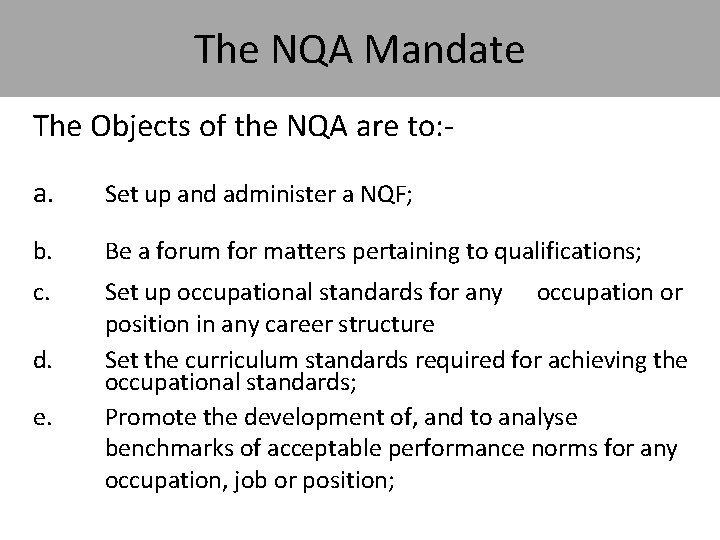
The NQA Mandate The Objects of the NQA are to: a. Set up and administer a NQF; b. Be a forum for matters pertaining to qualifications; c. Set up occupational standards for any occupation or position in any career structure Set the curriculum standards required for achieving the occupational standards; Promote the development of, and to analyse benchmarks of acceptable performance norms for any occupation, job or position; d. e.
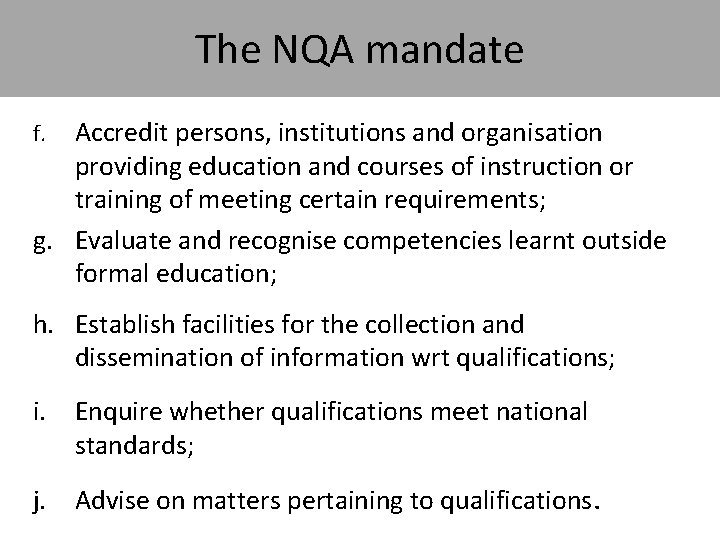
The NQA mandate Accredit persons, institutions and organisation providing education and courses of instruction or training of meeting certain requirements; g. Evaluate and recognise competencies learnt outside formal education; f. h. Establish facilities for the collection and dissemination of information wrt qualifications; i. Enquire whether qualifications meet national standards; j. Advise on matters pertaining to qualifications.
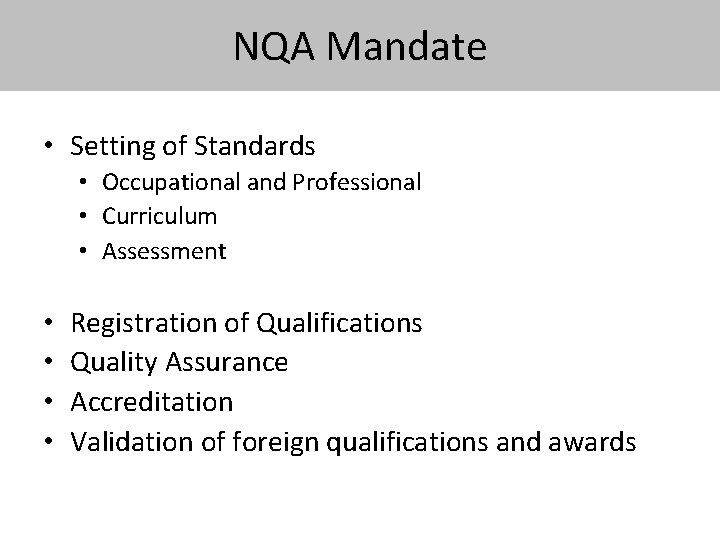
NQA Mandate • Setting of Standards • Occupational and Professional • Curriculum • Assessment • • Registration of Qualifications Quality Assurance Accreditation Validation of foreign qualifications and awards
Vision Global and reputable authority empowering people
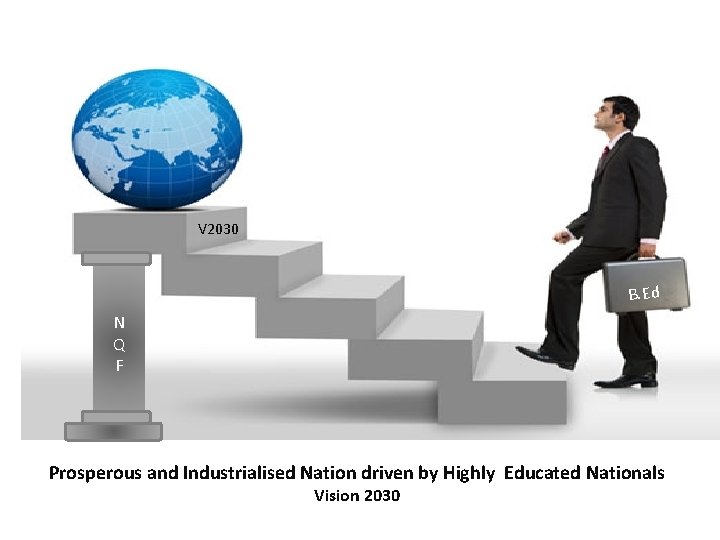
V 2030 B. Ed N Q F Prosperous and Industrialised Nation driven by Highly Educated Nationals Vision 2030
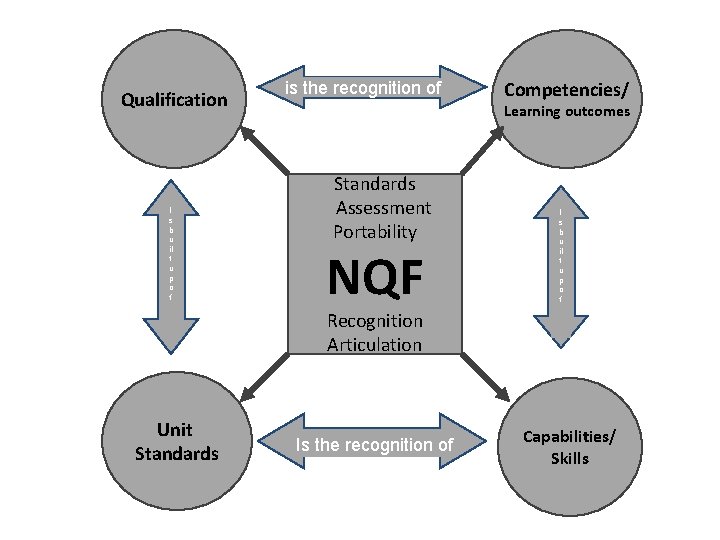
Qualification I s b u il t u p o f is the recognition of Competencies/ Learning outcomes Standards Assessment Portability NQF I s b u il t u p o f Recognition Articulation Unit Standards Is the recognition of Capabilities/ Skills
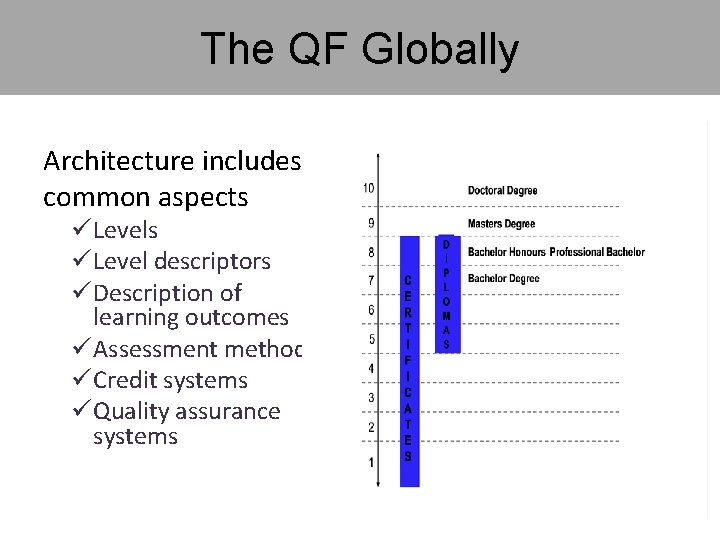
The QF Globally Architecture includes common aspects ü Level descriptors ü Description of learning outcomes ü Assessment methods ü Credit systems ü Quality assurance systems
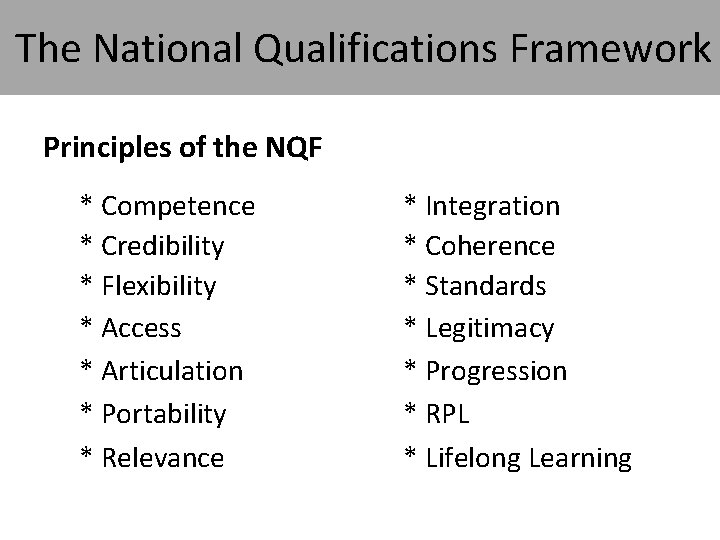
The National Qualifications Framework Principles of the NQF * Competence * Credibility * Flexibility * Access * Articulation * Portability * Relevance * Integration * Coherence * Standards * Legitimacy * Progression * RPL * Lifelong Learning
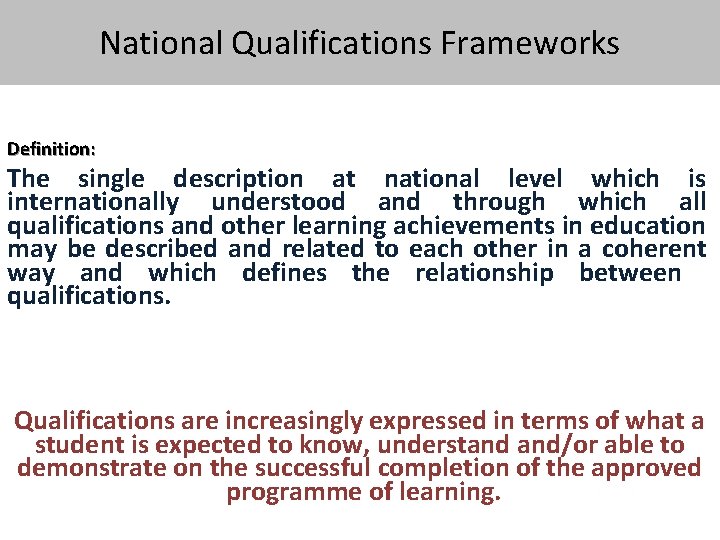
National Qualifications Frameworks Definition: The single description at national level which is internationally understood and through which all qualifications and other learning achievements in education may be described and related to each other in a coherent way and which defines the relationship between qualifications. Qualifications are increasingly expressed in terms of what a student is expected to know, understand and/or able to demonstrate on the successful completion of the approved programme of learning.
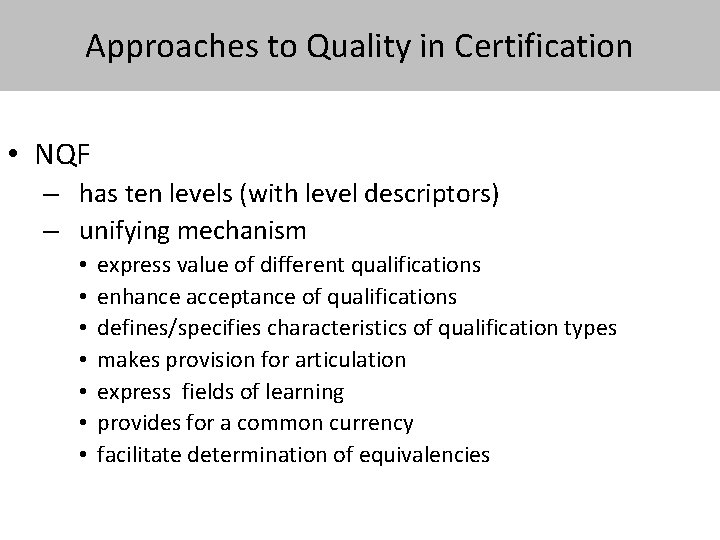
Approaches to Quality in Certification • NQF – has ten levels (with level descriptors) – unifying mechanism • • express value of different qualifications enhance acceptance of qualifications defines/specifies characteristics of qualification types makes provision for articulation express fields of learning provides for a common currency facilitate determination of equivalencies
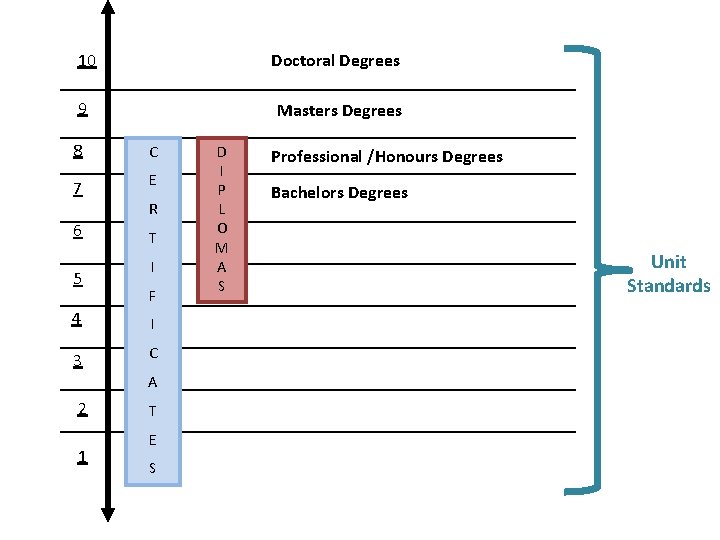
10 Doctoral Degrees 9 Masters Degrees 8 C 7 E 6 5 R T I F 4 I 3 C A 2 1 T E S D I P L O M A S Professional /Honours Degrees Bachelors Degrees Unit Standards

NQF and its Levels
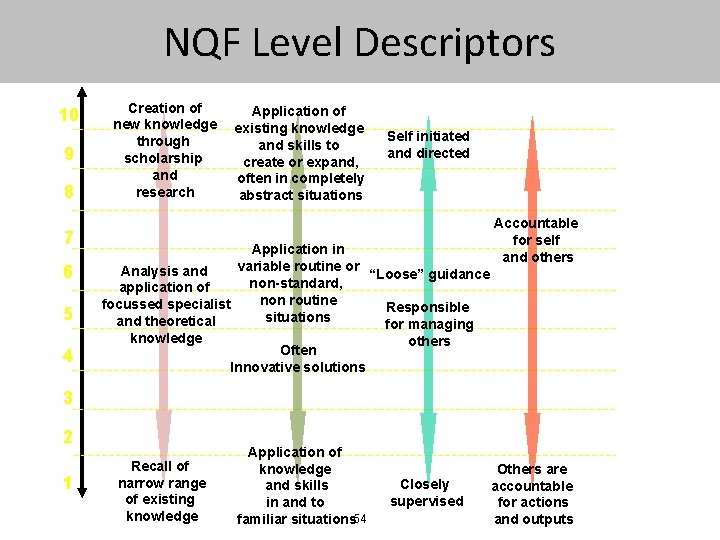
NQF Level Descriptors 10 9 8 7 6 5 4 Creation of new knowledge through scholarship and research Application of existing knowledge and skills to create or expand, often in completely abstract situations Self initiated and directed Application in variable routine or Analysis and “Loose” guidance non-standard, application of non routine focussed specialist Responsible situations and theoretical for managing knowledge others Often Innovative solutions Accountable for self and others 3 2 1 Recall of narrow range of existing knowledge Application of knowledge and skills in and to familiar situations 54 Closely supervised Others are accountable for actions and outputs
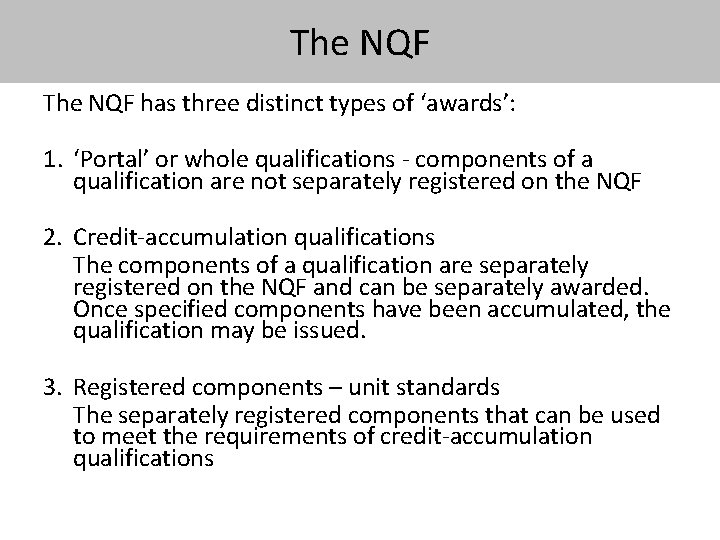
The NQF has three distinct types of ‘awards’: 1. ‘Portal’ or whole qualifications - components of a qualification are not separately registered on the NQF 2. Credit-accumulation qualifications The components of a qualification are separately registered on the NQF and can be separately awarded. Once specified components have been accumulated, the qualification may be issued. 3. Registered components – unit standards The separately registered components that can be used to meet the requirements of credit-accumulation qualifications
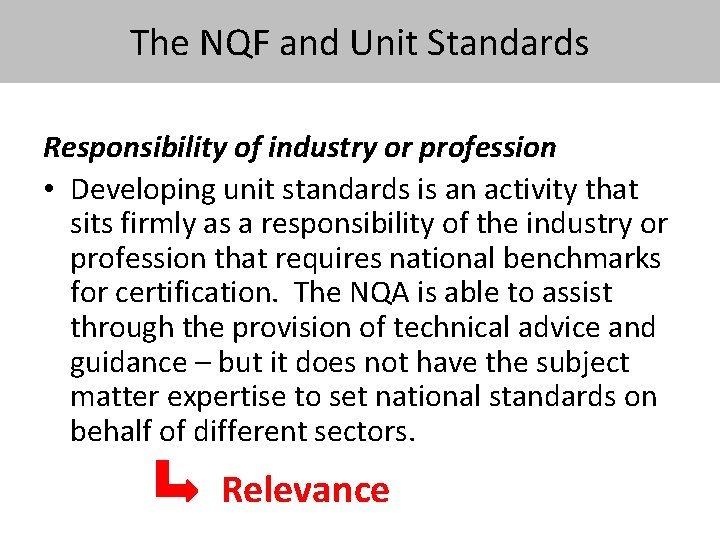
The NQF and Unit Standards Responsibility of industry or profession • Developing unit standards is an activity that sits firmly as a responsibility of the industry or profession that requires national benchmarks for certification. The NQA is able to assist through the provision of technical advice and guidance – but it does not have the subject matter expertise to set national standards on behalf of different sectors. Relevance
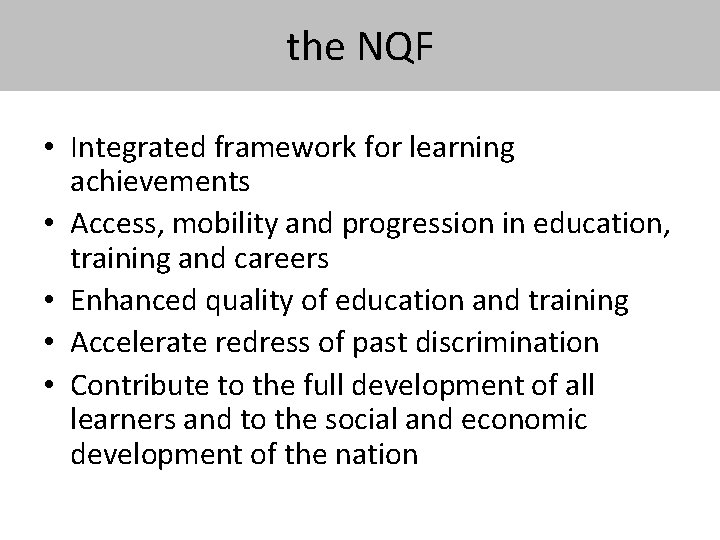
the NQF • Integrated framework for learning achievements • Access, mobility and progression in education, training and careers • Enhanced quality of education and training • Accelerate redress of past discrimination • Contribute to the full development of all learners and to the social and economic development of the nation
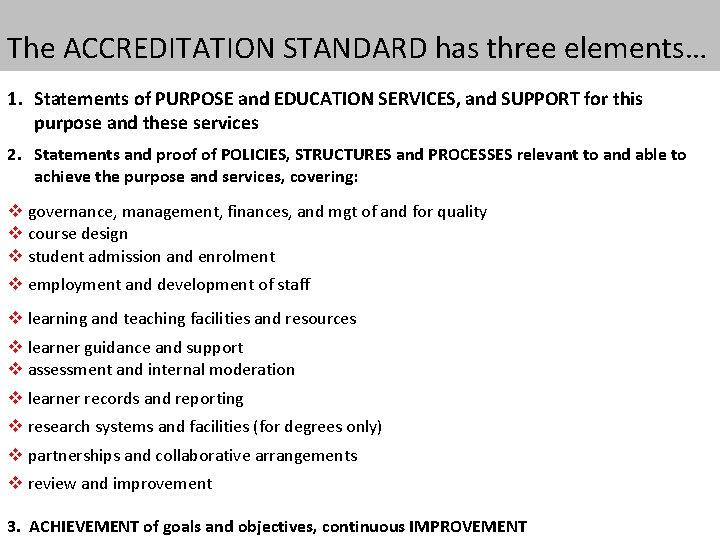
The ACCREDITATION STANDARD has three elements… 1. Statements of PURPOSE and EDUCATION SERVICES, and SUPPORT for this purpose and these services 2. Statements and proof of POLICIES, STRUCTURES and PROCESSES relevant to and able to achieve the purpose and services, covering: v governance, management, finances, and mgt of and for quality v course design v student admission and enrolment v employment and development of staff v learning and teaching facilities and resources v learner guidance and support v assessment and internal moderation v learner records and reporting v research systems and facilities (for degrees only) v partnerships and collaborative arrangements v review and improvement 3. ACHIEVEMENT of goals and objectives, continuous IMPROVEMENT
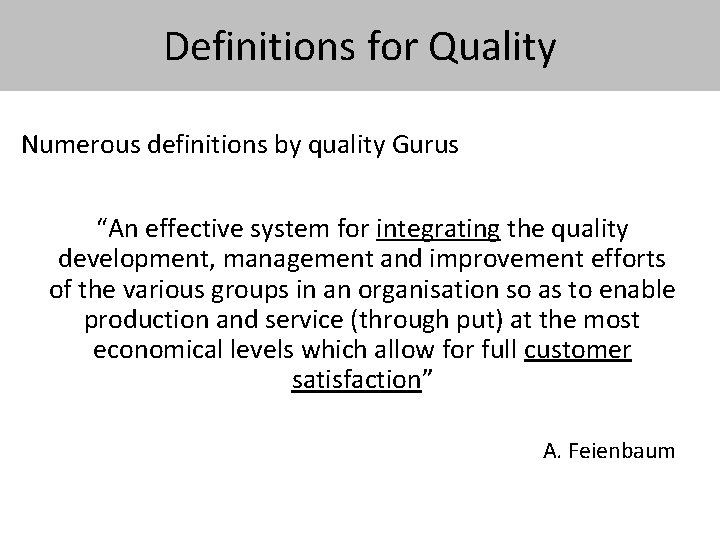
Definitions for Quality Numerous definitions by quality Gurus “An effective system for integrating the quality development, management and improvement efforts of the various groups in an organisation so as to enable production and service (through put) at the most economical levels which allow for full customer satisfaction” A. Feienbaum
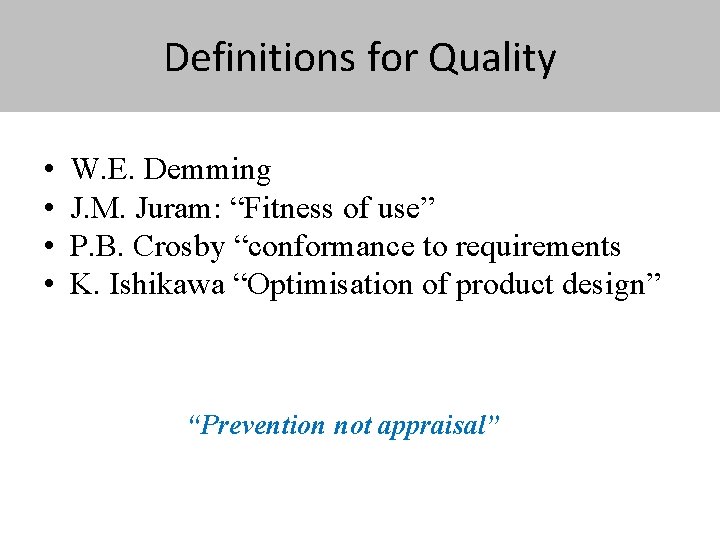
Definitions for Quality • • W. E. Demming J. M. Juram: “Fitness of use” P. B. Crosby “conformance to requirements K. Ishikawa “Optimisation of product design” “Prevention not appraisal”
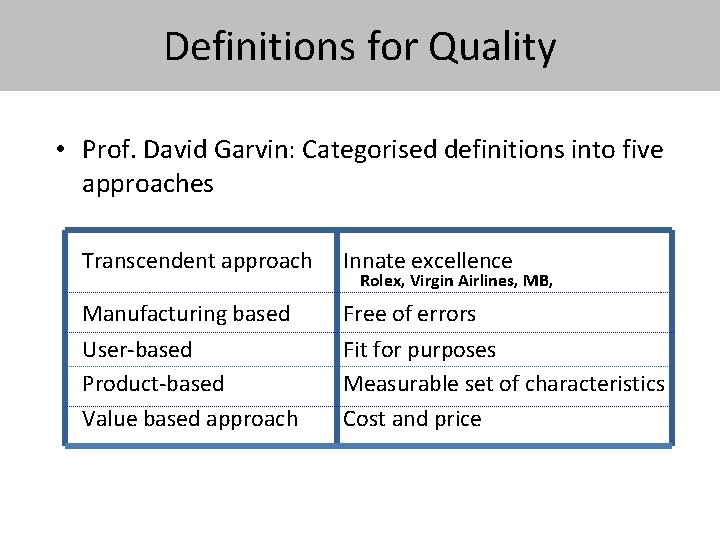
Definitions for Quality • Prof. David Garvin: Categorised definitions into five approaches Transcendent approach Innate excellence Manufacturing based User-based Product-based Value based approach Free of errors Fit for purposes Measurable set of characteristics Cost and price Rolex, Virgin Airlines, MB,
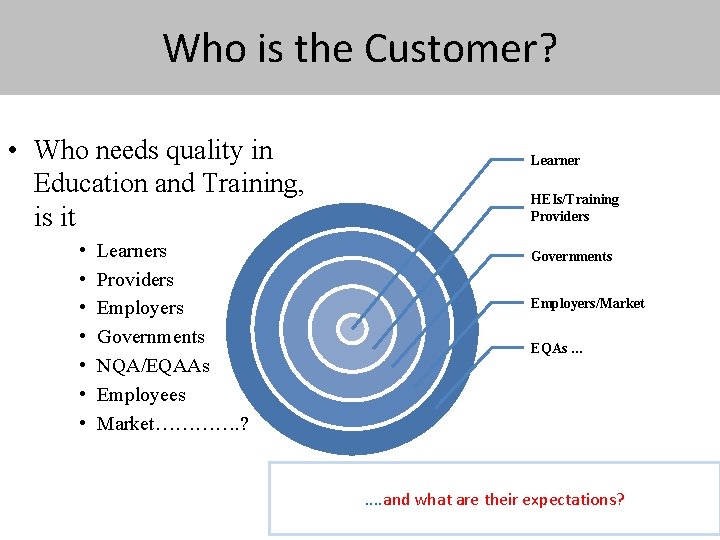
Who is the Customer? • Who needs quality in Education and Training, is it • • Learners Providers Employers Governments NQA/EQAAs Employees Market…………. ? Learner HEIs/Training Providers Governments Employers/Market EQAs … . . and what are their expectations?
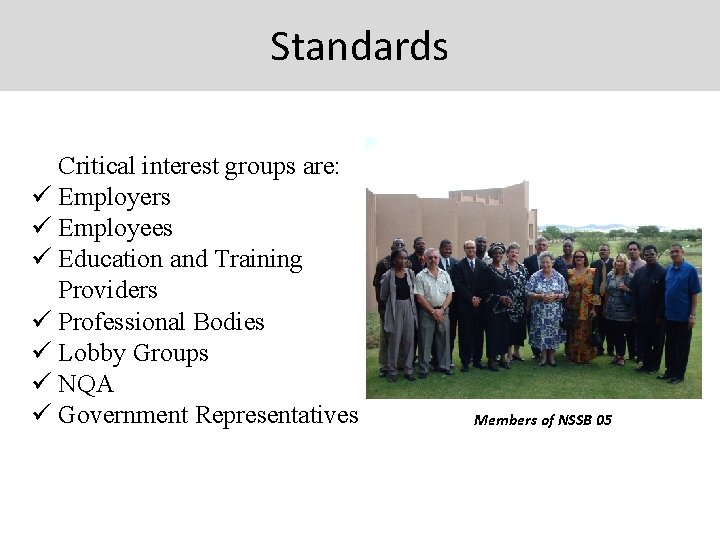
Standards Critical interest groups are: ü Employers ü Employees ü Education and Training Providers ü Professional Bodies ü Lobby Groups ü NQA ü Government Representatives Members of NSSB 05
Standards What is a standard? “…. a measure, devised by general consent, as a basis for comparison against which judgements might be made as to the levels of acceptability
How does a learner benefit from the NQF? • NQF will provide quality assured learning and qualifications. • Enable all people to develop to their full potential. • Enhance access for everyone to learning and assessment. • Provide opportunity for the previous disadvantaged to have their skills and knowledge formally recognised and engaged in further learning. 67
Significance Of NQF: Providers • Assist in establishing the national and international credibility • Strengthen the validity of credit transfer decisions & articulation with other providers • Provide external verification of quality of their education and related programmes of learning 68
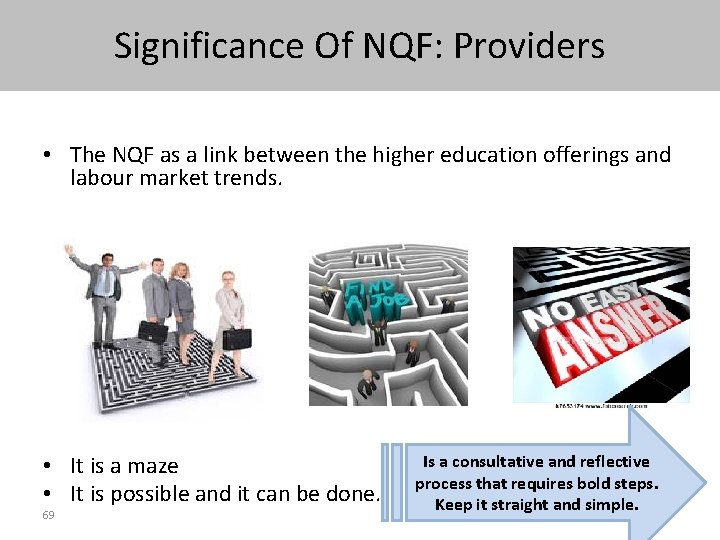
Significance Of NQF: Providers • The NQF as a link between the higher education offerings and labour market trends. • It is a maze • It is possible and it can be done. 69 Is a consultative and reflective process that requires bold steps. Keep it straight and simple.


QUESTIONS?

- Slides: 73