
Higher education in colleges why isnt there more
- Slides: 33
Higher education in colleges: why isn’t there more of it? Leesa Wheelahan Centre for Global Higher Education, UCL Institute of Education 23 June 2016
1. If we have high participation systems… Why has there not been more growth in FE/ TAFE/ community colleges? Cheaper to deliver
2. What is the nature of the new tertiary education system that is emerging? What are the opportunities for students? What are the challenges for colleges?
Arguments 1. Depends on government policy, but colleges can’t win in HE markets 2. HE in colleges opens new opportunities for students but contributes to stratification & maintenance of inequality
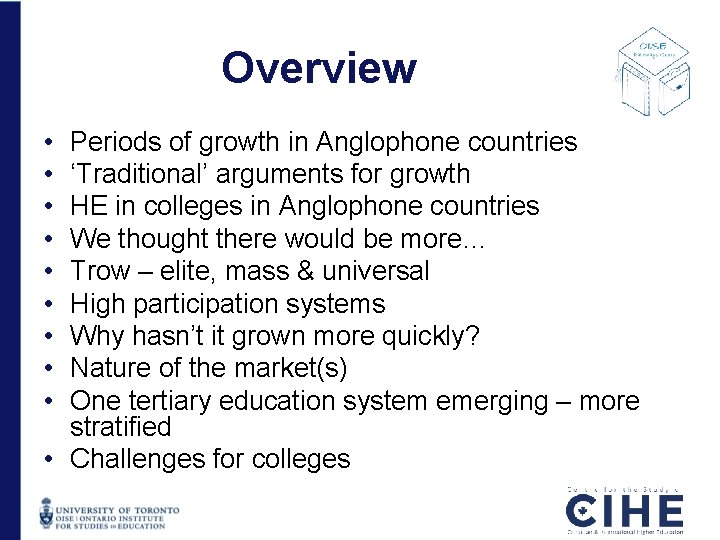
Overview • • • Periods of growth in Anglophone countries ‘Traditional’ arguments for growth HE in colleges in Anglophone countries We thought there would be more… Trow – elite, mass & universal High participation systems Why hasn’t it grown more quickly? Nature of the market(s) One tertiary education system emerging – more stratified • Challenges for colleges
Growth of HE in Anglophone countries • 1 st period 1950 s & 1960 s • 2 nd period – 1980 s • 3 rd period – 2000 s
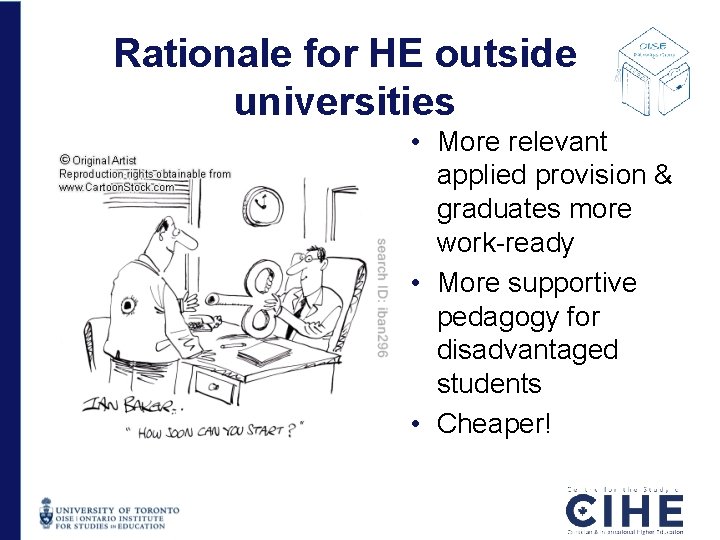
Rationale for HE outside universities • More relevant applied provision & graduates more work-ready • More supportive pedagogy for disadvantaged students • Cheaper!
We thought there would be a lot of growth of HE in colleges
What we said in Australia… • “Unlike earlier periods of expansion of higher education which occurred through the growth of university systems, this process of expansion is occurring through publicly funded non-university providers in the more vocationally oriented sectors of tertiary education and through the growth of private educational providers in Australia and in Anglophone countries with similar systems” (Wheelahan, Moodie, Billett & Kelly 2009)
What we said in Australia • “Degrees in technical and further education (TAFE) are relatively new, but are likely to grow as a consequence of government policies that both seek to increase the percentage of Australians holding a bachelor degree and create a more unified tertiary education sector. ” (Wheelahan, Moodie, Billett & Kelly, 2009)
What colleagues said in England • “Colleges and universities that provide both further and higher education are a key component of government policies to expand participation in English undergraduate education. The opportunities for access and progression made available by these organisations are regarded as central. ” (Bathmaker, Brooks, Parry & Smith, 2008)
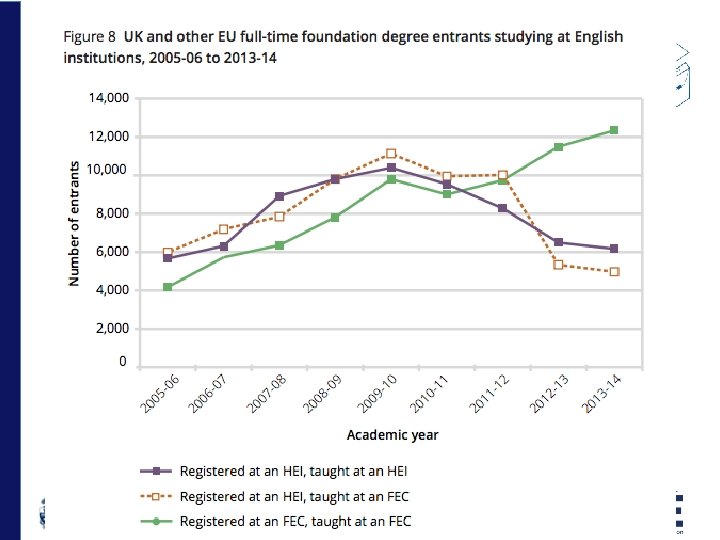
Growth hasn’t been as fast as we thought • About 8% of HE in England in FE – Parry et al. 2012 • Some growth in Australia, but still constrained • Canada – varies between provinces – government constraints • Growth in US, but many states can’t be in direct competition with universities – have to demonstrate a gap
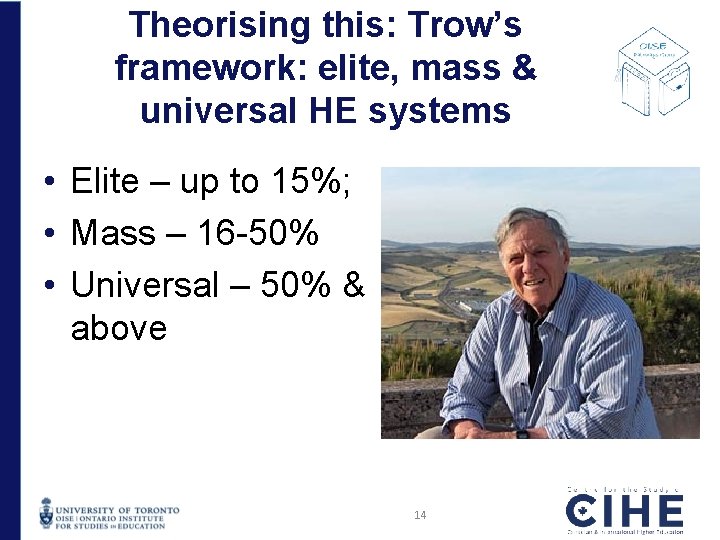
Theorising this: Trow’s framework: elite, mass & universal HE systems • Elite – up to 15%; • Mass – 16 -50% • Universal – 50% & above 14
Elite system • Prepare social elite • Curriculum ‘shapes mind & character’ • Highly structured academic & professional knowledge • Strong boundaries between institution & society • Train future leaders in elite roles in government & learned professions
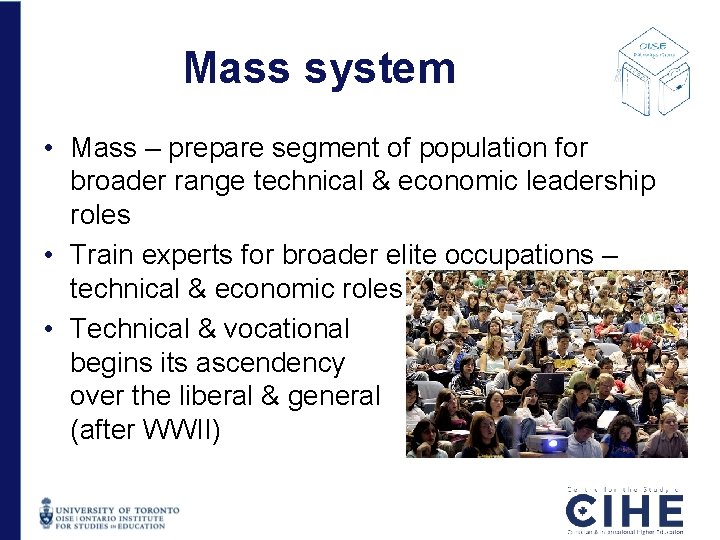
Mass system • Mass – prepare segment of population for broader range technical & economic leadership roles • Train experts for broader elite occupations – technical & economic roles • Technical & vocational begins its ascendency over the liberal & general (after WWII)
Universal • Universal – prepare whole population for rapid social & technological change in advanced industrial society • Penalties for exclusion in universal systems worse than in elite systems
Marginson: High Participation Systems • Gross tertiary enrolment rate exceeds 50% • Helpful in thinking through nature of expansion & reasons for it • Arguments about ‘over-skilling’ miss the point • Access to HE mediates access to jobs, culture & opportunity • Reason why degrees unlikely to be replaced with ‘badges’ etc • Mechanism of social reproduction now relative advantage, rather than exclusion
But given HPS – why hasn’t HE in colleges grown more quickly?
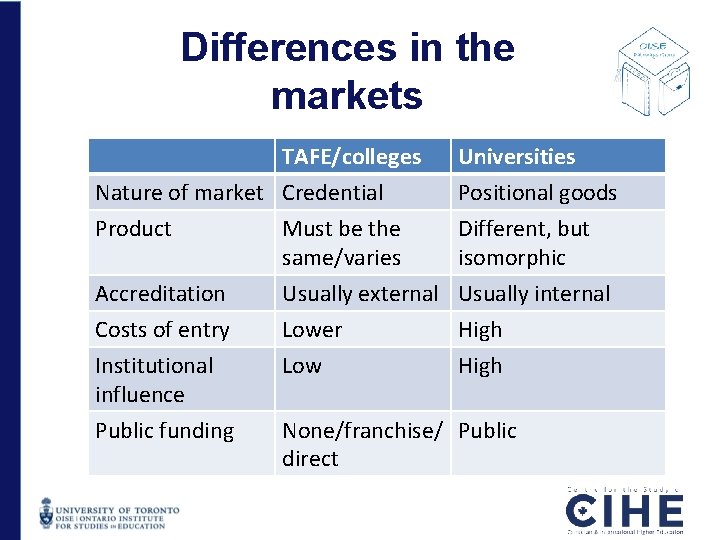
Differences in the markets TAFE/colleges Nature of market Credential Product Must be the same/varies Accreditation Costs of entry Institutional influence Public funding Universities Positional goods Different, but isomorphic Usually external Usually internal Lower High Low High None/franchise/ Public direct
Dimensions of different systems: Clark • 3 ideal types – state, market & professional system – interaction between 3 • “HE systems vary widely between dependence on authority & dependence on exchange: the more loosely joined the system the greater the dependence on exchange”, p. 138 • Continuum – unitary & unified state administration to market linkage
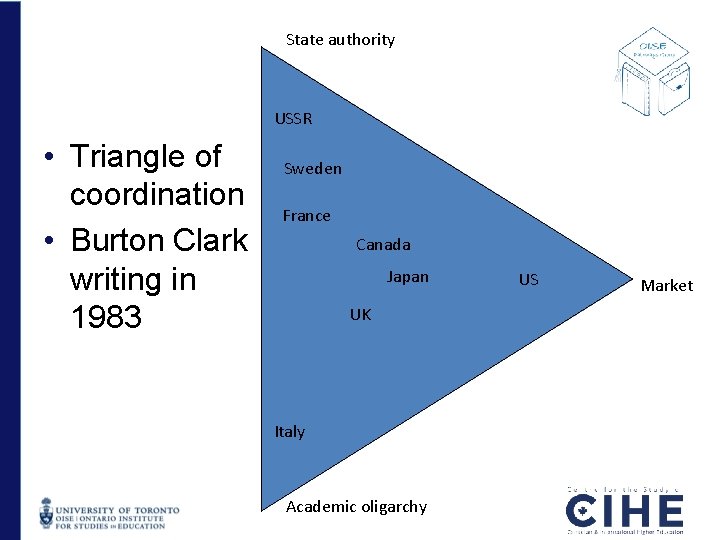
State authority USSR • Triangle of coordination • Burton Clark writing in 1983 Sweden France Canada Japan UK Italy Academic oligarchy US Market
Governments construct systems • Government authority • 2 key limitations – Intermittent enthusiasm for differentiation – Markets
Market authority: 3 markets in HE • Consumer markets – Competition – tuition fees, wares & goods – Consumer choice (government may shape) • Labour markets – Competition for faculty, administrators etc • Institutional markets – ‘markets where enterprises interact with one another, instead of with consumers or employees’ Burton Clark
Government policies focus on consumer market – van Vught • “It is the first market (consumer markets) that appears to be the object of many governmental policies that try to increase the coordinative capabilities of market forces in higher education. By increasing the capacity of the consumers of higher education outputs (students, clients) to choose among the various products of higher education institutions, these policies intend to strengthen the consumer market. However… these policies are usually only marginally effective. ” (2008: 168)
Market for reputation • “…HE institutions are first & foremost each other’s competitors (on the institutional market). They compete among themselves for the best students, the best faculty, the largest research contracts, the highest endowments, etc. They compete for all the resources that may have an impact on their institutional reputation. ” van Vught 2008: 168
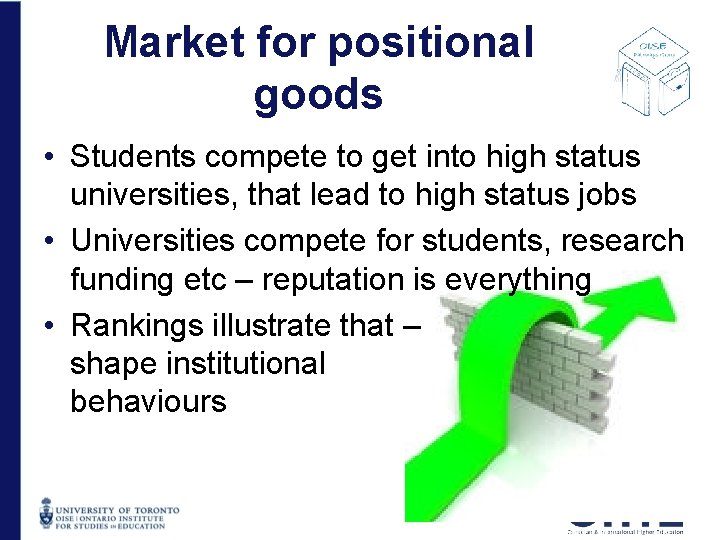
Market for positional goods • Students compete to get into high status universities, that lead to high status jobs • Universities compete for students, research funding etc – reputation is everything • Rankings illustrate that – shape institutional behaviours
Academic oligarchy • Complaints by colleges about accreditation processes • Vexed question – Is a question of power – But also a question of standards & quality • We need to problematise nature of knowledge in qualifications
Challenges facing colleges
Commonalities between Anglophone countries • Feel accreditation process • All two tiers of tertiary enforces ‘university’ mould education even if don’t have sharp curricular • All under scrutiny, suspected division of qualifications ‘not at same standard’ • All have closer relationship with local communities & employers • All have similar problems with universities – elitist • All are lower status, funded at lower rate, 30 teaching only
Commonalities between Anglophone countries cont… • Teachers in all systems say they need: lighter teaching loads; more time to prepare & to engage in scholarship; & access to better resources • Students in all more likely to come from disadvantaged backgrounds & be underprepared • Students need to recognise that it is a ‘step -up’ to become HE students
Challenges for colleges • What is higher education & how do we know when we see it? • Responding to credential creep while not succumbing to mission creep • Governance, economies of scale • Will always be under scrutiny • Build the capacity of institutions 32
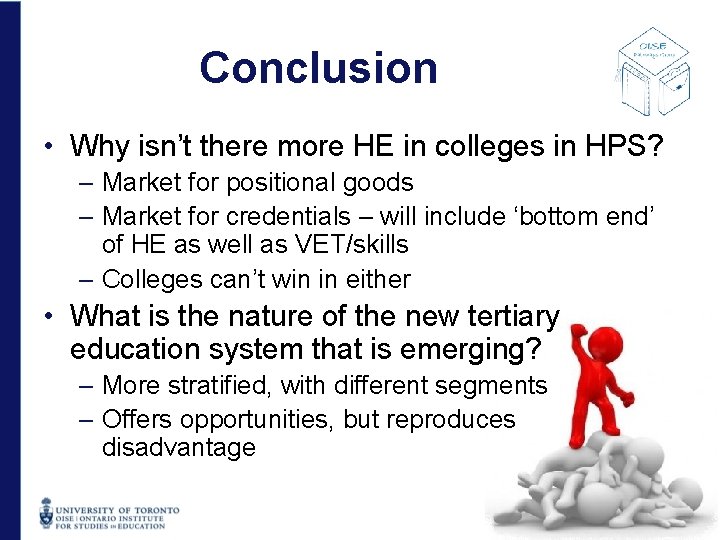
Conclusion • Why isn’t there more HE in colleges in HPS? – Market for positional goods – Market for credentials – will include ‘bottom end’ of HE as well as VET/skills – Colleges can’t win in either • What is the nature of the new tertiary education system that is emerging? – More stratified, with different segments – Offers opportunities, but reproduces disadvantage