
Higher Education Funding Realities and parameters Higher Education


- Slides: 18
Higher Education Funding: Realities and parameters Higher Education Conference 3 October 2019 CSIR Dr Diane Parker DDG: University Education Department of Higher Education and Training
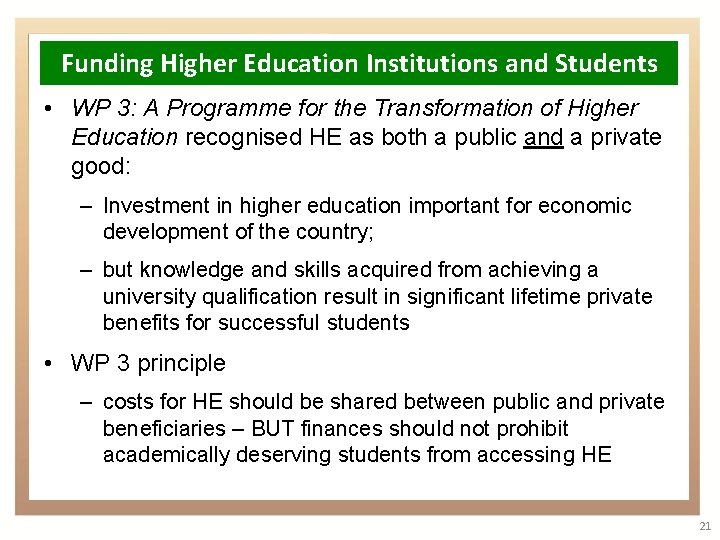
Funding Higher Education Institutions and Students • WP 3: A Programme for the Transformation of Higher Education recognised HE as both a public and a private good: – Investment in higher education important for economic development of the country; – but knowledge and skills acquired from achieving a university qualification result in significant lifetime private benefits for successful students • WP 3 principle – costs for HE should be shared between public and private beneficiaries – BUT finances should not prohibit academically deserving students from accessing HE 21
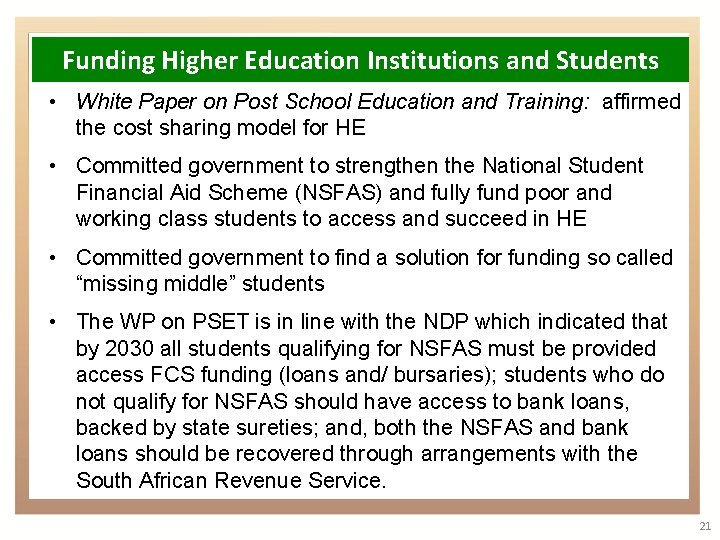
Funding Higher Education Institutions and Students • White Paper on Post School Education and Training: affirmed the cost sharing model for HE • Committed government to strengthen the National Student Financial Aid Scheme (NSFAS) and fully fund poor and working class students to access and succeed in HE • Committed government to find a solution for funding so called “missing middle” students • The WP on PSET is in line with the NDP which indicated that by 2030 all students qualifying for NSFAS must be provided access FCS funding (loans and/ bursaries); students who do not qualify for NSFAS should have access to bank loans, backed by state sureties; and, both the NSFAS and bank loans should be recovered through arrangements with the South African Revenue Service. 21
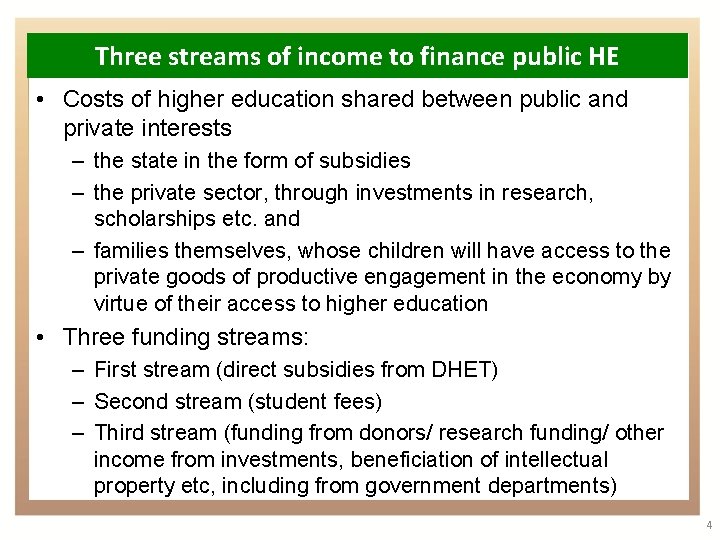
Three streams of income to finance public HE • Costs of higher education shared between public and private interests – the state in the form of subsidies – the private sector, through investments in research, scholarships etc. and – families themselves, whose children will have access to the private goods of productive engagement in the economy by virtue of their access to higher education • Three funding streams: – First stream (direct subsidies from DHET) – Second stream (student fees) – Third stream (funding from donors/ research funding/ other income from investments, beneficiation of intellectual property etc, including from government departments) 4
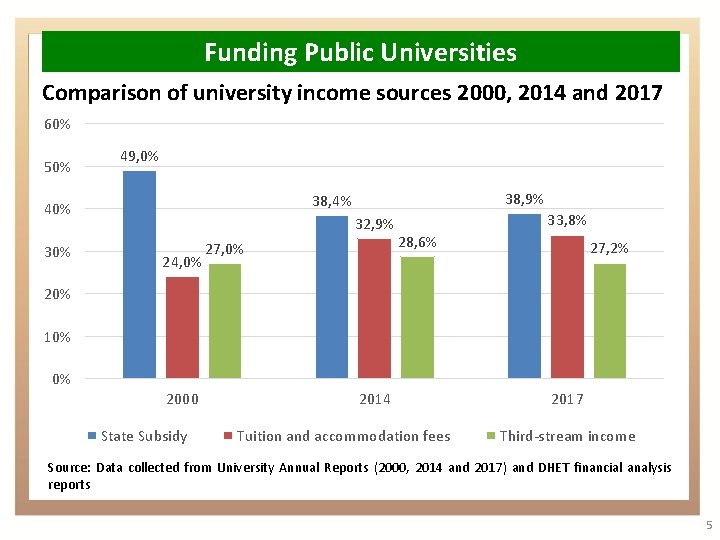
Funding Public Universities Comparison of university income sources 2000, 2014 and 2017 60% 50% 49, 0% 38, 9% 38, 4% 40% 32, 9% 24, 0% 27, 0% 33, 8% 28, 6% 27, 2% 20% 10% 0% 2000 State Subsidy 2014 Tuition and accommodation fees 2017 Third-stream income Source: Data collected from University Annual Reports (2000, 2014 and 2017) and DHET financial analysis reports 5
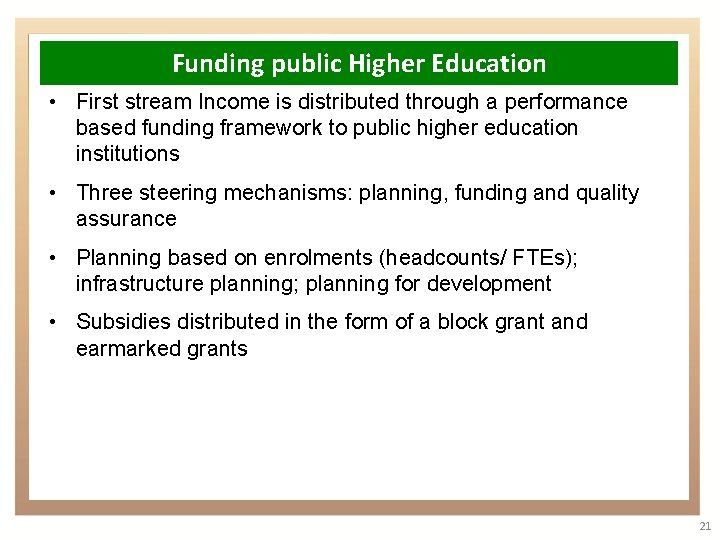
Funding public Higher Education • First stream Income is distributed through a performance based funding framework to public higher education institutions • Three steering mechanisms: planning, funding and quality assurance • Planning based on enrolments (headcounts/ FTEs); infrastructure planning; planning for development • Subsidies distributed in the form of a block grant and earmarked grants 21
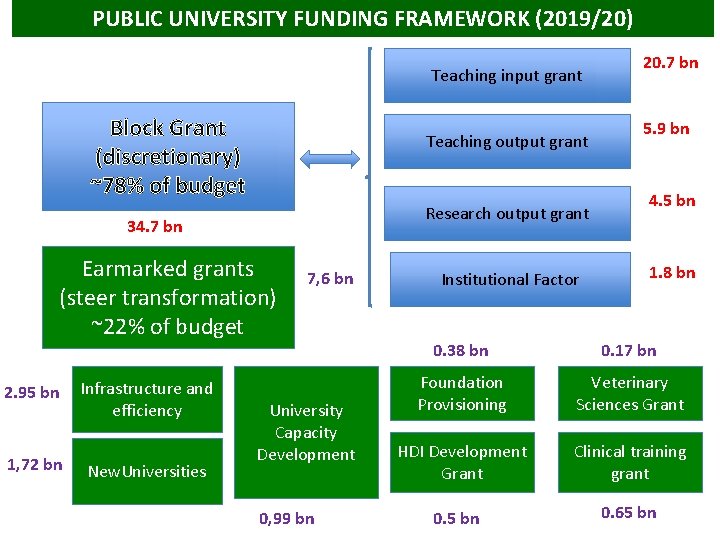
PUBLIC UNIVERSITY FUNDING FRAMEWORK (2019/20) Teaching input grant Block Grant (discretionary) ~78% of budget Teaching output grant Research output grant 34. 7 bn Earmarked grants (steer transformation) ~22% of budget 2. 95 bn 1, 72 bn Infrastructure and efficiency New. Universities 7, 6 bn University Capacity Development 0, 99 bn Institutional Factor 20. 7 bn 5. 9 bn 4. 5 bn 1. 8 bn 0. 38 bn 0. 17 bn Foundation Provisioning Veterinary Sciences Grant HDI Development Grant Clinical training grant 0. 5 bn 0. 65 bn
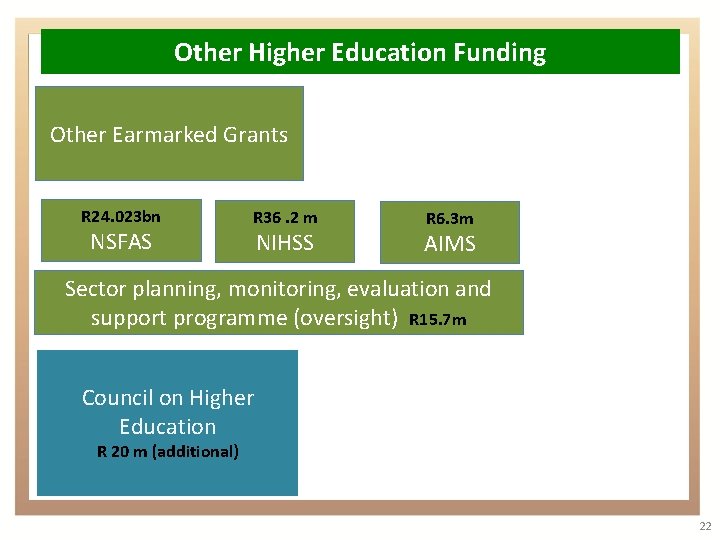
Other Higher Education Funding Other Earmarked Grants R 24. 023 bn NSFAS R 36. 2 m NIHSS R 6. 3 m AIMS Sector planning, monitoring, evaluation and support programme (oversight) R 15. 7 m Council on Higher Education R 20 m (additional) 22
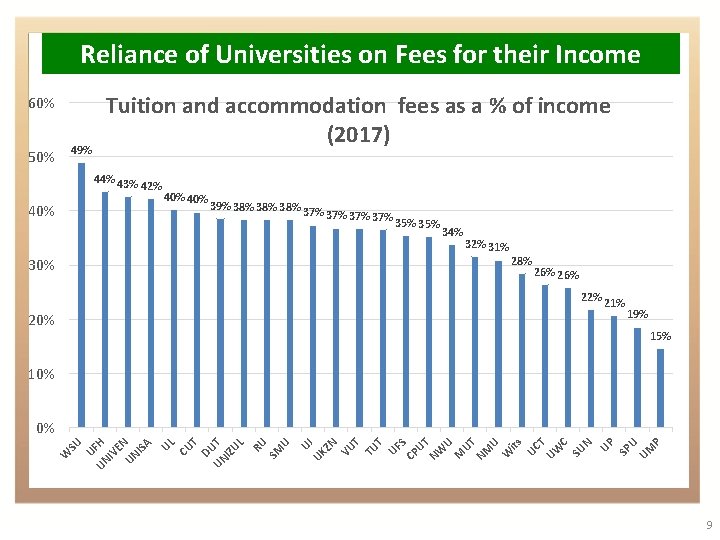
Reliance of Universities on Fees for their Income 60% 49% 50% Tuition and accommodation fees as a % of income (2017) 44% 43% 42% 40% 40% 39% 38% 38% 37% 37% 35% 30% 34% 32% 31% 28% 26% 22% 21% 20% 19% 15% 10% UP SP U UM P UT NW U M UT NM U W its UC T UW C SU N S CP UF T T TU VU ZN UJ UK UN T IZ UL RU SM U T DU UL CU W SU U UN FH IV EN UN IS A 0% 9
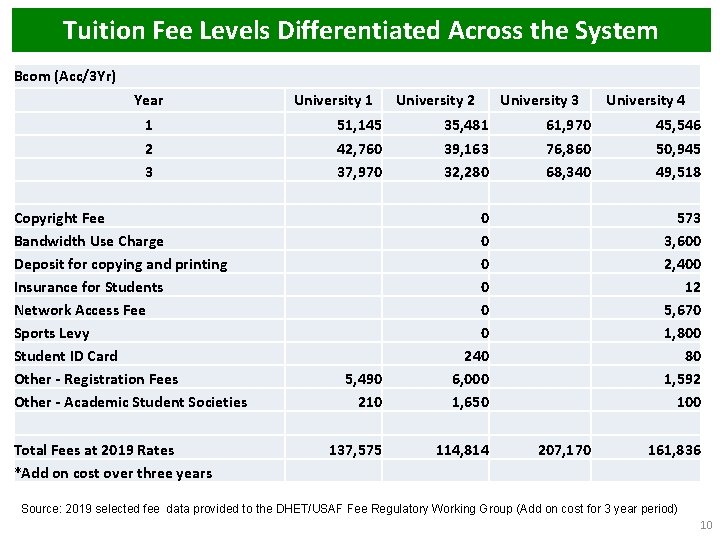
Tuition Fee Levels Differentiated Across the System Bcom (Acc/3 Yr) Year 1 2 3 Copyright Fee Bandwidth Use Charge Deposit for copying and printing Insurance for Students Network Access Fee Sports Levy Student ID Card Other - Registration Fees Other - Academic Student Societies Total Fees at 2019 Rates *Add on cost over three years University 1 University 2 51, 145 42, 760 37, 970 35, 481 39, 163 32, 280 5, 490 210 0 0 0 240 6, 000 1, 650 137, 575 114, 814 University 3 61, 970 76, 860 68, 340 University 4 45, 546 50, 945 49, 518 573 3, 600 2, 400 12 5, 670 1, 800 80 1, 592 100 207, 170 161, 836 Source: 2019 selected fee data provided to the DHET/USAF Fee Regulatory Working Group (Add on cost for 3 year period) 10
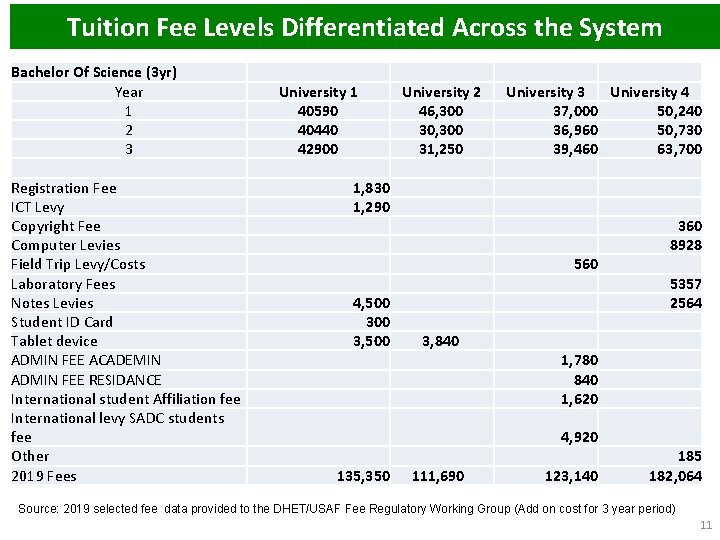
Tuition Fee Levels Differentiated Across the System Bachelor Of Science (3 yr) Year 1 2 3 Registration Fee ICT Levy Copyright Fee Computer Levies Field Trip Levy/Costs Laboratory Fees Notes Levies Student ID Card Tablet device ADMIN FEE ACADEMIN ADMIN FEE RESIDANCE International student Affiliation fee International levy SADC students fee Other 2019 Fees University 1 40590 40440 42900 University 2 46, 300 30, 300 31, 250 University 3 University 4 37, 000 50, 240 36, 960 50, 730 39, 460 63, 700 1, 830 1, 290 560 4, 500 3, 840 111, 690 5357 2564 1, 780 840 1, 620 4, 920 135, 350 360 8928 123, 140 185 182, 064 Source: 2019 selected fee data provided to the DHET/USAF Fee Regulatory Working Group (Add on cost for 3 year period) 11
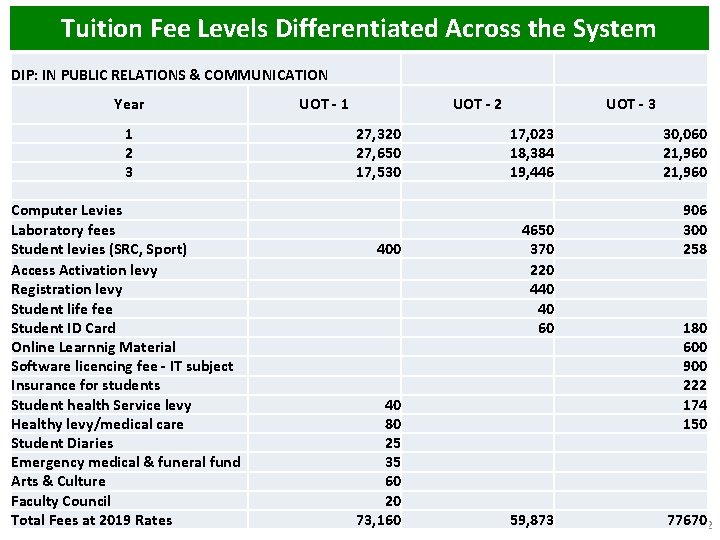
Tuition Fee Levels Differentiated Across the System DIP: IN PUBLIC RELATIONS & COMMUNICATION Year 1 2 3 UOT - 1 UOT - 2 27, 320 27, 650 17, 530 UOT - 3 17, 023 18, 384 19, 446 30, 060 21, 960 Computer Levies Laboratory fees 4650 Student levies (SRC, Sport) 400 370 Access Activation levy 220 Registration levy 440 Student life fee 40 Student ID Card 60 Online Learnnig Material Software licencing fee - IT subject Insurance for students Student health Service levy 40 Healthy levy/medical care 80 Student Diaries 25 Emergency medical & funeral fund 35 Arts & Culture 60 Faculty Council 20 Total. Source: Fees at 2019 Ratesfee data provided to the DHET/USAF 73, 160 59, 873 selected Fee Regulatory Working Group 906 300 258 180 600 900 222 174 150 7767012
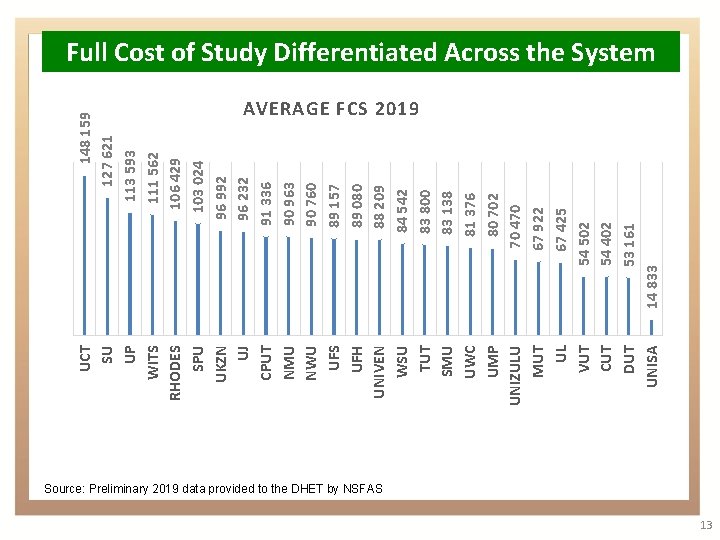
UCT SU UP WITS RHODES SPU UKZN UJ CPUT NMU NWU UFS UFH UNIVEN WSU TUT SMU UWC UMP UNIZULU MUT UL VUT CUT DUT UNISA 148 159 127 621 113 593 111 562 106 429 103 024 96 992 96 232 91 336 90 963 90 760 89 157 89 080 88 209 84 542 83 800 83 138 81 376 80 702 70 470 67 922 67 425 54 502 54 402 53 161 14 833 Full Cost of Study Differentiated Across the System AVERAGE FCS 2019 Source: Preliminary 2019 data provided to the DHET by NSFAS 13
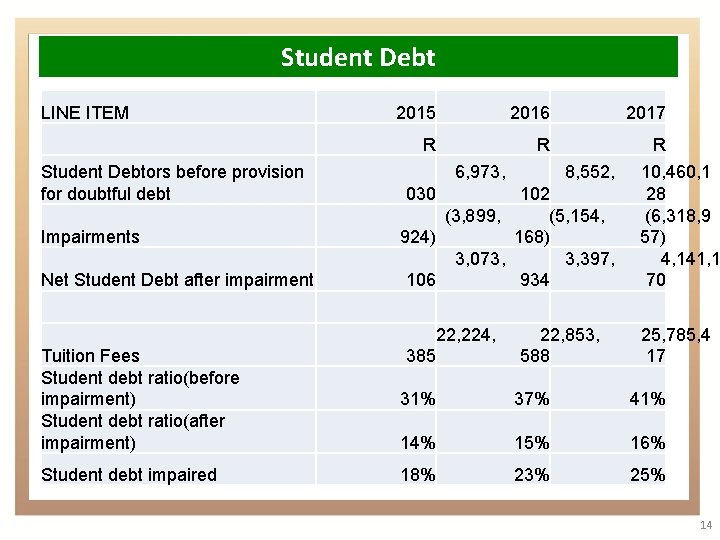
Student Debt LINE ITEM Student Debtors before provision for doubtful debt Impairments Net Student Debt after impairment 2015 2016 2017 R R R 6, 973, 8, 552, 030 102 (3, 899, (5, 154, 924) 168) 3, 073, 3, 397, 106 934 22, 224, 385 22, 853, 588 10, 460, 1 28 (6, 318, 9 57) 4, 141, 1 70 25, 785, 4 17 Tuition Fees Student debt ratio(before impairment) Student debt ratio(after impairment) 31% 37% 41% 14% 15% 16% Student debt impaired 18% 23% 25% 14
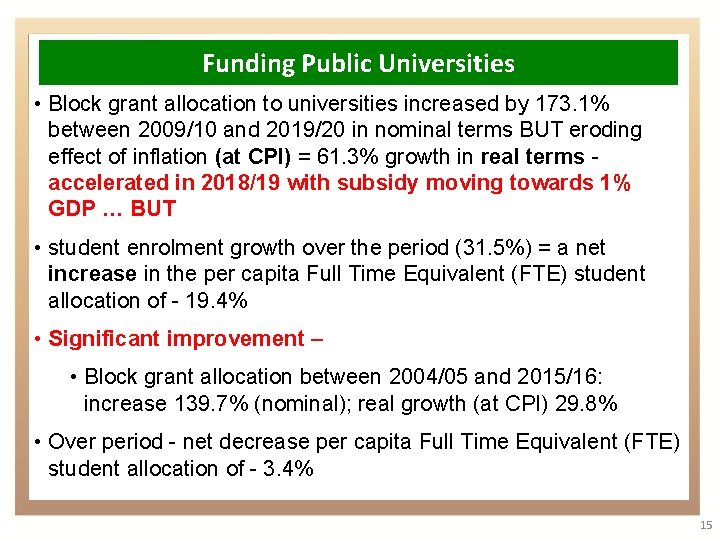
Funding Public Universities • Block grant allocation to universities increased by 173. 1% between 2009/10 and 2019/20 in nominal terms BUT eroding effect of inflation (at CPI) = 61. 3% growth in real terms accelerated in 2018/19 with subsidy moving towards 1% GDP … BUT • student enrolment growth over the period (31. 5%) = a net increase in the per capita Full Time Equivalent (FTE) student allocation of - 19. 4% • Significant improvement – • Block grant allocation between 2004/05 and 2015/16: increase 139. 7% (nominal); real growth (at CPI) 29. 8% • Over period - net decrease per capita Full Time Equivalent (FTE) student allocation of - 3. 4% 15
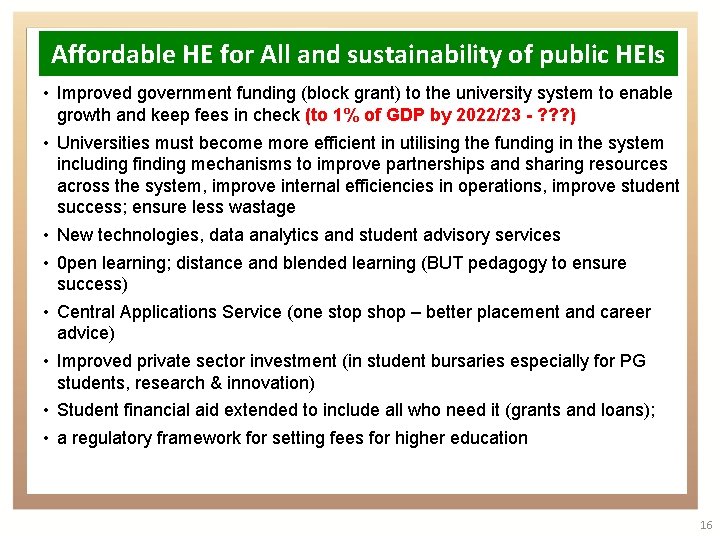
Affordable HE for All and sustainability of public HEIs • Improved government funding (block grant) to the university system to enable growth and keep fees in check (to 1% of GDP by 2022/23 - ? ? ? ) • Universities must become more efficient in utilising the funding in the system including finding mechanisms to improve partnerships and sharing resources across the system, improve internal efficiencies in operations, improve student success; ensure less wastage • New technologies, data analytics and student advisory services • 0 pen learning; distance and blended learning (BUT pedagogy to ensure success) • Central Applications Service (one stop shop – better placement and career advice) • Improved private sector investment (in student bursaries especially for PG students, research & innovation) • Student financial aid extended to include all who need it (grants and loans); • a regulatory framework for setting fees for higher education 16
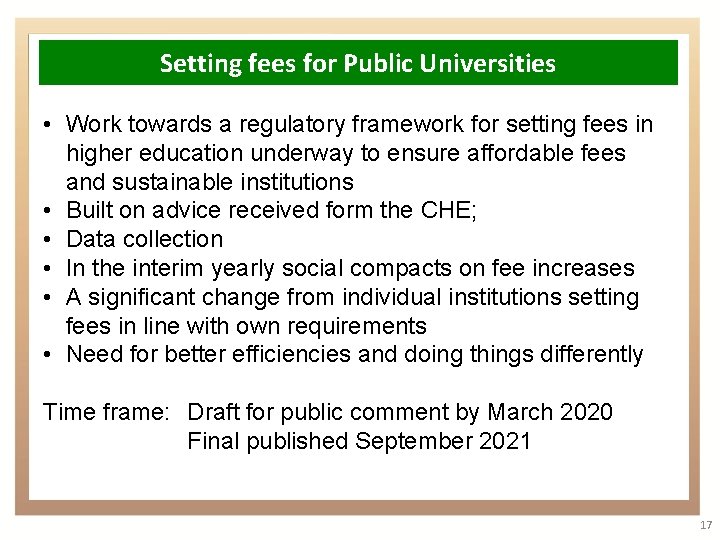
Setting fees for Public Universities • Work towards a regulatory framework for setting fees in higher education underway to ensure affordable fees and sustainable institutions • Built on advice received form the CHE; • Data collection • In the interim yearly social compacts on fee increases • A significant change from individual institutions setting fees in line with own requirements • Need for better efficiencies and doing things differently Time frame: Draft for public comment by March 2020 Final published September 2021 17
Thank You