
Higher Degree Total Variation for 3 D Image

- Slides: 46
Higher Degree Total Variation for 3 -D Image Recovery Greg Ongie*, Yue Hu, Mathews Jacob Computational Biomedical Imaging Group (CBIG) University of Iowa ISBI 2014 Beijing, China
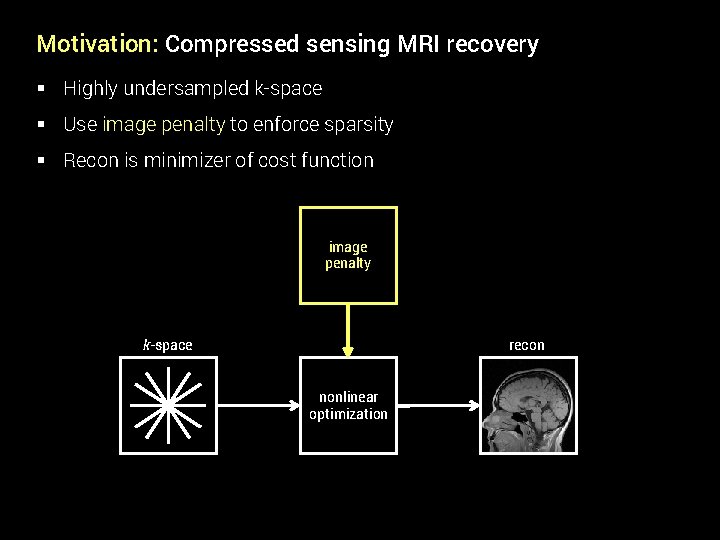
Motivation: Compressed sensing MRI recovery § Highly undersampled k-space § Use image penalty to enforce sparsity § Recon is minimizer of cost function image penalty recon k-space nonlinear optimization
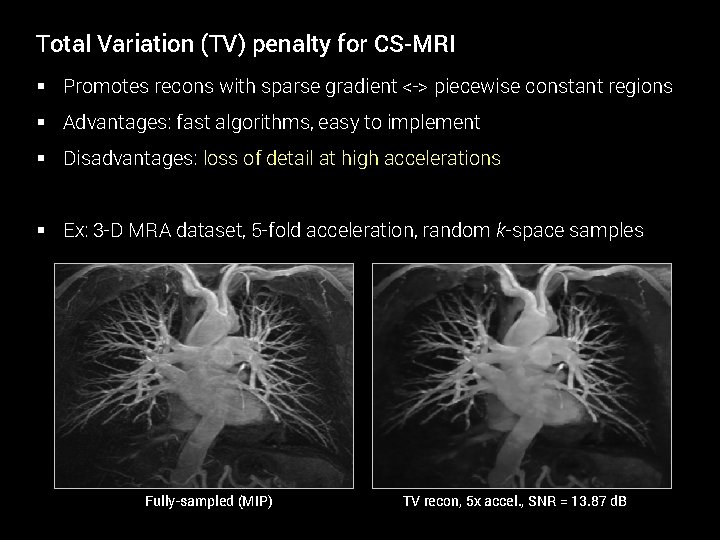
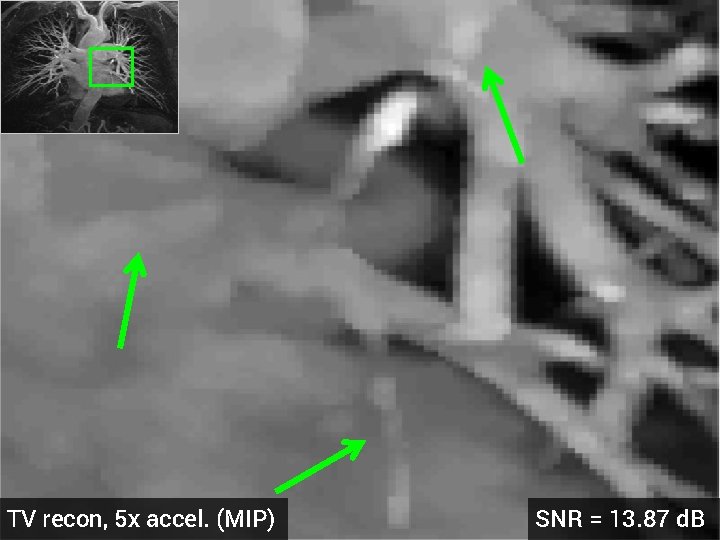
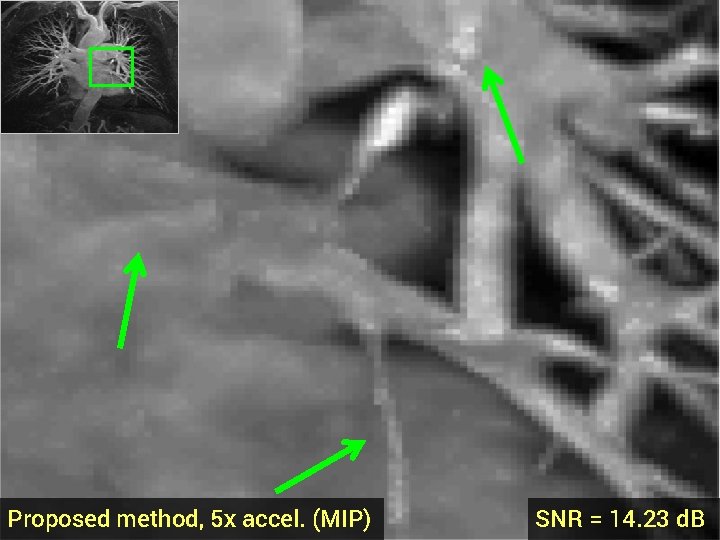
Total Variation (TV) penalty for CS-MRI § Promotes recons with sparse gradient <-> piecewise constant regions § Advantages: fast algorithms, easy to implement § Disadvantages: loss of detail at high accelerations § Ex: 3 -D MRA dataset, 5 -fold acceleration, random k-space samples Fully-sampled (MIP) TV recon, 5 x accel. , SNR = 13. 87 d. B
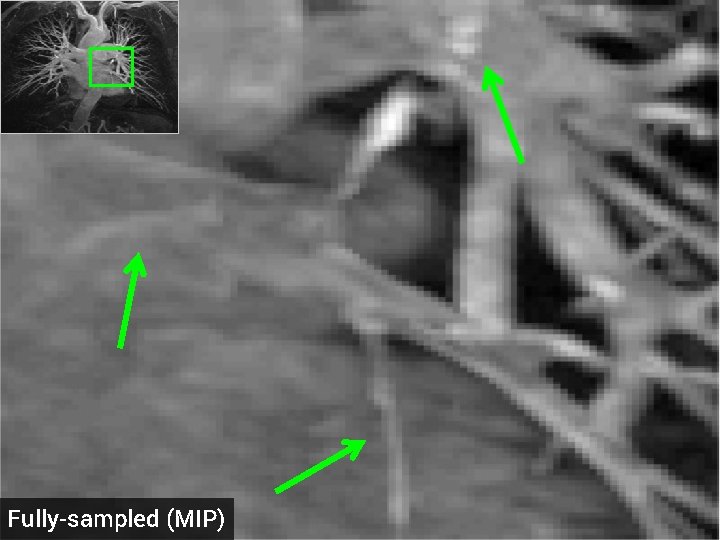
Fully-sampled (MIP)
TV recon, 5 x accel. (MIP) SNR = 13. 87 d. B
Proposed method, 5 x accel. (MIP) SNR = 14. 23 d. B
Higher Degree Total Variation (HDTV) in 2 -D
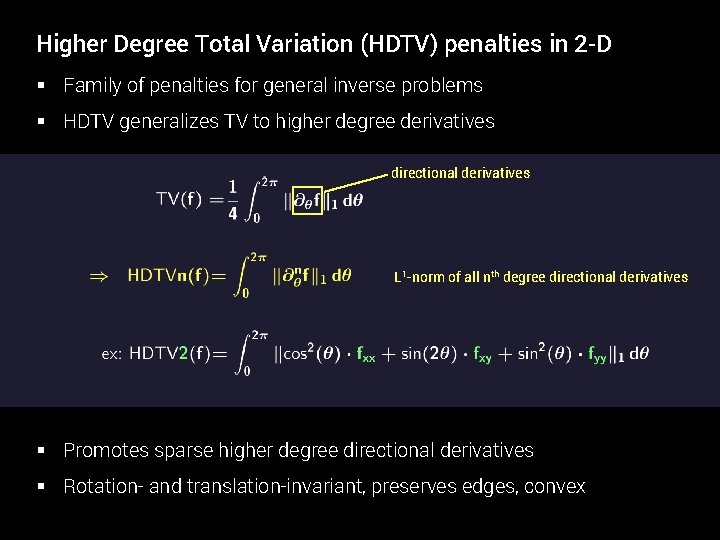
Higher Degree Total Variation (HDTV) penalties in 2 -D § Family of penalties for general inverse problems § HDTV generalizes TV to higher degree derivatives directional derivatives L 1 -norm of all nth degree directional derivatives § Promotes sparse higher degree directional derivatives § Rotation- and translation-invariant, preserves edges, convex
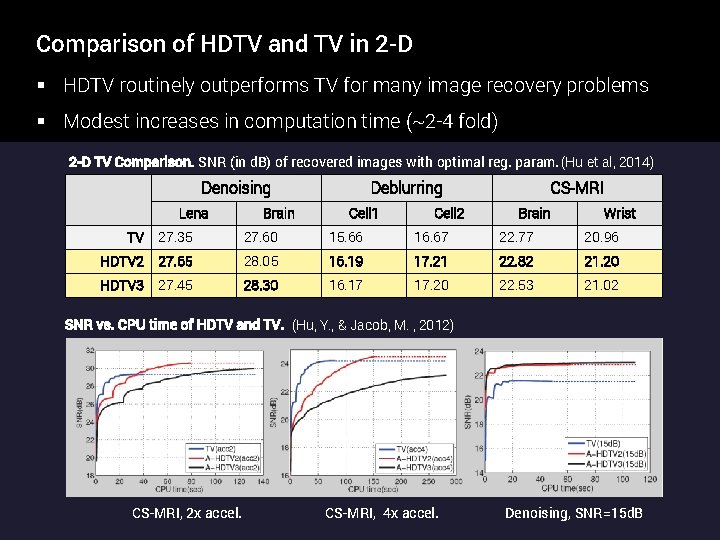
Comparison of HDTV and TV in 2 -D § HDTV routinely outperforms TV for many image recovery problems § Modest increases in computation time (~2 -4 fold) 2 -D TV Comparison. SNR (in d. B) of recovered images with optimal reg. param. (Hu et al, 2014) Denoising Lena Brain Deblurring Cell 1 Cell 2 CS-MRI Brain Wrist TV 27. 35 27. 60 15. 66 16. 67 22. 77 20. 96 HDTV 2 27. 65 28. 05 16. 19 17. 21 22. 82 21. 20 HDTV 3 27. 45 28. 30 16. 17 17. 20 22. 53 21. 02 SNR vs. CPU time of HDTV and TV. (Hu, Y. , & Jacob, M. , 2012) CS-MRI, 2 x accel. CS-MRI, 4 x accel. Denoising, SNR=15 d. B
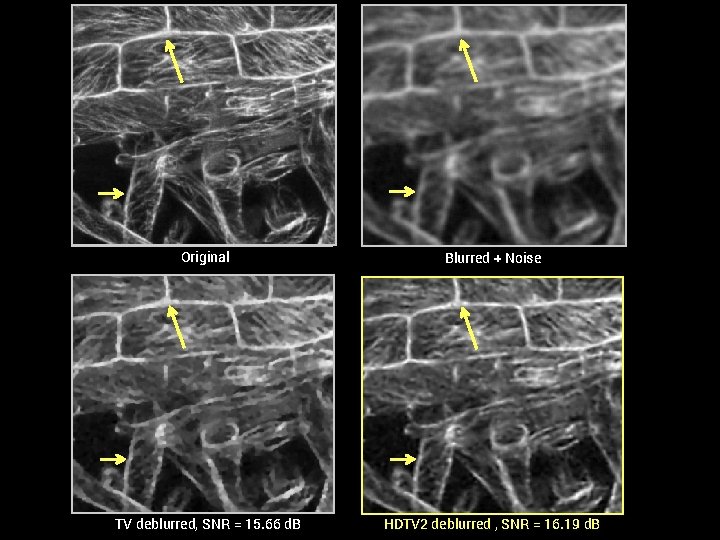
Original Blurred + Noise TV deblurred, SNR = 15. 66 d. B HDTV 2 deblurred , SNR = 16. 19 d. B
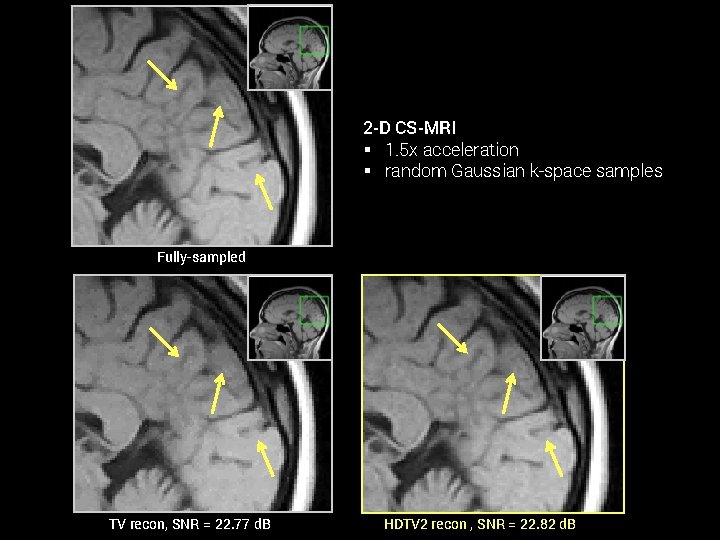
2 -D CS-MRI § 1. 5 x acceleration § random Gaussian k-space samples Fully-sampled TV recon, SNR = 22. 77 d. B HDTV 2 recon , SNR = 22. 82 d. B
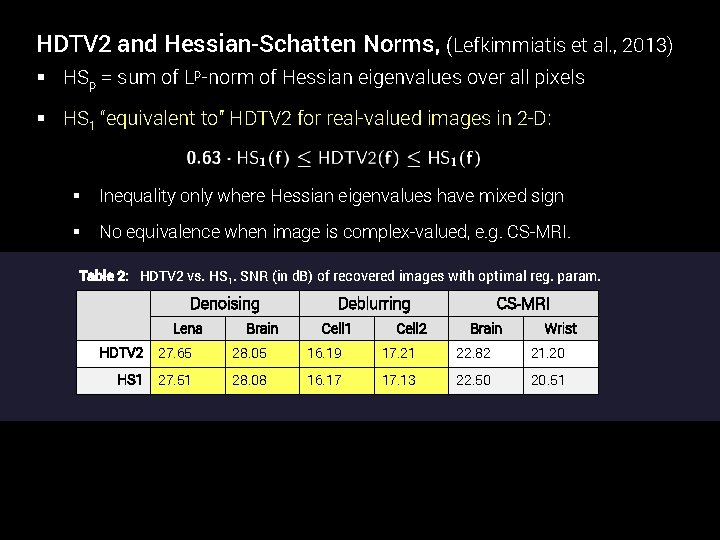
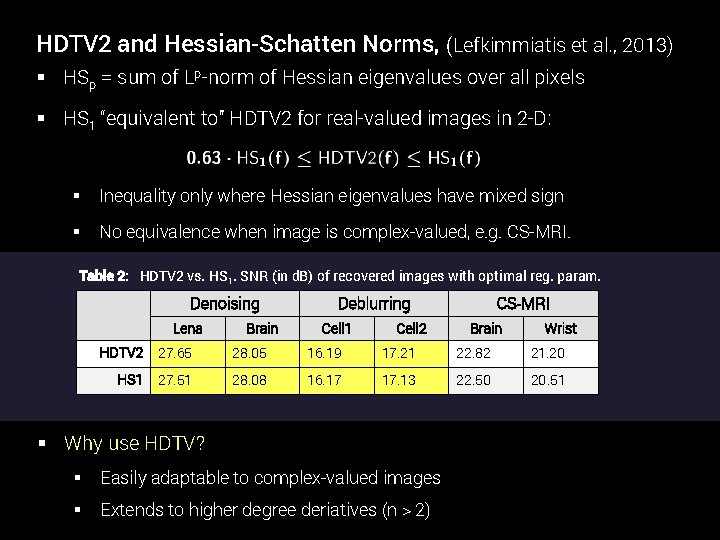
HDTV 2 and Hessian-Schatten Norms, (Lefkimmiatis et al. , 2013) § HSp = sum of Lp-norm of Hessian eigenvalues over all pixels § HS 1 “equivalent to” HDTV 2 for real-valued images in 2 -D: § Inequality only where Hessian eigenvalues have mixed sign § No equivalence when image is complex-valued, e. g. CS-MRI. Table 2: HDTV 2 vs. HS 1. SNR (in d. B) of recovered images with optimal reg. param. Denoising Lena Brain Deblurring Cell 1 Cell 2 CS-MRI Brain Wrist HDTV 2 27. 65 28. 05 16. 19 17. 21 22. 82 21. 20 HS 1 27. 51 28. 08 16. 17 17. 13 22. 50 20. 51
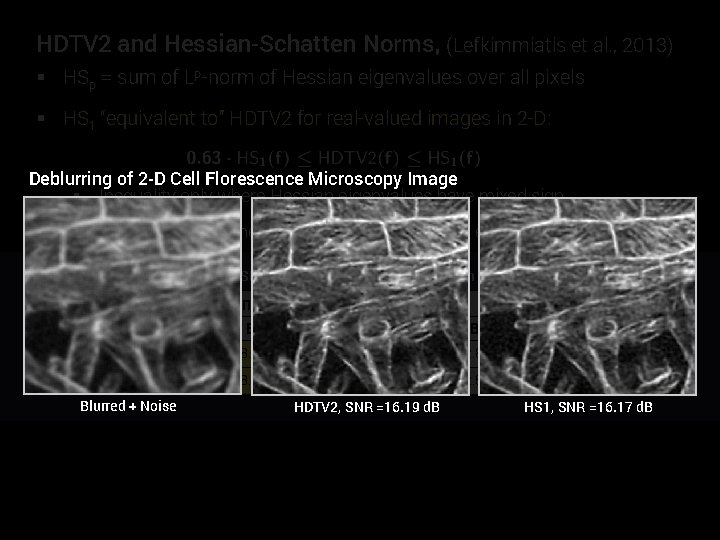
HDTV 2 and Hessian-Schatten Norms, (Lefkimmiatis et al. , 2013) § HSp = sum of Lp-norm of Hessian eigenvalues over all pixels § HS 1 “equivalent to” HDTV 2 for real-valued images in 2 -D: Deblurring of 2 -D Cell Florescence Microscopy Image § Inequality only where Hessian eigenvalues have mixed sign § No equivalence when image is complex-valued, e. g. CS-MRI. Table 2: HDTV 2 vs. HS 1. SNR (in d. B) of recovered images with optimal reg. param. Denoising Lena Brain Deblurring Cell 1 Cell 2 CS-MRI Brain Wrist HDTV 2 27. 65 28. 05 16. 19 17. 21 22. 82 21. 20 HS 1 27. 51 28. 08 16. 17 17. 13 22. 50 20. 51 Blurred + Noise HDTV 2, SNR =16. 19 d. B HS 1, SNR =16. 17 d. B
HDTV 2 and Hessian-Schatten Norms, (Lefkimmiatis et al. , 2013) § HSp = sum of Lp-norm of Hessian eigenvalues over all pixels § HS 1 “equivalent to” HDTV 2 for real-valued images in 2 -D: § Inequality only where Hessian eigenvalues have mixed sign § No equivalence when image is complex-valued, e. g. CS-MRI. Table 2: HDTV 2 vs. HS 1. SNR (in d. B) of recovered images with optimal reg. param. Denoising Lena Brain Deblurring Cell 1 Cell 2 CS-MRI Brain Wrist HDTV 2 27. 65 28. 05 16. 19 17. 21 22. 82 21. 20 HS 1 27. 51 28. 08 16. 17 17. 13 22. 50 20. 51 § Why use HDTV? § Easily adaptable to complex-valued images § Extends to higher degree deriatives (n > 2)
Extension of HDTV to 3 -D
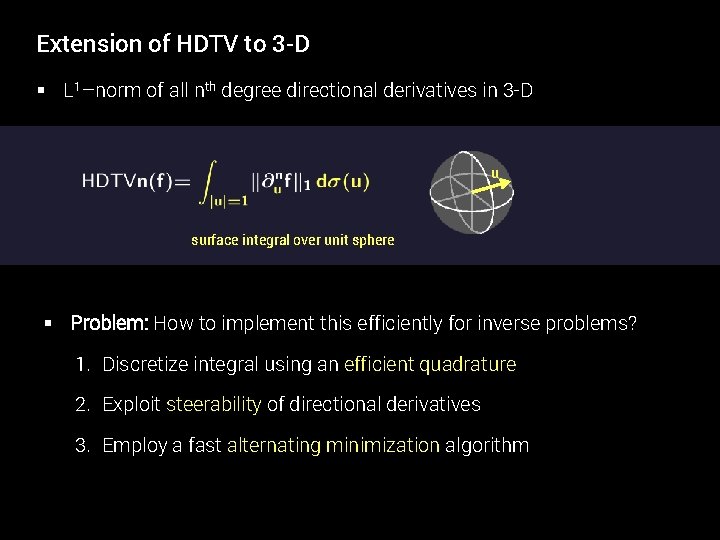
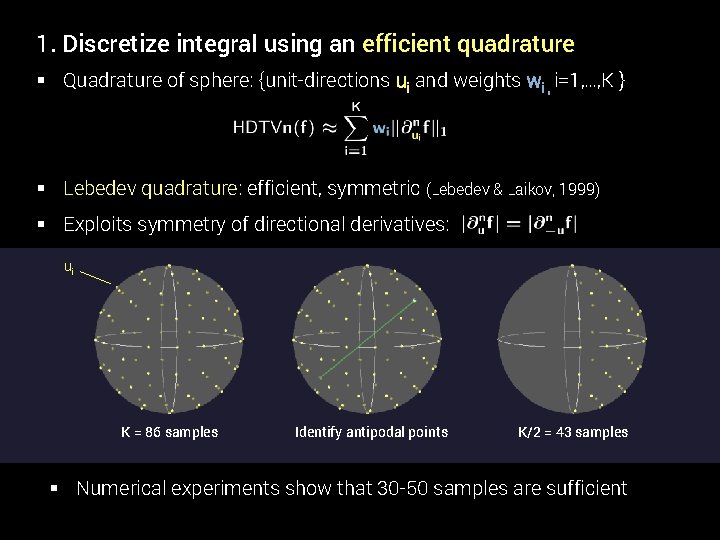
Extension of HDTV to 3 -D § L 1–norm of all nth degree directional derivatives in 3 -D u surface integral over unit sphere § Problem: How to implement this efficiently for inverse problems? 1. Discretize integral using an efficient quadrature 2. Exploit steerability of directional derivatives 3. Employ a fast alternating minimization algorithm
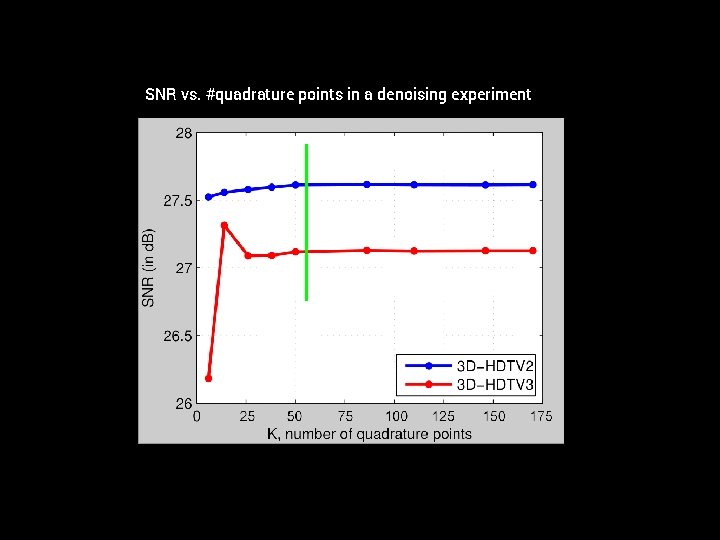
1. Discretize integral using an efficient quadrature § Quadrature of sphere: {unit-directions ui and weights wi , i=1, …, K } § Lebedev quadrature: efficient, symmetric (Lebedev & Laikov, 1999) § Exploits symmetry of directional derivatives: ui K = 86 samples Identify antipodal points K/2 = 43 samples § Numerical experiments show that 30 -50 samples are sufficient
SNR vs. #quadrature points in a denoising experiment
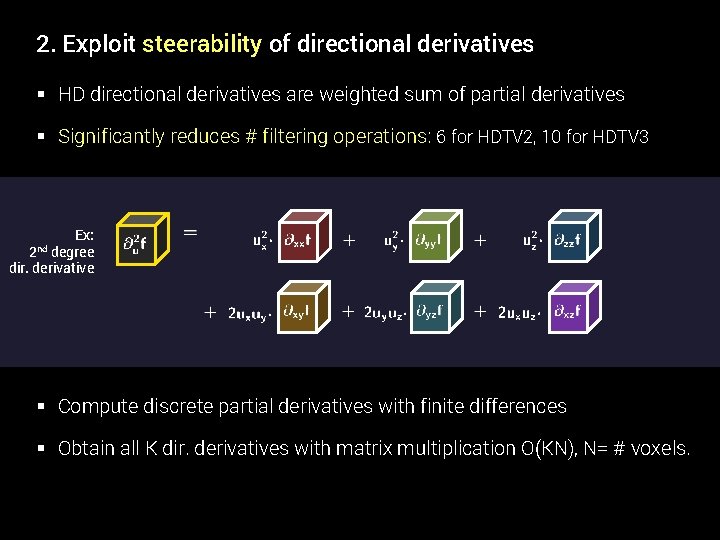
2. Exploit steerability of directional derivatives § HD directional derivatives are weighted sum of partial derivatives § Significantly reduces # filtering operations: 6 for HDTV 2, 10 for HDTV 3 Ex: 2 nd degree dir. derivative § Compute discrete partial derivatives with finite differences § Obtain all K dir. derivatives with matrix multiplication O(KN), N= # voxels.
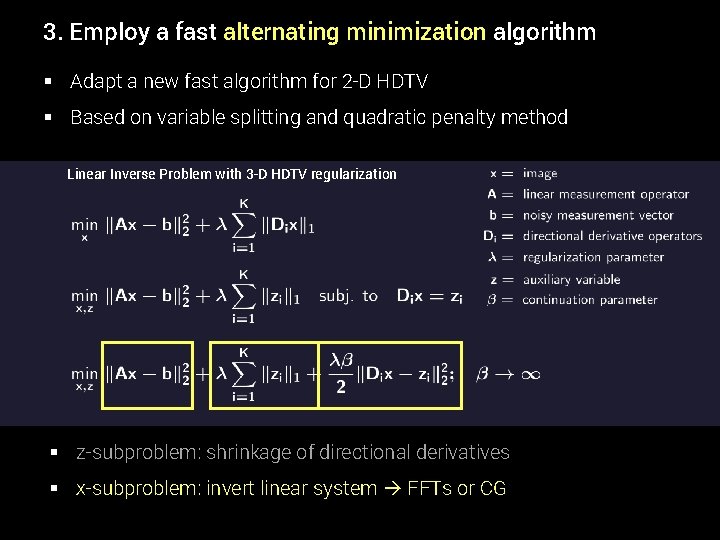
3. Employ a fast alternating minimization algorithm § Adapt a new fast algorithm for 2 -D HDTV § Based on variable splitting and quadratic penalty method Linear Inverse Problem with 3 -D HDTV regularization § z-subproblem: shrinkage of directional derivatives § x-subproblem: invert linear system FFTs or CG
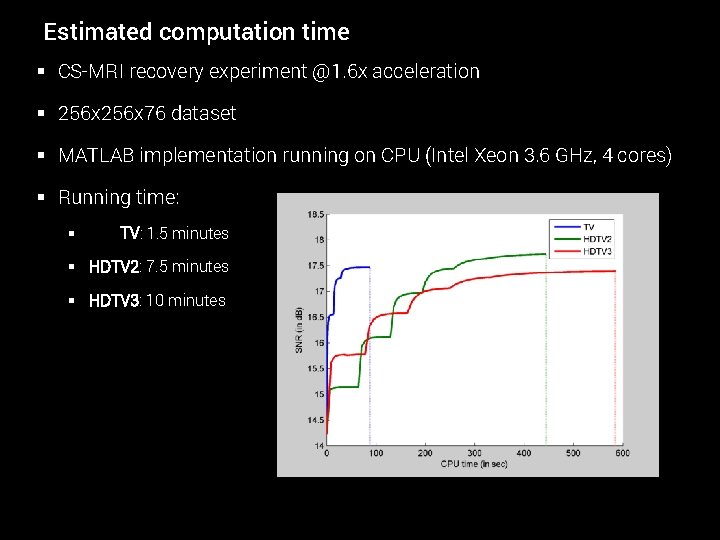
Estimated computation time § CS-MRI recovery experiment @1. 6 x acceleration § 256 x 76 dataset § MATLAB implementation running on CPU (Intel Xeon 3. 6 GHz, 4 cores) § Running time: § TV: 1. 5 minutes § HDTV 2: 7. 5 minutes § HDTV 3: 10 minutes
Results
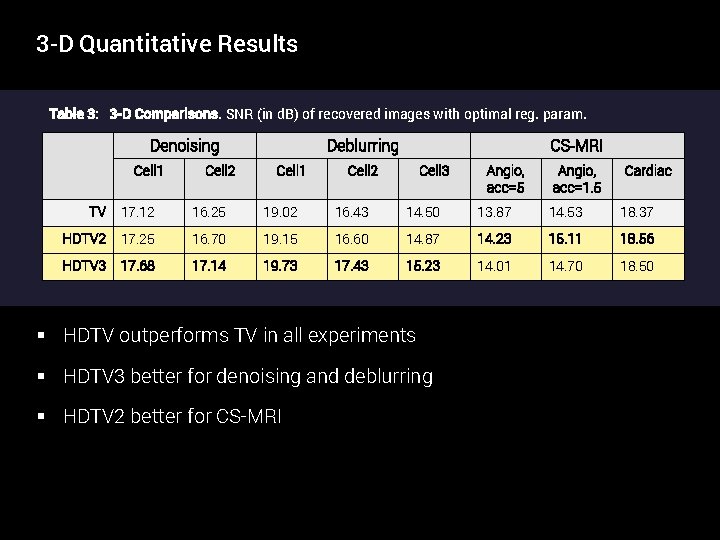
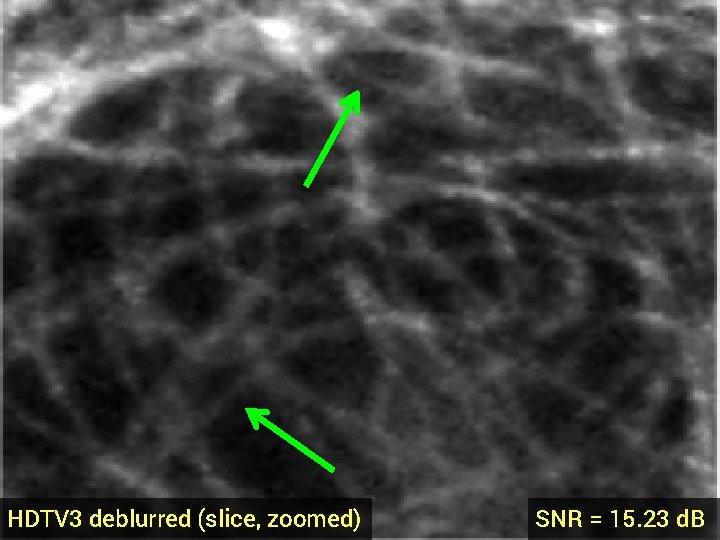
3 -D Quantitative Results Table 3: 3 -D Comparisons. SNR (in d. B) of recovered images with optimal reg. param. Denoising Cell 1 Cell 2 Deblurring Cell 1 CS-MRI Cell 2 Cell 3 Angio, acc=5 Angio, acc=1. 5 Cardiac TV 17. 12 16. 25 19. 02 16. 43 14. 50 13. 87 14. 53 18. 37 HDTV 2 17. 25 16. 70 19. 15 16. 60 14. 87 14. 23 15. 11 18. 56 HDTV 3 17. 68 17. 14 19. 73 17. 43 15. 23 14. 01 14. 70 18. 50 § HDTV outperforms TV in all experiments § HDTV 3 better for denoising and deblurring § HDTV 2 better for CS-MRI
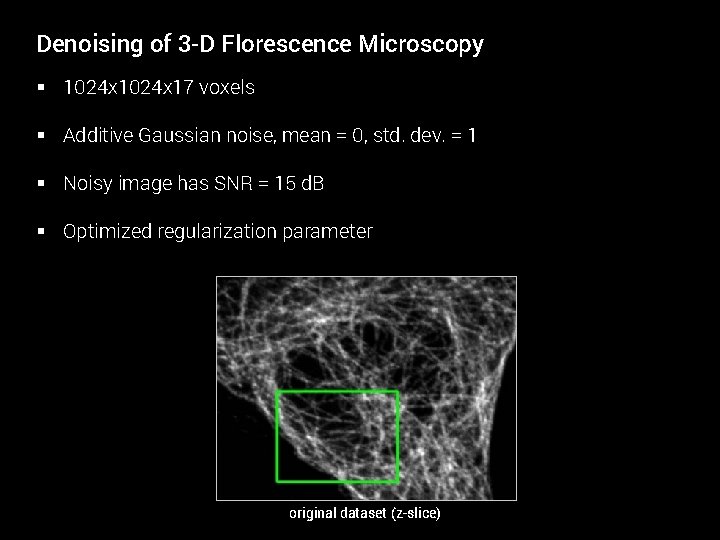
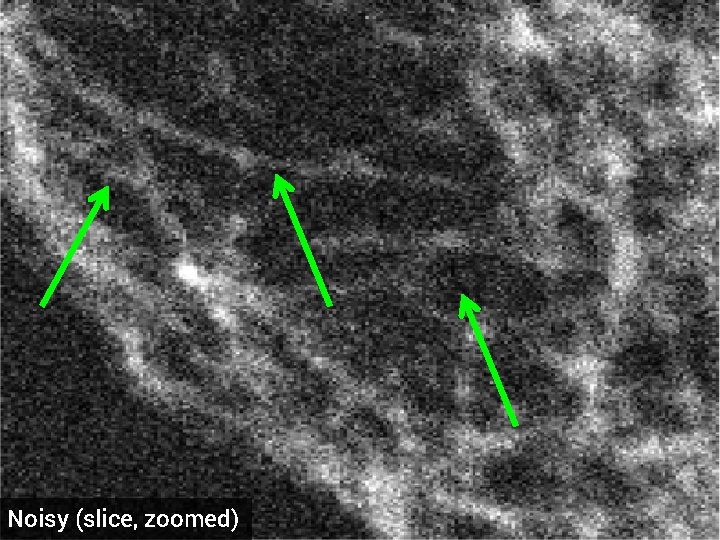
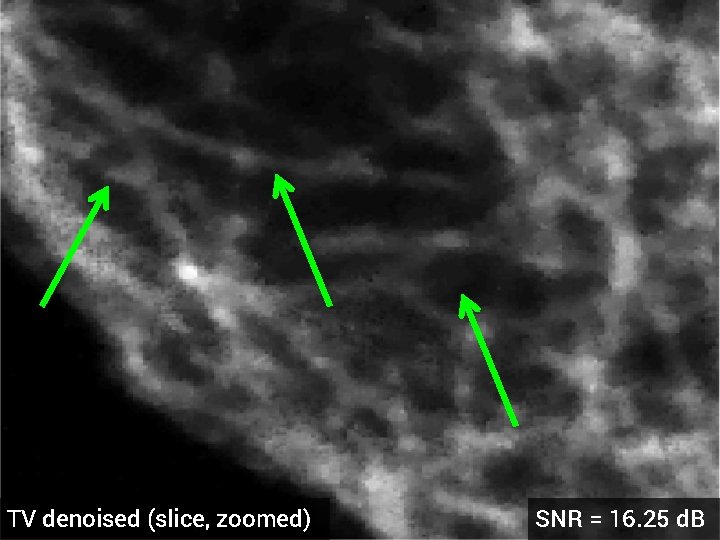
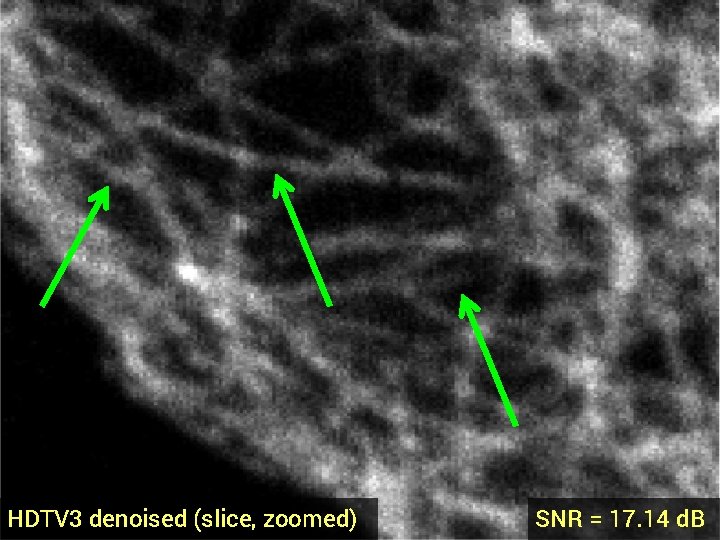
Denoising of 3 -D Florescence Microscopy § 1024 x 17 voxels § Additive Gaussian noise, mean = 0, std. dev. = 1 § Noisy image has SNR = 15 d. B § Optimized regularization parameter original dataset (z-slice)
Noisy (slice, zoomed)
TV denoised (slice, zoomed) SNR = 16. 25 d. B
HDTV 3 denoised (slice, zoomed) SNR = 17. 14 d. B
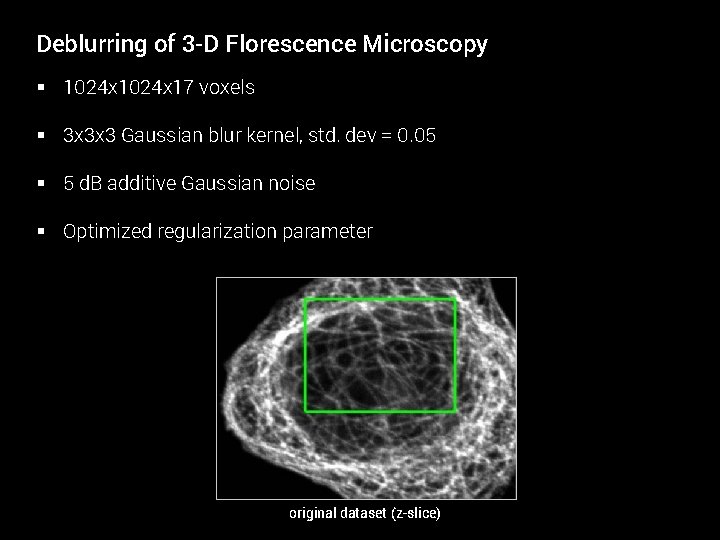
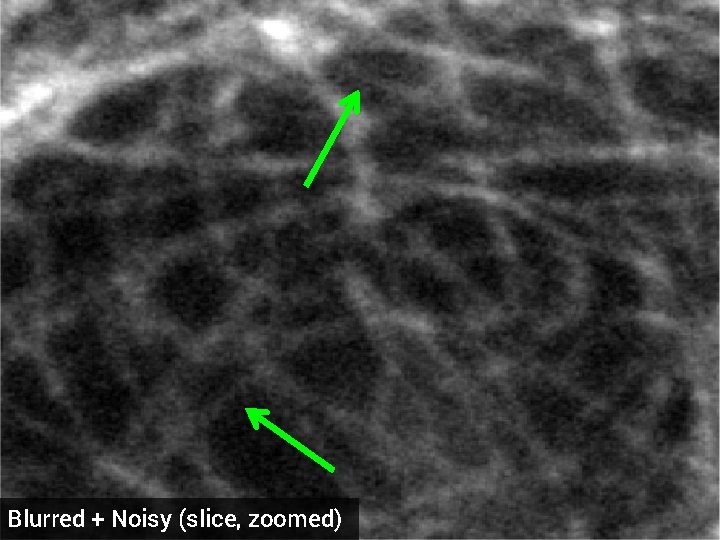
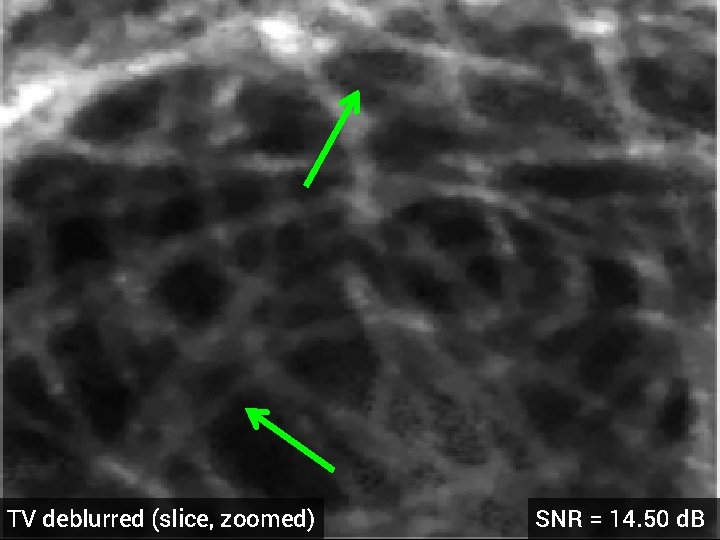
Deblurring of 3 -D Florescence Microscopy § 1024 x 17 voxels § 3 x 3 x 3 Gaussian blur kernel, std. dev = 0. 05 § 5 d. B additive Gaussian noise § Optimized regularization parameter original dataset (z-slice)
Blurred + Noisy (slice, zoomed)
TV deblurred (slice, zoomed) SNR = 14. 50 d. B
HDTV 3 deblurred (slice, zoomed) SNR = 15. 23 d. B
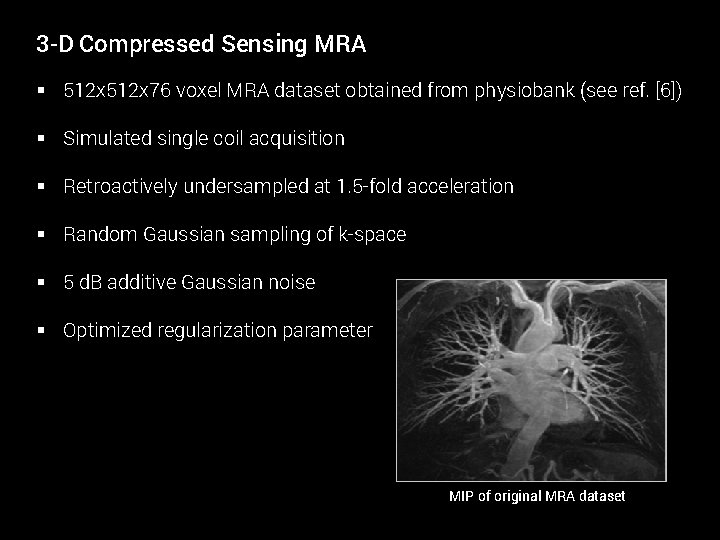
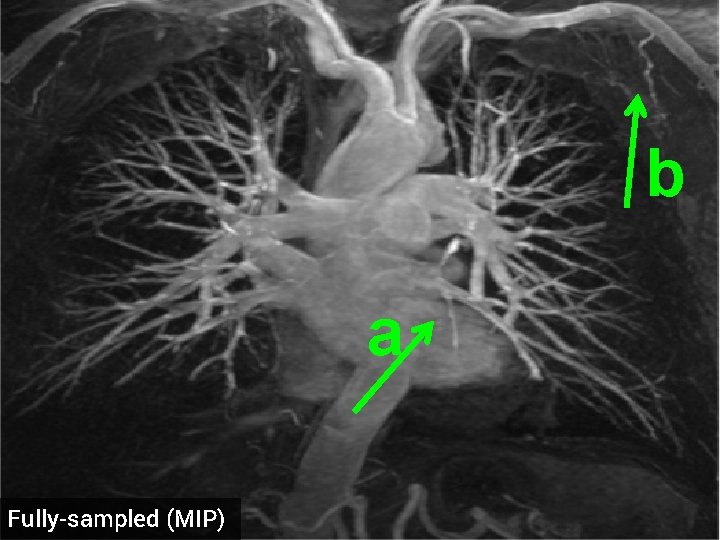
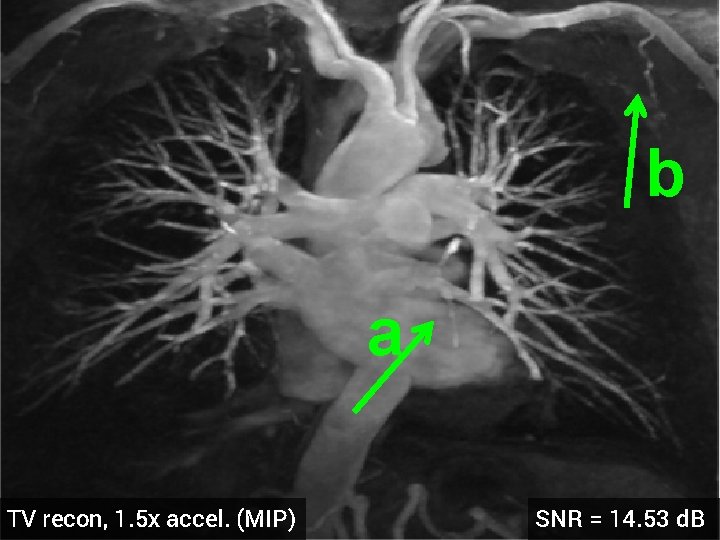
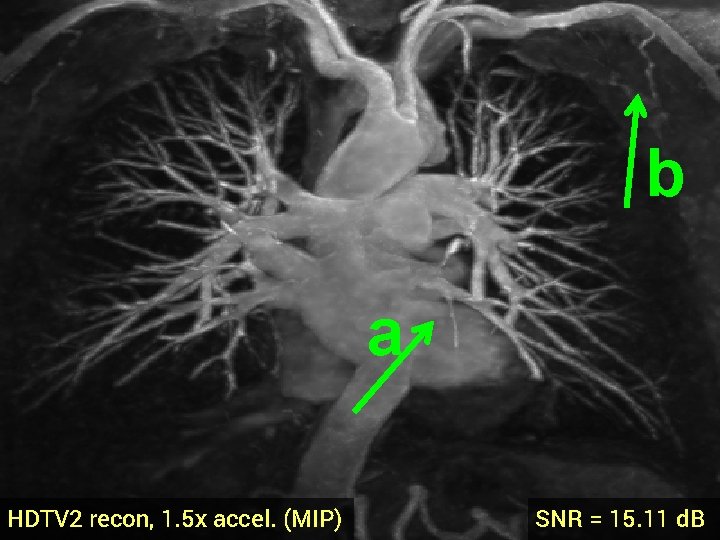
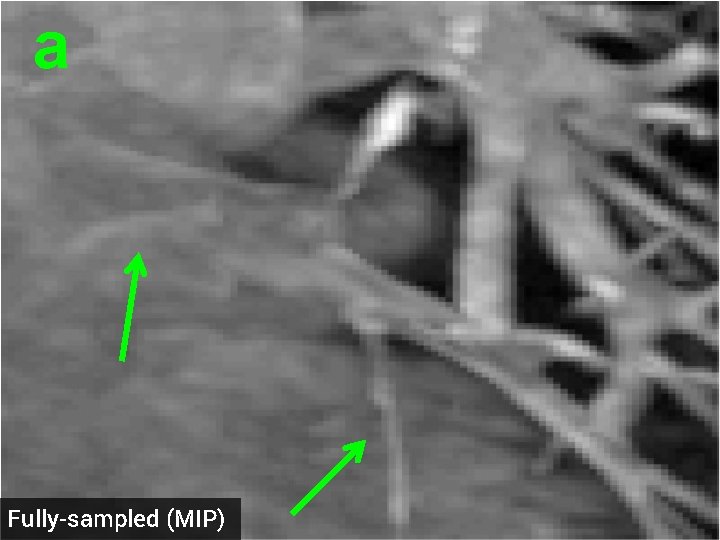
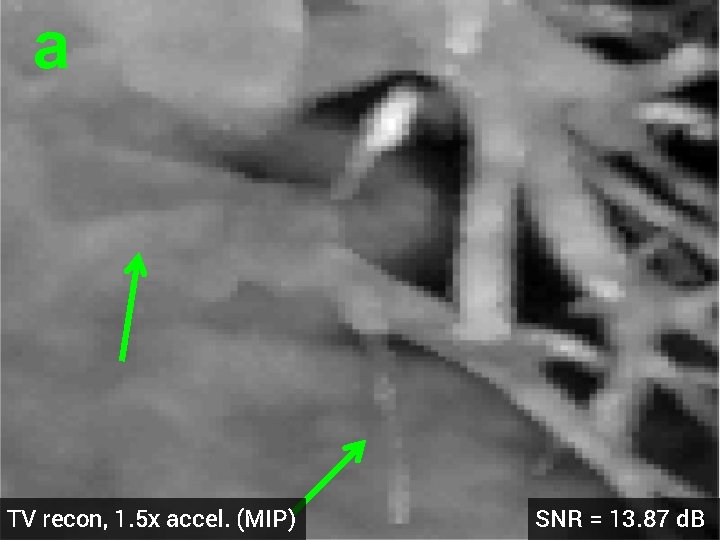
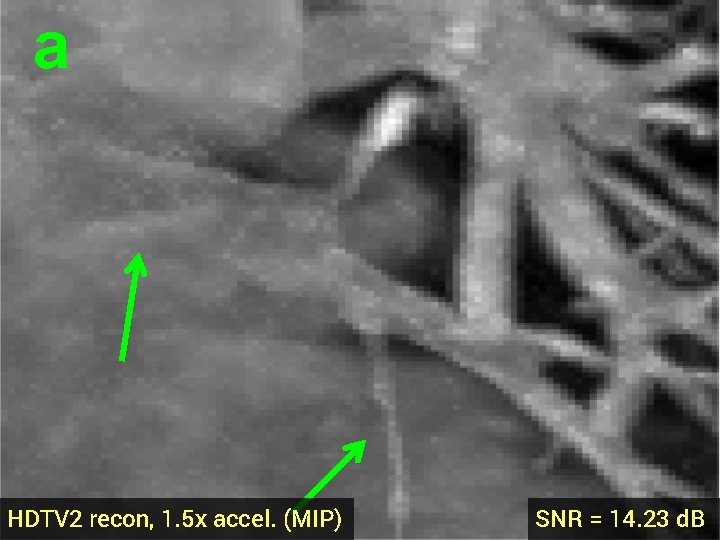
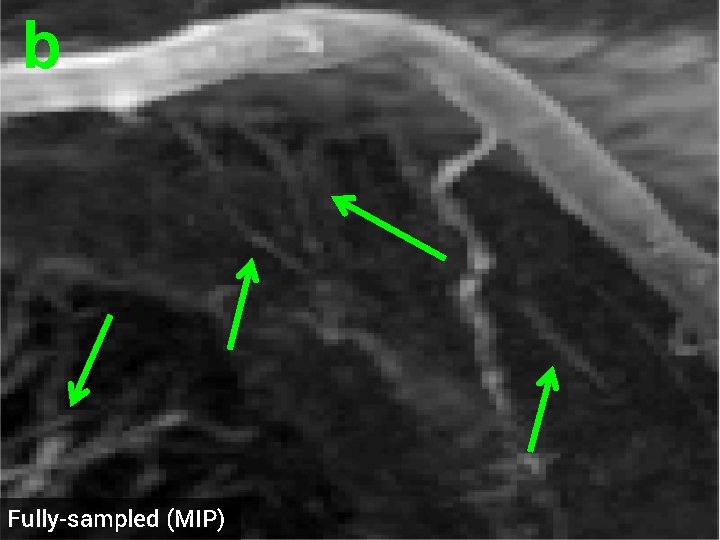
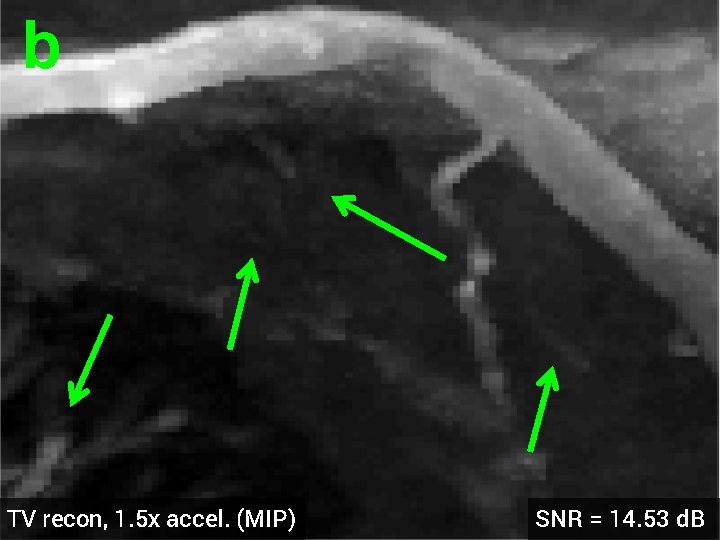
3 -D Compressed Sensing MRA § 512 x 76 voxel MRA dataset obtained from physiobank (see ref. [6]) § Simulated single coil acquisition § Retroactively undersampled at 1. 5 -fold acceleration § Random Gaussian sampling of k-space § 5 d. B additive Gaussian noise § Optimized regularization parameter MIP of original MRA dataset
b a Fully-sampled (MIP)
b a TV recon, 1. 5 x accel. (MIP) SNR = 14. 53 d. B
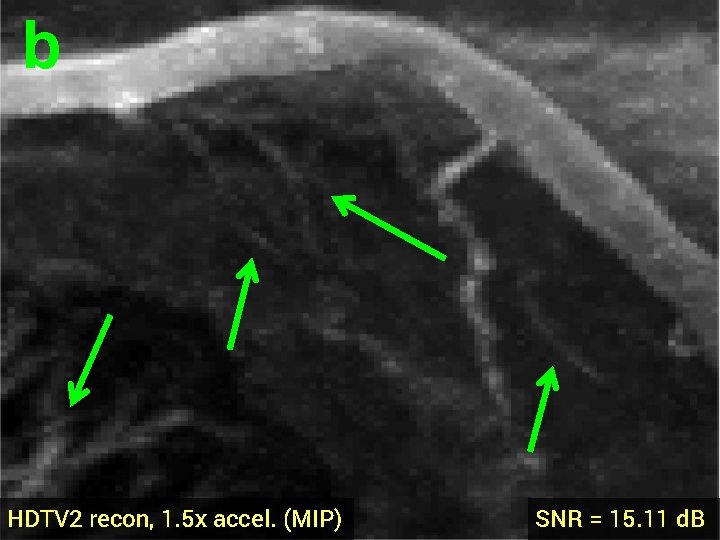
b a HDTV 2 recon, 1. 5 x accel. (MIP) SNR = 15. 11 d. B
a Fully-sampled (MIP)
a TV recon, 1. 5 x accel. (MIP) SNR = 13. 87 d. B
a HDTV 2 recon, 1. 5 x accel. (MIP) SNR = 14. 23 d. B
b Fully-sampled (MIP)
b TV recon, 1. 5 x accel. (MIP) SNR = 14. 53 d. B
b HDTV 2 recon, 1. 5 x accel. (MIP) SNR = 15. 11 d. B
Conclusion
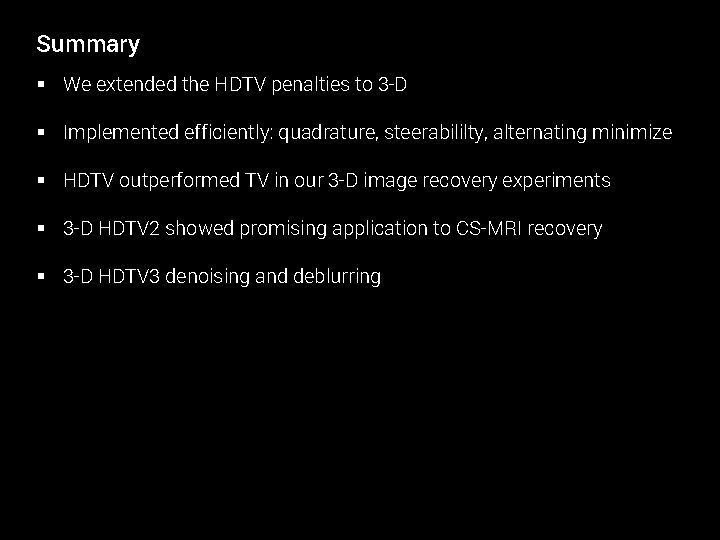
Summary § We extended the HDTV penalties to 3 -D § Implemented efficiently: quadrature, steerabililty, alternating minimize § HDTV outperformed TV in our 3 -D image recovery experiments § 3 -D HDTV 2 showed promising application to CS-MRI recovery § 3 -D HDTV 3 denoising and deblurring
Code § MATLAB implementation available at: CBIG Website: http: //research. engineering. uiowa. edu/cbig http: //github. com/cbig-iowa/hdtv § plug-in for 3 -D HDTV denoising (in development)
Acknowledgements Thank You! § Hans Johnson § Supported by grants: NSF CCF-0844812, NSF CCF-1116067, NIH 1 R 21 HL 109710 -01 A 1, ACS RSG-11 -267 -01 -CCE, and ONR-N 000141310202. References [1] Hu, Y. , & Jacob, M. (2012). HDTV regularization for image recovery. IEEE TIP , 21(5), 2559 -2571 [2] Hu, Y. , Ongie, G. , Ramani, S. , & Jacob, M. (2014). Generalized Higher degree total variation (HDTV). IEEE TIP (in press). [3] Lefkimmiatis, S. , Ward, J. P. , & Unser, M. (2013). Hessian Schatten-Norm Regularization for Linear Inverse Problems. IEEE TIP, 22, 1873 -1888. [5] V. I. Lebedev, and D. N. Laikov (1999). A quadrature formula for the sphere of the 131 st algebraic order of accuracy. Doklady Mathematics, Vol. 59, No. 3, pp. 477 -481. [6] Physiobank: http: //physionet. org/physiobank/database/images/,
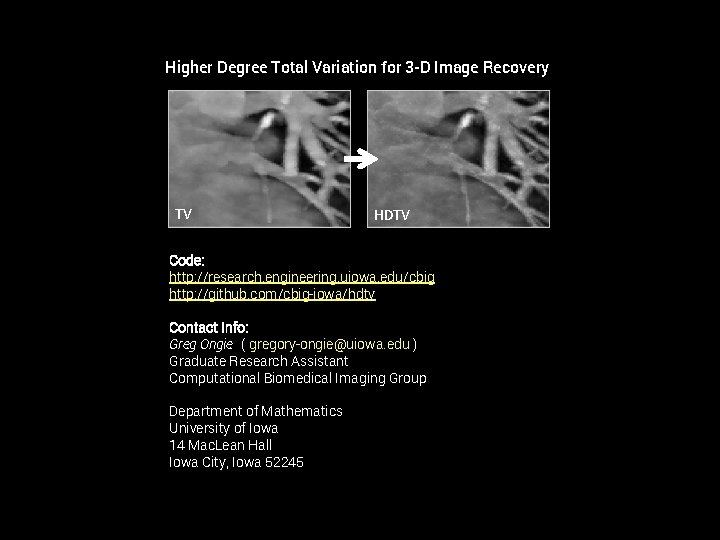
Higher Degree Total Variation for 3 -D Image Recovery TV HDTV Code: http: //research. engineering. uiowa. edu/cbig http: //github. com/cbig-iowa/hdtv Contact Info: Greg Ongie ( gregory-ongie@uiowa. edu ) Graduate Research Assistant Computational Biomedical Imaging Group Department of Mathematics University of Iowa 14 Mac. Lean Hall Iowa City, Iowa 52245