
Higher Biology Evolution Da R G r M
Higher Biology Evolution Da R G r M so d i v n
Inheritance v. Evolution is the gradual change in the characteristics of a population resulting from the selected alleles. v. Evolution occurs over many generations. v. Alleles are selected based on their usefulness. 15 December 2021 G R Davidson 2
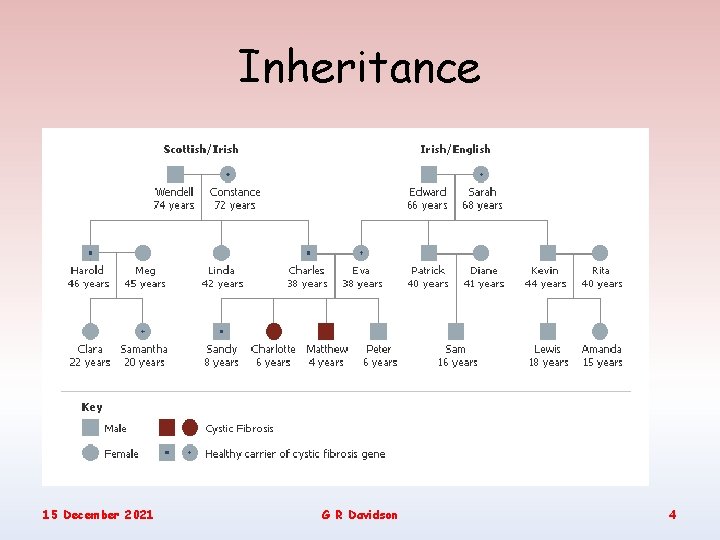
Inheritance v. Vertical inheritance is the passing of genetic material from parents to offspring. v. In sexual reproduction, this mixes the genetic material of both parents and creates further variation. v. This can be represented in a family tree diagram. 15 December 2021 G R Davidson 3
Inheritance 15 December 2021 G R Davidson 4
Inheritance v. Asexual reproduction is much quicker than sexual reproduction. v. However, the genetic material being passed on is identical and therefore, there is no variation. 15 December 2021 G R Davidson 5

Inheritance v. Prokaryotes can transfer genetic material horizontally, i. e. from one organism to another. v. This also promotes variation. v. This horizontal transfer happens within a population, but it can also happen between different species. 15 December 2021 G R Davidson 6
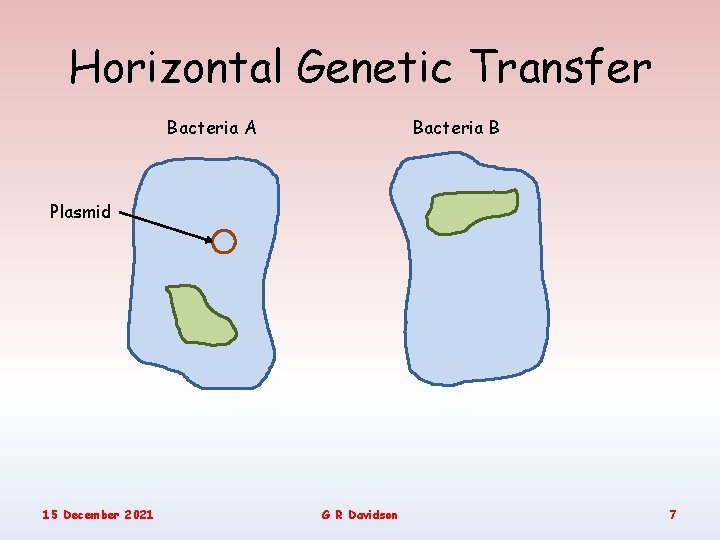
Horizontal Genetic Transfer Bacteria B Bacteria A Plasmid 15 December 2021 G R Davidson 7
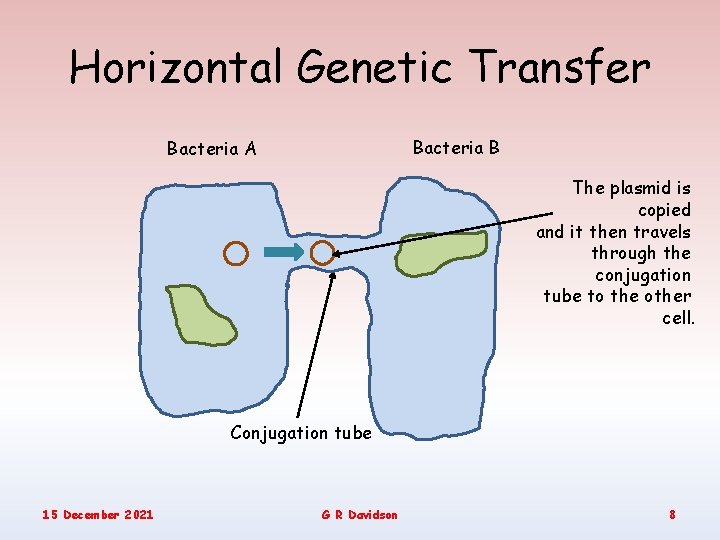
Horizontal Genetic Transfer Bacteria B Bacteria A The plasmid is copied and it then travels through the conjugation tube to the other cell. Conjugation tube 15 December 2021 G R Davidson 8
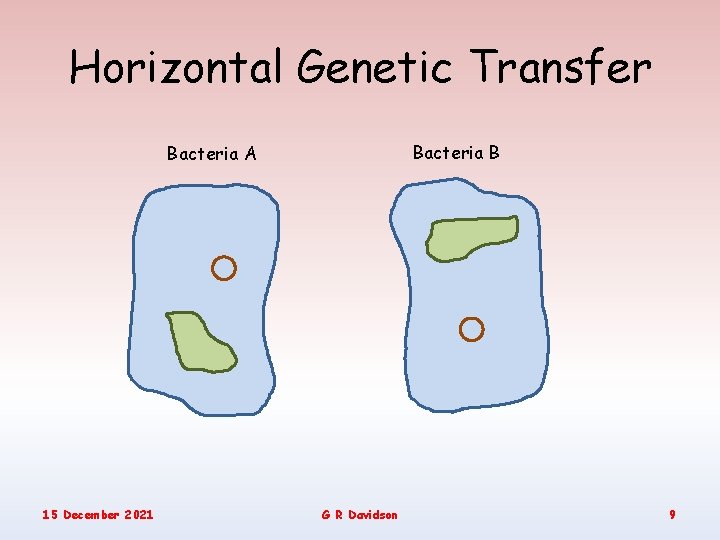
Horizontal Genetic Transfer Bacteria B Bacteria A 15 December 2021 G R Davidson 9
Selection v. Selection is the process where some genes in a population increase in frequency because they are favourable. v. Other genes are not selected and so their frequency decreases. v. This is a non-random process. 15 December 2021 G R Davidson 10
Natural Selection v. Natural selection was first put forward by Charles Darwin. v. It suggested that: ØMore offspring are produced than the environment is able to support. ØThis leads to a struggle for survival brought about by selection pressures like food shortage, poor disease resistance, etc. . 15 December 2021 G R Davidson 11
Natural Selection ØBecause the offspring show variation and are all slightly different, those better adapted to the environment will survive to reproduce and so pass on these favourable genes. ØThose not so well adapted don’t survive and their genes are lost. v. This results in certain genes increasing in their frequency, and is a non-random process. 15 December 2021 G R Davidson 12
Selection v. Some DNA sequences are damaging and these are called deleterious. v. These will eventually disappear from the population as their frequency decreases. v. Some mutations can be lethal and will disappear much quicker. v. This process of negative selection is also non-random. 15 December 2021 G R Davidson 13
Selection v. Since females produce very few eggs, the females need to ensure that her offspring have the greatest survival chances. v. This sexual selection operates in two ways: 15 December 2021 G R Davidson 14
Selection ØMale to male competition. § Males compete fiercely with each other over females and space. § In this way, only the more dominant males get to reproduce and pass their genes on, e. g. red deer. ØFemale Choice § The females have to choose a male based on the traits he possesses and displays, e. g. peacocks. 15 December 2021 G R Davidson 15
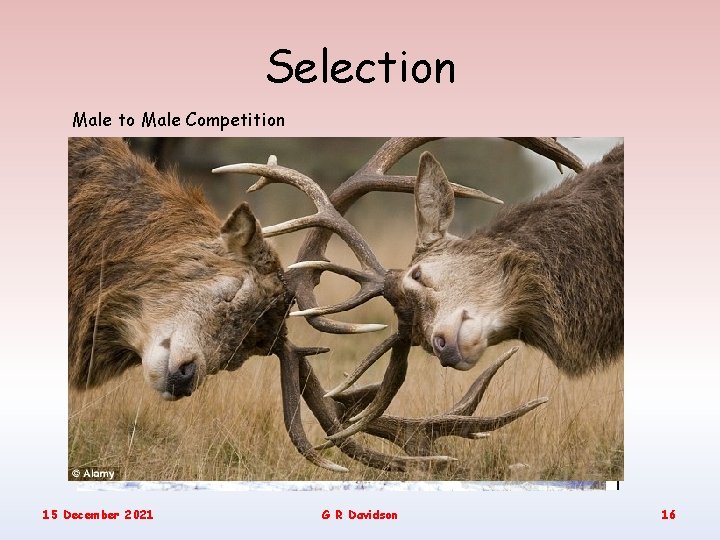
Selection Male to Male Competition 15 December 2021 G R Davidson 16
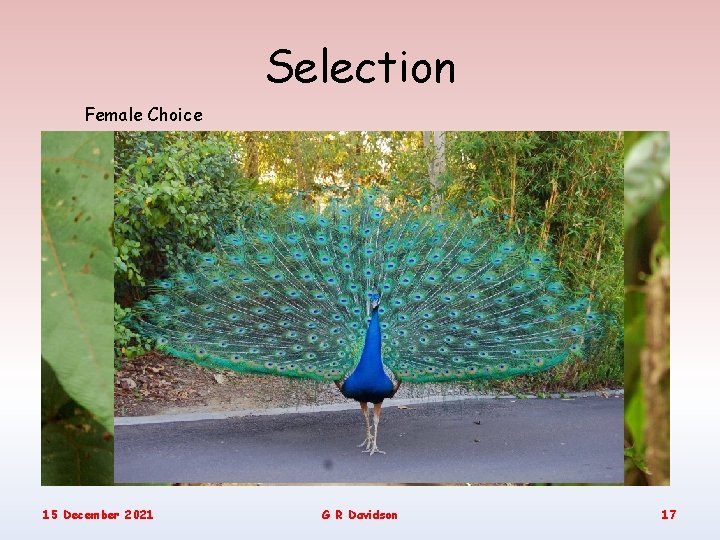
Selection Female Choice 15 December 2021 G R Davidson 17
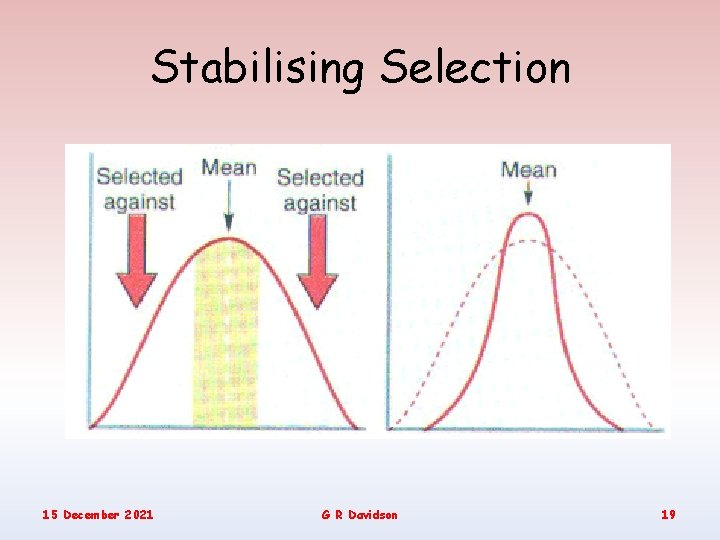
Stabilising Selection v. This type of selection puts pressures on the extremes of a range. v. The mean value doesn’t change but the genetic diversity decreases. v. Examples include human babies. ØBabies born with a very low birth weight are more likely to develop life threatening conditions and those with a high birth weight are more likely to have difficulties during the birth process. 15 December 2021 G R Davidson 18
Stabilising Selection 15 December 2021 G R Davidson 19
Directional Selection v. Directional selection tends to move the mean towards one of the extreme values. v. It is usually brought about by a change in the environment which results in a progressive shift towards the extreme. v. Examples include Industrial Melanism in the peppered moth. 15 December 2021 G R Davidson 20
Industrial Melanism v One of the most well researched examples of evidence for natural selection is that of Biston betularia – the peppered moth. v This moth, which is common in England, normally rests on trunks and branches of trees. Wednesday, December 15, 2021 G Davidson 21
Industrial Melanism v One form of it is a light colour, but since 1848, melanic (darker, with more melanin pigment) forms have been found, the first near Manchester. v As the moths are predated on by birds, the dark form survives better in polluted areas, while the light form survives better in nonpolluted areas. v This shifts the mean value of the frequency of the alleles for the dark colour. Wednesday, December 15, 2021 G Davidson 22
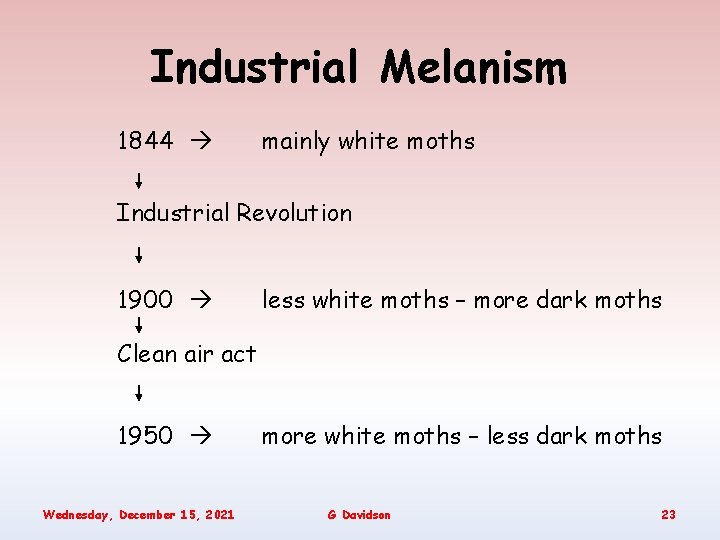
Industrial Melanism 1844 mainly white moths Industrial Revolution 1900 less white moths – more dark moths Clean air act 1950 Wednesday, December 15, 2021 more white moths – less dark moths G Davidson 23
Industrial Melanism v The reason white moths survive better in non -polluted areas is the presence of a light coloured lichen growing on trees providing the white moths with camouflage whereas dark moths are easily seen and eaten by the birds. v In heavily polluted areas, the soot kills the lichens and darkens the trees, giving camouflage to the dark moths and making the white moths susceptible to predation. Wednesday, December 15, 2021 G Davidson 24
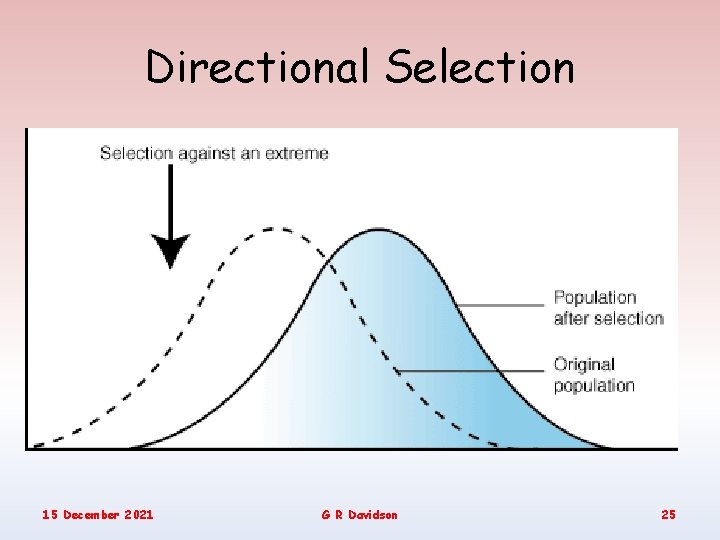
Directional Selection 15 December 2021 G R Davidson 25
Disruptive Selection v. This type of selection involves the two extreme forms of a characteristic being favoured over the intermediate. v. It results in 2 mean values and the population becoming split into 2 distinct groups. v. Examples include body size in male salmon. 15 December 2021 G R Davidson 26
Disruptive Selection v. In male salmon, the larger body sized fish compete better for territories. v. The very small bodied males, however, have the ability to sneak into these territories and fertilise the eggs without being spotted. v. This means that both groups get to pass on their genes, while the intermediate group don’t. 15 December 2021 G R Davidson 27
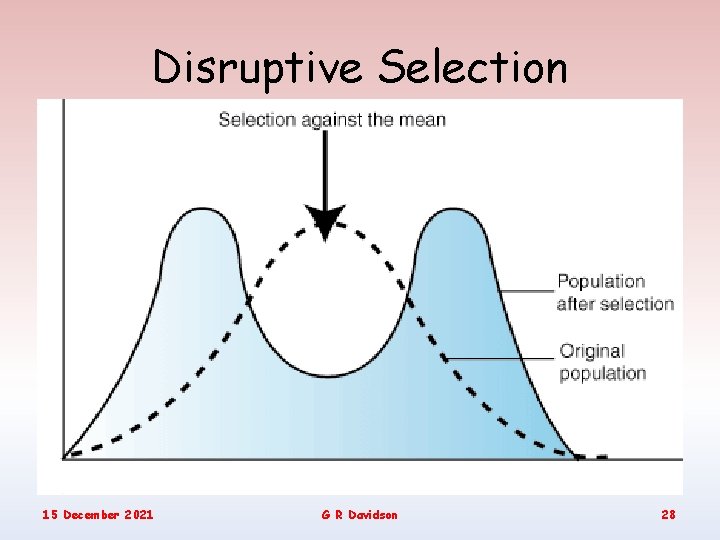
Disruptive Selection 15 December 2021 G R Davidson 28
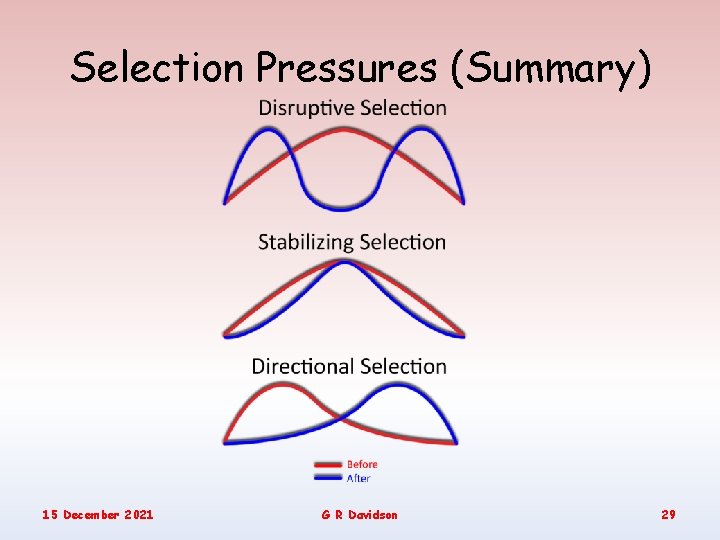
Selection Pressures (Summary) 15 December 2021 G R Davidson 29
Genetic Drift v. The total number of gene sequences in a population is known as the gene pool. v. In very large populations the gene frequency tends to remain fairly constant. v. However, in much smaller populations, some alleles will increase in frequency while others will decrease. v. This is called genetic drift. 15 December 2021 G R Davidson 30
Founder Effect v. The founder effect is a special case of genetic drift. v. If a small splinter group becomes separated from the main population, it will contain the same alleles as the main group but these may have different frequencies. 15 December 2021 G R Davidson 31
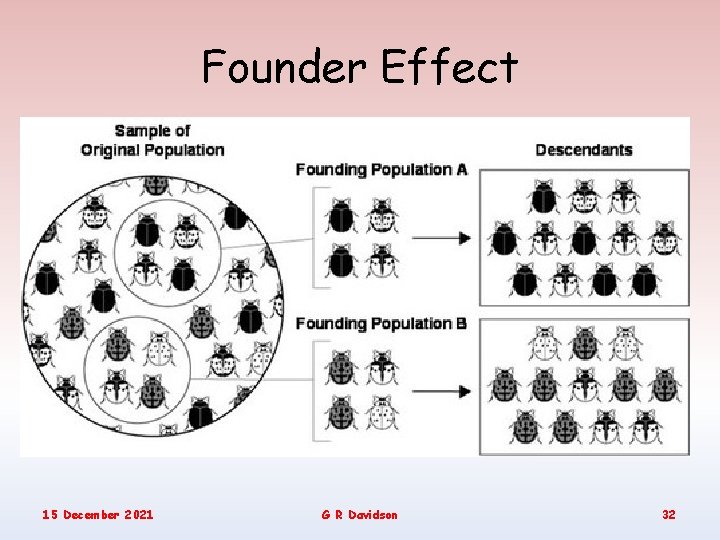
Founder Effect 15 December 2021 G R Davidson 32
Neutral Mutations v. Most minor mutations don’t have any effect on how well an organism is adapted to its environment, and are thus termed neutral mutations. v. However, several neutral mutations could become combined resulting in either an advantage or disadvantage to the organism. v. These, however, are very rare. 15 December 2021 G R Davidson 33
Speciation v. A species is a population of organisms which can breed together successfully and produce fertile offspring. v. Differences between organisms are called variation. 15 December 2021 G R Davidson 34
Speciation v. If variation between members of populations of the same species becomes great and the population becomes split into two or more separate units each with its own slightly different distribution of genes, then a new species may develop. v. This is called speciation. v. There are two types of speciation. 15 December 2021 G R Davidson 35
Allopatric Speciation v. Allopatric speciation is brought about by geographical barriers preventing two populations of the same species from inter-breeding. v. Barriers such as deserts, mountains, seas, etc. . 15 December 2021 G R Davidson 36
Allopatric Speciation v. Over a long period of time, the two groups evolve and become genetically different. v. If this occurs to the point where they can no longer interbreed and produce fertile offspring, they are now two distinct species. 15 December 2021 G R Davidson 37
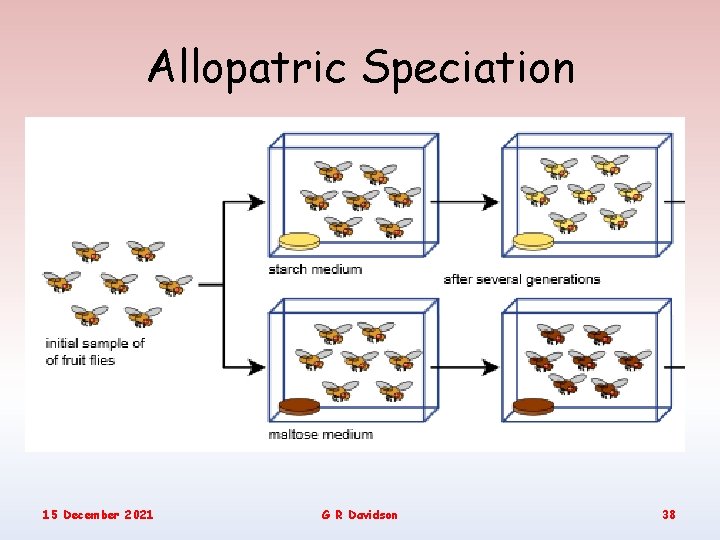
Allopatric Speciation 15 December 2021 G R Davidson 38
Sympatric Speciation v. Sympatric speciation is a result of the gene flow being prevented, not by geographical barriers, but by ecological or behavioural barriers. Ø Ecological barriers such as the habitat changing and some individuals will adapt better to the new habitat while others will prefer the old one. Ø Behavioural barriers such as the different groups now having different reproductive times. 15 December 2021 G R Davidson 39
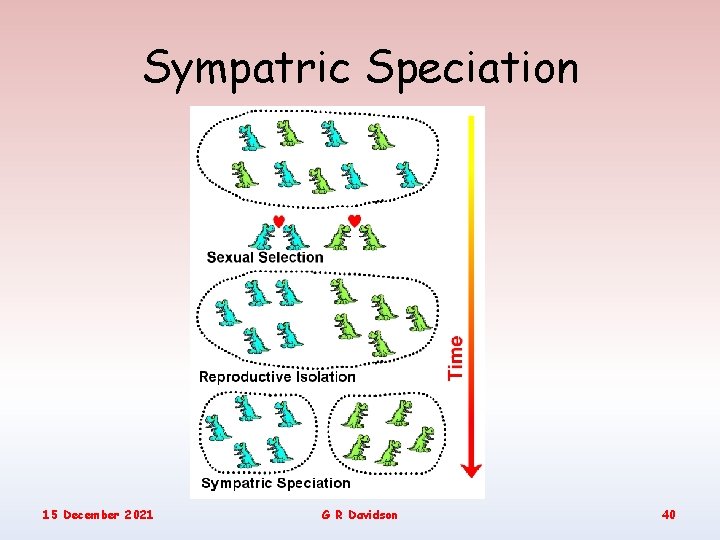
Sympatric Speciation 15 December 2021 G R Davidson 40
Hybrid Zone v. A hybrid zone is an area where two populations meet. v. They have the ability to interbreed and produce fertile offspring called hybrids. 15 December 2021 G R Davidson 41
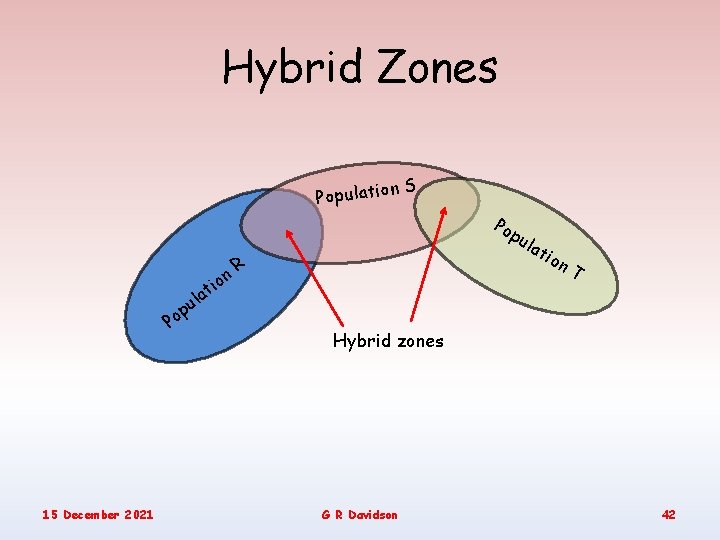
Hybrid Zones Population S Po pu l pu a Po 15 December 2021 tio n R lat ion T Hybrid zones G R Davidson 42
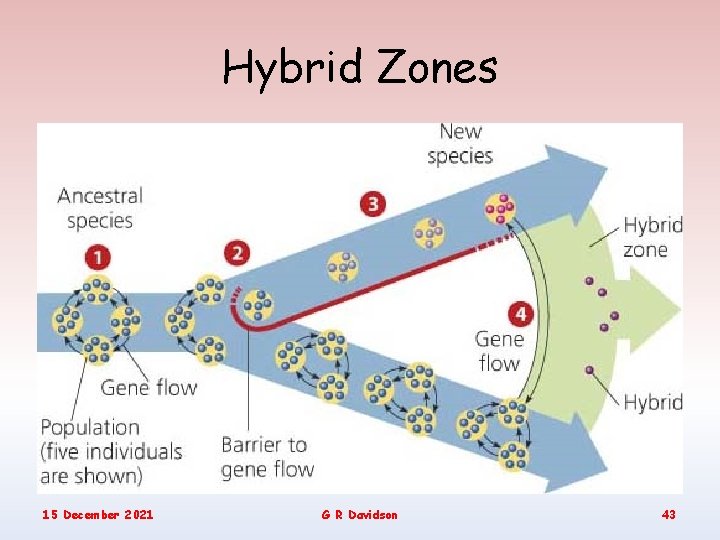
Hybrid Zones 15 December 2021 G R Davidson 43
- Slides: 43