
Highenergy neutrino astronomy with Ice Cube Ignacio Taboada
High-energy neutrino astronomy with Ice. Cube Ignacio Taboada Georgia Institute of Technology for the Ice. Cube collaboration Madison, NDM 2009 I Taboada, GA Tech
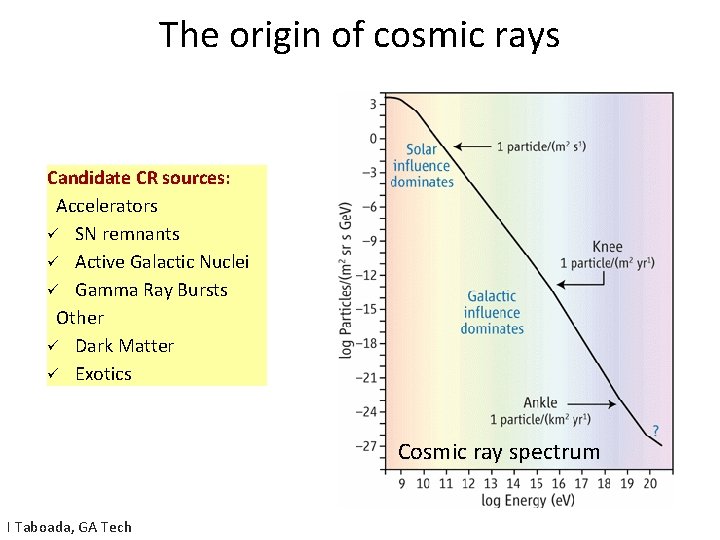
The origin of cosmic rays Candidate CR sources: Accelerators ü SN remnants ü Active Galactic Nuclei ü Gamma Ray Bursts Other ü Dark Matter ü Exotics Cosmic ray spectrum I Taboada, GA Tech
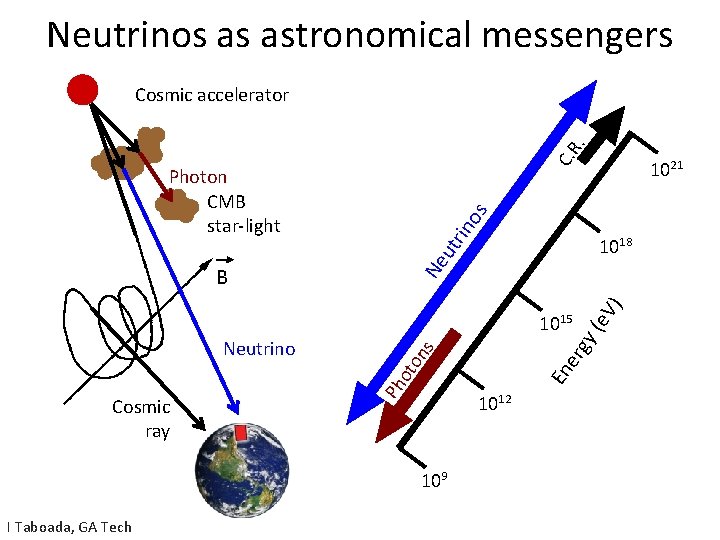
Neutrinos as astronomical messengers C. R . Cosmic accelerator 1021 rin os Photon CMB star-light Ne ut 1018 Cosmic ray En er ns Ph o to Neutrino gy 1015 1012 109 I Taboada, GA Tech (e. V ) B
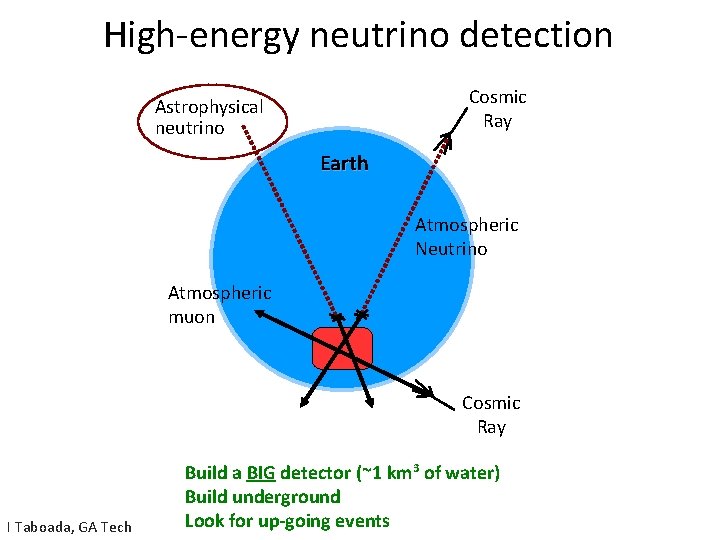
High-energy neutrino detection Cosmic Ray Astrophysical neutrino Earth Atmospheric Neutrino Atmospheric muon Cosmic Ray I Taboada, GA Tech Build a BIG detector (~1 km 3 of water) Build underground Look for up-going events
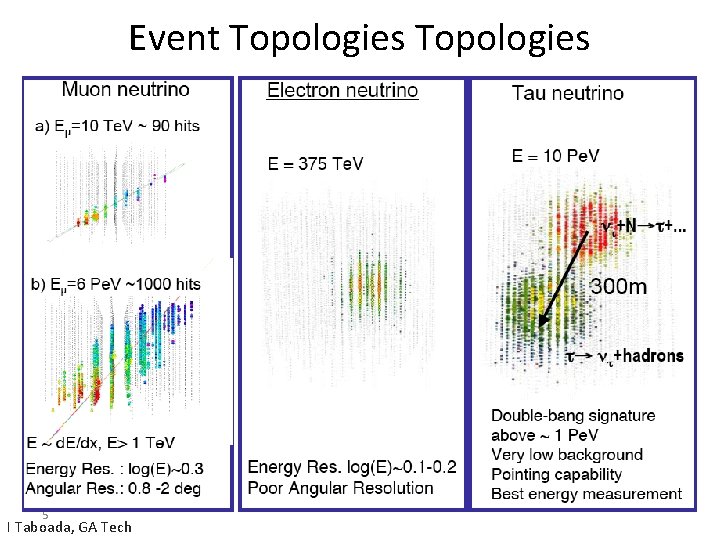
Event Topologies 5 I Taboada, GA Tech
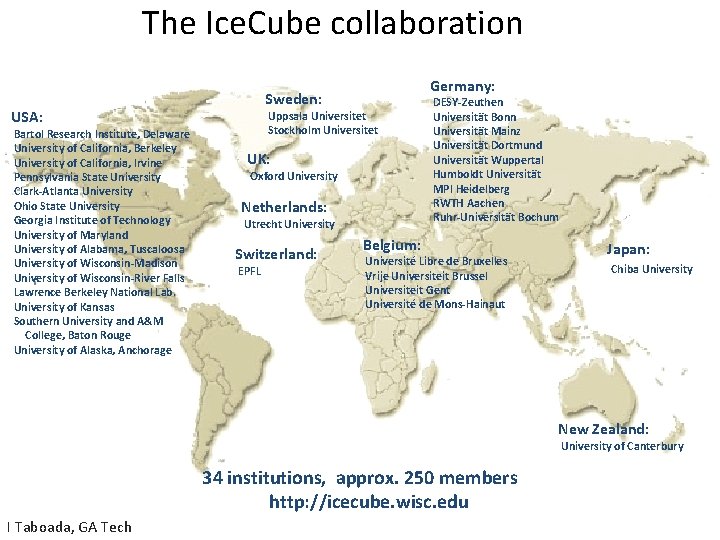
The Ice. Cube collaboration Sweden: USA: Bartol Research Institute, Delaware University of California, Berkeley University of California, Irvine Pennsylvania State University Clark-Atlanta University Ohio State University Georgia Institute of Technology University of Maryland University of Alabama, Tuscaloosa University of Wisconsin-Madison University of Wisconsin-River Falls Lawrence Berkeley National Lab. University of Kansas Southern University and A&M College, Baton Rouge University of Alaska, Anchorage Germany: Uppsala Universitet Stockholm Universitet UK: Oxford University Netherlands: Utrecht University Switzerland: EPFL DESY-Zeuthen Universität Bonn Universität Mainz Universität Dortmund Universität Wuppertal Humboldt Universität MPI Heidelberg RWTH Aachen Ruhr-Universität Bochum Belgium: Université Libre de Bruxelles Vrije Universiteit Brussel Universiteit Gent Université de Mons-Hainaut Japan: Chiba University New Zealand: University of Canterbury 34 institutions, approx. 250 members http: //icecube. wisc. edu I Taboada, GA Tech
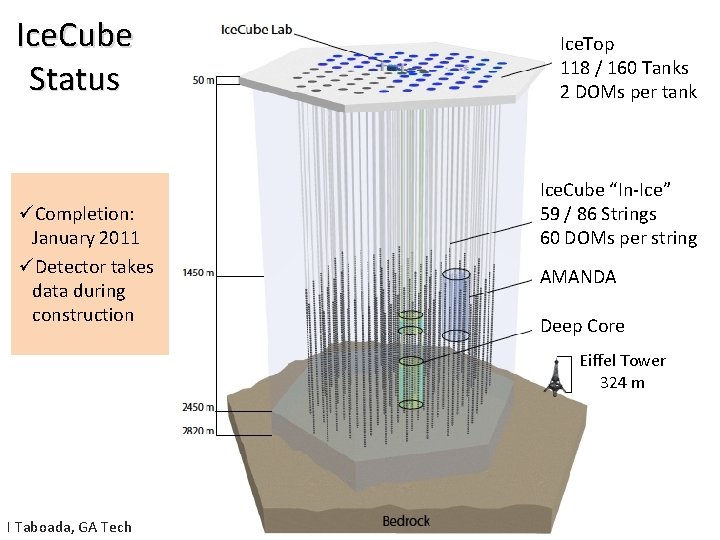
Ice. Cube Status üCompletion: January 2011 üDetector takes data during construction Ice. Top 118 / 160 Tanks 2 DOMs per tank Ice. Cube “In-Ice” 59 / 86 Strings 60 DOMs per string AMANDA Deep Core Eiffel Tower 324 m I Taboada, GA Tech
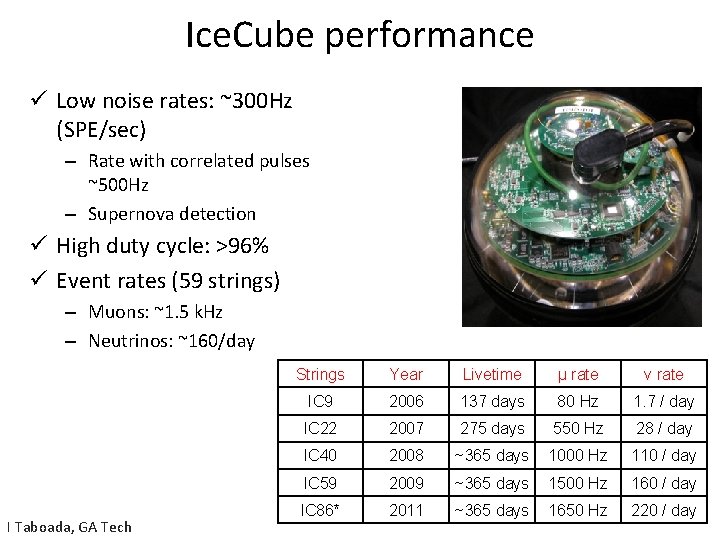
Ice. Cube performance ü Low noise rates: ~300 Hz (SPE/sec) – Rate with correlated pulses ~500 Hz – Supernova detection ü High duty cycle: >96% ü Event rates (59 strings) – Muons: ~1. 5 k. Hz – Neutrinos: ~160/day I Taboada, GA Tech Strings Year Livetime μ rate ν rate IC 9 2006 137 days 80 Hz 1. 7 / day IC 22 2007 275 days 550 Hz 28 / day IC 40 2008 ~365 days 1000 Hz 110 / day IC 59 2009 ~365 days 1500 Hz 160 / day IC 86* 2011 ~365 days 1650 Hz 220 / day
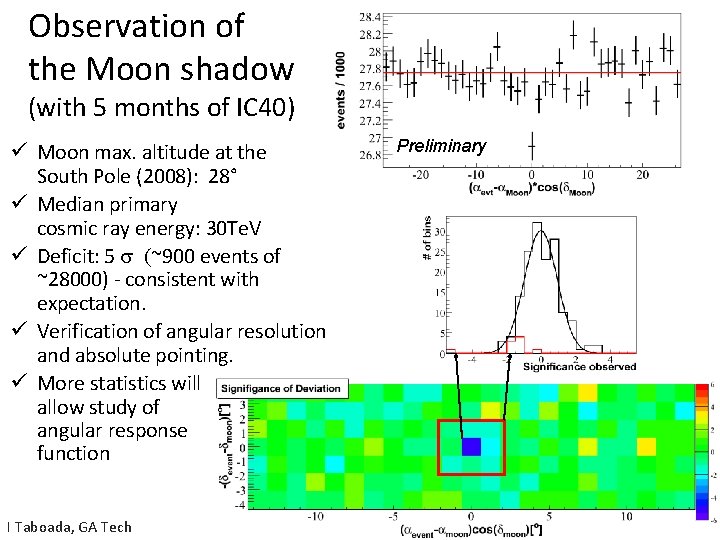
Observation of the Moon shadow (with 5 months of IC 40) ü Moon max. altitude at the South Pole (2008): 28° ü Median primary cosmic ray energy: 30 Te. V ü Deficit: 5 s (~900 events of ~28000) - consistent with expectation. ü Verification of angular resolution and absolute pointing. ü More statistics will allow study of angular response function I Taboada, GA Tech Preliminary
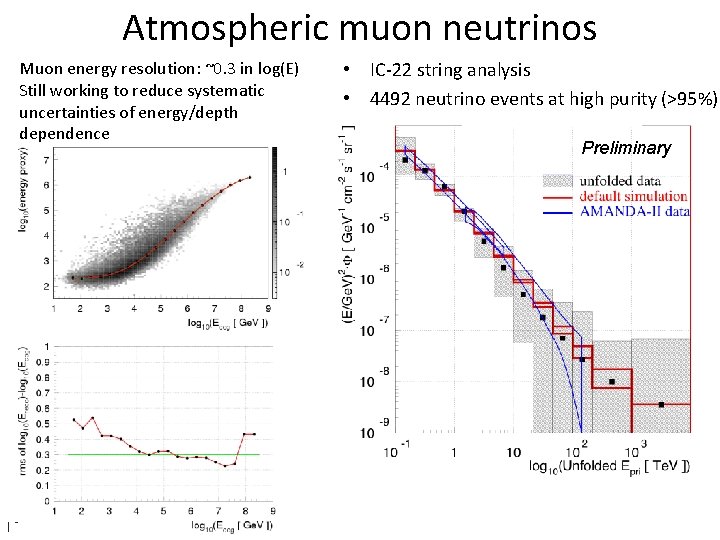
Atmospheric muon neutrinos Muon energy resolution: ~0. 3 in log(E) Still working to reduce systematic uncertainties of energy/depth dependence I Taboada, GA Tech • IC-22 string analysis • 4492 neutrino events at high purity (>95%) Preliminary
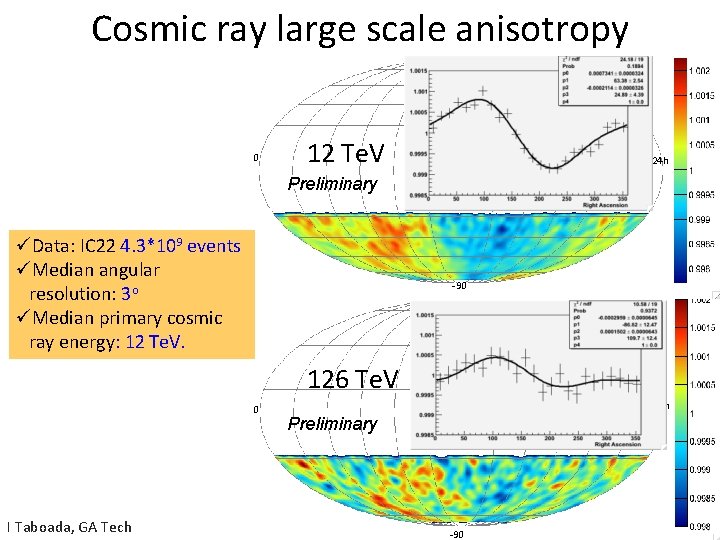
Cosmic ray large scale anisotropy 90 0 12 Te. V 24 h Preliminary üData: IC 22 4. 3*109 events üMedian angular resolution: 3 o üMedian primary cosmic ray energy: 12 Te. V. -90 90 126 Te. V 0 I Taboada, GA Tech 24 h Preliminary -90
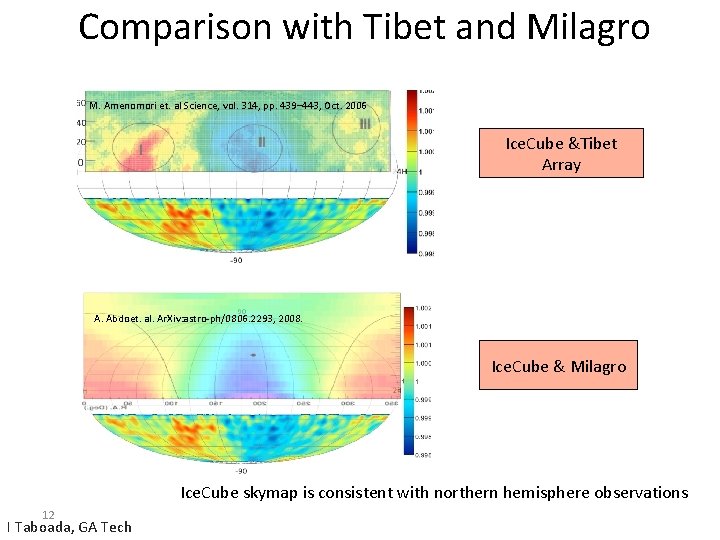
Comparison with Tibet and Milagro M. Amenomori et. al Science, vol. 314, pp. 439– 443, Oct. 2006 Ice. Cube &Tibet Array A. Abdoet. al. Ar. Xiv: astro-ph/0806. 2293, 2008. Ice. Cube & Milagro Ice. Cube skymap is consistent with northern hemisphere observations 12 I Taboada, GA Tech
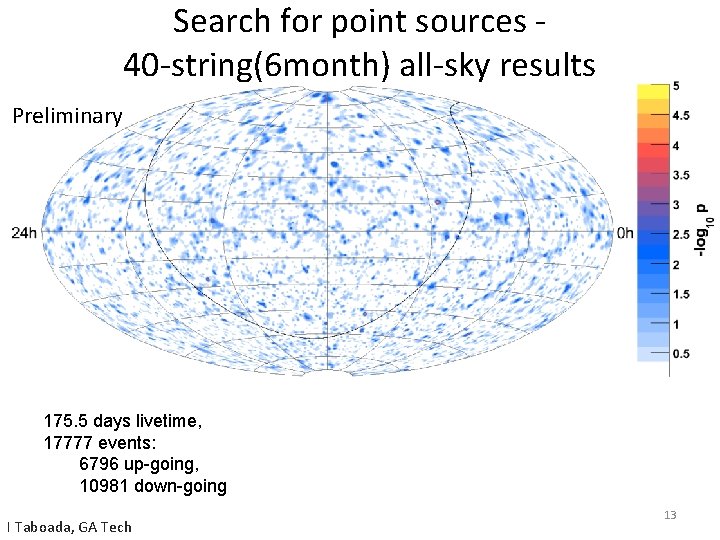
Search for point sources 40 -string(6 month) all-sky results Preliminary 175. 5 days livetime, 17777 events: 6796 up-going, 10981 down-going I Taboada, GA Tech 13
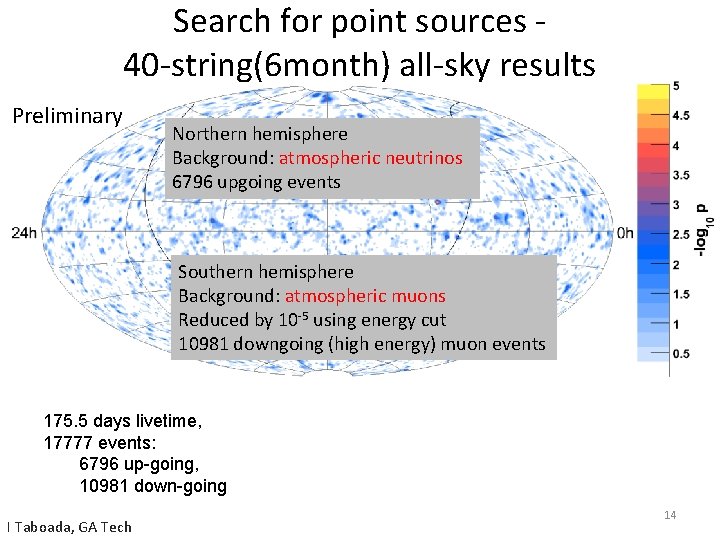
Search for point sources 40 -string(6 month) all-sky results Preliminary Northern hemisphere Background: atmospheric neutrinos 6796 upgoing events Southern hemisphere Background: atmospheric muons Reduced by 10 -5 using energy cut 10981 downgoing (high energy) muon events 175. 5 days livetime, 17777 events: 6796 up-going, 10981 down-going I Taboada, GA Tech 14
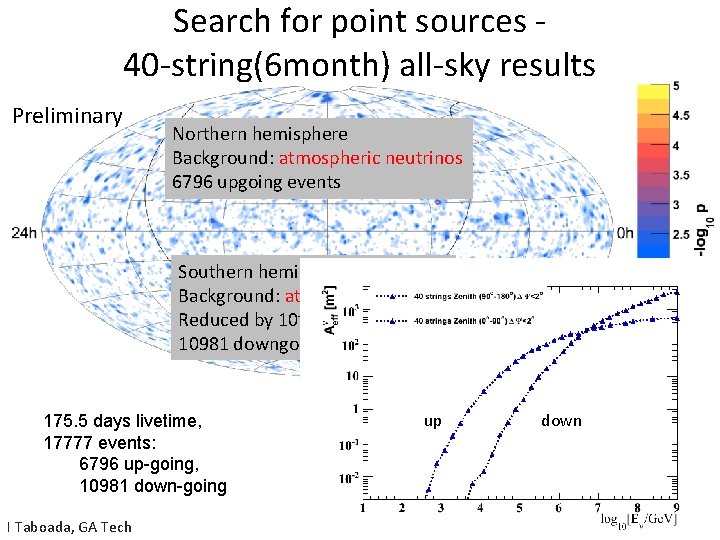
Search for point sources 40 -string(6 month) all-sky results Preliminary Northern hemisphere Background: atmospheric neutrinos 6796 upgoing events Southern hemisphere Background: atmospheric muons Reduced by 10 -5 using energy cut 10981 downgoing muon events 175. 5 days livetime, 17777 events: 6796 up-going, 10981 down-going I Taboada, GA Tech up down 15
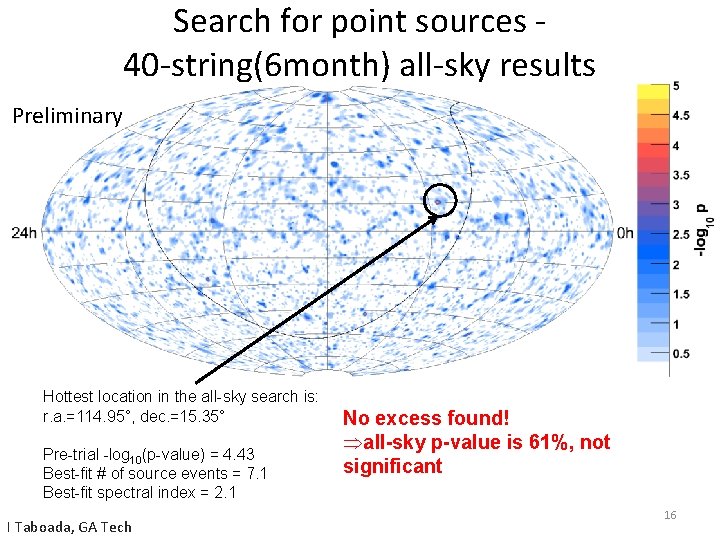
Search for point sources 40 -string(6 month) all-sky results Preliminary Hottest location in the all-sky search is: r. a. =114. 95°, dec. =15. 35° Pre-trial -log 10(p-value) = 4. 43 Best-fit # of source events = 7. 1 Best-fit spectral index = 2. 1 I Taboada, GA Tech No excess found! all-sky p-value is 61%, not significant 16
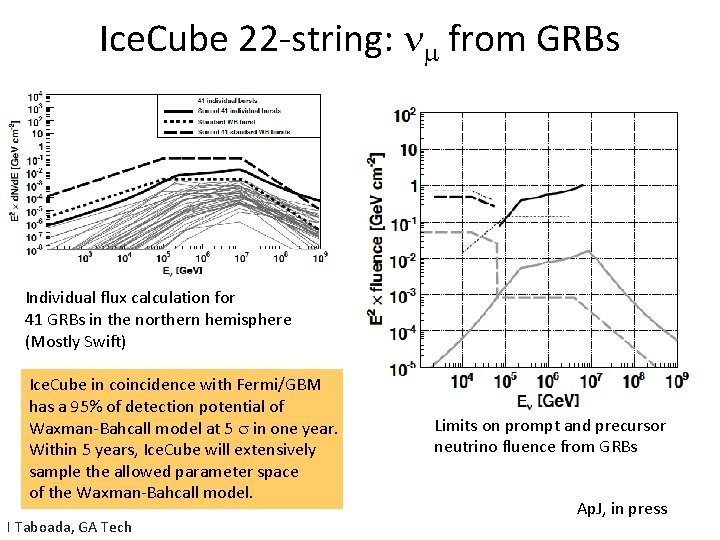
Ice. Cube 22 -string: nm from GRBs Individual flux calculation for 41 GRBs in the northern hemisphere (Mostly Swift) Ice. Cube in coincidence with Fermi/GBM has a 95% of detection potential of Waxman-Bahcall model at 5 s in one year. Within 5 years, Ice. Cube will extensively sample the allowed parameter space of the Waxman-Bahcall model. I Taboada, GA Tech Limits on prompt and precursor neutrino fluence from GRBs Ap. J, in press
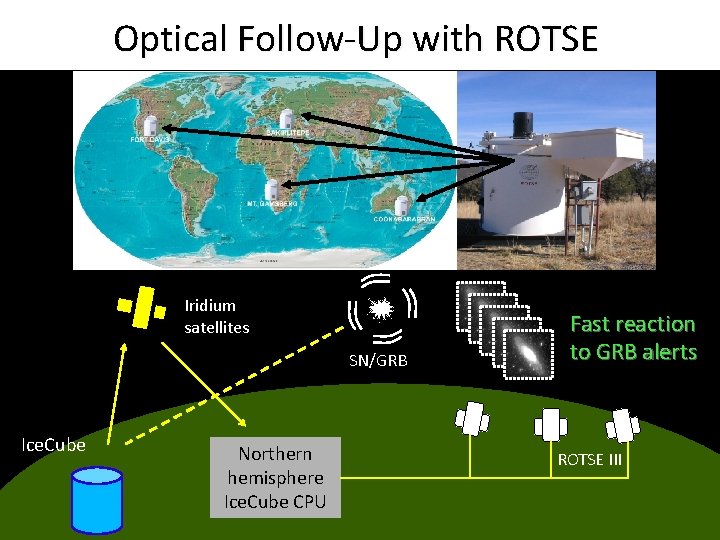
Optical Follow-Up with ROTSE Iridium satellites SN/GRB Ice. Cube I Taboada, GA Tech Northern hemisphere Ice. Cube CPU Fast reaction to GRB alerts ROTSE III
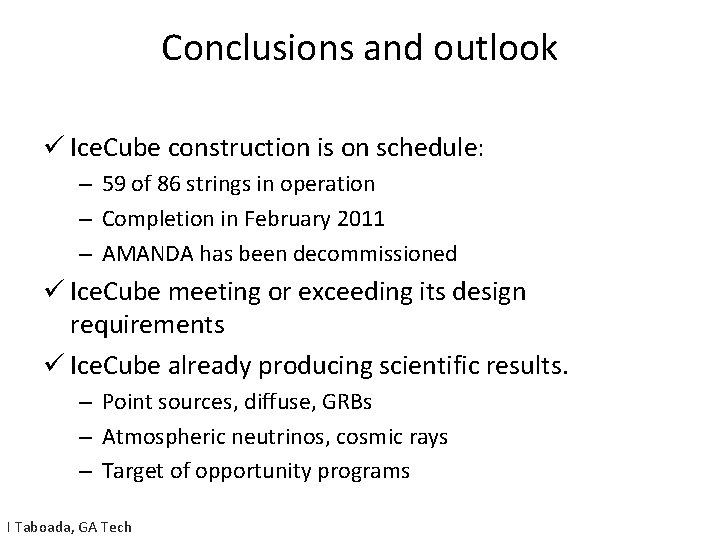
Conclusions and outlook ü Ice. Cube construction is on schedule: – 59 of 86 strings in operation – Completion in February 2011 – AMANDA has been decommissioned ü Ice. Cube meeting or exceeding its design requirements ü Ice. Cube already producing scientific results. – Point sources, diffuse, GRBs – Atmospheric neutrinos, cosmic rays – Target of opportunity programs I Taboada, GA Tech

Overflow I Taboada, GA Tech
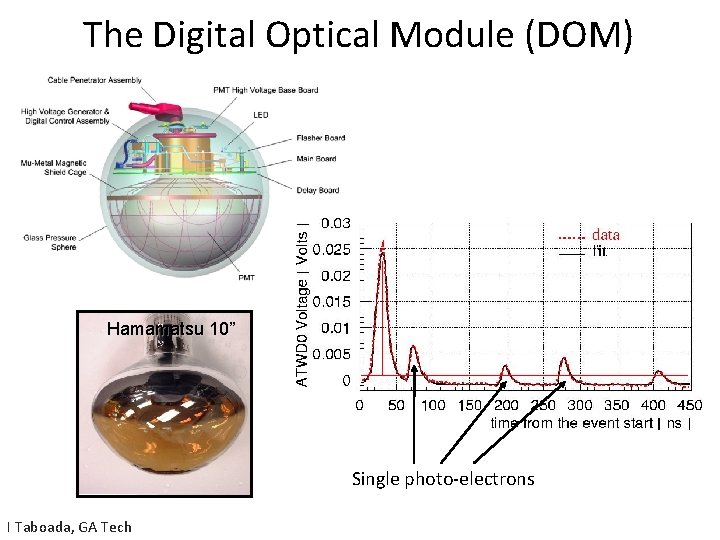
The Digital Optical Module (DOM) Hamamatsu 10” Single photo-electrons I Taboada, GA Tech
- Slides: 21