
HighEnergy Emission from Young and Massive Stellar Objects
High-Energy Emission from Young and Massive Stellar Objects Gustavo E. Romero IAR-CONICET romero@iar-conicet. gov. ar Felix Aharonian’s Workshop November 7 th, 2012
What are the contents of star-forming regions? Gas (Hayakawa 1952, Morrison 1958, Aharonian & Atoyan 1996). � Young, massive stars with winds collective effects (Bykov & Fleishman 1992, Romero & Torres 2003, Torres et al. 2004, Parizot et al. 2004, Bykov: yesterday, etc). � Young pulsars. � SNRs (yesterday’s talks). � Colliding wind binaries (Eichler & Usov 1993, Benaglia & Romero 2003, Pittard & Daugherty 2006). � Accreting sources (Paredes, Mirabel, Bosch-Ramon – this workshop). � � FORMING MASSIVE STARS. � RUNAWAY MASSIVE STARS.
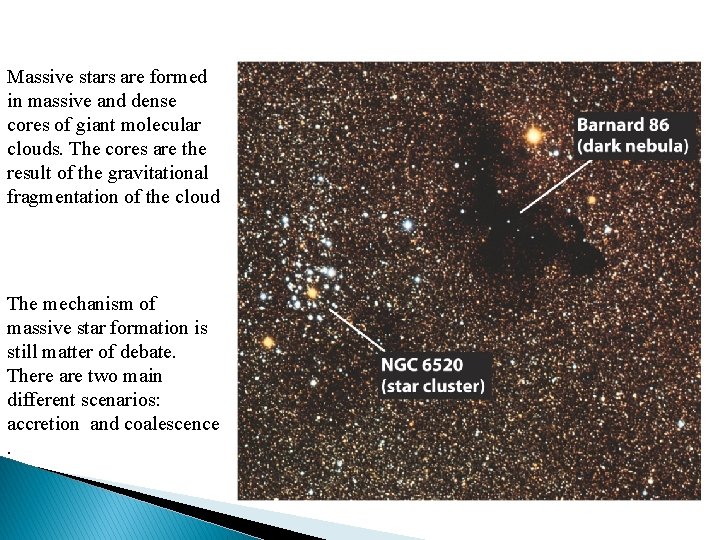
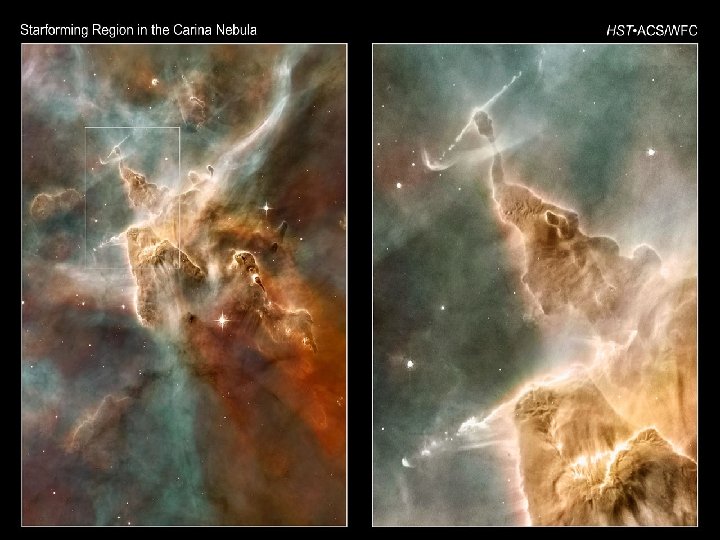
Massive stars are formed in massive and dense cores of giant molecular clouds. The cores are the result of the gravitational fragmentation of the cloud The mechanism of massive star formation is still matter of debate. There are two main different scenarios: accretion and coalescence.
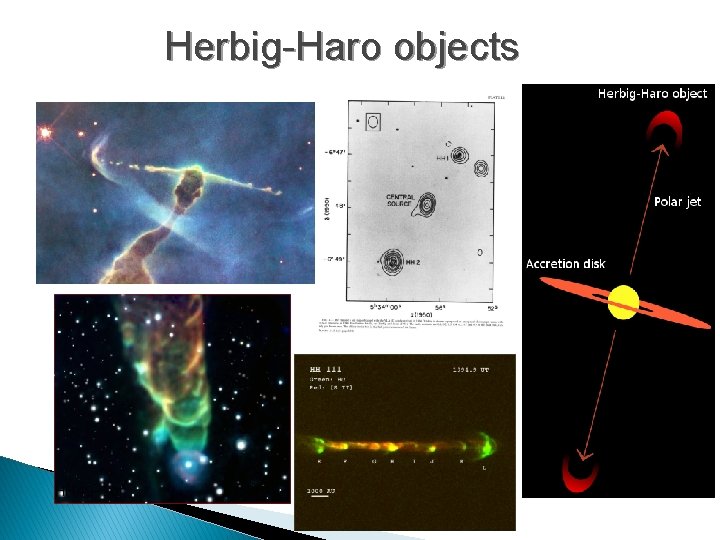
Herbig-Haro objects HH 49 -50
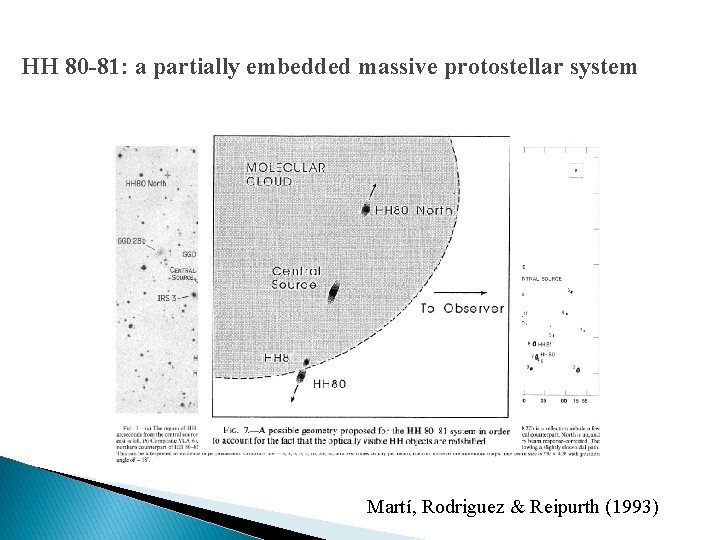
HH 80 -81: a partially embedded massive protostellar system Martí, Rodriguez & Reipurth (1993)
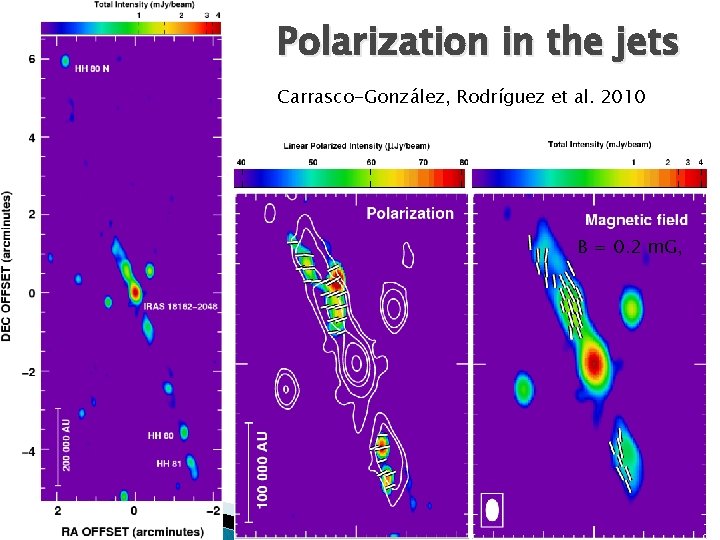
Polarization in the jets Carrasco-González, Rodríguez et al. 2010 B = 0. 2 m. G,
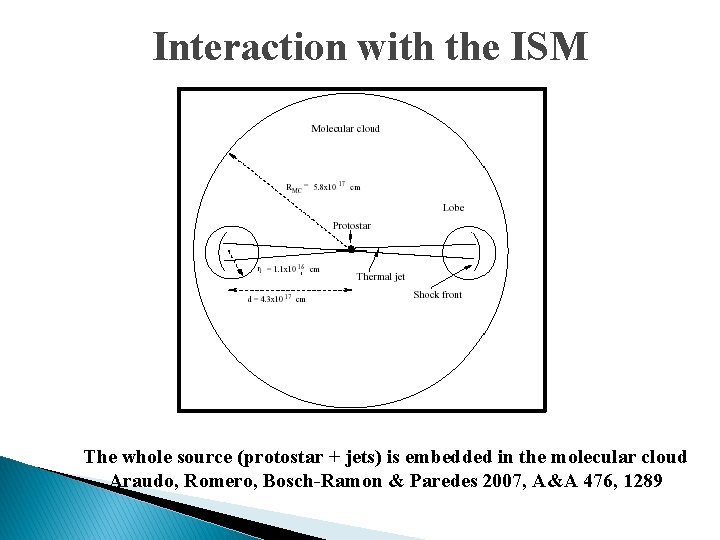
Interaction with the ISM The whole source (protostar + jets) is embedded in the molecular cloud Araudo, Romero, Bosch-Ramon & Paredes 2007, A&A 476, 1289
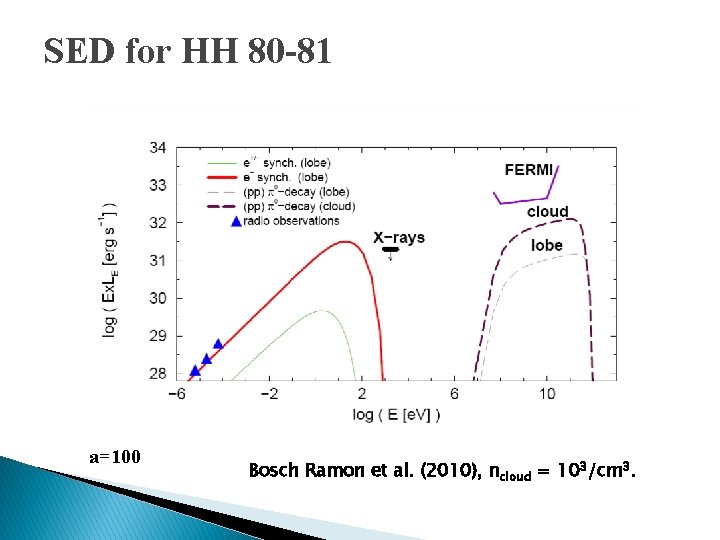
SED for HH 80 -81 a=100 Bosch Ramon et al. (2010), ncloud = 103/cm 3.
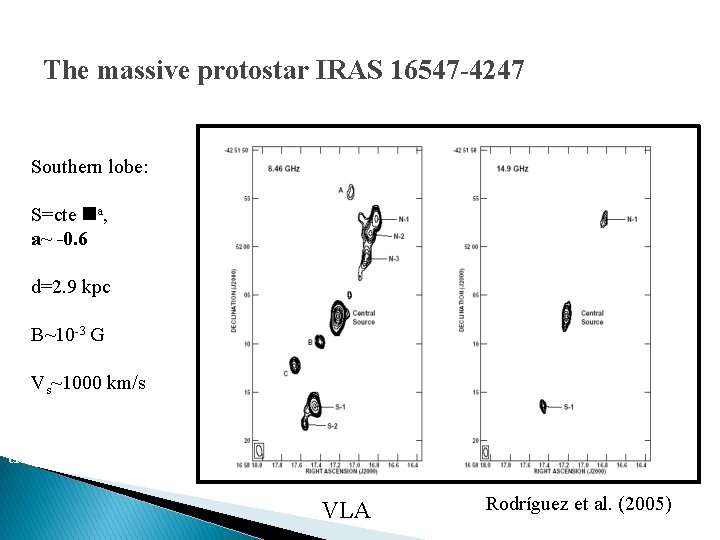
The massive protostar IRAS 16547 -4247 Southern lobe: S=cte na, a~ -0. 6 d=2. 9 kpc B~10 -3 G Vs~1000 km/s Clear nonthermal emission VLA Rodríguez et al. (2005)
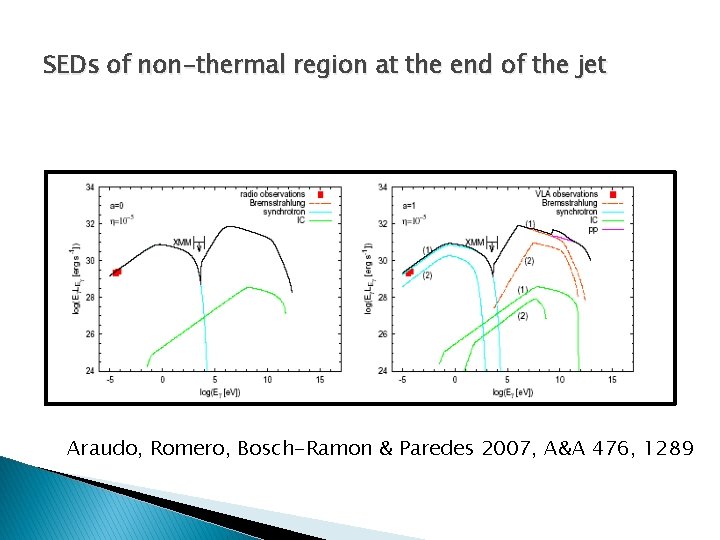
SEDs of non-thermal region at the end of the jet Araudo, Romero, Bosch-Ramon & Paredes 2007, A&A 476, 1289
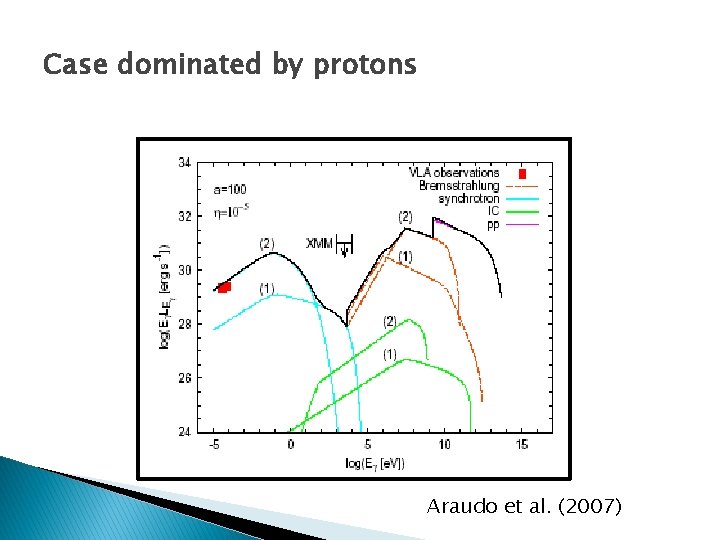
Case dominated by protons Araudo et al. (2007)
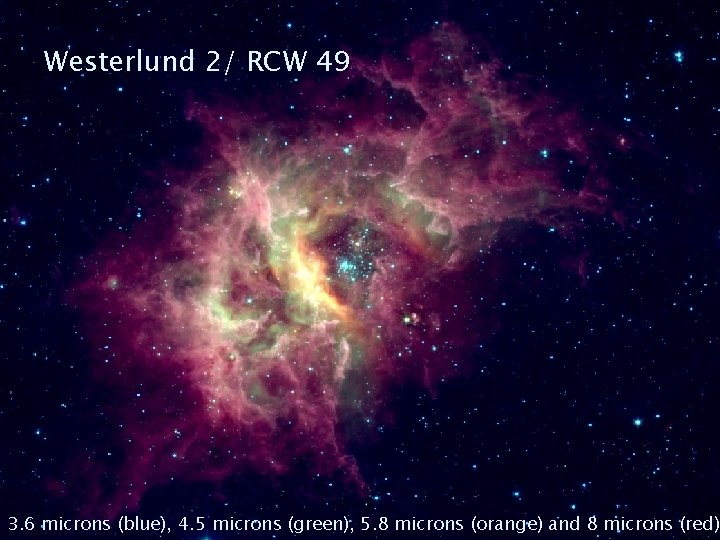
Westerlund 2/ RCW 49 3. 6 microns (blue), 4. 5 microns (green), 5. 8 microns (orange) and 8 microns (red)
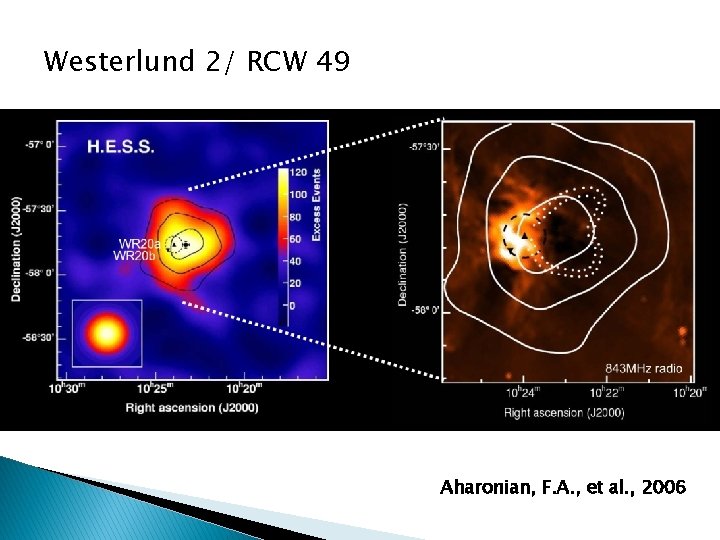
Westerlund 2/ RCW 49 Aharonian, F. A. , et al. , 2006
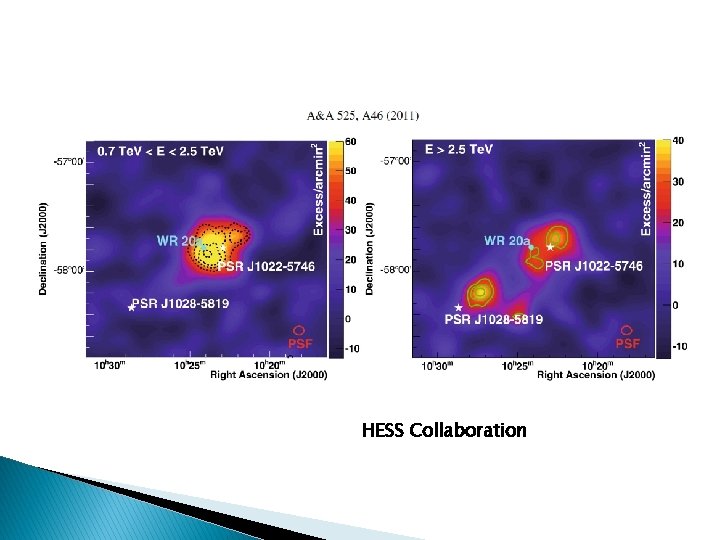
HESS Collaboration
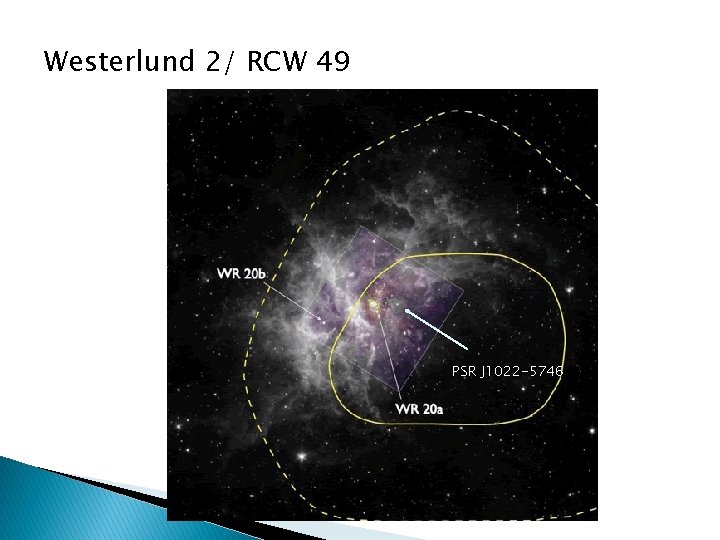
Westerlund 2/ RCW 49 PSR J 1022 -5746
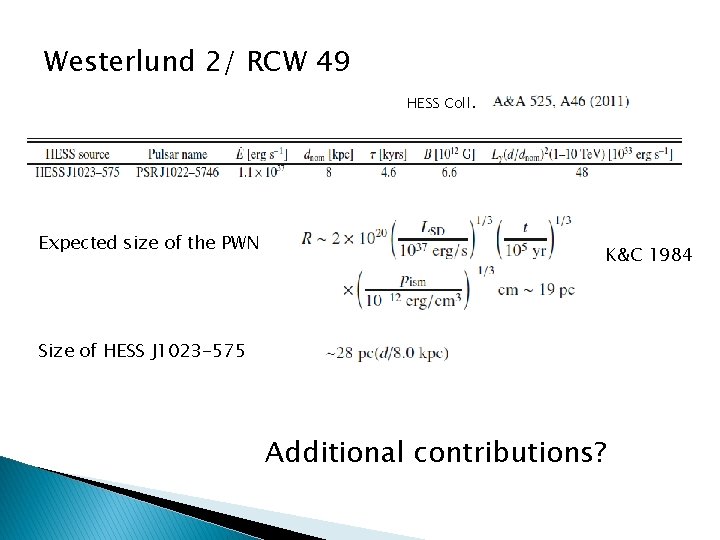
Westerlund 2/ RCW 49 HESS Coll. Expected size of the PWN K&C 1984 Size of HESS J 1023 -575 Additional contributions?
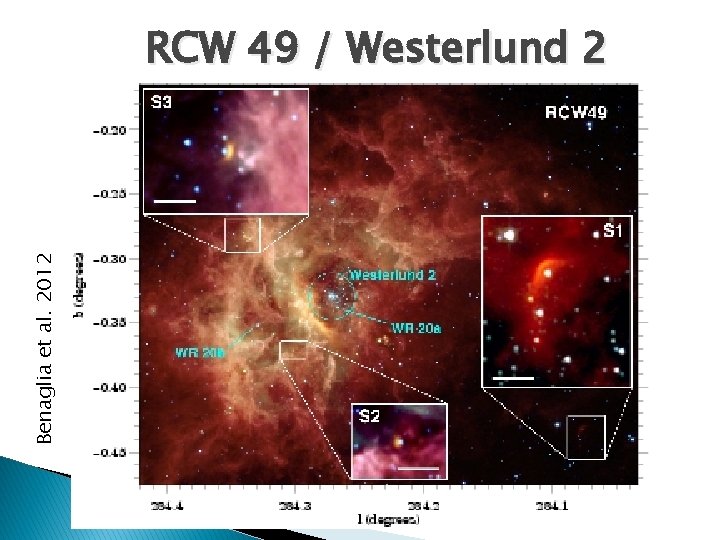
Benaglia et al. 2012 RCW 49 / Westerlund 2
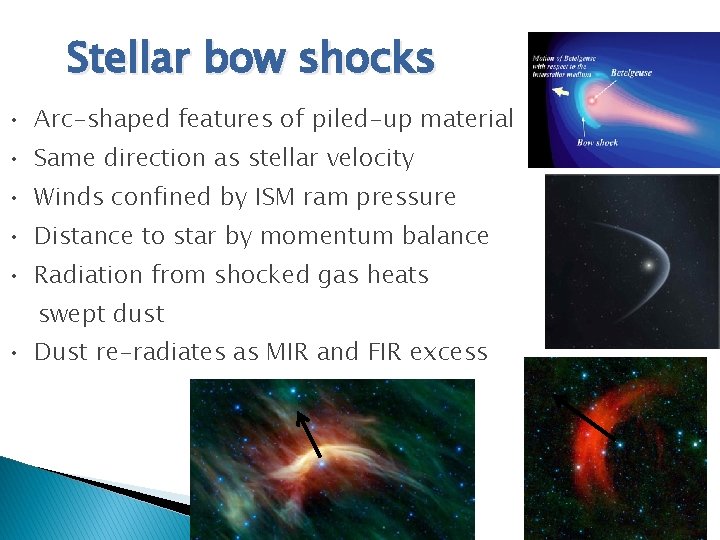
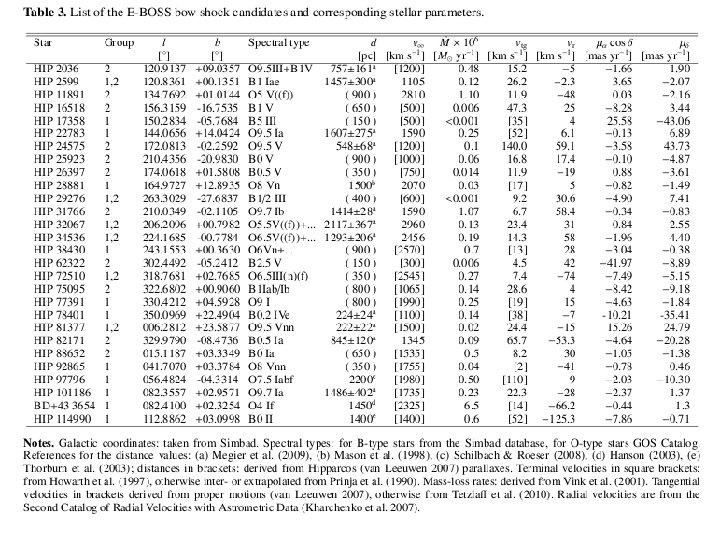
Stellar bow shocks • Arc-shaped features of piled-up material • Same direction as stellar velocity • Winds confined by ISM ram pressure • Distance to star by momentum balance • Radiation from shocked gas heats swept dust • Dust re-radiates as MIR and FIR excess
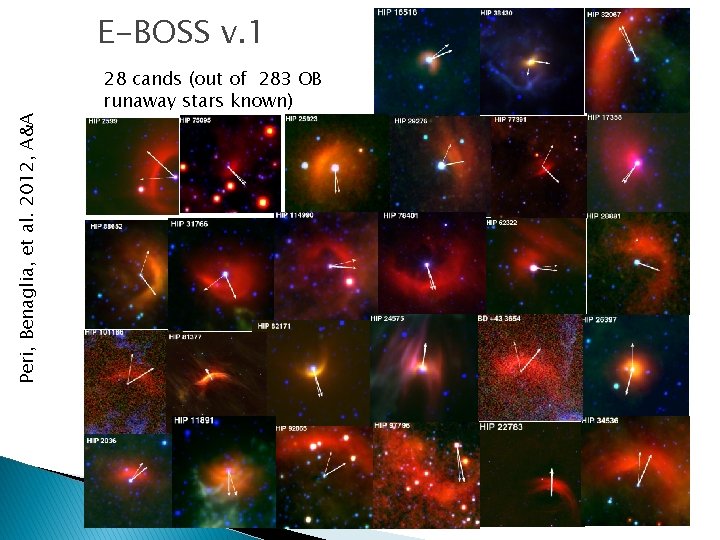
Peri, Benaglia, et al. 2012, A&A E-BOSS v. 1 28 cands (out of 283 OB runaway stars known)
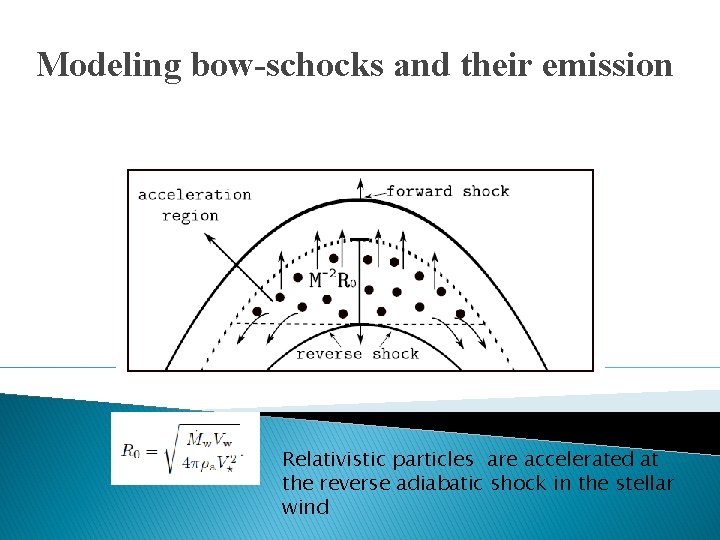
Modeling bow-schocks and their emission Relativistic particles are accelerated at the reverse adiabatic shock in the stellar wind
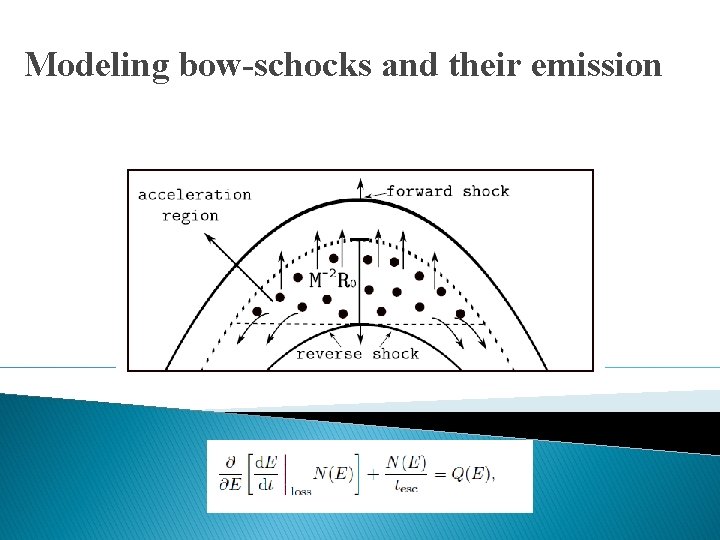
Modeling bow-schocks and their emission
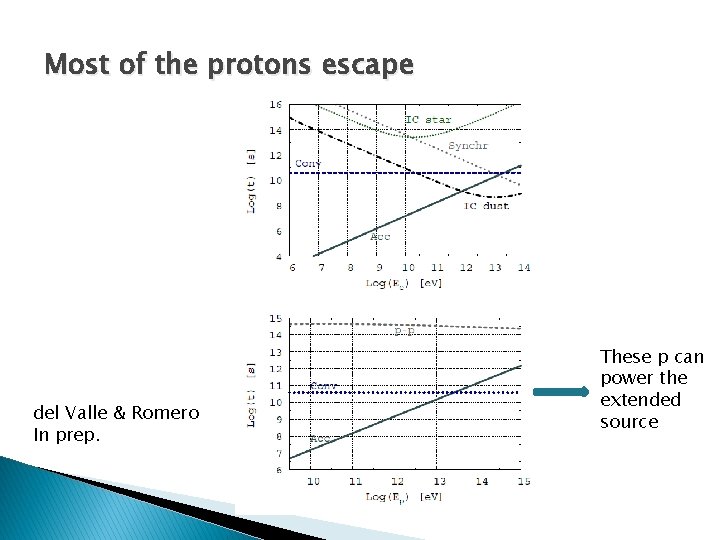
Most of the protons escape del Valle & Romero In prep. These p can power the extended source
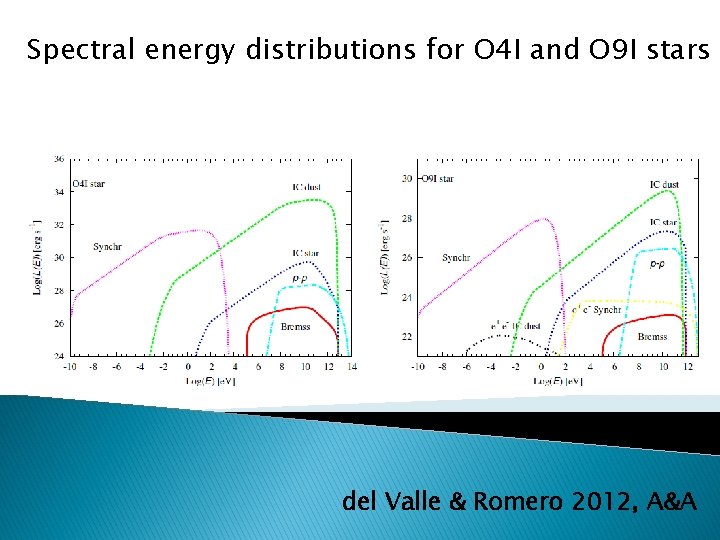
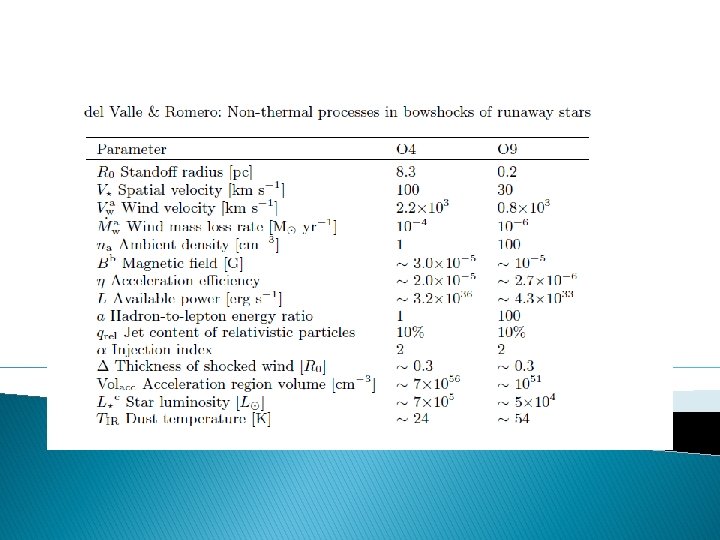
Spectral energy distributions for O 4 I and O 9 I stars del Valle & Romero 2012, A&A
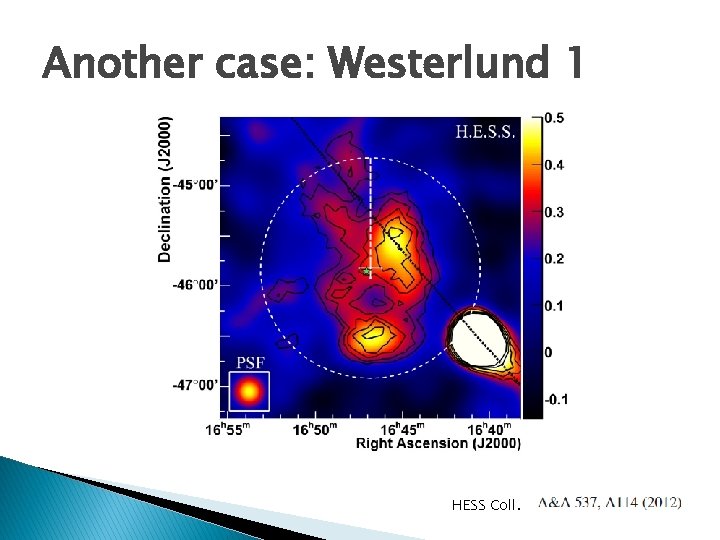
Another case: Westerlund 1 HESS Coll.
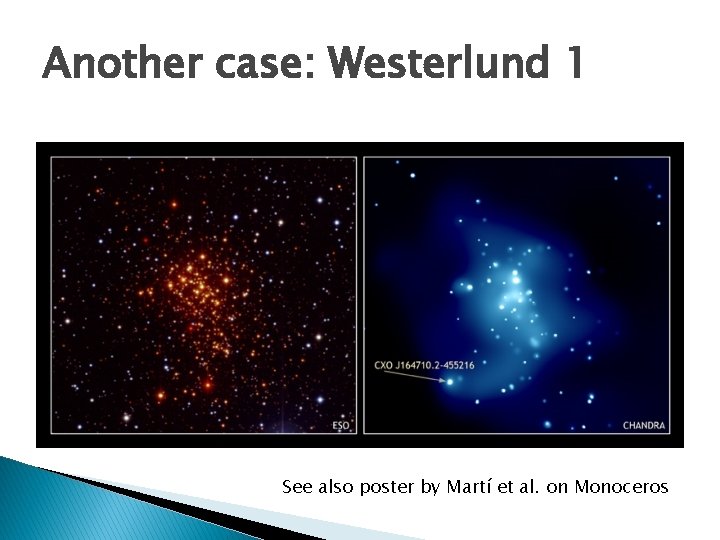
Another case: Westerlund 1 See also poster by Martí et al. on Monoceros
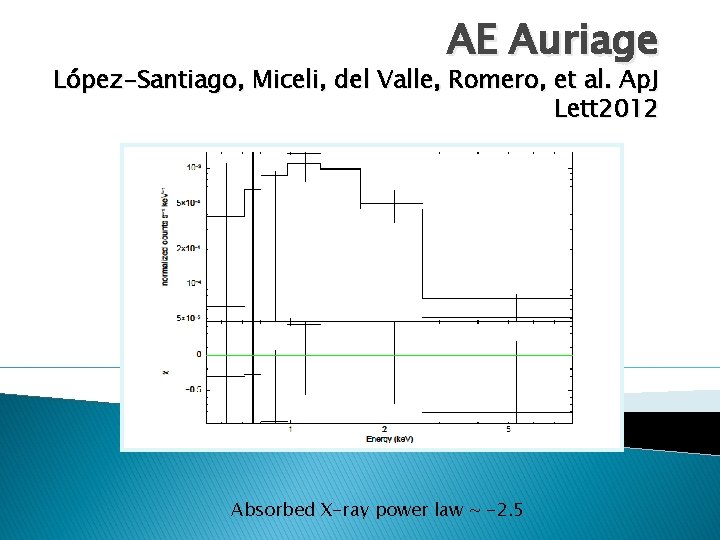
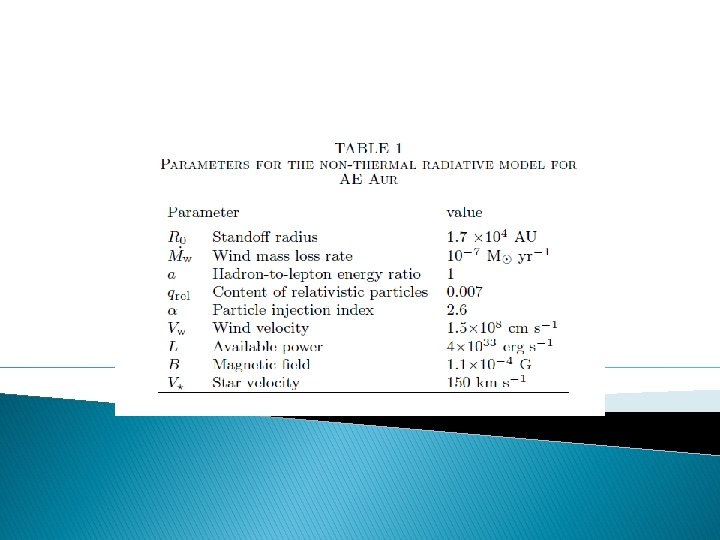
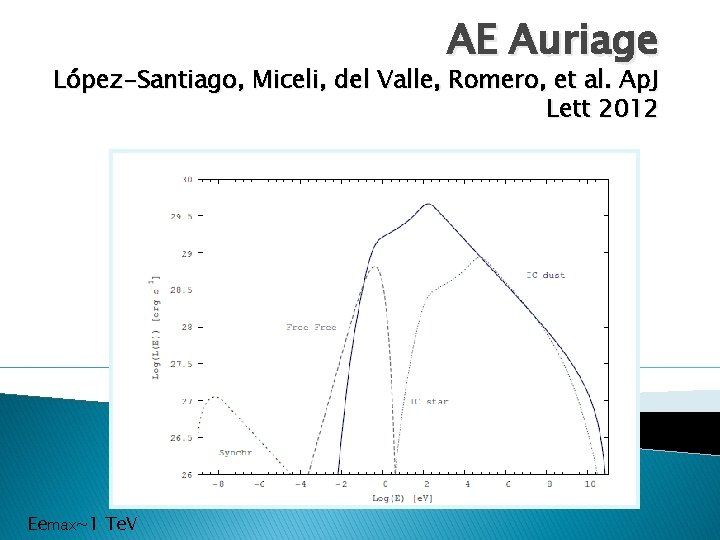
AE Auriage López-Santiago, Miceli, del Valle, Romero, et al. Ap. J Lett 2012 Absorbed X-ray power law ~ -2. 5
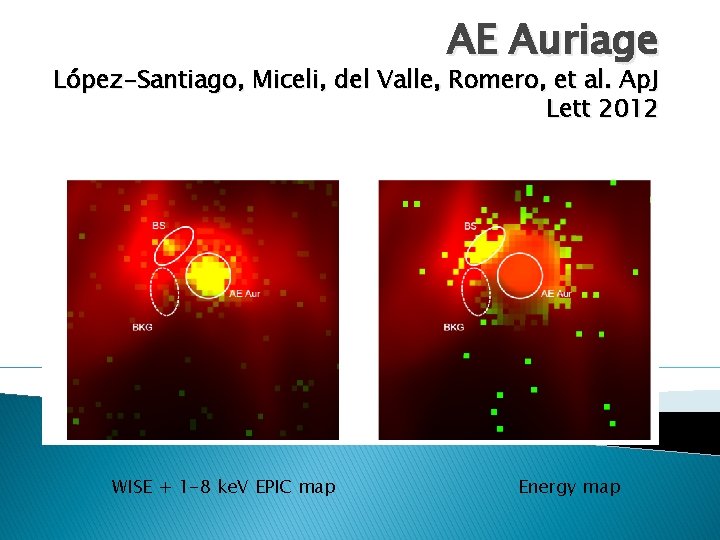
AE Auriage López-Santiago, Miceli, del Valle, Romero, et al. Ap. J Lett 2012 WISE + 1 -8 ke. V EPIC map Energy map
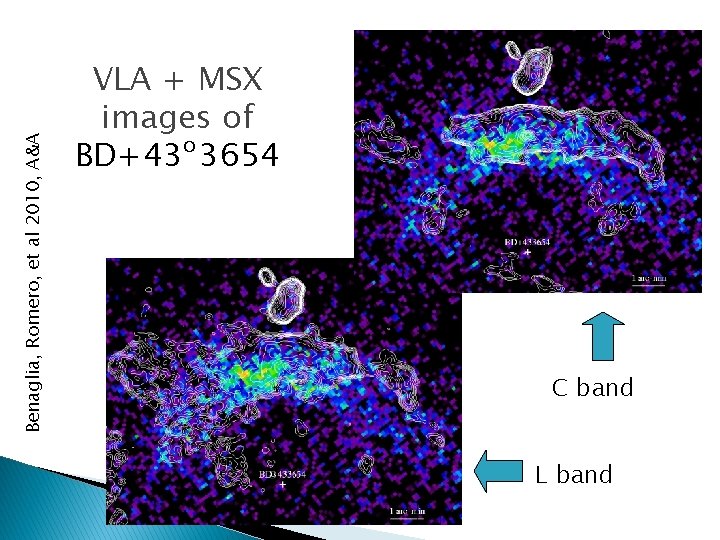
Benaglia, Romero, et al 2010, A&A VLA + MSX images of BD+43 o 3654 C band L band
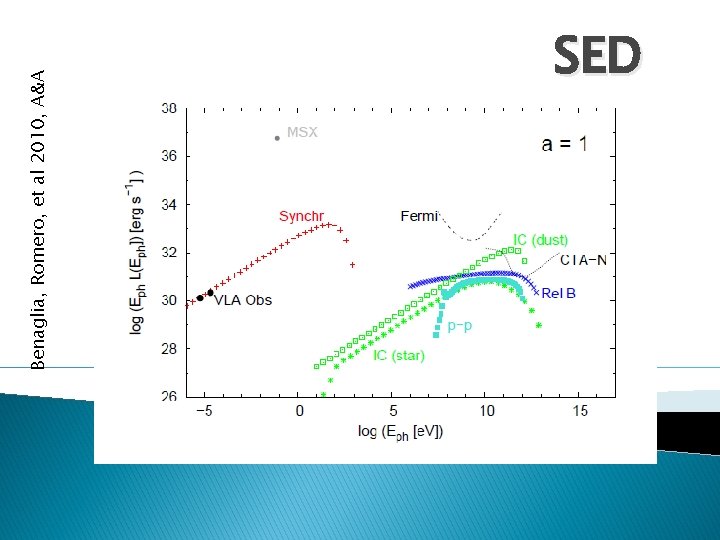
Benaglia, Romero, et al 2010, A&A SED
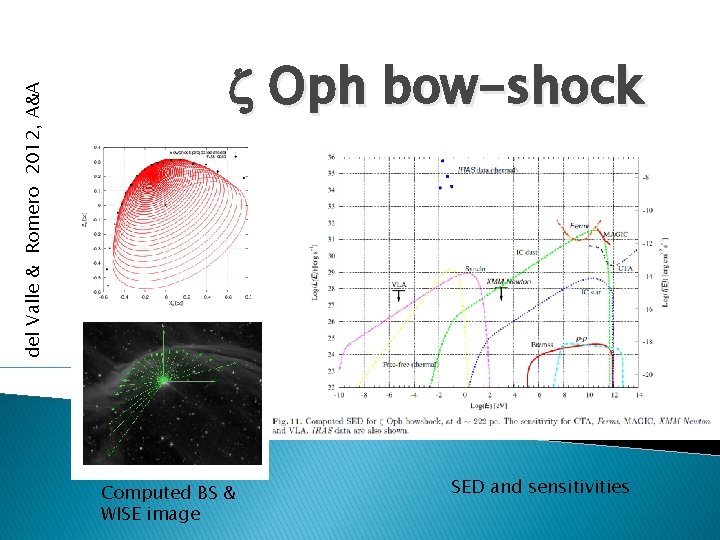
del Valle & Romero 2012, A&A z Oph bow-shock Computed BS & WISE image SED and sensitivities
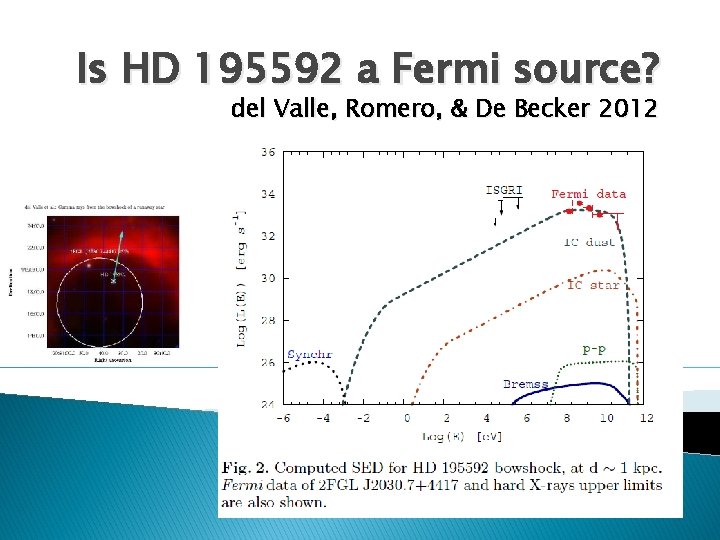
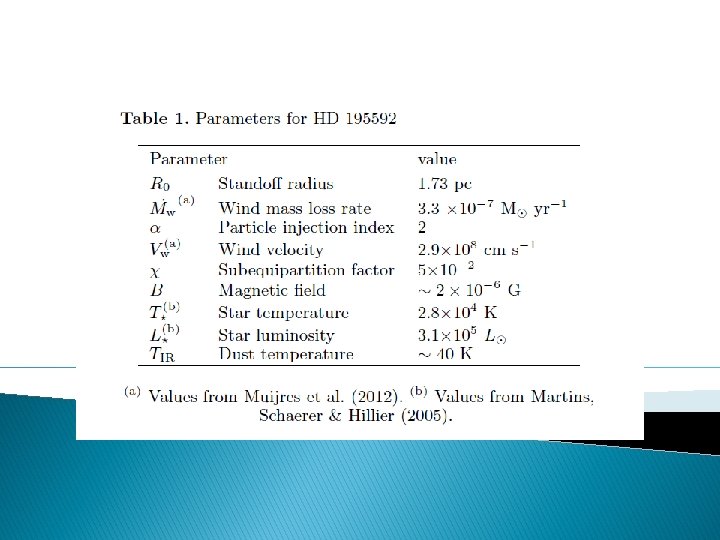
Is HD 195592 a Fermi source? del Valle, Romero, & De Becker 2012
Conclusions * Protostars in SFRs can be gamma-ray sources when embedded in the original molecular core. * The typical luminosities are ~ 1031 -33 erg/s at E>100 Me. V. * Runaway massive stars can produce relativistic particles in their bowshocks, and local (IC) and difusse (pp) gamma-ray emission. * Some nearby runaway O stars can be detected in gamma-rays by Fermi and in the future by CTA. Gamma-ray astronomy can open a new window to the study of massive star forming processes.
“Relaxed gamma-ray astronomy team” What a world! Thanks!
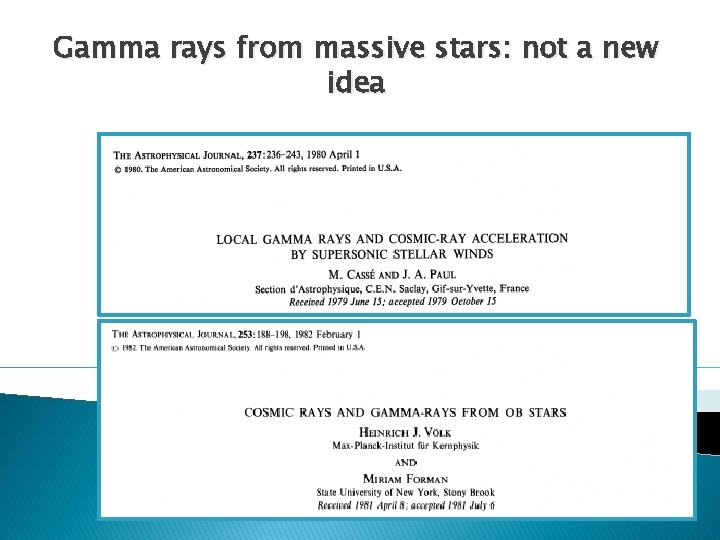
Gamma rays from massive stars: not a new idea
Some basic parameters for HH 80 -81 � vj ~ 700 km/s � n ~ 1000 cm-3 � RHH ~ 5 1016 cm � D ~ 1. 7 kpc � LX ~ 4 1031 erg/s � Beq ~ 5 m. G � E max, p ~ 3 1014 e. V - E max, e ~ E max, p/12 See Martí et al. (1993) and Pravdo et al. (2004) for details on the source
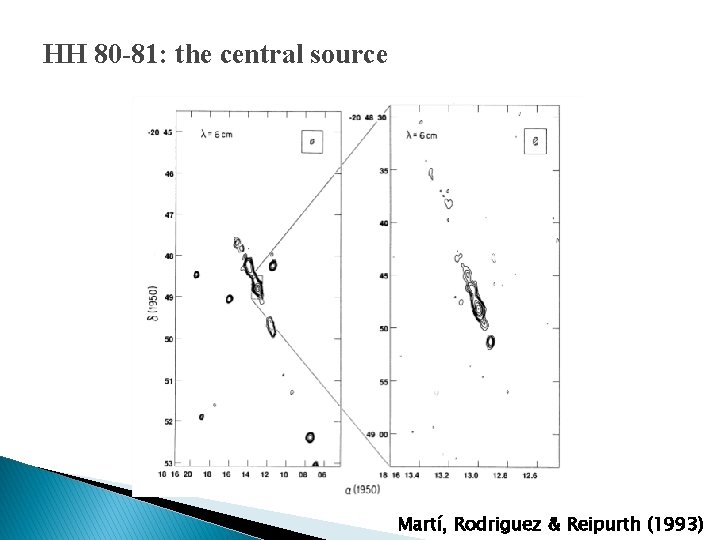
HH 80 -81: the central source Martí, Rodriguez & Reipurth (1993)
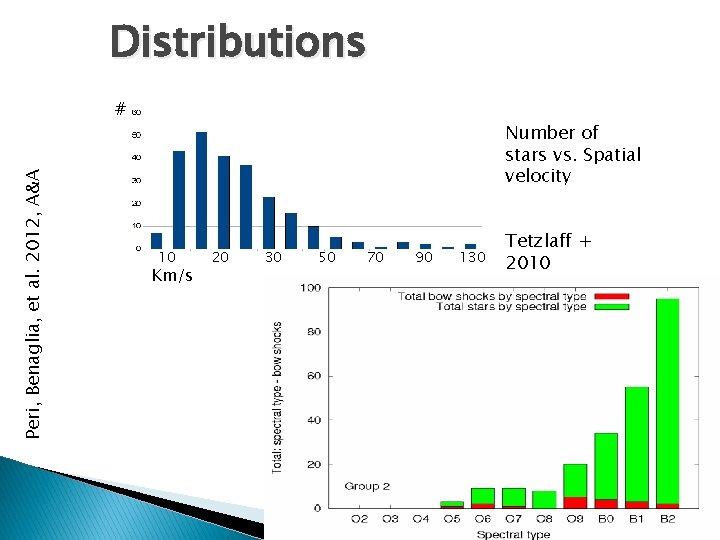
Distributions Peri, Benaglia, et al. 2012, A&A # Number of stars vs. Spatial velocity 10 Km/s 20 30 50 70 90 130 Tetzlaff + 2010
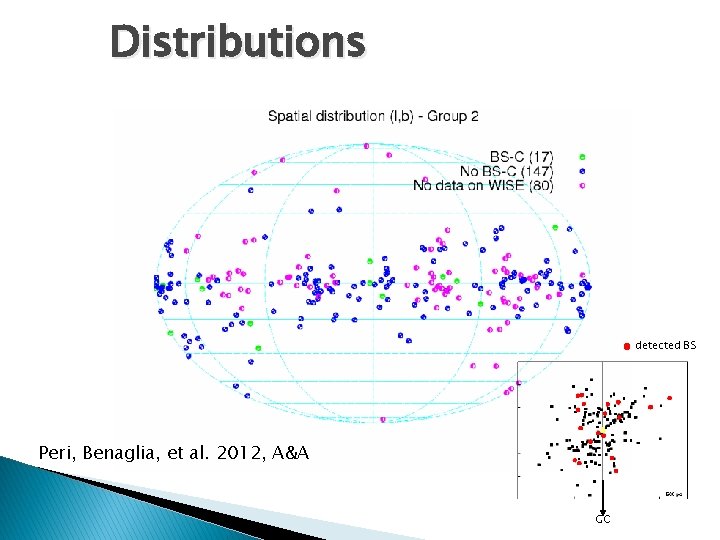
Distributions detected BS Peri, Benaglia, et al. 2012, A&A GC
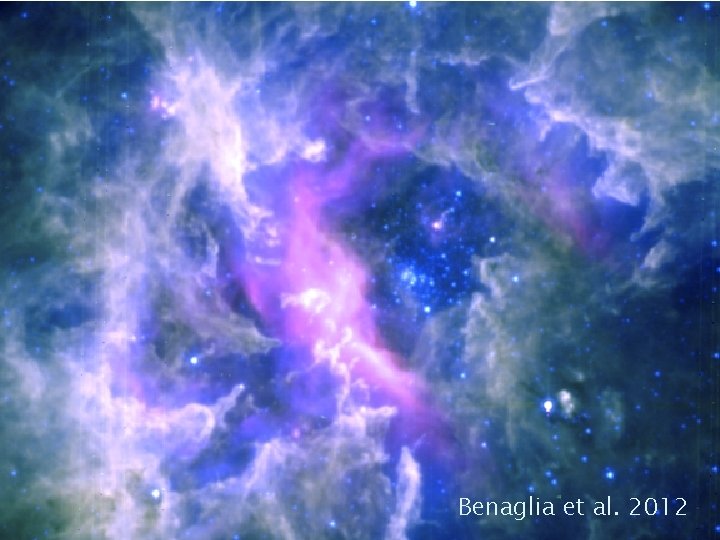
Benaglia et al. 2012
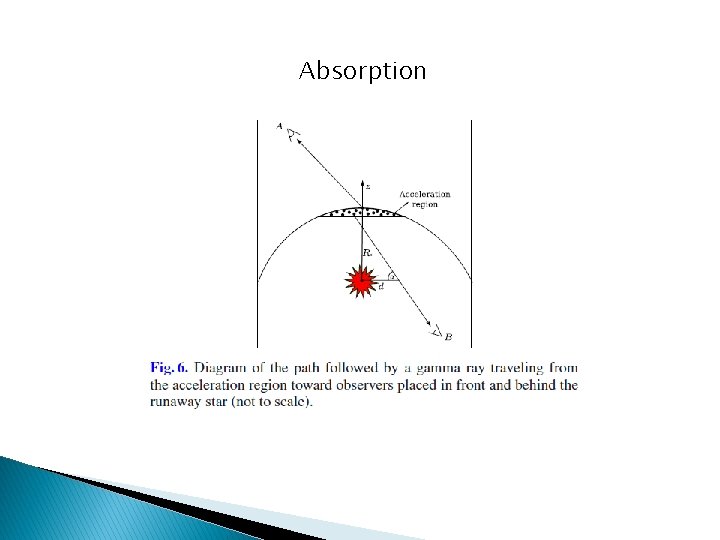
Absorption
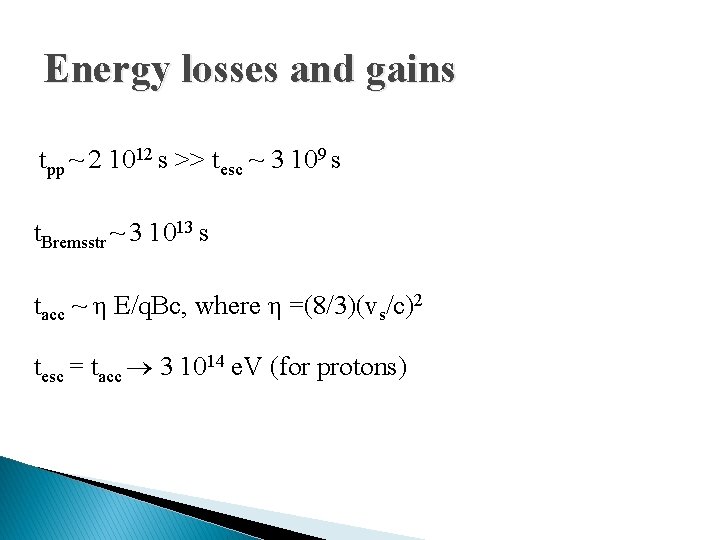
Energy losses and gains tpp ~ 2 1012 s >> tesc ~ 3 109 s t. Bremsstr ~ 3 1013 s tacc ~ η E/q. Bc, where η =(8/3)(vs/c)2 tesc = tacc 3 1014 e. V (for protons)
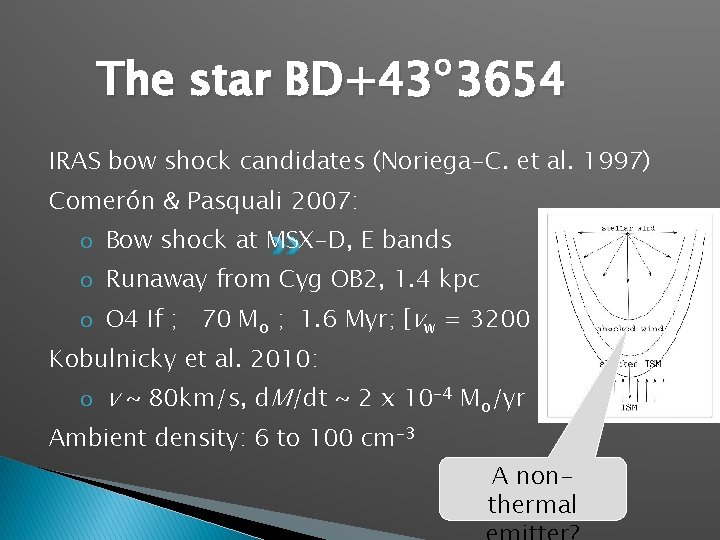
o The star BD+43 3654 IRAS bow shock candidates (Noriega-C. et al. 1997) Comerón & Pasquali 2007: o Bow shock at MSX-D, E bands o Runaway from Cyg OB 2, 1. 4 kpc o O 4 If ; 70 Mo ; 1. 6 Myr; [vw = 3200 km/s] Kobulnicky et al. 2010: o v ~ 80 km/s, d. M/dt ~ 2 x 10 -4 Mo/yr Ambient density: 6 to 100 cm-3 A nonthermal
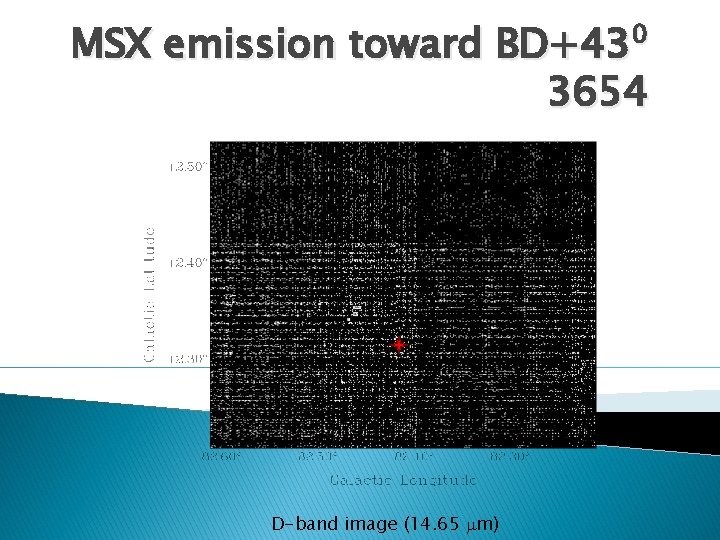
0 BD+43 MSX emission toward BD+43 3654 D-band image (14. 65 mm)
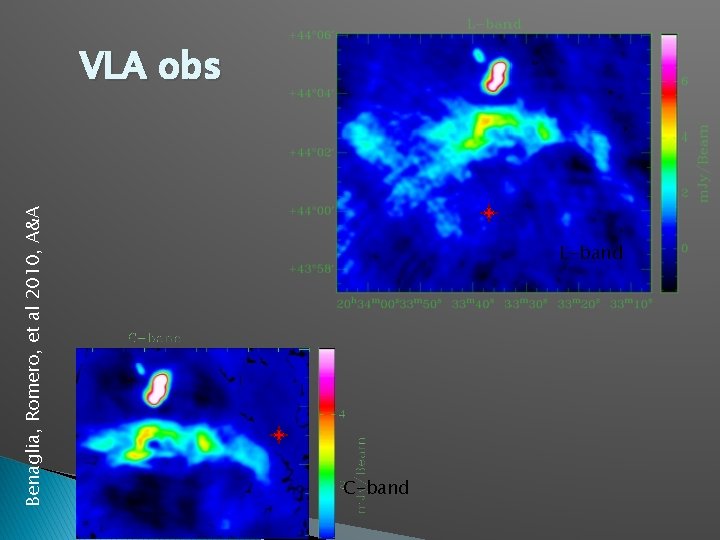
Benaglia, Romero, et al 2010, A&A VLA obs L-band C-band
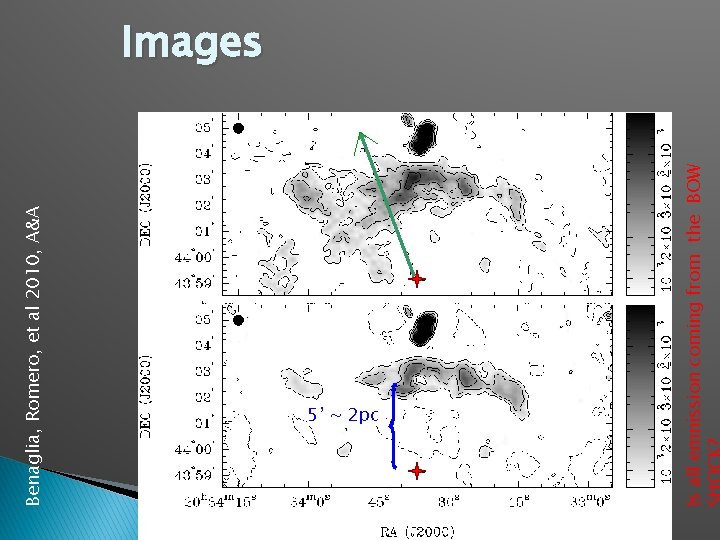
Benaglia, Romero, et al 2010, A&A 5’ ~ 2 pc Is all emnission coming from the BOW Images
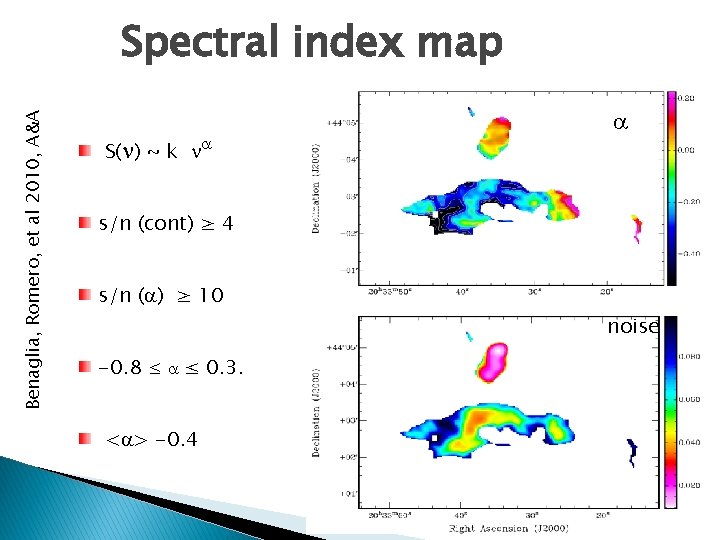
Benaglia, Romero, et al 2010, A&A Spectral index map S(n) ~ k na a s/n (cont) ≥ 4 s/n (a) ≥ 10 noise -0. 8 ≤ a ≤ 0. 3. <a> -0. 4
AE Auriage López-Santiago, Miceli, del Valle, Romero, et al. Ap. J Lett 2012 Eemax~1 Te. V
- Slides: 52