
Highcapacity Optical Communications Using OAMbased Space Division Multiplexing
High-capacity Optical Communications Using OAM-based Space Division Multiplexing Yongxiong Ren (yongxior@usc. edu) Advisor: Prof. Alan. E Willner Nov. 18 th 2016 Acknowledge my advisor Prof. Willner, my OCLab mates (Guodong, Yan, Nisar, Long, Zhe, Yinwen, Joe, C. Bao, and LPC) and all
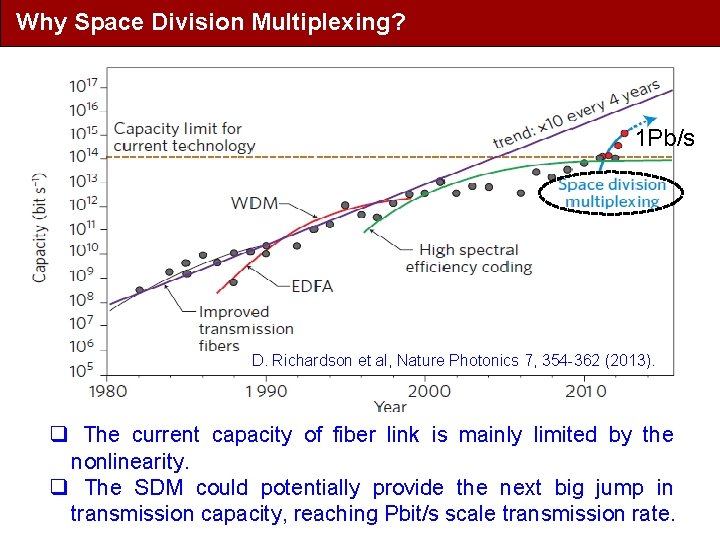
Why Space Division Multiplexing? 1 Pb/s D. Richardson et al, Nature Photonics 7, 354 -362 (2013). q The current capacity of fiber link is mainly limited by the nonlinearity. q The SDM could potentially provide the next big jump in transmission capacity, reaching Pbit/s scale transmission rate.
My Research Work on Communications using OAM Beams 1. Atmospheric turbulence effects on orbital angular momentum (OAM) beams q Upgraded to CLEO 2013 Invited 2. Turbulence compensation of OAM beams q Fi. O 2014 postdeadline paper q High-impact OSA journal: Optica 3. 120 -meter free-space optical link using OAM beam multiplexing on EEB building roof q Top Scored Paper in OFC 2015 (1 out of ~100) 4. Free-space communications using OAM multiplexing combined with conventional spatial multiplexing q IEEE Globecom Best Paper Award
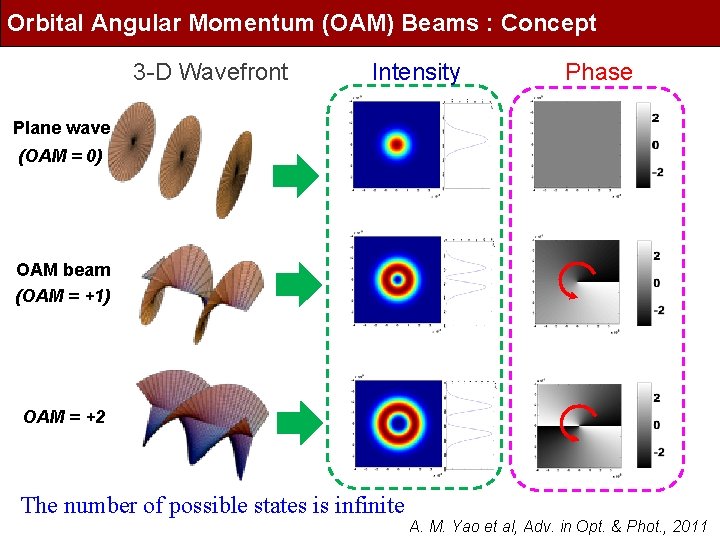
Orbital Angular Momentum (OAM) Beams : Concept 3 -D Wavefront Intensity Phase Plane wave (OAM = 0) l =0 OAM beam (OAM = +1) OAM = +2 The number of possible states is infinite A. M. Yao et al, Adv. in Opt. & Phot. , 2011
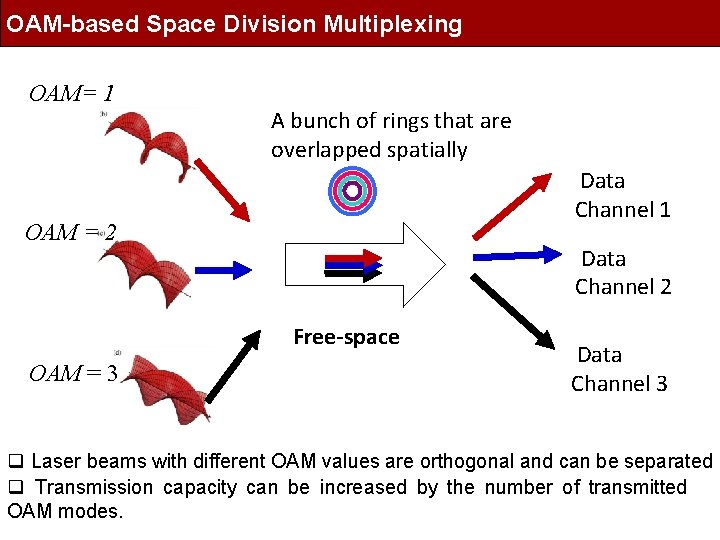
OAM-based Space Division Multiplexing OAM= 1 A bunch of rings that are overlapped spatially Data Channel 1 OAM = 2 Data Channel 2 Free-space OAM = 3 Data Channel 3 q Laser beams with different OAM values are orthogonal and can be separated q Transmission capacity can be increased by the number of transmitted OAM modes.
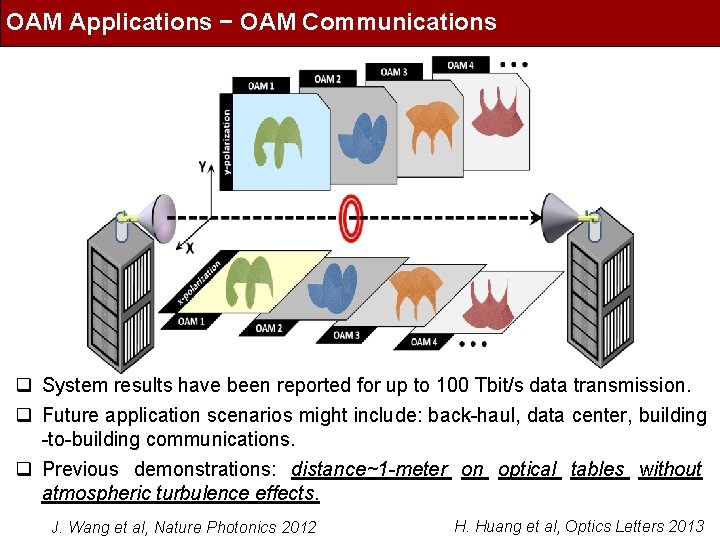
OAM Applications − OAM Communications q System results have been reported for up to 100 Tbit/s data transmission. q Future application scenarios might include: back-haul, data center, building -to-building communications. q Previous demonstrations: distance~1 -meter on optical tables without atmospheric turbulence effects. J. Wang et al, Nature Photonics 2012 H. Huang et al, Optics Letters 2013
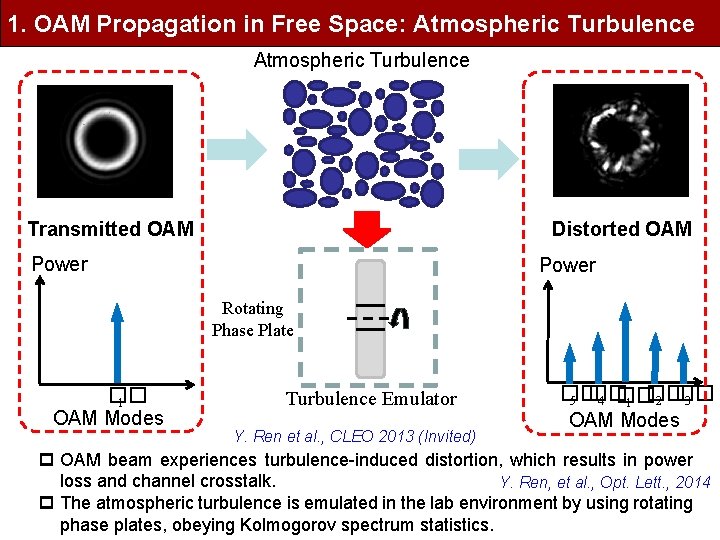
1. OAM Propagation in Free Space: Atmospheric Turbulence Transmitted OAM Distorted OAM Power Rotating Phase Plate �� 1 OAM Modes Turbulence Emulator Y. Ren et al. , CLEO 2013 (Invited) �� 5 �� 4 �� 2 �� 3 1 �� OAM Modes p OAM beam experiences turbulence-induced distortion, which results in power loss and channel crosstalk. Y. Ren, et al. , Opt. Lett. , 2014 p The atmospheric turbulence is emulated in the lab environment by using rotating phase plates, obeying Kolmogorov spectrum statistics.
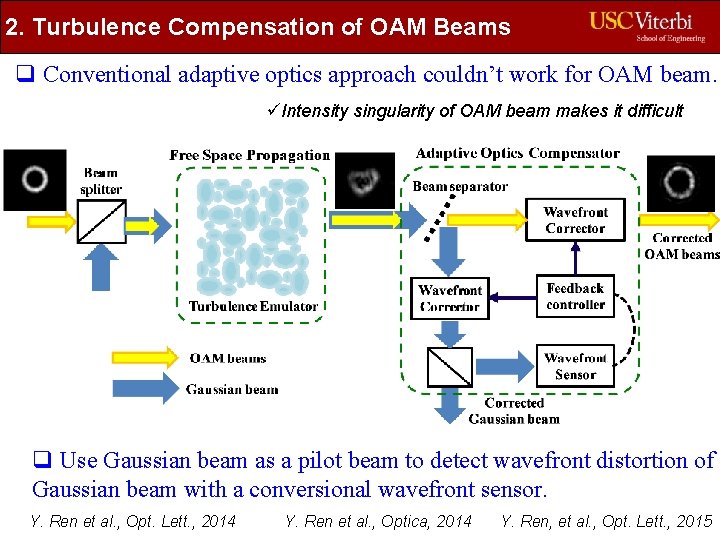
2. Turbulence Compensation of OAM Beams q Conventional adaptive optics approach couldn’t work for OAM beam. üIntensity singularity of OAM beam makes it difficult q Use Gaussian beam as a pilot beam to detect wavefront distortion of Gaussian beam with a conversional wavefront sensor. Y. Ren et al. , Opt. Lett. , 2014 Y. Ren et al. , Optica, 2014 Y. Ren, et al. , Opt. Lett. , 2015
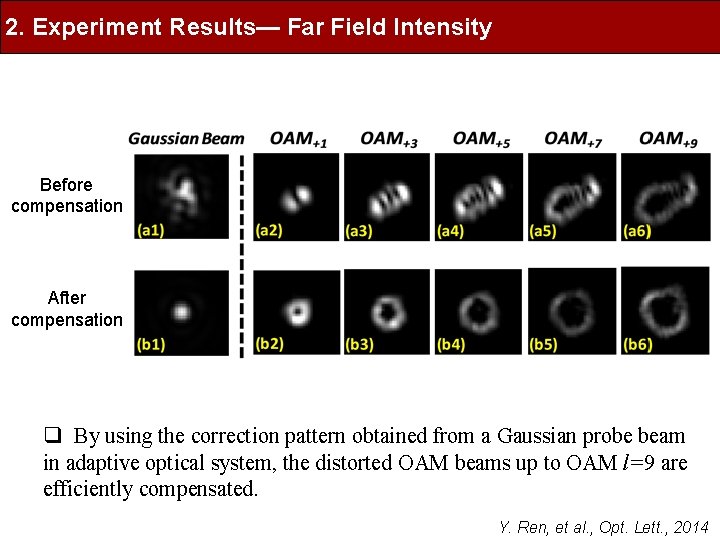
2. Experiment Results— Far Field Intensity Before compensation After compensation q By using the correction pattern obtained from a Gaussian probe beam in adaptive optical system, the distorted OAM beams up to OAM l=9 are efficiently compensated. Y. Ren, et al. , Opt. Lett. , 2014
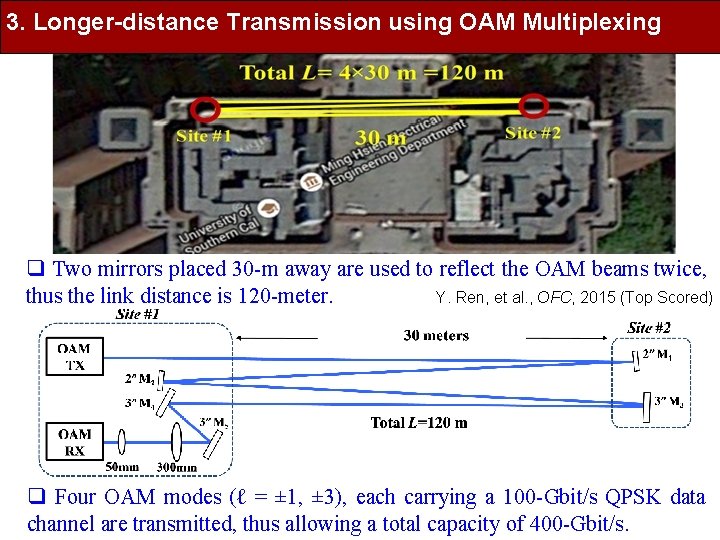
3. Longer-distance Transmission using OAM Multiplexing q Two mirrors placed 30 -m away are used to reflect the OAM beams twice, thus the link distance is 120 -meter. Y. Ren, et al. , OFC, 2015 (Top Scored) q Four OAM modes (ℓ = ± 1, ± 3), each carrying a 100 -Gbit/s QPSK data channel are transmitted, thus allowing a total capacity of 400 -Gbit/s.
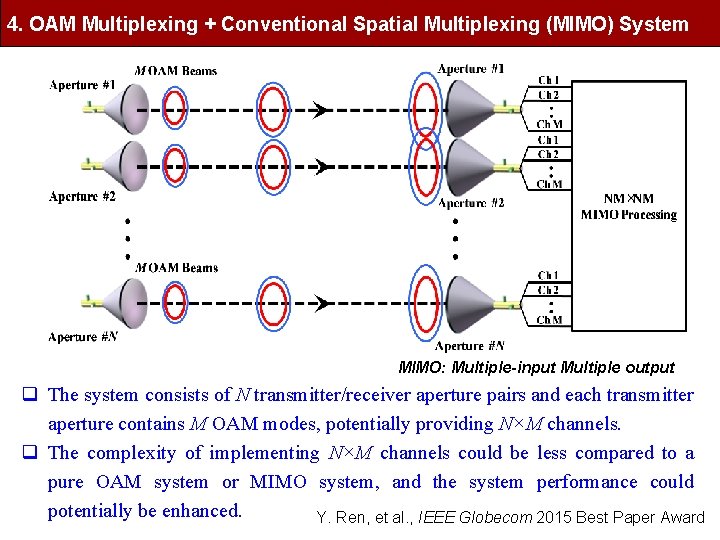
4. OAM Multiplexing + Conventional Spatial Multiplexing (MIMO) System MIMO: Multiple-input Multiple output q The system consists of N transmitter/receiver aperture pairs and each transmitter aperture contains M OAM modes, potentially providing N×M channels. q The complexity of implementing N×M channels could be less compared to a pure OAM system or MIMO system, and the system performance could potentially be enhanced. Y. Ren, et al. , IEEE Globecom 2015 Best Paper Award
Selected Publications p 45 journal papers (including Science, Nat. Photonics, Nat. Communications, Optica and Scientific Reports) and 67 conference proceedings p Selected first-authored papers: 1. Y. Ren, et al. , Scientific Reports, vol. 40, no. 18, pp. 4190 -4193, 2016. 2. Y. Ren, et al. , Optics Letters, vol. 40, no. 10, pp. 2249 -2252, 2016. 3. Y. Ren, et al. , Optica, vol. 1, no. 6, pp. 376 -382, 2016. 4. Y. Ren, et al. , Optics Letters, vol. 40, no. 18, pp. 4190 -4193, 2015. 5. Y. Ren, et al. , Optics Letters, vol. 40, no. 10, pp. 2249 -2252, 2015. 6. Y. Ren, et al. , Optica, vol. 1, no. 6, pp. 376 -382, 2014. 7. Y. Ren, et al. , Optics Letters, vol. 39, no. 10, pp. 2845 -2848, 2014. 8. Y. Ren, et al. , Optics Letters, vol. 38, no. 20, pp. 4062 -4065, 2013. 9. Y. Ren , et al. , OFC 2014. *Top scored paper* 10. Y. Ren, et al. , IEEE Globecom 2014. *2014 Globecom Best Paper Award* 11. Y. Ren, et al. , Frontiers in Optics (Fi. O) 2013. *Fi. O postdeadline paper 2013* 12. Y. Ren, et al. , Invited Paper, CLEO 2013. *Upgraded to invited status*

Thank You!!!! yongxior@usc. edu MHI Research Festival, Nov. 11 th 2016
- Slides: 13