
HighBandwidth Energyefficient DRAM Architectures for GPU systems Mike
High-Bandwidth, Energy-efficient DRAM Architectures for GPU systems Mike O’Connor – November 2, 2015
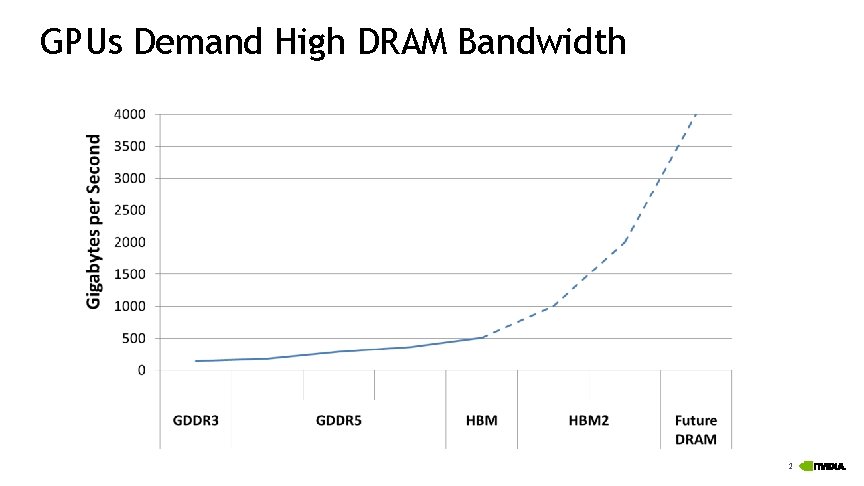
GPUs Demand High DRAM Bandwidth 2
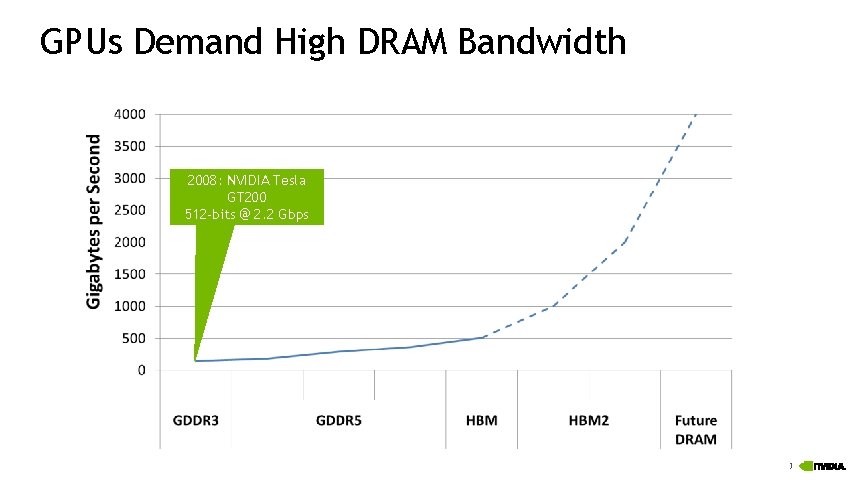
GPUs Demand High DRAM Bandwidth 2008: NVIDIA Tesla GT 200 512 -bits @ 2. 2 Gbps 3
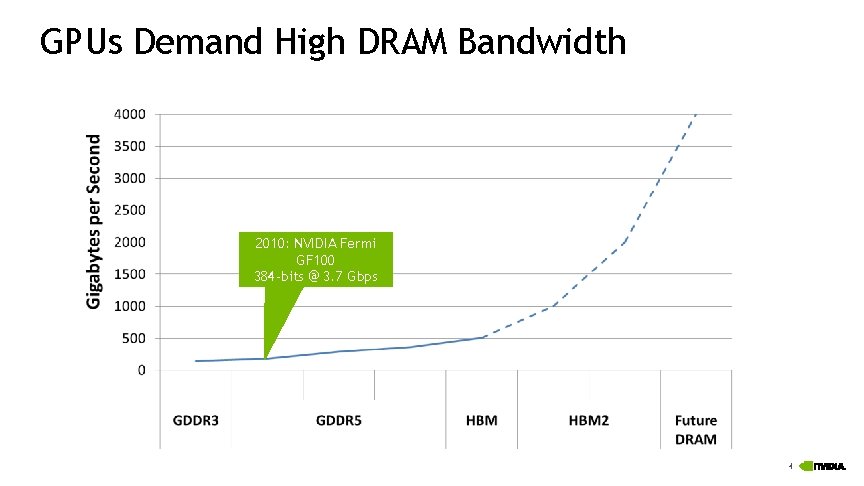
GPUs Demand High DRAM Bandwidth 2010: NVIDIA Fermi GF 100 384 -bits @ 3. 7 Gbps 4
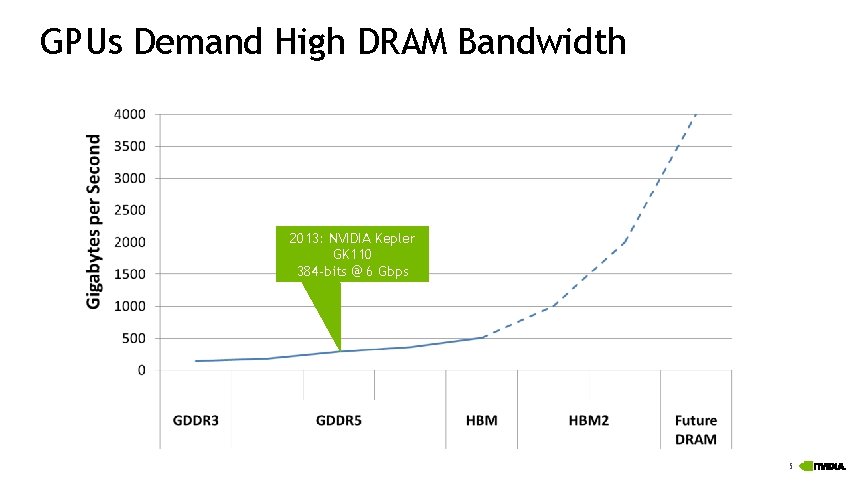
GPUs Demand High DRAM Bandwidth 2013: NVIDIA Kepler GK 110 384 -bits @ 6 Gbps 5
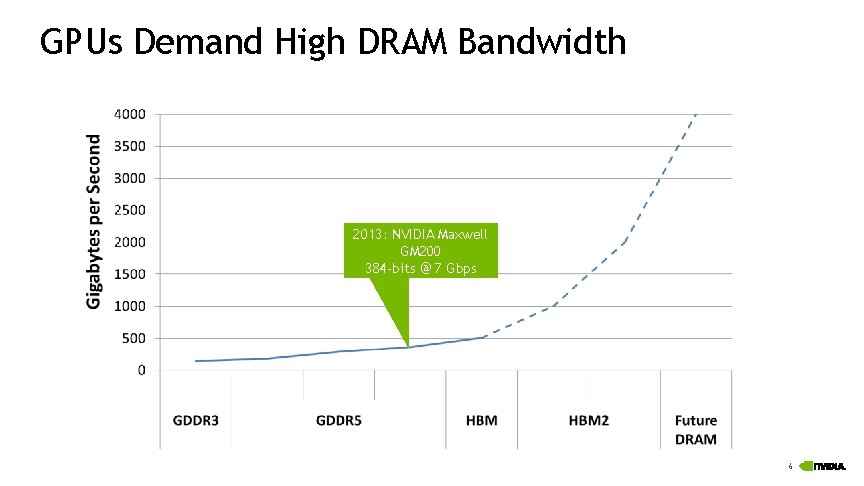
GPUs Demand High DRAM Bandwidth 2013: NVIDIA Maxwell GM 200 384 -bits @ 7 Gbps 6
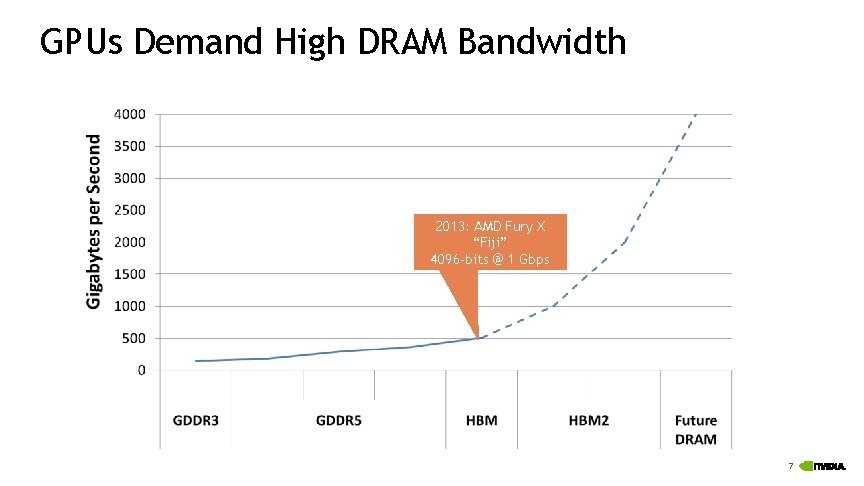
GPUs Demand High DRAM Bandwidth 2013: AMD Fury X “Fiji” 4096 -bits @ 1 Gbps 7
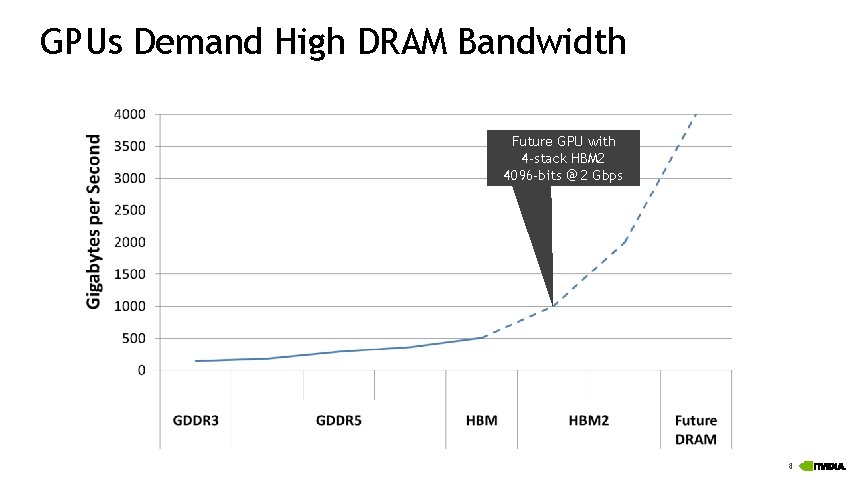
GPUs Demand High DRAM Bandwidth Future GPU with 4 -stack HBM 2 4096 -bits @ 2 Gbps 8
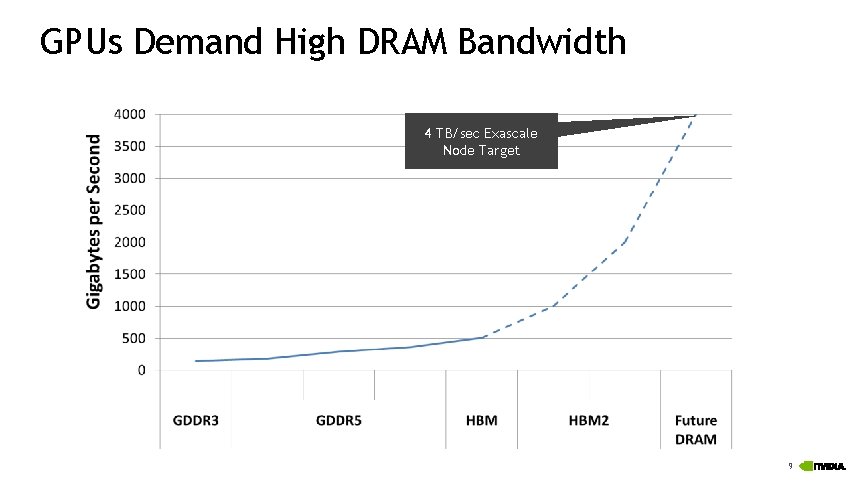
GPUs Demand High DRAM Bandwidth 4 TB/sec Exascale Node Target 9
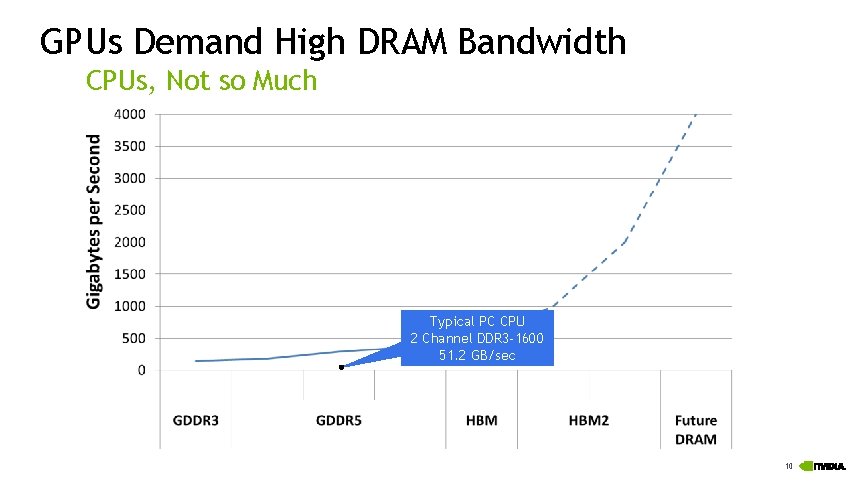
GPUs Demand High DRAM Bandwidth CPUs, Not so Much Typical PC CPU 2 Channel DDR 3 -1600 51. 2 GB/sec 10

GPUs Demand High DRAM Bandwidth CPUs, Not so Much Newer High-End CPU 2 Channel DDR 4 -3200 102. 4 GB/sec 11
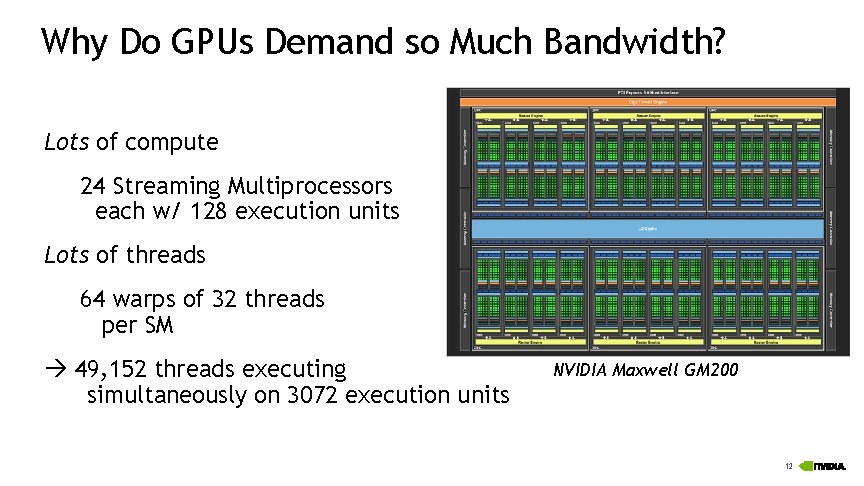
Why Do GPUs Demand so Much Bandwidth? Lots of compute 24 Streaming Multiprocessors each w/ 128 execution units Lots of threads 64 warps of 32 threads per SM 49, 152 threads executing simultaneously on 3072 execution units NVIDIA Maxwell GM 200 12
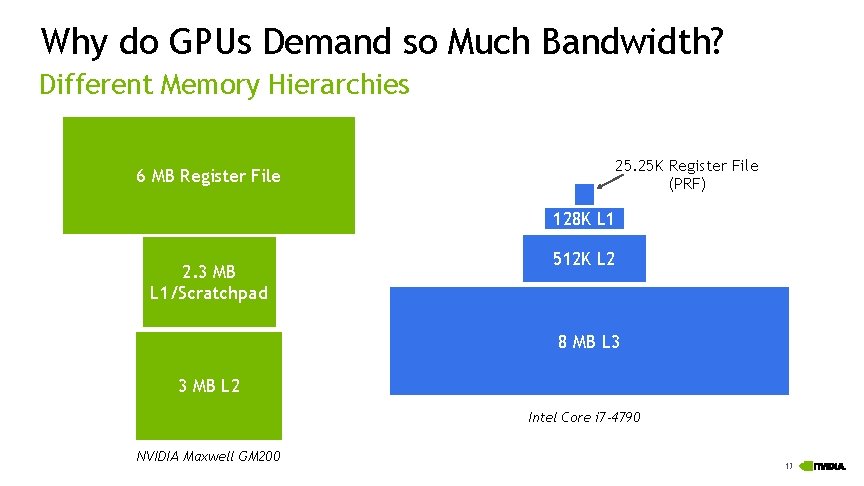
Why do GPUs Demand so Much Bandwidth? Different Memory Hierarchies 6 MB Register File 6 (Holds MB Register state File for many threads) 25. 25 K Register File (PRF) 128 K L 1 ~2 MB L 1 and Scratchpad 2. 3 MB L 1/Scratchpad 512 K L 2 8 MB L 3 3 MB L 2 Intel Core i 7 -4790 NVIDIA Maxwell GM 200 13
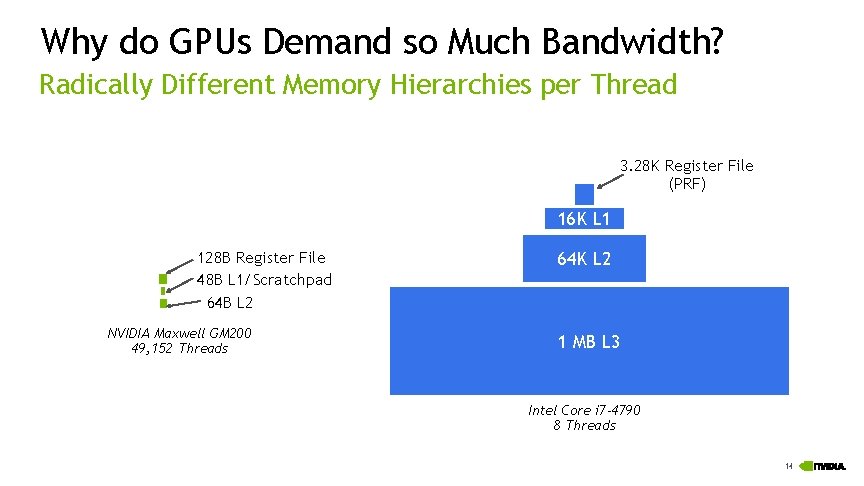
Why do GPUs Demand so Much Bandwidth? Radically Different Memory Hierarchies per Thread 3. 28 K Register File (PRF) 16 K L 1 128 B Register File ~2 Register MB L 1 and Scratchpad 6 MB File (Holds state 48 B for. L 1/Scratchpad many threads) 64 K L 2 64 B L 2 NVIDIA Maxwell GM 200 49, 152 Threads 1 MB L 3 Intel Core i 7 -4790 8 Threads 14
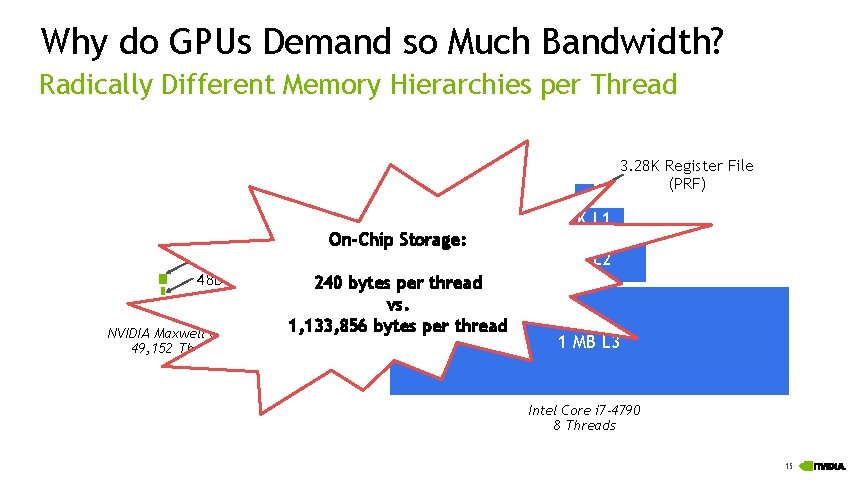
Why do GPUs Demand so Much Bandwidth? Radically Different Memory Hierarchies per Thread 3. 28 K Register File (PRF) On-Chip Storage: 128 B Register File ~2 Register MB L 1 and Scratchpad 6 MB File (Holds state 48 B for. L 1/Scratchpad many threads) 240 bytes per thread 64 B L 2 vs. 1, 133, 856 bytes per thread NVIDIA Maxwell GM 200 49, 152 Threads 16 K L 1 64 K L 2 1 MB L 3 Intel Core i 7 -4790 8 Threads 15
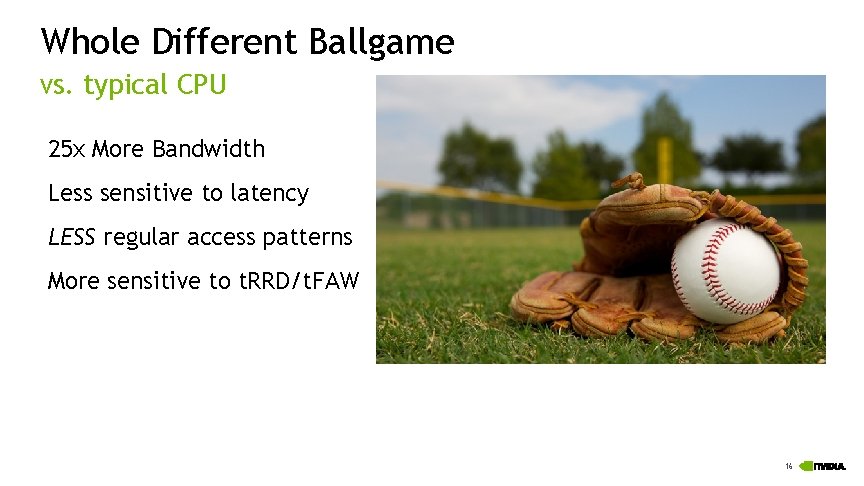
Whole Different Ballgame vs. typical CPU 25 x More Bandwidth Less sensitive to latency LESS regular access patterns More sensitive to t. RRD/t. FAW 16
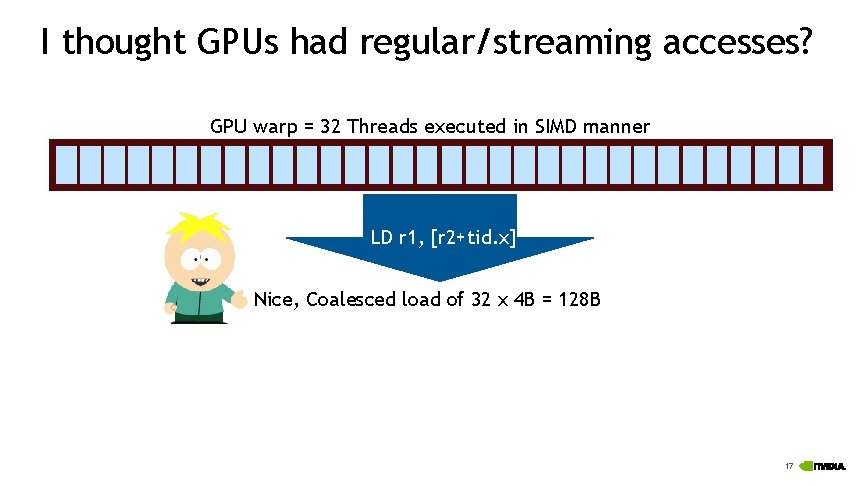
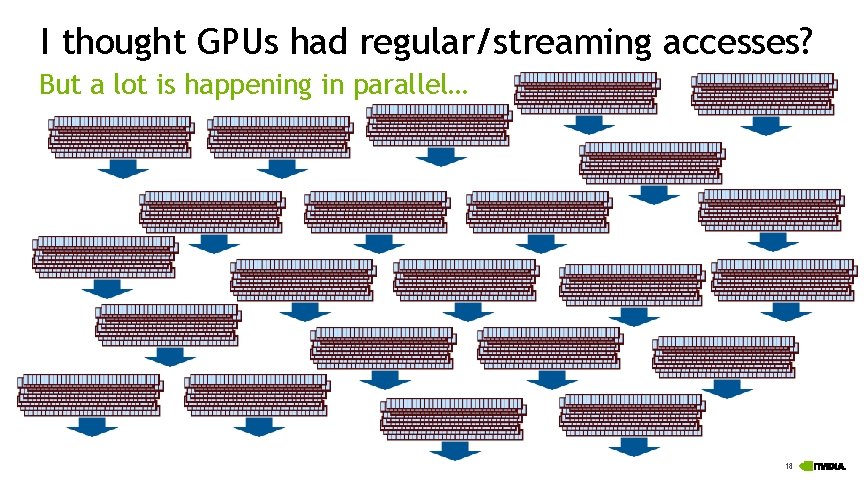
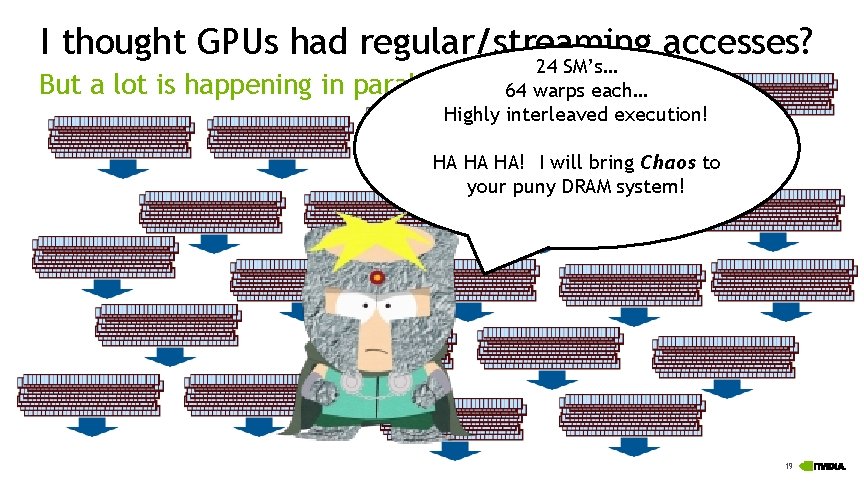
I thought GPUs had regular/streaming accesses? GPU warp = 32 Threads executed in SIMD manner http: //www. shopbuy. org/static/category/original/rope LD r 1, [r 2+tid. x] /14174435 -seamless-heamp-rope-texturepattern. jpg Nice, Coalesced load of 32 x 4 B = 128 B 17
I thought GPUs had regular/streaming accesses? But a lot is happening in parallel… 18
I thought GPUs had regular/streaming accesses? But a lot is happening in 24 SM’s… parallel… 64 warps each… Highly interleaved execution! HA HA HA! I will bring Chaos to your puny DRAM system! 19
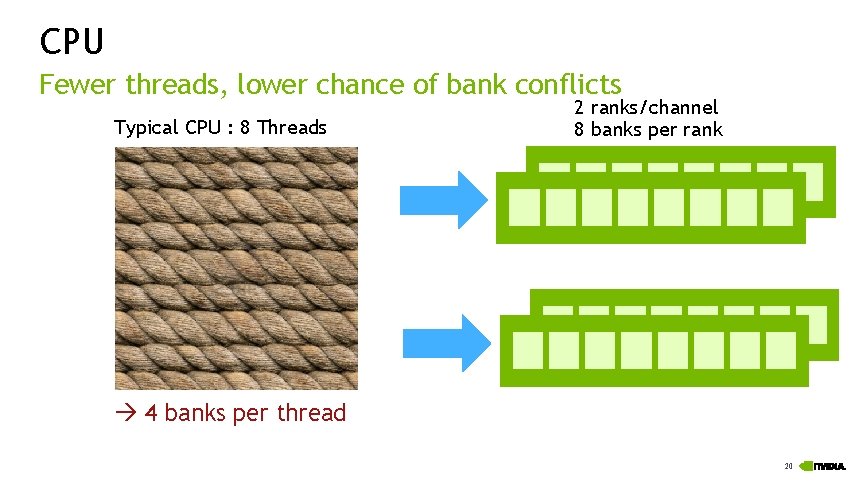
CPU Fewer threads, lower chance of bank conflicts Typical CPU : 8 Threads 2 ranks/channel 8 banks per rank http: //www. shopbuy. org/static/category/original/rope /14174435 -seamless-heamp-rope-texturepattern. jpg 4 banks per thread 20
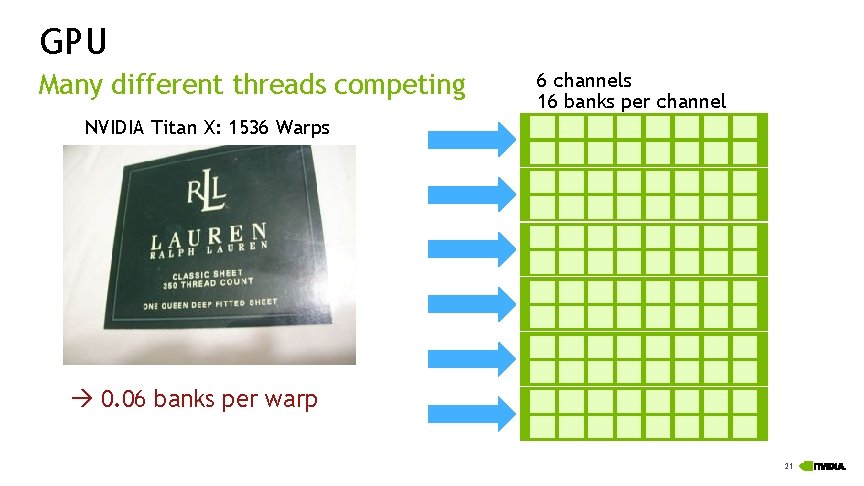
GPU Many different threads competing 6 channels 16 banks per channel NVIDIA Titan X: 1536 Warps 0. 06 banks per warp 21
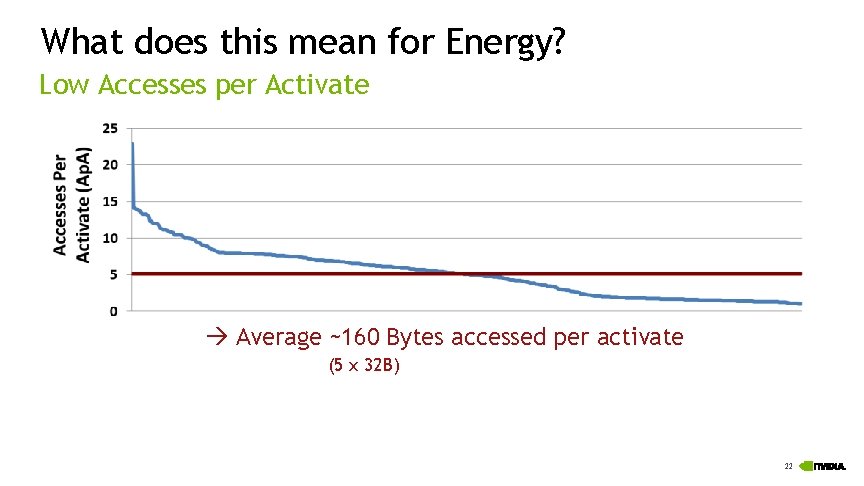
What does this mean for Energy? Low Accesses per Activate Average ~160 Bytes accessed per activate (5 x 32 B) 22
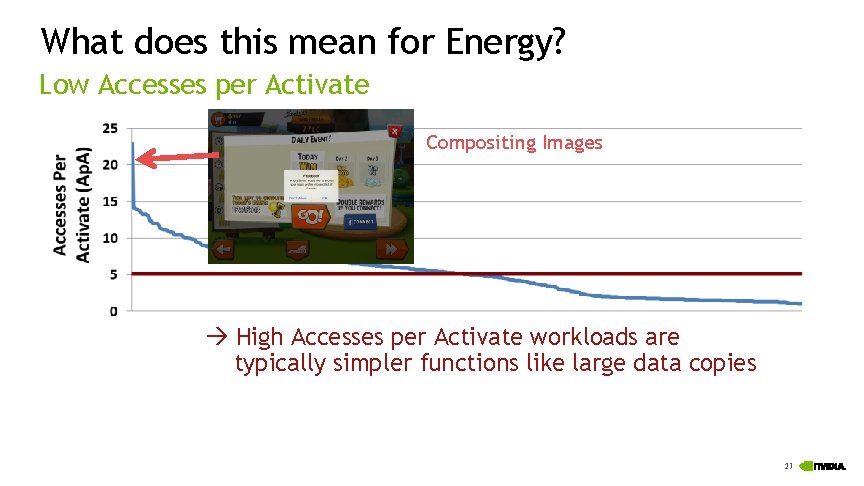
What does this mean for Energy? Low Accesses per Activate Compositing Images High Accesses per Activate workloads are typically simpler functions like large data copies 23
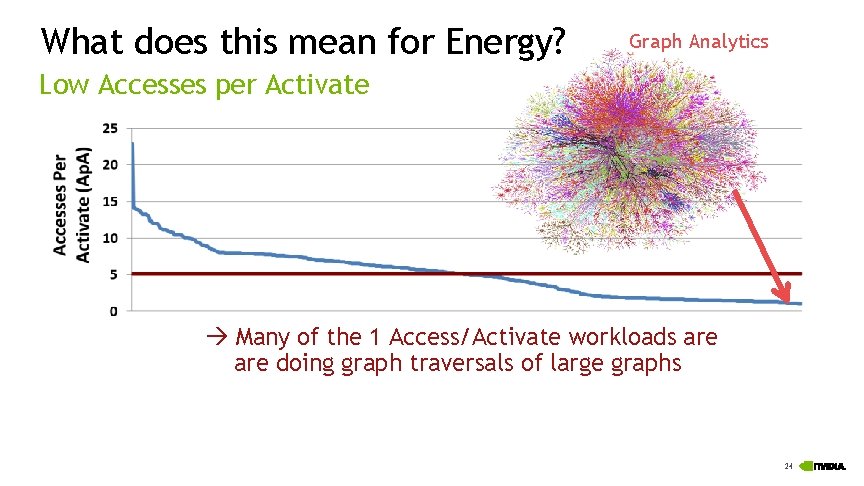
What does this mean for Energy? Graph Analytics Low Accesses per Activate Many of the 1 Access/Activate workloads are doing graph traversals of large graphs 24
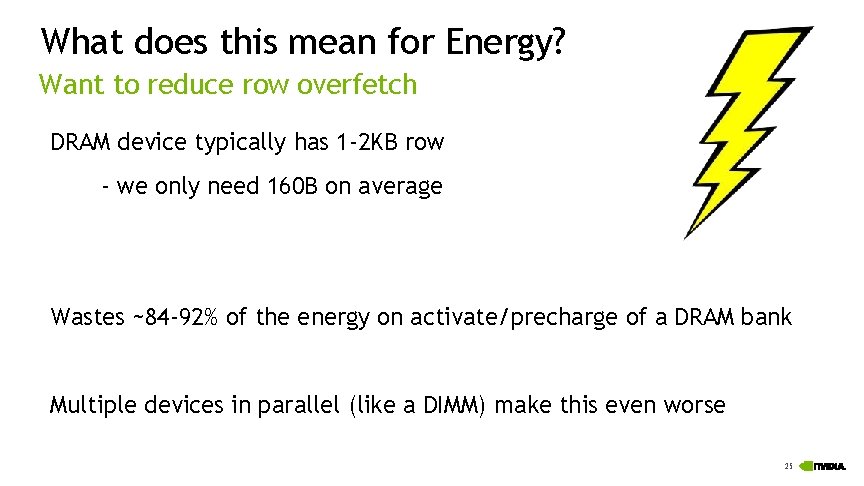
What does this mean for Energy? Want to reduce row overfetch DRAM device typically has 1 -2 KB row - we only need 160 B on average Wastes ~84 -92% of the energy on activate/precharge of a DRAM bank Multiple devices in parallel (like a DIMM) make this even worse 25
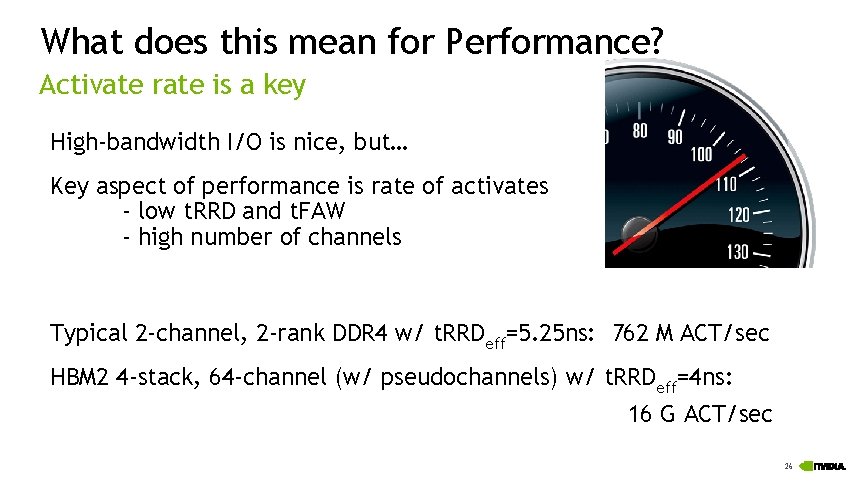
What does this mean for Performance? Activate rate is a key High-bandwidth I/O is nice, but… Key aspect of performance is rate of activates - low t. RRD and t. FAW - high number of channels Typical 2 -channel, 2 -rank DDR 4 w/ t. RRDeff=5. 25 ns: 762 M ACT/sec HBM 2 4 -stack, 64 -channel (w/ pseudochannels) w/ t. RRDeff=4 ns: 16 G ACT/sec 26
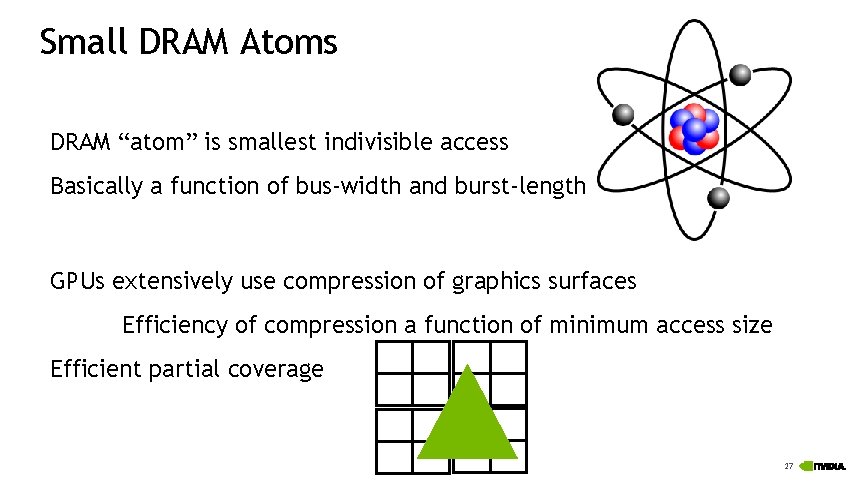
Small DRAM Atoms DRAM “atom” is smallest indivisible access Basically a function of bus-width and burst-length GPUs extensively use compression of graphics surfaces Efficiency of compression a function of minimum access size Efficient partial coverage 27
What to GPUs need from DRAM? High Bandwidth (w/ low access / activate) Energy-efficient (largely because of high bandwidth) Small minimum burst sizes (e. g. 16 -32 B) Not necessarily concerned with: Low-latency Extremely large capacities Lowest possible cost 28
One Approach: High-Speed Signaling Start with a commodity DRAM core Since GPUs don’t need huge capacities, drop multi-rank support Without multi-drop busses and sockets, push I/O data rates Beef-up the DRAM core to keep up (reduce t. RRD/t. FAW if possible) Basic approach behind GDDR DRAMs 29
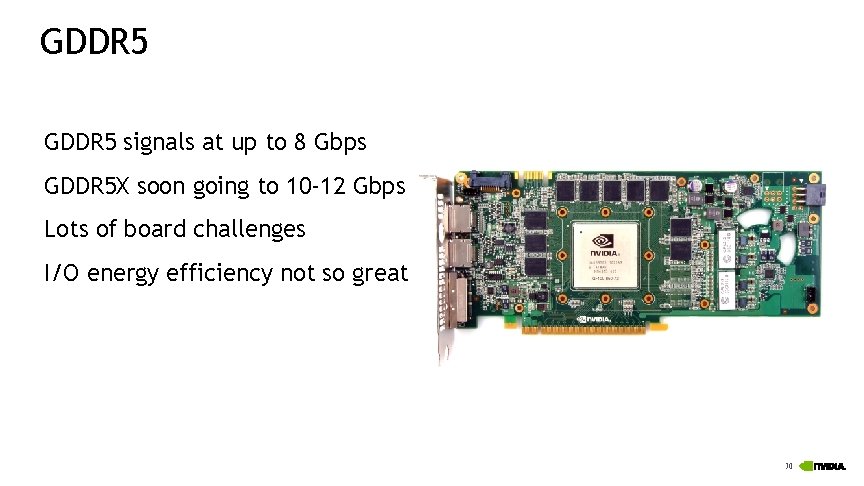
GDDR 5 signals at up to 8 Gbps GDDR 5 X soon going to 10 -12 Gbps Lots of board challenges I/O energy efficiency not so great 30
Challenges with High-speed Signaling Limits on data rates with inexpensive board & package High-data rates place demands on the DRAM core - Cycle the DRAM core arrays faster And/Or - Sub-partition pieces of the DRAM array And/Or - Fetch more data from the array each time 31
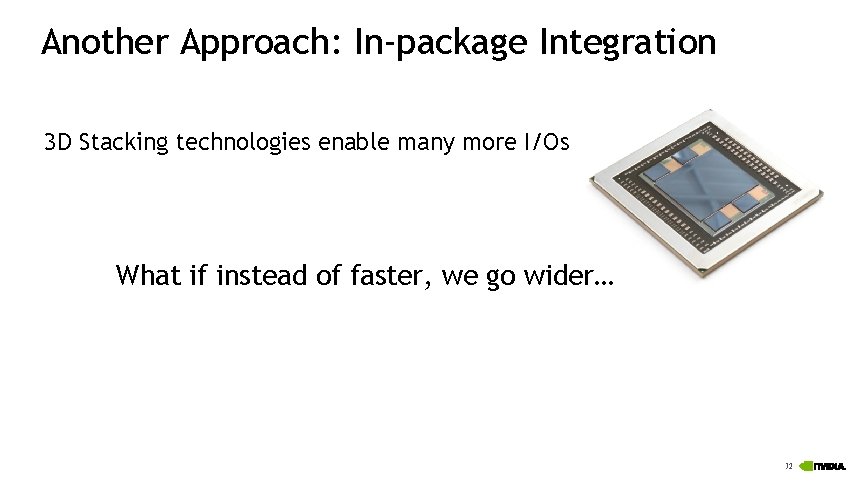
Another Approach: In-package Integration 3 D Stacking technologies enable many more I/Os What if instead of faster, we go wider… 32
What is High-Bandwidth Memory (HBM)? Memory standard designed for needs of future GPU and HPC systems: Exploit very large number of signals available with die-stacking technologies for very high memory bandwidth Reduce I/O energy costs Enable higher fraction of peak bandwidth to be exploited by sophisticated memory controllers Enable ECC/Resilience Features JEDEC standard JESD 235, adopted Oct 2013. Initial work started in 2010 33
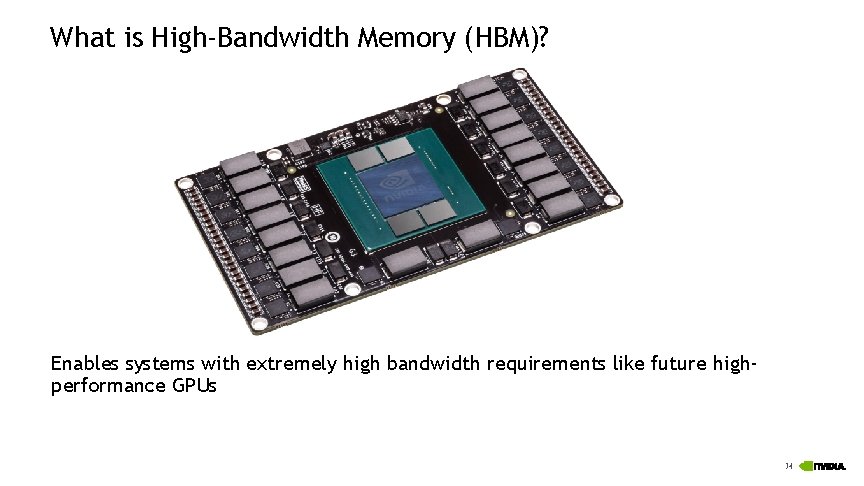
What is High-Bandwidth Memory (HBM)? Enables systems with extremely high bandwidth requirements like future highperformance GPUs 34
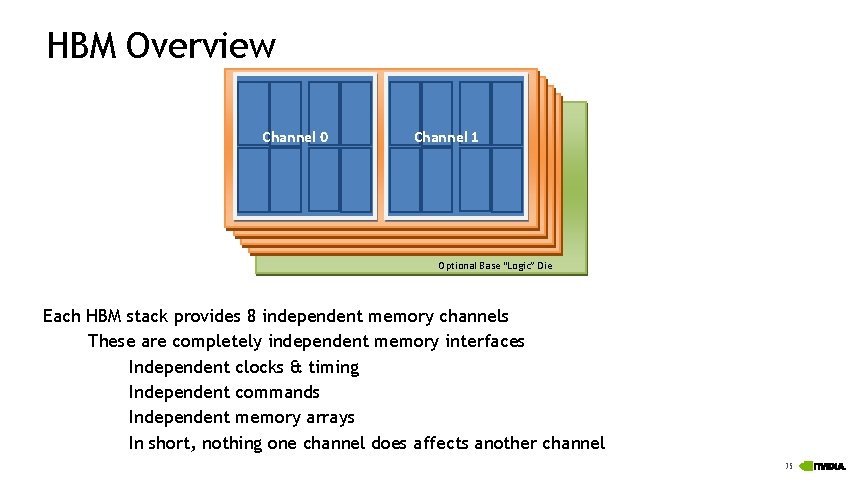
HBM Overview Channel 0 4 DRAM dies with 2 channels per die Channel 1 Optional Base “Logic” Die Each HBM stack provides 8 independent memory channels These are completely independent memory interfaces Independent clocks & timing Independent commands Independent memory arrays In short, nothing one channel does affects another channel 35
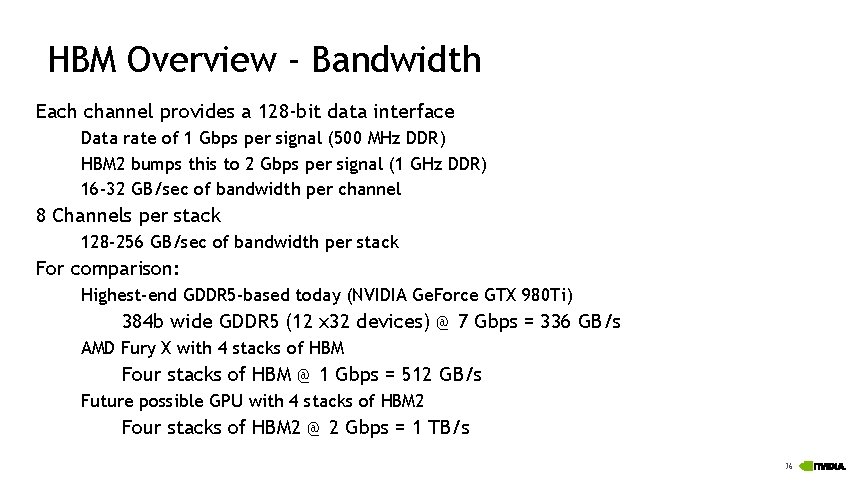
HBM Overview - Bandwidth Each channel provides a 128 -bit data interface Data rate of 1 Gbps per signal (500 MHz DDR) HBM 2 bumps this to 2 Gbps per signal (1 GHz DDR) 16 -32 GB/sec of bandwidth per channel 8 Channels per stack 128 -256 GB/sec of bandwidth per stack For comparison: Highest-end GDDR 5 -based today (NVIDIA Ge. Force GTX 980 Ti) 384 b wide GDDR 5 (12 x 32 devices) @ 7 Gbps = 336 GB/s AMD Fury X with 4 stacks of HBM Four stacks of HBM @ 1 Gbps = 512 GB/s Future possible GPU with 4 stacks of HBM 2 Four stacks of HBM 2 @ 2 Gbps = 1 TB/s 36
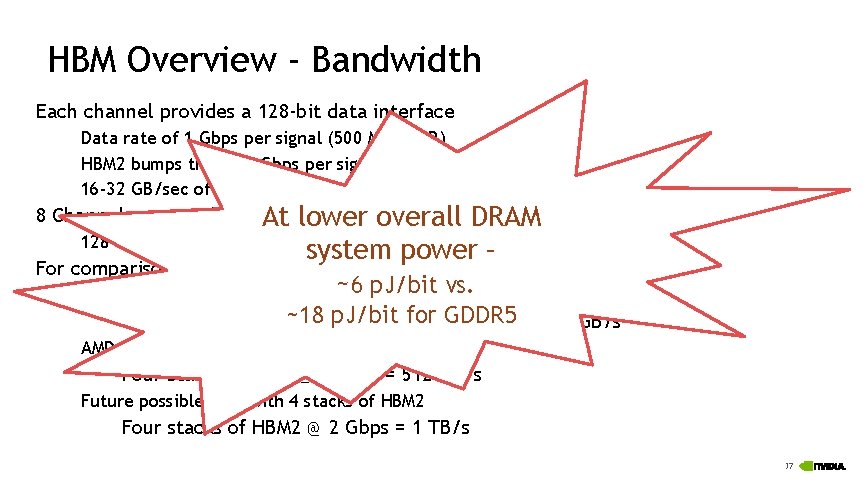
HBM Overview - Bandwidth Each channel provides a 128 -bit data interface Data rate of 1 Gbps per signal (500 MHz DDR) HBM 2 bumps this to 2 Gbps per signal (1 GHz DDR) 16 -32 GB/sec of bandwidth per channel At lower overall DRAM 128 -256 GB/sec of bandwidth per stack system power – For comparison: 6 p. J/bit vs. GTX 980 Ti) Highest-end GDDR 5 -based today~(NVIDIA Ge. Force 8 Channels per stack ~18 x 32 p. J/bit for@GDDR 5 384 b wide GDDR 5 (12 devices) 7 Gbps = 336 GB/s AMD Fury X with 4 stacks of HBM Four stacks of HBM @ 1 Gbps = 512 GB/s Future possible GPU with 4 stacks of HBM 2 Four stacks of HBM 2 @ 2 Gbps = 1 TB/s 37
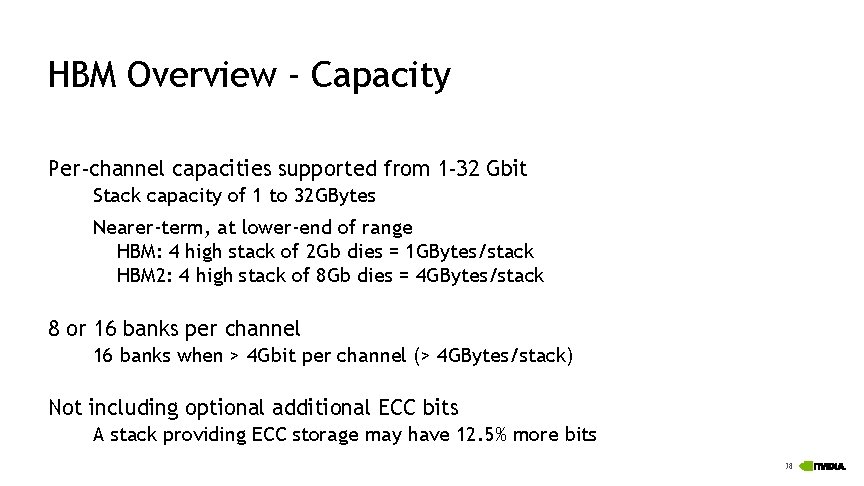
HBM Overview - Capacity Per-channel capacities supported from 1 -32 Gbit Stack capacity of 1 to 32 GBytes Nearer-term, at lower-end of range HBM: 4 high stack of 2 Gb dies = 1 GBytes/stack HBM 2: 4 high stack of 8 Gb dies = 4 GBytes/stack 8 or 16 banks per channel 16 banks when > 4 Gbit per channel (> 4 GBytes/stack) Not including optional additional ECC bits A stack providing ECC storage may have 12. 5% more bits 38
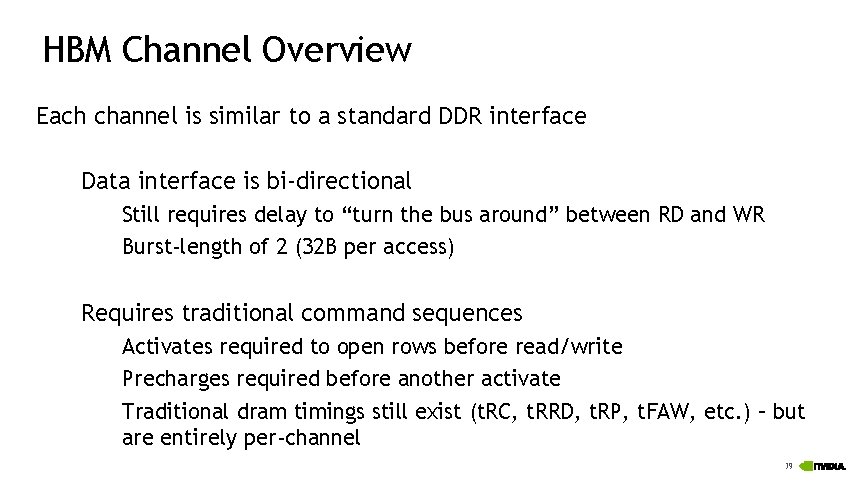
HBM Channel Overview Each channel is similar to a standard DDR interface Data interface is bi-directional Still requires delay to “turn the bus around” between RD and WR Burst-length of 2 (32 B per access) Requires traditional command sequences Activates required to open rows before read/write Precharges required before another activate Traditional dram timings still exist (t. RC, t. RRD, t. RP, t. FAW, etc. ) – but are entirely per-channel 39
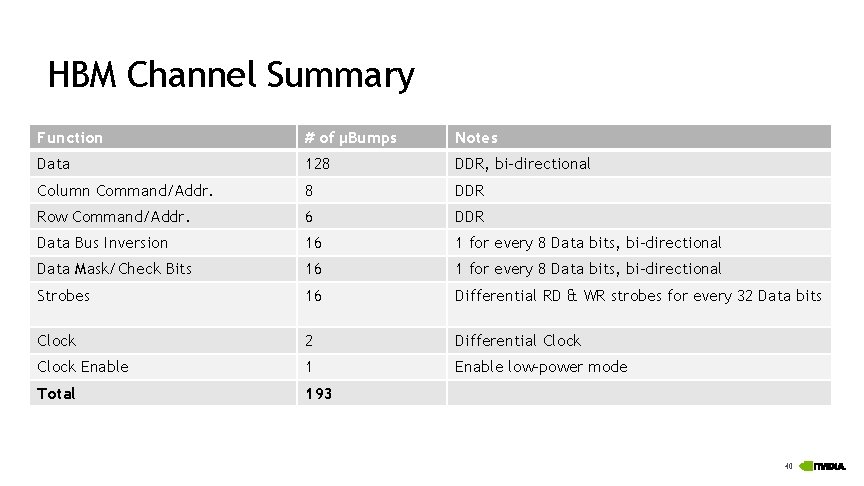
HBM Channel Summary Function # of µBumps Notes Data 128 DDR, bi-directional Column Command/Addr. 8 DDR Row Command/Addr. 6 DDR Data Bus Inversion 16 1 for every 8 Data bits, bi-directional Data Mask/Check Bits 16 1 for every 8 Data bits, bi-directional Strobes 16 Differential RD & WR strobes for every 32 Data bits Clock 2 Differential Clock Enable 1 Enable low-power mode Total 193 40
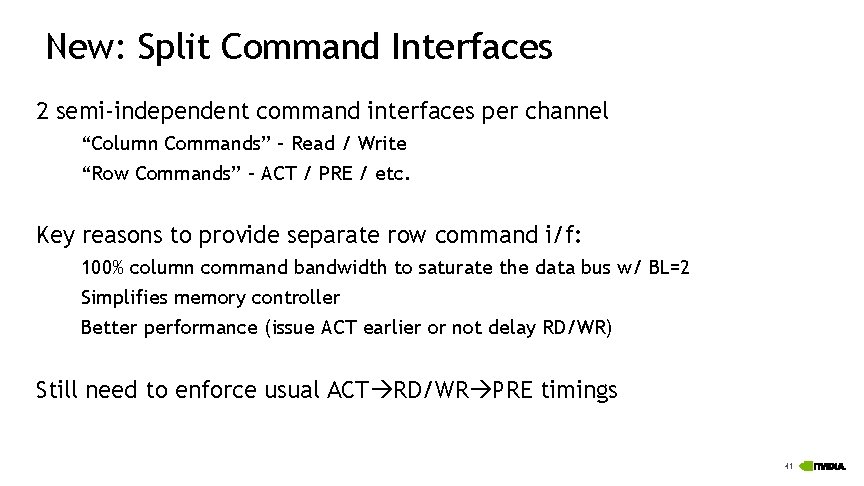
New: Split Command Interfaces 2 semi-independent command interfaces per channel “Column Commands” – Read / Write “Row Commands” – ACT / PRE / etc. Key reasons to provide separate row command i/f: 100% column command bandwidth to saturate the data bus w/ BL=2 Simplifies memory controller Better performance (issue ACT earlier or not delay RD/WR) Still need to enforce usual ACT RD/WR PRE timings 41
New: Single-Bank Refresh Current DRAMs require refresh operations Refresh commands require all banks to be closed ~ 1 refresh command every few µsec Can consume 5 -10% of potential bandwidth Increasing overheads with larger devices Sophisticated DRAM controllers work hard to overlap ACT/PRE in one bank with traffic to other banks Can manage the refresh similarly Added “Refresh Single Bank” command Like an ACT, but w/ internal per-bank row counter Can be issued to any banks in any order Memory controller responsible for ensuring all banks get enough refreshes each refresh period 42
New: RAS Support HBM standard supports ECC Optional: Not all stacks required to support it ECC and non-ECC stacks use same interface Key insight: Per-byte data mask signals and ECC not simultaneously useful Data Mask Signals can carry ECC data - makes them bi-directional on HBM stacks that support ECC 43
Other HBM Features HBM supports Temperature Compensated Self Refresh Temperature dependent refresh rates with several temperature ranges (e. g. cool/standby, normal, extended, emergency) Temperature sensor can be read by memory controller to adjust its refresh rates as well DBIac Data Bus Inversion coding Reduce number of simultaneously switching signals No more than 4 of 9 (DQ[0. . 7], DBI) signals switch DBI computation maintained across consecutive commands 44
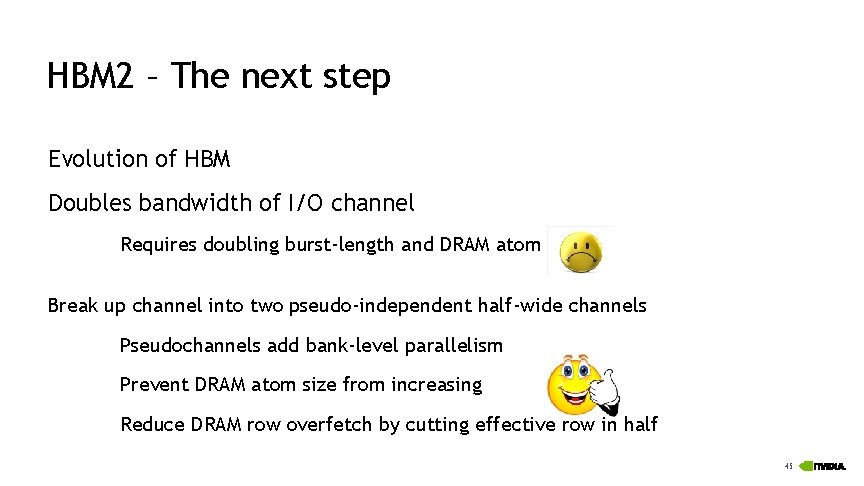
HBM 2 – The next step Evolution of HBM Doubles bandwidth of I/O channel Requires doubling burst-length and DRAM atom Break up channel into two pseudo-independent half-wide channels Pseudochannels add bank-level parallelism Prevent DRAM atom size from increasing Reduce DRAM row overfetch by cutting effective row in half 45
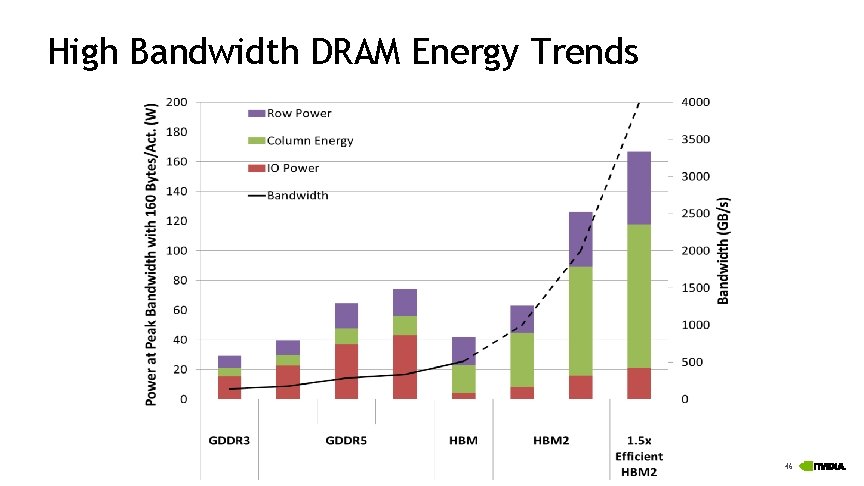
High Bandwidth DRAM Energy Trends 46
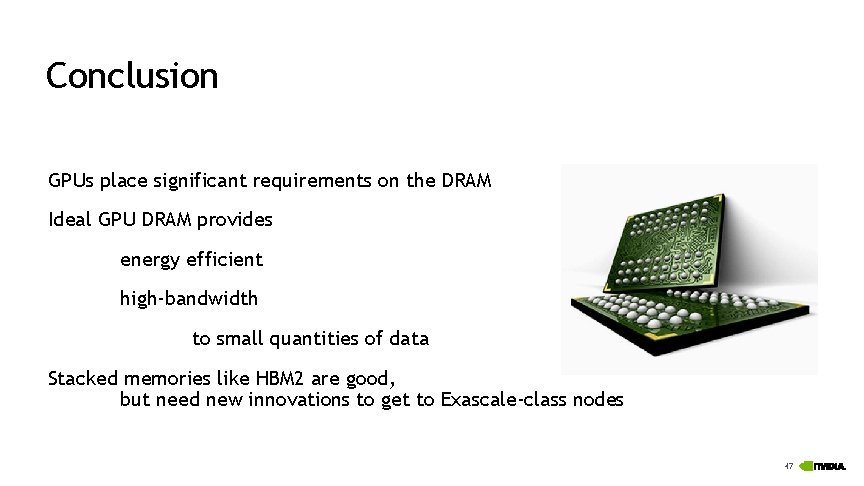
Conclusion GPUs place significant requirements on the DRAM Ideal GPU DRAM provides energy efficient high-bandwidth to small quantities of data Stacked memories like HBM 2 are good, but need new innovations to get to Exascale-class nodes 47
- Slides: 48