
HighAccuracy QuickChange Robot Factory Interface John Hart ajhartmit
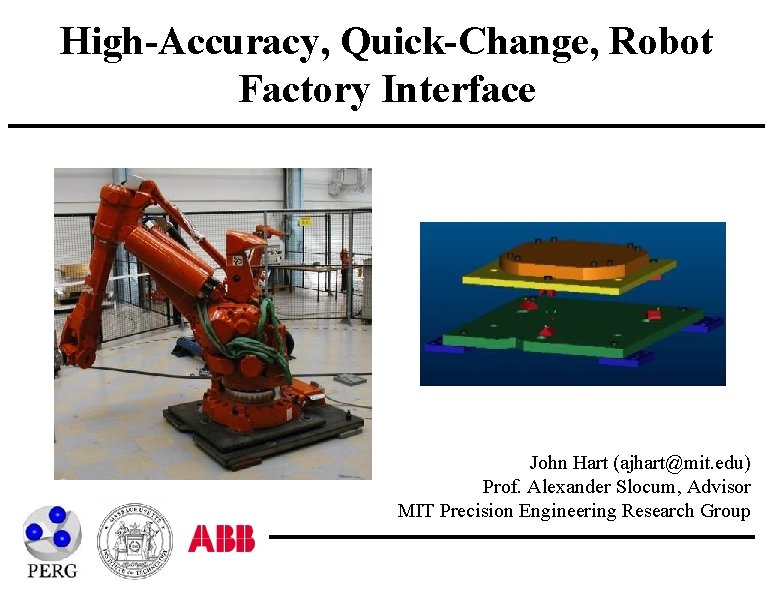
High-Accuracy, Quick-Change, Robot Factory Interface John Hart (ajhart@mit. edu) Prof. Alexander Slocum, Advisor MIT Precision Engineering Research Group
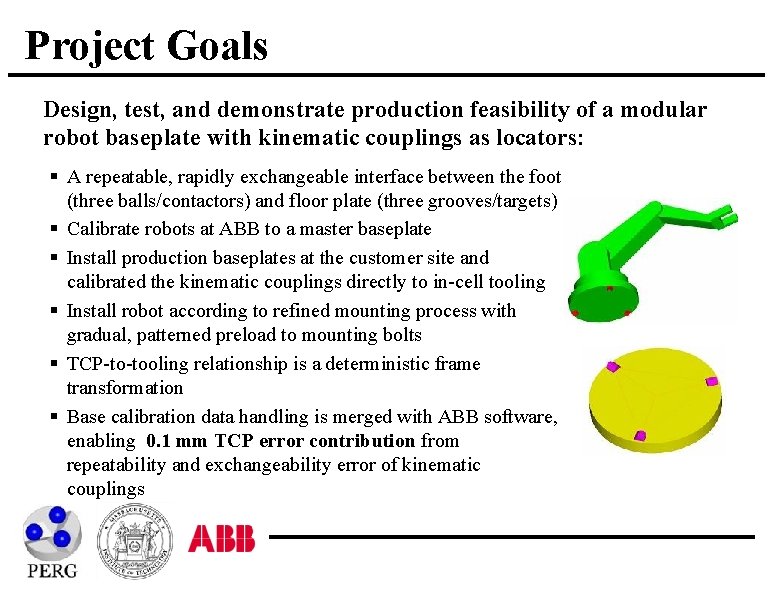
Project Goals Design, test, and demonstrate production feasibility of a modular robot baseplate with kinematic couplings as locators: § A repeatable, rapidly exchangeable interface between the foot (three balls/contactors) and floor plate (three grooves/targets) § Calibrate robots at ABB to a master baseplate § Install production baseplates at the customer site and calibrated the kinematic couplings directly to in-cell tooling § Install robot according to refined mounting process with gradual, patterned preload to mounting bolts § TCP-to-tooling relationship is a deterministic frame transformation § Base calibration data handling is merged with ABB software, enabling 0. 1 mm TCP error contribution from repeatability and exchangeability error of kinematic couplings
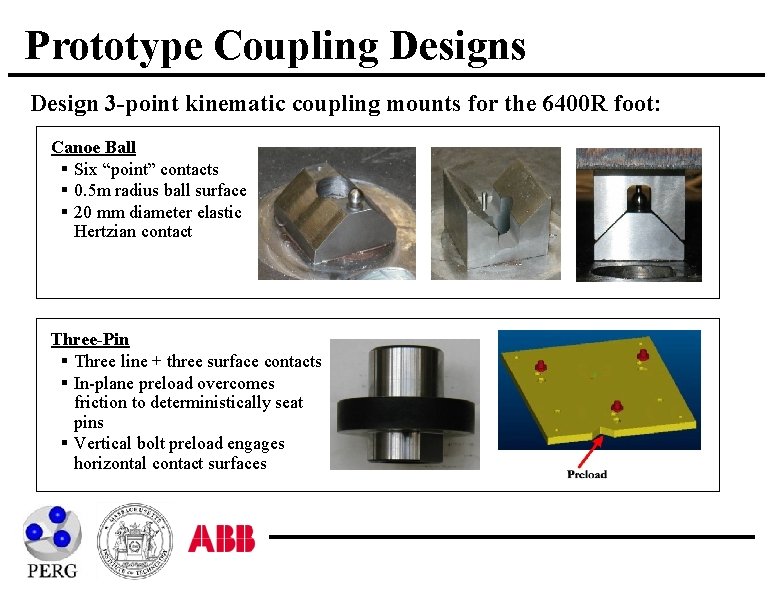
Prototype Coupling Designs Design 3 -point kinematic coupling mounts for the 6400 R foot: Canoe Ball § Six “point” contacts § 0. 5 m radius ball surface § 20 mm diameter elastic Hertzian contact Three-Pin § Three line + three surface contacts § In-plane preload overcomes friction to deterministically seat pins § Vertical bolt preload engages horizontal contact surfaces
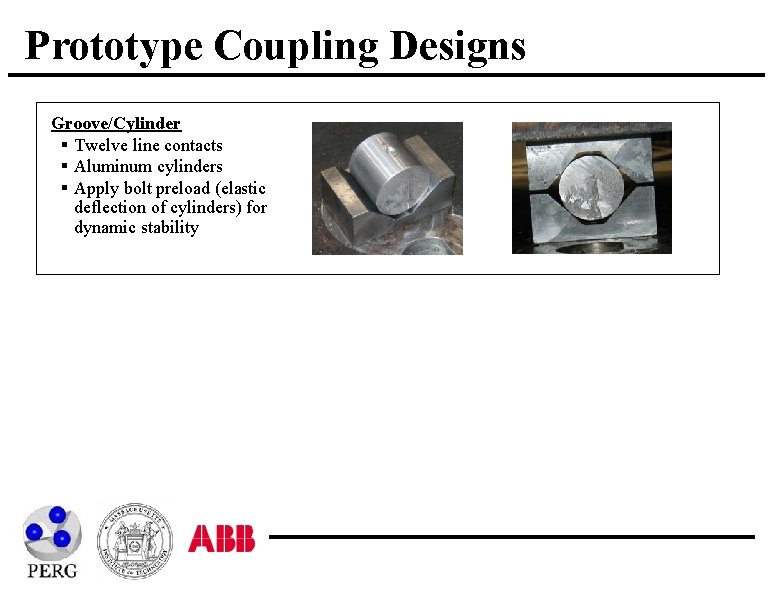
Prototype Coupling Designs Groove/Cylinder § Twelve line contacts § Aluminum cylinders § Apply bolt preload (elastic deflection of cylinders) for dynamic stability
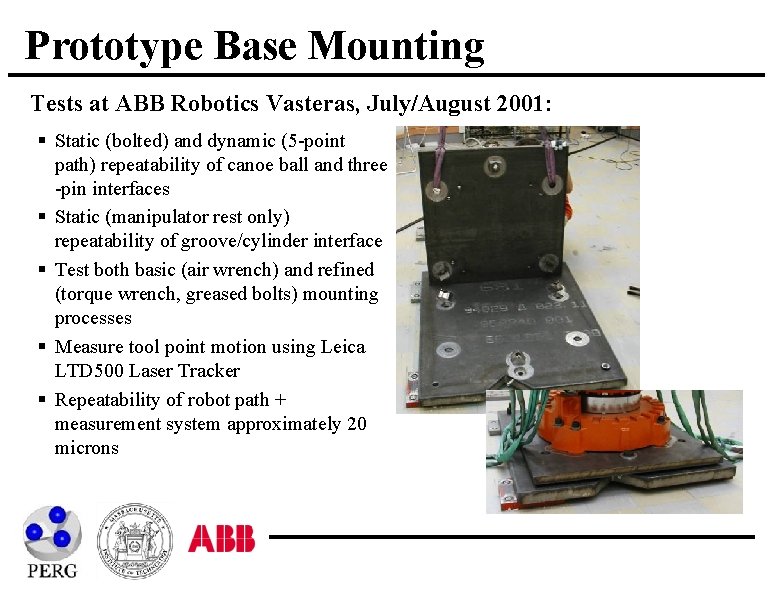
Prototype Base Mounting Tests at ABB Robotics Vasteras, July/August 2001: § Static (bolted) and dynamic (5 -point path) repeatability of canoe ball and three -pin interfaces § Static (manipulator rest only) repeatability of groove/cylinder interface § Test both basic (air wrench) and refined (torque wrench, greased bolts) mounting processes § Measure tool point motion using Leica LTD 500 Laser Tracker § Repeatability of robot path + measurement system approximately 20 microns
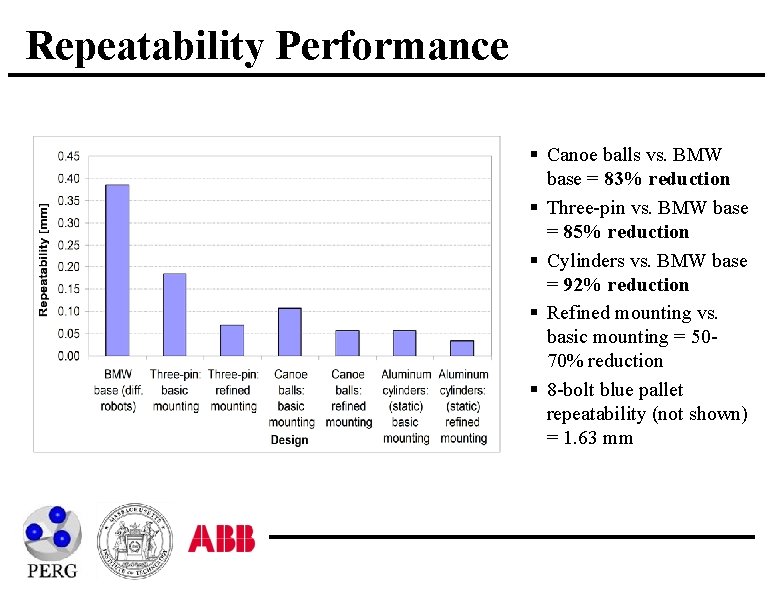
Repeatability Performance § Canoe balls vs. BMW base = 83% reduction § Three-pin vs. BMW base = 85% reduction § Cylinders vs. BMW base = 92% reduction § Refined mounting vs. basic mounting = 5070% reduction § 8 -bolt blue pallet repeatability (not shown) = 1. 63 mm
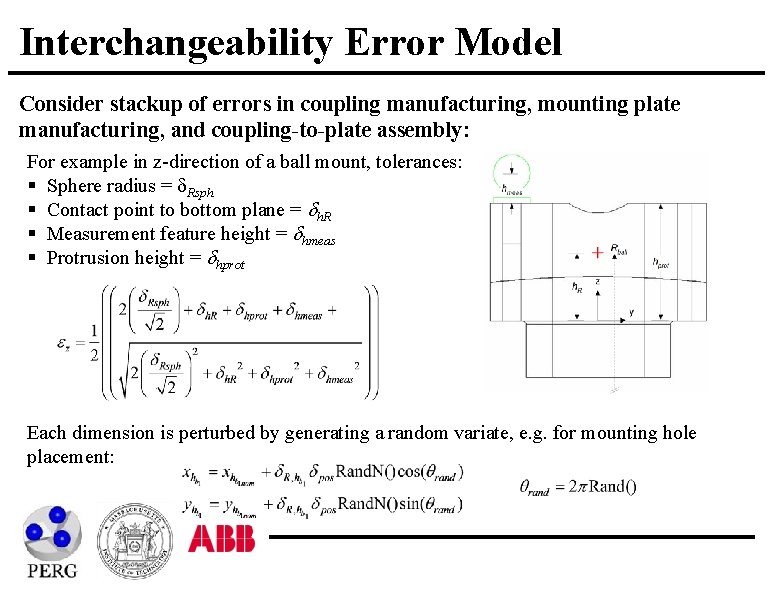
Interchangeability Error Model Consider stackup of errors in coupling manufacturing, mounting plate manufacturing, and coupling-to-plate assembly: For example in z-direction of a ball mount, tolerances: § Sphere radius = d. Rsph § Contact point to bottom plane = dh. R § Measurement feature height = dhmeas § Protrusion height = dhprot Each dimension is perturbed by generating a random variate, e. g. for mounting hole placement:
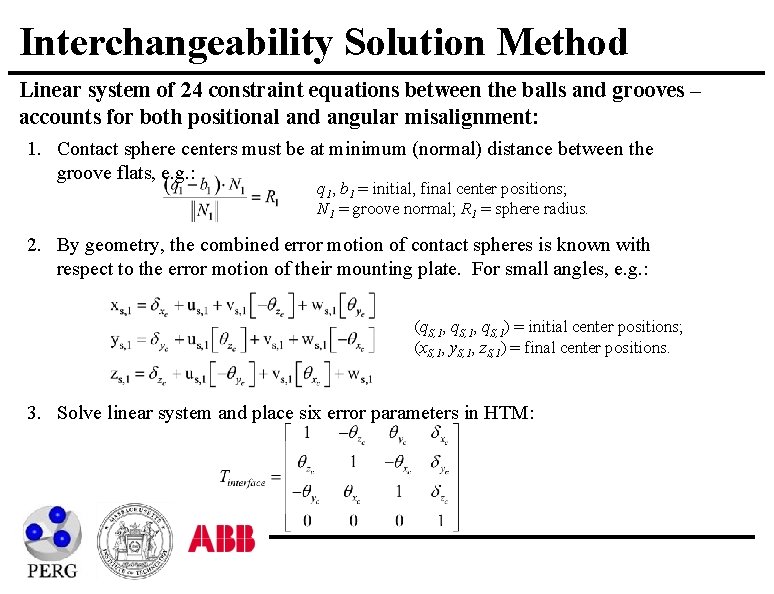
Interchangeability Solution Method Linear system of 24 constraint equations between the balls and grooves – accounts for both positional and angular misalignment: 1. Contact sphere centers must be at minimum (normal) distance between the groove flats, e. g. : q 1, b 1 = initial, final center positions; N 1 = groove normal; R 1 = sphere radius. 2. By geometry, the combined error motion of contact spheres is known with respect to the error motion of their mounting plate. For small angles, e. g. : (q. S, 1, q. S, 1) = initial center positions; (x. S, 1, y. S, 1, z. S, 1) = final center positions. 3. Solve linear system and place six error parameters in HTM:
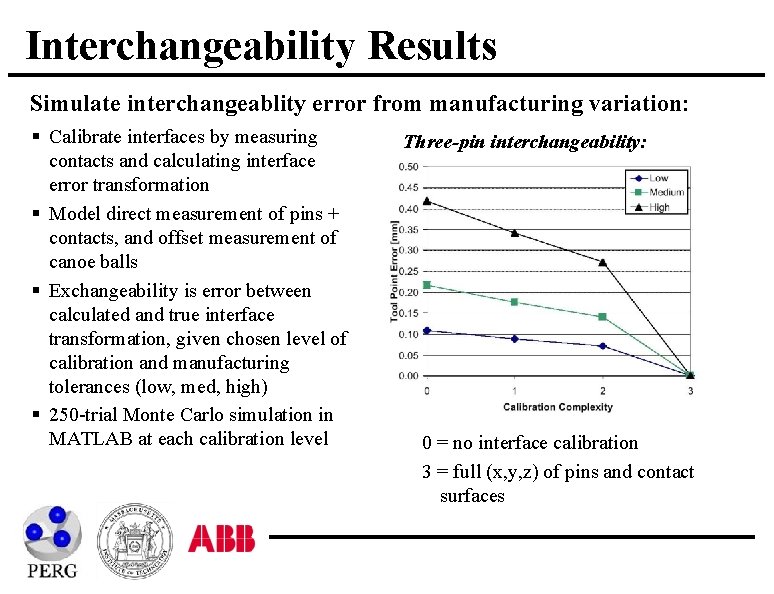
Interchangeability Results Simulate interchangeablity error from manufacturing variation: § Calibrate interfaces by measuring contacts and calculating interface error transformation § Model direct measurement of pins + contacts, and offset measurement of canoe balls § Exchangeability is error between calculated and true interface transformation, given chosen level of calibration and manufacturing tolerances (low, med, high) § 250 -trial Monte Carlo simulation in MATLAB at each calibration level Three-pin interchangeability: 0 = no interface calibration 3 = full (x, y, z) of pins and contact surfaces
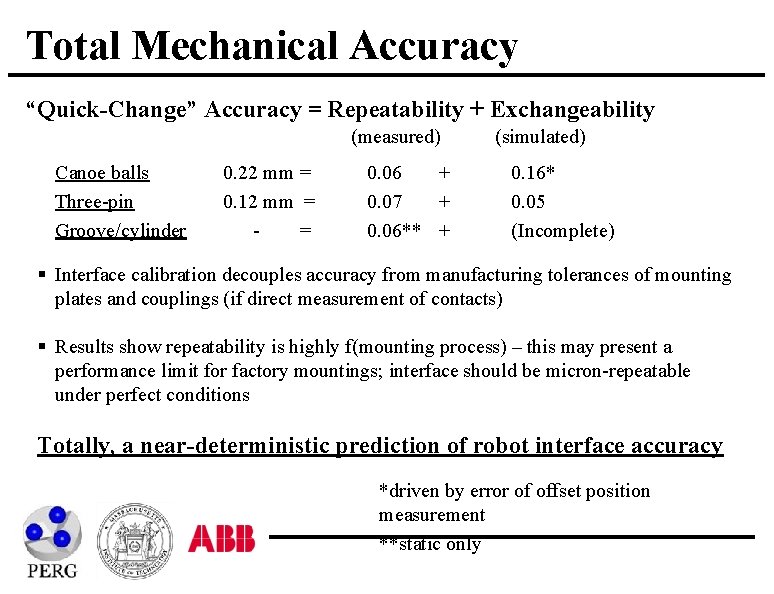
Total Mechanical Accuracy “Quick-Change” Accuracy = Repeatability + Exchangeability (measured) Canoe balls Three-pin Groove/cylinder 0. 22 mm = 0. 12 mm = = 0. 06 + 0. 07 + 0. 06** + (simulated) 0. 16* 0. 05 (Incomplete) § Interface calibration decouples accuracy from manufacturing tolerances of mounting plates and couplings (if direct measurement of contacts) § Results show repeatability is highly f(mounting process) – this may present a performance limit for factory mountings; interface should be micron-repeatable under perfect conditions Totally, a near-deterministic prediction of robot interface accuracy *driven by error of offset position measurement **static only
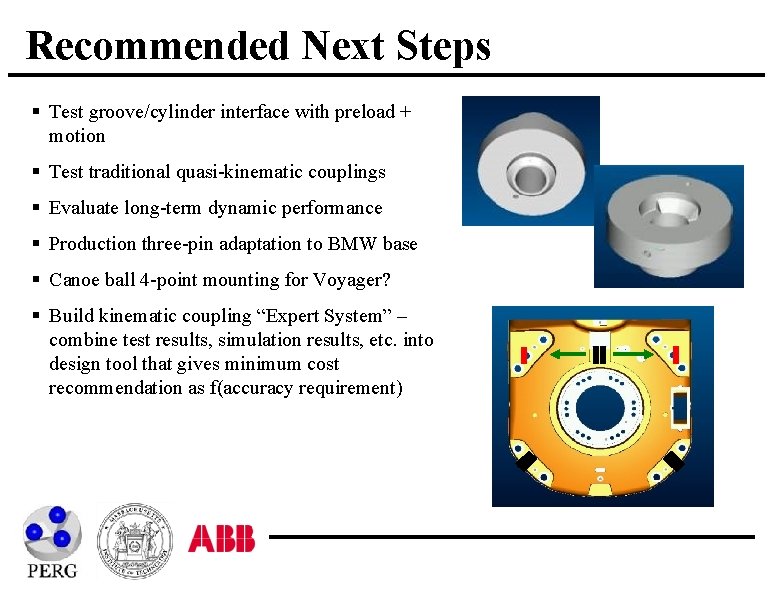
Recommended Next Steps § Test groove/cylinder interface with preload + motion § Test traditional quasi-kinematic couplings § Evaluate long-term dynamic performance § Production three-pin adaptation to BMW base § Canoe ball 4 -point mounting for Voyager? § Build kinematic coupling “Expert System” – combine test results, simulation results, etc. into design tool that gives minimum cost recommendation as f(accuracy requirement)
- Slides: 11