
High Wire Press Innovation by with scholars Michael
High. Wire Press Innovation by & with scholars Michael A. Keller Stanford University Libraries http: //highwire. stanford. edu
What is High. Wire Press? 1. A dept of the Stanford University Libraries 2. A service to scholarly societies & “responsible” publishers 3. A community of publishers 4. An enterprise (it is self-supporting) 5. Not an aggregator 6. Not a serials jobber 7. Not free, publishers charged fees for services
What is the mission of High. Wire Press? 1. Engage advanced network & other I. T. to enhance scholarly communication 1. -- innovate constantly on the basis of 2. -- publishers’ & editors’ desires & 3. -- feedback from readers 2. Contribute to marketplace correction by improving the competitive posture of scholarly societies and other “responsible” publishers 1. -- lifting the performance bars high 2. -- attracting authors & readers to scholarly societies
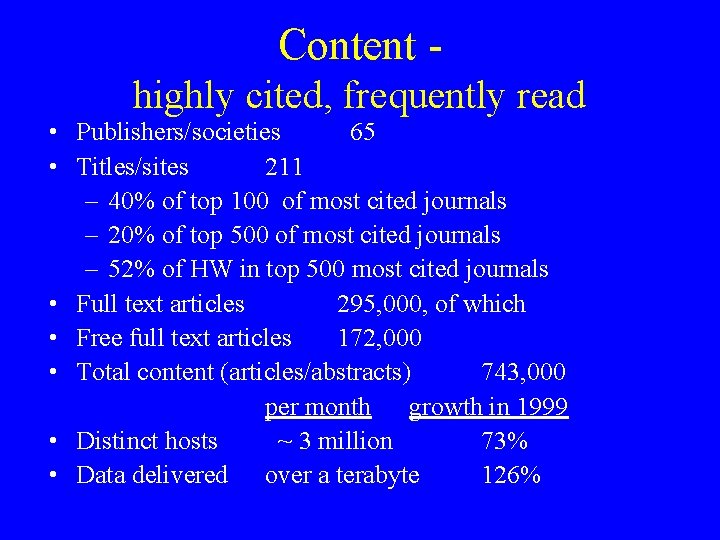
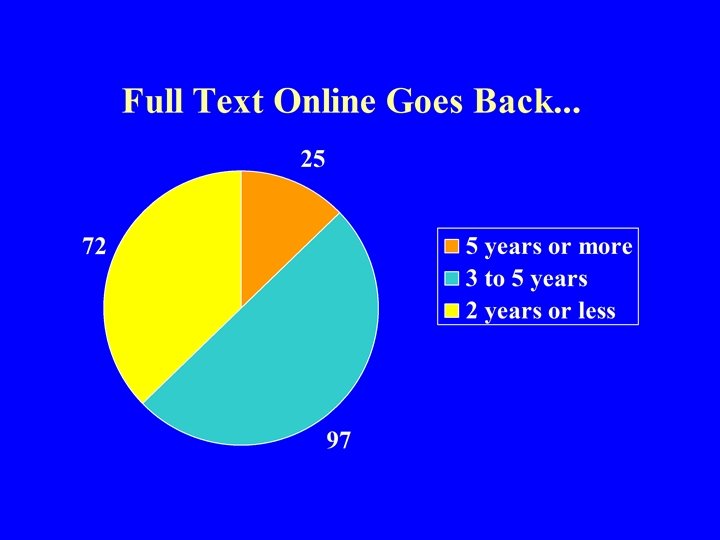
Content highly cited, frequently read • Publishers/societies 65 • Titles/sites 211 – 40% of top 100 of most cited journals – 20% of top 500 of most cited journals – 52% of HW in top 500 most cited journals • Full text articles 295, 000, of which • Free full text articles 172, 000 • Total content (articles/abstracts) 743, 000 per month growth in 1999 • Distinct hosts ~ 3 million 73% • Data delivered over a terabyte 126%
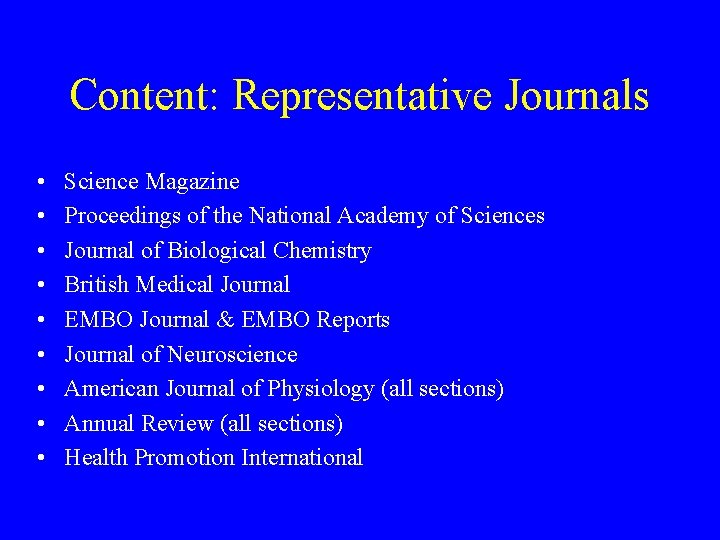
Content: Representative Journals • • • Science Magazine Proceedings of the National Academy of Sciences Journal of Biological Chemistry British Medical Journal EMBO Journal & EMBO Reports Journal of Neuroscience American Journal of Physiology (all sections) Annual Review (all sections) Health Promotion International
Content - available as published • No delay of content for institutional readers • Publication is becoming faster: – Ever shortening time between author submission & publication – Manuscript acceptance & publication are becoming simultaneous events – The issue is becoming a relic • Private overnet to Brazil (& 24 other nations)
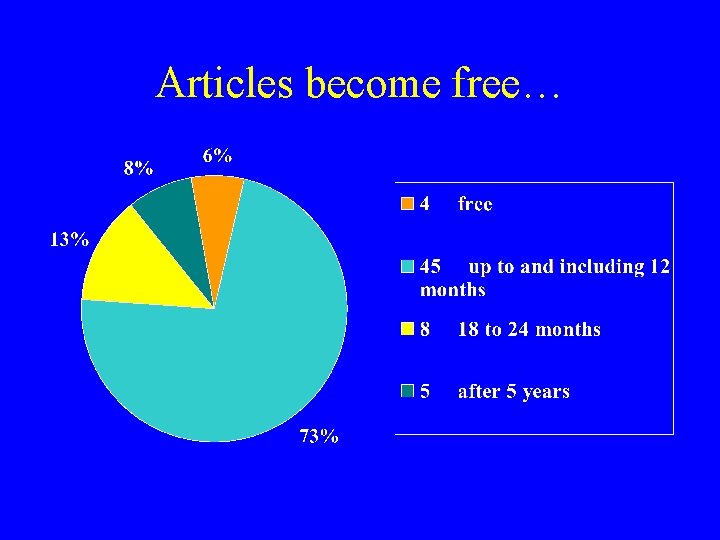
Articles become free…
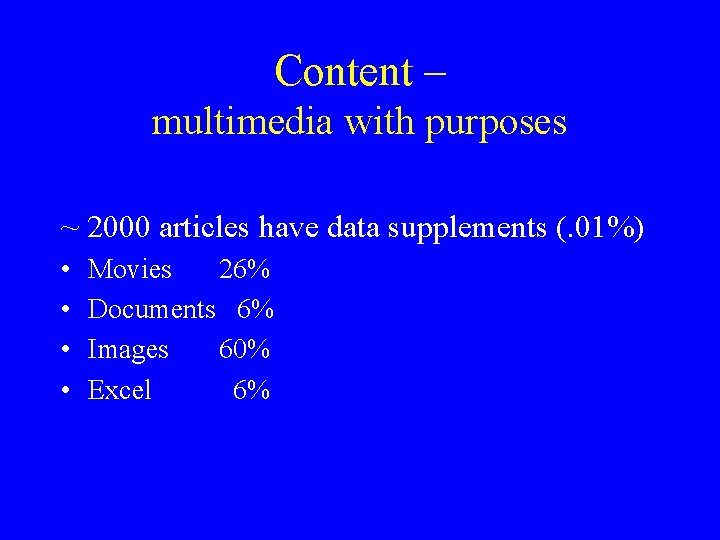
Content – multimedia with purposes ~ 2000 articles have data supplements (. 01%) • • Movies 26% Documents 6% Images 60% Excel 6%
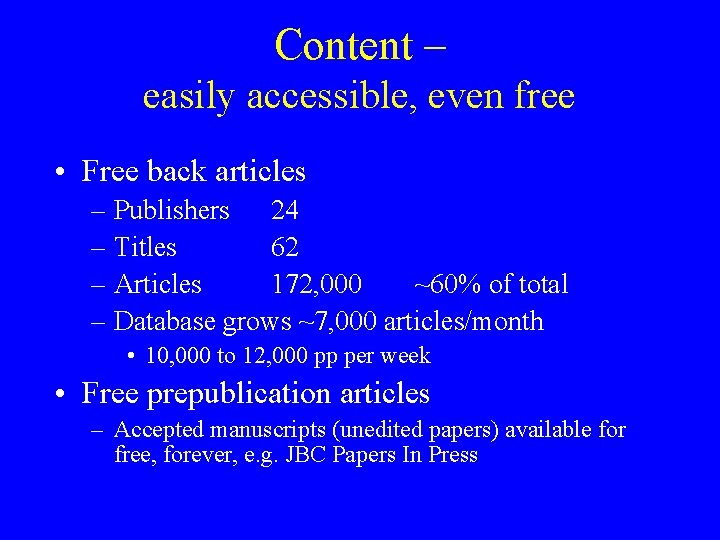
Content – easily accessible, even free • Free back articles – Publishers 24 – Titles 62 – Articles 172, 000 ~60% of total – Database grows ~7, 000 articles/month • 10, 000 to 12, 000 pp per week • Free prepublication articles – Accepted manuscripts (unedited papers) available for free, forever, e. g. JBC Papers In Press
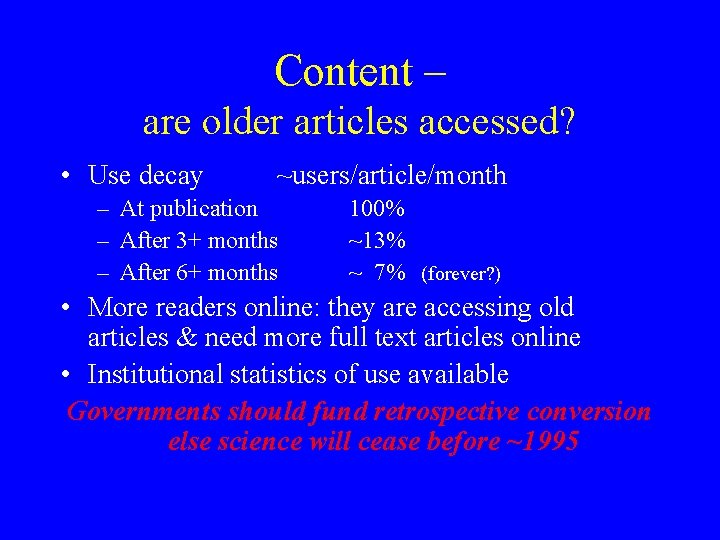
Content – are older articles accessed? • Use decay ~users/article/month – At publication – After 3+ months – After 6+ months 100% ~13% ~ 7% (forever? ) • More readers online: they are accessing old articles & need more full text articles online • Institutional statistics of use available Governments should fund retrospective conversion else science will cease before ~1995
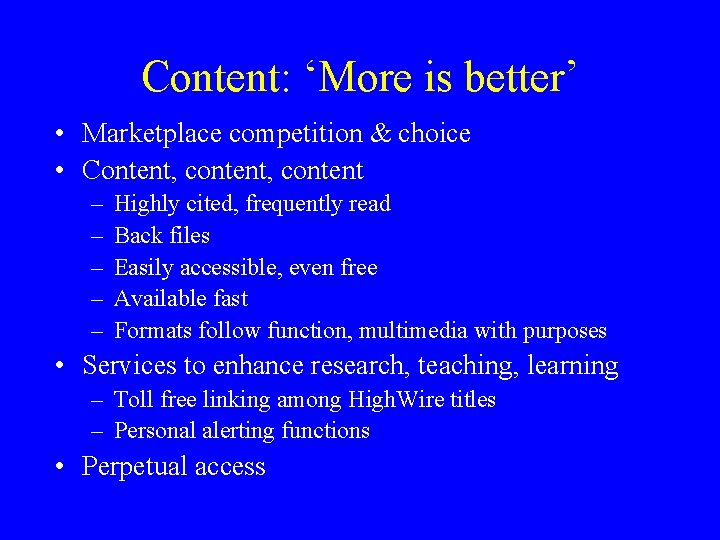
Content: ‘More is better’ • Marketplace competition & choice • Content, content – – – Highly cited, frequently read Back files Easily accessible, even free Available fast Formats follow function, multimedia with purposes • Services to enhance research, teaching, learning – Toll free linking among High. Wire titles – Personal alerting functions • Perpetual access
Services - links • ~ 2 million links from bibliographic references to full text articles & abstracts – Medline, ISI Web of Science, Gen. Bank, HW jrnls • ~ 500, 000 links to free full text articles
Services - alerts • Table of Contents • current • future • Subject and Author • topic/author match • article is cited – hot link in e-mail message • • Forward citation alert New titles ~1 million alerts to 1/3+ million readers Growth ~100, 000 alerts/month As of 4. 16. 00
Perpetual Access • STM publishing is a record of scholarship • Online is superset of the paper • Paper journals are no longer an archival record • E-journals are dynamic, have links and services • Static PDF or SGML archives are not sufficient • Back files & free access are services, not archives
Perpetual Access • Need many different systems and approaches • High. Wire migrates files (5 x, so far!) • High. Wire maintains source and operating file tape archive off-site • LOCKSS – Lots Of Copies Keeps Stuff Safe – A software protocol to locally store and manage web content • decentralized, distributed, highly replicated • easy to use, inexpensive to operate – Insures web content functionality, integrity, access – http: //lockss. stanford. edu • SUL “Dark Cave” digital archive in development
Innovations • Design/development & production site for Oxford English Dictionary, 3 rd ed – http: //www. oed. com • Signal Transduction Knowledge Environment – AAAS content & High. Wire technology – A digital library – information and information services – First of many http: //www. stke. org • Concept (semantic) searching in development
http: //Highwire. stanford. edu Contacts: vreich@stanford. edu bzavon@stanford. edu
More about lockss if questions arise • Provides simple web cache that: – never gets flushed – holds authorized content • The cache – pre-fetches content as published – continuously validates against other caches – repairs gaps from publisher and other caches • Persistence via redundancy – not via media archiving • Cheap hardware; free open source software
- Slides: 19