
High Throughput Scientific Computing with Condor Computer Science



- Slides: 61
High Throughput Scientific Computing with Condor: Computer Science Challenges in Large Scale Parallelism Douglas Thain University of Notre Dame UAB 27 October 2011 1
In a nutshell: Using Condor, you can build a high throughput computing system on thousands of cores. My research: How do we design applications so that it is easy to run on 1000 s of cores? 2
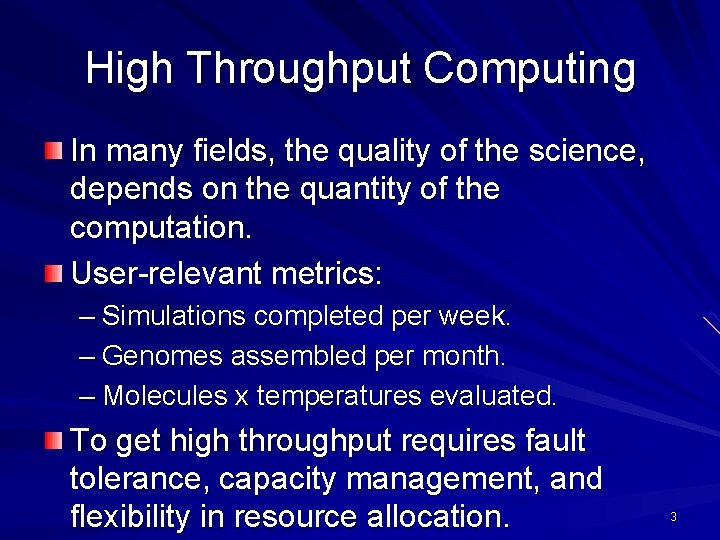
High Throughput Computing In many fields, the quality of the science, depends on the quantity of the computation. User-relevant metrics: – Simulations completed per week. – Genomes assembled per month. – Molecules x temperatures evaluated. To get high throughput requires fault tolerance, capacity management, and flexibility in resource allocation. 3
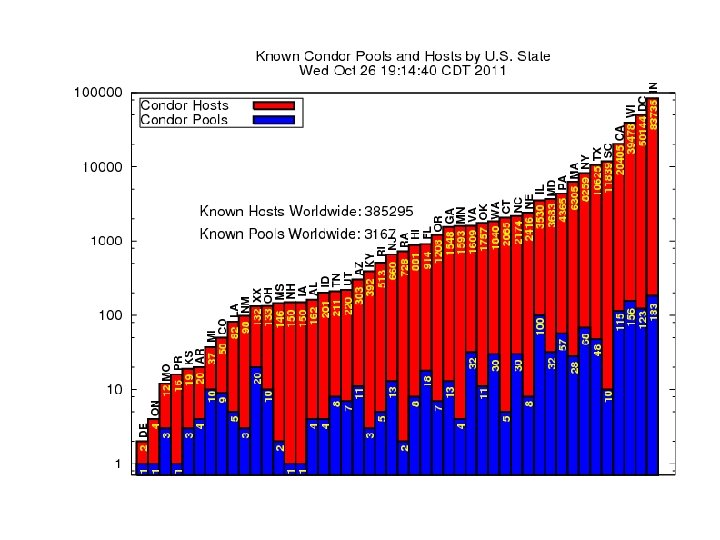
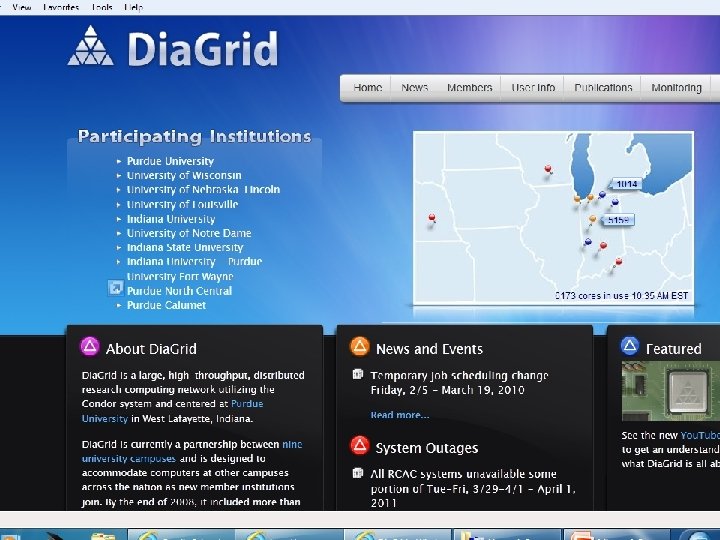
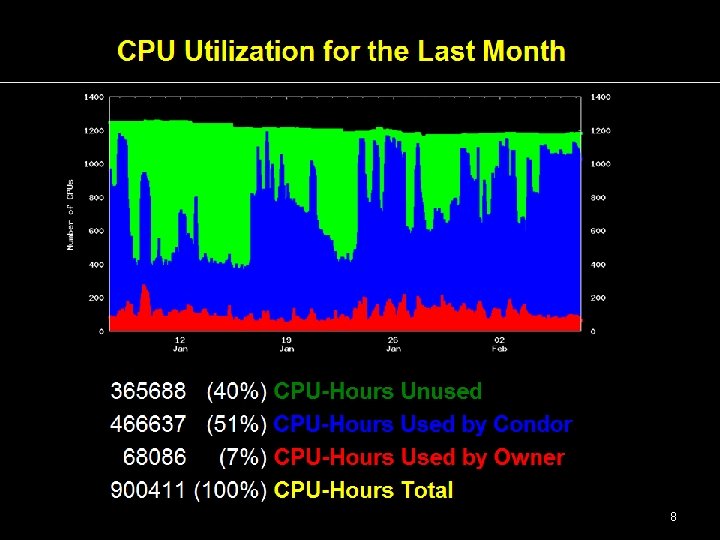
Condor creates a high-throughput computing environment from any heterogeneous collection of machines. Volunteer desktops to dedicated servers. Allows for complex sharing policies. Tolerant to a wide variety of failures. Scales to 10 K nodes, 1 M jobs. Created at UW – Madison in 1987. http: //www. cs. wisc. edu/condor 4
5
6
7
8
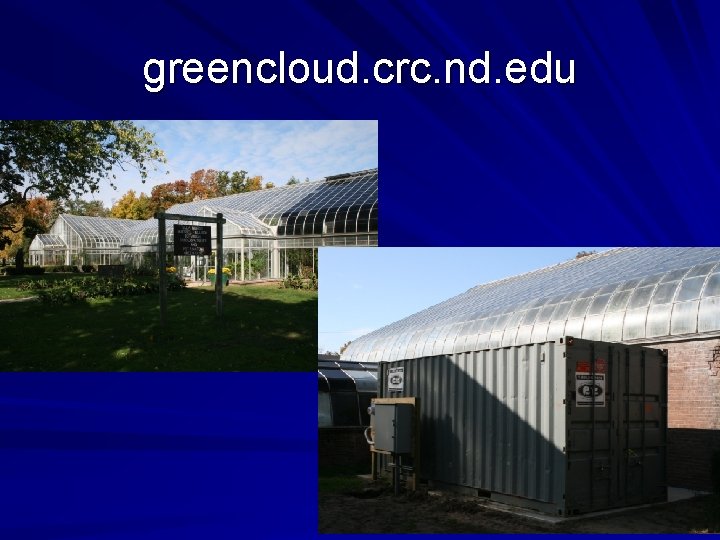
greencloud. crc. nd. edu 9
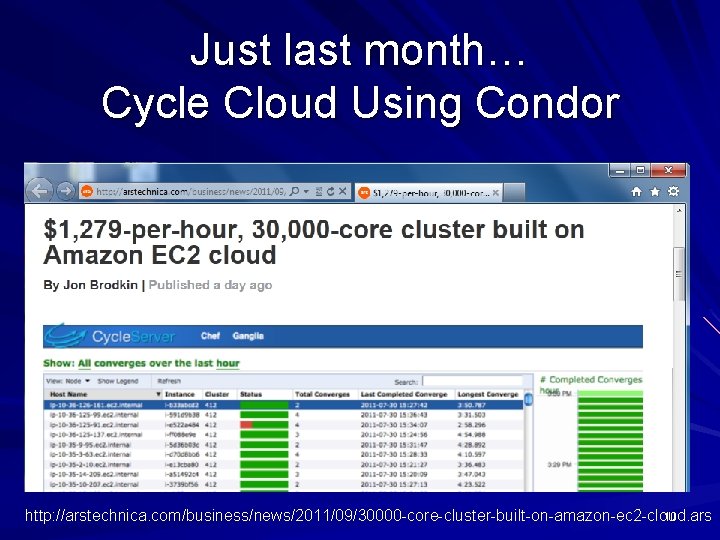
Just last month… Cycle Cloud Using Condor http: //arstechnica. com/business/news/2011/09/30000 -core-cluster-built-on-amazon-ec 2 -cloud. ars 10
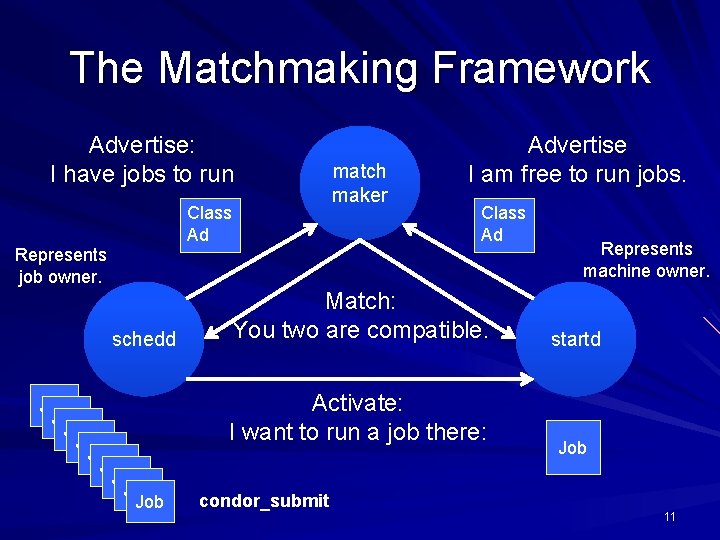
The Matchmaking Framework Advertise: I have jobs to run Class Ad match maker Advertise I am free to run jobs. Class Ad Represents job owner. schedd Job Job Job Match: You two are compatible. Activate: I want to run a job there: condor_submit Represents machine owner. startd Job 11
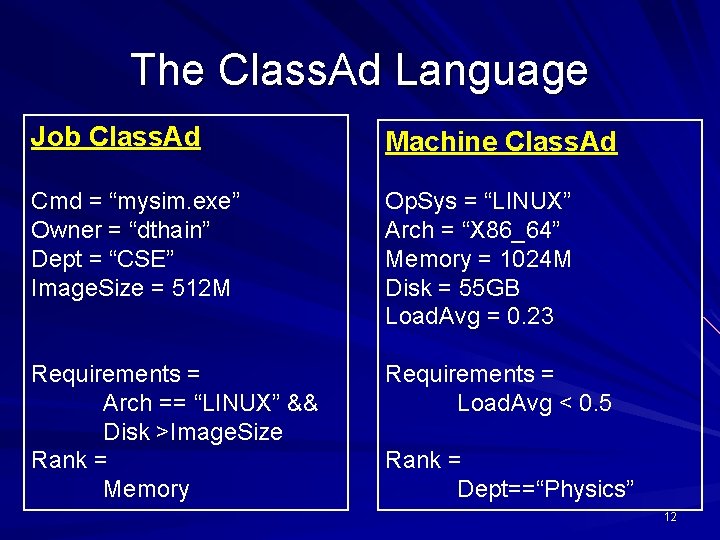
The Class. Ad Language Job Class. Ad Machine Class. Ad Cmd = “mysim. exe” Owner = “dthain” Dept = “CSE” Image. Size = 512 M Op. Sys = “LINUX” Arch = “X 86_64” Memory = 1024 M Disk = 55 GB Load. Avg = 0. 23 Requirements = Arch == “LINUX” && Disk >Image. Size Rank = Memory Requirements = Load. Avg < 0. 5 Rank = Dept==“Physics” 12
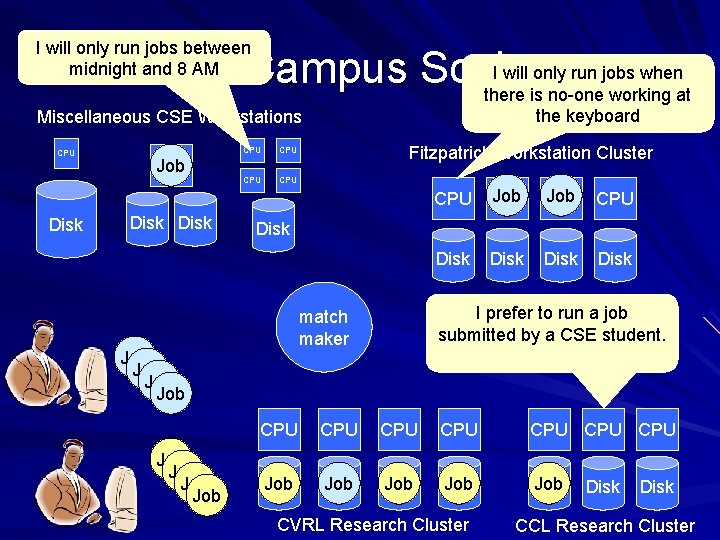
I will only run jobs between midnight and 8 AM I will only run jobs when At Campus Scale there is no-one working at the keyboard Miscellaneous CSE Workstations CPU Job CPU CPU Fitzpatrick Workstation Cluster Job CPU CPU Disk Disk Job Job Disk I prefer to run a job submitted by a CSE student. match maker Job Job Disk CPU CPU Job Disk Job Disk CVRL Research Cluster Disk CCL Research Cluster
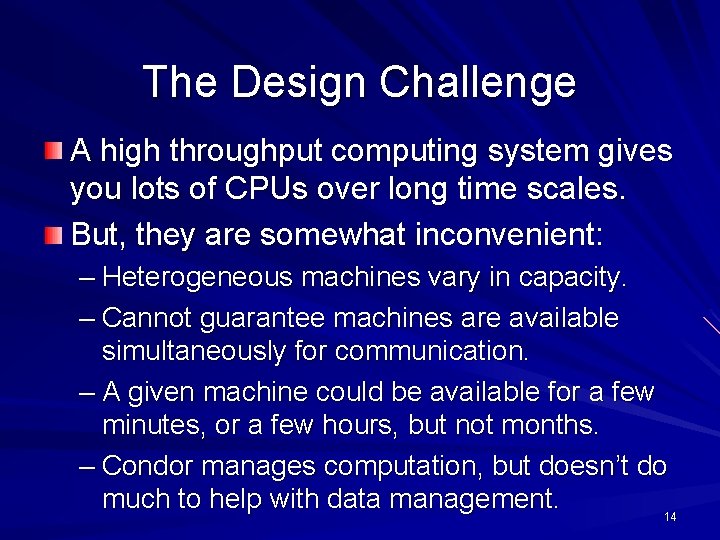
The Design Challenge A high throughput computing system gives you lots of CPUs over long time scales. But, they are somewhat inconvenient: – Heterogeneous machines vary in capacity. – Cannot guarantee machines are available simultaneously for communication. – A given machine could be available for a few minutes, or a few hours, but not months. – Condor manages computation, but doesn’t do much to help with data management. 14
The Cooperative Computing Lab We collaborate with people who have large scale computing problems in science, engineering, and other fields. We operate computer systems on the O(1000) cores: clusters, clouds, grids. We conduct computer science research in the context of real people and problems. We release open source software for large scale distributed computing. http: //www. nd. edu/~ccl 15
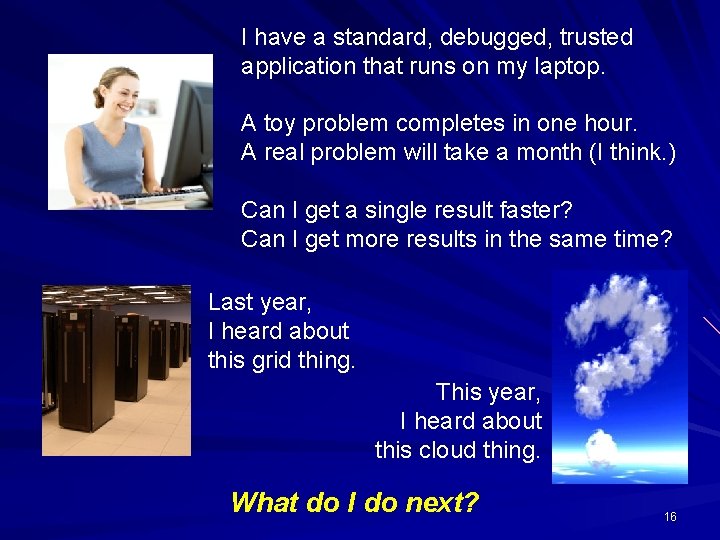
I have a standard, debugged, trusted application that runs on my laptop. A toy problem completes in one hour. A real problem will take a month (I think. ) Can I get a single result faster? Can I get more results in the same time? Last year, I heard about this grid thing. This year, I heard about this cloud thing. What do I do next? 16
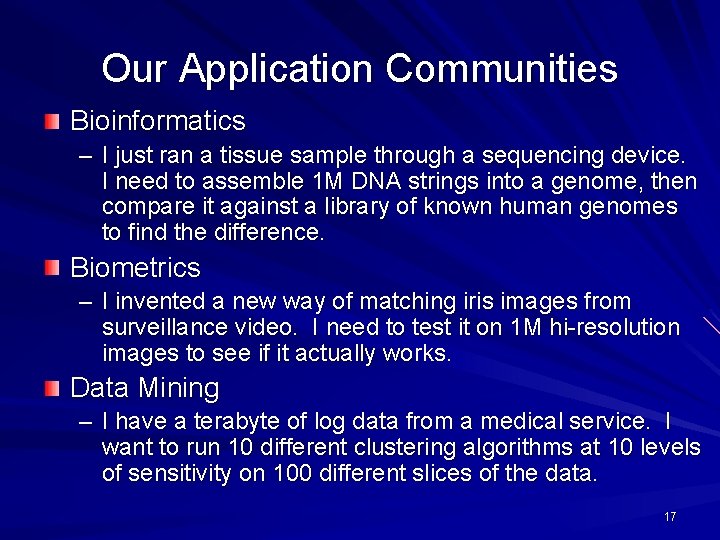
Our Application Communities Bioinformatics – I just ran a tissue sample through a sequencing device. I need to assemble 1 M DNA strings into a genome, then compare it against a library of known human genomes to find the difference. Biometrics – I invented a new way of matching iris images from surveillance video. I need to test it on 1 M hi-resolution images to see if it actually works. Data Mining – I have a terabyte of log data from a medical service. I want to run 10 different clustering algorithms at 10 levels of sensitivity on 100 different slices of the data. 17
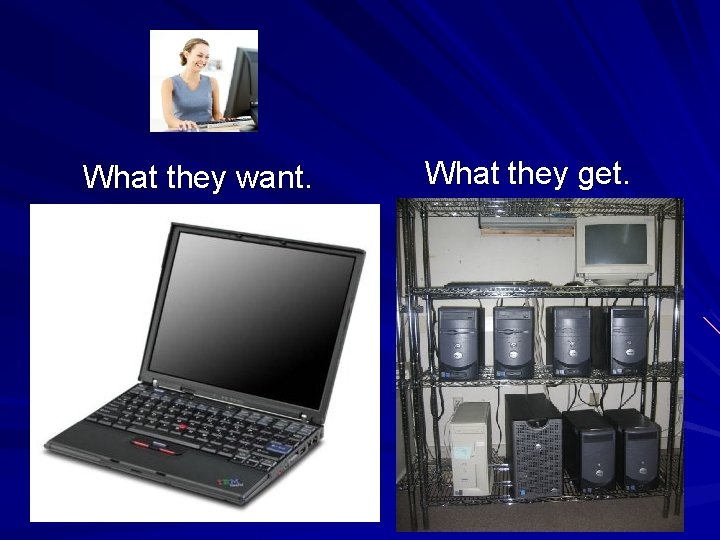
What they want. What they get. 18
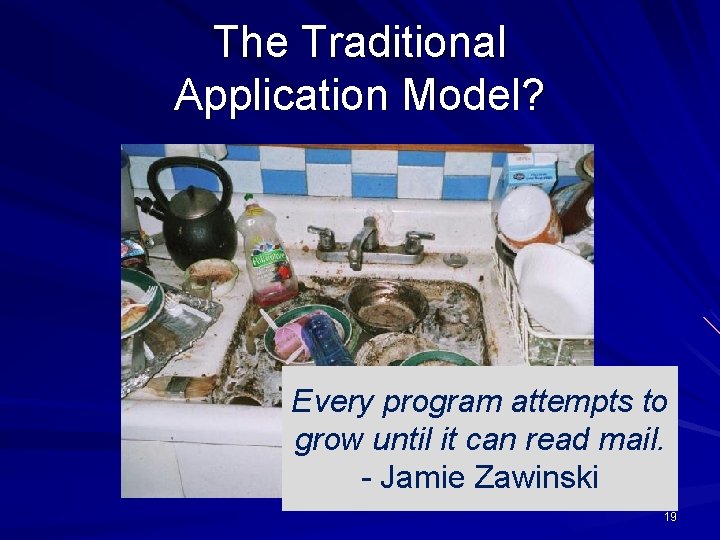
The Traditional Application Model? Every program attempts to grow until it can read mail. - Jamie Zawinski 19
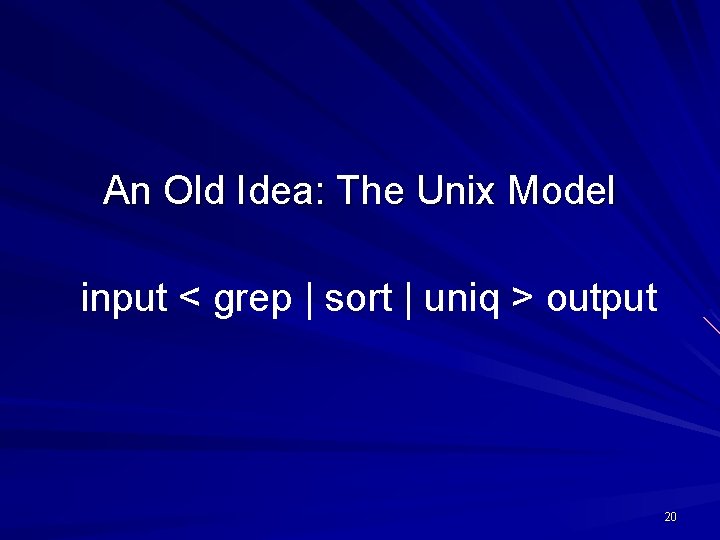
An Old Idea: The Unix Model input < grep | sort | uniq > output 20
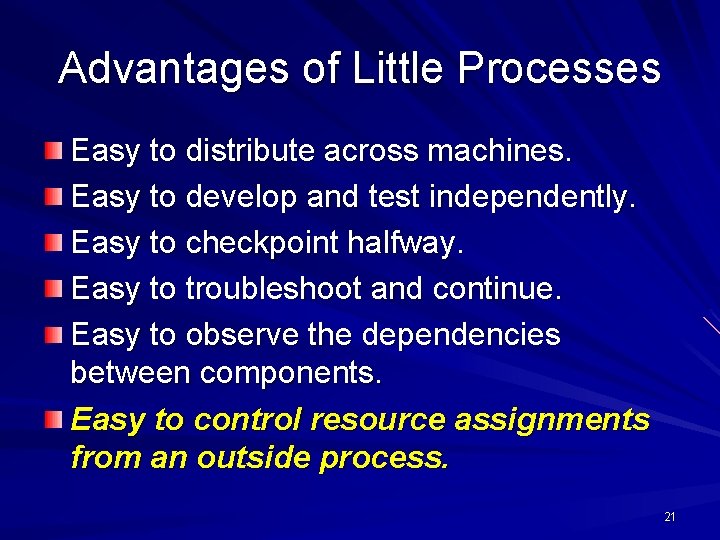
Advantages of Little Processes Easy to distribute across machines. Easy to develop and test independently. Easy to checkpoint halfway. Easy to troubleshoot and continue. Easy to observe the dependencies between components. Easy to control resource assignments from an outside process. 21
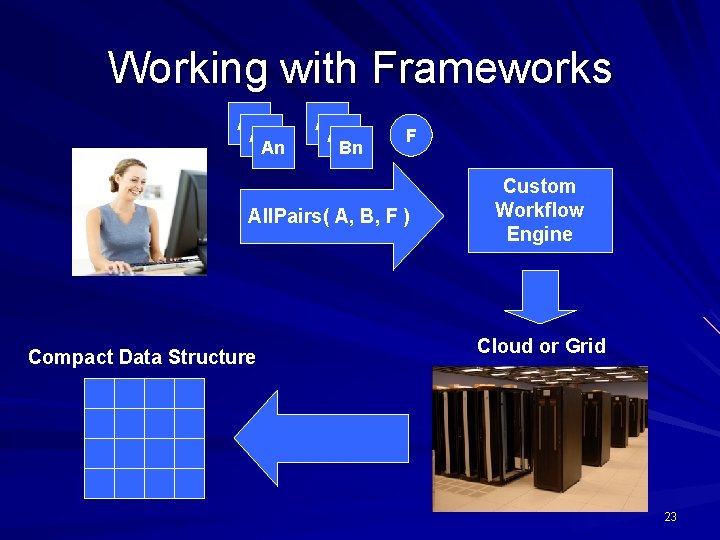
Our approach: Encourage users to decompose their applications into simple programs. Give them frameworks that can assemble them into programs of massive scale with high reliability. 22
Working with Frameworks A 1 A 2 An A 1 A 2 Bn F All. Pairs( A, B, F ) Compact Data Structure Custom Workflow Engine Cloud or Grid 23
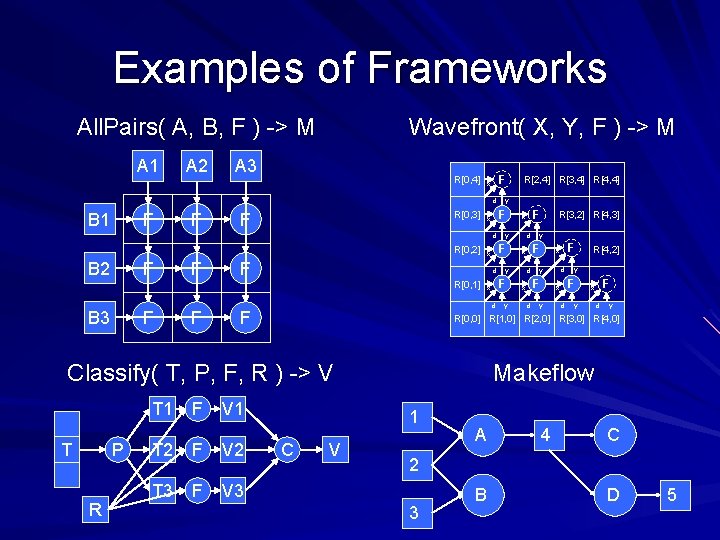
Examples of Frameworks All. Pairs( A, B, F ) -> M A 1 A 2 Wavefront( X, Y, F ) -> M A 3 R[0, 4] F x d B 1 F F R[0, 3] F d R[0, 2] B 2 F F B 3 F F F d F T P R F V 1 T 2 F V 2 T 3 F V 3 y R[3, 2] R[4, 3] y F x d d d y F x y y F x d R[4, 2] F x y d y R[0, 0] R[1, 0] R[2, 0] R[3, 0] R[4, 0] Classify( T, P, F, R ) -> V T 1 d y F x d R[0, 1] y F x R[2, 4] R[3, 4] R[4, 4] Makeflow 1 C V A 4 C 2 3 B D 5
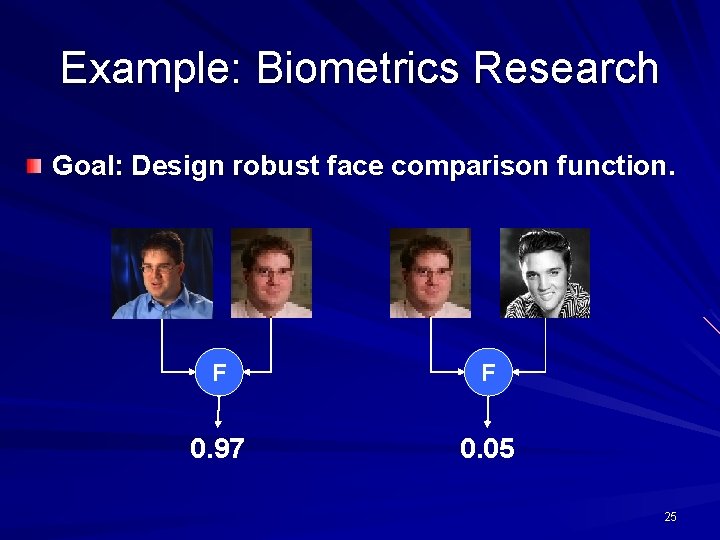
Example: Biometrics Research Goal: Design robust face comparison function. F F 0. 97 0. 05 25
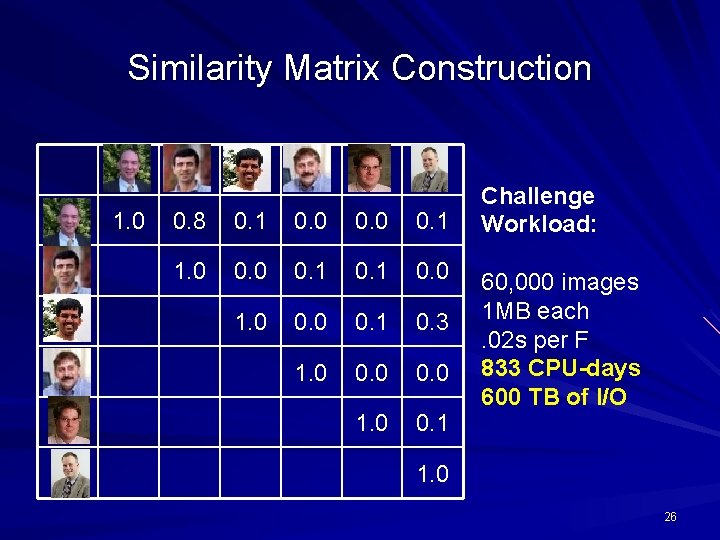
Similarity Matrix Construction 1. 0 0. 8 0. 1 0. 0 0. 1 1. 0 0. 1 0. 0 1. 0 0. 1 0. 3 1. 0 0. 0 1. 0 0. 1 Challenge Workload: 60, 000 images 1 MB each. 02 s per F 833 CPU-days 600 TB of I/O 1. 0 26
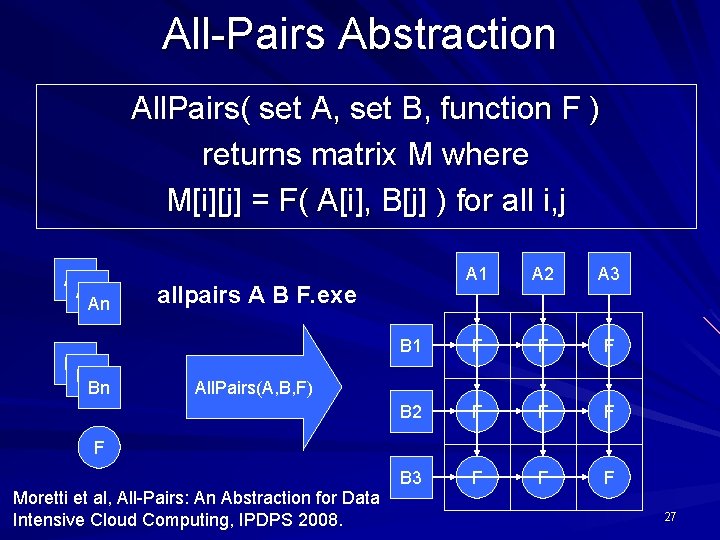
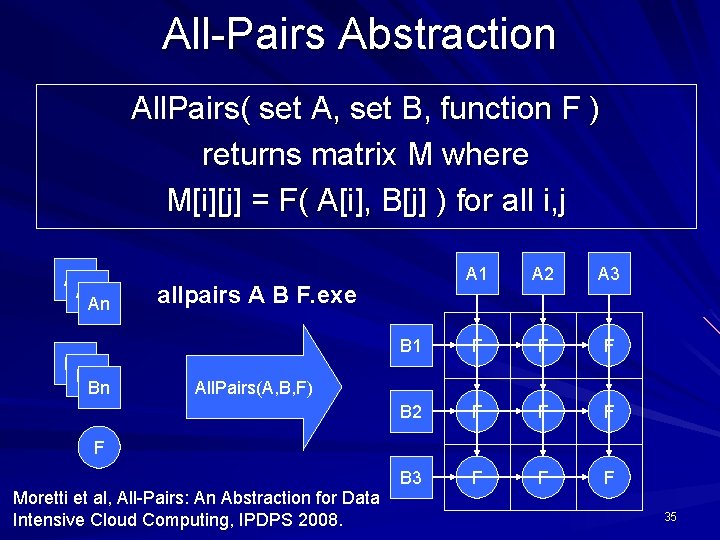
All-Pairs Abstraction All. Pairs( set A, set B, function F ) returns matrix M where M[i][j] = F( A[i], B[j] ) for all i, j A 1 An B 1 Bn A 1 A 2 A 3 B 1 F F F B 2 F F F B 3 F F F allpairs A B F. exe All. Pairs(A, B, F) F Moretti et al, All-Pairs: An Abstraction for Data Intensive Cloud Computing, IPDPS 2008. 27
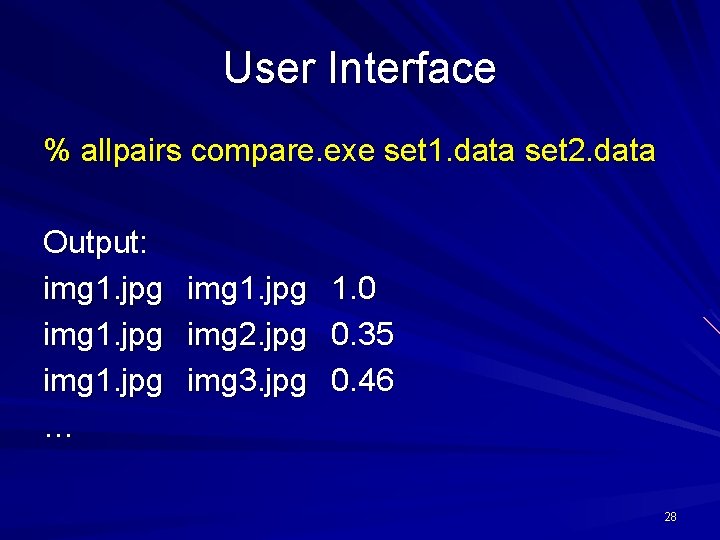
User Interface % allpairs compare. exe set 1. data set 2. data Output: img 1. jpg … img 1. jpg img 2. jpg img 3. jpg 1. 0 0. 35 0. 46 28
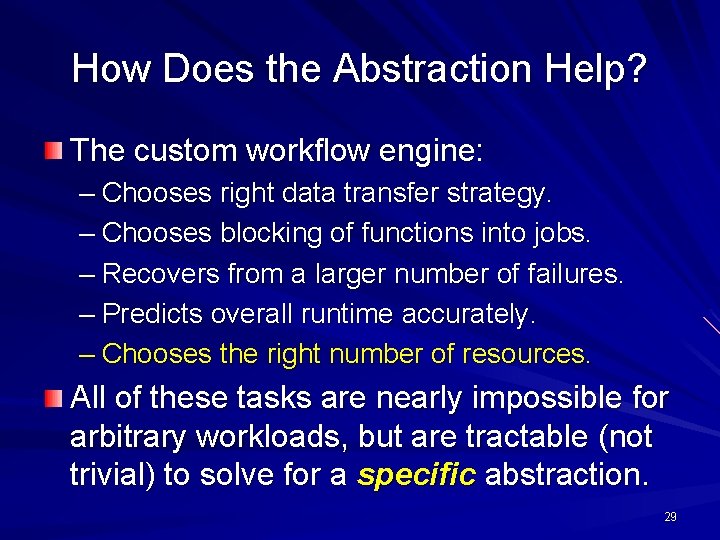
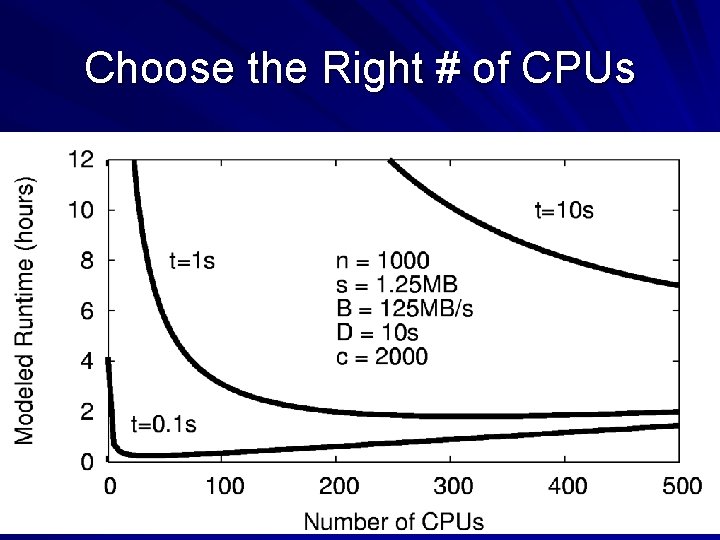
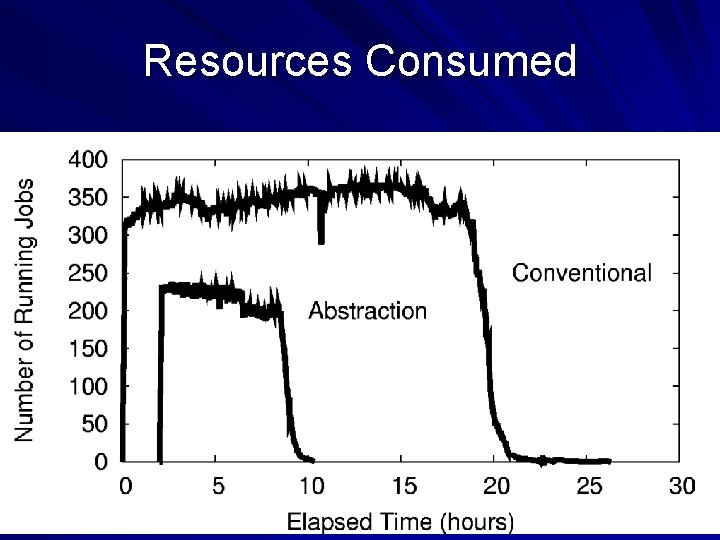
How Does the Abstraction Help? The custom workflow engine: – Chooses right data transfer strategy. – Chooses blocking of functions into jobs. – Recovers from a larger number of failures. – Predicts overall runtime accurately. – Chooses the right number of resources. All of these tasks are nearly impossible for arbitrary workloads, but are tractable (not trivial) to solve for a specific abstraction. 29
30
Choose the Right # of CPUs 31
Resources Consumed 32
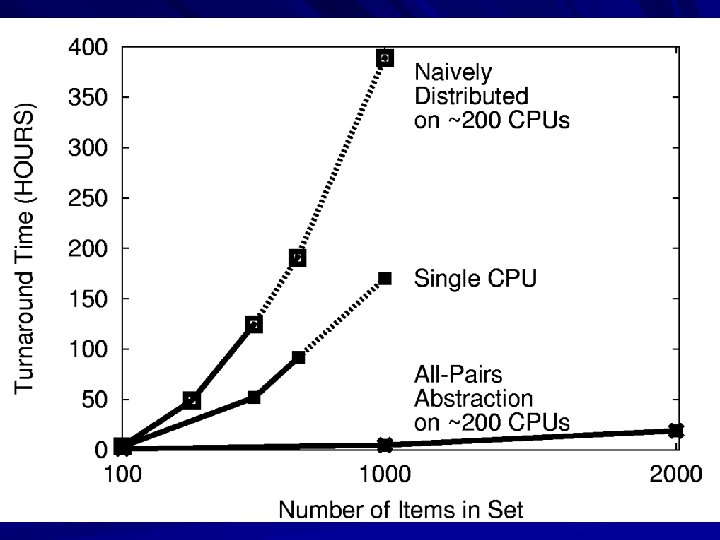
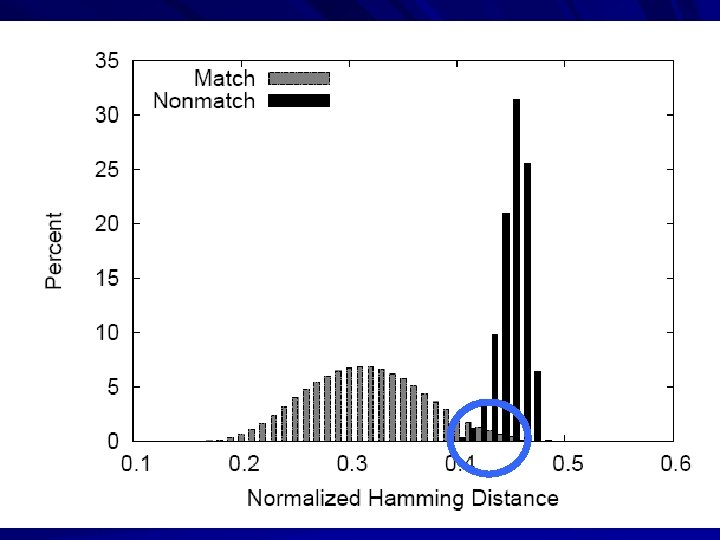
All-Pairs in Production Our All-Pairs implementation has provided over 57 CPU-years of computation to the ND biometrics research group in the first year. Largest run so far: 58, 396 irises from the Face Recognition Grand Challenge. The largest experiment ever run on publically available data. Competing biometric research relies on samples of 100 -1000 images, which can miss important population effects. Reduced computation time from 833 days to 10 days, making it feasible to repeat multiple times for 33 a graduate thesis. (We can go faster yet. )
34
All-Pairs Abstraction All. Pairs( set A, set B, function F ) returns matrix M where M[i][j] = F( A[i], B[j] ) for all i, j A 1 An B 1 Bn A 1 A 2 A 3 B 1 F F F B 2 F F F B 3 F F F allpairs A B F. exe All. Pairs(A, B, F) F Moretti et al, All-Pairs: An Abstraction for Data Intensive Cloud Computing, IPDPS 2008. 35
Are there other abstractions? 36
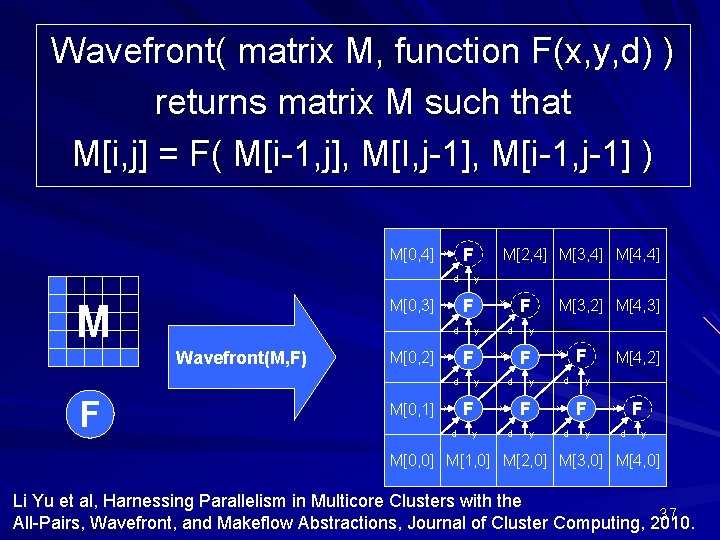
Wavefront( matrix M, function F(x, y, d) ) returns matrix M such that M[i, j] = F( M[i-1, j], M[I, j-1], M[i-1, j-1] ) M[0, 4] F x d M[0, 3] M y F x d Wavefront(M, F) M[0, 2] F x F d d y y d d y F x M[3, 2] M[4, 3] y F x F x y d M[0, 1] M[2, 4] M[3, 4] M[4, 4] y F x d M[4, 2] y F x d y M[0, 0] M[1, 0] M[2, 0] M[3, 0] M[4, 0] Li Yu et al, Harnessing Parallelism in Multicore Clusters with the 37 All-Pairs, Wavefront, and Makeflow Abstractions, Journal of Cluster Computing, 2010.
Applications of Wavefront Bioinformatics: – Compute the alignment of two large DNA strings in order to find similarities between species. Existing tools do not scale up to complete DNA strings. Economics: – Simulate the interaction between two competing firms, each of which has an effect on resource consumption and market price. E. g. When will we run out of oil? Applies to any kind of optimization problem solvable with dynamic programming. 38
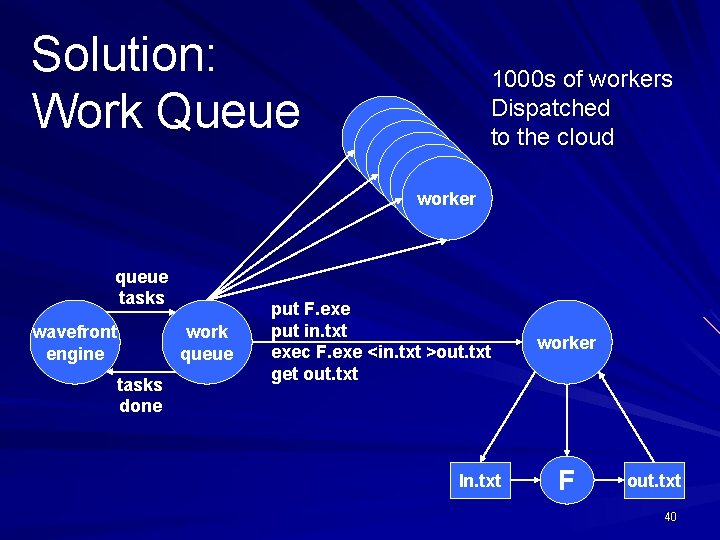
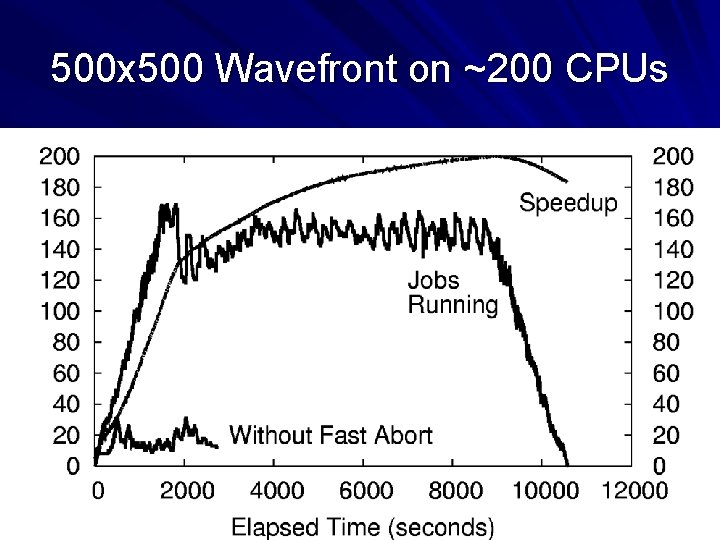
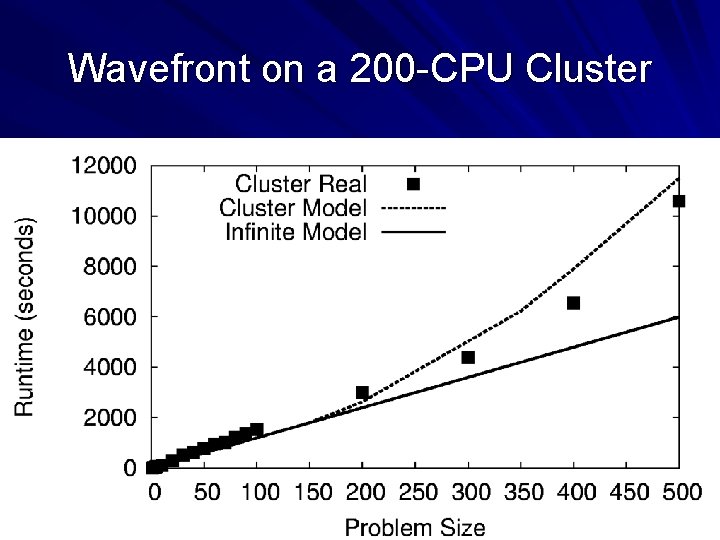
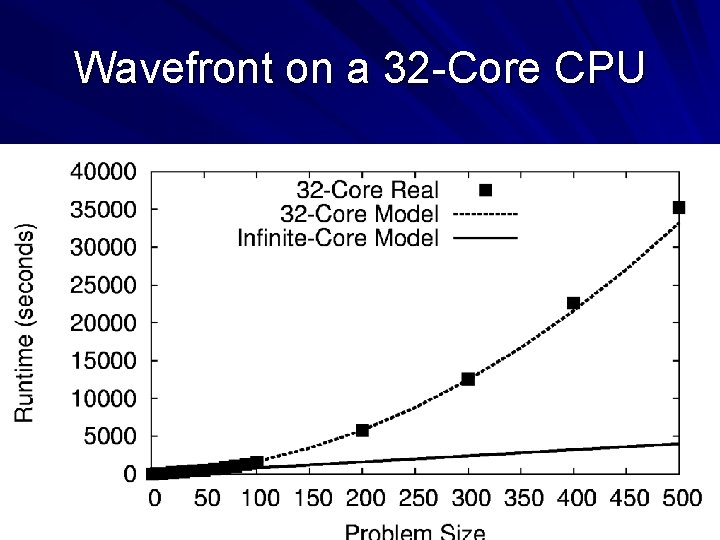
Problem: Dispatch Latency Even with an infinite number of CPUs, dispatch latency controls the total execution time: O(n) in the best case. However, job dispatch latency in an unloaded grid is about 30 seconds, which may outweigh the runtime of F. Things get worse when queues are long! Solution: Build a lightweight task dispatch system. (Idea from Falkon@UC) 39
Solution: Work Queue queue tasks wavefront engine tasks done work queue worker worker 1000 s of workers Dispatched to the cloud put F. exe put in. txt exec F. exe <in. txt >out. txt get out. txt In. txt worker F out. txt 40
500 x 500 Wavefront on ~200 CPUs
Wavefront on a 200 -CPU Cluster
Wavefront on a 32 -Core CPU
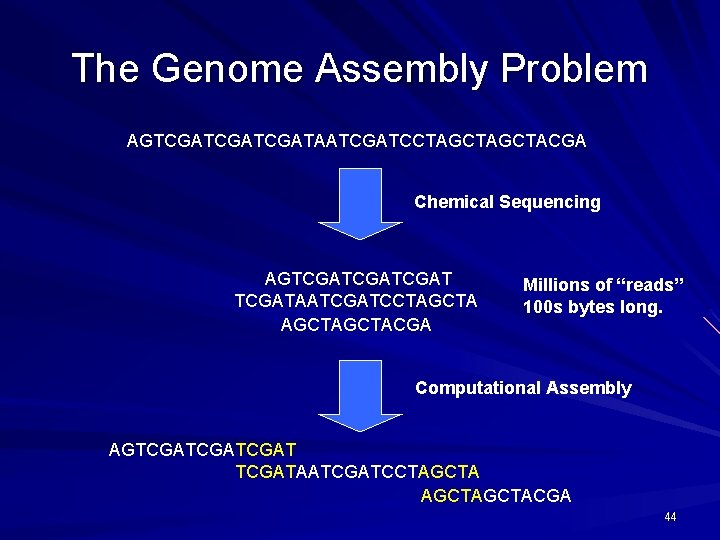
The Genome Assembly Problem AGTCGATCGATAATCGATCCTAGCTACGA Chemical Sequencing AGTCGATCGATAATCGATCCTAGCTACGA Millions of “reads” 100 s bytes long. Computational Assembly AGTCGATCGATAATCGATCCTAGCTACGA 44
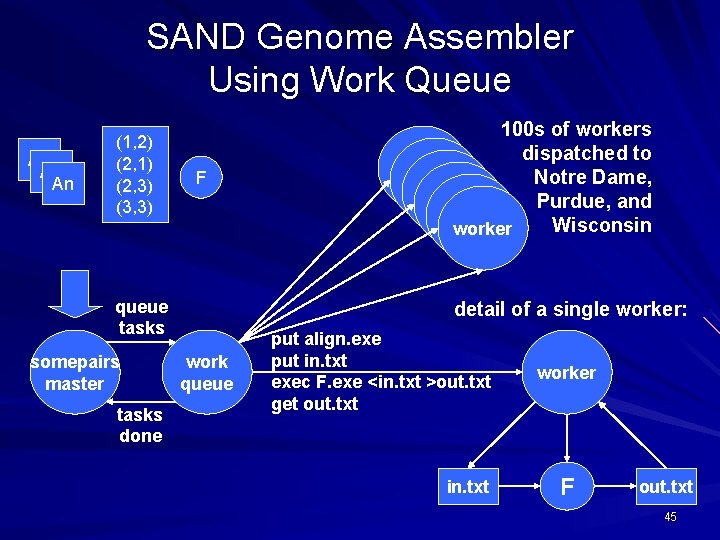
SAND Genome Assembler Using Work Queue A 1 An (1, 2) (2, 1) (2, 3) (3, 3) F queue tasks somepairs master tasks done 100 s of workers dispatched to worker Notre Dame, worker Purdue, and worker Wisconsin worker detail of a single worker: work queue put align. exe put in. txt exec F. exe <in. txt >out. txt get out. txt in. txt worker F out. txt 45
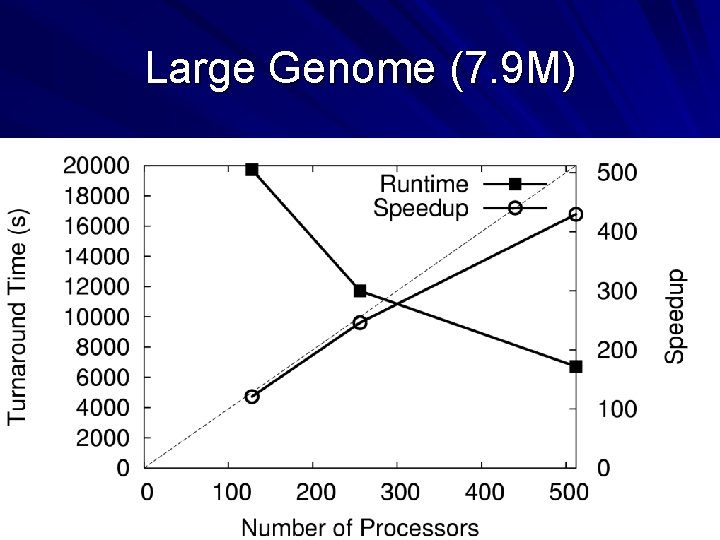
Large Genome (7. 9 M) 46
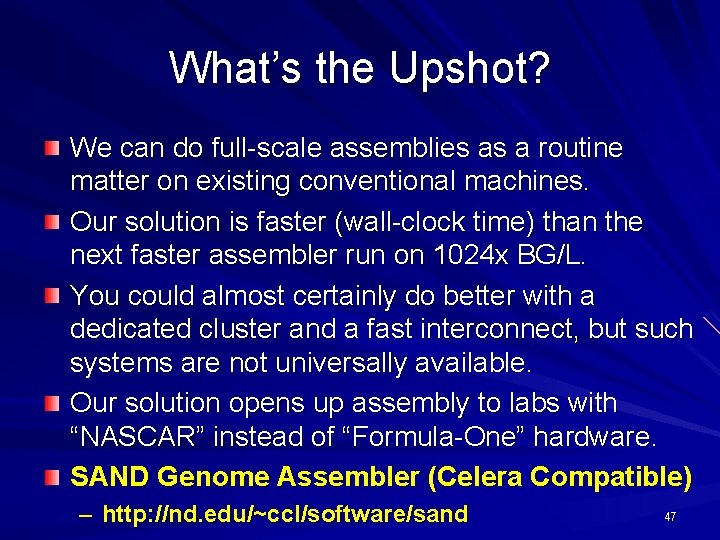
What’s the Upshot? We can do full-scale assemblies as a routine matter on existing conventional machines. Our solution is faster (wall-clock time) than the next faster assembler run on 1024 x BG/L. You could almost certainly do better with a dedicated cluster and a fast interconnect, but such systems are not universally available. Our solution opens up assembly to labs with “NASCAR” instead of “Formula-One” hardware. SAND Genome Assembler (Celera Compatible) – http: //nd. edu/~ccl/software/sand 47
What if your application doesn’t fit a regular pattern? 48
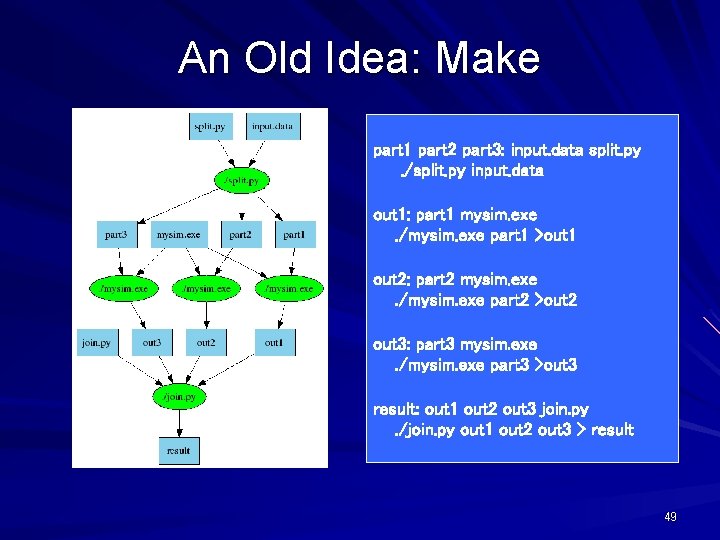
An Old Idea: Make part 1 part 2 part 3: input. data split. py. /split. py input. data out 1: part 1 mysim. exe. /mysim. exe part 1 >out 1 out 2: part 2 mysim. exe. /mysim. exe part 2 >out 2 out 3: part 3 mysim. exe. /mysim. exe part 3 >out 3 result: out 1 out 2 out 3 join. py. /join. py out 1 out 2 out 3 > result 49
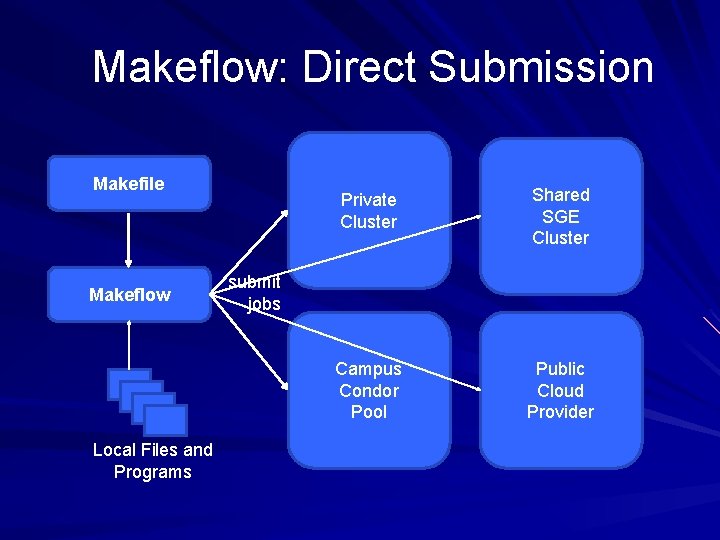
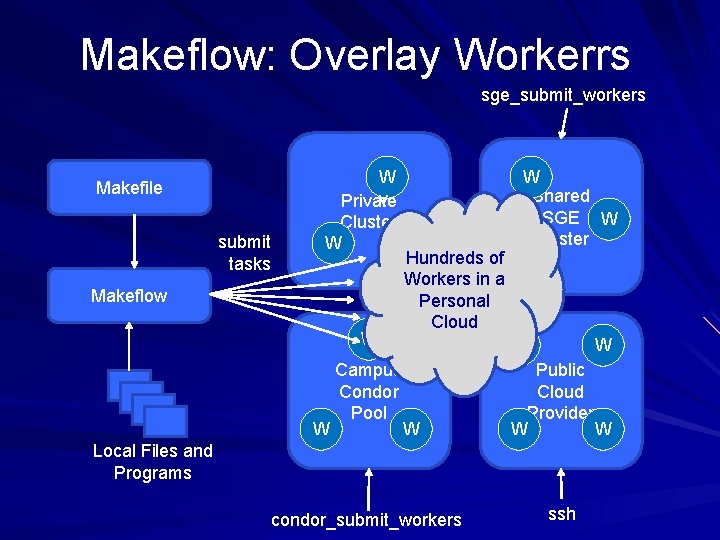
Makeflow: Direct Submission Makefile Makeflow Local Files and Programs Private Cluster Shared SGE Cluster Campus Condor Pool Public Cloud Provider submit jobs
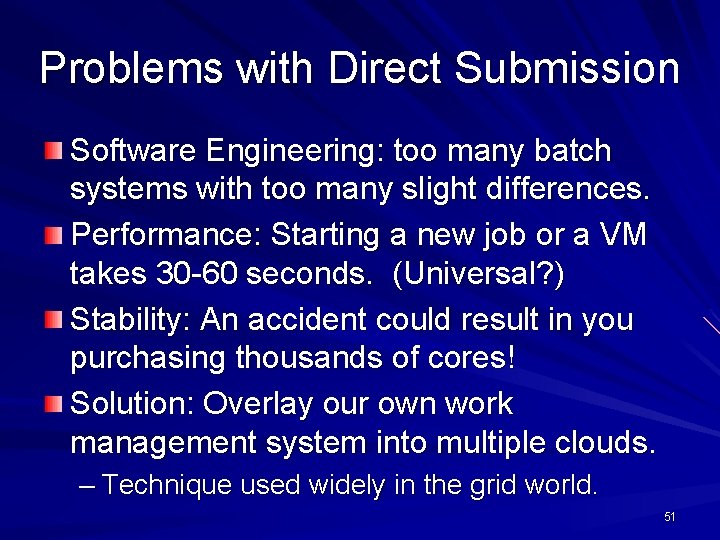
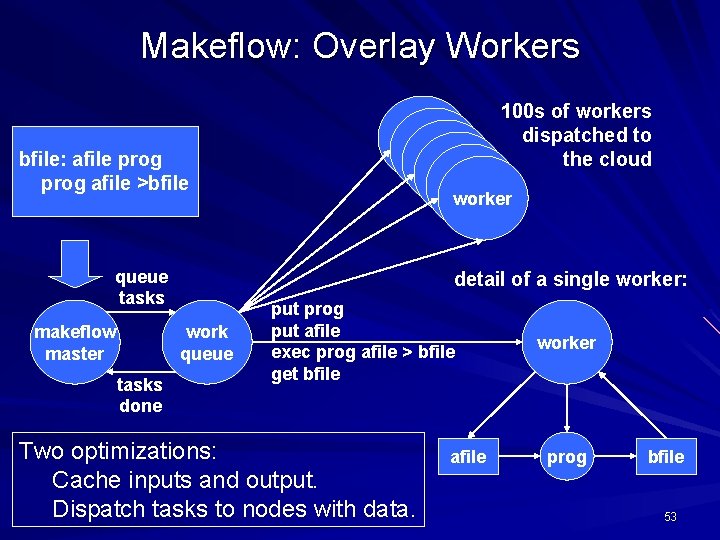
Problems with Direct Submission Software Engineering: too many batch systems with too many slight differences. Performance: Starting a new job or a VM takes 30 -60 seconds. (Universal? ) Stability: An accident could result in you purchasing thousands of cores! Solution: Overlay our own work management system into multiple clouds. – Technique used widely in the grid world. 51
Makeflow: Overlay Workerrs sge_submit_workers Makefile submit tasks Makeflow W W Shared v Private SGE W Cluster W W Hundreds of W Workers in a Personal Cloud W W W Campus Public Condor Cloud Pool Provider W W Local Files and Programs condor_submit_workers ssh
Makeflow: Overlay Workers bfile: afile prog afile >bfile queue tasks makeflow master worker worker detail of a single worker: work queue tasks done 100 s of workers dispatched to the cloud put prog put afile exec prog afile > bfile get bfile Two optimizations: Cache inputs and output. Dispatch tasks to nodes with data. afile worker prog bfile 53
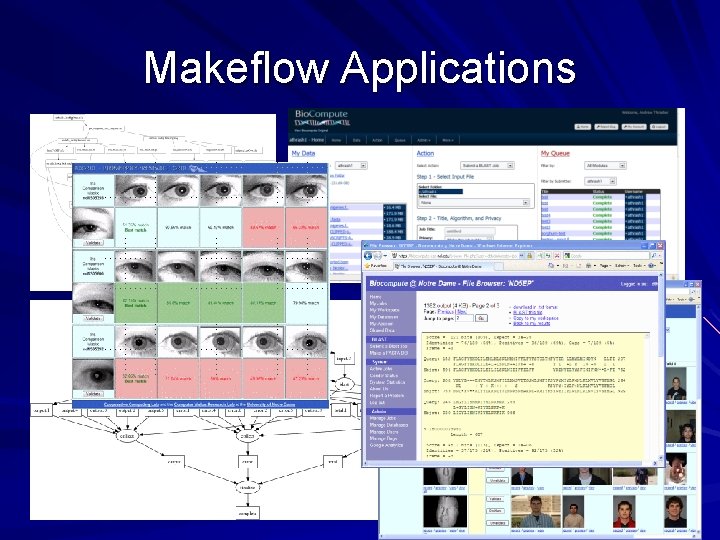
Makeflow Applications
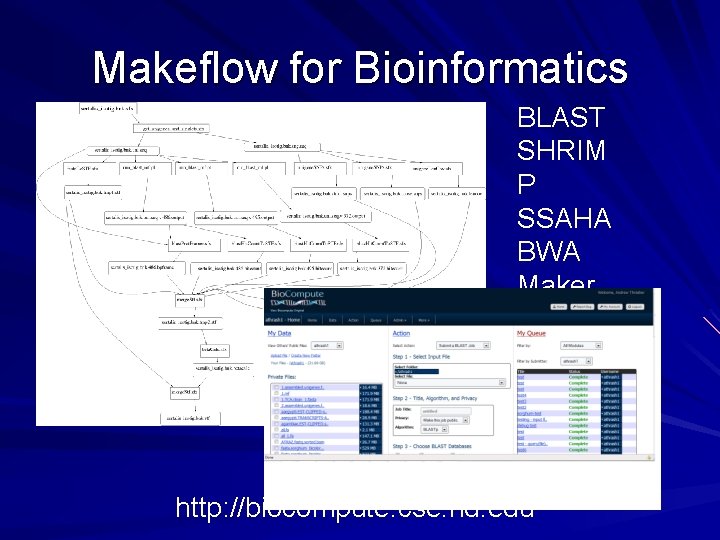
Makeflow for Bioinformatics BLAST SHRIM P SSAHA BWA Maker. . http: //biocompute. cse. nd. edu
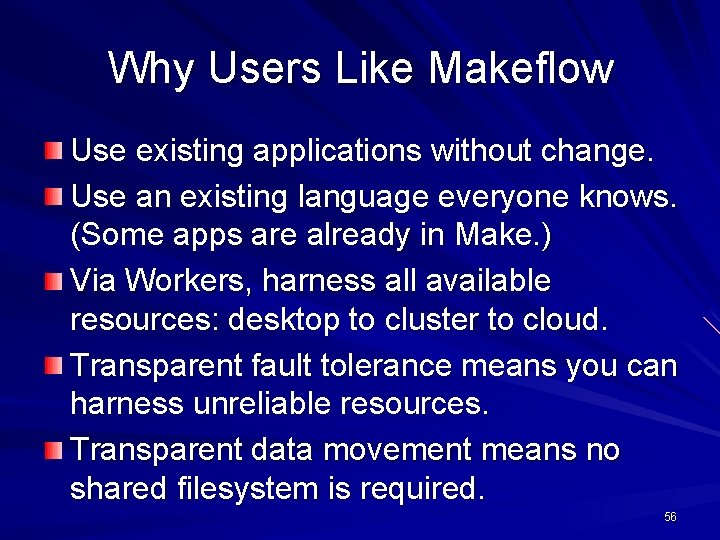
Why Users Like Makeflow Use existing applications without change. Use an existing language everyone knows. (Some apps are already in Make. ) Via Workers, harness all available resources: desktop to cluster to cloud. Transparent fault tolerance means you can harness unreliable resources. Transparent data movement means no shared filesystem is required. 56
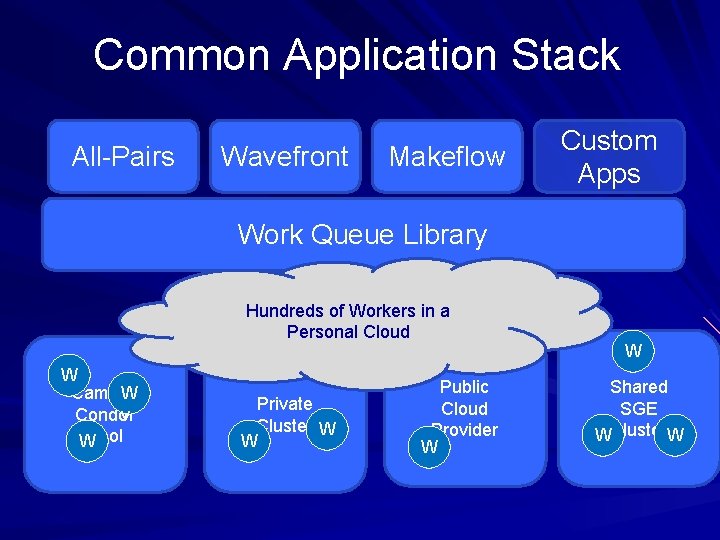
Common Application Stack All-Pairs Wavefront Makeflow Custom Apps Work Queue Library Hundreds of Workers in a Personal Cloud W Campus W Condor v Pool W Private Cluster W W Public Cloud Provider W W Shared SGE WCluster. W
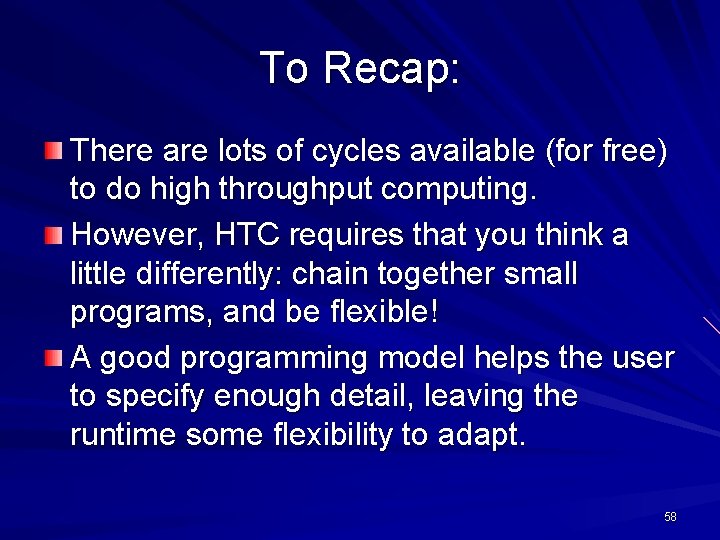
To Recap: There are lots of cycles available (for free) to do high throughput computing. However, HTC requires that you think a little differently: chain together small programs, and be flexible! A good programming model helps the user to specify enough detail, leaving the runtime some flexibility to adapt. 58
A Team Effort Faculty: – – – Patrick Flynn Scott Emrich Jesus Izaguirre Nitesh Chawla Kenneth Judd Grad Students – – – Hoang Bui Li Yu Peter Bui Michael Albrecht Peter Sempolinski Dinesh Rajan Undergrads – – – Rachel Witty Thomas Potthast Brenden Kokosza Zach Musgrave Anthony Canino NSF Grants CCF-0621434, CNS-0643229, and CNS 08 -554087. 59
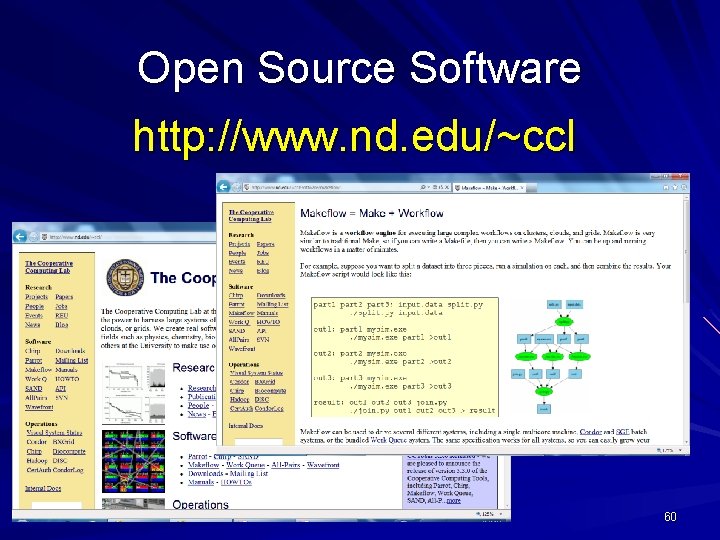
Open Source Software http: //www. nd. edu/~ccl 60
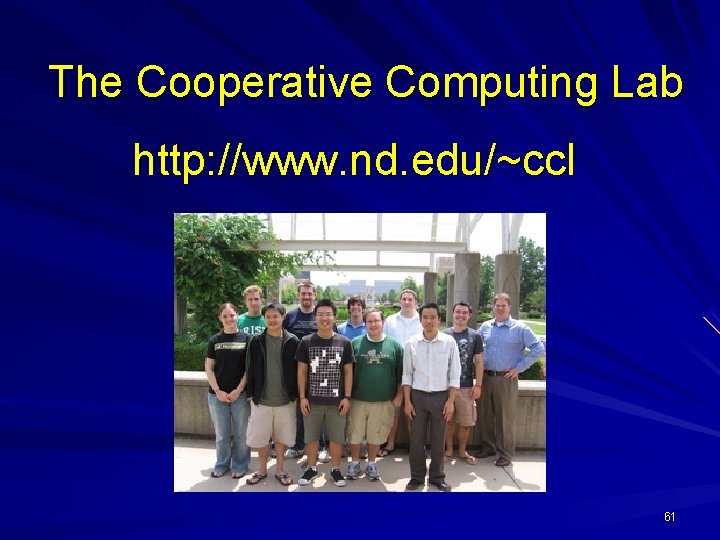
The Cooperative Computing Lab http: //www. nd. edu/~ccl 61