
High Throughput Computing Collaboration A CERN openlab Intel

High Throughput Computing Collaboration A CERN openlab / Intel collaboration Niko Neufeld, CERN/PH-Department niko. neufeld@cern. ch
HTCC in a nutshell Apply upcoming Intel technologies in an Online / Trigger & DAQ context Application domains: L 1 -trigger, data acquisition and event-building, acceleratorassisted processing for high-level trigger Intel/CERN High Throughput Computing Collaboration openlab Open Day June 2015 - Niko Neufeld CERN 2
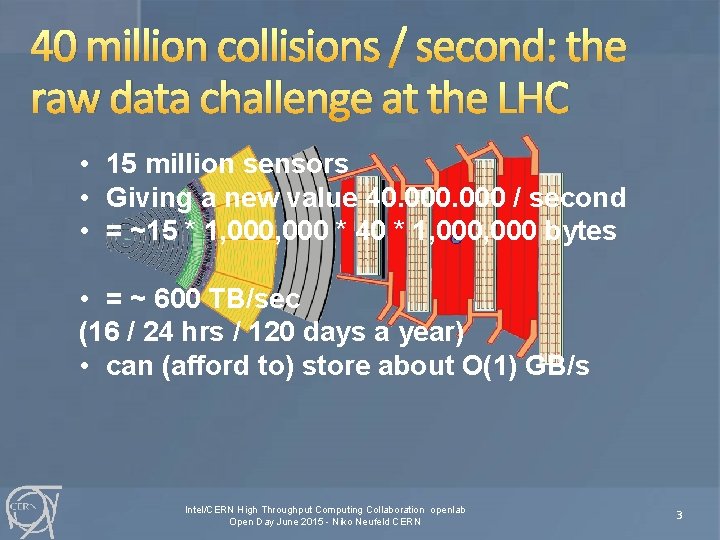
40 million collisions / second: the raw data challenge at the LHC • 15 million sensors • Giving a new value 40. 000 / second • = ~15 * 1, 000 * 40 * 1, 000 bytes • = ~ 600 TB/sec (16 / 24 hrs / 120 days a year) • can (afford to) store about O(1) GB/s Intel/CERN High Throughput Computing Collaboration openlab Open Day June 2015 - Niko Neufeld CERN 3
Defeating the odds 1. Thresholding and tight encoding 2. Real-time selection based on partial information 3. Final selection using full information of the collisions Selection systems are called “Triggers” in high energy physics Intel/CERN High Throughput Computing Collaboration openlab Open Day June 2015 - Niko Neufeld CERN 4

Challenge #1 First Level Triggering
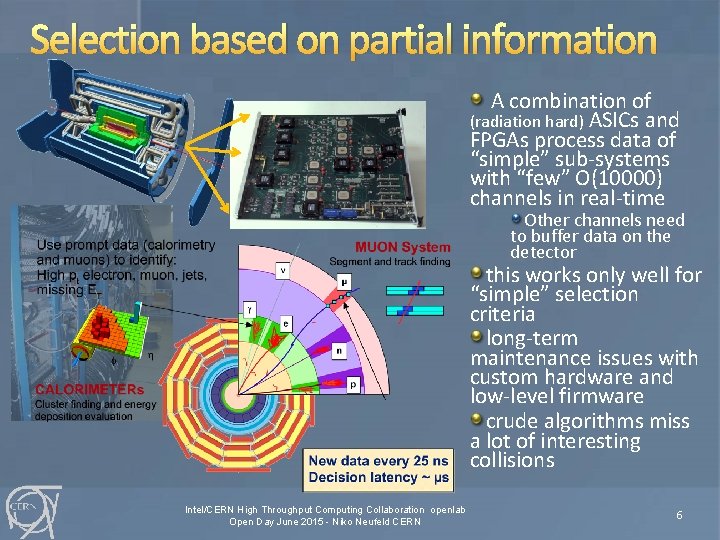
Selection based on partial information A combination of (radiation hard) ASICs and FPGAs process data of “simple” sub-systems with “few” O(10000) channels in real-time Other channels need to buffer data on the detector this works only well for “simple” selection criteria long-term maintenance issues with custom hardware and low-level firmware crude algorithms miss a lot of interesting collisions Intel/CERN High Throughput Computing Collaboration openlab Open Day June 2015 - Niko Neufeld CERN 6
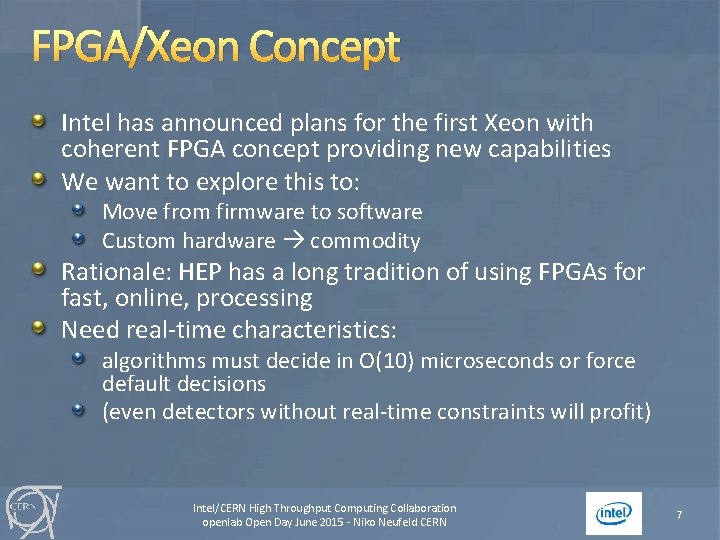
FPGA/Xeon Concept Intel has announced plans for the first Xeon with coherent FPGA concept providing new capabilities We want to explore this to: Move from firmware to software Custom hardware commodity Rationale: HEP has a long tradition of using FPGAs for fast, online, processing Need real-time characteristics: algorithms must decide in O(10) microseconds or force default decisions (even detectors without real-time constraints will profit) Intel/CERN High Throughput Computing Collaboration openlab Open Day June 2015 - Niko Neufeld CERN 7
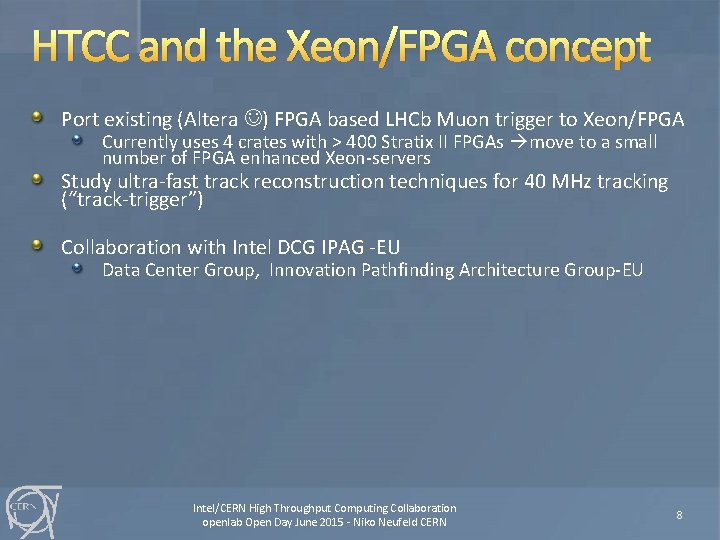
HTCC and the Xeon/FPGA concept Port existing (Altera ) FPGA based LHCb Muon trigger to Xeon/FPGA Currently uses 4 crates with > 400 Stratix II FPGAs move to a small number of FPGA enhanced Xeon-servers Study ultra-fast track reconstruction techniques for 40 MHz tracking (“track-trigger”) Collaboration with Intel DCG IPAG -EU Data Center Group, Innovation Pathfinding Architecture Group-EU Intel/CERN High Throughput Computing Collaboration openlab Open Day June 2015 - Niko Neufeld CERN 8
Challenge #2 Data Acquisition
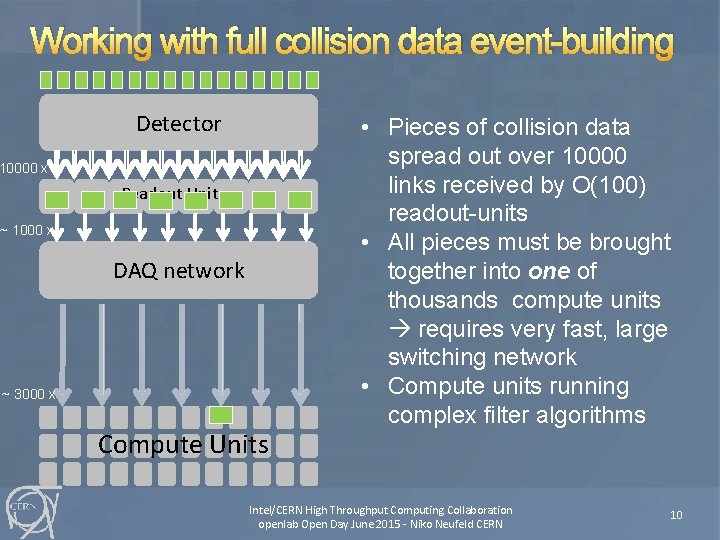
Working with full collision data event-building Detector 10000 x Readout Units ~ 1000 x DAQ network ~ 3000 x Compute Units • Pieces of collision data spread out over 10000 links received by O(100) readout-units • All pieces must be brought together into one of thousands compute units requires very fast, large switching network • Compute units running complex filter algorithms Intel/CERN High Throughput Computing Collaboration openlab Open Day June 2015 - Niko Neufeld CERN 10
![Future LHC DAQs in numbers Data-size / collision [k. B] Rate of collisions requiring](http://slidetodoc.com/presentation_image/d4a7798c81448ef8678c9ffd7b1aa1c8/image-11.jpg "Future LHC DAQs in numbers Data-size / collision [k. B] Rate of collisions requiring")
Future LHC DAQs in numbers Data-size / collision [k. B] Rate of collisions requiring full Required # of processing 100 Gbit/s Aggregated [k. Hz] links bandwidth From ALICE ATLAS 20000 4000 50 500 120 300 10 Tbit/s 2019 2022 CMS LHCb 4000 1000 40000 500 40 Tbit/s 2022 2019 Intel/CERN High Throughput Computing Collaboration openlab Open Day June 2015 - Niko Neufeld CERN 11
HTCC and data acquisition Explore Intel’s new Omni. Path interconnect to build the next generation data acquisition systems Build small demonstrator DAQ Use CPU-fabric integration to minimise transport overheads Use Omni. Path to integrate Xeon, Xeon/Phi and Xeon/FPGA concept in optimal proportions as compute units Work out flexible concept Study smooth integration with Ethernet (“the right link for the right task”) Intel/CERN High Throughput Computing Collaboration openlab Open Day June 2015 - Niko Neufeld CERN 12

Challenge #3 High Level Trigger
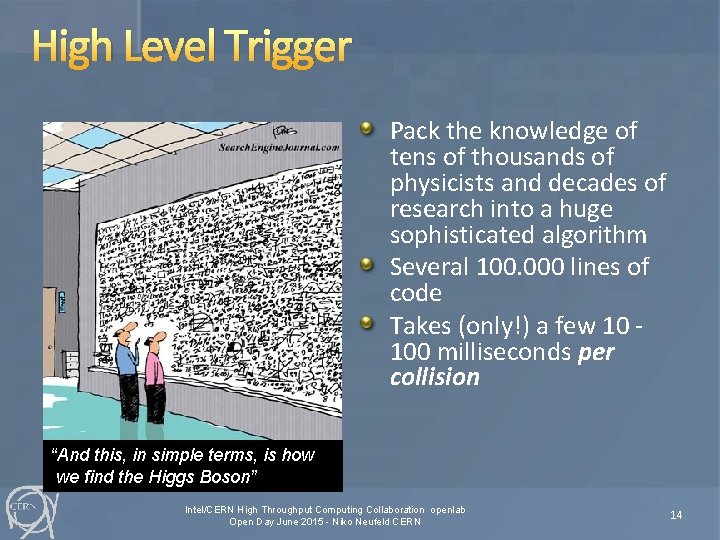
High Level Trigger Pack the knowledge of tens of thousands of physicists and decades of research into a huge sophisticated algorithm Several 100. 000 lines of code Takes (only!) a few 10 100 milliseconds per collision “And this, in simple terms, is how we find the Higgs Boson” Intel/CERN High Throughput Computing Collaboration openlab Open Day June 2015 - Niko Neufeld CERN 14
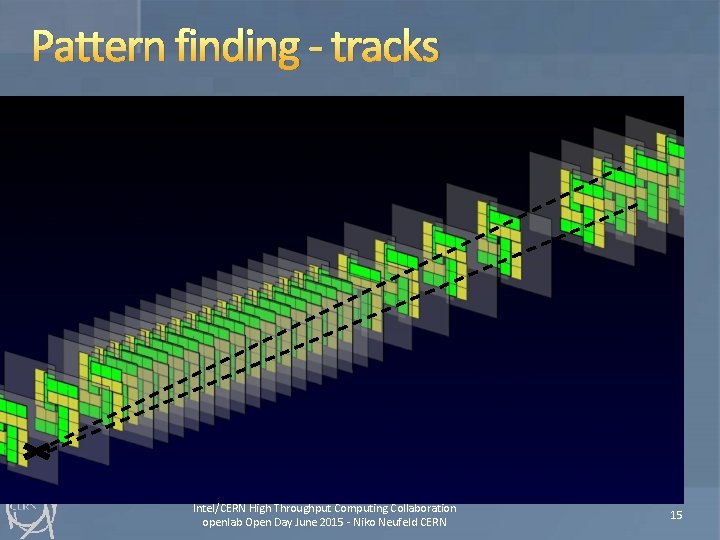
Pattern finding - tracks Intel/CERN High Throughput Computing Collaboration openlab Open Day June 2015 - Niko Neufeld CERN 15
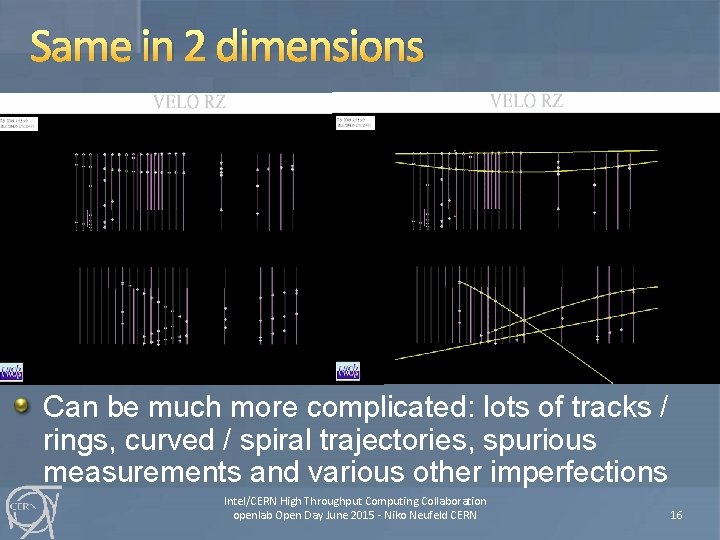
Same in 2 dimensions Can be much more complicated: lots of tracks / rings, curved / spiral trajectories, spurious measurements and various other imperfections Intel/CERN High Throughput Computing Collaboration openlab Open Day June 2015 - Niko Neufeld CERN 16
HTCC and the High Level Trigger Complex algorithms Hot spots difficult to identify cannot be accelerated by optimising 2 -3 kernels alone Classical algorithms very “sequential”, parallel versions need to be developed and their correctness (same physics!) needs to be demonstrated Lot of throughput necessary high memory bandwidth, strong I/O There is a lot of potential for parallelism, but the SIMT-kind (GPGPU-like) is challenging for many of our problems HTCC will use next generation Xeon/Phi (KNL) and port critical online applications as demonstrators: LHCb track reconstruction (“Hough Transformation & Kalman Filtering”) Particle identification using RICH detectors Intel/CERN High Throughput Computing Collaboration openlab Open Day June 2015 - Niko Neufeld CERN 17
Summary The LHC experiments need to reduce 100 TB/s to ~ 25 PB/ year Today this is achieved with massive use of custom ASICs and in-house built FPGA-boards and x 86 computing power Finding new physics requires massive increase of processing power, much more flexible algorithms in software and much faster interconnects The CERN/Intel HTC Collaboration will explore Intel’s Xeon/FPGA concept, Xeon/Phi and Omni. Path technologies for building future LHC TDAQ systems Intel/CERN High Throughput Computing Collaboration openlab Open Day June 2015 - Niko Neufeld CERN 18
- Slides: 18