
High Temperature Irradiation of 3 D CC Composite
- Slides: 12
High Temperature Irradiation of 3 -D C/C Composite in Support of Laser IFE Lance L Snead Timothy D Burchell Oak Ridge National Laboratory
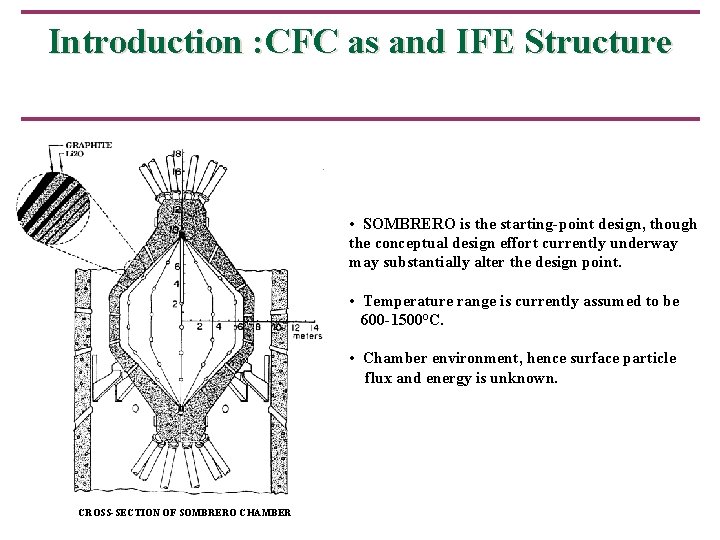
Introduction : CFC as and IFE Structure • SOMBRERO is the starting-point design, though the conceptual design effort currently underway may substantially alter the design point. • Temperature range is currently assumed to be 600 -1500°C. • Chamber environment, hence surface particle flux and energy is unknown. CROSS-SECTION OF SOMBRERO CHAMBER
Sombrero : Useful lifetime assumed based on existing graphite literature
Irradiation Induced Dimensional Change in Advanced CFC’s • Interstitials created during irradiation form new graphitic basal planes leading to highly anisotropic dimensional changes. • Engineering composites can “balance” and minimize such dimensional changes • There are no very high temperature data on 3 dimensional CFC’s. 1000°C, 10 dpa Oku Data NRL IFE 2/2001
Radiation stability of graphite fibers in composites Unidirectional Fiber Composite • Graphite fiber composites first gain strength (< few dpa) then rapidly lose strength as c-axis expansion causes widespread microcracking • Fiber can be expected to shrink axially and swell radially putting interface under tension. • Unidirectional composite will undergo large anisotropic swelling, eventually causing composite disintegration.
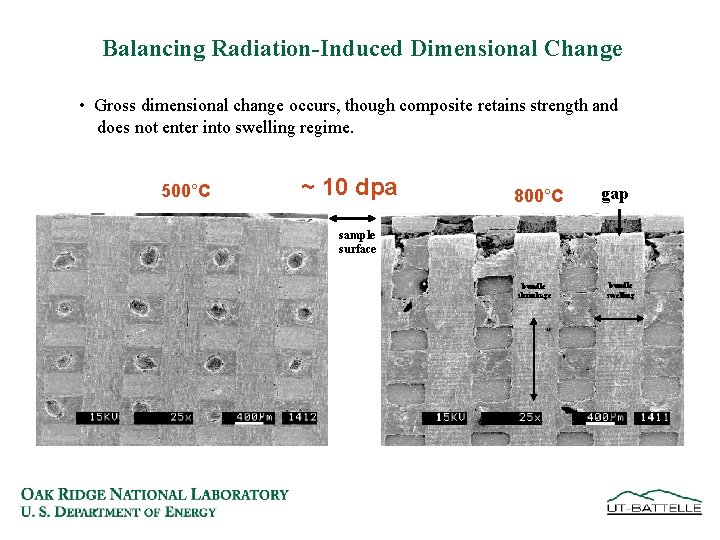
Materials and Irradiation 500 and 800°C, HFIR irradiation to ~ 10 dpa
Flexure Curves Poco AXF-5 Q Graphite 3 -D FMI-222 Comppsite
Results
Fiber Bundle Length Shrinkage
Fiber Bundle Diameter Swelling
Balancing Radiation-Induced Dimensional Change • Gross dimensional change occurs, though composite retains strength and does not enter into swelling regime. 500°C ~ 10 dpa 800°C gap sample surface bundle shrinkage bundle swelling
Conclusion This study has shown that, for a very high quality, balanced weave carbon fiber composite FMI-222, irradiation-induced increase in fracture strength is retained in the anisotropic swelling regime generally associated with severe loss in strength. This has been demonstrated by comparison of the standard isotropic graphite Poco AXF-5 Q and the balanced weave pitch-based fiber composite FMI-222. At the highest dose and temperature, 7. 7 x 1025 n/m 2 and 800°C, the graphite material was seen to undergo swelling with an associated 13% decrease in strength, while the composite material exhibited a 37% higher strength. Even though the material had entered into the “swelling regime” the 3 -D architecture compensated for these changes, extending its useful lifetime.