
High statistics testing of radiation hardness and reliability
High statistics testing of radiation hardness and reliability of lasers and photodiodes for CMS optical links Karl Gill CERN, Geneva karl. gill@cern. ch
Overview • • • Optical links in CMS Environment Advance validation test (AVT) Results, lasers then photodiodes: – Radiation damage – Annealing – Ageing Summary and Conclusions karl. gill@cern. ch LECC 2004
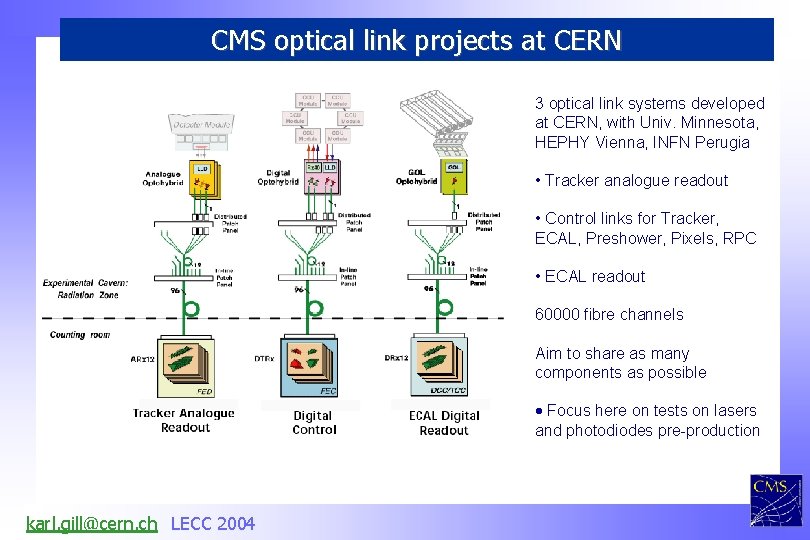
CMS optical link projects at CERN 3 optical link systems developed at CERN, with Univ. Minnesota, HEPHY Vienna, INFN Perugia • Tracker analogue readout • Control links for Tracker, ECAL, Preshower, Pixels, RPC • ECAL readout 60000 fibre channels Aim to share as many components as possible Focus here on tests on lasers and photodiodes pre-production karl. gill@cern. ch LECC 2004
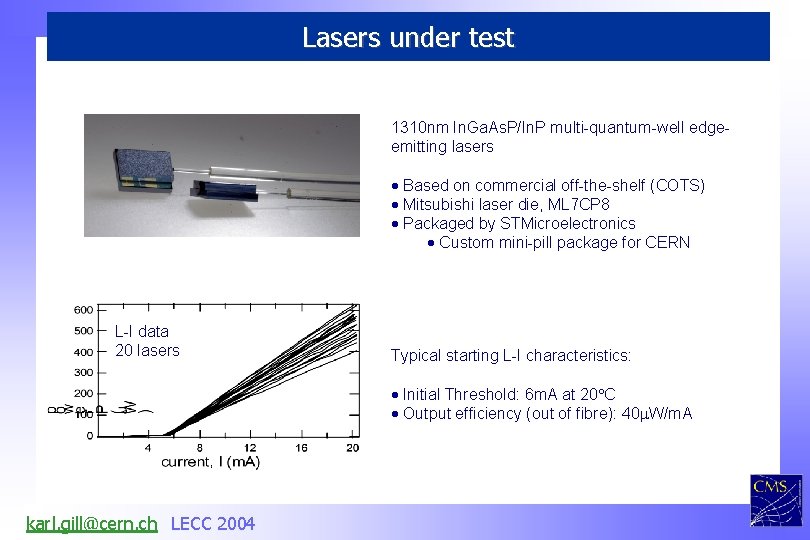
Lasers under test 1310 nm In. Ga. As. P/In. P multi-quantum-well edgeemitting lasers Based on commercial off-the-shelf (COTS) Mitsubishi laser die, ML 7 CP 8 Packaged by STMicroelectronics Custom mini-pill package for CERN L-I data 20 lasers Typical starting L-I characteristics: Initial Threshold: 6 m. A at 20 C Output efficiency (out of fibre): 40 W/m. A karl. gill@cern. ch LECC 2004
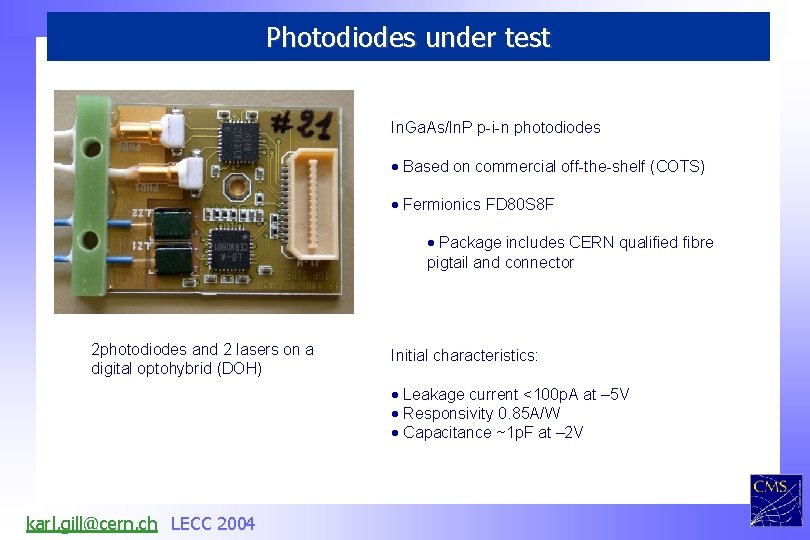
Photodiodes under test In. Ga. As/In. P p-i-n photodiodes Based on commercial off-the-shelf (COTS) Fermionics FD 80 S 8 F Package includes CERN qualified fibre pigtail and connector 2 photodiodes and 2 lasers on a digital optohybrid (DOH) Initial characteristics: Leakage current <100 p. A at – 5 V Responsivity 0. 85 A/W Capacitance ~1 p. F at – 2 V karl. gill@cern. ch LECC 2004
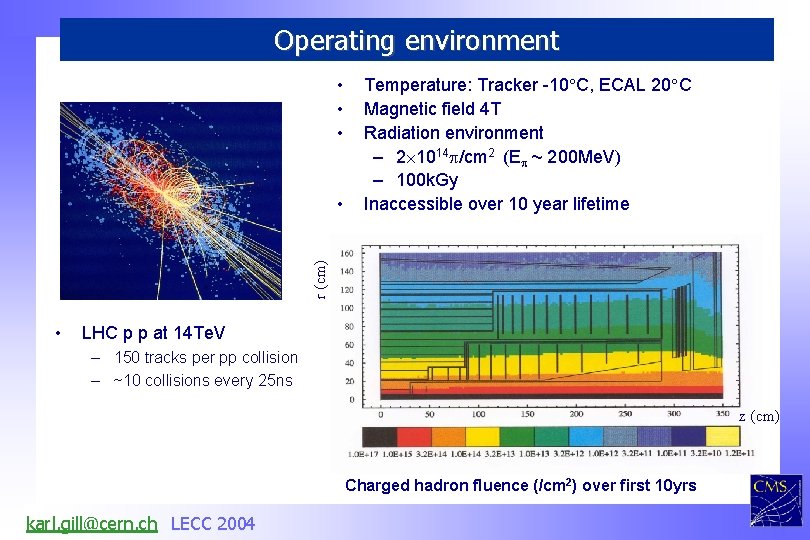
Operating environment • • • r (cm) • Temperature: Tracker -10 C, ECAL 20 C Magnetic field 4 T Radiation environment – 2 1014 /cm 2 (E ~ 200 Me. V) – 100 k. Gy Inaccessible over 10 year lifetime • LHC p p at 14 Te. V – 150 tracks per pp collision – ~10 collisions every 25 ns z (cm) Charged hadron fluence (/cm 2) over first 10 yrs karl. gill@cern. ch LECC 2004
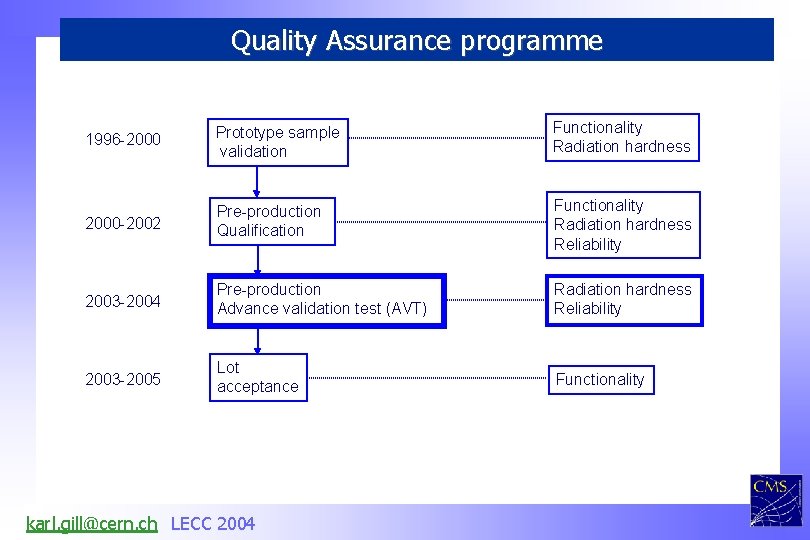
Quality Assurance programme 1996 -2000 AVT is essential Prototype sample validation for COTS parts Functionality Radiation hardness 2000 -2002 Pre-production Qualification Functionality Radiation hardness Reliability 2003 -2004 Pre-production Advance validation test (AVT) Radiation hardness Reliability 2003 -2005 Lot acceptance Functionality karl. gill@cern. ch LECC 2004
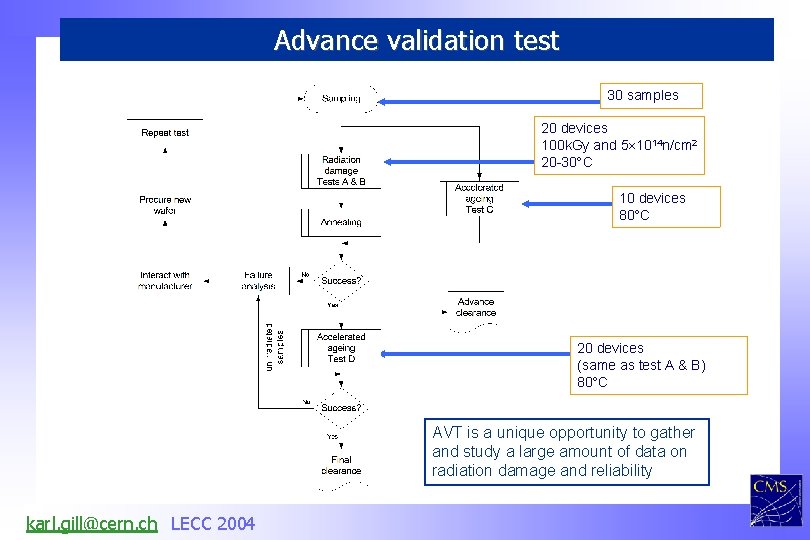
Advance validation test 30 samples 20 devices 100 k. Gy and 5 1014 n/cm 2 20 -30 C 10 devices 80 C 20 devices (same as test A & B) 80 C AVT is a unique opportunity to gather and study a large amount of data on radiation damage and reliability karl. gill@cern. ch LECC 2004
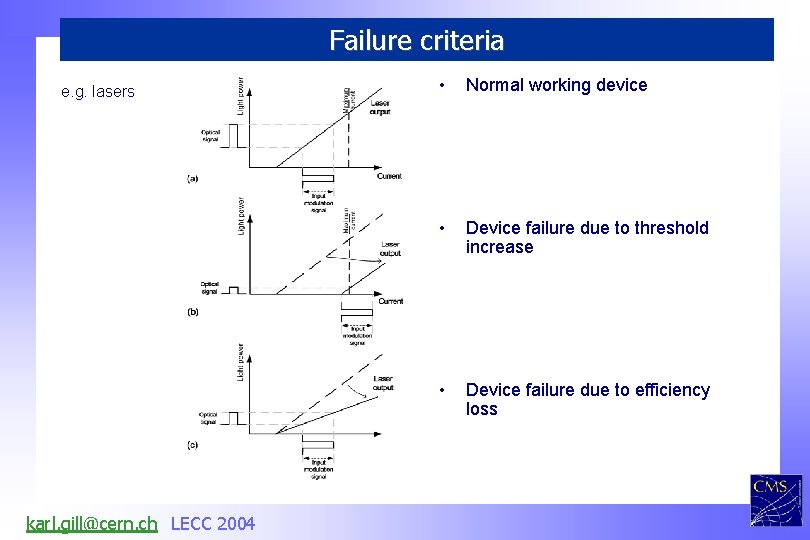
Failure criteria e. g. lasers karl. gill@cern. ch LECC 2004 • Normal working device • Device failure due to threshold increase • Device failure due to efficiency loss
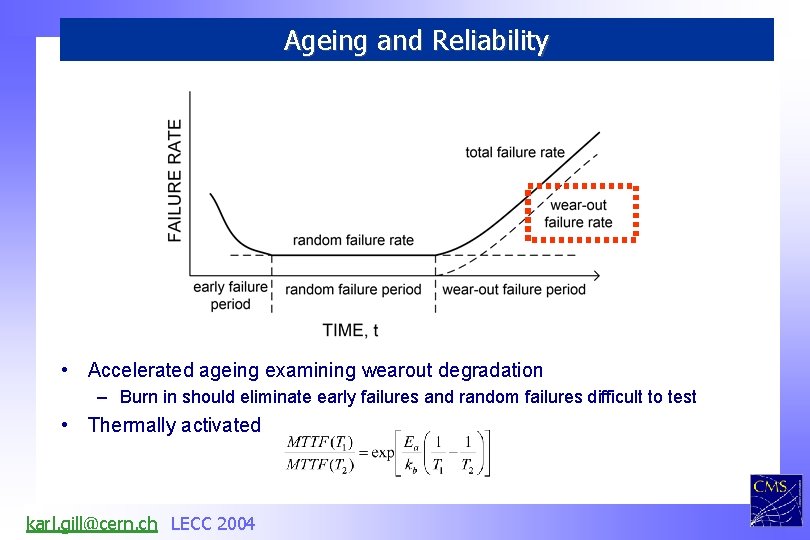
Ageing and Reliability • Accelerated ageing examining wearout degradation – Burn in should eliminate early failures and random failures difficult to test • Thermally activated karl. gill@cern. ch LECC 2004
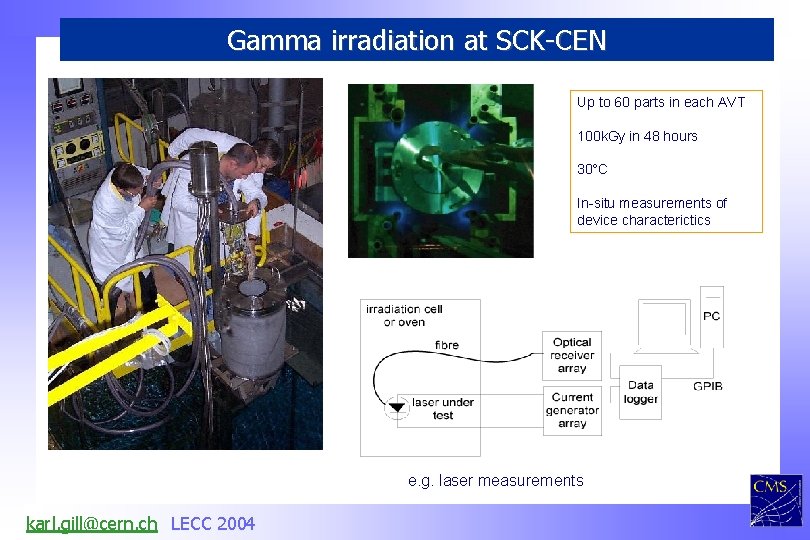
Gamma irradiation at SCK-CEN Up to 60 parts in each AVT 100 k. Gy in 48 hours 30 C In-situ measurements of device characterictics e. g. laser measurements karl. gill@cern. ch LECC 2004

deu ter on s Neutron irradiation at UCL Up to 60 parts (3 x 20) in each AVT 5 1014 n/cm 2 in 7 hours Eneutron ~ 20 Me. V 25 C tr u e ns o n karl. gill@cern. ch LECC 2004 In-situ measurements
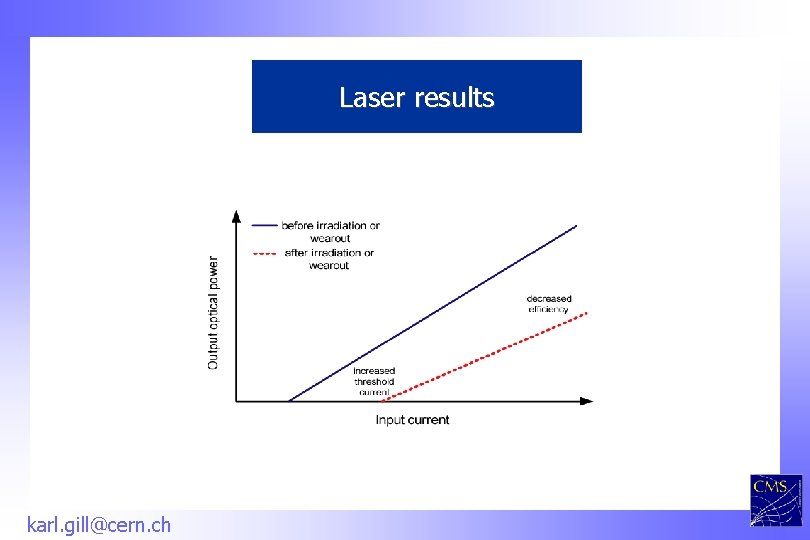
Laser results karl. gill@cern. ch
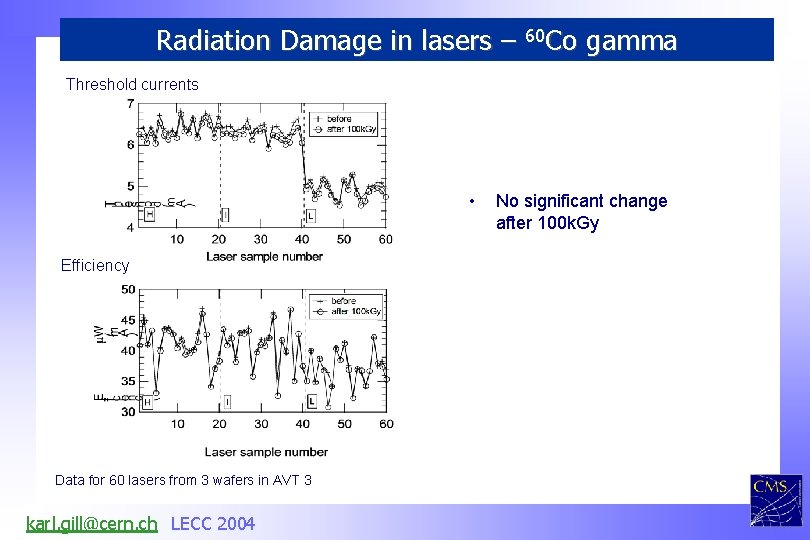
Radiation Damage in lasers – 60 Co gamma Threshold currents • Efficiency Data for 60 lasers from 3 wafers in AVT 3 karl. gill@cern. ch LECC 2004 No significant change after 100 k. Gy
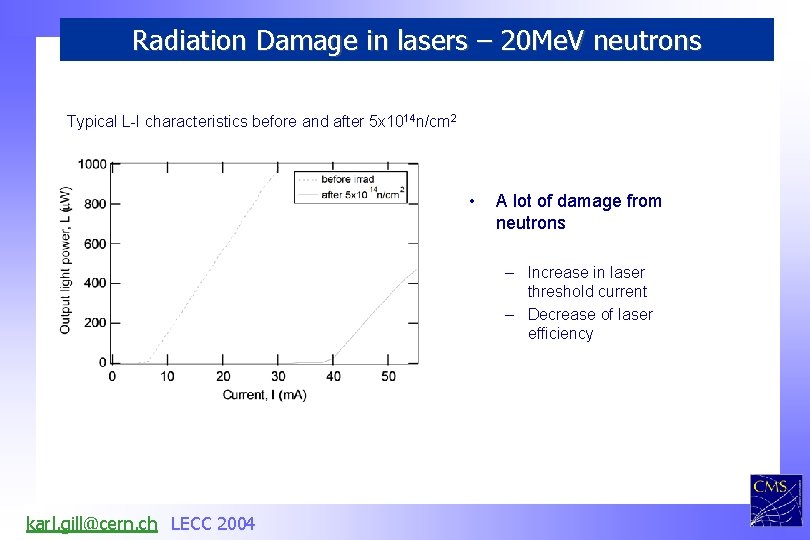
Radiation Damage in lasers – 20 Me. V neutrons Typical L-I characteristics before and after 5 x 10¹⁴ n/cm 2 • A lot of damage from neutrons – Increase in laser threshold current – Decrease of laser efficiency karl. gill@cern. ch LECC 2004
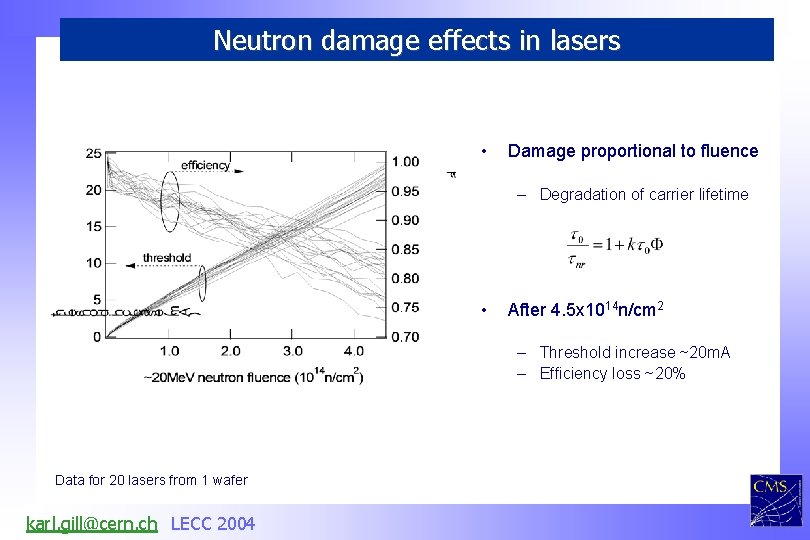
Neutron damage effects in lasers • Damage proportional to fluence – Degradation of carrier lifetime • After 4. 5 x 10¹⁴ n/cm 2 – Threshold increase ~20 m. A – Efficiency loss ~20% Data for 20 lasers from 1 wafer karl. gill@cern. ch LECC 2004
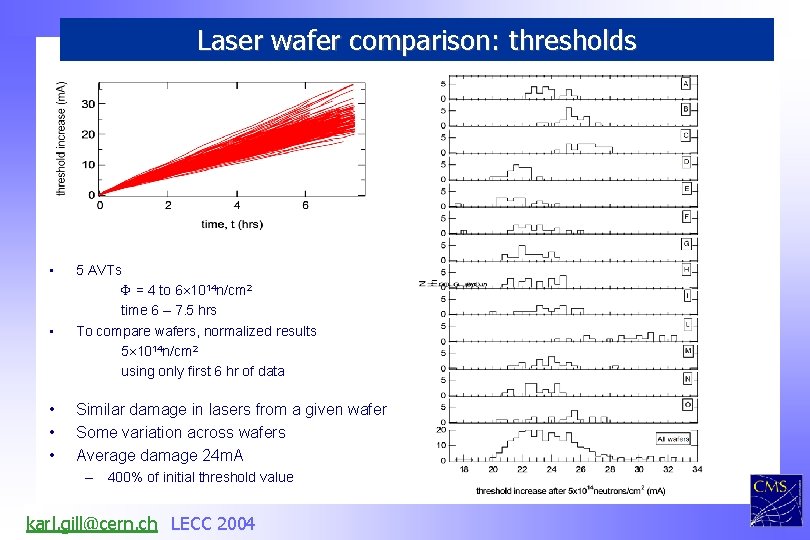
Laser wafer comparison: thresholds • • • 5 AVTs F = 4 to 6 1014 n/cm 2 time 6 – 7. 5 hrs To compare wafers, normalized results 5 1014 n/cm 2 using only first 6 hr of data Similar damage in lasers from a given wafer Some variation across wafers Average damage 24 m. A – 400% of initial threshold value karl. gill@cern. ch LECC 2004
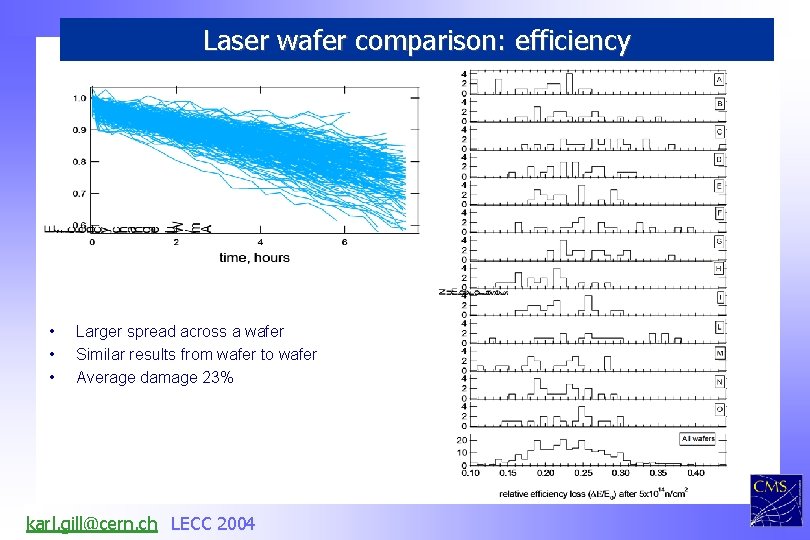
Laser wafer comparison: efficiency • • • Larger spread across a wafer Similar results from wafer to wafer Average damage 23% karl. gill@cern. ch LECC 2004
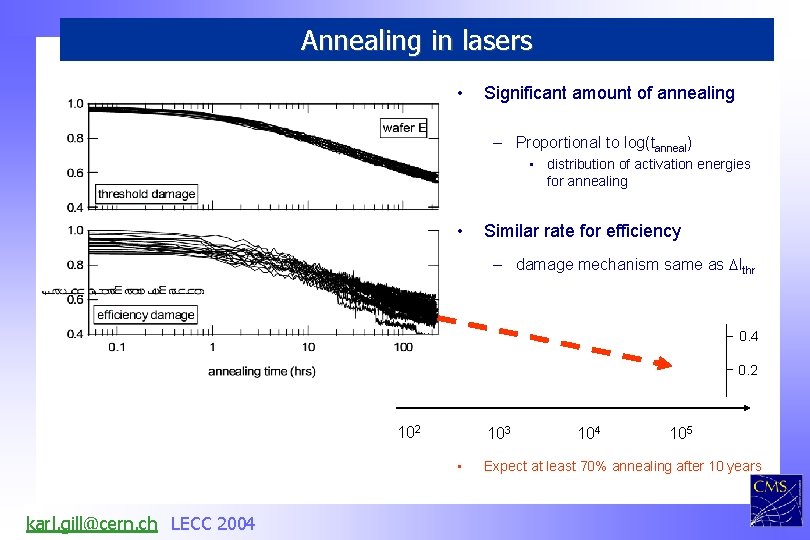
Annealing in lasers • Significant amount of annealing – Proportional to log(tanneal) • distribution of activation energies for annealing • Similar rate for efficiency – damage mechanism same as Ithr 0. 4 0. 2 103 • karl. gill@cern. ch LECC 2004 105 Expect at least 70% annealing after 10 years
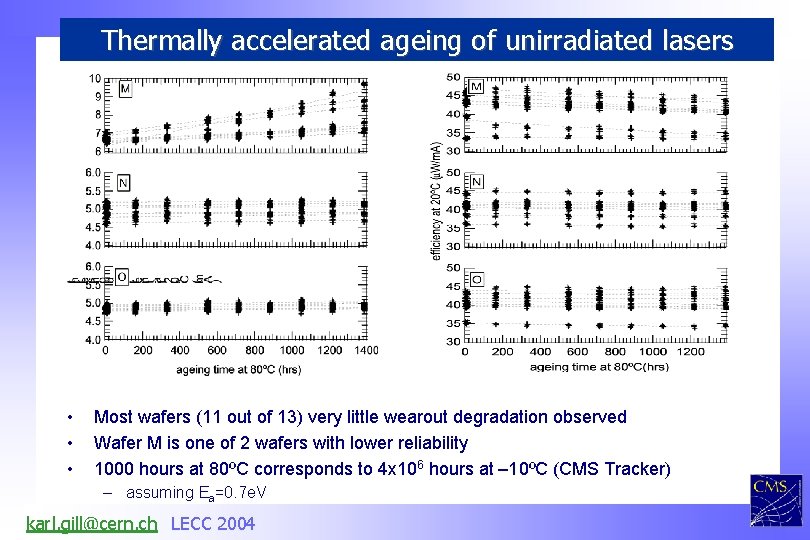
Thermally accelerated ageing of unirradiated lasers • • • Most wafers (11 out of 13) very little wearout degradation observed Wafer M is one of 2 wafers with lower reliability 1000 hours at 80ºC corresponds to 4 x 10⁶ hours at – 10ºC (CMS Tracker) – assuming Ea=0. 7 e. V karl. gill@cern. ch LECC 2004
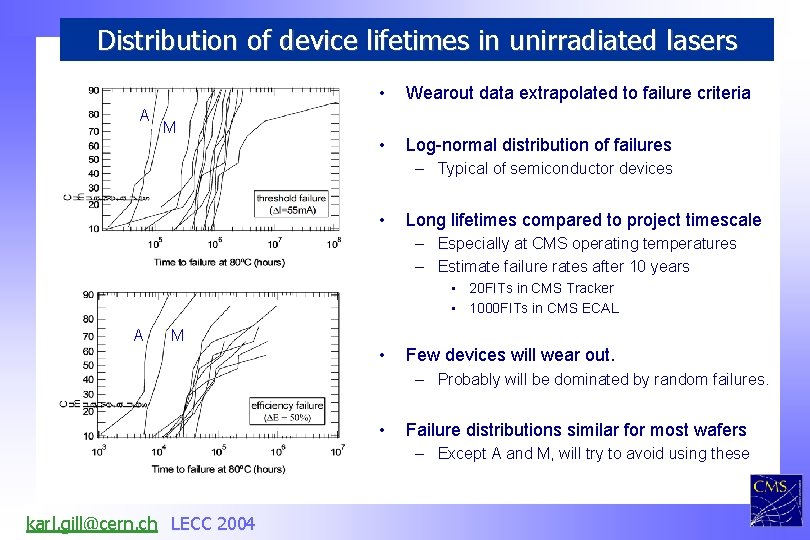
Distribution of device lifetimes in unirradiated lasers A M • Wearout data extrapolated to failure criteria • Log-normal distribution of failures – Typical of semiconductor devices • Long lifetimes compared to project timescale – Especially at CMS operating temperatures – Estimate failure rates after 10 years • 20 FITs in CMS Tracker • 1000 FITs in CMS ECAL A M • Few devices will wear out. – Probably will be dominated by random failures. • Failure distributions similar for most wafers – Except A and M, will try to avoid using these karl. gill@cern. ch LECC 2004
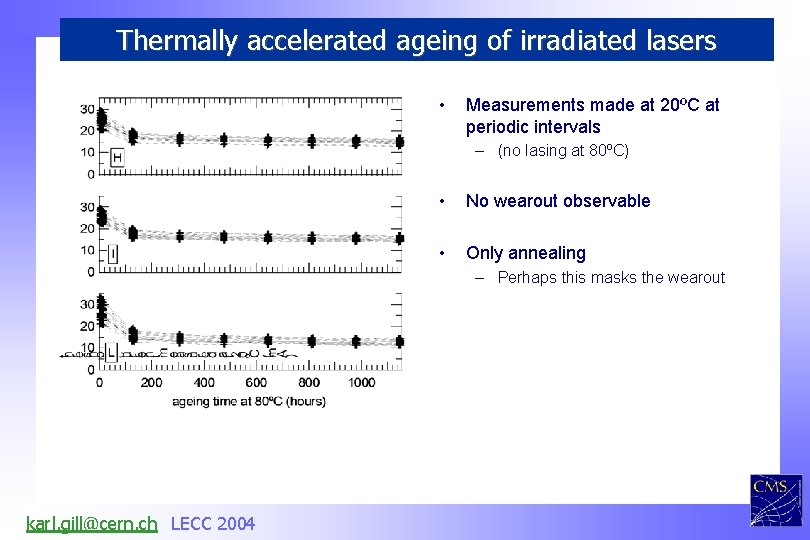
Thermally accelerated ageing of irradiated lasers • Measurements made at 20ºC at periodic intervals – (no lasing at 80ºC) • No wearout observable • Only annealing – Perhaps this masks the wearout karl. gill@cern. ch LECC 2004
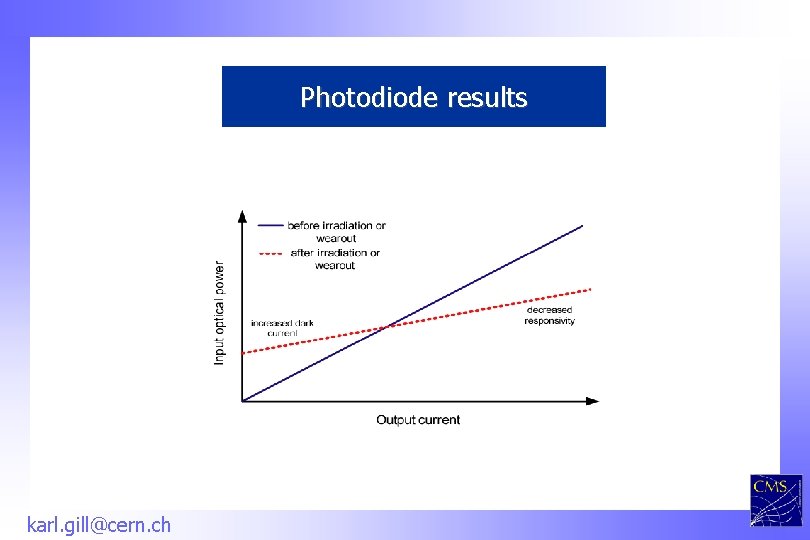
Photodiode results karl. gill@cern. ch
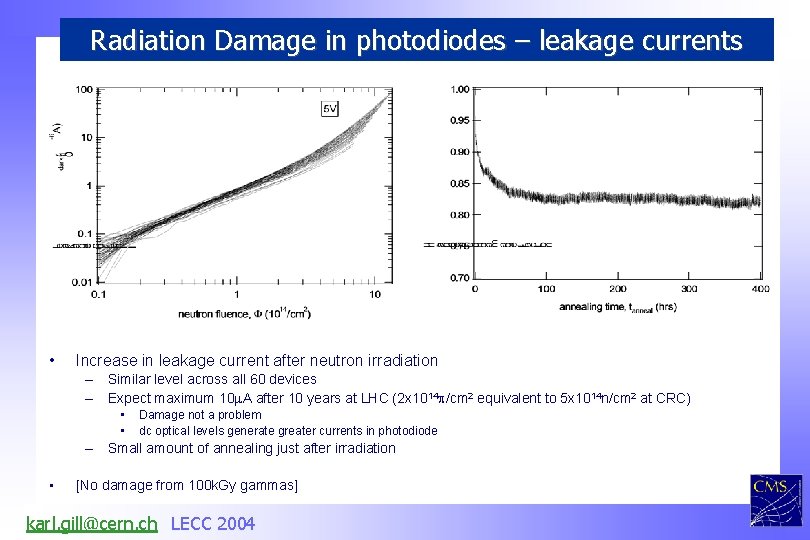
Radiation Damage in photodiodes – leakage currents • Increase in leakage current after neutron irradiation – Similar level across all 60 devices – Expect maximum 10 A after 10 years at LHC (2 x 10¹⁴ /cm 2 equivalent to 5 x 10¹⁴ n/cm 2 at CRC) • • Damage not a problem dc optical levels generate greater currents in photodiode – Small amount of annealing just after irradiation • [No damage from 100 k. Gy gammas] karl. gill@cern. ch LECC 2004
![Radiation Damage in photodiodes – photocurrents • Complicated evolution of photocurrent [responsivity] with fluence](http://slidetodoc.com/presentation_image_h2/3fffadef0cad8f71a6950e4f8d5017b4/image-25.jpg "Radiation Damage in photodiodes – photocurrents • Complicated evolution of photocurrent [responsivity] with fluence")
Radiation Damage in photodiodes – photocurrents • Complicated evolution of photocurrent [responsivity] with fluence – Not understood but fairly consistent from device to device – No more than 32% loss over fluence range tested – Again, only small amount of annealing just after irradiation • • Not same rate as for leakage current so probably different defects responsible for the two effects [Again, no damage from 100 k. Gy gammas] karl. gill@cern. ch LECC 2004
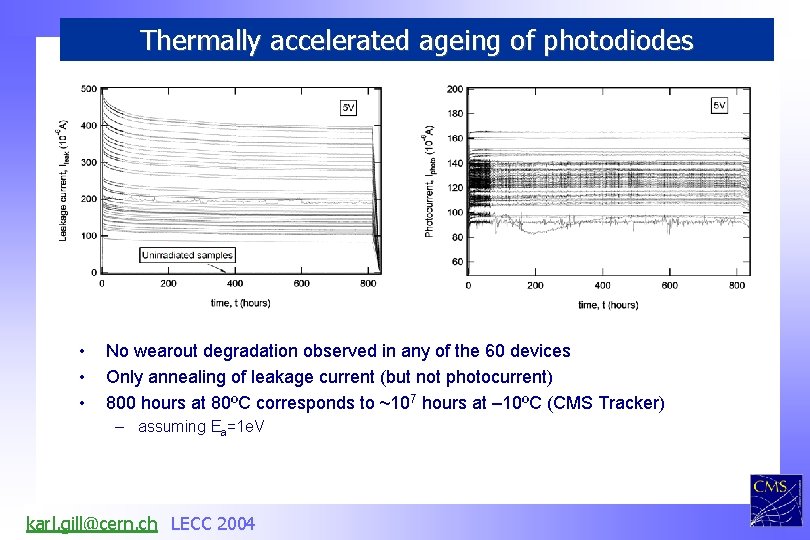
Thermally accelerated ageing of photodiodes • • • No wearout degradation observed in any of the 60 devices Only annealing of leakage current (but not photocurrent) 800 hours at 80ºC corresponds to ~107 hours at – 10ºC (CMS Tracker) – assuming Ea=1 e. V karl. gill@cern. ch LECC 2004
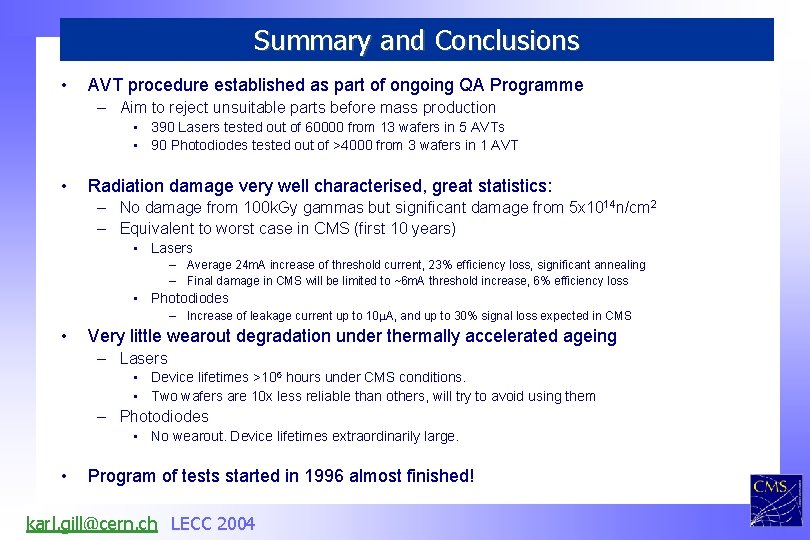
Summary and Conclusions • AVT procedure established as part of ongoing QA Programme – Aim to reject unsuitable parts before mass production • 390 Lasers tested out of 60000 from 13 wafers in 5 AVTs • 90 Photodiodes tested out of >4000 from 3 wafers in 1 AVT • Radiation damage very well characterised, great statistics: – No damage from 100 k. Gy gammas but significant damage from 5 x 10¹⁴ n/cm 2 – Equivalent to worst case in CMS (first 10 years) • Lasers – Average 24 m. A increase of threshold current, 23% efficiency loss, significant annealing – Final damage in CMS will be limited to ~6 m. A threshold increase, 6% efficiency loss • Photodiodes – Increase of leakage current up to 10 A, and up to 30% signal loss expected in CMS • Very little wearout degradation under thermally accelerated ageing – Lasers • Device lifetimes >106 hours under CMS conditions. • Two wafers are 10 x less reliable than others, will try to avoid using them – Photodiodes • No wearout. Device lifetimes extraordinarily large. • Program of tests started in 1996 almost finished! karl. gill@cern. ch LECC 2004
- Slides: 27