
HIGH STANDARDS AND THE ASSESSMENTS What Parents and
![Agenda • Superintendent [NAME]/Principal [NAME], [SCHOOL] • The Learning Standards • Why Aim High](https://slidetodoc.com/presentation_image_h2/8e46c4ab19618b28b1df2f38261058d6/image-2.jpg "Agenda • Superintendent [NAME]/Principal [NAME], [SCHOOL] • The Learning Standards • Why Aim High")

- Slides: 32
HIGH STANDARDS AND THE ASSESSMENTS: What Parents and Students Need to Know
Agenda • Superintendent [NAME]/Principal [NAME], [SCHOOL] • The Learning Standards • Why Aim High • Changes in the Classroom • Helping Teachers Help Students Reach the Higher Bar • 3 -8 Annual Assessments • Old versus New • Test Facts • What’s Next for the 3 -8 Tests? • Q+A 2
The Learning Standards
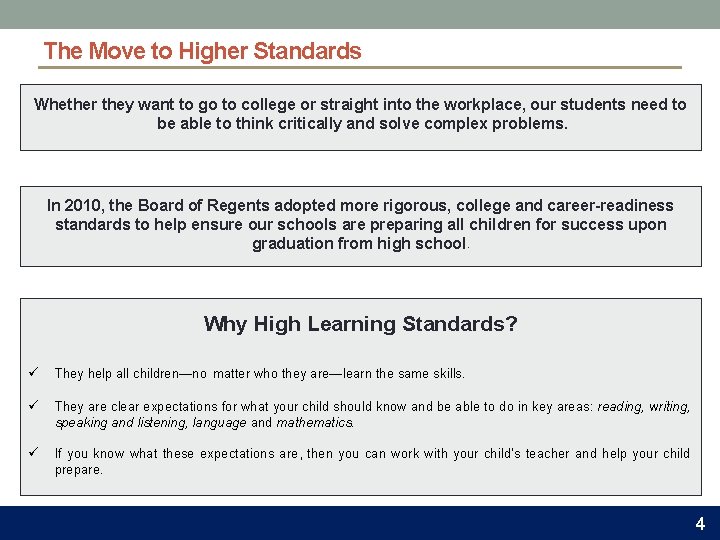
The Move to Higher Standards Whether they want to go to college or straight into the workplace, our students need to be able to think critically and solve complex problems. In 2010, the Board of Regents adopted more rigorous, college and career-readiness standards to help ensure our schools are preparing all children for success upon graduation from high school. Why High Learning Standards? They help all children—no matter who they are—learn the same skills. They are clear expectations for what your child should know and be able to do in key areas: reading, writing, speaking and listening, language and mathematics. If you know what these expectations are, then you can work with your child’s teacher and help your child prepare. 4
Higher Ed Supports Higher Standards https: //www. youtube. com/watch? v=lt. OCF 4 c. Um. TQ 5
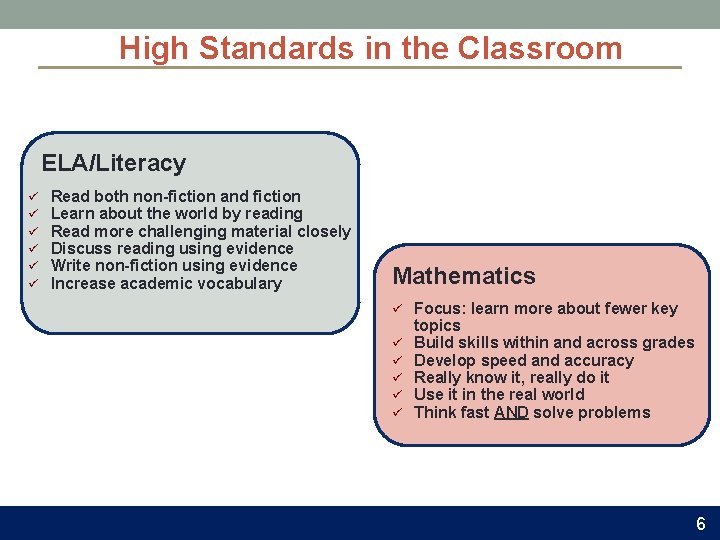
High Standards in the Classroom ELA/Literacy Read both non-fiction and fiction Learn about the world by reading Read more challenging material closely Discuss reading using evidence Write non-fiction using evidence Increase academic vocabulary Mathematics Focus: learn more about fewer key topics Build skills within and across grades Develop speed and accuracy Really know it, really do it Use it in the real world Think fast AND solve problems 6
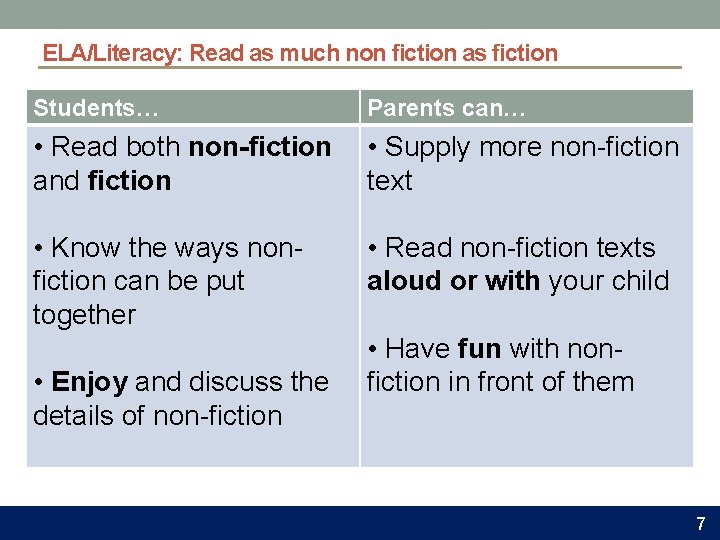
ELA/Literacy: Read as much non fiction as fiction Students… Parents can… • Read both non-fiction and fiction • Supply more non-fiction text • Know the ways nonfiction can be put together • Read non-fiction texts aloud or with your child • Enjoy and discuss the details of non-fiction • Have fun with nonfiction in front of them 7
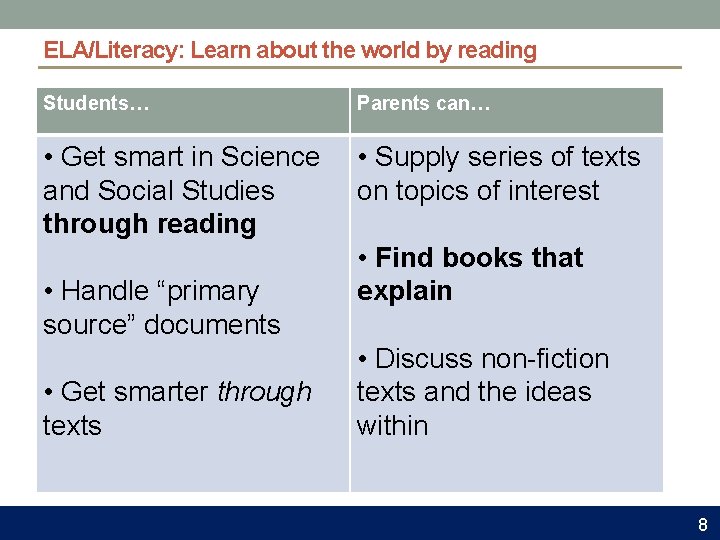
ELA/Literacy: Learn about the world by reading Students… Parents can… • Get smart in Science and Social Studies through reading • Supply series of texts on topics of interest • Handle “primary source” documents • Get smarter through texts • Find books that explain • Discuss non-fiction texts and the ideas within 8
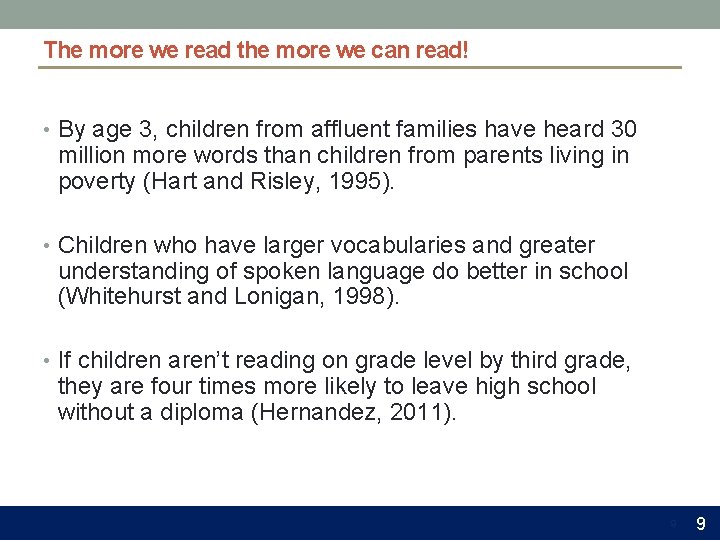
The more we read the more we can read! • By age 3, children from affluent families have heard 30 million more words than children from parents living in poverty (Hart and Risley, 1995). • Children who have larger vocabularies and greater understanding of spoken language do better in school (Whitehurst and Lonigan, 1998). • If children aren’t reading on grade level by third grade, they are four times more likely to leave high school without a diploma (Hernandez, 2011). 9 9
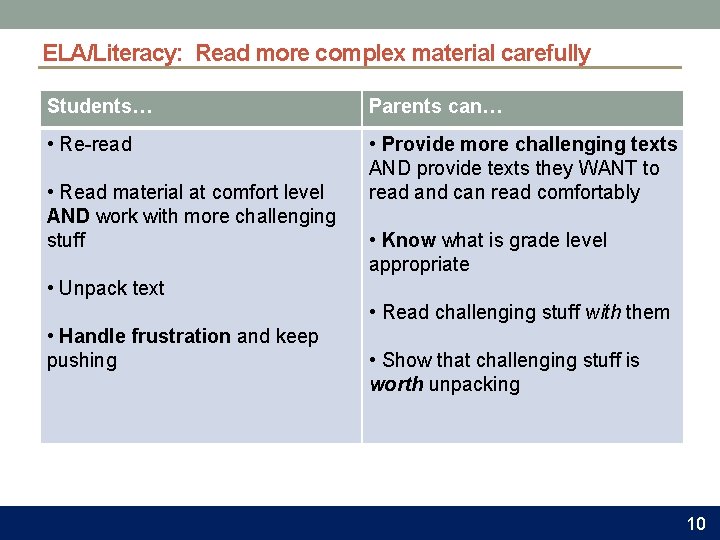
ELA/Literacy: Read more complex material carefully Students… Parents can… • Re-read • Provide more challenging texts AND provide texts they WANT to read and can read comfortably • Read material at comfort level AND work with more challenging stuff • Know what is grade level appropriate • Unpack text • Read challenging stuff with them • Handle frustration and keep pushing • Show that challenging stuff is worth unpacking 10
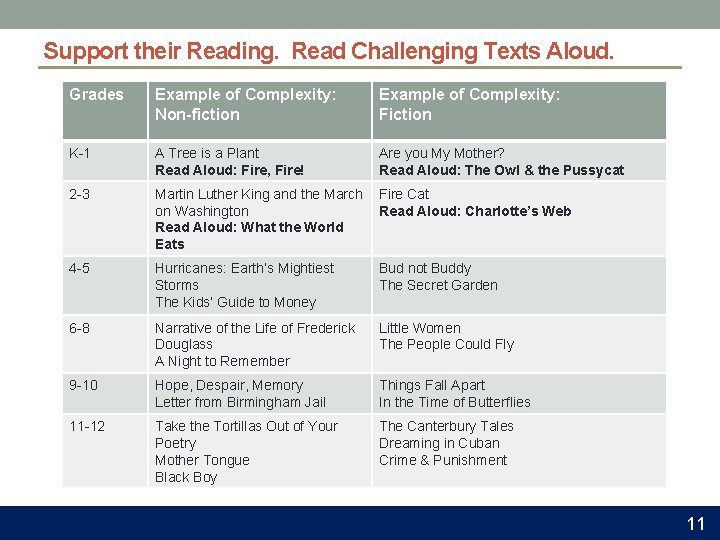
Support their Reading. Read Challenging Texts Aloud. Grades Example of Complexity: Non-fiction Example of Complexity: Fiction K-1 A Tree is a Plant Read Aloud: Fire, Fire! Are you My Mother? Read Aloud: The Owl & the Pussycat 2 -3 Martin Luther King and the March on Washington Read Aloud: What the World Eats Fire Cat Read Aloud: Charlotte’s Web 4 -5 Hurricanes: Earth’s Mightiest Storms The Kids’ Guide to Money Bud not Buddy The Secret Garden 6 -8 Narrative of the Life of Frederick Douglass A Night to Remember Little Women The People Could Fly 9 -10 Hope, Despair, Memory Letter from Birmingham Jail Things Fall Apart In the Time of Butterflies 11 -12 Take the Tortillas Out of Your Poetry Mother Tongue Black Boy The Canterbury Tales Dreaming in Cuban Crime & Punishment 11
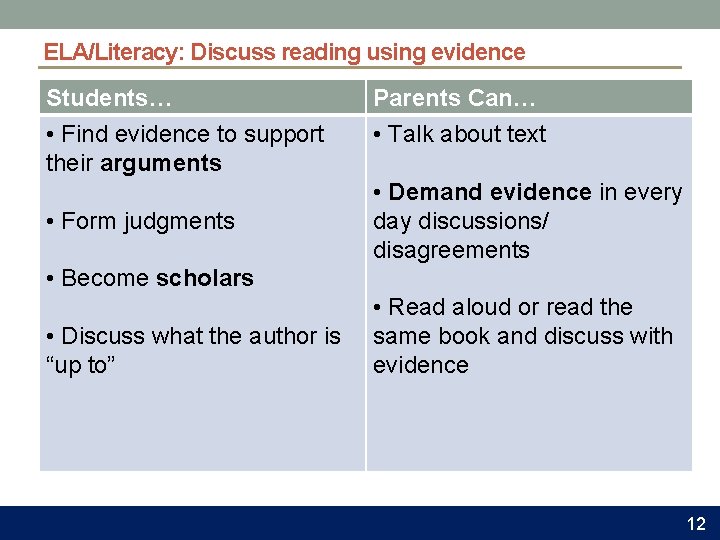
ELA/Literacy: Discuss reading using evidence Students… • Find evidence to support their arguments • Form judgments Parents Can… • Talk about text • Demand evidence in every day discussions/ disagreements • Become scholars • Discuss what the author is “up to” • Read aloud or read the same book and discuss with evidence 12
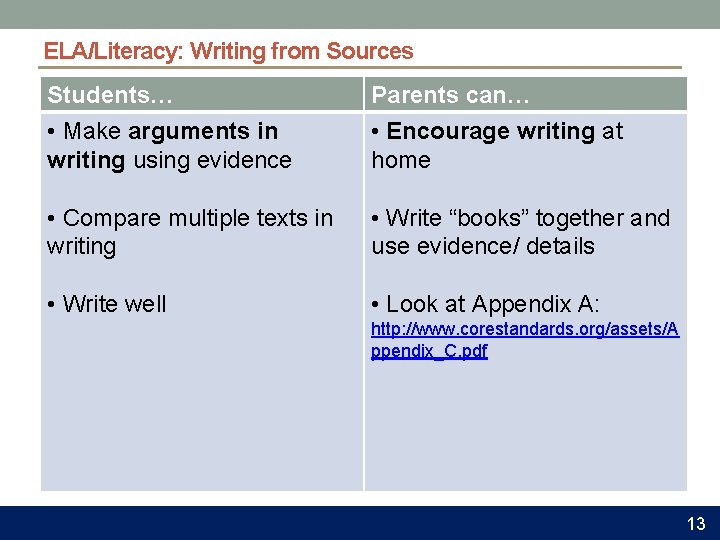
ELA/Literacy: Writing from Sources Students… • Make arguments in writing using evidence Parents can… • Encourage writing at home • Compare multiple texts in writing • Write “books” together and use evidence/ details • Write well • Look at Appendix A: http: //www. corestandards. org/assets/A ppendix_C. pdf 13
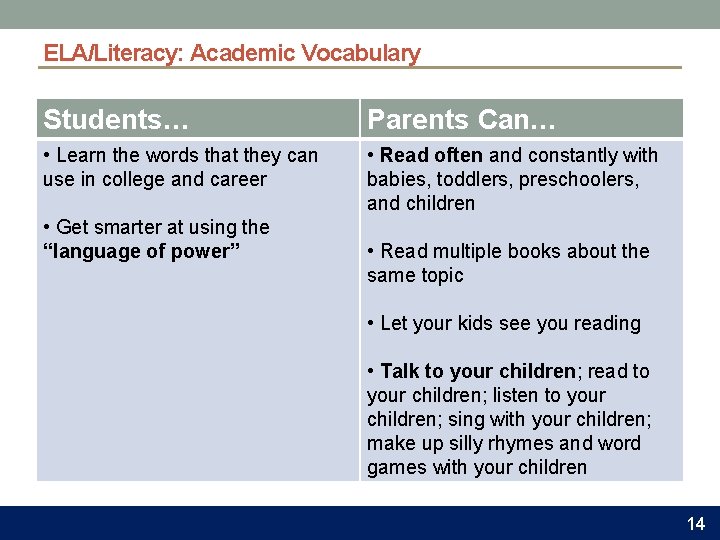
ELA/Literacy: Academic Vocabulary Students… Parents Can… • Learn the words that they can use in college and career • Read often and constantly with babies, toddlers, preschoolers, and children • Get smarter at using the “language of power” • Read multiple books about the same topic • Let your kids see you reading • Talk to your children; read to your children; listen to your children; sing with your children; make up silly rhymes and word games with your children 14
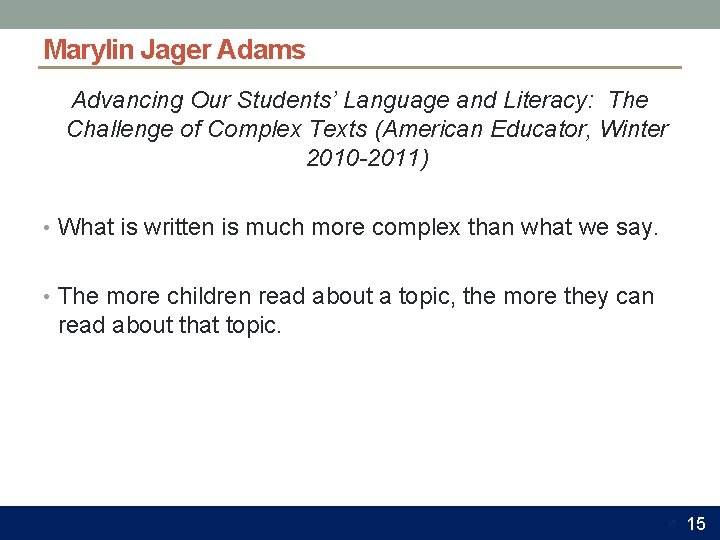
Marylin Jager Adams Advancing Our Students’ Language and Literacy: The Challenge of Complex Texts (American Educator, Winter 2010 -2011) • What is written is much more complex than what we say. • The more children read about a topic, the more they can read about that topic. 15 15
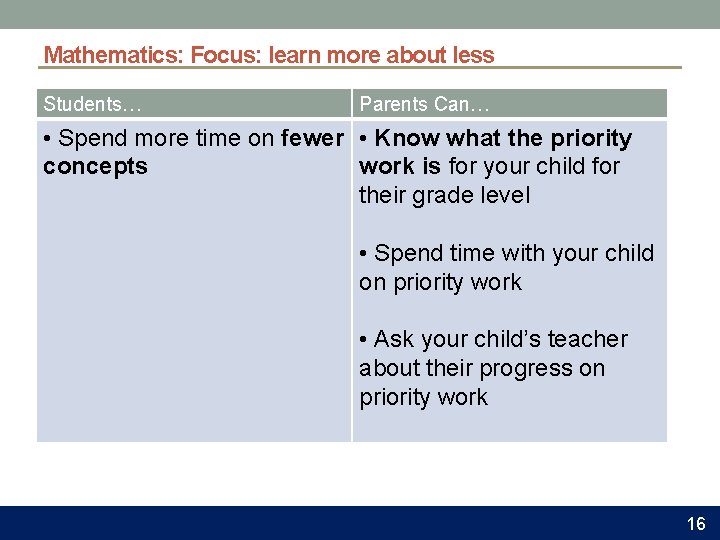
Mathematics: Focus: learn more about less Students… Parents Can… • Spend more time on fewer • Know what the priority concepts work is for your child for their grade level • Spend time with your child on priority work • Ask your child’s teacher about their progress on priority work 16
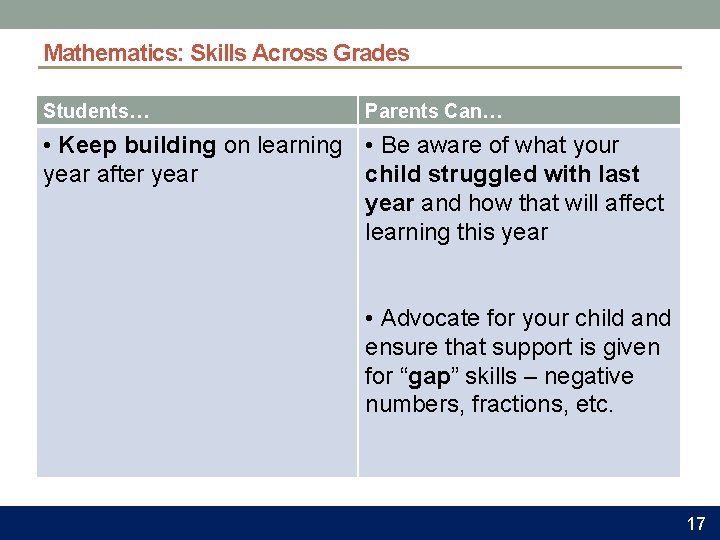
Mathematics: Skills Across Grades Students… Parents Can… • Keep building on learning • Be aware of what your year after year child struggled with last year and how that will affect learning this year • Advocate for your child and ensure that support is given for “gap” skills – negative numbers, fractions, etc. 17
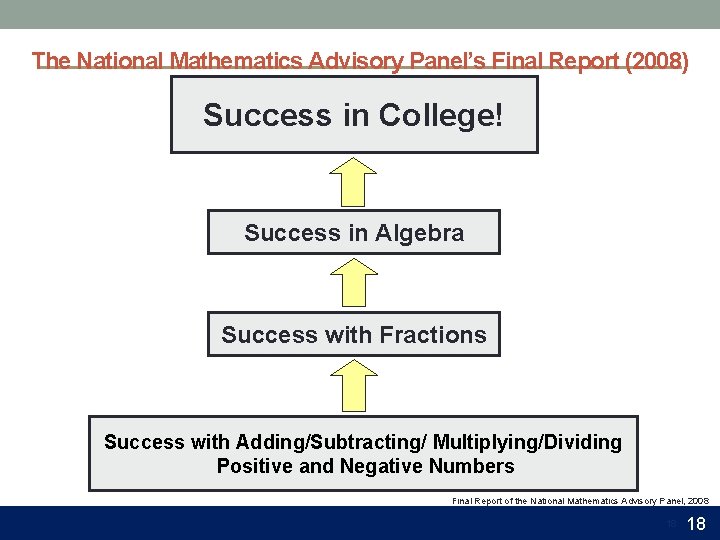
The National Mathematics Advisory Panel’s Final Report (2008) Success in College! Success in Algebra Success with Fractions Success with Adding/Subtracting/ Multiplying/Dividing Positive and Negative Numbers Final Report of the National Mathematics Advisory Panel, 2008 18 18
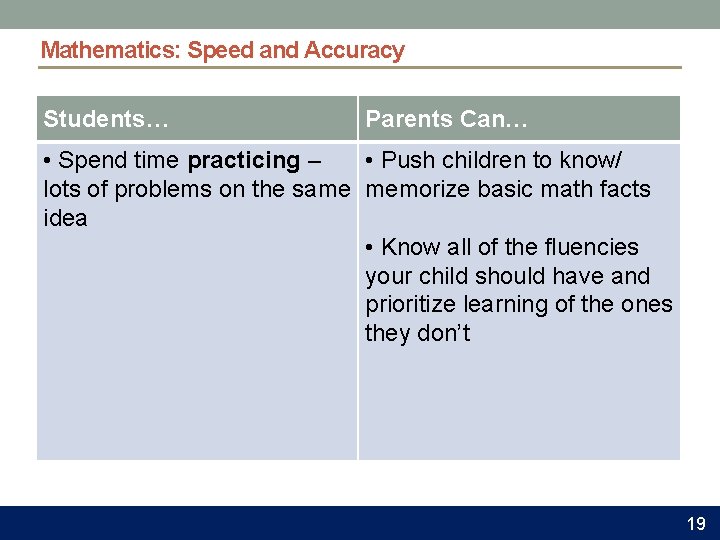
Mathematics: Speed and Accuracy Students… Parents Can… • Spend time practicing – • Push children to know/ lots of problems on the same memorize basic math facts idea • Know all of the fluencies your child should have and prioritize learning of the ones they don’t 19
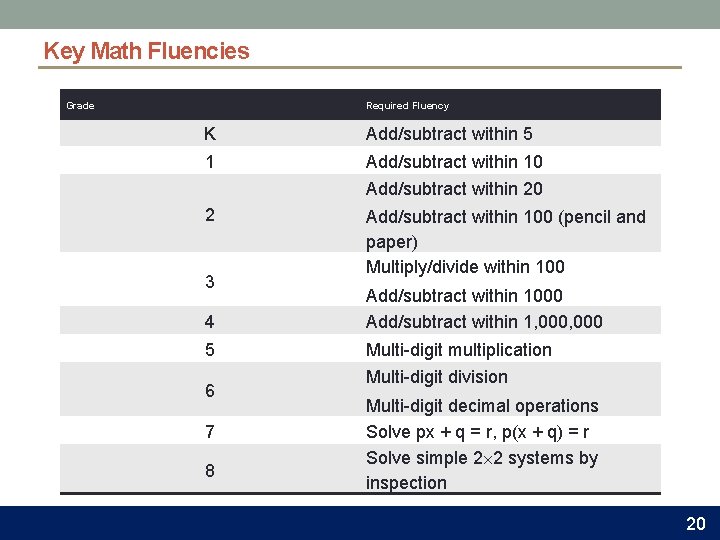
Key Math Fluencies Grade Required Fluency K Add/subtract within 5 1 Add/subtract within 10 Add/subtract within 20 2 Add/subtract within 100 (pencil and paper) Multiply/divide within 100 3 4 5 6 7 8 Add/subtract within 1000 Add/subtract within 1, 000 Multi-digit multiplication Multi-digit division Multi-digit decimal operations Solve px + q = r, p(x + q) = r Solve simple 2 2 systems by inspection 20
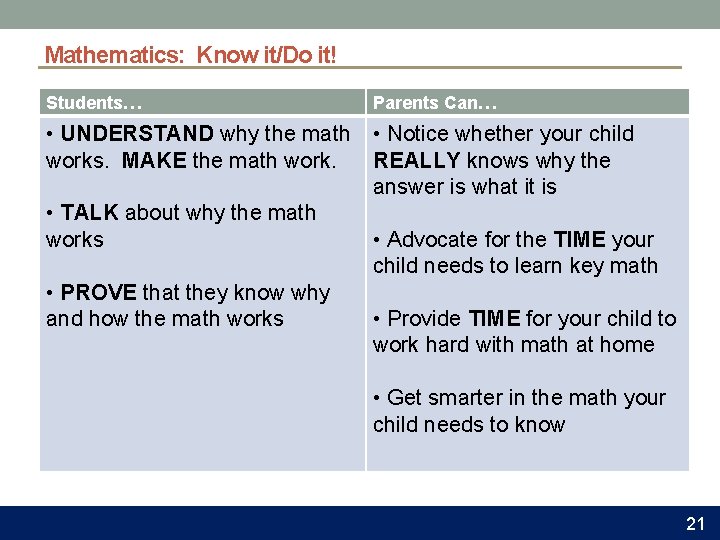
Mathematics: Know it/Do it! Students… Parents Can… • UNDERSTAND why the math • Notice whether your child works. MAKE the math work. REALLY knows why the answer is what it is • TALK about why the math works • Advocate for the TIME your child needs to learn key math • PROVE that they know why and how the math works • Provide TIME for your child to work hard with math at home • Get smarter in the math your child needs to know 21
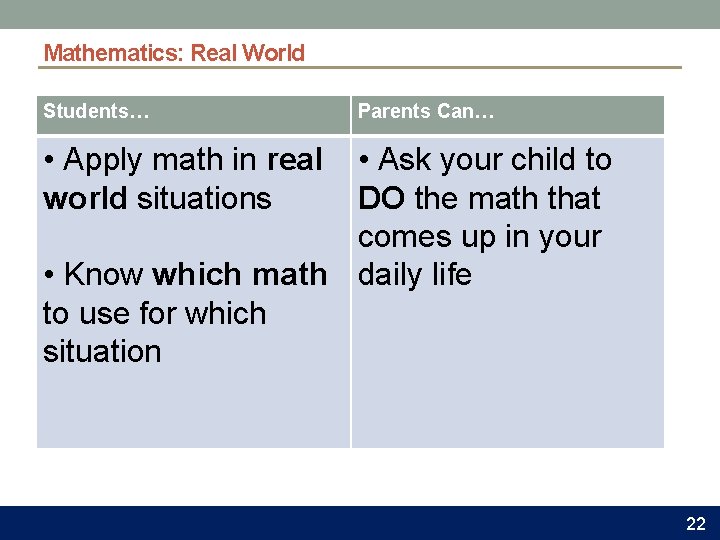
Mathematics: Real World Students… Parents Can… • Apply math in real world situations • Ask your child to DO the math that comes up in your • Know which math daily life to use for which situation 22
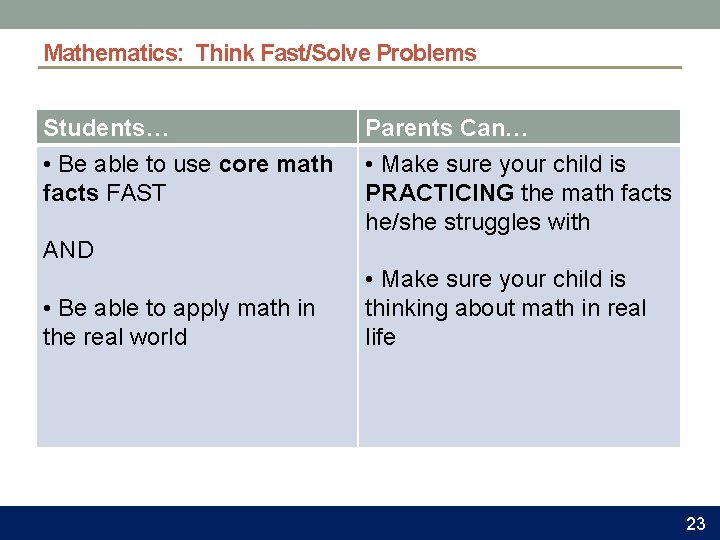
Mathematics: Think Fast/Solve Problems Students… • Be able to use core math facts FAST Parents Can… • Make sure your child is PRACTICING the math facts he/she struggles with AND • Be able to apply math in the real world • Make sure your child is thinking about math in real life 23
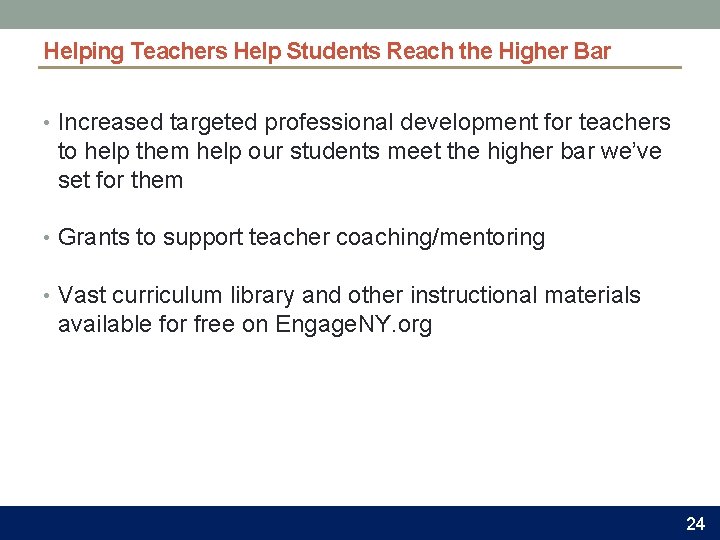
Helping Teachers Help Students Reach the Higher Bar • Increased targeted professional development for teachers to help them help our students meet the higher bar we’ve set for them • Grants to support teacher coaching/mentoring • Vast curriculum library and other instructional materials available for free on Engage. NY. org 24
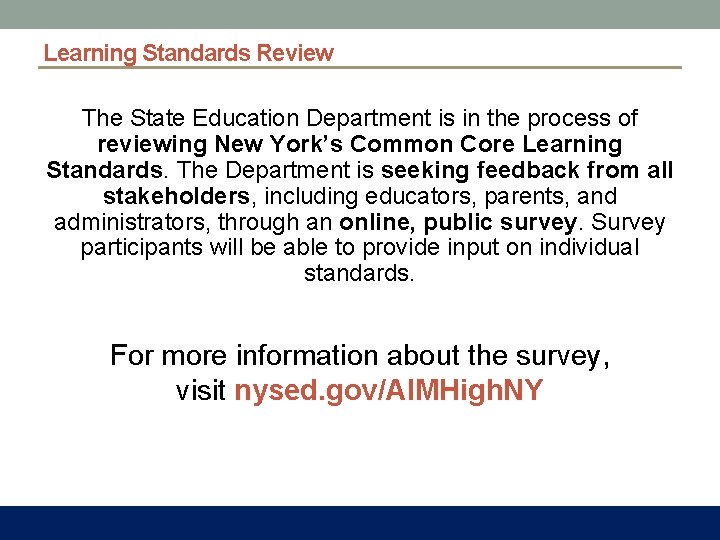
Learning Standards Review The State Education Department is in the process of reviewing New York’s Common Core Learning Standards. The Department is seeking feedback from all stakeholders, including educators, parents, and administrators, through an online, public survey. Survey participants will be able to provide input on individual standards. For more information about the survey, visit nysed. gov/AIMHigh. NY
Grades 3 -8 English Language Arts and Math Tests
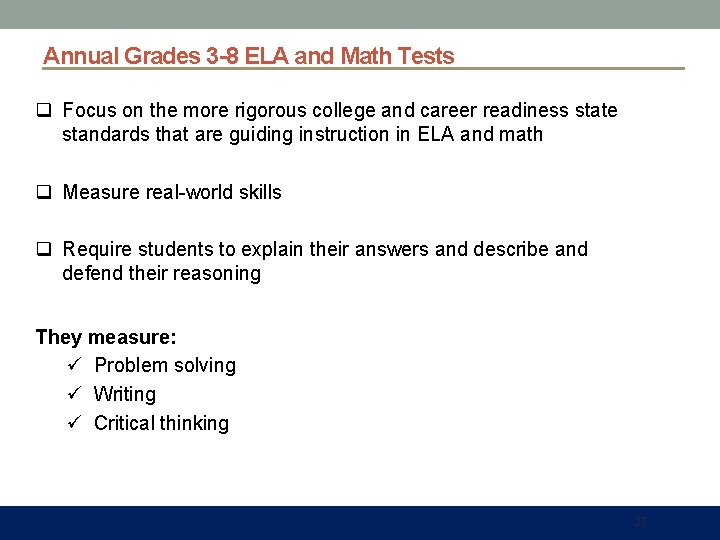
Annual Grades 3 -8 ELA and Math Tests q Focus on the more rigorous college and career readiness state standards that are guiding instruction in ELA and math q Measure real-world skills q Require students to explain their answers and describe and defend their reasoning They measure: Problem solving Writing Critical thinking 27
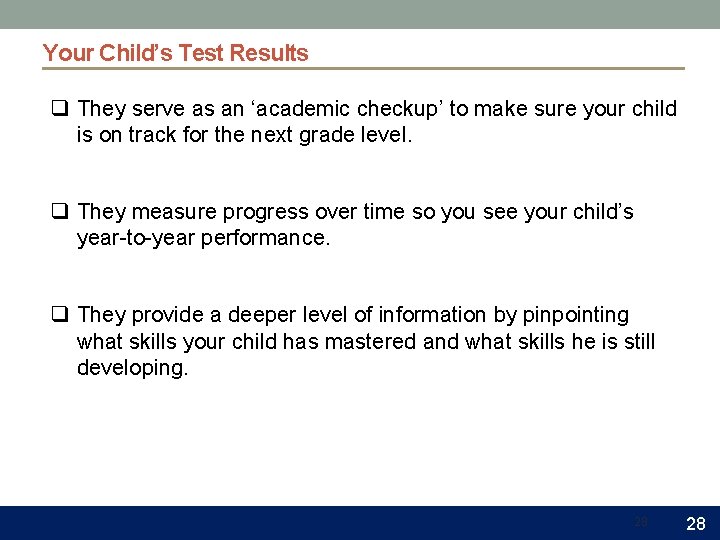
Your Child’s Test Results q They serve as an ‘academic checkup’ to make sure your child is on track for the next grade level. q They measure progress over time so you see your child’s year-to-year performance. q They provide a deeper level of information by pinpointing what skills your child has mastered and what skills he is still developing. 28 28
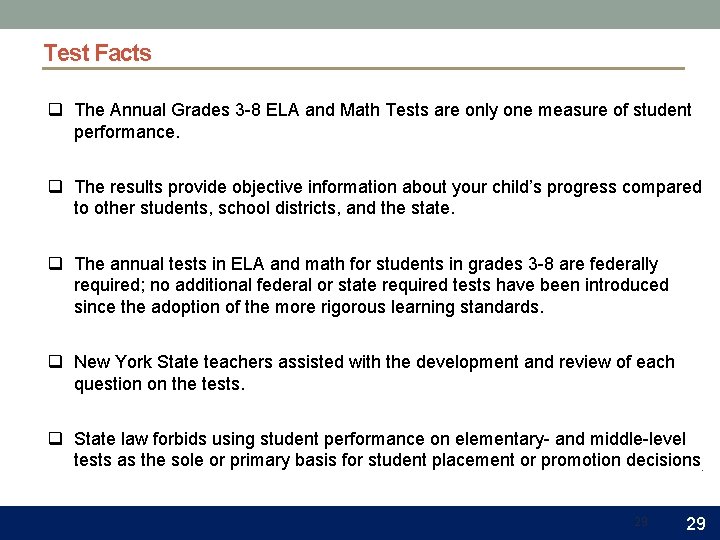
Test Facts q The Annual Grades 3 -8 ELA and Math Tests are only one measure of student performance. q The results provide objective information about your child’s progress compared to other students, school districts, and the state. q The annual tests in ELA and math for students in grades 3 -8 are federally required; no additional federal or state required tests have been introduced since the adoption of the more rigorous learning standards. q New York State teachers assisted with the development and review of each question on the tests. q State law forbids using student performance on elementary- and middle-level tests as the sole or primary basis for student placement or promotion decisions. 29 29
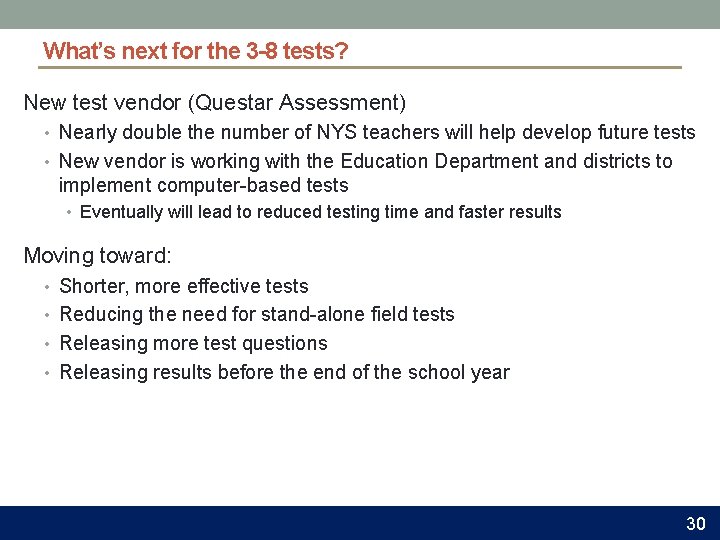
What’s next for the 3 -8 tests? New test vendor (Questar Assessment) • Nearly double the number of NYS teachers will help develop future tests • New vendor is working with the Education Department and districts to implement computer-based tests • Eventually will lead to reduced testing time and faster results Moving toward: • Shorter, more effective tests • Reducing the need for stand-alone field tests • Releasing more test questions • Releasing results before the end of the school year 30
Questions + Answers 31
Learn more about the standards and assessments Visit nysed. gov and engage. NY. org Talk to your child’s teacher 32