
High Stakes Testing Supovitz Can High Stakes Testing

- Slides: 14
High Stakes Testing
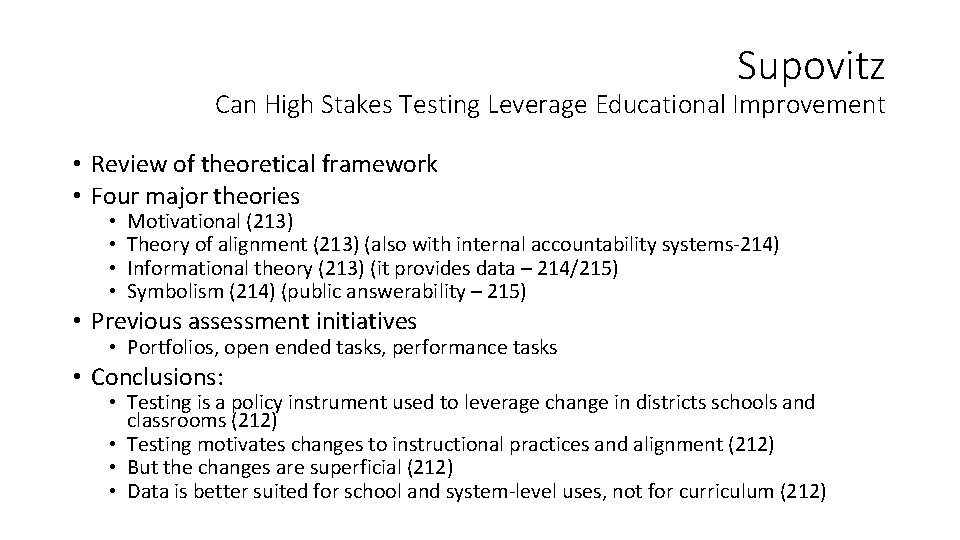
Supovitz Can High Stakes Testing Leverage Educational Improvement • Review of theoretical framework • Four major theories • • Motivational (213) Theory of alignment (213) (also with internal accountability systems-214) Informational theory (213) (it provides data – 214/215) Symbolism (214) (public answerability – 215) • Previous assessment initiatives • Portfolios, open ended tasks, performance tasks • Conclusions: • Testing is a policy instrument used to leverage change in districts schools and classrooms (212) • Testing motivates changes to instructional practices and alignment (212) • But the changes are superficial (212) • Data is better suited for school and system-level uses, not for curriculum (212)
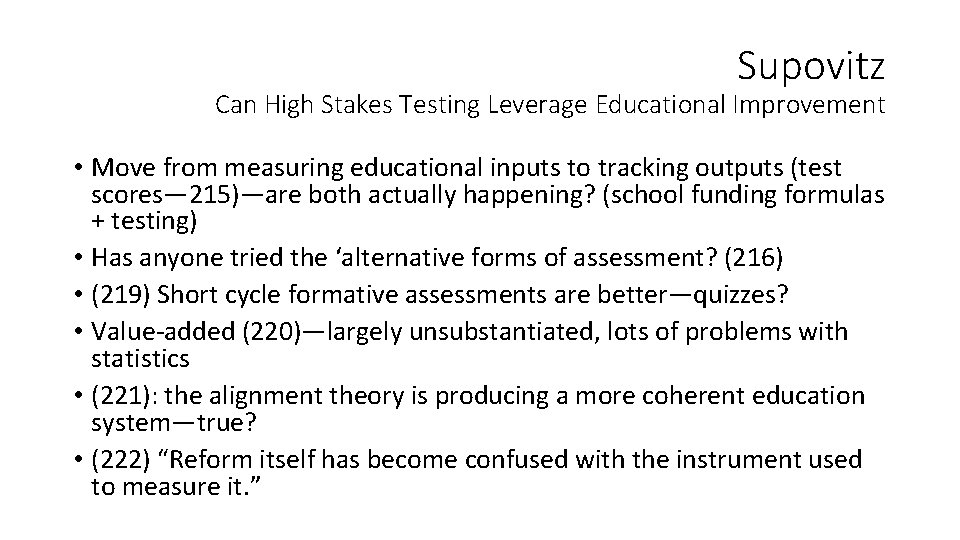
Supovitz Can High Stakes Testing Leverage Educational Improvement • Move from measuring educational inputs to tracking outputs (test scores— 215)—are both actually happening? (school funding formulas + testing) • Has anyone tried the ‘alternative forms of assessment? (216) • (219) Short cycle formative assessments are better—quizzes? • Value-added (220)—largely unsubstantiated, lots of problems with statistics • (221): the alignment theory is producing a more coherent education system—true? • (222) “Reform itself has become confused with the instrument used to measure it. ”
Koyama Making Failure Matter • A story of bureaucratic SNAFU • Did the whole situation, in the end, benefit the school? • Was the Principal complicit?
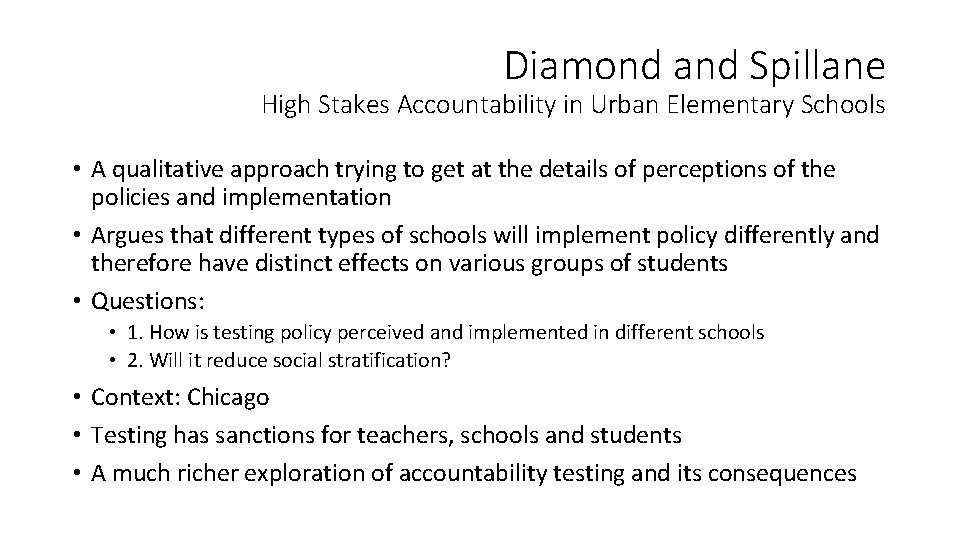
Diamond and Spillane High Stakes Accountability in Urban Elementary Schools • A qualitative approach trying to get at the details of perceptions of the policies and implementation • Argues that different types of schools will implement policy differently and therefore have distinct effects on various groups of students • Questions: • 1. How is testing policy perceived and implemented in different schools • 2. Will it reduce social stratification? • Context: Chicago • Testing has sanctions for teachers, schools and students • A much richer exploration of accountability testing and its consequences
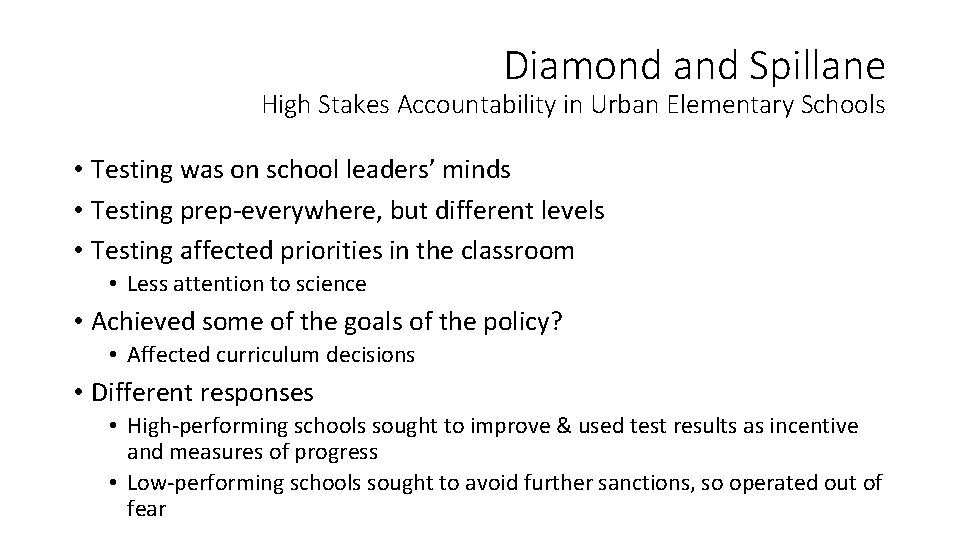
Diamond and Spillane High Stakes Accountability in Urban Elementary Schools • Testing was on school leaders’ minds • Testing prep-everywhere, but different levels • Testing affected priorities in the classroom • Less attention to science • Achieved some of the goals of the policy? • Affected curriculum decisions • Different responses • High-performing schools sought to improve & used test results as incentive and measures of progress • Low-performing schools sought to avoid further sanctions, so operated out of fear
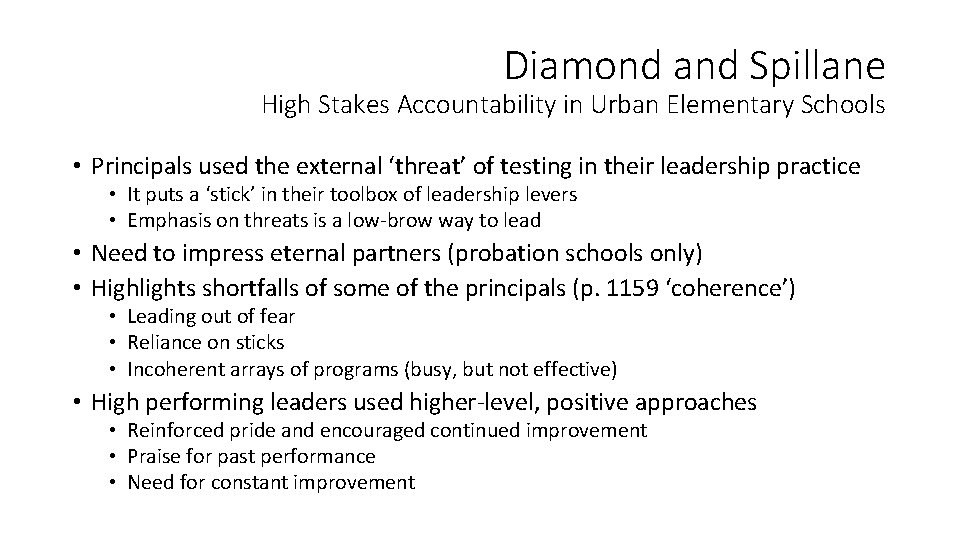
Diamond and Spillane High Stakes Accountability in Urban Elementary Schools • Principals used the external ‘threat’ of testing in their leadership practice • It puts a ‘stick’ in their toolbox of leadership levers • Emphasis on threats is a low-brow way to lead • Need to impress eternal partners (probation schools only) • Highlights shortfalls of some of the principals (p. 1159 ‘coherence’) • Leading out of fear • Reliance on sticks • Incoherent arrays of programs (busy, but not effective) • High performing leaders used higher-level, positive approaches • Reinforced pride and encouraged continued improvement • Praise for past performance • Need for constant improvement
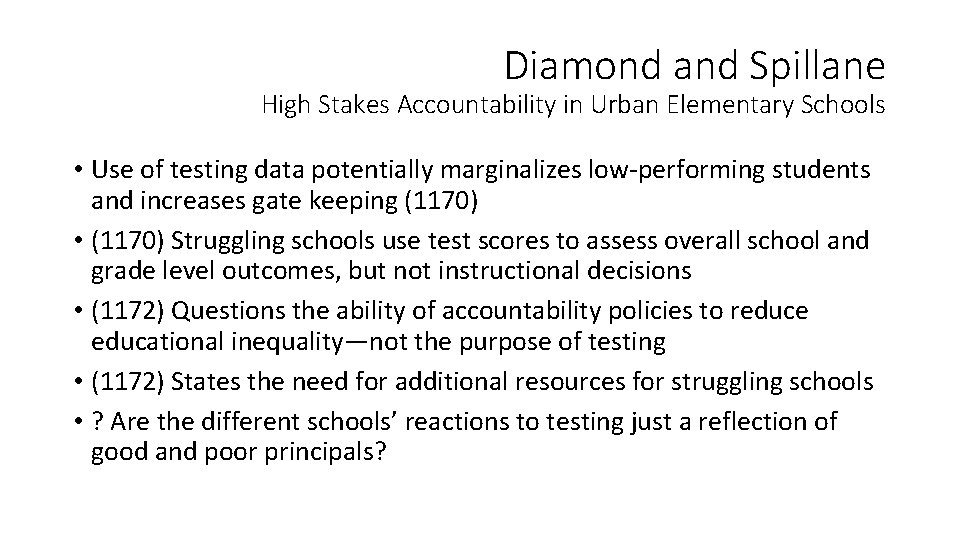
Diamond and Spillane High Stakes Accountability in Urban Elementary Schools • Use of testing data potentially marginalizes low-performing students and increases gate keeping (1170) • (1170) Struggling schools use test scores to assess overall school and grade level outcomes, but not instructional decisions • (1172) Questions the ability of accountability policies to reduce educational inequality—not the purpose of testing • (1172) States the need for additional resources for struggling schools • ? Are the different schools’ reactions to testing just a reflection of good and poor principals?
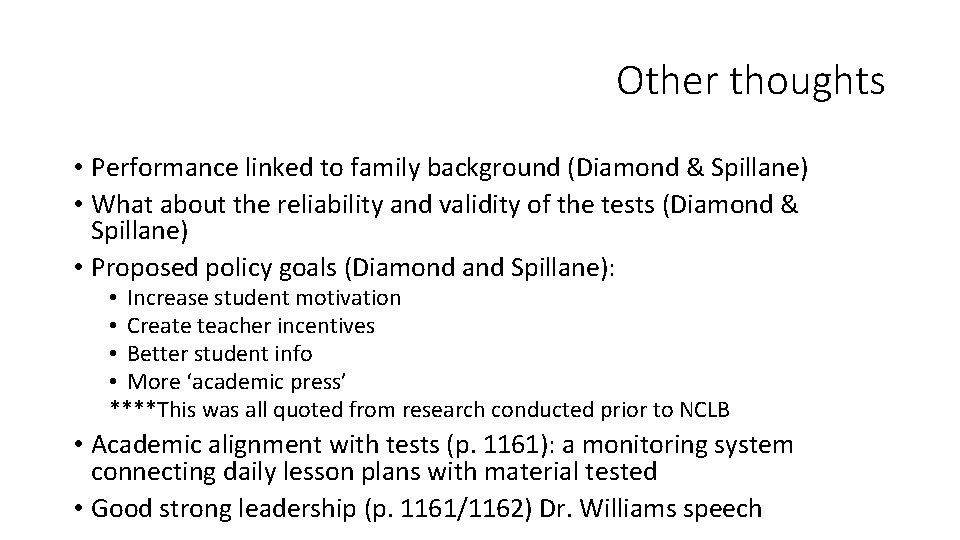
Other thoughts • Performance linked to family background (Diamond & Spillane) • What about the reliability and validity of the tests (Diamond & Spillane) • Proposed policy goals (Diamond and Spillane): • Increase student motivation • Create teacher incentives • Better student info • More ‘academic press’ ****This was all quoted from research conducted prior to NCLB • Academic alignment with tests (p. 1161): a monitoring system connecting daily lesson plans with material tested • Good strong leadership (p. 1161/1162) Dr. Williams speech
Other thoughts • The context is critical, but the context is much more complex than low-performing vs. high. • • Principal leadership styles and experience External factors Resources Political support
Conclusion • A good sequence of articles • Theory • 2 practical issues • 2 Cautions • Koyama might have overplayed a single SNAFU • Diamond and Spillane published in 2004—for a federal program, 2 -3 years is a relatively short time to implement and then evaluate its effectiveness
Conclusion • What is a more appropriate way to move forward? • How do we adjust curriculum or pedagogy based on what tests are telling us? • Teachers need complementary and shorter-term measures to hone in on learning problems (Supovitz, p. 223) • A more comprehensive system of assessment (Supovitz, p. 223) • Hints at a technological approach (Supovitz, p. 223)
Conclusion • Alternate look at assessment • ‘High-Tech’ approach • • Remote biometrics Remote heat sensing Other biological responses to learning/confusion/anxiety ‘Big Data’ analytics software (Apache &Hadoop—IBM, SAP, HP, MS, Oracle, Amazon), to integrate the data and provide a system of feedback to the teacher to react in real-time; collate the data and provide digestible reports to the principal for use in teacher development and school and district level reports for use by the school board.
Millimeter-Wave Remote Biometric Identification and Tracking (RBIT) System for Security Applications--Argonne National Laboratory and Northwestern University The mm. W RBIT System addresses the need for real-time, remote surveillance of aspects of human behavior. It involves the collection, measurement, and interpretation of biometric data from individuals (heart rate, breathing rate, and movement). Conducting constant surveillance on a large number of human subjects is difficult and complex. The task is especially difficult because the human targets are moving; thus, automated motion tracking and biometric surveillance from a distance are required. The tool must be noninvasive (i. e. , not touch the target) and work through clothing and perhaps walls. It must provide accurate results almost immediately. We developed this first remote heartbeat, respiration, and body motion identification and tracking system on the basis of modern mm. W techniques. Some of its beneficial features and capabilities are: Novel: It’s the first system to remotely identify and persistently track a subject while recording his or heartbeat, respiration, and movement; Nonintrusive: It senses through clothing and many common optically opaque materials, including masonry; Able to conduct long-range surveillance: It can take measurements from tens of meters away, and the camera maintains its aim when obstructions partially or temporarily block its field of view; Portable: The entire system can be rapidly deployed and adapted to covert operations; Fast response time: It provides real-time, on-the-spot measurements of biometric data; Reliable and secure: It uses advanced feature-extraction and data-analysis algorithms that are nearly 100% accurate in identifying humans and more than 98. 8% accurate in identifying heartbeat and respiration patterns; Adaptable: It can be integrated with existing vision-based biometric and video surveillance systems. • Many potential applications: It can be used for biometrics security, battlefield triage, to search for vital signs after disasters, to monitor a patient’s heart condition and movement, to combat identity theft, for on-line monitoring of operating machinery, and to monitor vehicles to avoid collisions.