
High Speed Networks and Internets Multimedia Transportation and
- Slides: 23
High Speed Networks and Internets: Multimedia Transportation and Quality of Service Meejeong Lee
Objectives l What is required to transport – Large volumes of traffic – With different Qo. S requirements – Over networks operating at very high data rates
The Need for Speed and Qo. S l Emergence of high-speed LANs – Explosive growth of processing power of personal computers – Network computing – Examples of requirements that calls for HSL l l l Centralized server farms Power workgroups High-speed local backbone – Examples of HSL: Fast Ethernet, Gigabit Ethernet, High speed wireless LAN, ATM LAN
The Need for Speed and Qo. S l Corporate Wide Area Networking needs – Intranet computing among dispersed employees – Internet access with graphical interfaces – Huge volumes of data with unpredictable traffic patterns
The Need for Speed and Qo. S l Digital electronics – Digital Video Disk (DVD) l l l Huge storage capacity and vivid quality PC games and educational software with more video New crest of traffic over the Internet and intranets as the material is incorporated into web sites – Digital still camera l l Convenience for use in networks Dramatic growth in the amount of on-line image and video traffic
The Need for Speed and Qo. S l Qo. S on the Internet – Internet and IP were designed to provide best-effort delivery service – With tremendous increase in traffic volume, and the introduction of new real -time, multimedia, and multicasting application, the traditional Internet services are woefully inadequately
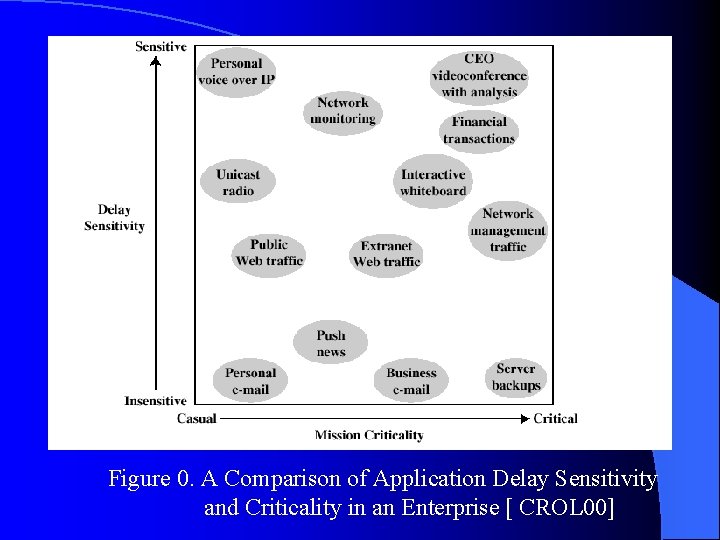
The Need for Speed and Qo. S l Qo. S requirements of Internet applications – Elastic traffic l Email, file transfer, network management, interactive applications(rlogin, web access) – Inelastic traffic l l Voice and video Throughput, delay variance, packet loss – Figure 0
Figure 0. A Comparison of Application Delay Sensitivity and Criticality in an Enterprise [ CROL 00]
Qo. S in IP Networks l Design requirements – Control congestion – Provide low delay – Provide high throughput – Support Qo. S – Provide fair service
Qo. S in IP Networks l Two complementary architectures – Integrated services – Differentiated services l Protocols for Qo. S support – RSVP: support the IS architecture by enabling the reservation of resources in a datagram environment – MPLS: framework for labeling traffic and routing based on traffic flows – RTP: transport level support for real-time application
Integrated Services Architecture (ISA) l Tools for controlling congestion in IPbased internet – Routing algorithm – Packet discard l ISA approaches – Admission control – Routing algorithm – Queueing discipline – Discard policy
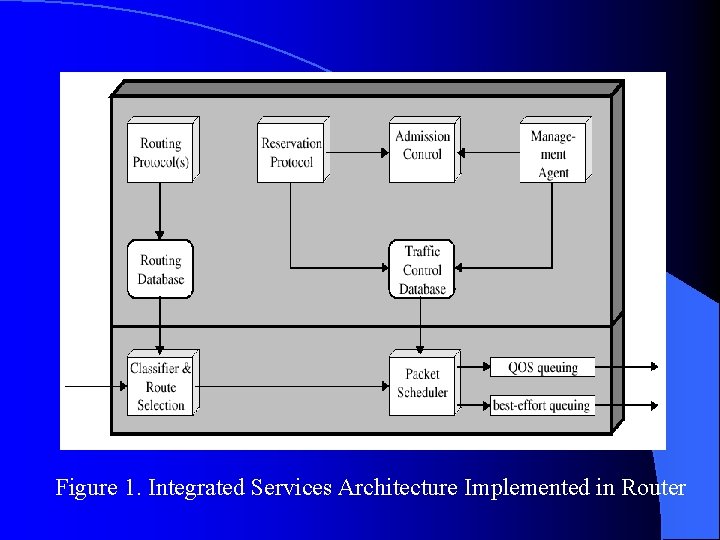
Integrated Services Architecture (ISA) l ISA components – Background functions l l Reservation protocol Admission control Management agent Routing protocol – Main task: forwarding of packets l l Classifier and route selection Packet scheduler – Figure 1
Figure 1. Integrated Services Architecture Implemented in Router
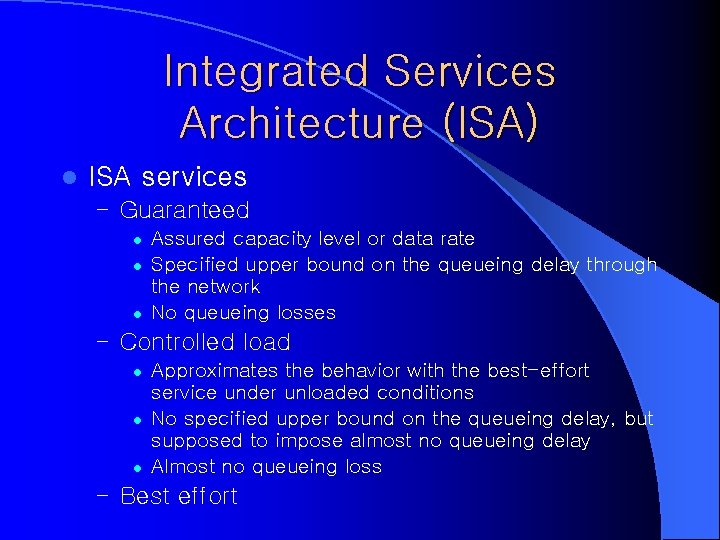
Integrated Services Architecture (ISA) l ISA services – Guaranteed l l l Assured capacity level or data rate Specified upper bound on the queueing delay through the network No queueing losses – Controlled load l l l Approximates the behavior with the best-effort service under unloaded conditions No specified upper bound on the queueing delay, but supposed to impose almost no queueing delay Almost no queueing loss – Best effort
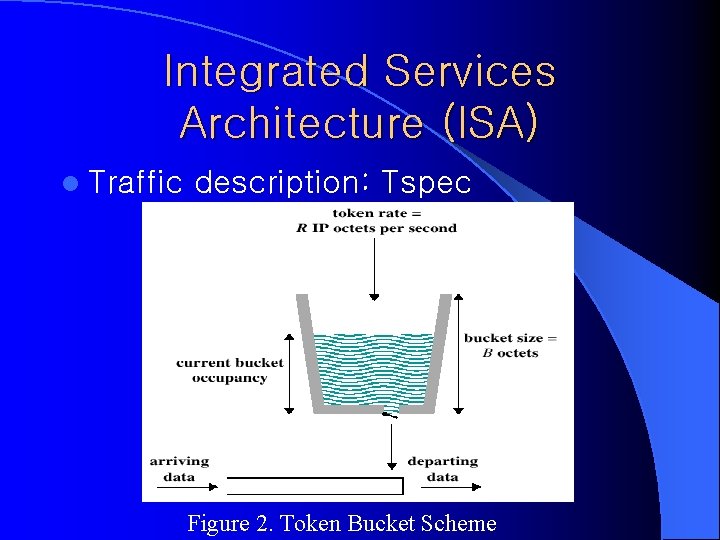
Integrated Services Architecture (ISA) l Traffic description: Tspec Figure 2. Token Bucket Scheme
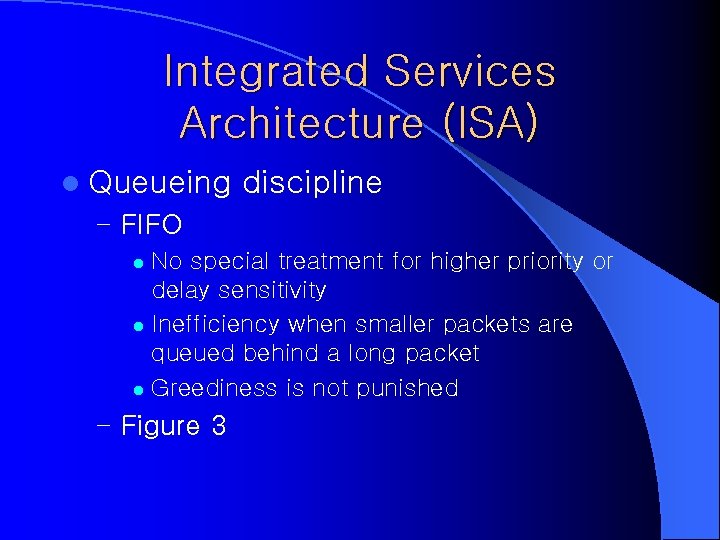
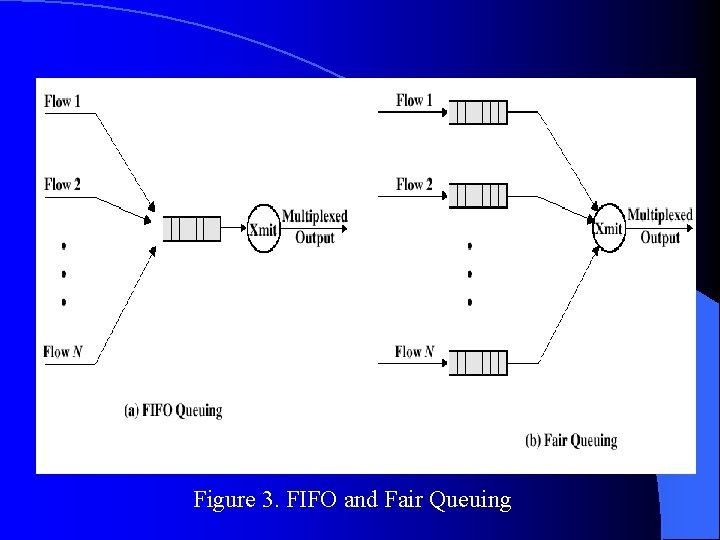
Integrated Services Architecture (ISA) l Queueing discipline – FIFO No special treatment for higher priority or delay sensitivity l Inefficiency when smaller packets are queued behind a long packet l Greediness is not punished l – Figure 3
Figure 3. FIFO and Fair Queuing
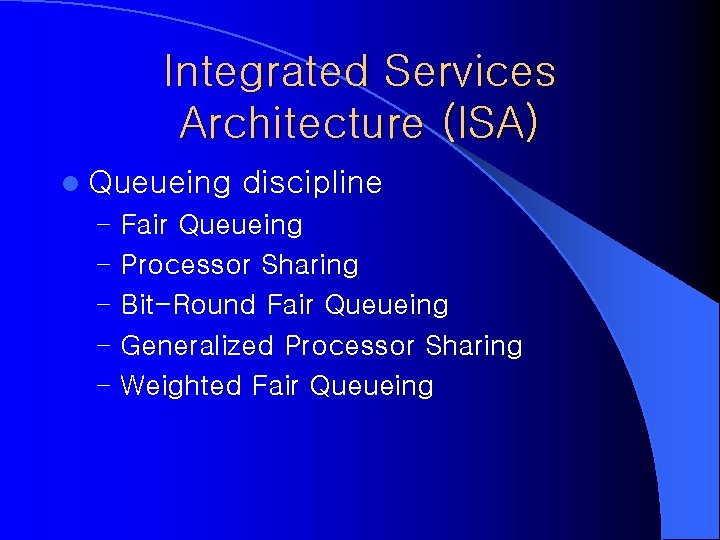
Integrated Services Architecture (ISA) l Queueing discipline – Fair Queueing – Processor Sharing – Bit-Round Fair Queueing – Generalized Processor Sharing – Weighted Fair Queueing
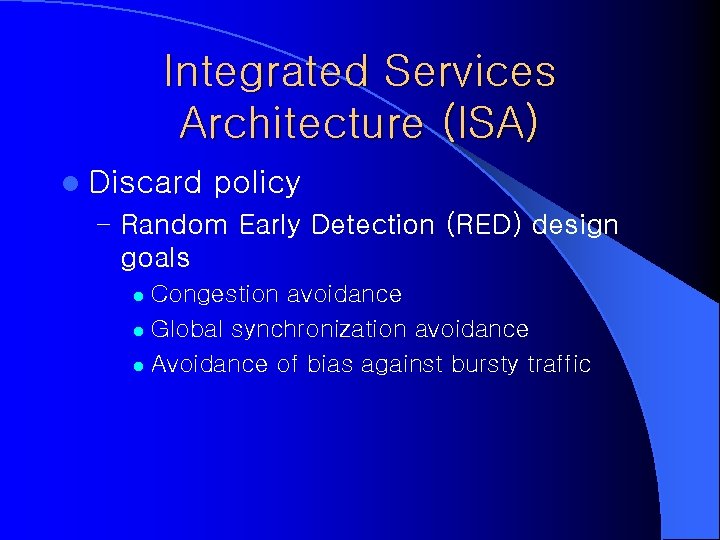
Integrated Services Architecture (ISA) l Discard policy – Random Early Detection (RED) design goals Congestion avoidance l Global synchronization avoidance l Avoidance of bias against bursty traffic l
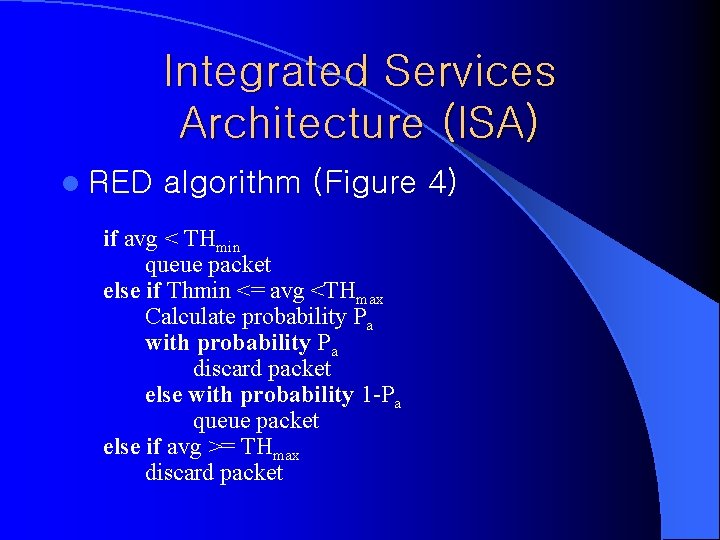
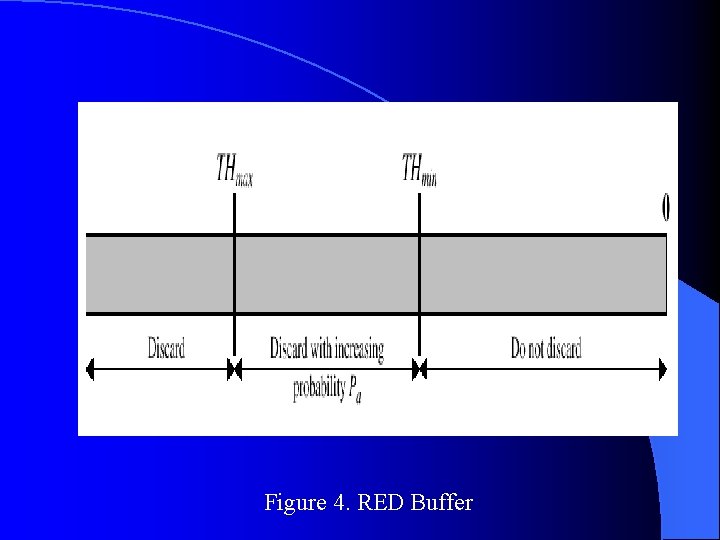
Integrated Services Architecture (ISA) l RED algorithm (Figure 4) if avg < THmin queue packet else if Thmin <= avg <THmax Calculate probability Pa with probability Pa discard packet else with probability 1 -Pa queue packet else if avg >= THmax discard packet
Figure 4. RED Buffer
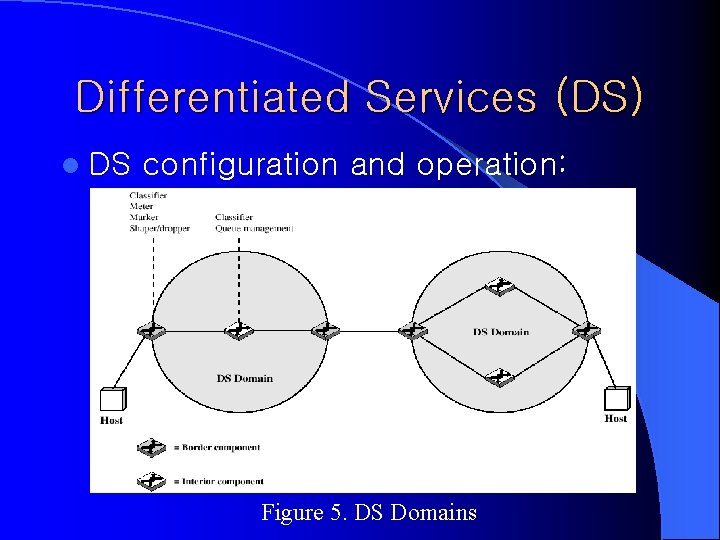
Differentiated Services (DS) l DS configuration and operation: Figure 5. DS Domains
Differentiated Services (DS) l Per-Hop Behavior (PHB) – Expedited Forwarding PHB: appears to the end points as a point-to-point connection or leased line – Assured Forwarding PHB: a service superior to best-effort