
High Speed Machining of Inconel 718 Focusing on
- Slides: 12
High Speed Machining of Inconel 718 Focusing on Wear Behaviours of PCBN Cutting Tool Haruki Tanaka, Tatsuya Sugihara, Toshiyuki Enomoto Department of Mechanical Engineering, Osaka University 7 th HPC 2016 – Procedia CIRP 46 (2016) 545 -548 1
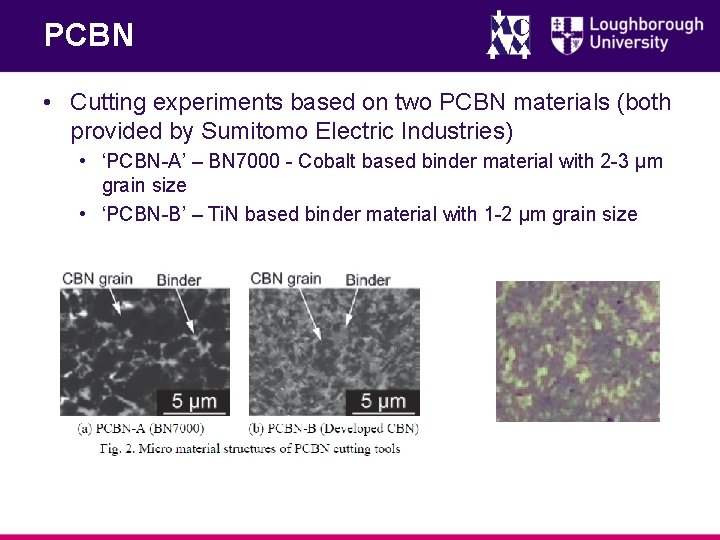
PCBN • Cutting experiments based on two PCBN materials (both provided by Sumitomo Electric Industries) • ‘PCBN-A’ – BN 7000 - Cobalt based binder material with 2 -3 μm grain size • ‘PCBN-B’ – Ti. N based binder material with 1 -2 μm grain size
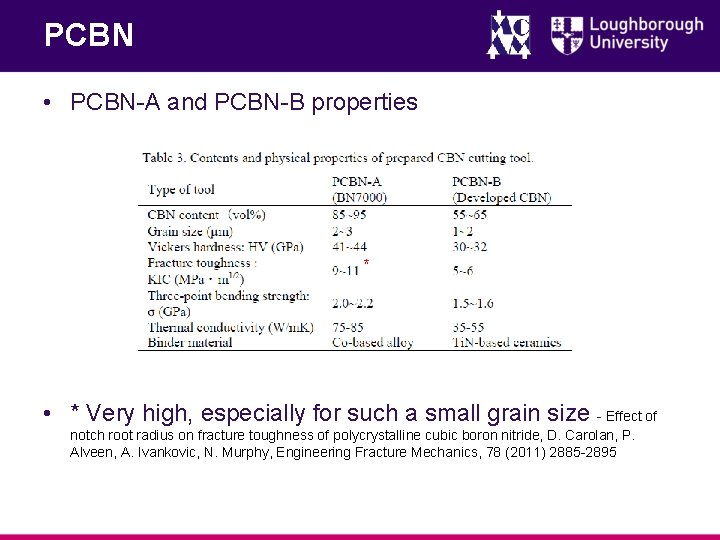
PCBN • PCBN-A and PCBN-B properties * • * Very high, especially for such a small grain size - Effect of notch root radius on fracture toughness of polycrystalline cubic boron nitride, D. Carolan, P. Alveen, A. Ivankovic, N. Murphy, Engineering Fracture Mechanics, 78 (2011) 2885 -2895
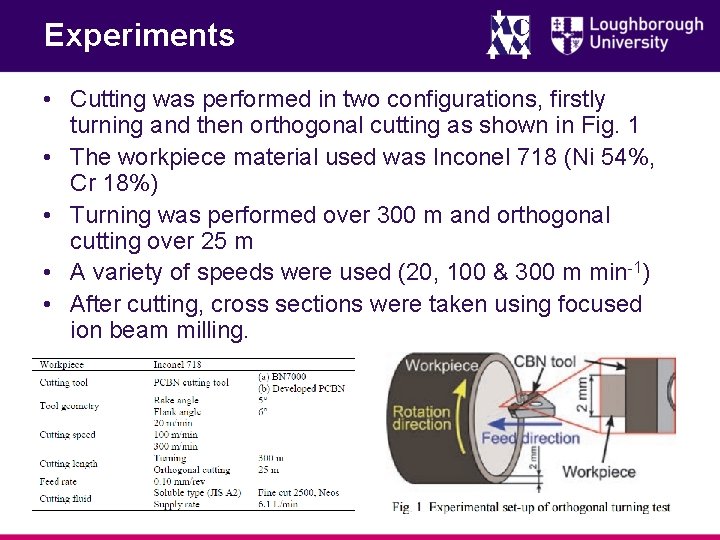
Experiments • Cutting was performed in two configurations, firstly turning and then orthogonal cutting as shown in Fig. 1 • The workpiece material used was Inconel 718 (Ni 54%, Cr 18%) • Turning was performed over 300 m and orthogonal cutting over 25 m • A variety of speeds were used (20, 100 & 300 m min-1) • After cutting, cross sections were taken using focused ion beam milling.
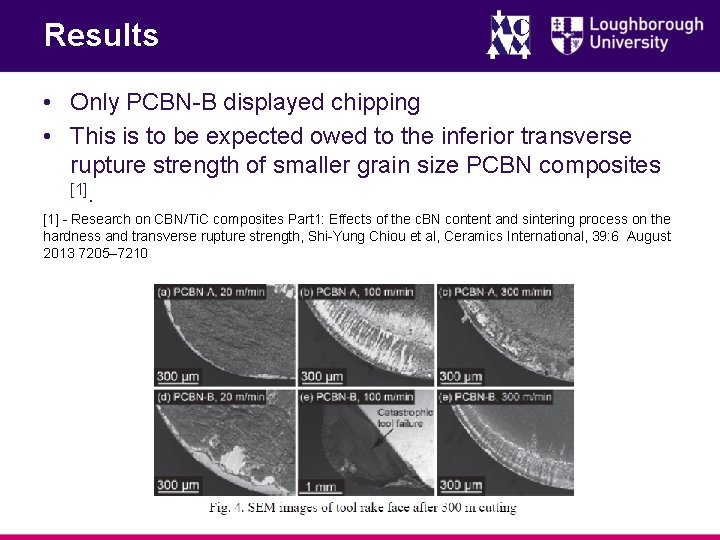
Results • Only PCBN-B displayed chipping • This is to be expected owed to the inferior transverse rupture strength of smaller grain size PCBN composites [1] - Research on CBN/Ti. C composites Part 1: Effects of the c. BN content and sintering process on the hardness and transverse rupture strength, Shi-Yung Chiou et al, Ceramics International, 39: 6 August 2013 7205– 7210
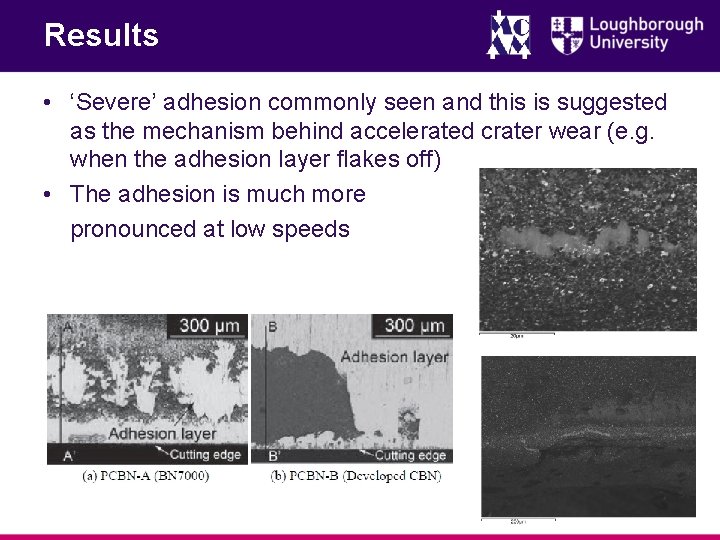
Results • ‘Severe’ adhesion commonly seen and this is suggested as the mechanism behind accelerated crater wear (e. g. when the adhesion layer flakes off) • The adhesion is much more pronounced at low speeds
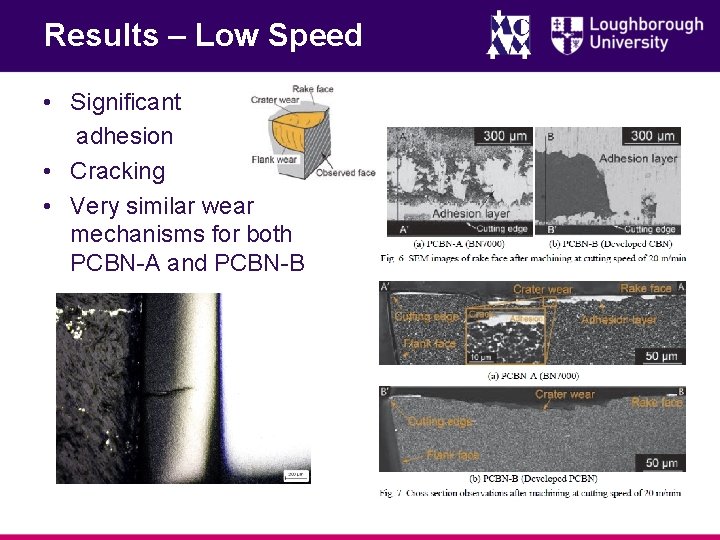
Results – Low Speed • Significant adhesion • Cracking • Very similar wear mechanisms for both PCBN-A and PCBN-B
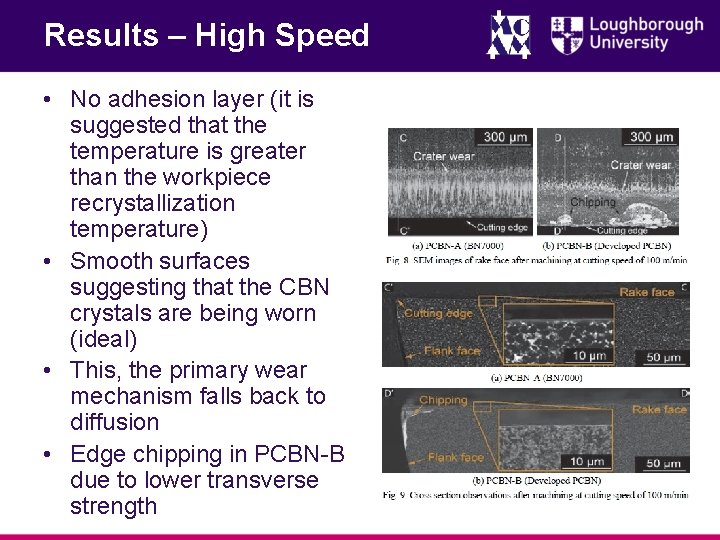
Results – High Speed • No adhesion layer (it is suggested that the temperature is greater than the workpiece recrystallization temperature) • Smooth surfaces suggesting that the CBN crystals are being worn (ideal) • This, the primary wear mechanism falls back to diffusion • Edge chipping in PCBN-B due to lower transverse strength
Conclusions 1. PCBN tool life depends significantly on cutting speed and PCBN tool material structures 2. At low cutting speed, crater wear is significantly accelerated by adhesion 3. At high cutting speed, diffusion due to high temperature is the primary driver behind crater wear. [Unless tool force exceeds] inferior mechanical properties 4. The Ti. N based binder tool displayed better wear resistance due to it’s superior temperature resistance and chemical stability.
Limitations • Too many differences between PCBN samples to fully attribute findings to any one property (e. g. grain size, binder material) • NEOS Co Finecut 2500 was used as a lubricant. Finecut 2500 is a fluorine based surfactant[1] and fluorine is known to have a strong chemical interaction with BN[2] though no remark was made to this effect. • For the chipped tool, time before failure was not quoted. • Conclusion 1) was already common knowledge [1] - http: //www. neos. co. jp/eng/product/ [2] - The roles of hydrogen and fluorine in the deposition of cubic boron nitride films in the Ar–N 2–BF 3 –H 2 system, W. J Zhang, S Matsumoto, 330 I 3 -4 10 November 2000, 243 -248
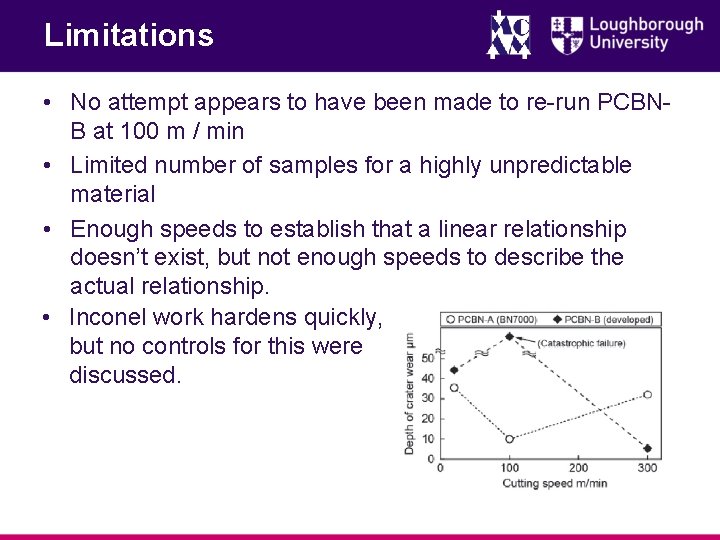
Limitations • No attempt appears to have been made to re-run PCBNB at 100 m / min • Limited number of samples for a highly unpredictable material • Enough speeds to establish that a linear relationship doesn’t exist, but not enough speeds to describe the actual relationship. • Inconel work hardens quickly, but no controls for this were discussed.
Mechanics of Advanced Materials Research Group High speed machining of Inconel 718 focusing on wear behaviours of PCBN cutting tool 7 th HPC 2016 – CIRP Conference on High Performance Cutting Procedia CIRP 46 ( 2016 ) 545 – 548 12