
High Speed Logic Transmission lines v 8 b
High Speed Logic Transmission lines (v. 8 b) 1
Transmission lines overview § (1) Characteristics of and applications of Transmission lines § (2) Reflections in transmission lines and methods to reduce them § Appendix 1 l Mathematics of transmission lines Transmission lines (v. 8 b) 2
(1) Characteristics of and applications of Transmission lines § Advantages: l Less distortion, radiation (EMI), cross-talk § Disadvantage l More power required. § Applications, can hanlde l l Signals traveling in long distance in Printedcircuit-board PCB Signals in a cables, connectors (USB, PCI). Transmission lines (v. 8 b) 3
Advantage of using transmission lines: Reduce Electromagnetic Interference (EMI) in point-to-point wiring § Wire-wrap connections create EMI. § Transmission lines reduce EMI because, l Current loop area is small, also it constraints the return current (in ground plane) closer to the outgoing signal path, magnetic current cancel each other. Transmission lines (v. 8 b) 4
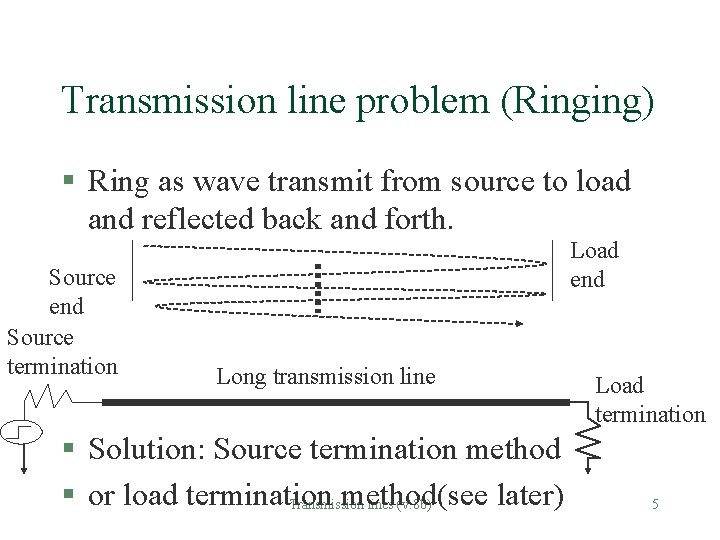
Transmission line problem (Ringing) § Ring as wave transmit from source to load and reflected back and forth. Source end Source termination Load end Long transmission line § Solution: Source termination method § or load termination method(see later) Transmission lines (v. 8 b) Load termination 5
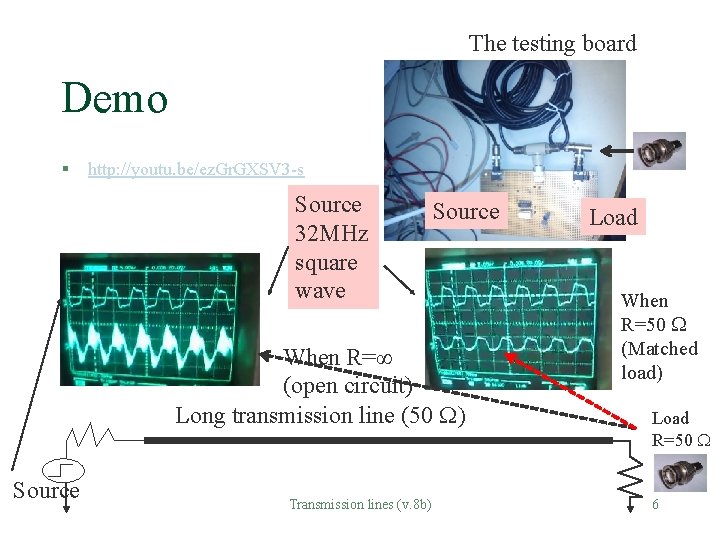
The testing board Demo § http: //youtu. be/ez. Gr. GXSV 3 -s Source 32 MHz square wave Source When R=∞ (open circuit) Long transmission line (50 ) Source Transmission lines (v. 8 b) Load When R=50 (Matched load) Load R=50 6
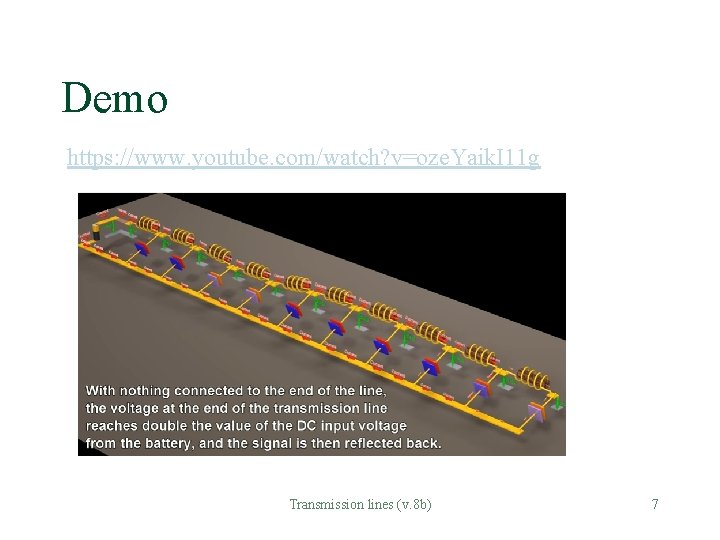
Demo https: //www. youtube. com/watch? v=oze. Yaik. I 11 g Transmission lines (v. 8 b) 7
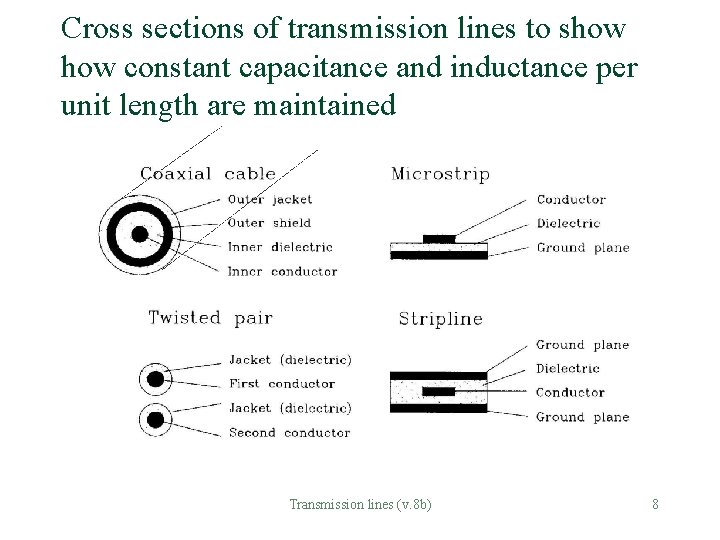
Cross sections of transmission lines to show constant capacitance and inductance per unit length are maintained § Transmission lines (v. 8 b) 8
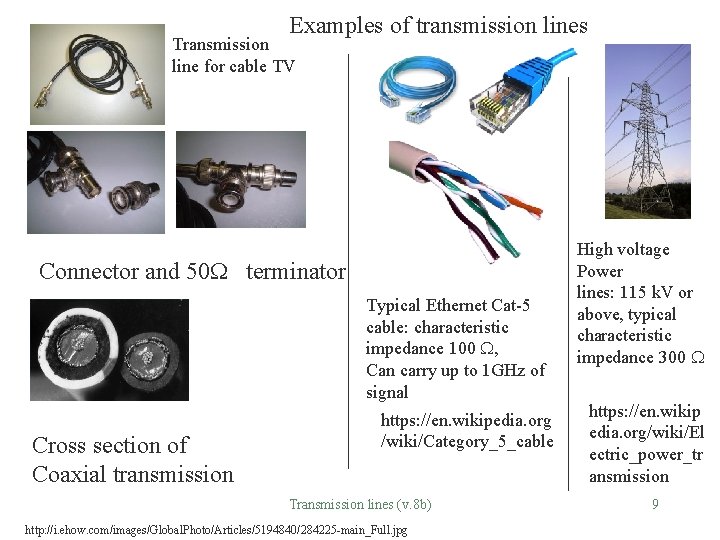
Examples of transmission lines Transmission line for cable TV Connector and 50 terminator Typical Ethernet Cat-5 cable: characteristic impedance 100 , Can carry up to 1 GHz of signal Cross section of Coaxial transmission https: //en. wikipedia. org /wiki/Category_5_cable Transmission lines (v. 8 b) http: //i. ehow. com/images/Global. Photo/Articles/5194840/284225 -main_Full. jpg High voltage Power lines: 115 k. V or above, typical characteristic impedance 300 https: //en. wikip edia. org/wiki/El ectric_power_tr ansmission 9
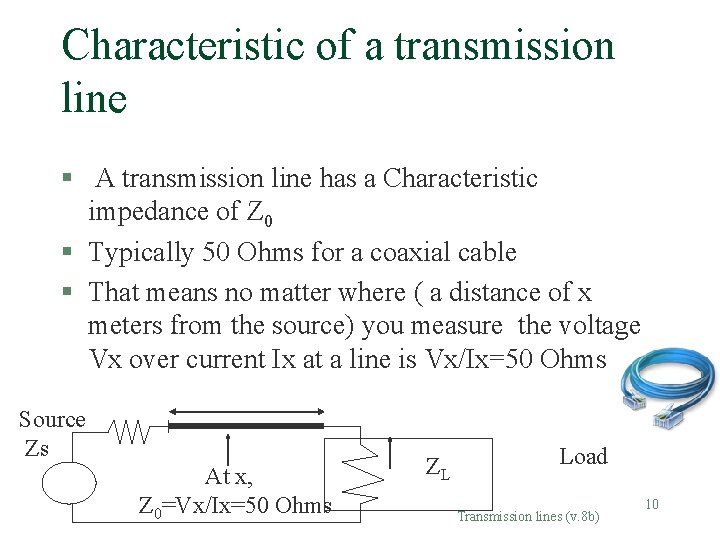
Characteristic of a transmission line § A transmission line has a Characteristic impedance of Z 0 § Typically 50 Ohms for a coaxial cable § That means no matter where ( a distance of x meters from the source) you measure the voltage Vx over current Ix at a line is Vx/Ix=50 Ohms Source Zs At x, Z 0=Vx/Ix=50 Ohms ZL Load Transmission lines (v. 8 b) 10
(2) Reflections in transmission lines and methods to reduce them Signals inside the line (assume the signal frequency is a constant) Transmission lines (v. 8 b) 11
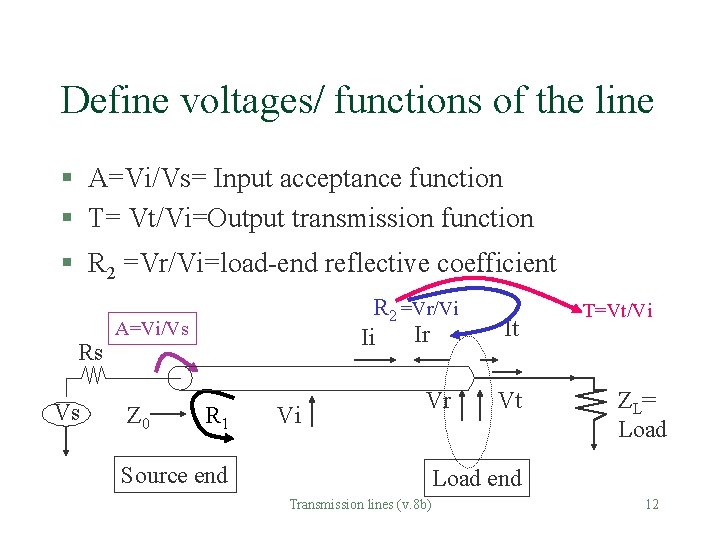
Define voltages/ functions of the line § A=Vi/Vs= Input acceptance function § T= Vt/Vi=Output transmission function § R 2 =Vr/Vi=load-end reflective coefficient Rs Vs R 2 =Vr/Vi Ir Ii A=Vi/Vs Z 0 R 1 Vi Vr Source end It Vt T=Vt/Vi Z L= Load end Transmission lines (v. 8 b) 12
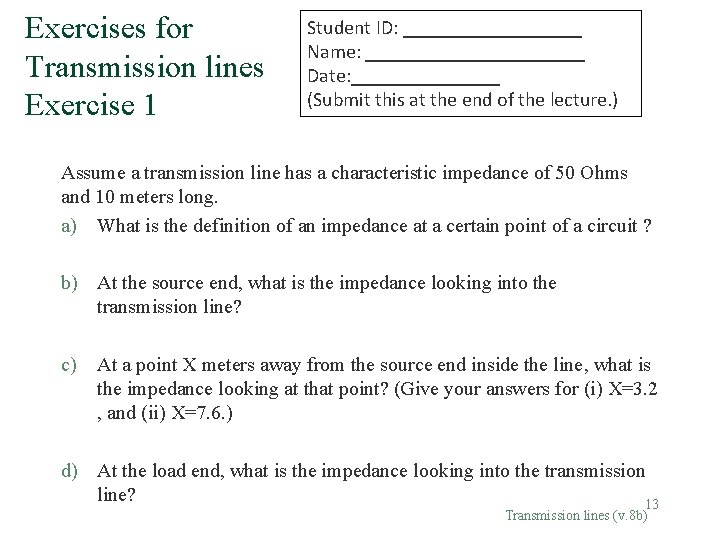
Exercises for Transmission lines Exercise 1 Student ID: _________ Name: ___________ Date: ________ (Submit this at the end of the lecture. ) Assume a transmission line has a characteristic impedance of 50 Ohms and 10 meters long. a) What is the definition of an impedance at a certain point of a circuit ? b) At the source end, what is the impedance looking into the transmission line? c) At a point X meters away from the source end inside the line, what is the impedance looking at that point? (Give your answers for (i) X=3. 2 , and (ii) X=7. 6. ) d) At the load end, what is the impedance looking into the transmission line? 13 Transmission lines (v. 8 b)
Load-end reflection Load-end reflective coefficient R 2 Output transmission function T Transmission lines (v. 8 b) 14
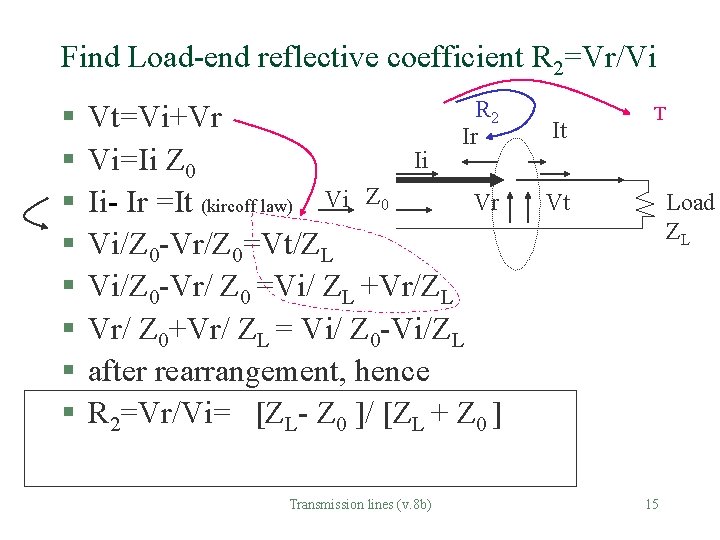
Find Load-end reflective coefficient R 2=Vr/Vi § § § § R 2 Vt=Vi+Vr Ir Ii Vi=Ii Z 0 Vr Ii- Ir =It (kircoff law) Vi Z 0 Vi/Z 0 -Vr/Z 0=Vt/ZL Vi/Z 0 -Vr/ Z 0 =Vi/ ZL +Vr/ZL Vr/ Z 0+Vr/ ZL = Vi/ Z 0 -Vi/ZL after rearrangement, hence R 2=Vr/Vi= [ZL- Z 0 ]/ [ZL + Z 0 ] Transmission lines (v. 8 b) It T Vt Load ZL 15
![Exercise 2 R 2=Vr/Vi= [ZL- Z 0 ]/ [ZL + Z 0 ] §](http://slidetodoc.com/presentation_image_h2/53257b1ad6350f211f1d45aa9b99e810/image-16.jpg "Exercise 2 R 2=Vr/Vi= [ZL- Z 0 ]/ [ZL + Z 0 ] §")
Exercise 2 R 2=Vr/Vi= [ZL- Z 0 ]/ [ZL + Z 0 ] § Assume a transmission line has a characteristic impedance of Z 0=50 Ohms and 10 meters long. The source impedance is RS=5 Ohms, and load impedance is RL=70 Ohms. a) Draw the diagram of this circuit. b) What is the meaning of Load-end reflective coefficient (R 2) in English? c) Calculate the value of R 2 of this circuit. Transmission lines (v. 8 b) 16
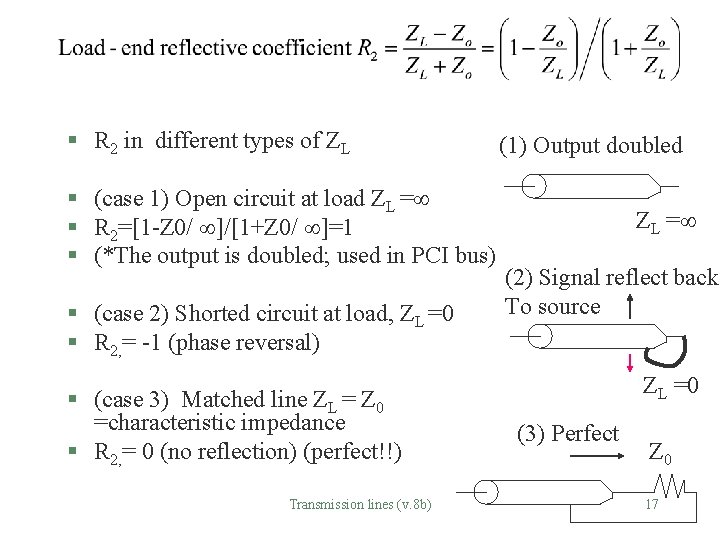
§ R 2 in different types of ZL § (case 1) Open circuit at load ZL = § R 2=[1 -Z 0/ ]/[1+Z 0/ ]=1 § (*The output is doubled; used in PCI bus) § (case 2) Shorted circuit at load, ZL =0 § R 2, = -1 (phase reversal) § (case 3) Matched line ZL = Z 0 =characteristic impedance § R 2, = 0 (no reflection) (perfect!!) Transmission lines (v. 8 b) (1) Output doubled ZL = (2) Signal reflect back To source ZL =0 (3) Perfect Z 0 17
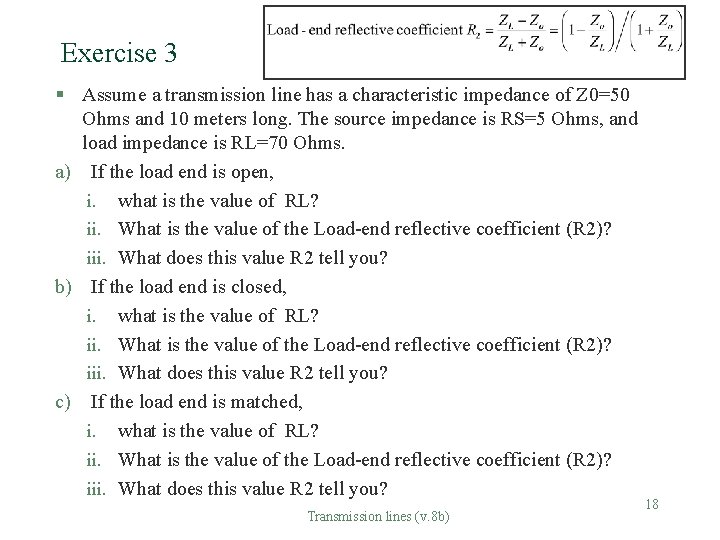
Exercise 3 § Assume a transmission line has a characteristic impedance of Z 0=50 Ohms and 10 meters long. The source impedance is RS=5 Ohms, and load impedance is RL=70 Ohms. a) If the load end is open, i. what is the value of RL? ii. What is the value of the Load-end reflective coefficient (R 2)? iii. What does this value R 2 tell you? b) If the load end is closed, i. what is the value of RL? ii. What is the value of the Load-end reflective coefficient (R 2)? iii. What does this value R 2 tell you? c) If the load end is matched, i. what is the value of RL? ii. What is the value of the Load-end reflective coefficient (R 2)? iii. What does this value R 2 tell you? Transmission lines (v. 8 b) 18
Load-end transmission Output transmission function T Transmission lines (v. 8 b) 19
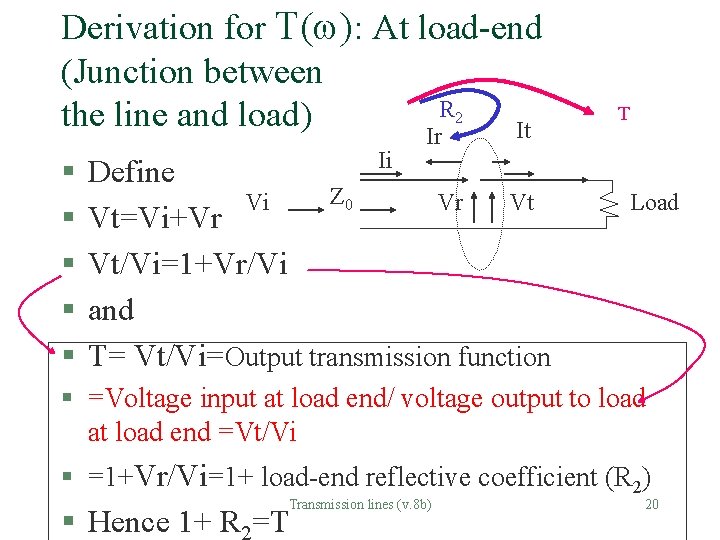
Derivation for T( ): At load-end (Junction between R 2 the line and load) It Ir § § § Ii Define Z 0 Vi Vr Vt Vt=Vi+Vr Vt/Vi=1+Vr/Vi and T= Vt/Vi=Output transmission function T Load § =Voltage input at load end/ voltage output to load at load end =Vt/Vi § =1+Vr/Vi=1+ load-end reflective coefficient (R 2) Transmission lines (v. 8 b) § Hence 1+ R =T 20
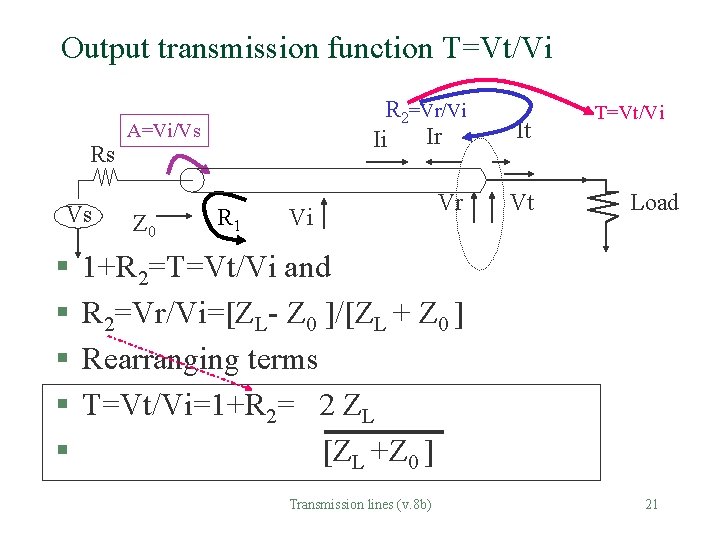
Output transmission function T=Vt/Vi Rs Vs § § § A=Vi/Vs Z 0 R 1 R 2=Vr/Vi Ir Ii It Vr Vt Vi T=Vt/Vi Load 1+R 2=T=Vt/Vi and R 2=Vr/Vi=[ZL- Z 0 ]/[ZL + Z 0 ] Rearranging terms T=Vt/Vi=1+R 2= 2 ZL [ZL +Z 0 ] Transmission lines (v. 8 b) 21
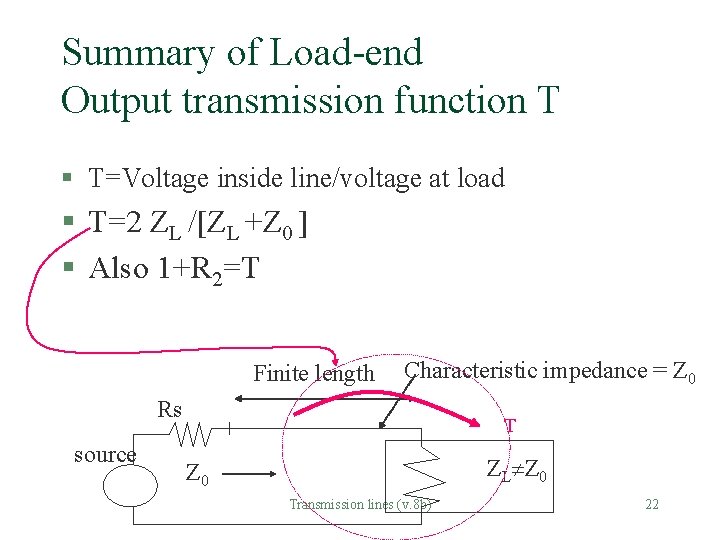
Summary of Load-end Output transmission function T § T=Voltage inside line/voltage at load § T=2 ZL /[ZL +Z 0 ] § Also 1+R 2=T Finite length Characteristic impedance = Z 0 Rs source T ZL Z 0 Transmission lines (v. 8 b) 22
![Exercise 4 Output transmission function T T=Vt/Vi=2 ZL /[ZL +Z 0 ] § Assume](http://slidetodoc.com/presentation_image_h2/53257b1ad6350f211f1d45aa9b99e810/image-23.jpg "Exercise 4 Output transmission function T T=Vt/Vi=2 ZL /[ZL +Z 0 ] § Assume")
Exercise 4 Output transmission function T T=Vt/Vi=2 ZL /[ZL +Z 0 ] § Assume a transmission line has a characteristic impedance of Z 0=50 Ohms and 10 meters long. The source impedance is RS=5 Ohms, and load impedance is RL=70 Ohms. a) What is the definition of Output transmission function T? b) If the load end is open, i. what is the value of the Output transmission function T? ii. What does this T value tell you? c) If the load end is closed, i. what is the value of the Output transmission function T? ii. What does this value T tell you? d) If the load end is matched, i. what is the value of the Output transmission function T. ii. What does this value T tell you? 23 Transmission lines (v. 8 b)
Source-end reflection Source-end reflective coefficient R 1 Input acceptance function A Transmission lines (v. 8 b) 24
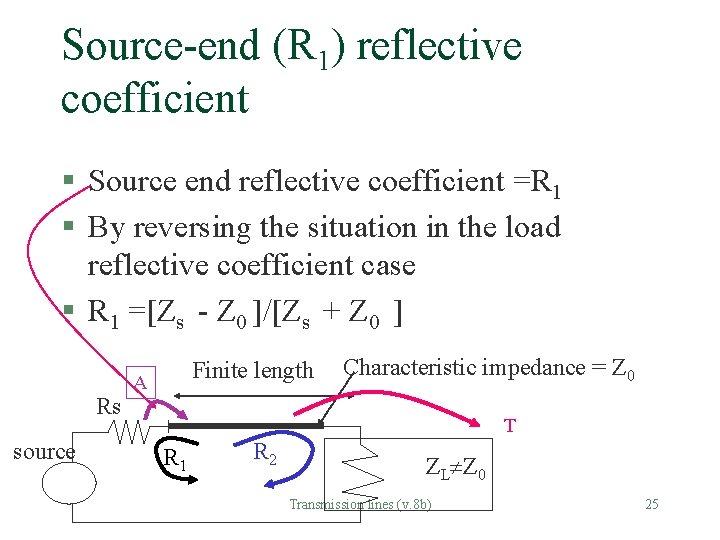
Source-end (R 1) reflective coefficient § Source end reflective coefficient =R 1 § By reversing the situation in the load reflective coefficient case § R 1 =[Zs - Z 0 ]/[Zs + Z 0 ] Rs source Finite length A Characteristic impedance = Z 0 T R 1 R 2 ZL Z 0 Transmission lines (v. 8 b) 25
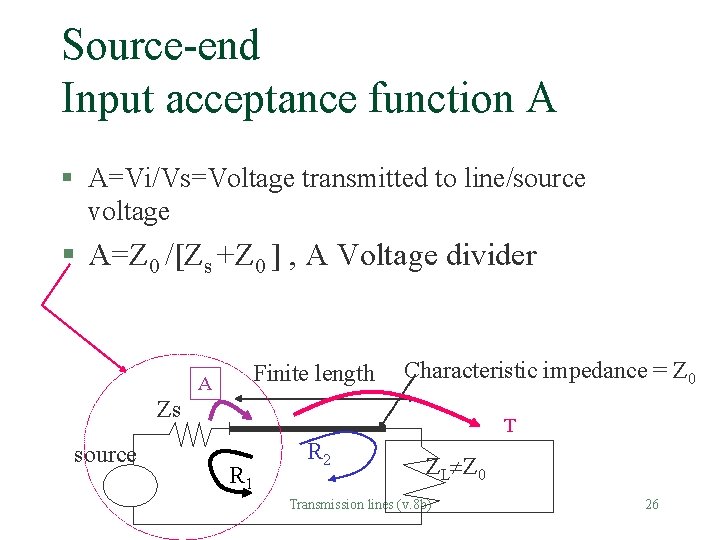
Source-end Input acceptance function A § A=Vi/Vs=Voltage transmitted to line/source voltage § A=Z 0 /[Zs +Z 0 ] , A Voltage divider Finite length A Characteristic impedance = Z 0 Zs source T R 1 R 2 ZL Z 0 Transmission lines (v. 8 b) 26
![Exercise 5 Source-end Input acceptance function A A=Vi/Vs=Z 0 /[Zs +Z 0 ] §](http://slidetodoc.com/presentation_image_h2/53257b1ad6350f211f1d45aa9b99e810/image-27.jpg "Exercise 5 Source-end Input acceptance function A A=Vi/Vs=Z 0 /[Zs +Z 0 ] §")
Exercise 5 Source-end Input acceptance function A A=Vi/Vs=Z 0 /[Zs +Z 0 ] § Assume a transmission line has a characteristic impedance of Z 0=50 Ohms and 10 meters long. The source impedance is RS=5 Ohms, and load impedance is RL=70 Ohms. a) What is the definition of the Source-end Input acceptance function ? b) If the source end is 5 Ohms, i. what is the value of Source-end Input acceptance function A? ii. What does this A value tell you? c) If the source end is matched, i. what is the value of RS? ii. What is the value of Source-end Input acceptance function A? iii. What is the advantage of this setting (RS= characteristic impedance of the line Z 0)? 27 Transmission lines (v. 8 b)
Reflections on un-matched transmission lines § Reflection happens in un-terminated transmission line. § Ways to reduce reflections l l l End termination eliminates the first reflection at load. Source reflection eliminates second reflection at source. Very short wire -- 1/6 of the length traveled by the edge (lumped circuit) has little reflection. 28 Transmission lines (v. 8 b)
![A summary § § A= Input acceptance func=Z 0 /[Zs +Z 0 ]. T=Output](http://slidetodoc.com/presentation_image_h2/53257b1ad6350f211f1d45aa9b99e810/image-29.jpg "A summary § § A= Input acceptance func=Z 0 /[Zs +Z 0 ]. T=Output")
A summary § § A= Input acceptance func=Z 0 /[Zs +Z 0 ]. T=Output transmission func. = 2 ZL/[ZL+Z 0]= 1+ R 2=load-end reflective coef. =[ZL - Z 0 ]/ [ZL + Z 0 ] R 1=source-end reflective coef. =[Zs - Z 0 ]/[Zs + Z 0 ] Transmission lines (v. 8 b) 29
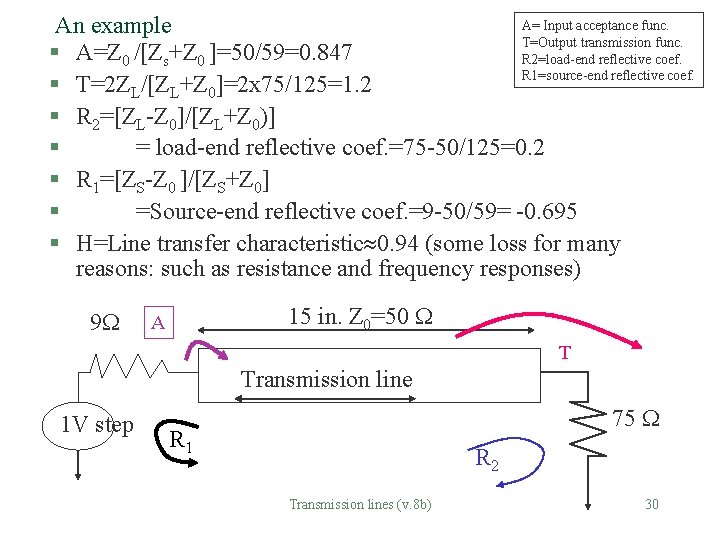
A= Input acceptance func. An example T=Output transmission func. § A=Z 0 /[Zs+Z 0 ]=50/59=0. 847 R 2=load-end reflective coef. R 1=source-end reflective coef. § T=2 ZL/[ZL+Z 0]=2 x 75/125=1. 2 § R 2=[ZL-Z 0]/[ZL+Z 0)] § = load-end reflective coef. =75 -50/125=0. 2 § R 1=[ZS-Z 0 ]/[ZS+Z 0] § =Source-end reflective coef. =9 -50/59= -0. 695 § H=Line transfer characteristic 0. 94 (some loss for many reasons: such as resistance and frequency responses) 9 15 in. Z 0=50 A T Transmission line 1 V step 75 R 1 R 2 Transmission lines (v. 8 b) 30
![Delay=Tp=180 ps/in 15 in => Tdelay= 2700 ps From [1] Transmission lines (v. 8](http://slidetodoc.com/presentation_image_h2/53257b1ad6350f211f1d45aa9b99e810/image-31.jpg "Delay=Tp=180 ps/in 15 in => Tdelay= 2700 ps From [1] Transmission lines (v. 8")
Delay=Tp=180 ps/in 15 in => Tdelay= 2700 ps From [1] Transmission lines (v. 8 b) 31
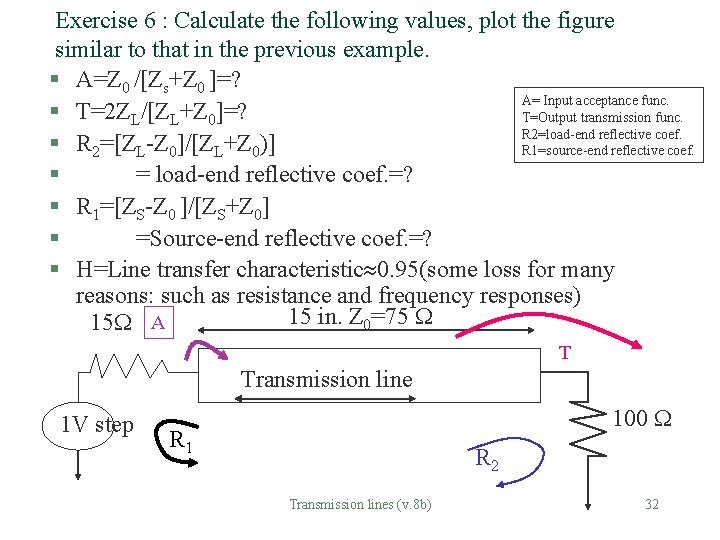
Exercise 6 : Calculate the following values, plot the figure similar to that in the previous example. § A=Z 0 /[Zs+Z 0 ]=? A= Input acceptance func. § T=2 ZL/[ZL+Z 0]=? T=Output transmission func. R 2=load-end reflective coef. § R 2=[ZL-Z 0]/[ZL+Z 0)] R 1=source-end reflective coef. § = load-end reflective coef. =? § R 1=[ZS-Z 0 ]/[ZS+Z 0] § =Source-end reflective coef. =? § H=Line transfer characteristic 0. 95(some loss for many reasons: such as resistance and frequency responses) 15 in. Z 0=75 15 A T Transmission line 1 V step 100 R 1 R 2 Transmission lines (v. 8 b) 32
Ways to reduce reflections § End termination -- If ZL=Z 0, no first reflective would be generated. Easy to implement but sometimes you cannot change the load impedance. § Source termination -- If Zs=Z 0 The first reflective wave arriving at the source would not go back to the load again. Easy to implement but sometimes you cannot change the source impedance. § Short (lumped) wire: all reflections merged when l l Length << Trise/{6 (LC) } But sometimes it is not possible Transmission lines (v. 8 b)to use short wire. 33
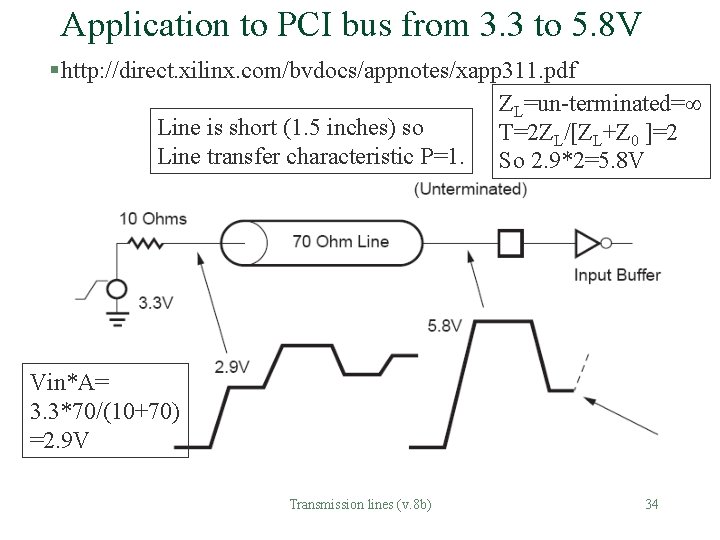
Application to PCI bus from 3. 3 to 5. 8 V § http: //direct. xilinx. com/bvdocs/appnotes/xapp 311. pdf ZL=un-terminated= Line is short (1. 5 inches) so T=2 ZL/[ZL+Z 0 ]=2 Line transfer characteristic P=1. So 2. 9*2=5. 8 V Vin*A= 3. 3*70/(10+70) =2. 9 V Transmission lines (v. 8 b) 34
From: http: //direct. xilinx. com/bvdocs/appnotes/xapp 311. pdf § [The PCI electrical spec is defined in such a way as to provide open termination incident wave switching across a wide range of board impedances. It does this by defining minimum and maximum driving impedances for the ICs output buffers. The PCI specification also stipulates mandatory use of an input clamp diode to VCC for 3. 3 V signaling. The reason for this is to ensure signal integrity at the input pin by preventing the resultant ringing on lowto-high edges from dipping below the switching threshold. To see this, consider the unclamped case, which is shown in Figure 3. A 3. 3 V output signal from a 10 ohm source impedance 1 into a 70 ohm transmission line will generate an incident wave voltage of 5. 8 V at the receiving end. After two flight delays, a negative reflected wave will follow, getting dangerously close to the upper end of the input 35 Transmission lines (v. 8 b) threshold 2. ]
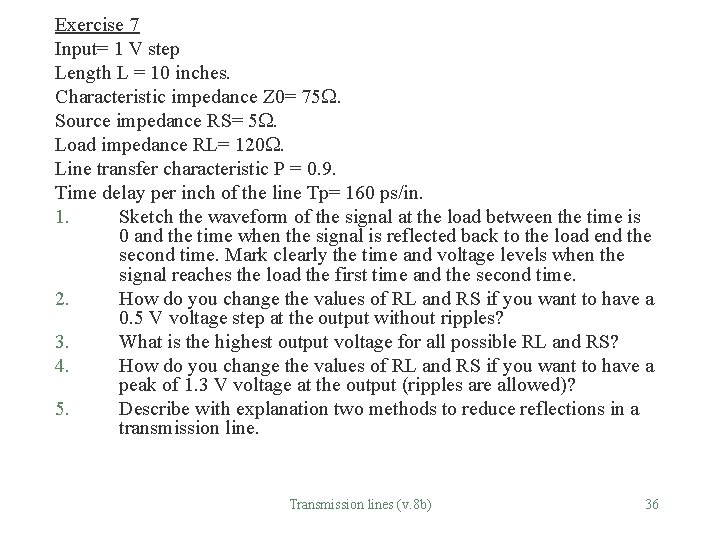
Exercise 7 Input= 1 V step Length L = 10 inches. Characteristic impedance Z 0= 75. Source impedance RS= 5. Load impedance RL= 120. Line transfer characteristic P = 0. 9. Time delay per inch of the line Tp= 160 ps/in. 1. Sketch the waveform of the signal at the load between the time is 0 and the time when the signal is reflected back to the load end the second time. Mark clearly the time and voltage levels when the signal reaches the load the first time and the second time. 2. How do you change the values of RL and RS if you want to have a 0. 5 V voltage step at the output without ripples? 3. What is the highest output voltage for all possible RL and RS? 4. How do you change the values of RL and RS if you want to have a peak of 1. 3 V voltage at the output (ripples are allowed)? 5. Describe with explanation two methods to reduce reflections in a transmission line. Transmission lines (v. 8 b) 36
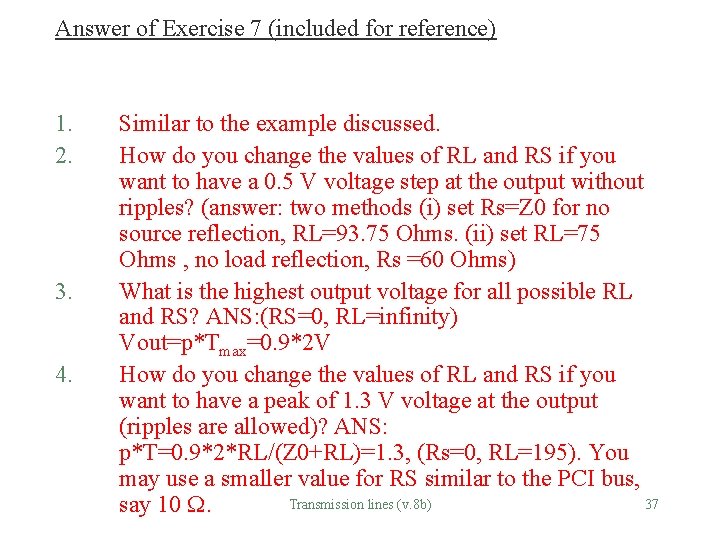
Answer of Exercise 7 (included for reference) 1. 2. 3. 4. Similar to the example discussed. How do you change the values of RL and RS if you want to have a 0. 5 V voltage step at the output without ripples? (answer: two methods (i) set Rs=Z 0 for no source reflection, RL=93. 75 Ohms. (ii) set RL=75 Ohms , no load reflection, Rs =60 Ohms) What is the highest output voltage for all possible RL and RS? ANS: (RS=0, RL=infinity) Vout=p*Tmax=0. 9*2 V How do you change the values of RL and RS if you want to have a peak of 1. 3 V voltage at the output (ripples are allowed)? ANS: p*T=0. 9*2*RL/(Z 0+RL)=1. 3, (Rs=0, RL=195). You may use a smaller value for RS similar to the PCI bus, Transmission lines (v. 8 b) 37 say 10 .
Conclusion § Studied Characteristics of transmission lines. § Studied ways to terminate the line to avoid reflection. Transmission lines (v. 8 b) 38
![References § [1]Chapter 4 of High speed digital design , by Johnson and Graham](http://slidetodoc.com/presentation_image_h2/53257b1ad6350f211f1d45aa9b99e810/image-39.jpg "References § [1]Chapter 4 of High speed digital design , by Johnson and Graham")
References § [1]Chapter 4 of High speed digital design , by Johnson and Graham § [2] Kreyszig, Advanced Engineering maths, edition 6, Page 74 § [3] Buckley, Transmissions networks and circuits , The Macmillan press. Page 1 § [4]http: //direct. xilinx. com/bvdocs/appnotes/ xapp 311. pdf (For PCI application) Transmission lines (v. 8 b) 39
Appendix 1 Transmission lines (v. 8 b) 40
Mathematics of transmission lines Transmission lines (v. 8 b) 41
![Main formulas (for proof, see appendix 1) § If = [(R+ j L)(G+j C)]](http://slidetodoc.com/presentation_image_h2/53257b1ad6350f211f1d45aa9b99e810/image-42.jpg "Main formulas (for proof, see appendix 1) § If = [(R+ j L)(G+j C)]")
Main formulas (for proof, see appendix 1) § If = [(R+ j L)(G+j C)] § V=Ae- x +Be x -----------(13) § I=(A/Z 0)e- x - (B/Z 0)e x ------(14) § Z 0= [(R+j L)/(G+j C)]=characteristic impedance Transmission lines (v. 8 b) 42
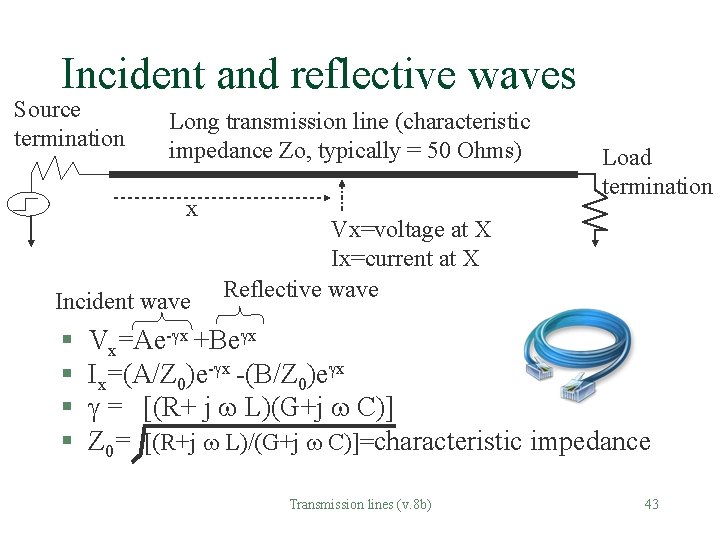
Incident and reflective waves Source termination Long transmission line (characteristic impedance Zo, typically = 50 Ohms) x Incident wave § § Load termination Vx=voltage at X Ix=current at X Reflective wave Vx=Ae- x +Be x Ix=(A/Z 0)e- x -(B/Z 0)e x = [(R+ j L)(G+j C)] Z 0= [(R+j L)/(G+j C)]=characteristic impedance Transmission lines (v. 8 b) 43
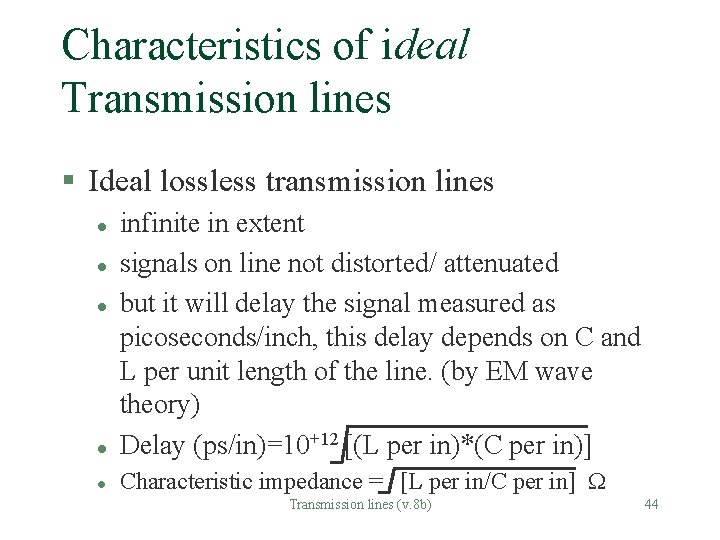
Characteristics of ideal Transmission lines § Ideal lossless transmission lines l infinite in extent signals on line not distorted/ attenuated but it will delay the signal measured as picoseconds/inch, this delay depends on C and L per unit length of the line. (by EM wave theory) Delay (ps/in)=10+12 [(L per in)*(C per in)] l Characteristic impedance = [L per in/C per in] l l l Transmission lines (v. 8 b) 44
Appendix 1 Math of transmission lines Transmission lines (v. 8 b) 45
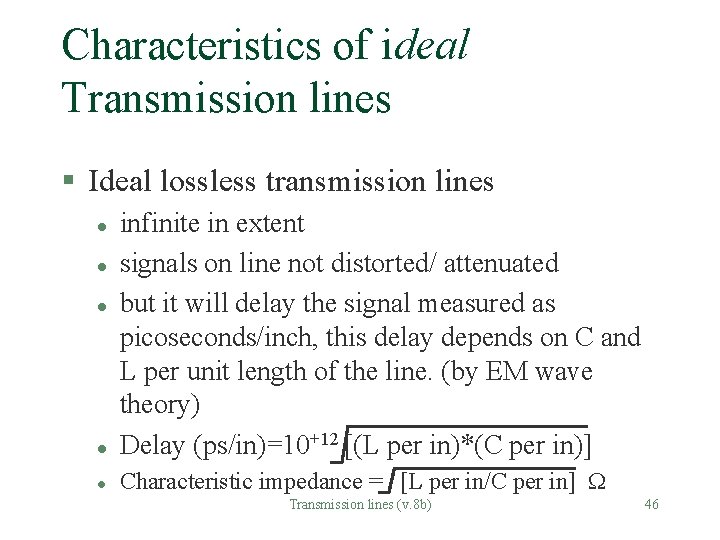
Characteristics of ideal Transmission lines § Ideal lossless transmission lines l infinite in extent signals on line not distorted/ attenuated but it will delay the signal measured as picoseconds/inch, this delay depends on C and L per unit length of the line. (by EM wave theory) Delay (ps/in)=10+12 [(L per in)*(C per in)] l Characteristic impedance = [L per in/C per in] l l l Transmission lines (v. 8 b) 46
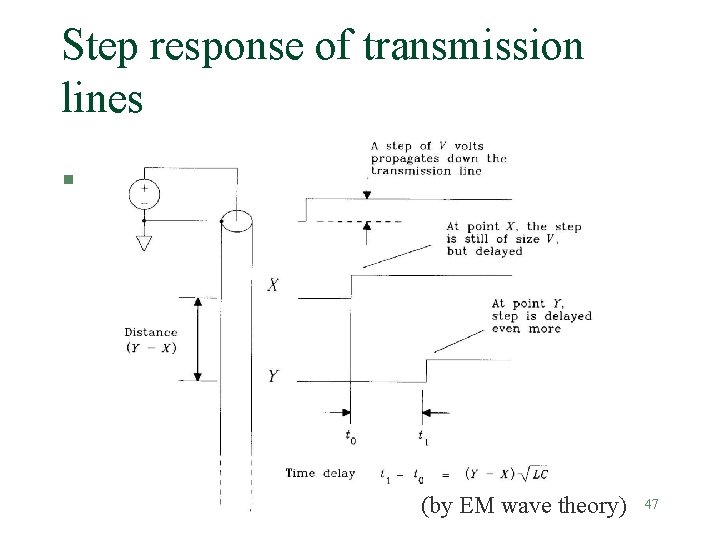
Step response of transmission lines § (by EM wave theory) Transmission lines (v. 8 b) 47
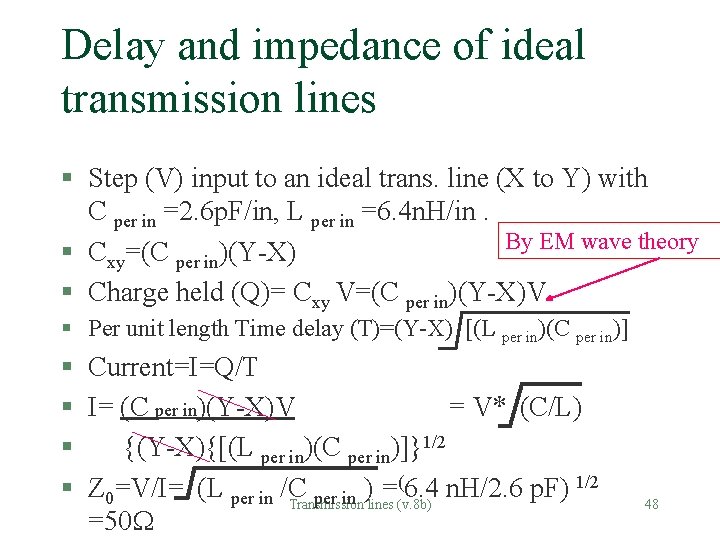
Delay and impedance of ideal transmission lines § Step (V) input to an ideal trans. line (X to Y) with C per in =2. 6 p. F/in, L per in =6. 4 n. H/in. By EM wave theory § Cxy=(C per in)(Y-X) § Charge held (Q)= Cxy V=(C per in)(Y-X)V § Per unit length Time delay (T)=(Y-X) [(L per in)(C per in)] § Current=I=Q/T § I= (C per in)(Y-X)V = V* (C/L) § {(Y-X){[(L per in)(C per in)]}1/2 (6. 4 n. H/2. 6 p. F) 1/2 § Z 0=V/I= (L per in /C ) = per in Transmission lines (v. 8 b) =50 48
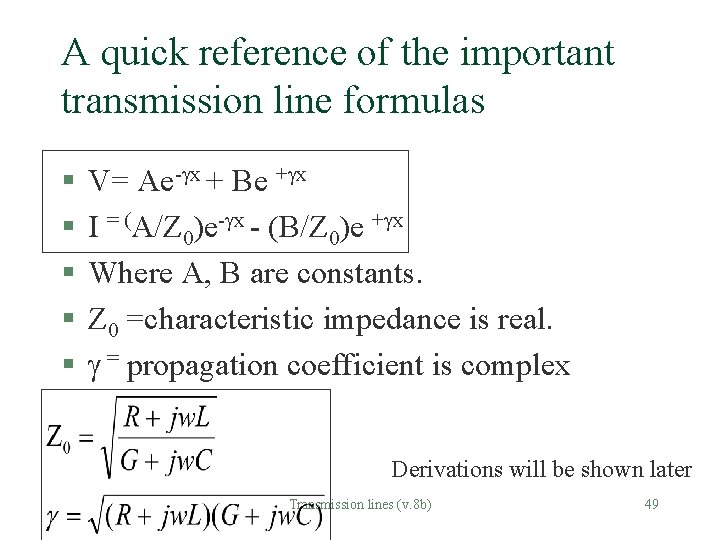
A quick reference of the important transmission line formulas § § § V= Ae- x + Be + x I = (A/Z 0)e- x - (B/Z 0)e + x Where A, B are constants. Z 0 =characteristic impedance is real. = propagation coefficient is complex Derivations will be shown later Transmission lines (v. 8 b) 49
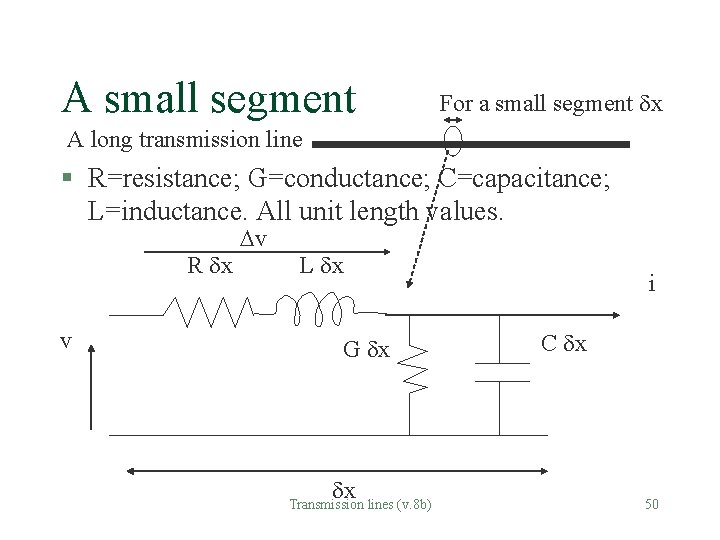
A small segment For a small segment x A long transmission line § R=resistance; G=conductance; C=capacitance; L=inductance. All unit length values. R x v v L x G x x Transmission lines (v. 8 b) i C x 50
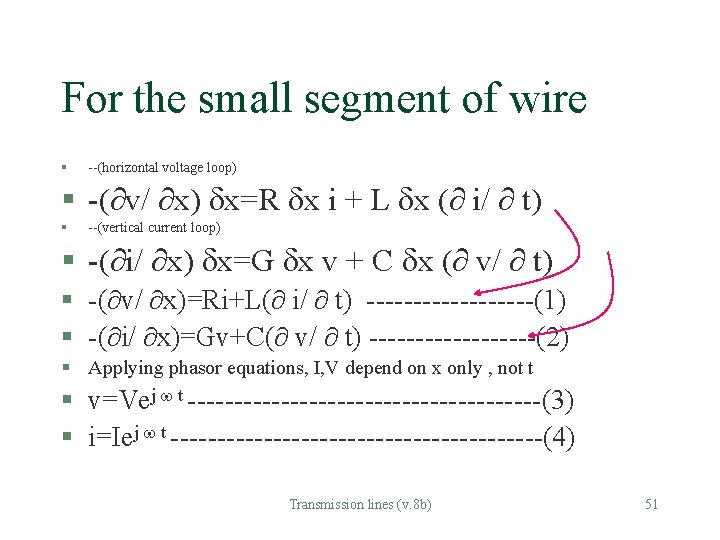
For the small segment of wire § --(horizontal voltage loop) § -( v/ x) x=R x i + L x ( i/ t) § --(vertical current loop) § -( i/ x) x=G x v + C x ( v/ t) § -( v/ x)=Ri+L( i/ t) ---------(1) § -( i/ x)=Gv+C( v/ t) ---------(2) § Applying phasor equations, I, V depend on x only , not t § v=Vej t -------------------(3) § i=Iej t --------------------(4) Transmission lines (v. 8 b) 51
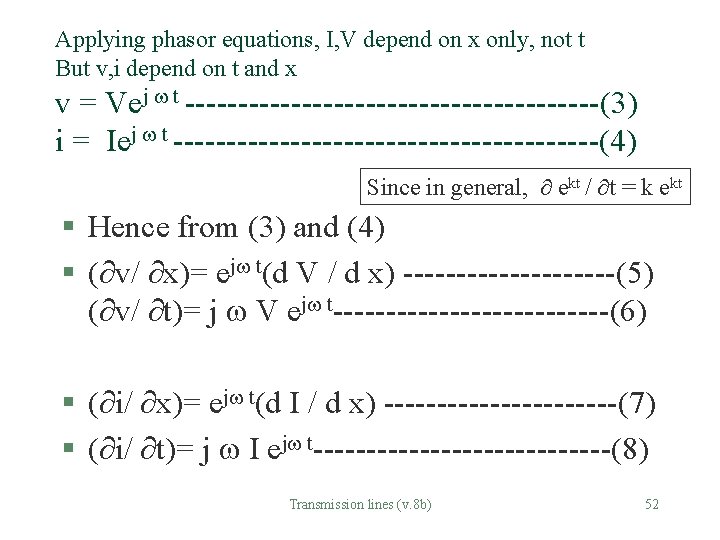
Applying phasor equations, I, V depend on x only, not t But v, i depend on t and x v = Vej t --------------------(3) i = Iej t --------------------(4) Since in general, ekt / t = k ekt § Hence from (3) and (4) § ( v/ x)= ej t(d V / d x) ----------(5) ( v/ t)= j V ej t-------------(6) § ( i/ x)= ej t(d I / d x) -----------(7) § ( i/ t)= j I ej t--------------(8) Transmission lines (v. 8 b) 52
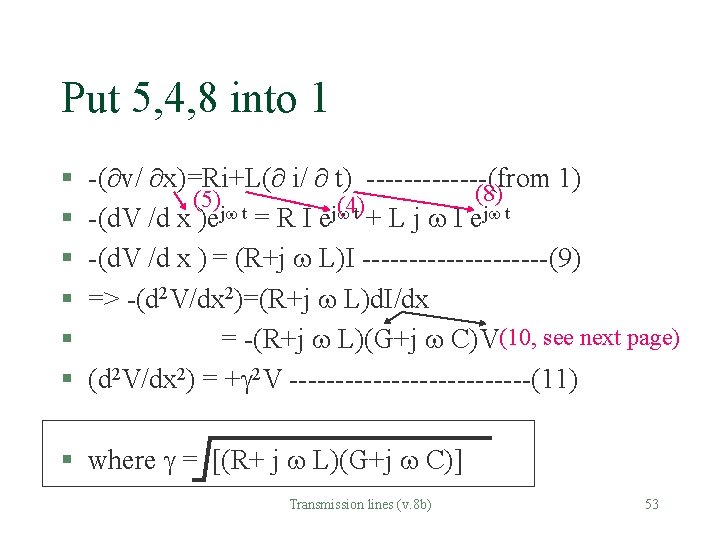
Put 5, 4, 8 into 1 § § § -( v/ x)=Ri+L( i/ t) -------(from 1) (8) (5)j t (4) -(d. V /d x )e = R I ej t + L j I ej t -(d. V /d x ) = (R+j L)I ----------(9) => -(d 2 V/dx 2)=(R+j L)d. I/dx = -(R+j L)(G+j C)V(10, see next page) (d 2 V/dx 2) = + 2 V -------------(11) § where = [(R+ j L)(G+j C)] Transmission lines (v. 8 b) 53
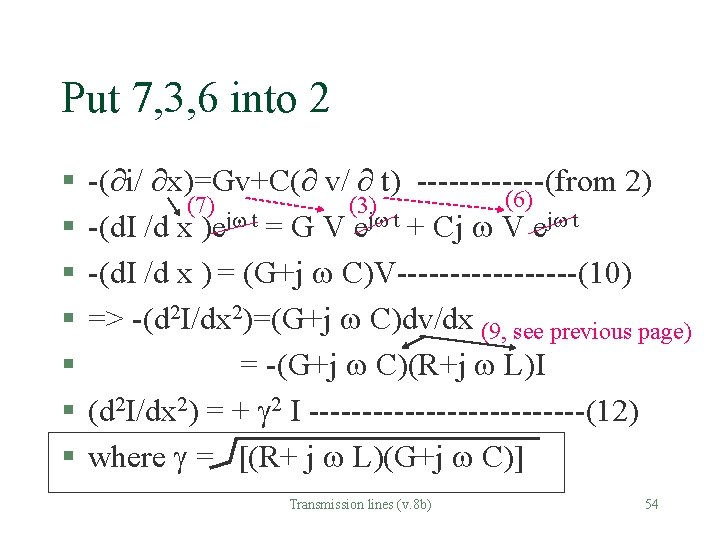
Put 7, 3, 6 into 2 § § § § -( i/ x)=Gv+C( v/ t) ------(from 2) (6) (7) (3) -(d. I /d x )ej t = G V ej t + Cj V ej t -(d. I /d x ) = (G+j C)V---------(10) => -(d 2 I/dx 2)=(G+j C)dv/dx (9, see previous page) = -(G+j C)(R+j L)I (d 2 I/dx 2) = + 2 I -------------(12) where = [(R+ j L)(G+j C)] Transmission lines (v. 8 b) 54
![From the wave equation form (see [2] , Homogeneous 2 nd order differential equations,](http://slidetodoc.com/presentation_image_h2/53257b1ad6350f211f1d45aa9b99e810/image-55.jpg "From the wave equation form (see [2] , Homogeneous 2 nd order differential equations,")
From the wave equation form (see [2] , Homogeneous 2 nd order differential equations, also see appendix 2, 3) § § § § (d 2 V/dx 2) = 2 V -------(11) (d 2 I/dx 2) = 2 I -----(12) where = [(R+ j L)(G+j C)] Solution is V=Ae- x +Be x -----------(13) Differentiate (13) and put into (9), see appendix 2 I=(A/Z 0)e- x - (B/Z 0)e x ------(14) Z 0= [(R+j L)/(G+j C)]=characteristic impedance Transmission lines (v. 8 b) 55
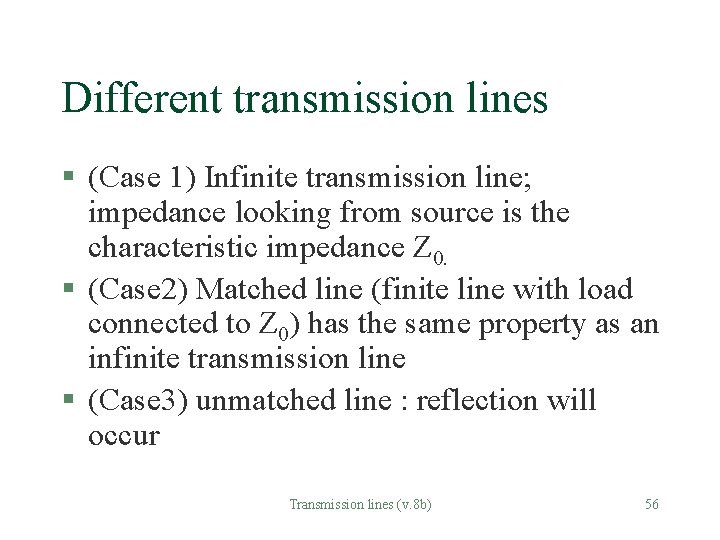
Different transmission lines § (Case 1) Infinite transmission line; impedance looking from source is the characteristic impedance Z 0. § (Case 2) Matched line (finite line with load connected to Z 0) has the same property as an infinite transmission line § (Case 3) unmatched line : reflection will occur Transmission lines (v. 8 b) 56
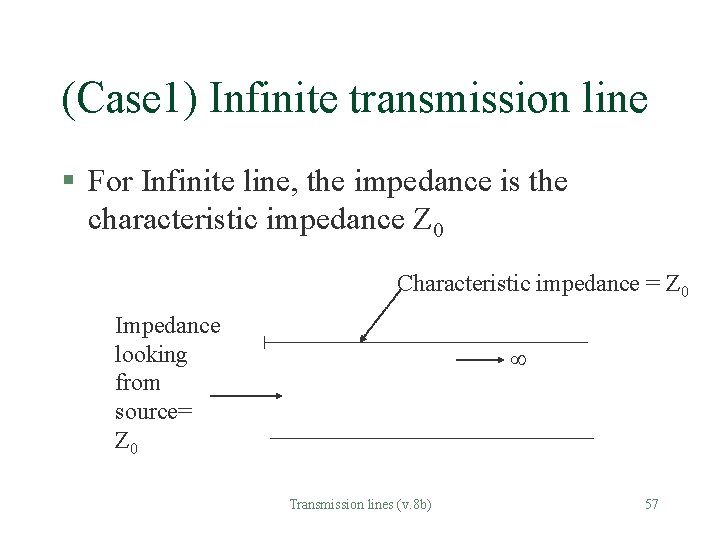
(Case 1) Infinite transmission line § For Infinite line, the impedance is the characteristic impedance Z 0 Characteristic impedance = Z 0 Impedance looking from source= Z 0 Transmission lines (v. 8 b) 57
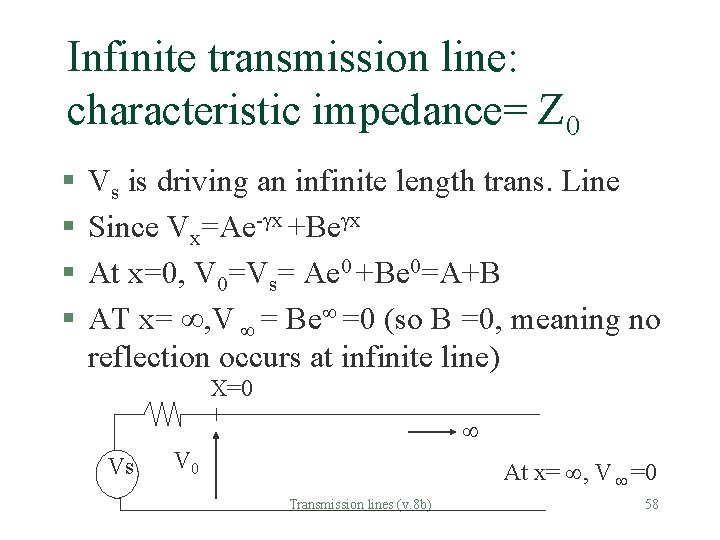
Infinite transmission line: characteristic impedance= Z 0 § § Vs is driving an infinite length trans. Line Since Vx=Ae- x +Be x At x=0, V 0=Vs= Ae 0 +Be 0=A+B AT x= , V = Be =0 (so B =0, meaning no reflection occurs at infinite line) X=0 Vs V 0 At x= , V =0 Transmission lines (v. 8 b) 58
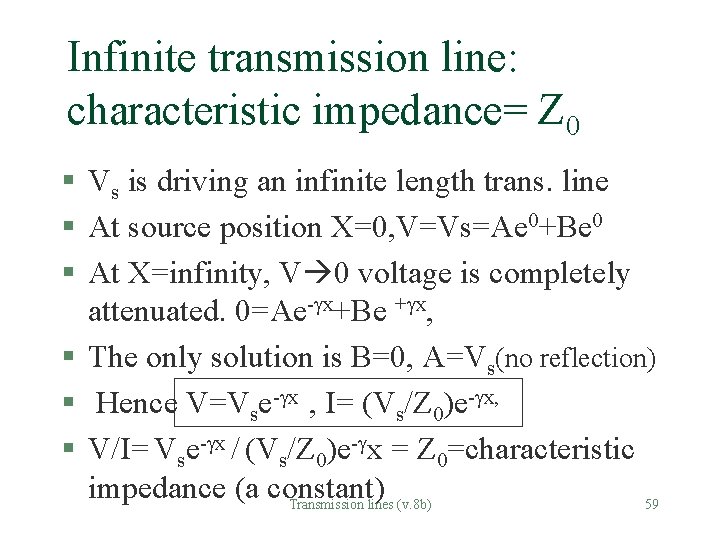
Infinite transmission line: characteristic impedance= Z 0 § Vs is driving an infinite length trans. line § At source position X=0, V=Vs=Ae 0+Be 0 § At X=infinity, V 0 voltage is completely attenuated. 0=Ae- x+Be + x, § The only solution is B=0, A=Vs(no reflection) § Hence V=Vse- x , I= (Vs/Z 0)e- x, § V/I= Vse- x / (Vs/Z 0)e- x = Z 0=characteristic impedance (a constant) Transmission lines (v. 8 b) 59
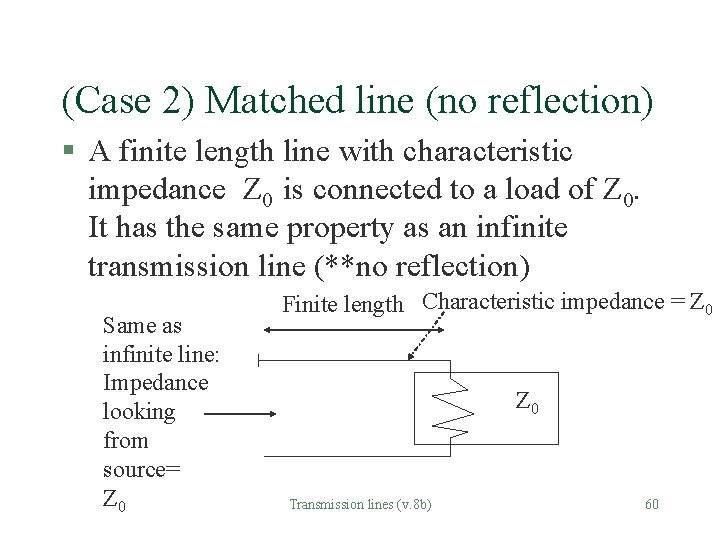
(Case 2) Matched line (no reflection) § A finite length line with characteristic impedance Z 0 is connected to a load of Z 0. It has the same property as an infinite transmission line (**no reflection) Same as infinite line: Impedance looking from source= Z 0 Finite length Characteristic impedance = Z 0 Transmission lines (v. 8 b) 60
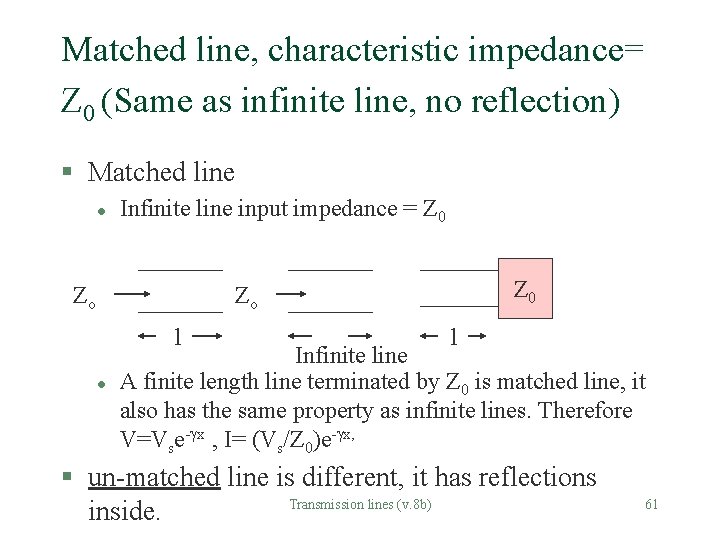
Matched line, characteristic impedance= Z 0 (Same as infinite line, no reflection) § Matched line l Infinite line input impedance = Z 0 Zo l l l Infinite line A finite length line terminated by Z 0 is matched line, it also has the same property as infinite lines. Therefore V=Vse- x , I= (Vs/Z 0)e- x, § un-matched line is different, it has reflections Transmission lines (v. 8 b) inside. 61
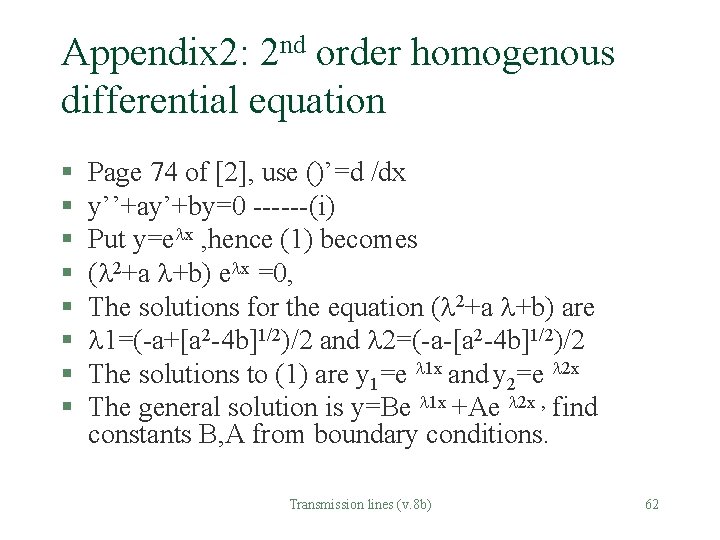
Appendix 2: 2 nd order homogenous differential equation § § § § Page 74 of [2], use ()’=d /dx y’’+ay’+by=0 ------(i) Put y=e x , hence (1) becomes ( 2+a +b) e x =0, The solutions for the equation ( 2+a +b) are 1=(-a+[a 2 -4 b]1/2)/2 and 2=(-a-[a 2 -4 b]1/2)/2 The solutions to (1) are y 1=e 1 x and y 2=e 2 x The general solution is y=Be 1 x +Ae 2 x , find constants B, A from boundary conditions. Transmission lines (v. 8 b) 62
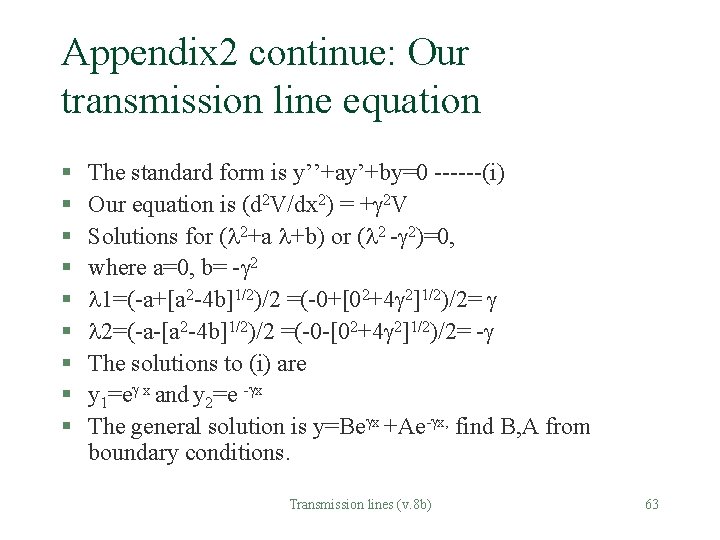
Appendix 2 continue: Our transmission line equation § § § § § The standard form is y’’+ay’+by=0 ------(i) Our equation is (d 2 V/dx 2) = + 2 V Solutions for ( 2+a +b) or ( 2 - 2)=0, where a=0, b= - 2 1=(-a+[a 2 -4 b]1/2)/2 =(-0+[02+4 2]1/2)/2= 2=(-a-[a 2 -4 b]1/2)/2 =(-0 -[02+4 2]1/2)/2= - The solutions to (i) are y 1=e x and y 2=e - x The general solution is y=Be x +Ae- x, find B, A from boundary conditions. Transmission lines (v. 8 b) 63
![Appendix 3, from ref. [3] § § § § § -(d. V /d x](http://slidetodoc.com/presentation_image_h2/53257b1ad6350f211f1d45aa9b99e810/image-64.jpg "Appendix 3, from ref. [3] § § § § § -(d. V /d x")
Appendix 3, from ref. [3] § § § § § -(d. V /d x ) = (R+j L)I ----------(9) V=Ae- x +Be x -----------(13) Differentiate (13) w. r. t. dx d. V/dx=- Ae- x + Be x, put this into (9), hence (R+j L)I= Ae- x - Be x I= ( Ae- x - Be x)/ (R+j L) I=(A/Z 0)e- x - (B/Z 0)e x Since = [(R+ j L)(G+j C)]1/2 and Z 0= [(R+j L)/(G+j C)]1/2 Transmission lines (v. 8 b) 64
- Slides: 64