
High Speed Flight Chapter 7 Pressure Change Pressure

- Slides: 14
High Speed Flight Chapter 7
Pressure Change • Pressure change affect the density of air pressure in its vicinity • At low speeds (100 -200 mph) the density change is slight • In low speed flight, the air is incompressible meaning that the density of the air flowing over the aircraft does not change from the surrounding ambient air
Supersonic Flight • The Bell X-1 was the first taken to supersonic flight by Chuck Yeager Oct. 14, 1947. • The significance of the speed of sound is that sound is due to pressure disturbances in the air. • We hear sounds because of pressure disturbances being transmitted to our ears in wave like fashion through the air.
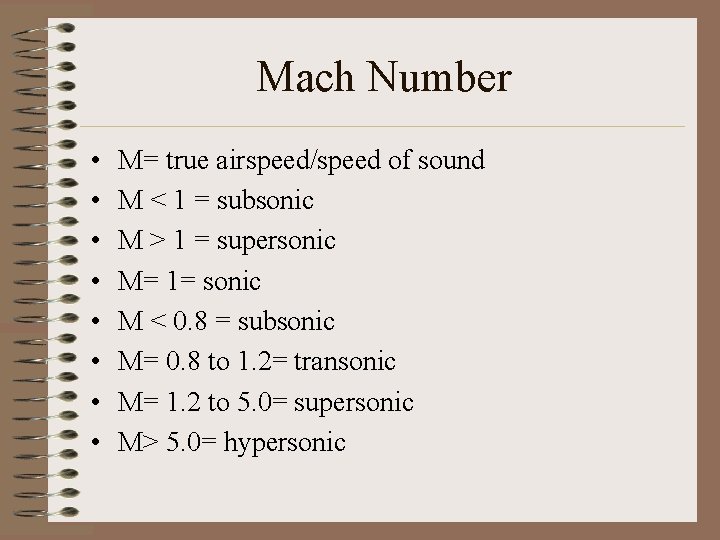
Mach Number • • M= true airspeed/speed of sound M < 1 = subsonic M > 1 = supersonic M= 1= sonic M < 0. 8 = subsonic M= 0. 8 to 1. 2= transonic M= 1. 2 to 5. 0= supersonic M> 5. 0= hypersonic
Shock Waves • Figure 7 -2 A B C • Mach Wave • Shock Wave • Oblique Shock Wave
Critical Mach Number • Critical mach number is the value of the free stream that causes the flow to reach mach 1 somewhere on the airfoil. • Figure 7 -4 A B • Bow wave
Wave Drag • Wave Drag is the combined effect of energy loss across and the wake formed behind the shock wave. • At speeds slightly above critical mach number is due mostly to the energy dissipation. • Figure 7 -5, 7 -6, 7 -7
Swept Wings • Swept wings allowed for high critical Mach numbers. • Swept wing pros • Swept wing cons
High Speed Airfoils • The ideal supersonic airfoil is one with a sharp leading edge. • Very poor low speed characteristics • Used for military fighters & missiles • Another desirable trait is to have the point of maximum thickness far back on the airfoil.
Control Problems • Shock wave can cause separation to occur on the airfoil surfaces and form small wakes behind. • Vortex Generators • Supersonic flight at the junction of stabilizer and elevator can form a shock wave that prevents any influence of the elevator on the stabilizer. • All moveable surfaces
Area Rule • Richard Whitcomb experimented with many wing-body shapes in a high speed wind tunnel. • Whitcomb found that for a low aspect ratio the drag rise in the transonic region. • Figure 7 -16 • Sears-Haack/Coke bottle
Hypersonic Flight • Traveling at above or below Mach not as good. Why? • Aerodynamic effects • Aircraft Concepts • Propulsion Systems
Quiz on Chapter 7 Please take out a sheet of paper Include today’s date and your name
Quiz on Chapter 7 • What is a critical Mach number? • List and explain one advantage and one disadvantage to the swept wing. • Explain the purpose of a vortex generator.