
High Sensitivity Optical Coherence Detector Optimization R C
- Slides: 12
High Sensitivity Optical Coherence Detector Optimization R. C. Coutinho, D. R. Selviah, H. A. French and H. D. Griffiths Department of Electronic and Electrical Engineering, University College London, United Kingdom
Outline • • • Technique Description Derivation of Theoretical Responsivity Description of the Experiment Theoretical Vs. Experimental Results Conclusion
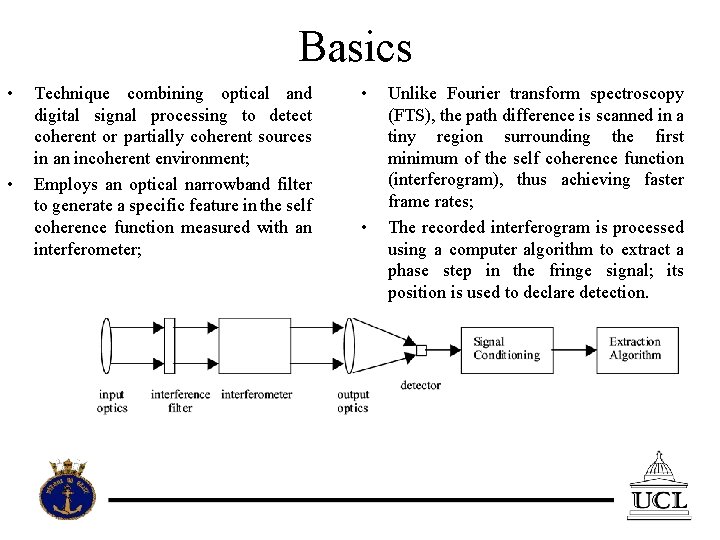
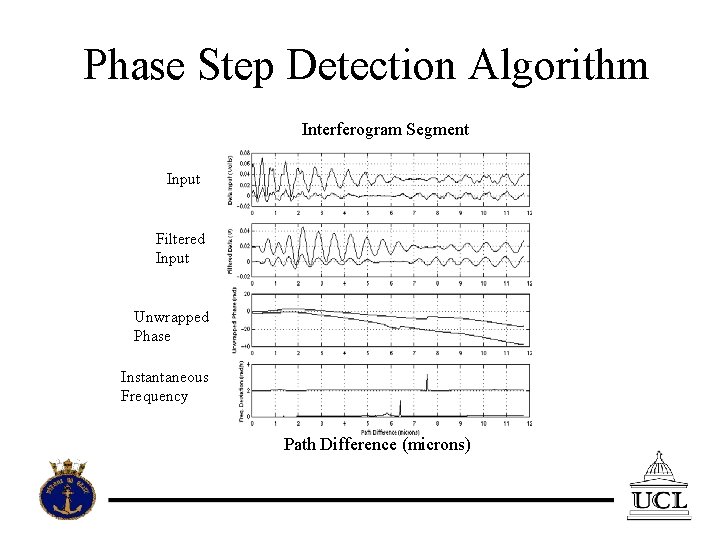
Basics • • Technique combining optical and digital signal processing to detect coherent or partially coherent sources in an incoherent environment; Employs an optical narrowband filter to generate a specific feature in the self coherence function measured with an interferometer; • • Unlike Fourier transform spectroscopy (FTS), the path difference is scanned in a tiny region surrounding the first minimum of the self coherence function (interferogram), thus achieving faster frame rates; The recorded interferogram is processed using a computer algorithm to extract a phase step in the fringe signal; its position is used to declare detection.
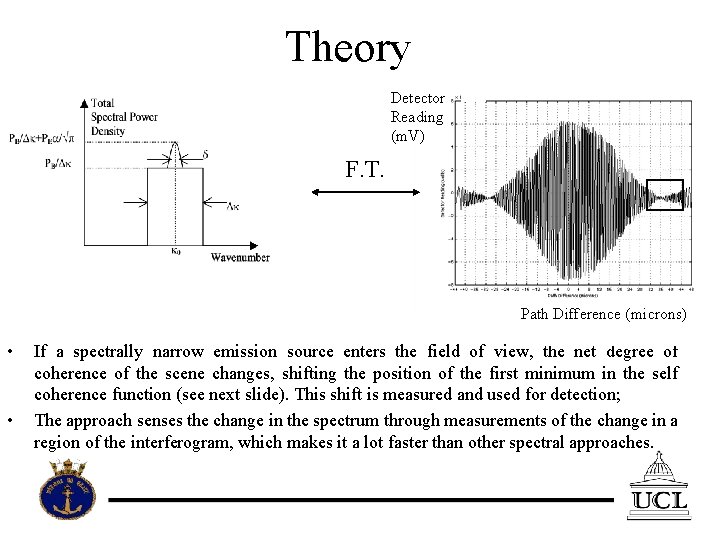
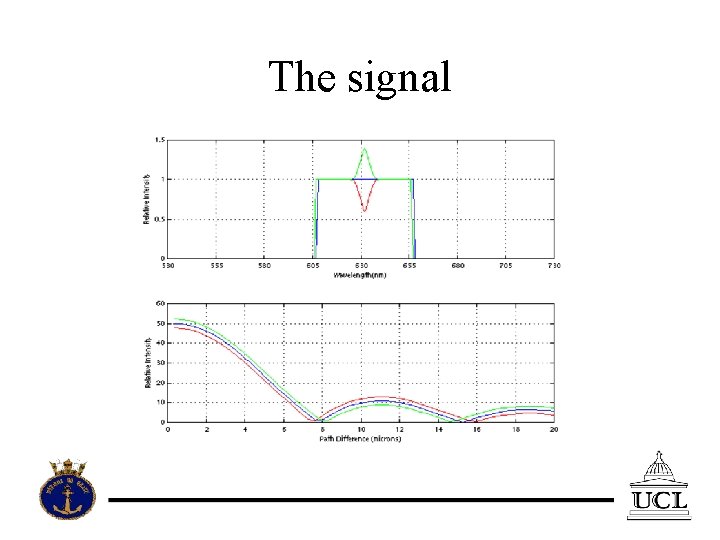
Theory Detector Reading (m. V) F. T. Path Difference (microns) • • If a spectrally narrow emission source enters the field of view, the net degree of coherence of the scene changes, shifting the position of the first minimum in the self coherence function (see next slide). This shift is measured and used for detection; The approach senses the change in the spectrum through measurements of the change in a region of the interferogram, which makes it a lot faster than other spectral approaches.
The signal
Phase Step Detection Algorithm Interferogram Segment Input Filtered Input Unwrapped Phase Instantaneous Frequency Path Difference (microns)
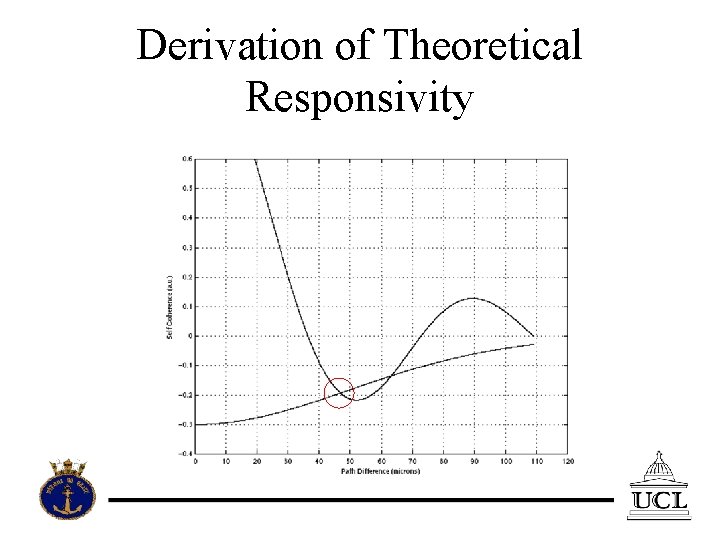
Derivation of Theoretical Responsivity
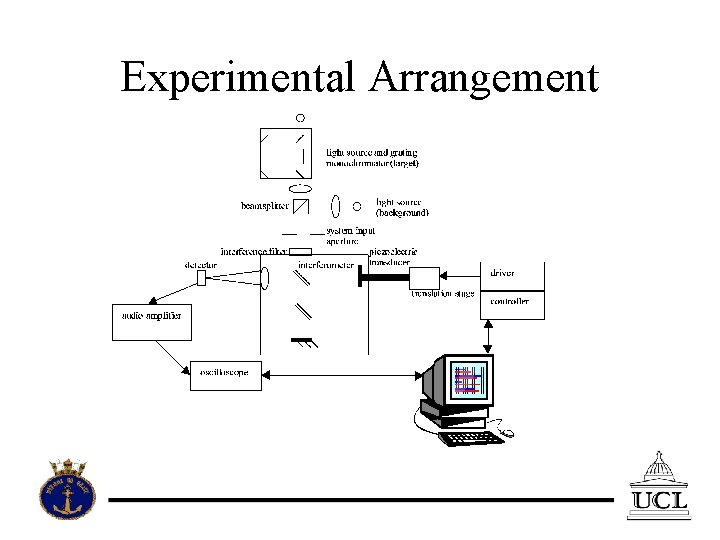
Experimental Arrangement
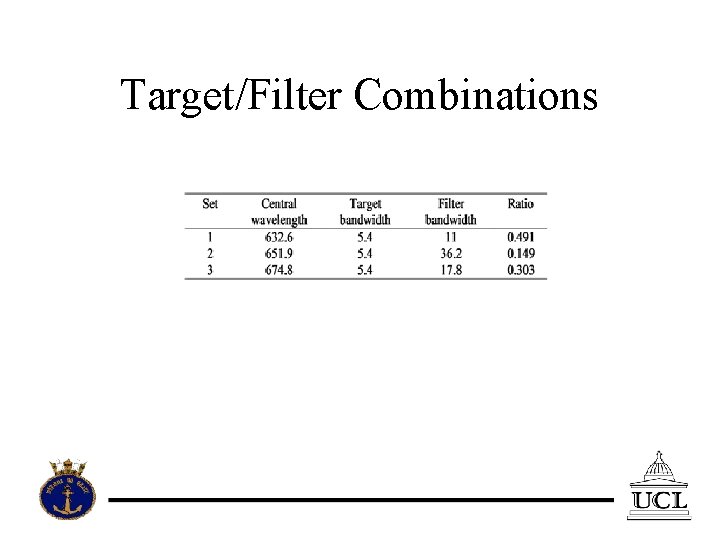
Target/Filter Combinations
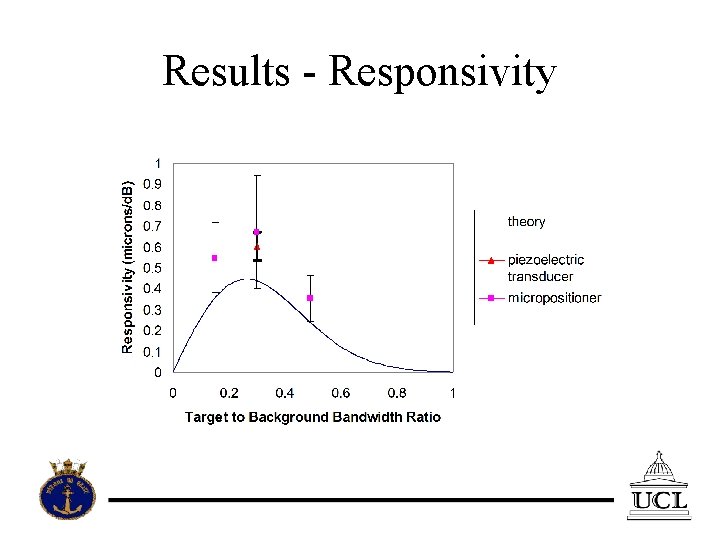
Results - Responsivity
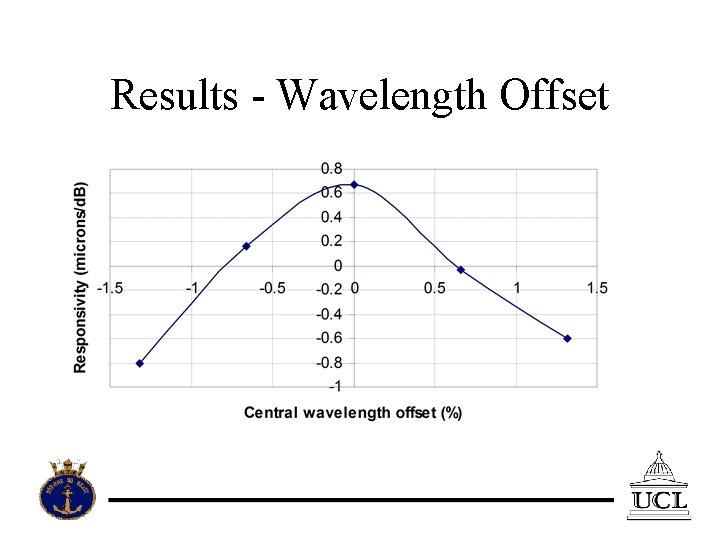
Results - Wavelength Offset
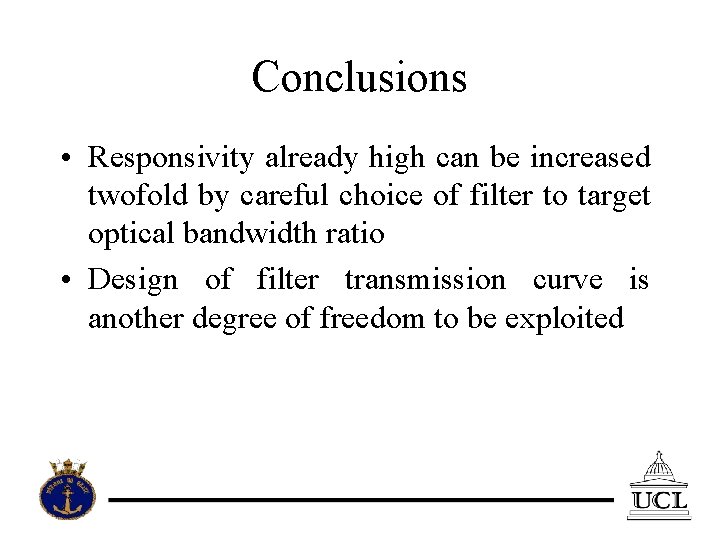
Conclusions • Responsivity already high can be increased twofold by careful choice of filter to target optical bandwidth ratio • Design of filter transmission curve is another degree of freedom to be exploited