
High Sensitivity Magnetic Gradiometer for Earthquake Research Applications





- Slides: 28
High Sensitivity Magnetic Gradiometer for Earthquake Research Applications ISRAEL 2005 Ivan Hrvoic H. Ginzburg, H. Zafrir, G. Steinitz, B. Shirman, G. Hollyer
Overview • Magnetic Earthquake Research Methods – Introduction to Past and Current Methods – Detectability of Earthquakes by Gradiometers – Short Base (Gradient) Measurements • Potassium Super. Gradiometer – Installation and Data Records • Summary
Introduction to Magnetics • Several decades of investigation • Based on theory of piezomagnetism and / or electrokinetics • Possibility of detection is related to gradual pressure build-up prior to earthquakes or “events”
Monitoring Systems (1) • Traditional Methods – Magnetic sensors (0. 1 n. T sensitivity) – Long base measurements • Some startling results • No duplication of results • Recent Work – Induction coils • Improved sensitivity to 25 p. T • But, limited bandwidth (0. 01 Hz)
Monitoring Systems (2) • Induction Coils – Detect first derivative of magnetic field – Detect all 3 components – Skin Effect Problems • 50 km @ 0. 01 Hz • 1. 6 km @ 10 Hz
Detectability of Earthquakes by Gradiometers • Assuming earthquakes create dipolar anomalies, can calculate detectability of earthquakes of given magnitude: • Where o is magnetic permeability, M is magnetic moment, and α is the angle between radius vector, r, and dipole direction. • r is distance from hypocenter to the observation point
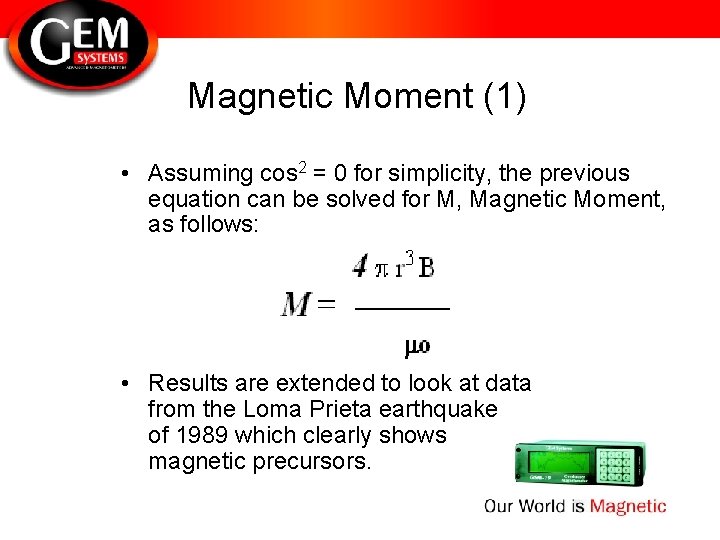
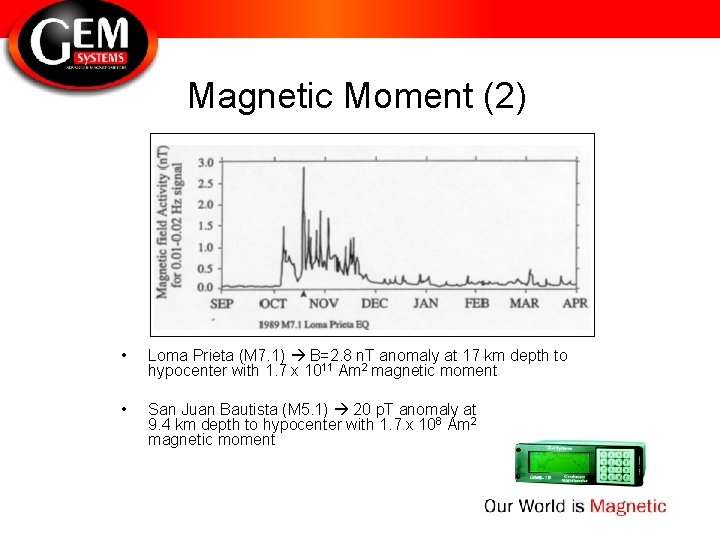
Magnetic Moment (1) • Assuming cos 2 = 0 for simplicity, the previous equation can be solved for M, Magnetic Moment, as follows: • Results are extended to look at data from the Loma Prieta earthquake of 1989 which clearly shows magnetic precursors.
Magnetic Moment (2) • Loma Prieta (M 7. 1) B=2. 8 n. T anomaly at 17 km depth to hypocenter with 1. 7 x 10¹¹ Am 2 magnetic moment • San Juan Bautista (M 5. 1) 20 p. T anomaly at 9. 4 km depth to hypocenter with 1. 7 x 10⁸ Am 2 magnetic moment
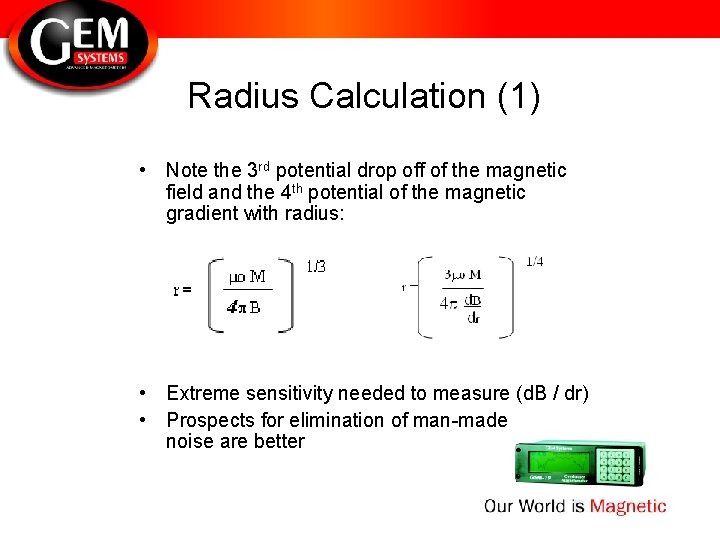
Radius Calculation (1) • Note the 3 rd potential drop off of the magnetic field and the 4 th potential of the magnetic gradient with radius: • Extreme sensitivity needed to measure (d. B / dr) • Prospects for elimination of man-made noise are better
Radius Calculation (2) • Maximum distance at which an event can be detected by different sensors • Skin effect not taken into account
Potassium Super. Gradiometer
Super. Grad Array • 3 sensors arranged according to terrain (horizontal or vertical) S 2 140 m 100 m S 3 100 m Computer • Sensor spacing up to 140 m • Long term integration is promising S 1
Data (1)
Data (2)
Data (3)
Installations • Currently in use near Dead Sea, Israel • Measures fields at 3 sensors, 20 times per second with 50 msec and 1 sec integration • 6 channels of data to 1 f. T resolution • GPS receiver provides Universal Time • Noise background is about 0. 1 p. T for 1 sec integration; giving 2 f. T/m sensitivity at 50 m spacing • Since July 2002, has acquired more than 10 billion readings; likely the most ever recorded for this type of application
Initial Installation - Israel
Data - Israel p. T 8 hours
Additional Installations • System deployed in Magnetic observatory of the Geological Survey of Canada near Ottawa • Test of basic system configuration for 6 months – Remote operation – Downloading of data via internet or telephone • Installation in Mexico (Oaxaca State) – Photos and records from Mexico • Also seeking other jurisdictions for siting system; potentially in regions of more active tectonism
Site Location- Mexico
Site Selection - Mexico
Site Survey Data - Mexico
Gradient Survey Data - Mexico
Sensor Installation - Mexico
Data Acquisition & Communication - Mexico
Data - Mexico p. T sec
Integrated Grad / Radon • Complementary radon emanation measurements. • Correlation with weak earthquakes in Dead Sea rift region • The combined Supergradiometer / Radon system is now available for application by various groups pursuing earthquake research studies.
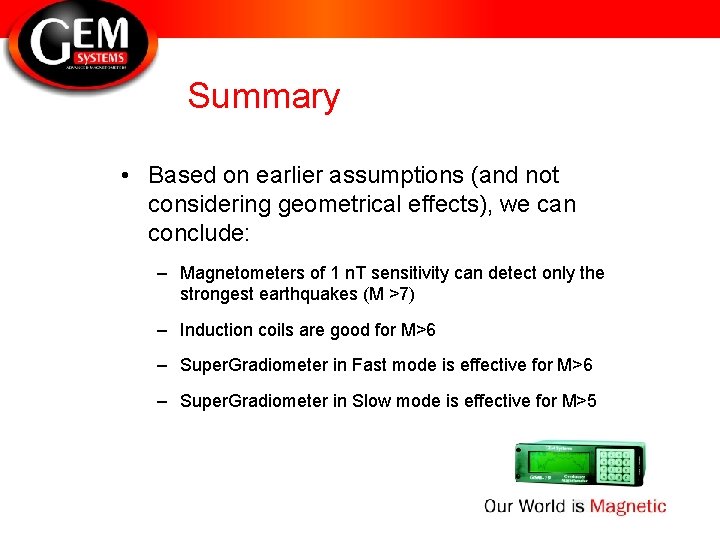
Summary • Based on earlier assumptions (and not considering geometrical effects), we can conclude: – Magnetometers of 1 n. T sensitivity can detect only the strongest earthquakes (M >7) – Induction coils are good for M>6 – Super. Gradiometer in Fast mode is effective for M>6 – Super. Gradiometer in Slow mode is effective for M>5