
High School Restructuring Plan for Graduation Day 3














- Slides: 66
High School Restructuring Plan for Graduation Day 3
• Welcome – Agenda for the day – Logistics • Introductions
Vision To create a world-class educational system that gives students the knowledge and skills to be successful in college and the workforce, and to flourish as parents and citizens Mission To provide leadership through the development of policy and accountability systems so that all students are prepared to compete in the global community ©MDE – Board of Education Strategic Plan
MISSISSIPPI BOARD OF EDUCATION 5 Goals 1. All Students Are Proficient and Show Growth in All Assessed Areas 2. Every Student Graduates High School and Is Ready for College and Career 3. Every Child Has Access to a High Quality Early Childhood Program 4. Every School Has Effective Teachers and Leaders 5. Every Community Effectively Uses a World Class Data System to Improve Student Outcomes
Purpose State Board Goal: EVERY STUDENT GRADUATES HIGH SCHOOL AND IS READY FOR COLLEGE AND CAREER State Statute Schools with a graduation rate below 80% must develop a restructuring plan, as per Mississippi Code of 1972 Ann. § 37 -167, amended in 2013
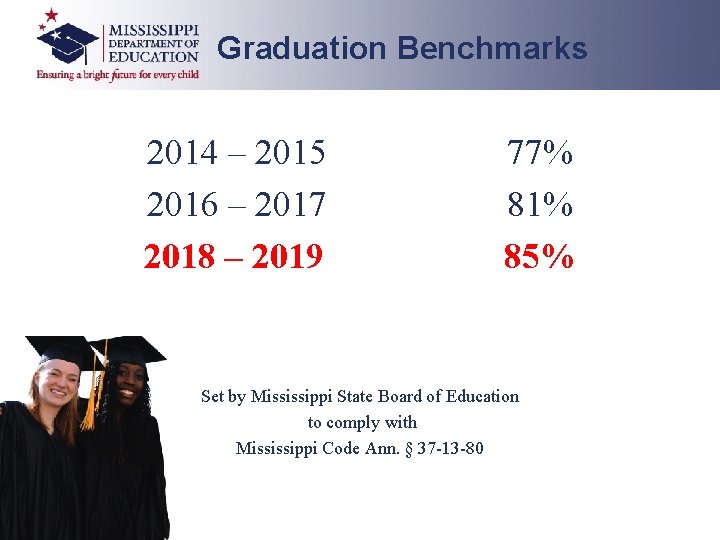
Graduation Benchmarks 2014 – 2015 2016 – 2017 2018 – 2019 77% 81% 85% Set by Mississippi State Board of Education to comply with Mississippi Code Ann. § 37 -13 -80
Design Principles 1. 2. 3. 4. 5. 6. Ready for College and Career Powerful Teaching and Learning Personalization Redesign Professionalism Leadership Purposeful Design
Design Principle 1 Ready for College and Career (work) Schools are characterized by the pervasive, transparent, and consistent understanding that the school exists for the purpose of preparing all students for college and work. They maintain a common set of high standards for every student to overcome the harmful consequences of tracking and sorting.
Design Principle 2 Powerful Teaching and Learning Schools are characterized by the presence of commonly held standards for high quality instructional practice. Teachers in these schools design rigorous instruction that ensures the development of critical thinking, application and problem solving skills often neglected in traditional settings.
Design Principle 3 Personalization Schools understand that knowing students well is an essential condition of helping them achieve academically. These high schools ensure adults leverage knowledge of students in order to improve student learning.
• Wall Walk activity – Person #1 stand with school poster and be the spokesperson – Persons #2 and/or 3 – you have two jobs: • Listen to spokesperson and make suggestions on sticky notes for the school you are listening too that may help with action plans. • Report back to your own school any ideas you heard that may help your own action plans.
Design Principle 4 Redesign Professionalism Evident in the schools are the collaborative work orientation of staff, the shared responsibility for decision making, and the commitment to growing the capacity of staff.
Design Principle 5 Leadership Schools work to develop a shared mission for their school and work actively as agents of change, sharing leadership for improved student outcomes in a culture of high expectations for all students.
Design Principle 6 Purposeful Design Schools are designed to create the conditions that ensure the other five design principles: ready for college, powerful teaching and learning, personalization, leadership and redefined professionalism. The organization of time, space, and the allocation of resources ensures that these best practices become common practice.
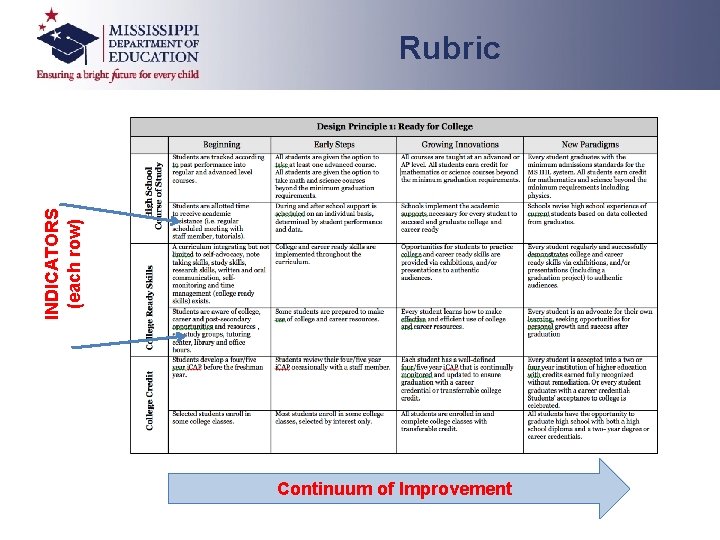
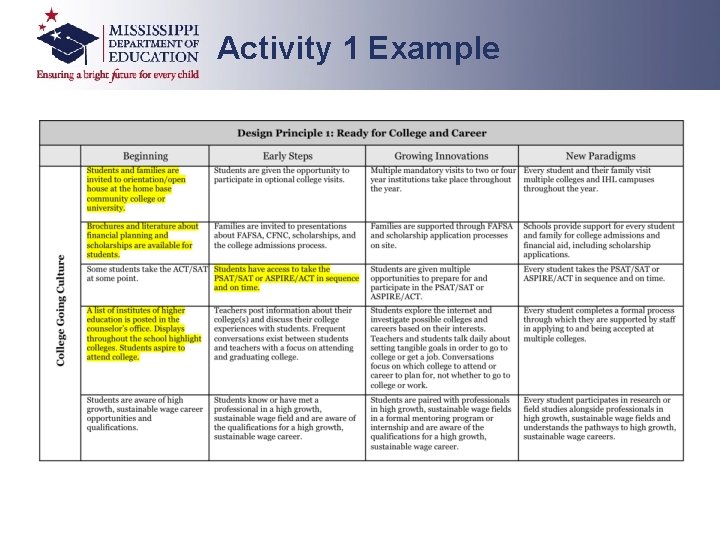
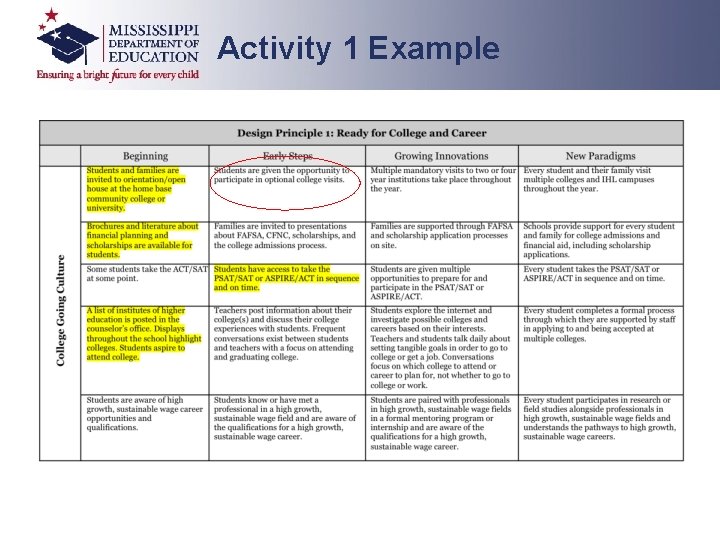
Design Principles • Design Principles in Action – Review handouts and explain rubric – Rubric is a self-evaluation tool – The indicators and strategies are researched and proven to be effective
INDICATORS (each row) Rubric Continuum of Improvement
Self Evaluation • Review each indicator (ROW) in PRINCIPLE 4 6. • Highlight where you are now: Beginning, Early Steps, Growing Innovations, or New Paradigm
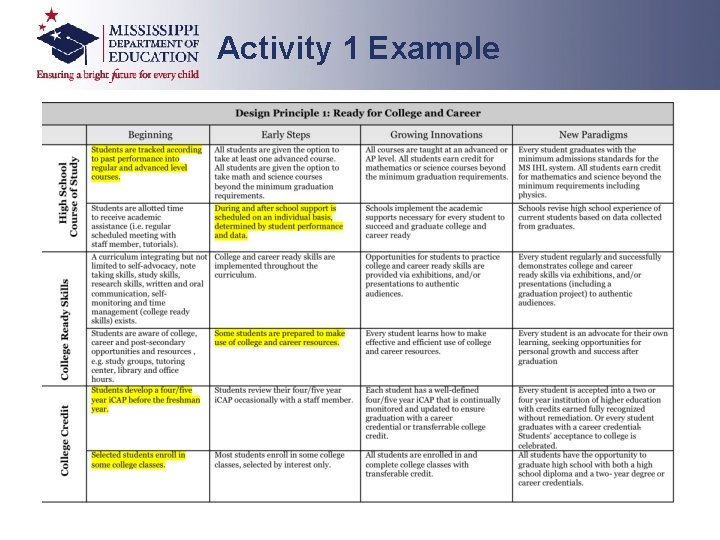
Activity 1 Example
Activity 1 Example
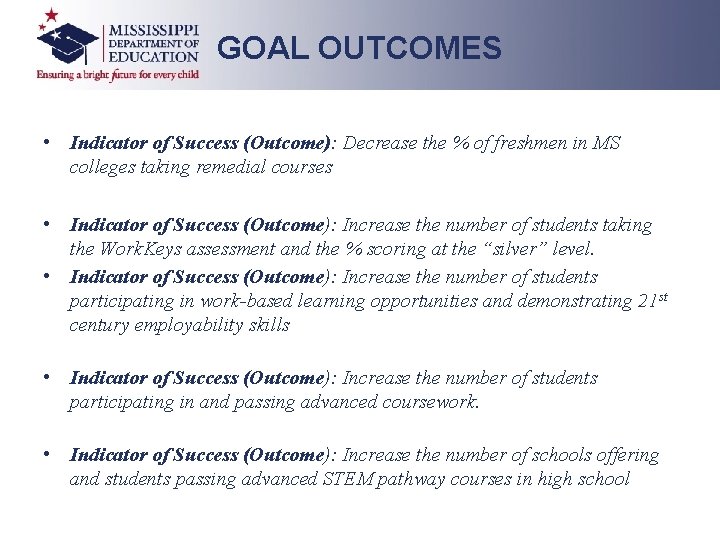
GOAL OUTCOMES • Indicator of Success (Outcome): Decrease the % of freshmen in MS colleges taking remedial courses • Indicator of Success (Outcome): Increase the number of students taking the Work. Keys assessment and the % scoring at the “silver” level. • Indicator of Success (Outcome): Increase the number of students participating in work-based learning opportunities and demonstrating 21 st century employability skills • Indicator of Success (Outcome): Increase the number of students participating in and passing advanced coursework. • Indicator of Success (Outcome): Increase the number of schools offering and students passing advanced STEM pathway courses in high school
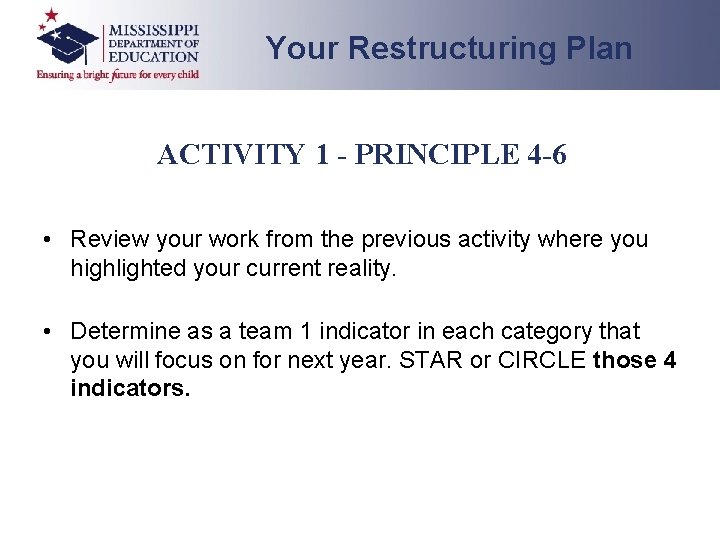
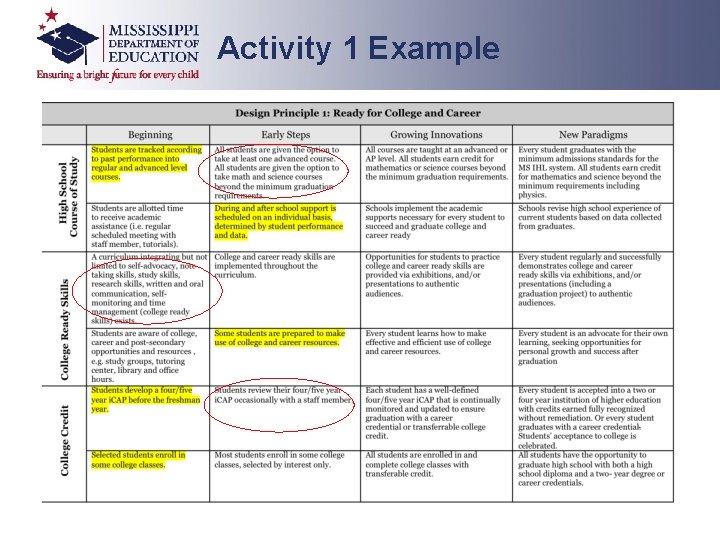
Your Restructuring Plan ACTIVITY 1 - PRINCIPLE 4 -6 • Review your work from the previous activity where you highlighted your current reality. • Determine as a team 1 indicator in each category that you will focus on for next year. STAR or CIRCLE those 4 indicators.
Activity 1 Example
Activity 1 Example
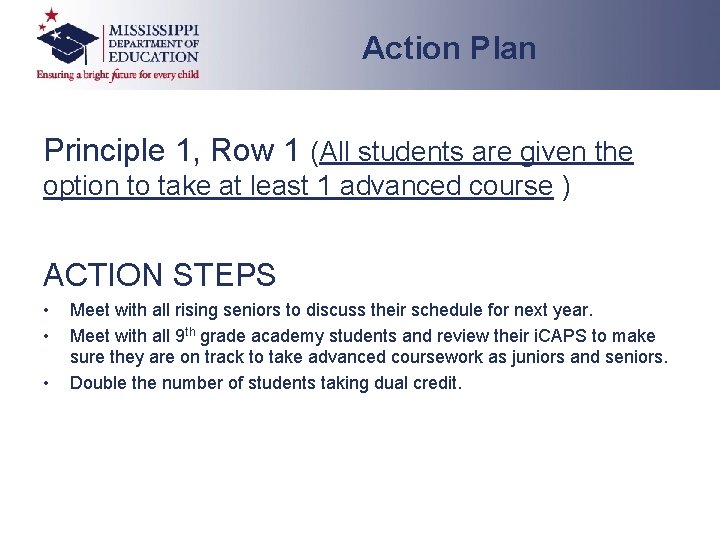
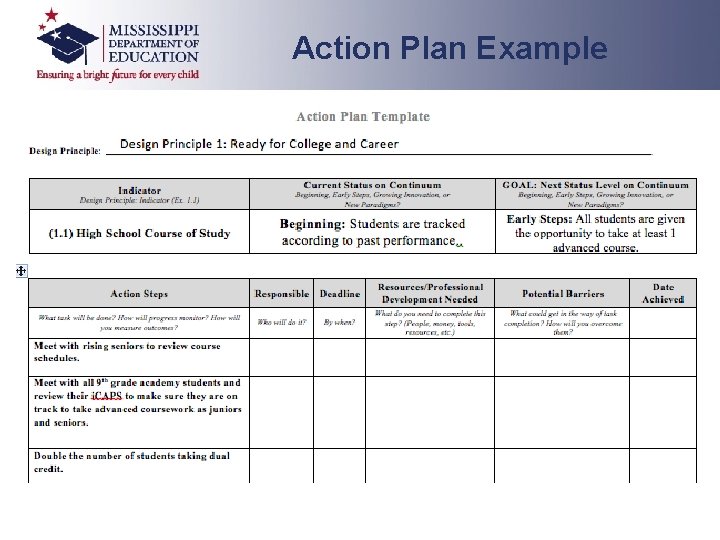
Action Plan Principle 1, Row 1 (All students are given the option to take at least 1 advanced course ) ACTION STEPS • • • Meet with all rising seniors to discuss their schedule for next year. Meet with all 9 th grade academy students and review their i. CAPS to make sure they are on track to take advanced coursework as juniors and seniors. Double the number of students taking dual credit.
Action Plan Example
A Stronger Nation • Snapshot of Mississippi – http: //strongernation. luminafoundation. org/rep ort/#mississippi
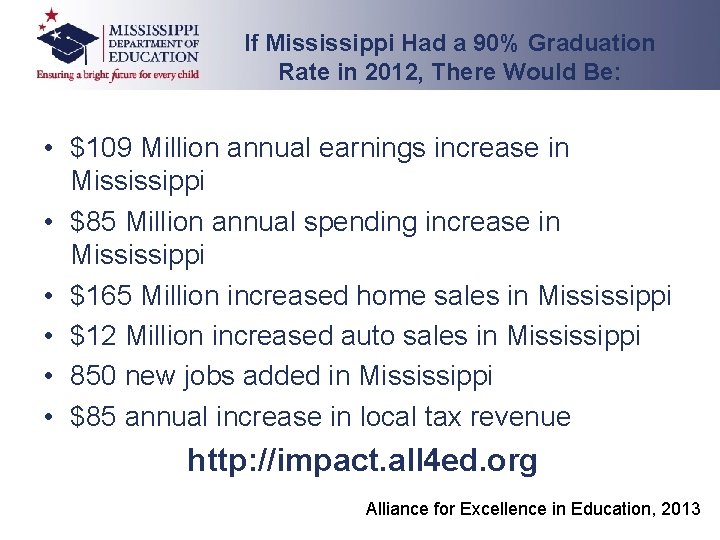
If Mississippi Had a 90% Graduation Rate in 2012, There Would Be: • $109 Million annual earnings increase in Mississippi • $85 Million annual spending increase in Mississippi • $165 Million increased home sales in Mississippi • $12 Million increased auto sales in Mississippi • 850 new jobs added in Mississippi • $85 annual increase in local tax revenue http: //impact. all 4 ed. org Alliance for Excellence in Education, 2013
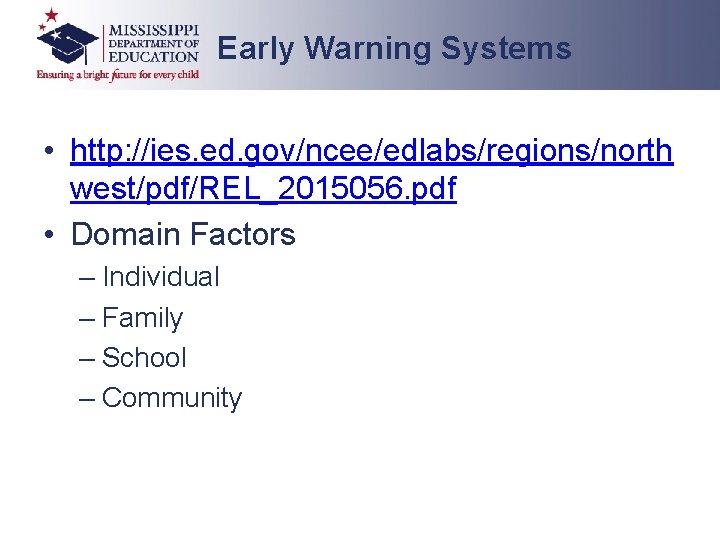
Early Warning Systems • http: //ies. ed. gov/ncee/edlabs/regions/north west/pdf/REL_2015056. pdf • Domain Factors – Individual – Family – School – Community
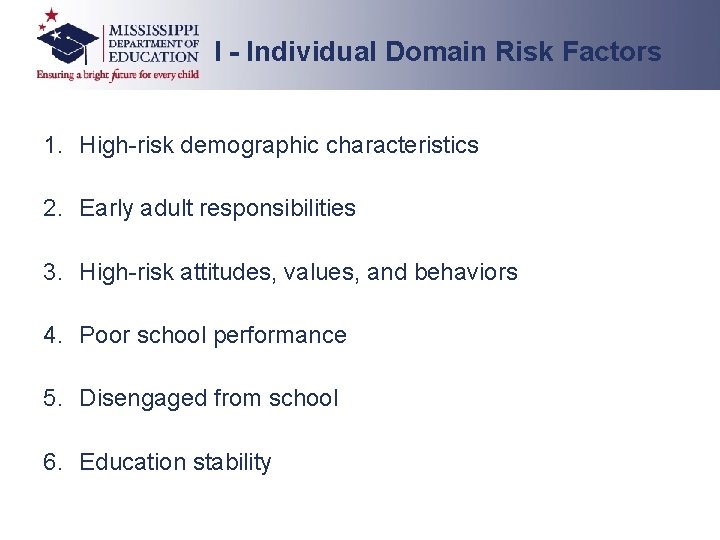
I - Individual Domain Risk Factors 1. High risk demographic characteristics 2. Early adult responsibilities 3. High risk attitudes, values, and behaviors 4. Poor school performance 5. Disengaged from school 6. Education stability
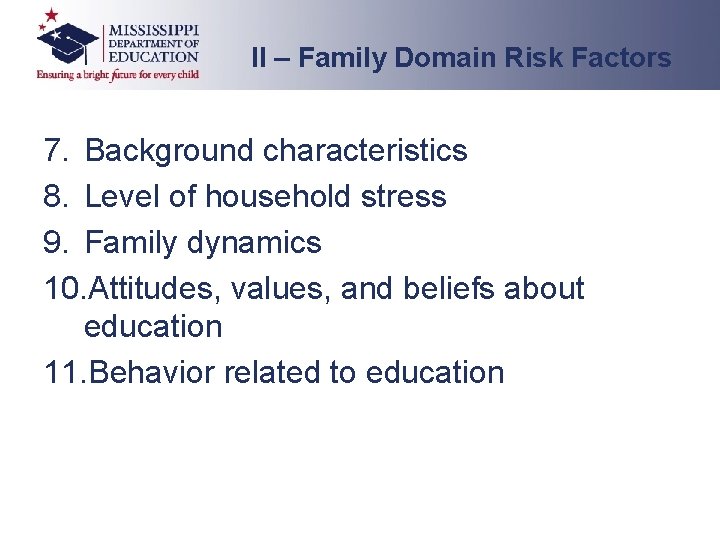
II – Family Domain Risk Factors 7. Background characteristics 8. Level of household stress 9. Family dynamics 10. Attitudes, values, and beliefs about education 11. Behavior related to education
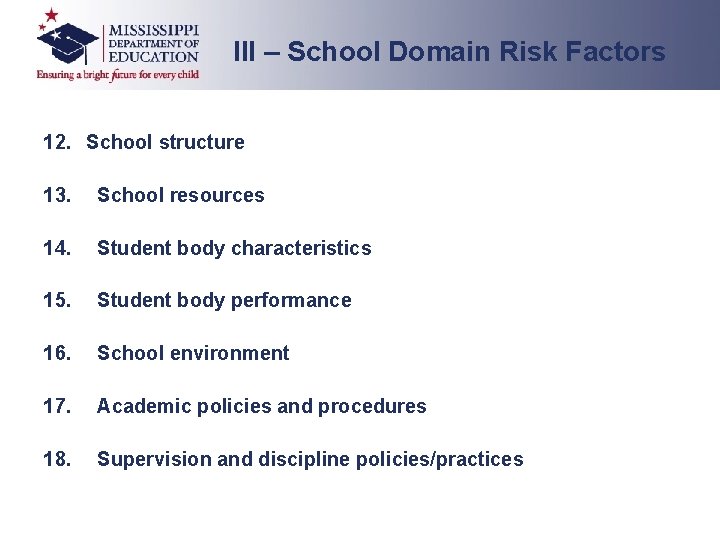
III – School Domain Risk Factors 12. School structure 13. School resources 14. Student body characteristics 15. Student body performance 16. School environment 17. Academic policies and procedures 18. Supervision and discipline policies/practices
IV – Community Domain Risk Factors 19. Location and type of community 20. Demographic characteristics of community 21. Environment of community
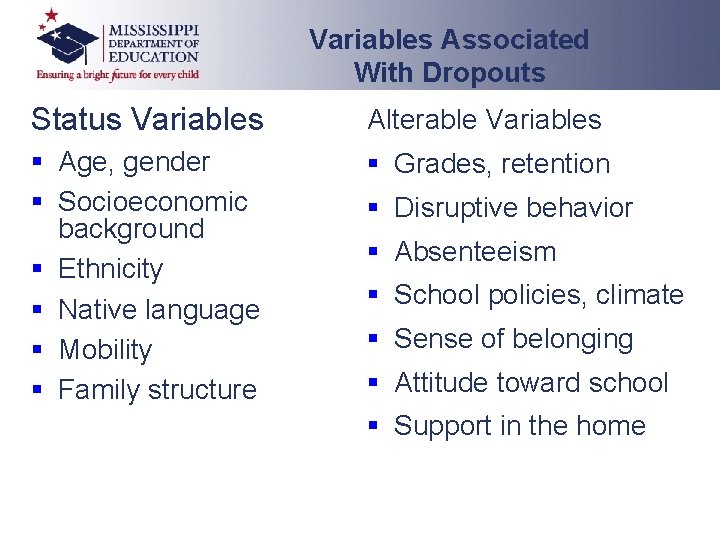
Variables Associated With Dropouts Status Variables Alterable Variables § Age, gender § Socioeconomic background § Ethnicity § Native language § Mobility § Family structure § Grades, retention § Disruptive behavior § Absenteeism § School policies, climate § Sense of belonging § Attitude toward school § Support in the home
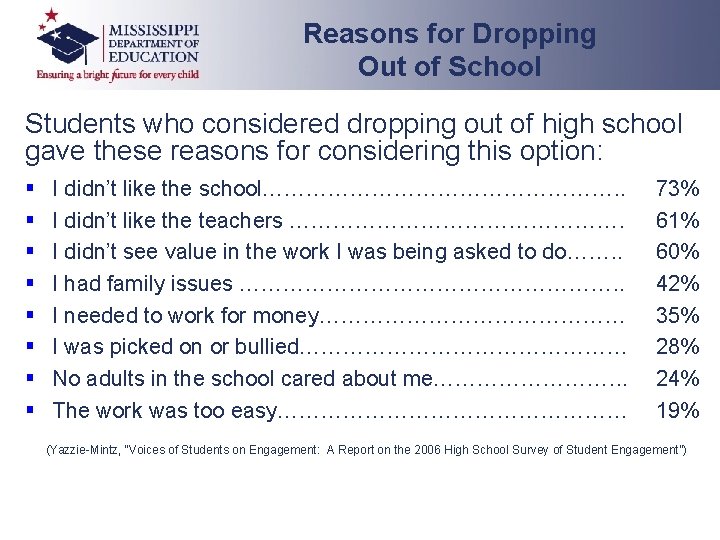
Reasons for Dropping Out of School Students who considered dropping out of high school gave these reasons for considering this option: § § § § I didn’t like the school……………………. . I didn’t like the teachers ……………………. I didn’t see value in the work I was being asked to do……. . I had family issues ………………………. . I needed to work for money………………… I was picked on or bullied…………………… No adults in the school cared about me…………. . . The work was too easy…………………… 73% 61% 60% 42% 35% 28% 24% 19% (Yazzie Mintz, “Voices of Students on Engagement: A Report on the 2006 High School Survey of Student Engagement”)
MDE Updates
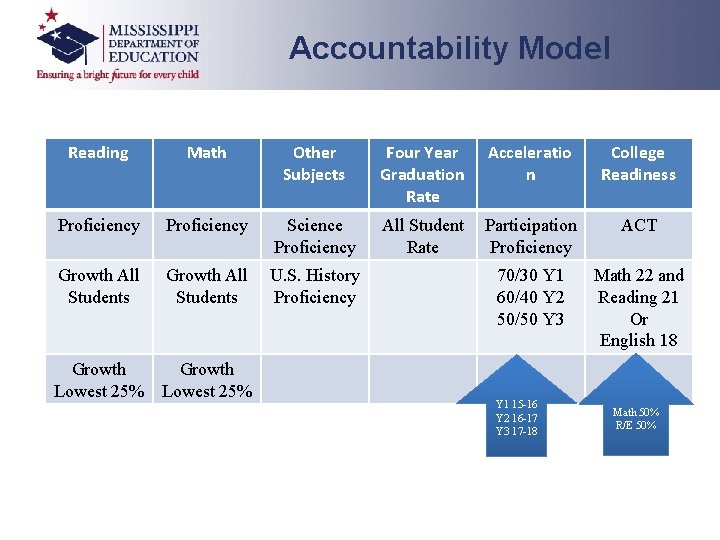
Accountability Model Reading Math Proficiency Growth All Students Other of. Four Year Changes model Subjects Graduation Rate Proficiency Science Proficiency All Student Rate Growth All Students U. S. History Proficiency Growth Lowest 25% Acceleratio n College Readiness Participation Proficiency ACT 70/30 Y 1 60/40 Y 2 50/50 Y 3 Math 22 and Reading 21 Or English 18 Y 1 15 -16 Y 2 16 -17 Y 3 17 -18 Math 50% R/E 50%
Graduation Diploma Options
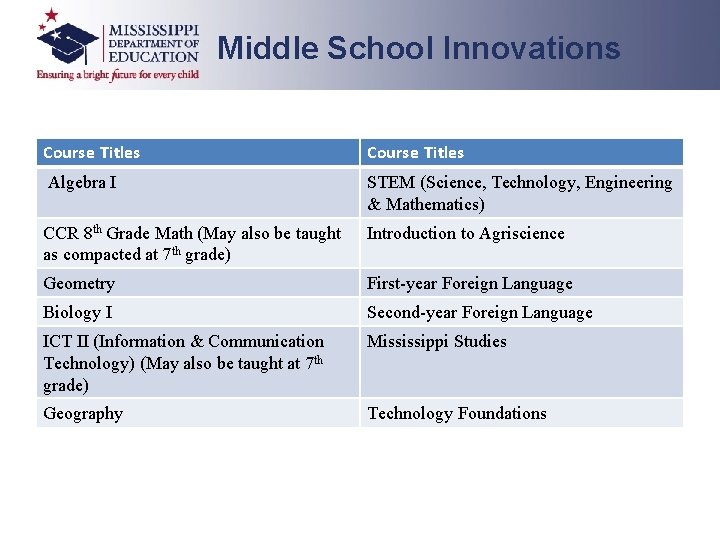
Middle School Innovations Course Titles Algebra I STEM (Science, Technology, Engineering & Mathematics) CCR 8 th Grade Math (May also be taught as compacted at 7 th grade) Introduction to Agriscience Geometry First-year Foreign Language Biology I Second-year Foreign Language ICT II (Information & Communication Technology) (May also be taught at 7 th grade) Mississippi Studies Geography Technology Foundations
High School Course • Foundations to Algebra • Keystone • CTE courses w academic credit
Innovative Models • Career Academies • Project Lead The Way (PLTW) • SREB High Schools That Work, Middle Schools That Work, Technology Centers That Work • Capturing Kids Hearts • STAR Academy (PITSCO): George County and Vicksburg Warren • MS New Schools: comprehensive redesign
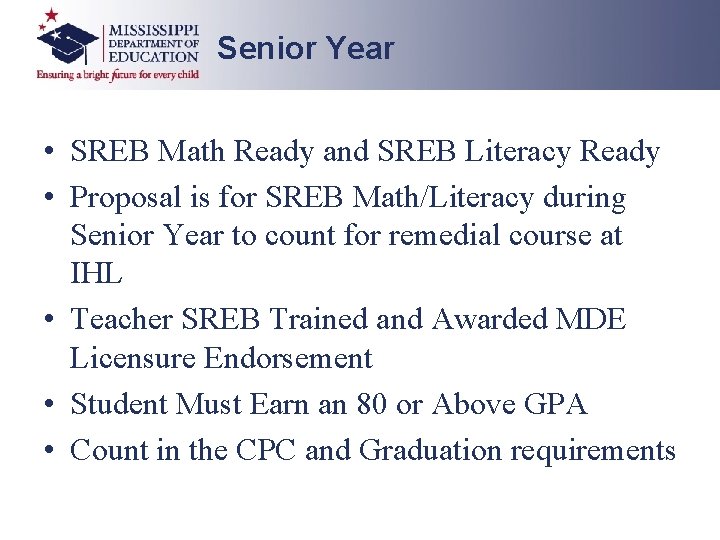
Senior Year • SREB Math Ready and SREB Literacy Ready • Proposal is for SREB Math/Literacy during Senior Year to count for remedial course at IHL • Teacher SREB Trained and Awarded MDE Licensure Endorsement • Student Must Earn an 80 or Above GPA • Count in the CPC and Graduation requirements
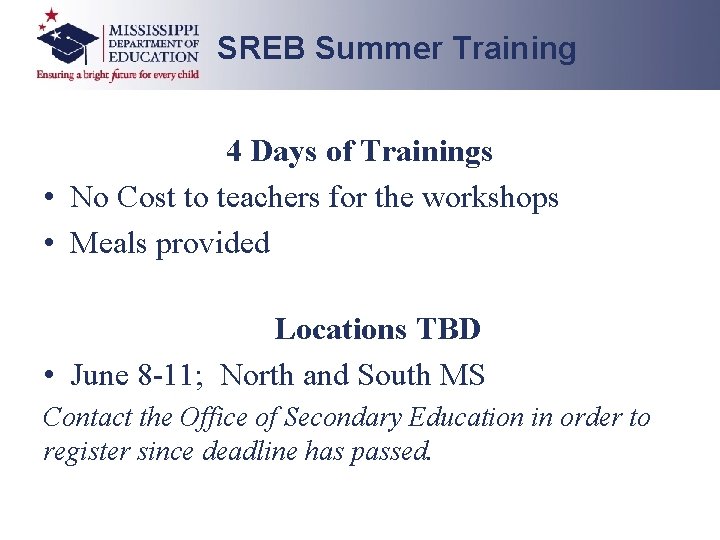
SREB Summer Training 4 Days of Trainings • No Cost to teachers for the workshops • Meals provided Locations TBD • June 8 -11; North and South MS Contact the Office of Secondary Education in order to register since deadline has passed.
Individual Career and Academic Plan i. CAPs • Process Standard 14. 1. 4 – Beginning in school year 2011 -2012, all eighth grade students are required to have an Individualized Career and Academic Plan (i. CAP) prior to exiting the eighth grade. – School Year 2014 -15 includes all students grades 8 -11 – Not just a four year graduation plan – Beginning summer 2015 pilot groups to develop full implementation plans – Watch for Memo for pilot sites and individuals to help with development/selection of tools
Choices Update • For more information about upcoming changes to choices visit: http: //tinyurl. com/qdtpnoq. • View files Getting Ready to Launch…. And MS Choices Flyer
State Board Policy 3801 Beginning with the 2014 2015 school year, students shall not be required to pass any end of course Subject Area Test in a course for which the student earns or receives credit in a Mississippi public school as a requirement for graduation. Student performance on the end of course Subject Area Test shall be considered, along with the overall course grade based on the SBE approved Concordance Table as referenced in State Board Policy 3803 and provided to school districts by the Mississippi Department of Education. Graduation Requirements Meetings April 20 through May 1, 2015 © MDE 45
State Board Policy 3802 Policies for Carnegie Unit Credit • Removes redundancy from items and revises terminology • States that all students enrolled in one (1) of the four (4) end of course Subject Area Test courses must pass the course and participate in the applicable end of course Subject Area Test in order to earn the Carnegie Unit. Graduation Requirements Meetings April 20 through May 1, 2015 © MDE 46
State Board Policy 3803 Removes passing an end of course Subject Area Test as a requirement for graduation and incorporates the score on the applicable assessment into the final grade in the course. 1. All students enrolled in one (1) of the four (4) end of course Subject Area Test courses must participate in the applicable Subject Area Test in order to earn the Carnegie Unit. Graduation Requirements Meetings April 20 through May 1, 2015 © MDE 47
State Board Policy 3803 … continued 2. Beginning with school year 2014 2015, students shall graduate by passing the course and meeting one (1) of the following options: a) Passing the applicable end of course Subject Area Test; or b) Using one of the options outlined in State Board Policy 3804; or Graduation Requirements Meetings April 20 through May 1, 2015 © MDE 48
State Board Policy 3803 … continued c) Using the end of course Subject Area Test score with the overall course grade based on the SBE approved Concordance Table for each of the four (4) end of course Subject Area Tests as provided to school districts by the Mississippi Department of Education. Note: Students must be enrolled in school in order to utilize this option. Graduation Requirements Meetings April 20 through May 1, 2015 © MDE 49
State Board Policy 3803 … continued 3. Beginning with school year 2015 2016, in addition to number 2, as previously discussed, all students enrolled may achieve a combined minimum score from the end of course Subject Area Tests to meet the requirement for graduation in lieu of passing the applicable end of course Subject Area Test. Graduation Requirements Meetings April 20 through May 1, 2015 © MDE 50
State Board Policy 3803 … continued 4. Beginning with school year 2016 2017, all students enrolled in an end of course Subject Area Test course for the first time must participate in the assessment in order to earn the Carnegie Unit. The assessment score will constitute 25% of the student's final grade in the course. Graduation Requirements Meetings April 20 through May 1, 2015 © MDE 51
State Board Policy 3803 … continued 5. Any Mississippi public school student who fails to pass a required end of course Subject Area Test, prior to school year 2016 2017, will be offered opportunities to retake the test. Graduation Requirements Meetings April 20 through May 1, 2015 © MDE 52
State Board Policy 3804 provides approved options for students to meet high school end of course Subject Area Test requirements for graduation through approved alternate measures. Note: State Board Policy 3804 applies to past, current, and future Mississippi students. Graduation Requirements Meetings April 20 through May 1, 2015 © MDE 53
State Board Policy 3804 … continued • The SBE granted approval to begin the APA process for the proposed revision of State Board of Education Policy 3804 on February 20, 2015. • The public comment period extended March 9, 2015, through April 7, 2015. • The revision allows a student to meet the graduation requirements once he or she has failed to pass any required end of course Subject Area Test one (1) time. Graduation Requirements Meetings April 20 through May 1, 2015 © MDE 54
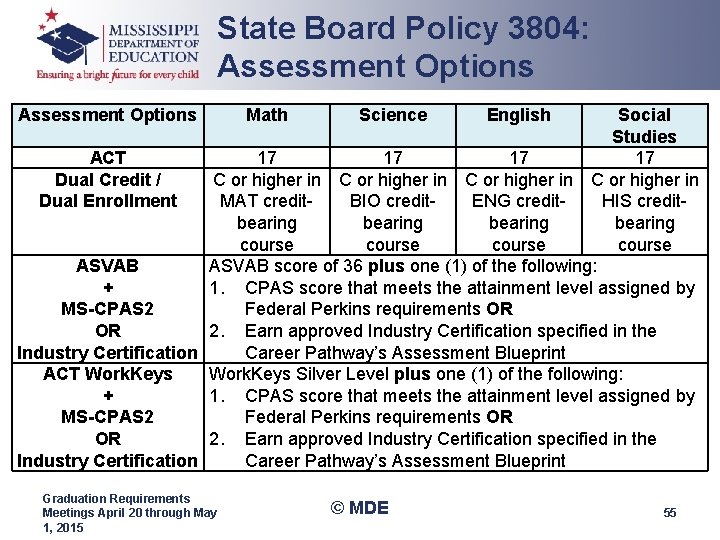
State Board Policy 3804: Assessment Options Social Studies ACT 17 17 Dual Credit / C or higher in Dual Enrollment MAT credit BIO credit ENG credit HIS credit bearing course ASVAB score of 36 plus one (1) of the following: + 1. CPAS score that meets the attainment level assigned by MS-CPAS 2 Federal Perkins requirements OR OR 2. Earn approved Industry Certification specified in the Industry Certification Career Pathway’s Assessment Blueprint ACT Work. Keys Silver Level plus one (1) of the following: + 1. CPAS score that meets the attainment level assigned by MS-CPAS 2 Federal Perkins requirements OR OR 2. Earn approved Industry Certification specified in the Industry Certification Career Pathway’s Assessment Blueprint Graduation Requirements Meetings April 20 through May 1, 2015 Math Science © MDE English 55
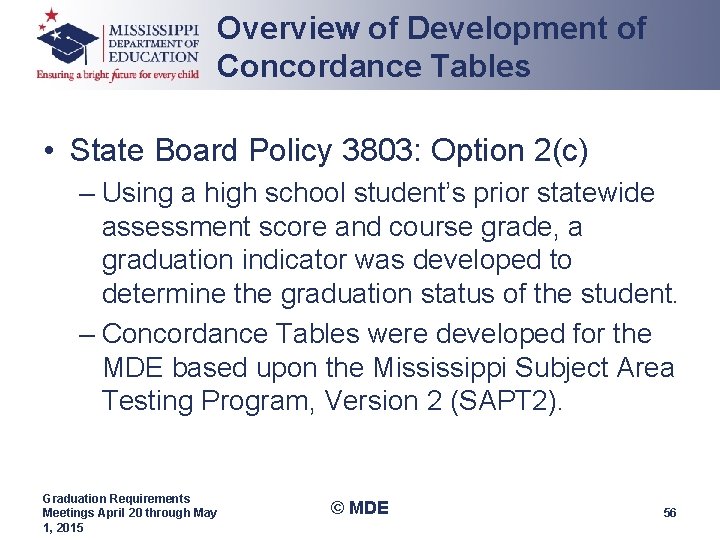
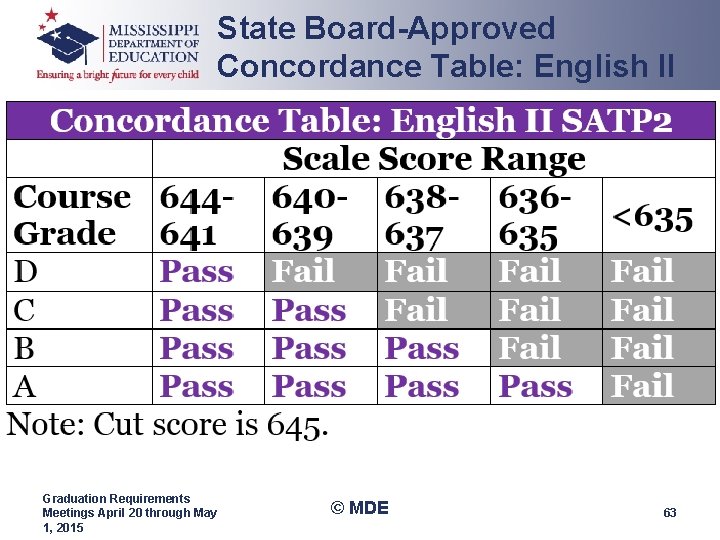
Overview of Development of Concordance Tables • State Board Policy 3803: Option 2(c) – Using a high school student’s prior statewide assessment score and course grade, a graduation indicator was developed to determine the graduation status of the student. – Concordance Tables were developed for the MDE based upon the Mississippi Subject Area Testing Program, Version 2 (SAPT 2). Graduation Requirements Meetings April 20 through May 1, 2015 © MDE 56
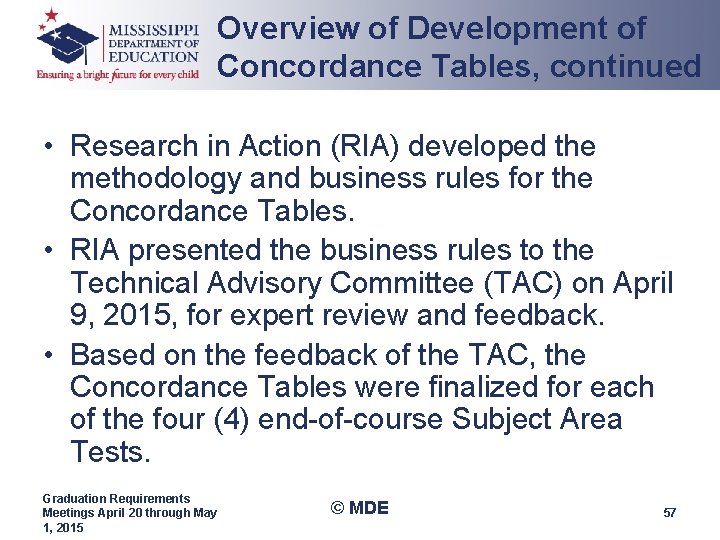
Overview of Development of Concordance Tables, continued • Research in Action (RIA) developed the methodology and business rules for the Concordance Tables. • RIA presented the business rules to the Technical Advisory Committee (TAC) on April 9, 2015, for expert review and feedback. • Based on the feedback of the TAC, the Concordance Tables were finalized for each of the four (4) end of course Subject Area Tests. Graduation Requirements Meetings April 20 through May 1, 2015 © MDE 57
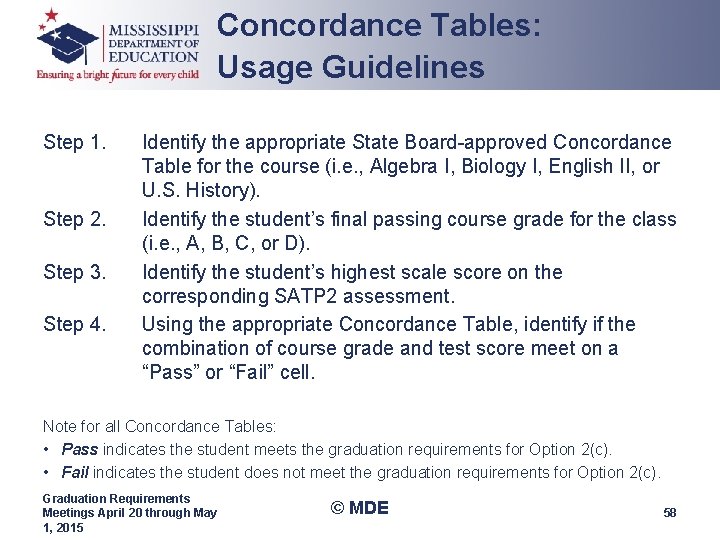
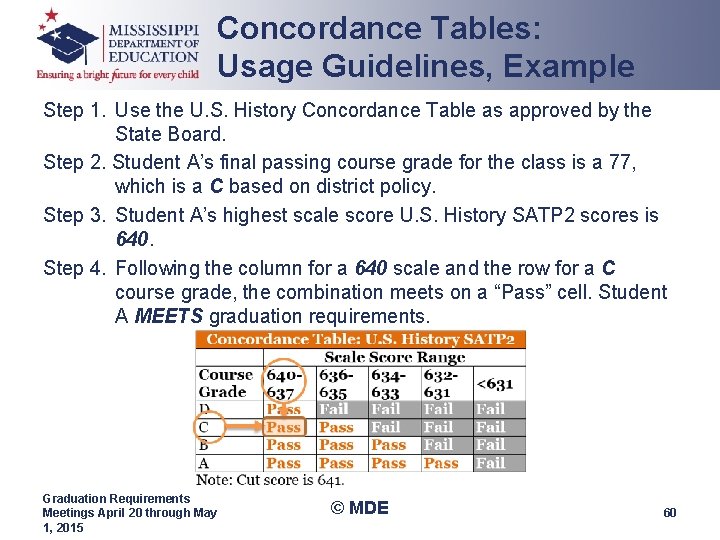
Concordance Tables: Usage Guidelines Step 1. Step 2. Step 3. Step 4. Identify the appropriate State Board approved Concordance Table for the course (i. e. , Algebra I, Biology I, English II, or U. S. History). Identify the student’s final passing course grade for the class (i. e. , A, B, C, or D). Identify the student’s highest scale score on the corresponding SATP 2 assessment. Using the appropriate Concordance Table, identify if the combination of course grade and test score meet on a “Pass” or “Fail” cell. Note for all Concordance Tables: • Pass indicates the student meets the graduation requirements for Option 2(c). • Fail indicates the student does not meet the graduation requirements for Option 2(c). Graduation Requirements Meetings April 20 through May 1, 2015 © MDE 58
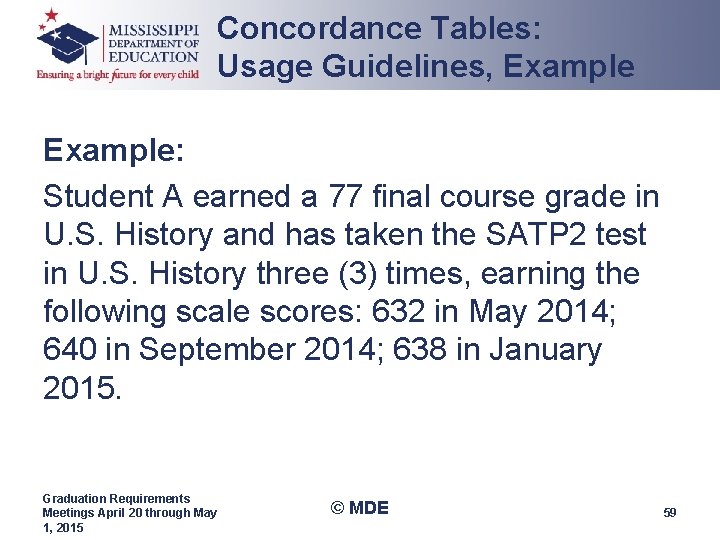
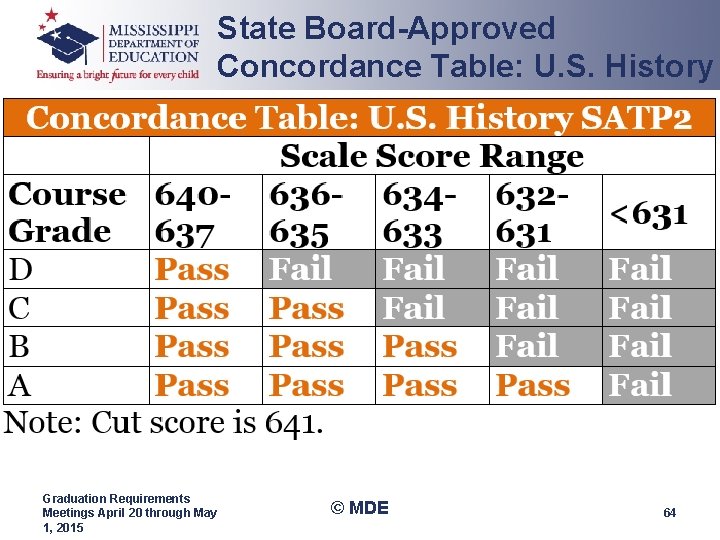
Concordance Tables: Usage Guidelines, Example: Student A earned a 77 final course grade in U. S. History and has taken the SATP 2 test in U. S. History three (3) times, earning the following scale scores: 632 in May 2014; 640 in September 2014; 638 in January 2015. Graduation Requirements Meetings April 20 through May 1, 2015 © MDE 59
Concordance Tables: Usage Guidelines, Example Step 1. Use the U. S. History Concordance Table as approved by the State Board. Step 2. Student A’s final passing course grade for the class is a 77, which is a C based on district policy. Step 3. Student A’s highest scale score U. S. History SATP 2 scores is 640. Step 4. Following the column for a 640 scale and the row for a C course grade, the combination meets on a “Pass” cell. Student A MEETS graduation requirements. Graduation Requirements Meetings April 20 through May 1, 2015 © MDE 60
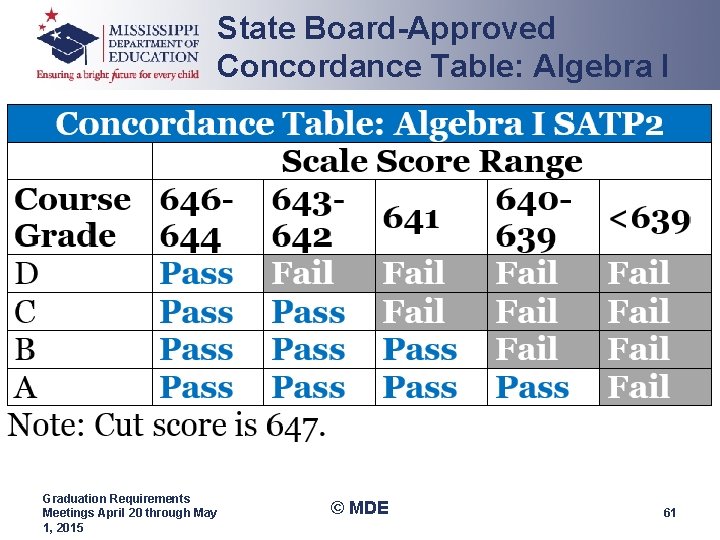
State Board-Approved Concordance Table: Algebra I Graduation Requirements Meetings April 20 through May 1, 2015 © MDE 61
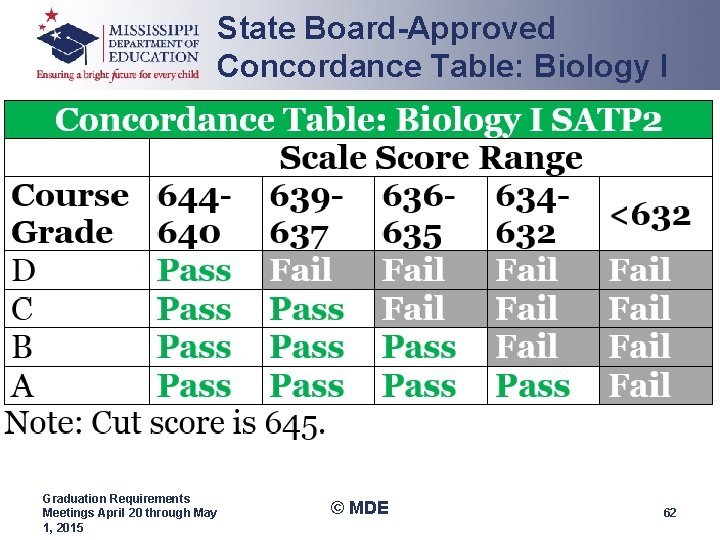
State Board-Approved Concordance Table: Biology I Graduation Requirements Meetings April 20 through May 1, 2015 © MDE 62
State Board-Approved Concordance Table: English II Graduation Requirements Meetings April 20 through May 1, 2015 © MDE 63
State Board-Approved Concordance Table: U. S. History Graduation Requirements Meetings April 20 through May 1, 2015 © MDE 64
Contact Jean Massey, Executive Director Office of Secondary Education jmassey@mde. k 12. ms. us 601. 359. 3461 Paula Vanderford, Executive Director Office of Accreditation and Accountability pvanderford@mde. k 12. ms. us 601. 359. 3764
Wrap Up • Assignment for Day 2 – Completion of action plans – Present to groups