
HIGH SCHOOL COLLEGE DUAL ENROLLMENT Information And Procedures

- Slides: 29
HIGH SCHOOL /COLLEGE DUAL ENROLLMENT Information And Procedures * Subject to change based on legislative action
WHAT IS THE HIGH SCHOOL/COLLEGE DUAL ENROLLMENT PROGRAM? The Dual Enrollment Program is an opportunity for qualified high school students to earn college credits paid for by the state of Georgia, including a book allowance or free book usage (depending on the institution). Some programs may require fees (program fees) that are not part of the Dual Enrollment funding. The student is “jointly” enrolled in high school and in college. Students can be a full time or part time college student in Fall, Spring, or even Summer semester. The student earns college credits as well as high school credits needed for graduation.
WHAT ARE THE PROS AND CONS? PROS CONS • Students can get a head start on college. • Students must keep up with important Junior/Senior High School information. School websites are VITAL sources of information. • Helps students adjust to the college experience. • Students may take classes not available at the high school. • Earning College credits saves money on future college coursework— earlier graduation from college (not high school). • Many colleges prefer a different curriculum path (i. e. AP classes). • Colleges will not “usually” communicate with parents of Dual Enrollment students.
HB 444 Dual Enrollment Act!! HB 444 passed the House during the 18 -19 Legislative session, but was tabled in the Senate. It was “recommitted” in the Senate, revised, and has now passed the Senate and is awaiting signature by the governor. • Limiting Dual Enrollment “core course work” to Juniors and Seniors • Allowing 10 th grade students to participate ONLY in CTAE area coursework. • No 9 th grade participation. • Limiting new students and existing students with less than 18 credit hours of Dual Enrollment credit to a maximum of 30 hours of post-secondary coursework. • Limiting students with more than 19 hours to 12 additional hours. More information about HB 444? Google HB 444 Dual Enrollment Act.
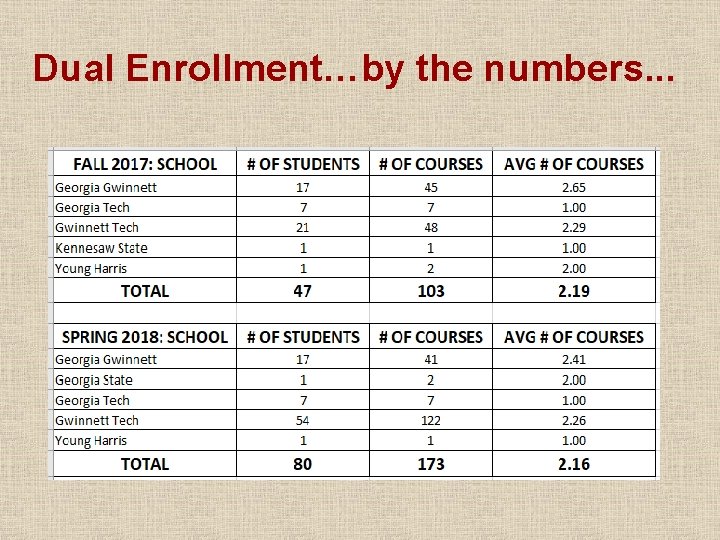
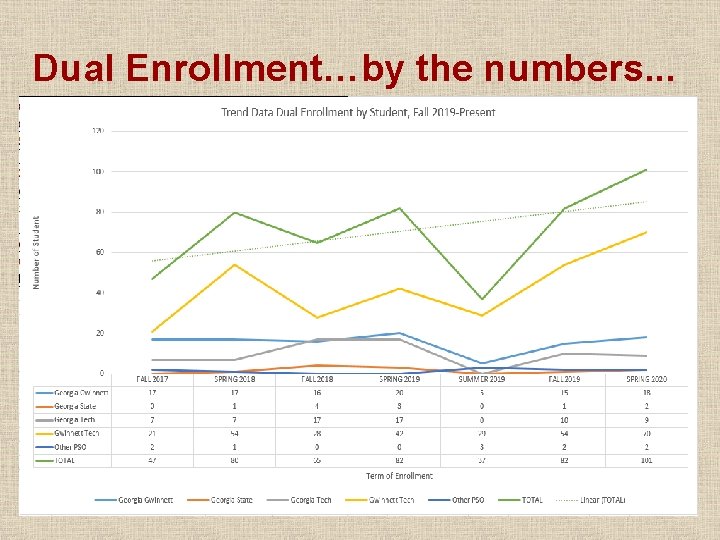
Dual Enrollment…by the numbers. . .
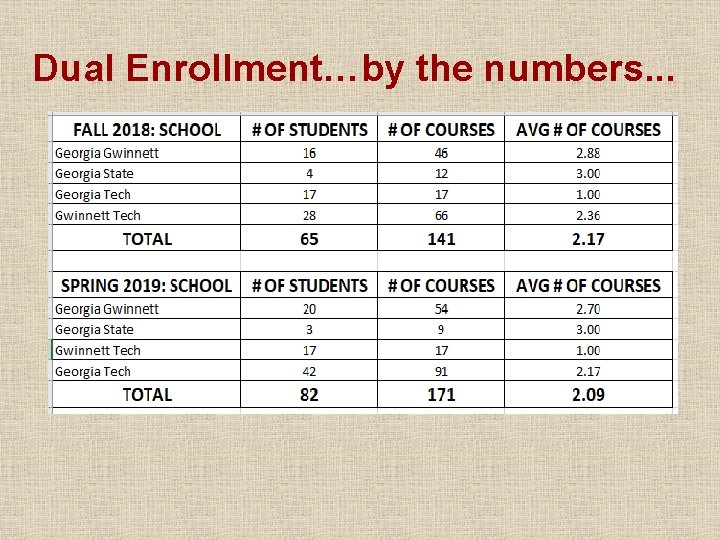
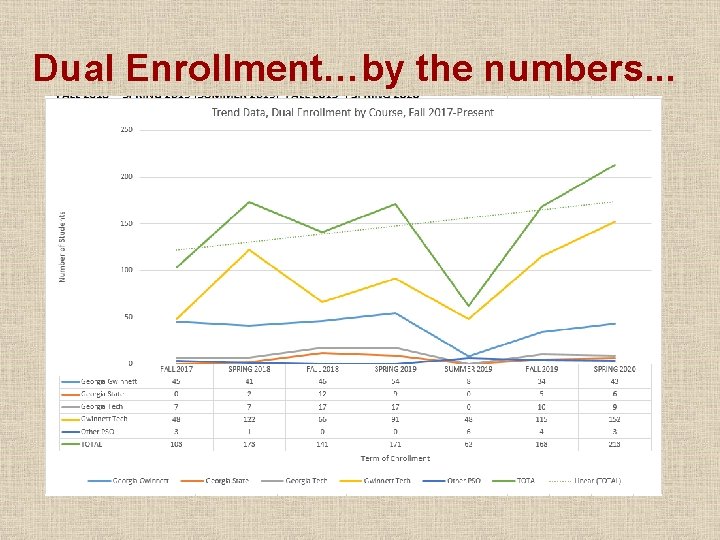
Dual Enrollment…by the numbers. . .
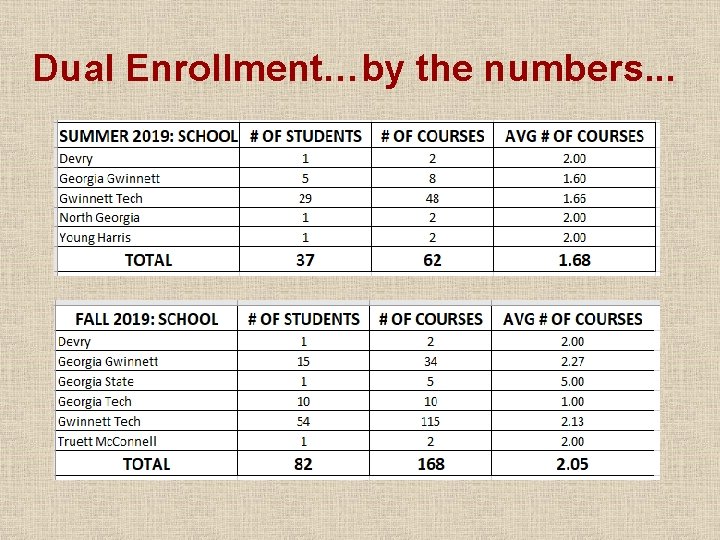
Dual Enrollment…by the numbers. . .
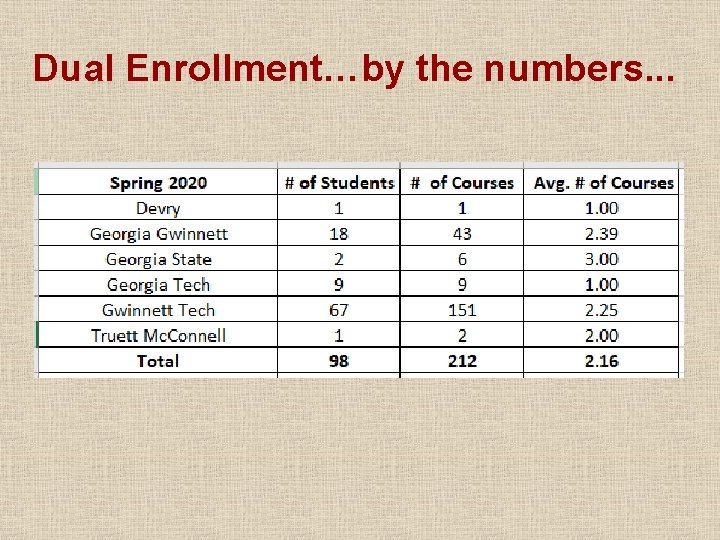
Dual Enrollment…by the numbers. . .
Dual Enrollment…by the numbers. . . TREND DATA, ENROLLMENT ALL PSO Fall 2017 -Present
Dual Enrollment…by the numbers. . .
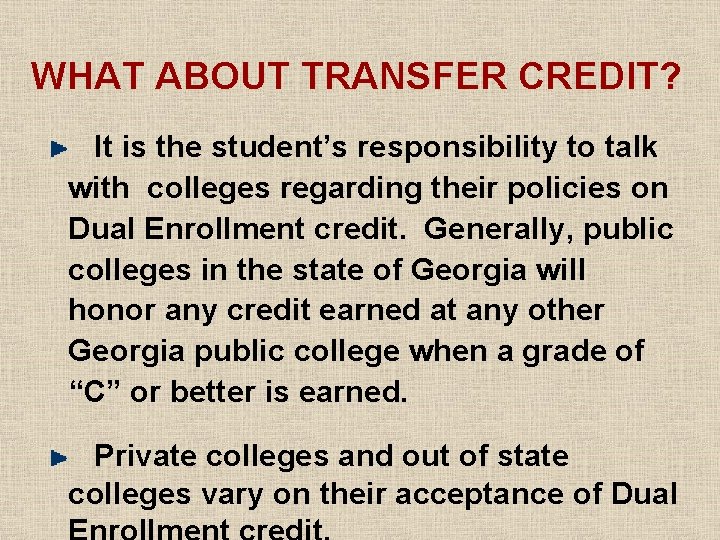
WHAT ABOUT TRANSFER CREDIT? It is the student’s responsibility to talk with colleges regarding their policies on Dual Enrollment credit. Generally, public colleges in the state of Georgia will honor any credit earned at any other Georgia public college when a grade of “C” or better is earned. Private colleges and out of state colleges vary on their acceptance of Dual
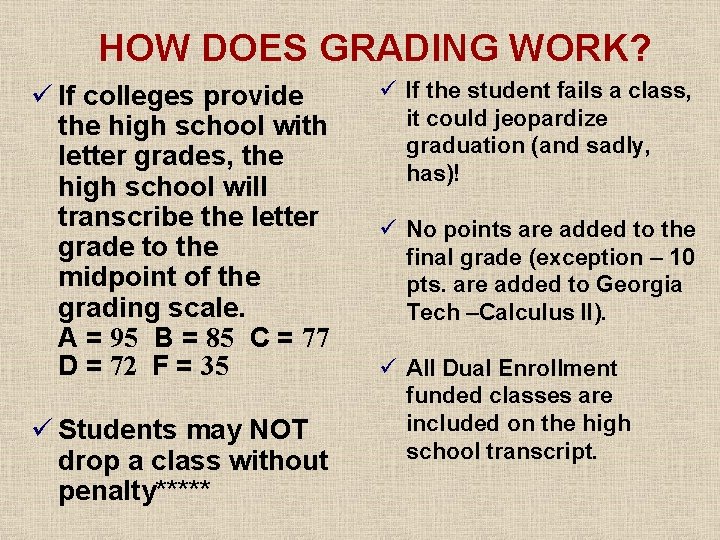
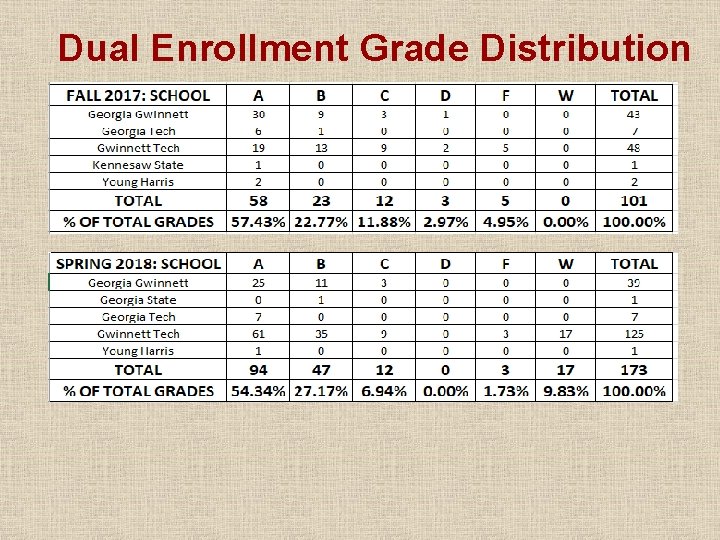
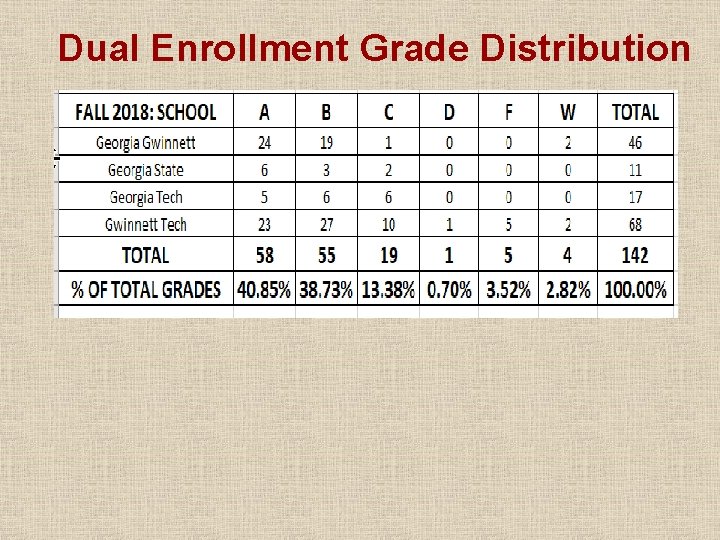
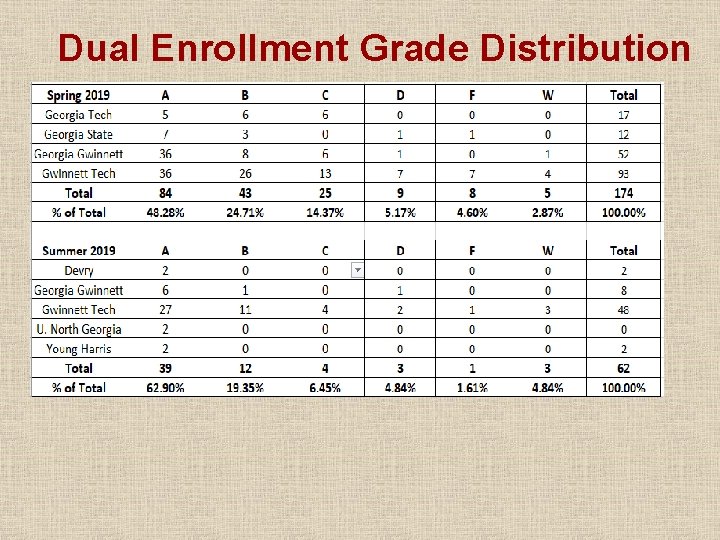
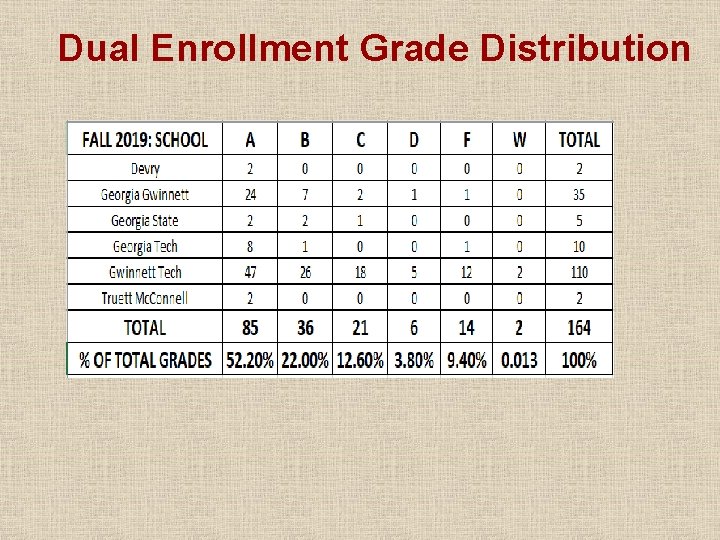
HOW DOES GRADING WORK? ü If colleges provide the high school with letter grades, the high school will transcribe the letter grade to the midpoint of the grading scale. A = 95 B = 85 C = 77 D = 72 F = 35 ü Students may NOT drop a class without penalty***** ü If the student fails a class, it could jeopardize graduation (and sadly, has)! ü No points are added to the final grade (exception – 10 pts. are added to Georgia Tech –Calculus II). ü All Dual Enrollment funded classes are included on the high school transcript.
Dual Enrollment Grade Distribution
Dual Enrollment Grade Distribution
Dual Enrollment Grade Distribution
Dual Enrollment Grade Distribution
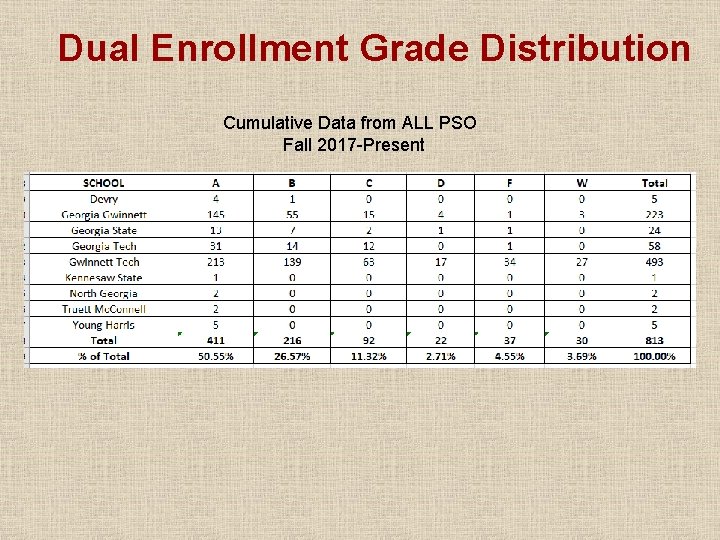
Dual Enrollment Grade Distribution Cumulative Data from ALL PSO Fall 2017 -Present
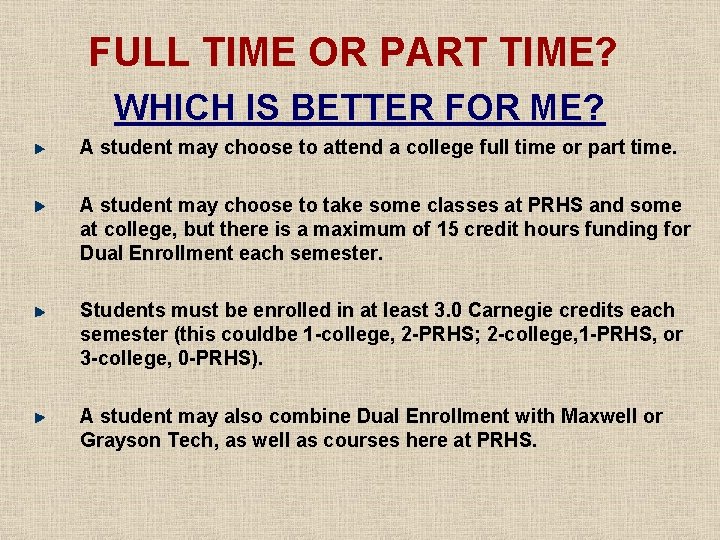
FULL TIME OR PART TIME? WHICH IS BETTER FOR ME? A student may choose to attend a college full time or part time. A student may choose to take some classes at PRHS and some at college, but there is a maximum of 15 credit hours funding for Dual Enrollment each semester. Students must be enrolled in at least 3. 0 Carnegie credits each semester (this couldbe 1 -college, 2 -PRHS; 2 -college, 1 -PRHS, or 3 -college, 0 -PRHS). A student may also combine Dual Enrollment with Maxwell or Grayson Tech, as well as courses here at PRHS.
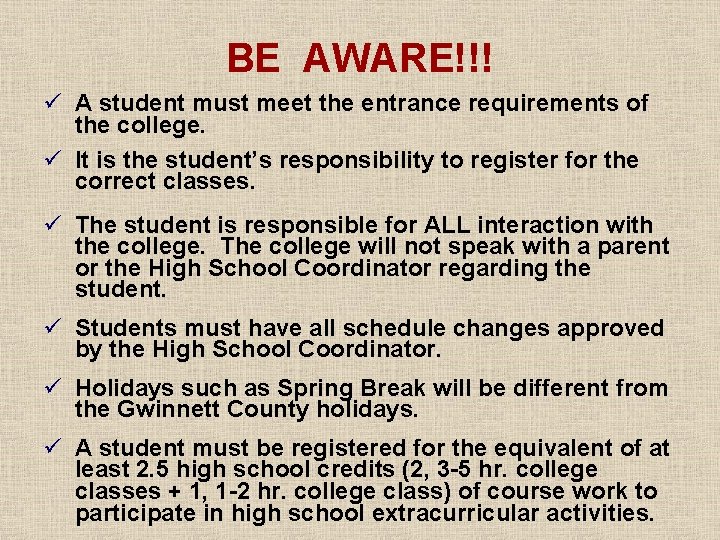
BE AWARE!!! ü A student must meet the entrance requirements of the college. ü It is the student’s responsibility to register for the correct classes. ü The student is responsible for ALL interaction with the college. The college will not speak with a parent or the High School Coordinator regarding the student. ü Students must have all schedule changes approved by the High School Coordinator. ü Holidays such as Spring Break will be different from the Gwinnett County holidays. ü A student must be registered for the equivalent of at least 2. 5 high school credits (2, 3 -5 hr. college classes + 1, 1 -2 hr. college class) of course work to participate in high school extracurricular activities.
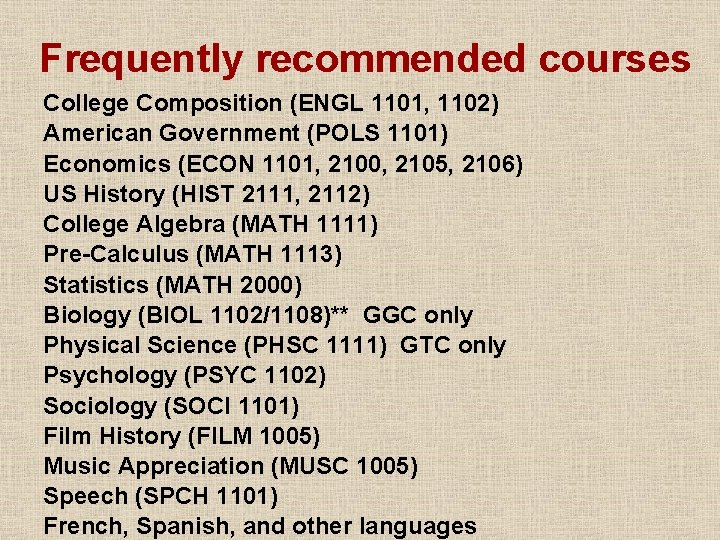
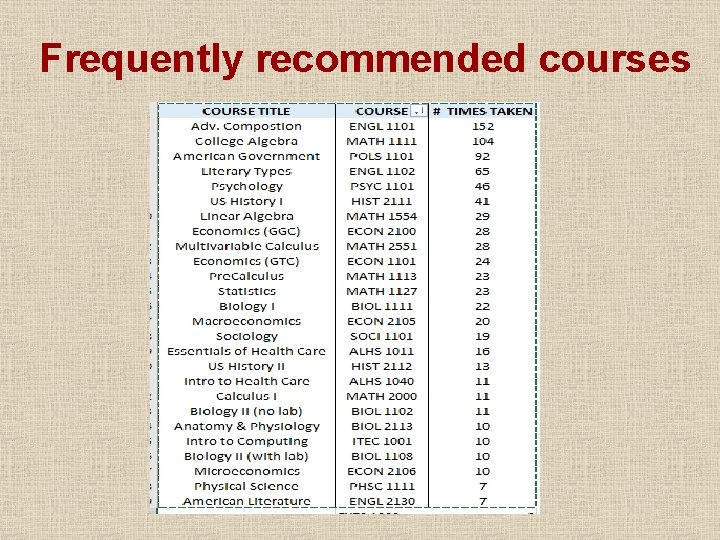
Frequently recommended courses College Composition (ENGL 1101, 1102) American Government (POLS 1101) Economics (ECON 1101, 2100, 2105, 2106) US History (HIST 2111, 2112) College Algebra (MATH 1111) Pre-Calculus (MATH 1113) Statistics (MATH 2000) Biology (BIOL 1102/1108)** GGC only Physical Science (PHSC 1111) GTC only Psychology (PSYC 1102) Sociology (SOCI 1101) Film History (FILM 1005) Music Appreciation (MUSC 1005) Speech (SPCH 1101) French, Spanish, and other languages
Frequently recommended courses
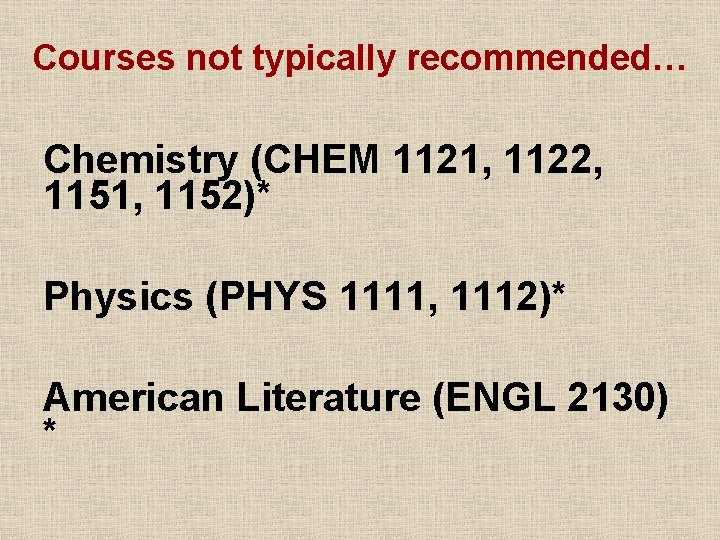
Courses not typically recommended… Chemistry (CHEM 1121, 1122, 1151, 1152)* Physics (PHYS 1111, 1112)* American Literature (ENGL 2130) *
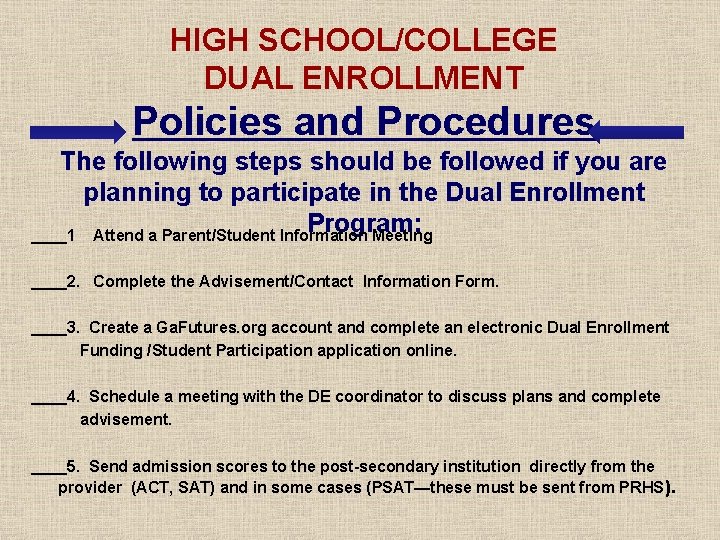
HIGH SCHOOL/COLLEGE DUAL ENROLLMENT Policies and Procedures The following steps should be followed if you are planning to participate in the Dual Enrollment Program: ____1 Attend a Parent/Student Information Meeting ____2. Complete the Advisement/Contact Information Form. ____3. Create a Ga. Futures. org account and complete an electronic Dual Enrollment Funding /Student Participation application online. ____4. Schedule a meeting with the DE coordinator to discuss plans and complete advisement. ____5. Send admission scores to the post-secondary institution directly from the provider (ACT, SAT) and in some cases (PSAT—these must be sent from PRHS ).
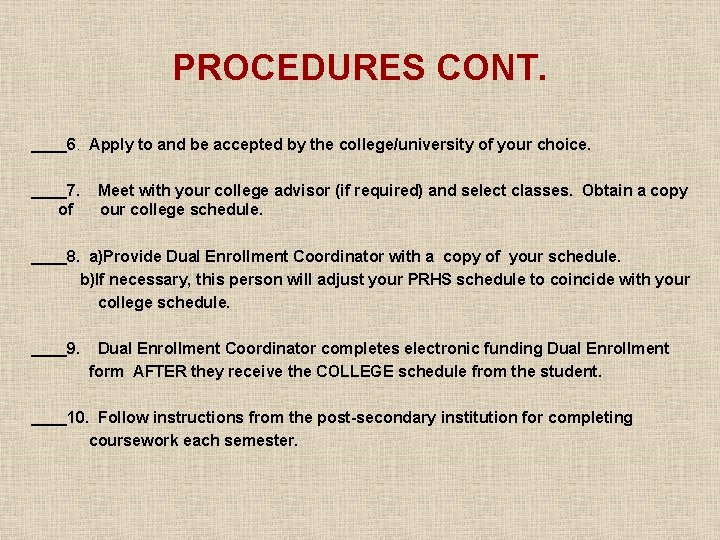
PROCEDURES CONT. ____6. Apply to and be accepted by the college/university of your choice. ____7. of Meet with your college advisor (if required) and select classes. Obtain a copy our college schedule. ____8. a)Provide Dual Enrollment Coordinator with a copy of your schedule. b)If necessary, this person will adjust your PRHS schedule to coincide with your college schedule. ____9. Dual Enrollment Coordinator completes electronic funding Dual Enrollment form AFTER they receive the COLLEGE schedule from the student. ____10. Follow instructions from the post-secondary institution for completing coursework each semester.
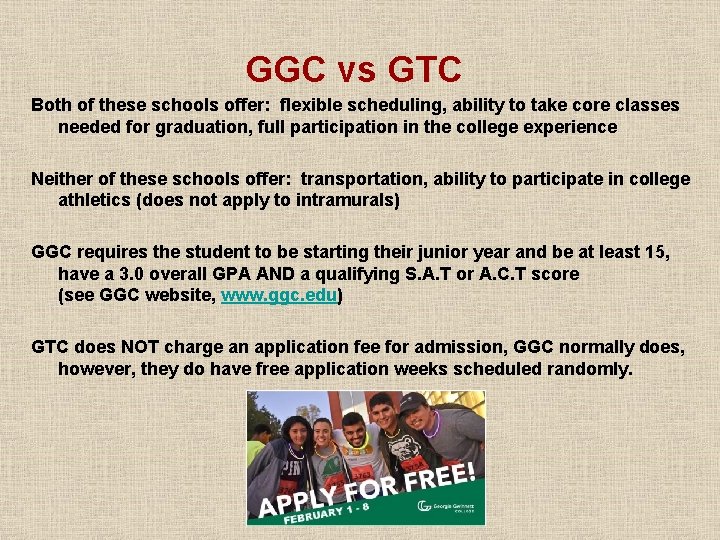
GGC vs GTC Both of these schools offer: flexible scheduling, ability to take core classes needed for graduation, full participation in the college experience Neither of these schools offer: transportation, ability to participate in college athletics (does not apply to intramurals) GGC requires the student to be starting their junior year and be at least 15, have a 3. 0 overall GPA AND a qualifying S. A. T or A. C. T score (see GGC website, www. ggc. edu) GTC does NOT charge an application fee for admission, GGC normally does, however, they do have free application weeks scheduled randomly.
GGC vs GTC allows the use of the **P. S. AT, S. A. T, A. C. T or a qualifying score on the Accu-Placer assessment (offered at GTC). There is no GPA requirement nor is there an age limit as long as the student is in high school. GGC offers core electives and foreign languages in contrast to GTC which does NOT offer foreign languages, but does have a PLETHORA of other electives typically not offered in a 2/4 year school.
And what about Georgia State? As with GGC, GSU is a four year college (and more) and offers a WIDE variety of courses for Dual Enrollment. Application process is similar with fees, admissions requirements (entering 11 th grade and 3. 0 GPA, S. A. T and A. C. T requirements comparable to other schools). Most students participate in DE through Perimeter College which has FIVE campuses including: Alpharetta, Dunwoody, and Clarkston. Students may also participate in DE through the main campus in Atlanta. BONUS: Students who successfully complete coursework through GSU are classified as transfer students into the MAIN campus and not entering Freshman making the admission process more streamlined.
More Information… www. gafutures. org www. gwinnetttech. edu www. ggc. edu www. gsu. edu
Questions and Contacts Dr. Paul Johnson, Assistant Principal OFFICE: E 108 paul_johnson@gwinnett. k 12. ga. us 678 -5126069