
High School Biology EOC Systems Thinking and Field

High School Biology EOC Systems Thinking and Field Studies March 18, 2013 § Welcome- Networking and Coffee § Door Prizes
Goals Teachers will learning and apply system thinking tools as a means to better understand EALR 1: Systems (Sys) Teachers will write multiple-choice questions to address the Item Specs for Systems and LS 2 (Ecosystems). Teachers will develop lesson plans to address Item Specs for Systems and LS 2 (Ecosystems). Teachers will write and EOC-type field study scenario to use in their biology classes this spring.
Biology Bingo § So, it is March where am I at in preparing my kids. § Move and talk to others in the room about their teaching. § If they have addressed the topic in the square, have them sign. § Winning?

Instructional Strategies § Brainstorm three Biology EOC strategies you have implemented in your classroom this year. § Write the strategies on a three separate sticky notes.

Give One, Get One § Share with your group members and create list, clump similarities § Share out with everyone
Lessons Learned from OSPI Item Writing § MM will share here
What will the EOC look like? § 5 -6 scenarios § Inquiry (Field Study and Controlled Investigation) § Application § Systems § 45 total questions (5 are pilot items) § 35 Mult. Choice or Completion § 5 Short Answer Questions
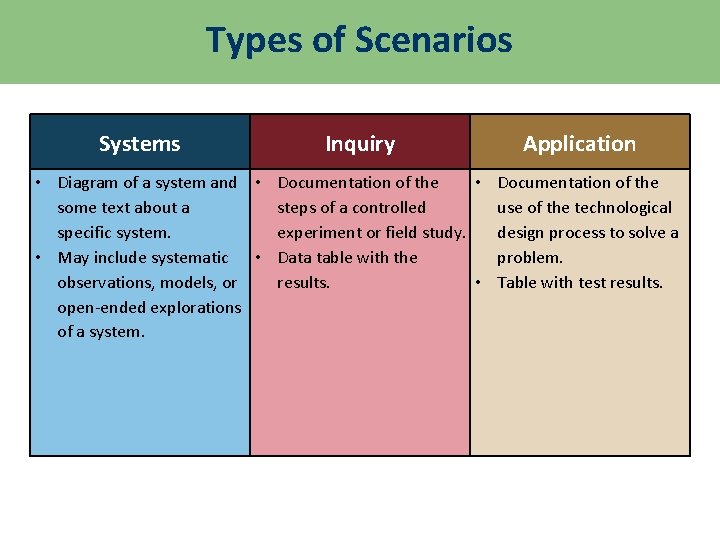
Types of Scenarios Systems Inquiry Application • Diagram of a system and • Documentation of the some text about a steps of a controlled use of the technological specific system. experiment or field study. design process to solve a • May include systematic • Data table with the problem. observations, models, or results. • Table with test results. open-ended explorations of a system.

Approx. Distribution of Standards for the EOC § 50% - Cross-cutting standards § Inqiury (8 questions) § Systems (6 questions) § Application (6 questions) § 50% - Content Standards § LS 1 Structure and Function (9 questions) § LS 2 Ecology and Populations (6 questions) § LS 3 Biological Evolution (5 questions)

Biology EOC Test Map EALR Percent of EOC 1: Systems (crossed with Life Science and alone) At least 15 2: Inquiry (crossed with Life Science and alone) 20 – 25 3: Application (crossed with Life Science and alone) 4: Life science domain of EALR 4 (alone) 15 45 – 50
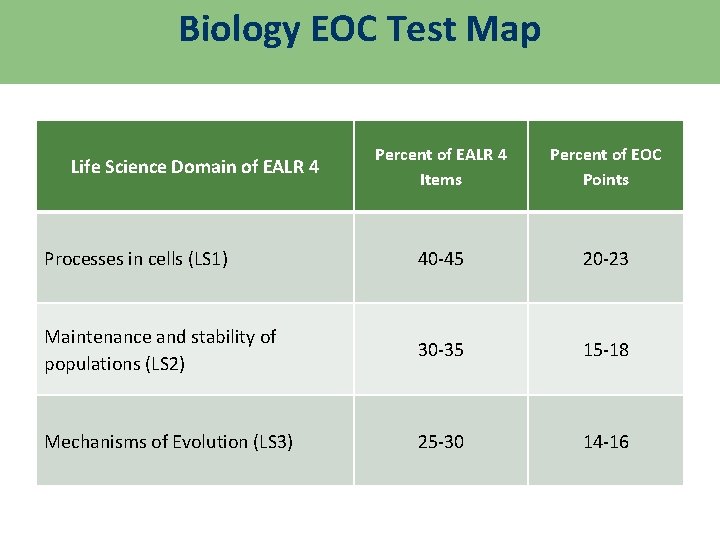
Biology EOC Test Map Percent of EALR 4 Items Percent of EOC Points Processes in cells (LS 1) 40 -45 20 -23 Maintenance and stability of populations (LS 2) 30 -35 15 -18 Mechanisms of Evolution (LS 3) 25 -30 14 -16 Life Science Domain of EALR 4
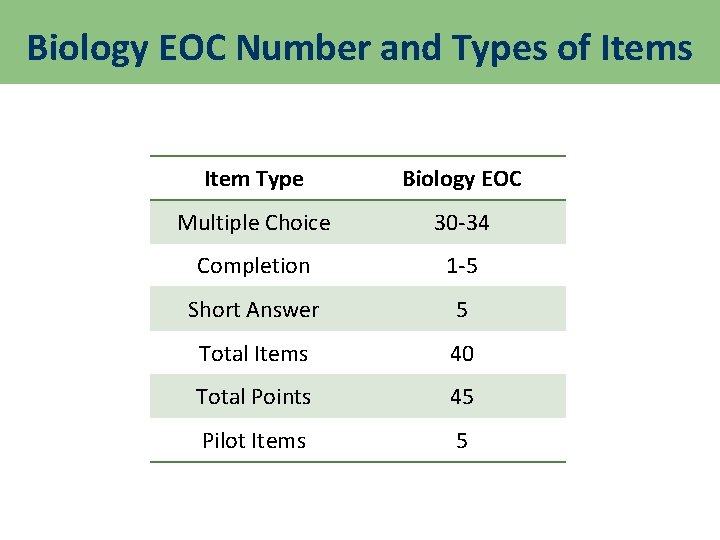
Biology EOC Number and Types of Items Item Type Biology EOC Multiple Choice 30 -34 Completion 1 -5 Short Answer 5 Total Items 40 Total Points 45 Pilot Items 5
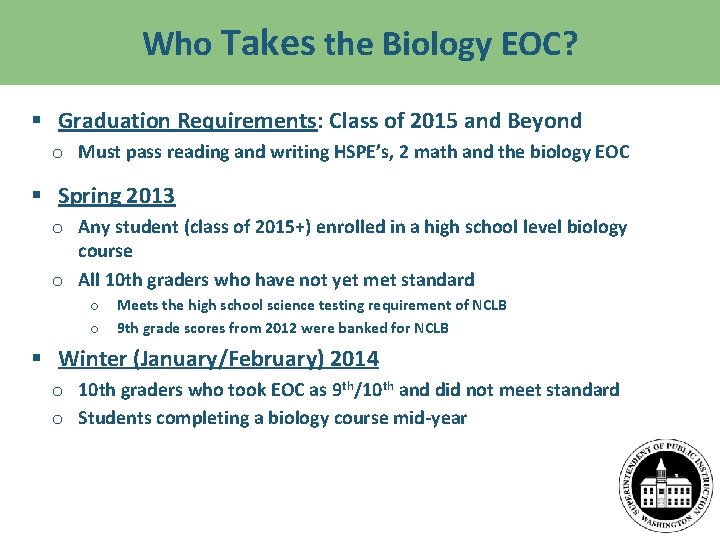
Who Takes the Biology EOC? § Graduation Requirements: Class of 2015 and Beyond o Must pass reading and writing HSPE’s, 2 math and the biology EOC § Spring 2013 o Any student (class of 2015+) enrolled in a high school level biology course o All 10 th graders who have not yet met standard o o Meets the high school science testing requirement of NCLB 9 th grade scores from 2012 were banked for NCLB § Winter (January/February) 2014 o 10 th graders who took EOC as 9 th/10 th and did not meet standard o Students completing a biology course mid-year

Test Overview--EOC Align to Standards 2012 aligned to new content standards Completion Items Operational in 2012; Worth 1 point Test Window Spring-May 6 to June 21 Locally determined schedule, during last 3 weeks of the course Test Length Three sessions: 50 minutes each OR Single session: about 150 minutes* *additional time needed for passing out materials and reading directions

Next Generation Science Standards Updates • Public draft of the Next Generation Science Standards Development are due out in December. • Final draft due out Spring 2012 • Adopted by the state of Washington by 2014 (estimated) • State assessment aligned to new standards 2017 (estimated) • Consider how Next Generation Science Standards (NGSS) will impact current teaching practices. 1996 2013+ 2009 15
9: 15 Modeling Systems Approach S. T. O. P. §Story §Variables §Boundaries §Sketch Trends §Iceberg

Break Return at 10: 27
Positive and Negative Feedback §Learning Together §Reflection for me §Reflection for my kids

11: 30 Your turn! Try the Systems Approach! § Use the cards to guide a lesson § Maybe: • • Wolves 501 or 9 Ticks and Moths 530 or 41 Putting the Bite on Planet Earth p 537 Bringing back the Everglades p 579
and…. . Write EOC-type questions! § Use the cards to focus your assessment. § Include a scenario and multiple choice questions § SYS § LS 2

Lunch 12: 30 -1: 00
Nature Bridge (Olympic Park Institute) § Kristen Emmett, Science & Technology Project Manager, Naturebridge §You can explore Olympic National Park Field. Scope with Nature. Bridge at: olympic. fieldscope. org. § http: //www. naturebridge. org/olympicnational-park
Your time § Explore wiki field study resources § Create lesson plans around existing field studies § Create your own field studies § Assessment
Field Study Resources § Field Study Examples from Insights (page 2, Life in a Square Meter) § Field Study Examples from OSPI (Strawberry Habitats) § Templates and additional resources on wiki!

2: 30 Collaboration Share your lesson Feedback from colleagues

Exit Ticket: Reflection and Feedback § What can we do to support you and your students? § Survey Monkey on your email
- Slides: 26