
HIGH RISK MEDICINES SAFE USE OF OPIOID SKIN

- Slides: 20
HIGH RISK MEDICINES SAFE USE OF OPIOID SKIN PATCHES EDUCATION 1
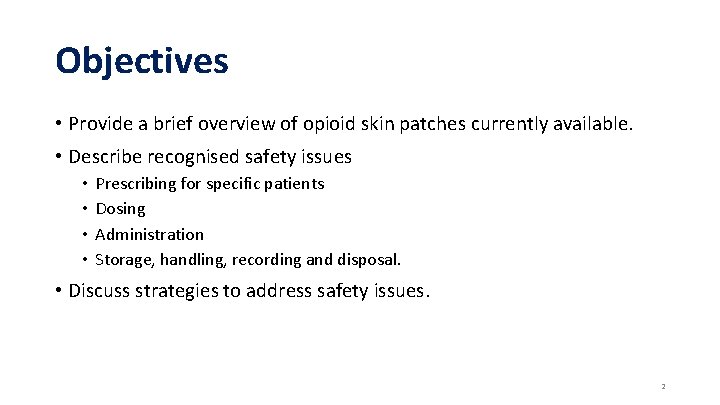
Objectives • Provide a brief overview of opioid skin patches currently available. • Describe recognised safety issues • • Prescribing for specific patients Dosing Administration Storage, handling, recording and disposal. • Discuss strategies to address safety issues. 2
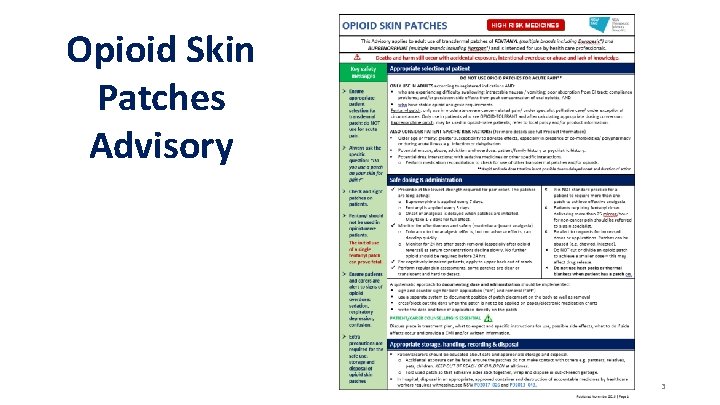
Opioid Skin Patches Advisory 3
Opioid skin patches This presentation and the accompanying Advisory applies to ADULT use of transdermal patches of fentanyl and buprenorphine and is intended for use by health care professionals. Deaths from these products still occur with accidental exposure, intentional overdose and lack of knowledge. 4
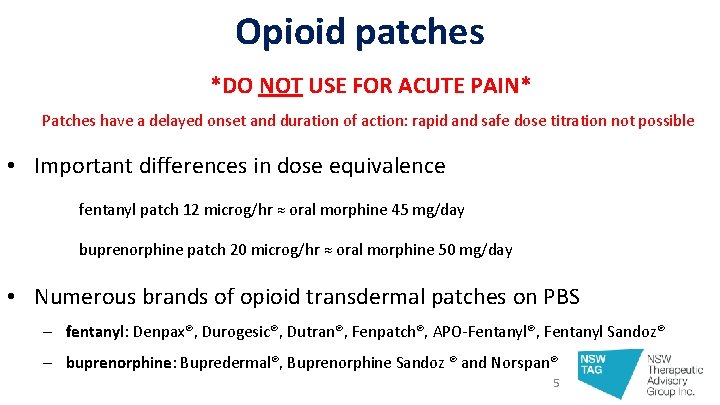
Opioid patches *DO NOT USE FOR ACUTE PAIN* Patches have a delayed onset and duration of action: rapid and safe dose titration not possible • Important differences in dose equivalence fentanyl patch 12 microg/hr ≈ oral morphine 45 mg/day buprenorphine patch 20 microg/hr ≈ oral morphine 50 mg/day • Numerous brands of opioid transdermal patches on PBS – fentanyl: Denpax®, Durogesic®, Dutran®, Fenpatch®, APO-Fentanyl®, Fentanyl Sandoz® – buprenorphine: Bupredermal®, Buprenorphine Sandoz ® and Norspan® 5
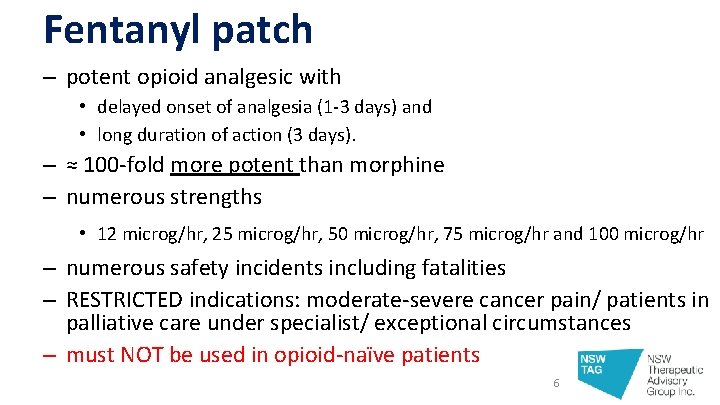
Fentanyl patch – potent opioid analgesic with • delayed onset of analgesia (1 -3 days) and • long duration of action (3 days). – ≈ 100 -fold more potent than morphine – numerous strengths • 12 microg/hr, 25 microg/hr, 50 microg/hr, 75 microg/hr and 100 microg/hr – numerous safety incidents including fatalities – RESTRICTED indications: moderate-severe cancer pain/ patients in palliative care under specialist/ exceptional circumstances – must NOT be used in opioid-naïve patients 6
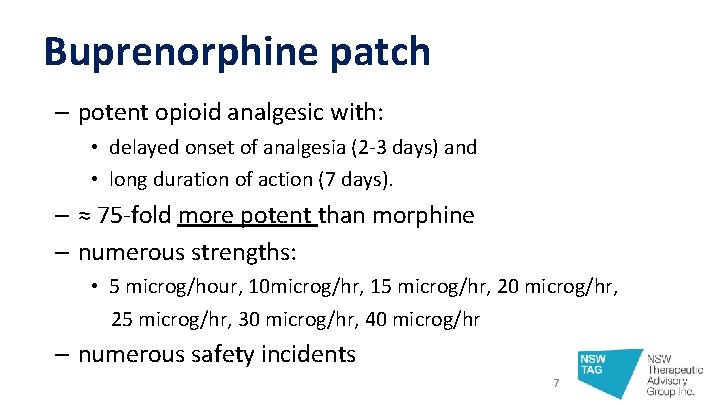
Buprenorphine patch – potent opioid analgesic with: • delayed onset of analgesia (2 -3 days) and • long duration of action (7 days). – ≈ 75 -fold more potent than morphine – numerous strengths: • 5 microg/hour, 10 microg/hr, 15 microg/hr, 20 microg/hr, 25 microg/hr, 30 microg/hr, 40 microg/hr – numerous safety incidents 7
Opioid patches Serious harm can occur with INAPPROPRIATE - patient selection - dosing and administration - disposal 8
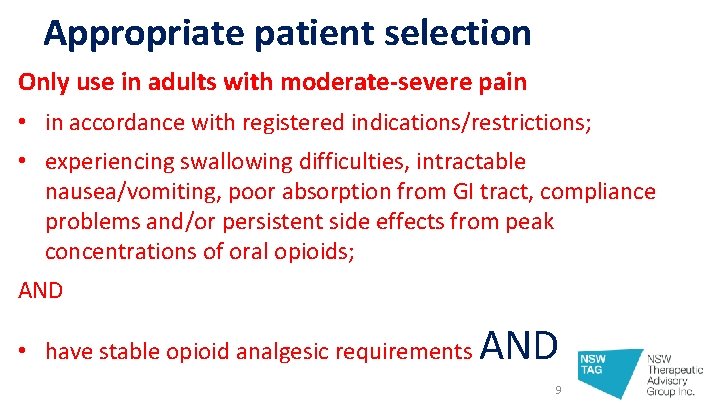
Appropriate patient selection Only use in adults with moderate-severe pain • in accordance with registered indications/restrictions; • experiencing swallowing difficulties, intractable nausea/vomiting, poor absorption from GI tract, compliance problems and/or persistent side effects from peak concentrations of oral opioids; AND • have stable opioid analgesic requirements AND 9
Also consider the following risk factors • Older age or frailty: – susceptibility to adverse effects, especially in presence of comorbidities/ polypharmacy or during acute illness e. g. infection or dehydration • Potential misuse, abuse, addiction and overdose: patient/family history or psychiatric history • Potential drug interactions – other sedative medicines, serotonergic medicines (fentanyl), CYP 3 A 4 inhibitors and inducers (fentanyl) • Perform medication reconciliation to check for use of transdermal patches and/or other opioids 10
Prescribing practice principles • • Prescribe at the lowest strength required for pain relief Patches are long acting: - fentanyl is applied every 3 days - buprenorphine is applied every 7 days • It is NOT standard for a patient to require > 1 patch to achieve effective analgesia • Monitor for effectiveness and safety (maximise other analgesia where possible) – NB: once a patch is removed and not replaced, a reservoir remains and appropriate monitoring should continue for 24 hours after removal • Tolerance to the analgesic effects, but not adverse effects, develops quickly. Consider hyperalgesia, tolerance and progression of underlying disease if inadequate pain control. • Do NOT cut an opioid patch to achieve a smaller dose–affects drug release 11
Safe dosing & administration • Remove old patch before applying new one – NB: some patches are clear which makes them hard to detect; – May have fallen off: check bed linen, clothes, floor • Implement a systematic approach to documenting dose and administration – – sign and counter-sign for both application (“on”) and removal (“off”) use a separate system to document position of placement of patch and removal cross out the days when the patch is not to be applied on medication charts the date and time of application should be written on the patch • Perform regular skin assessments to ensure patch has correct adhesion • Monitor sedation and cardiorespiratory status 12
Administration & key counselling points • DO NOT EXPOSE patch application site to heat sources: hot baths, heat packs or thermal blankets • Write the date & time of application on the patch with permanent marker • For cognitively impaired patients – Apply to the upper back (scapula area; out of reach of the patient) to prevent the patient removing the patch (*case of a patient found with a patch in their mouth) • Check the patch is still attached on the days between patch changes – Patients may tape down edges of patch that become loose with sticky adhesive film such as Tegaderm® 13
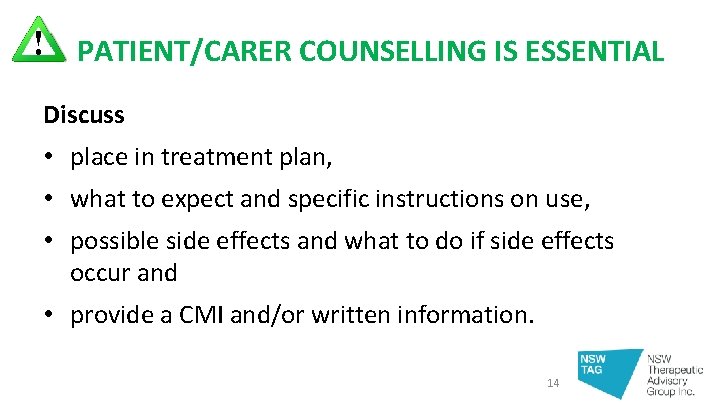
PATIENT/CARER COUNSELLING IS ESSENTIAL Discuss • place in treatment plan, • what to expect and specific instructions on use, • possible side effects and what to do if side effects occur and • provide a CMI and/or written information. 14
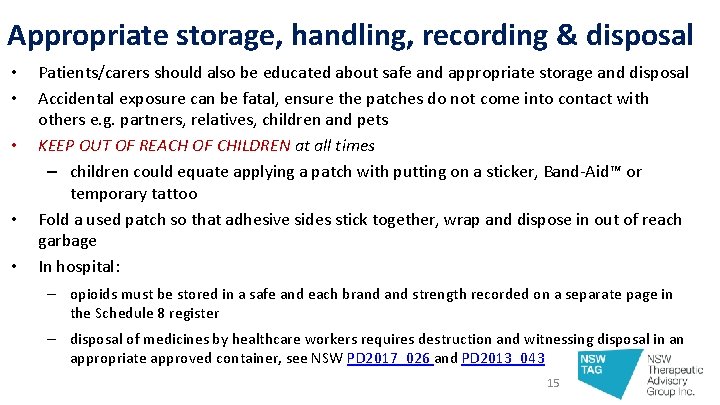
Appropriate storage, handling, recording & disposal • • • Patients/carers should also be educated about safe and appropriate storage and disposal Accidental exposure can be fatal, ensure the patches do not come into contact with others e. g. partners, relatives, children and pets KEEP OUT OF REACH OF CHILDREN at all times – children could equate applying a patch with putting on a sticker, Band-Aid™ or temporary tattoo Fold a used patch so that adhesive sides stick together, wrap and dispose in out of reach garbage In hospital: – opioids must be stored in a safe and each brand strength recorded on a separate page in the Schedule 8 register – disposal of medicines by healthcare workers requires destruction and witnessing disposal in an appropriate approved container, see NSW PD 2017_026 and PD 2013_043 15
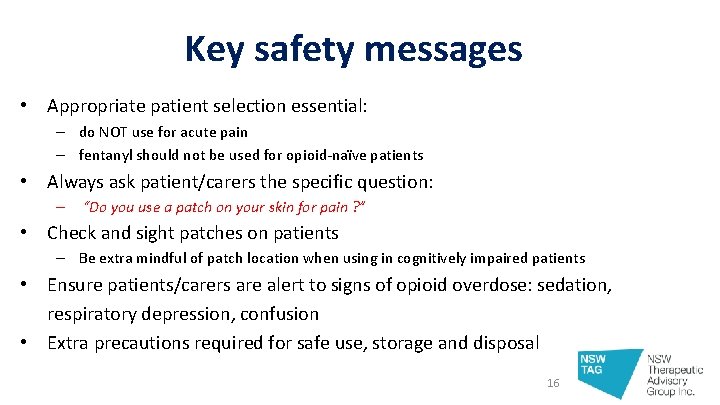
Key safety messages • Appropriate patient selection essential: – do NOT use for acute pain – fentanyl should not be used for opioid-naïve patients • Always ask patient/carers the specific question: – “Do you use a patch on your skin for pain ? ” • Check and sight patches on patients – Be extra mindful of patch location when using in cognitively impaired patients • Ensure patients/carers are alert to signs of opioid overdose: sedation, respiratory depression, confusion • Extra precautions required for safe use, storage and disposal 16
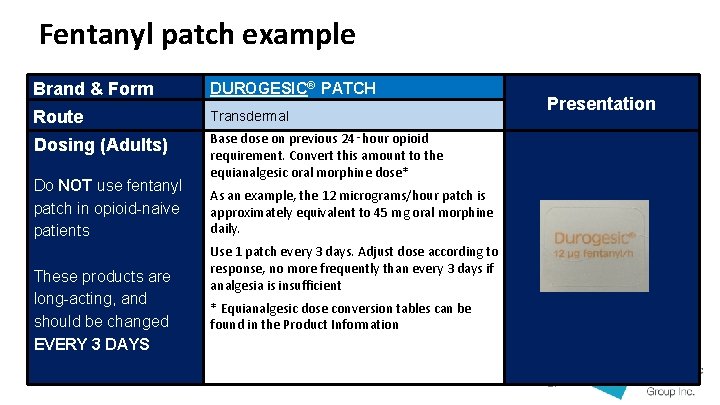
Fentanyl patch example Brand & Form DUROGESIC® PATCH Route Transdermal Dosing (Adults) Base dose on previous 24‑hour opioid requirement. Convert this amount to the equianalgesic oral morphine dose* Do NOT use fentanyl patch in opioid-naive patients These products are long-acting, and should be changed EVERY 3 DAYS Presentation As an example, the 12 micrograms/hour patch is approximately equivalent to 45 mg oral morphine daily. Use 1 patch every 3 days. Adjust dose according to response, no more frequently than every 3 days if analgesia is insufficient * Equianalgesic dose conversion tables can be found in the Product Information 17
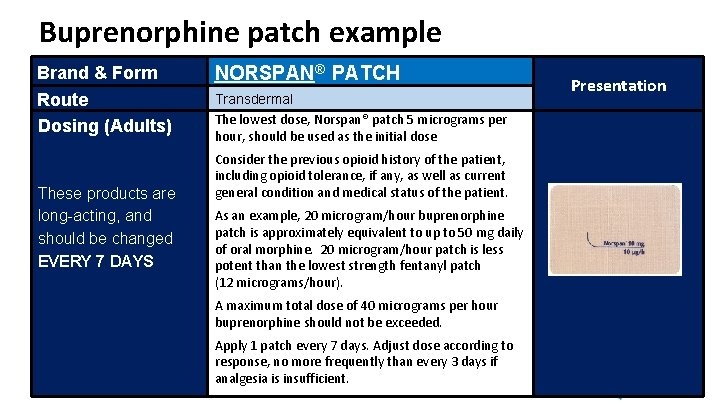
Buprenorphine patch example Brand & Form NORSPAN® PATCH Route Dosing (Adults) Transdermal The lowest dose, Norspan® patch 5 micrograms per hour, should be used as the initial dose These products are long-acting, and should be changed EVERY 7 DAYS Presentation Consider the previous opioid history of the patient, including opioid tolerance, if any, as well as current general condition and medical status of the patient. As an example, 20 microgram/hour buprenorphine patch is approximately equivalent to up to 50 mg daily of oral morphine. 20 microgram/hour patch is less potent than the lowest strength fentanyl patch (12 micrograms/hour). A maximum total dose of 40 micrograms per hour buprenorphine should not be exceeded. Apply 1 patch every 7 days. Adjust dose according to response, no more frequently than every 3 days if analgesia is insufficient. 18
References • • • MIMS online, version May 2019. Accessed on 30/5/19 via CIAP NPS Radar. Fentanyl patches for chronic pain. 1 August 2006. https: //www. nps. org. au/radar/articles/fentanyl-patches-durogesic-forchronic-pain Accessed 30/5/2019 PBS online. http: //www. pbs. gov. au/pbs/home e. TG complete Palliative Care. Pain: opioid therapy in palliative care. Accessed on 30/5/19 via CIAP Australian Medicines Handbook online, 2019. Accessed on 30/5/19 via CIAP Royal College of Anaesthetists. Dose equivalent and changing opioids. https: //www. rcoa. ac. uk/faculty-of-pain-medicine/opioidsaware/structured-approach-to-prescribing/dose-equivalents-and-changing-opioids Accessed 30/5/19 evi. Q Opioid Conversion Calculator. https: //www. eviq. org. au/clinical-resources/eviq-calculators/3201 -opioid-conversion-calculator Accessed 30/5/19 FDA Drug Safety Communications. FDA requiring color changes to Duragesic (fentanyl) pain patches to aid safety―emphasizing that accidental exposure to used patches can cause Death. 23 September 2013. http: //wayback. archiveit. org/7993/20170113080921/http: //www. fda. gov/downloads/Drug. Safety/UCM 368911. pdf Accessed 30/5/19 Health Quality & Safety Commission New Zealand. ALERT: Transdermal patches. 26 September 2019. https: //www. hqsc. govt. nz/ourprogrammes/medication-safety/publications-and-resources/publication/1303/ Accessed on 3/10/19 Therapeutic Goods Administration. Safety information, Prescription opioids: Upcoming changes to reduce harm. 31 October 2019. https: //www. tga. gov. au/node/877210 Accessed 4/11/19 19
Contact details: << Health service name >> Ph: << 0000 pager XXXX >> Email: <<add email address>> 20