
High Rise Sustainability Integrity of Fire Alarm Retrofits
High Rise Sustainability + Integrity of Fire Alarm Retrofits using NFPA 72 -2010 Jerry ‘Dutch’ Forstater, PE, PSP, CET Member, Society of Fire Protection Engineers Committee for Continuing Professional Development 18 May 2016 Delaware County Emergency Services Training Center
First Impression �Handouts Available (because we do not have 40 hours to cover all of NFPA 72 2010) 1. Paper: High Rise Sustainability + Integrity of Fire Alarm Retrofits using NFPA 72 -2010 by: Jerry ‘Dutch’ Forstater, PE, PSP, CET Daniel H. Broughton, EIT Professional Systems Engineering, LLC 2. Definitions Reference 3. Fire Trends G. I. Forstater, PE, PSP, CET 2
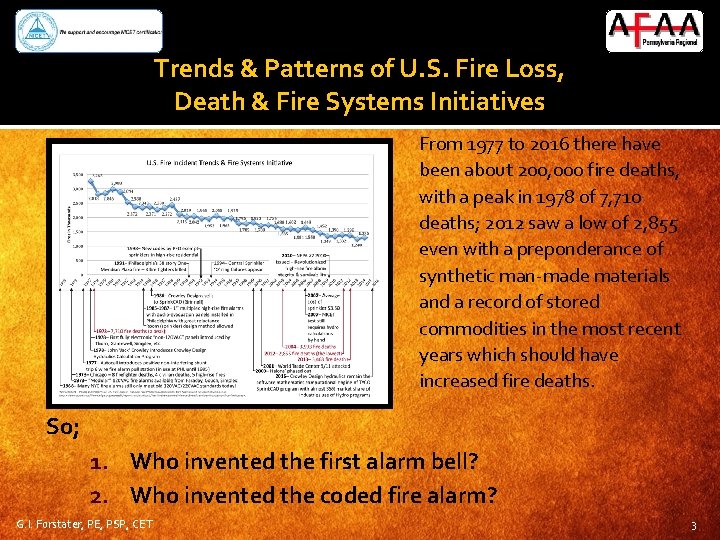
Trends & Patterns of U. S. Fire Loss, Death & Fire Systems Initiatives From 1977 to 2016 there have been about 200, 000 fire deaths, with a peak in 1978 of 7, 710 deaths; 2012 saw a low of 2, 855 even with a preponderance of synthetic man-made materials and a record of stored commodities in the most recent years which should have increased fire deaths. So; 1. Who invented the first alarm bell? 2. Who invented the coded fire alarm? G. I. Forstater, PE, PSP, CET 3
What We Will Cover Compliance – You need to know the Target from Acts to Adopted Codes and everything “in-between” 2. NFPA 72 Performance Standards – You need to know Techniques to accomplish 1. The easy ones The nuanced ones The risk-based ones 3. Installation – You need to employ the right Tools to get it done Interconnection Classes Survivability Integrity Samples (yeah, it’s complicated) G. I. Forstater, PE, PSP, CET 4
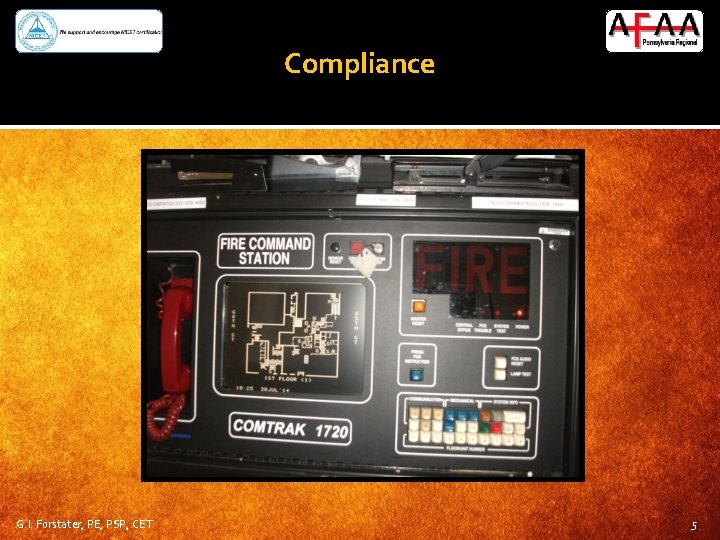
Compliance G. I. Forstater, PE, PSP, CET 5
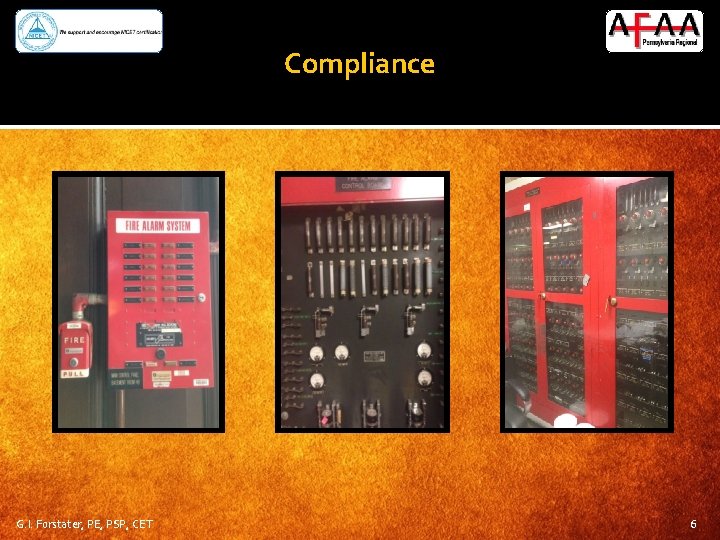
Compliance G. I. Forstater, PE, PSP, CET 6
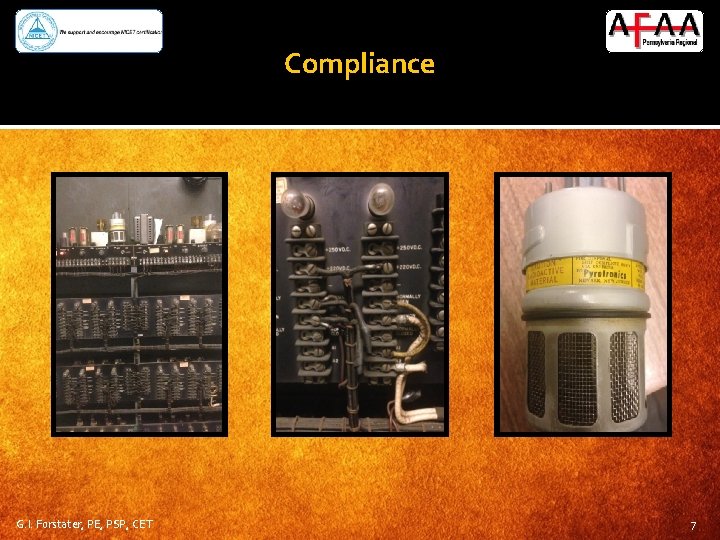
Compliance G. I. Forstater, PE, PSP, CET 7

Compliance Acts, Standards, Regulations, Local Laws, Adopted Codes, and Master Codes These, in addition to local AHJ approval, provide the means by which a Certificate of Occupancy or a TCO may be issued. (According to the State Secretary of Labor and Industry in 1995, only 10% of properties in Pennsylvania had a CO!) G. I. Forstater, PE, PSP, CET 8
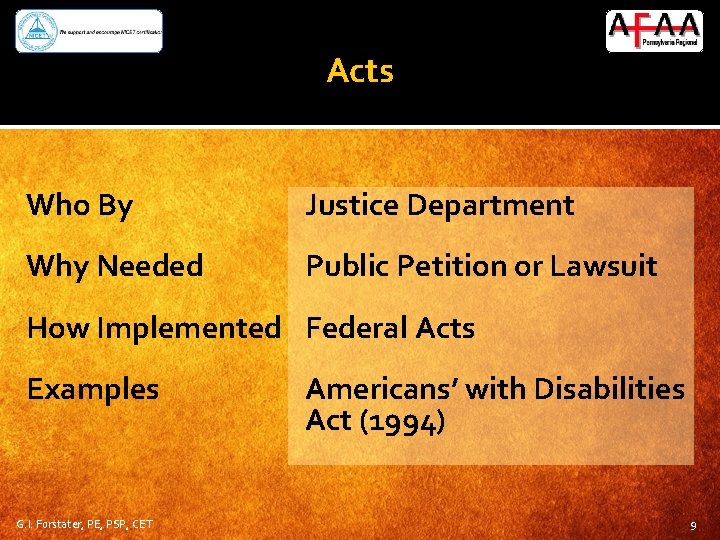
Acts Who By Justice Department Why Needed Public Petition or Lawsuit How Implemented Federal Acts Examples G. I. Forstater, PE, PSP, CET Americans’ with Disabilities Act (1994) 9
Standards National & Federal Who By NFPA ANSI Why Needed Safety How Implemented Research + Adoption Examples G. I. Forstater, PE, PSP, CET NFPA 72 10
Regulations Who By DCA L&I Why Needed Enforcement How Implemented AHJ Examples G. I. Forstater, PE, PSP, CET Permits/COs 11

Local Laws Who By AHJ/Compliance Firms Why Needed Missing Pieces How Implemented AHJ Examples G. I. Forstater, PE, PSP, CET Chartered Rules 12
Adopted Codes Who State/1 st Class Cities Why Uniformity How Legislative Adoption Examples UCC/IBC* * Codes adopted in all 50 states by 2007 G. I. Forstater, PE, PSP, CET 13
These Form Our Compliance To Meet Acts, Standards, Regulations, Local Laws, & Adopted Codes Who For Build’s/Managers/Arch’s/En gr’s/Insurance Why Needed Means and Measures How Implemented Adopted Standards Examples G. I. Forstater, PE, PSP, CET UCC/IBC/NFPA/State/Local 14
NFPA Performance Standards The Easy Ones: § Dedicated Branch Circuits (ahead of breaker – no disconnecting means) § Standby Capacity 24 hours + 15 minutes! ECS + Mass Notification § 10 Second Response after activation of initiating device (seems easy but not) § Annunciation Zoning by floor plus Integrity – One zone must not affect another (it gets deep) G. I. Forstater, PE, PSP, CET 15

NFPA Performance Standards (continued) � 2 Way ‘FFT’ supervised in a multitude of minimum locations (10 types) � Elevator Status Monitoring includes availability of power, status of location, direction, doors position, and if occupied. Even temperature in machine room! � Voice Evacuation Messaging with Intelligibility – 8 exceptions with “acoustically distinguishable spaces” � Records of Completion, Inspection, Testing, and Maintenance. A 12 -page completion record! G. I. Forstater, PE, PSP, CET 16
NFPA Performance Standards The Nuanced Ones � Residential Notification – 520 Hz +/- 10% square wave in sleeping spaces with textural, strobe, or vibration to meet ADA. Have you heard it? Raise your hands. I brought a sample. (effective Jan. 1, 2014 with 2 year manufacturer delay) � Unfortunately – no wireless detector + 520 Hz devices available as of yet. � “Exit Marking” audible devices to “…produce a desired directional effect for 50 ft. within an unobstructed egress. ” Localization queues for finding the exit – Really? � ECS signaling may serve as a mass notification system (and background music too!) G. I. Forstater, PE, PSP, CET 17
NFPA Performance Standards The Risk-Based Ones Risk Analysis by trained, licensed Fire Protection Engineer required for: Ø EVC Signaling Ø Residential Fire Warnings Ø NFPA 1600 Disaster / Emergency Management Ø Automation Sequence Ø Pressurization (if needed) Control Ø Relief Control / Supply Control (damper monitoring and door control) Ø Purge Control Ø Fire Command Center / Emergency Management & Response Design Ø Integrity and Survivability (why not in handbook? ) G. I. Forstater, PE, PSP, CET 18
Installation § Interconnection Classes Circuits and pathways have been redeveloped to identify clearly Class A, Class B, Class C, Class D, Class E, and Class X pathways. Refer to Table 1 for definition applicability. § Survivability The path survivability is defined to comply with survivability from level 0 being no provision for pathways survivability to the maximum Level 3 pathway survivability with Level 1 and 2 being partially survivable. § Integrity Most modern high rise buildings may require a pathway survivability of Level 3 which will consist of pathways and buildings that are fully protected by an automatic sprinkler system in accordance with NFPA 13 with interconnecting conductors, cables, and physical pathways installed in metal raceways or 2 -hour rated cable. This is per Code paragraph 12. 4. 2. § Sample A performance based sample (do not try this at home) G. I. Forstater, PE, PSP, CET 19
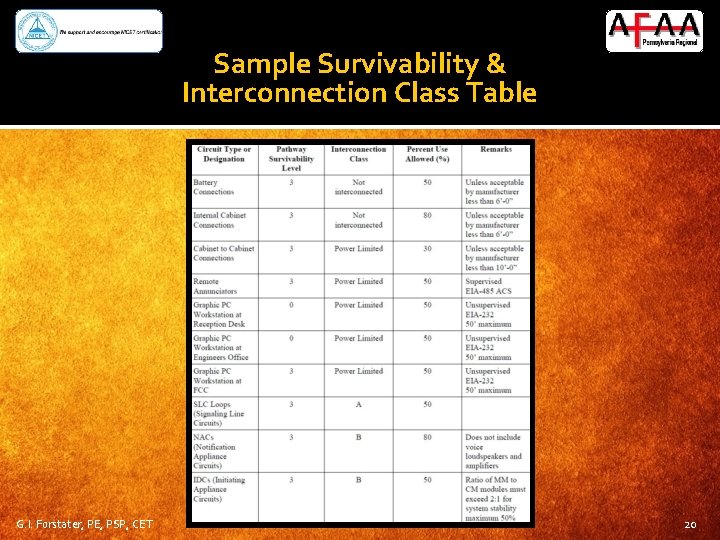
Sample Survivability & Interconnection Class Table G. I. Forstater, PE, PSP, CET 20
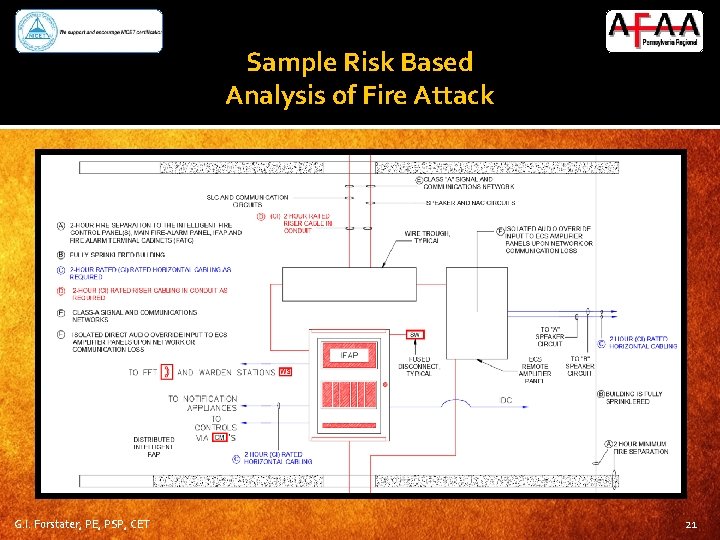
Sample Risk Based Analysis of Fire Attack G. I. Forstater, PE, PSP, CET 21
Installation Survivability: Pathway survivability is the topic of greatest concern. It is also second in cost only to equipment costs in single impact items affecting retrofit compliance. Table 2 also reviews the highlights of pathway survivability for conformance. Pathway survivability is identified in 24. 3. 5. 4. 1 requiring that in systems employing relocation of occupants or a partial evacuation, Level 2 or Level 3 pathway survivability is required. As an example, if the evacuation procedure will be floor in alarm / floor above / floor below, this relocation, within a fully sprinklered facility, would require a Level 2 pathway survivability. The following are some of the nuances of this section: G. I. Forstater, PE, PSP, CET 22
Installation The following requirements shall apply to both audible tone, pre-recorded voice, and visible notification appliance circuits � Fire alarm systems used for partial evacuation and relocation shall be designed and installed such that attack by fire within an evacuation signaling zone shall not impair (the integrity) for control and operation of the notification appliances outside of the signaling zone. Performance features provided to ensure survivability shall be as described and technical justification (for interconnection classes) provided in the construction documents. G. I. Forstater, PE, PSP, CET 23
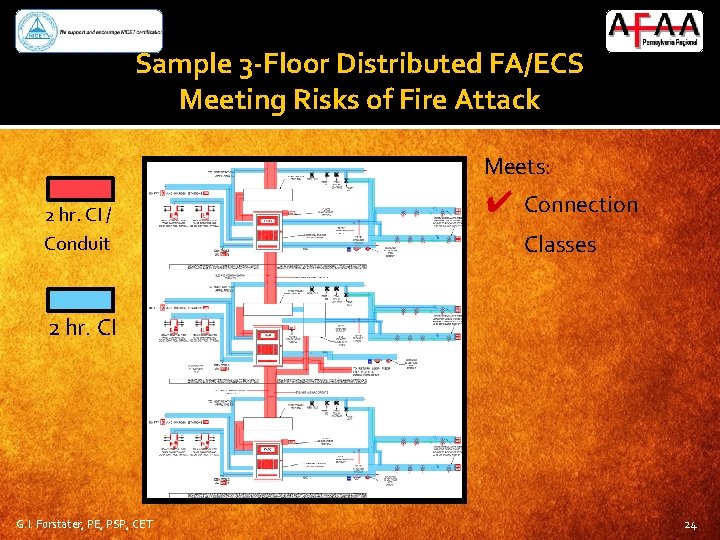
Sample 3 -Floor Distributed FA/ECS Meeting Risks of Fire Attack Meets: 2 hr. CI / Conduit ✔ Connection Classes 2 hr. CI G. I. Forstater, PE, PSP, CET 24
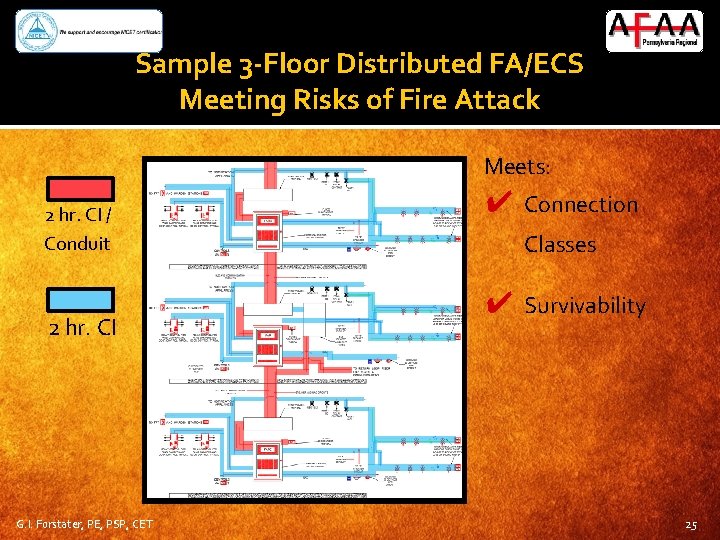
Sample 3 -Floor Distributed FA/ECS Meeting Risks of Fire Attack Meets: 2 hr. CI / Conduit 2 hr. CI G. I. Forstater, PE, PSP, CET ✔ Connection Classes ✔ Survivability 25
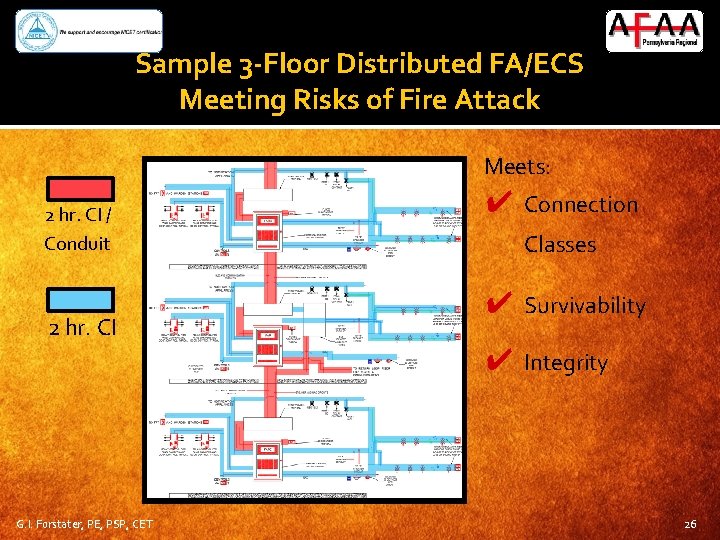
Sample 3 -Floor Distributed FA/ECS Meeting Risks of Fire Attack Meets: 2 hr. CI / Conduit 2 hr. CI G. I. Forstater, PE, PSP, CET ✔ Connection Classes ✔ Survivability ✔ Integrity 26
Installation § For a non-sprinklered building, Level 3 may not be obtained Final without architectural modifications within the structure of Additional the building to some extent. However, a Level 3 pathway Considerations survivability plan may be implemented at least partially within most buildings without major reconstruction. § 2 -way in-building wired emergency communication systems must also have a pathway survivability of Level 2 or Level 3. § All areas of refuge emergency communication systems must also have a pathway survivability of Level 2 or Level 3 with complete communications to landings / shelters. § Elevator emergency communication systems may have a pathway survivability of Level 0, Level 2, or Level 3. § The Central Command Station emergency communication systems shall have a pathway survivability as determined by Risk Analysis. This expected analysis of performance is by a trained fire protection engineer. G. I. Forstater, PE, PSP, CET 27
Conclusion Why did NFPA expand while contracting at the same time? G. I. Forstater, PE, PSP, CET 28
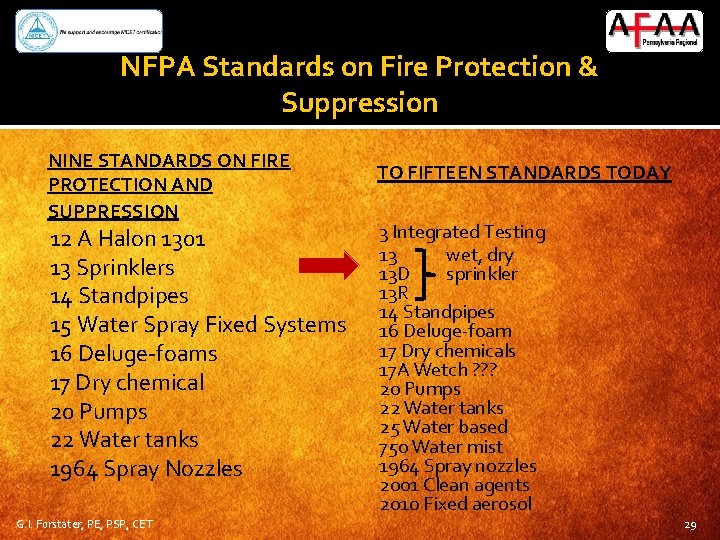
NFPA Standards on Fire Protection & Suppression NINE STANDARDS ON FIRE PROTECTION AND SUPPRESSION 12 A Halon 1301 13 Sprinklers 14 Standpipes 15 Water Spray Fixed Systems 16 Deluge-foams 17 Dry chemical 20 Pumps 22 Water tanks 1964 Spray Nozzles G. I. Forstater, PE, PSP, CET TO FIFTEEN STANDARDS TODAY 3 Integrated Testing 13 wet, dry 13 D sprinkler 13 R 14 Standpipes 16 Deluge-foam 17 Dry chemicals 17 A Wetch ? ? ? 20 Pumps 22 Water tanks 25 Water based 750 Water mist 1964 Spray nozzles 2001 Clean agents 2010 Fixed aerosol 29
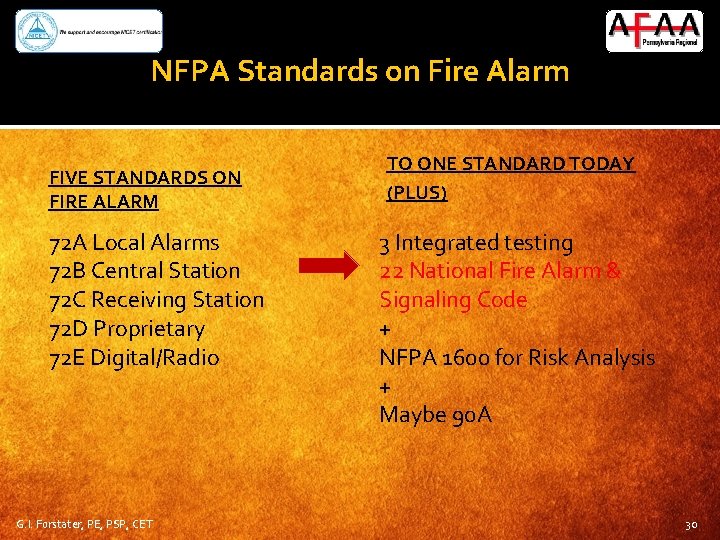
NFPA Standards on Fire Alarm FIVE STANDARDS ON FIRE ALARM 72 A Local Alarms 72 B Central Station 72 C Receiving Station 72 D Proprietary 72 E Digital/Radio G. I. Forstater, PE, PSP, CET TO ONE STANDARD TODAY (PLUS) 3 Integrated testing 22 National Fire Alarm & Signaling Code + NFPA 1600 for Risk Analysis + Maybe 90 A 30
�Thank You! Questions? �Answers G. I. Forstater, PE, PSP, CET by Dan! 31
- Slides: 31