
High Resolution Spectroscopy of the IGM How High

- Slides: 15
High Resolution Spectroscopy of the IGM: How High? Jill Bechtold, University of Arizona Central Question: How were large galaxies like our Milky Way assembled out of small star forming fragments and the intergalactic gas during the last 10 billion years? Technique: UV spectra of background quasars and starburst galaxies to study the IGM and its evolving relationship to luminous and dark matter in the Universe
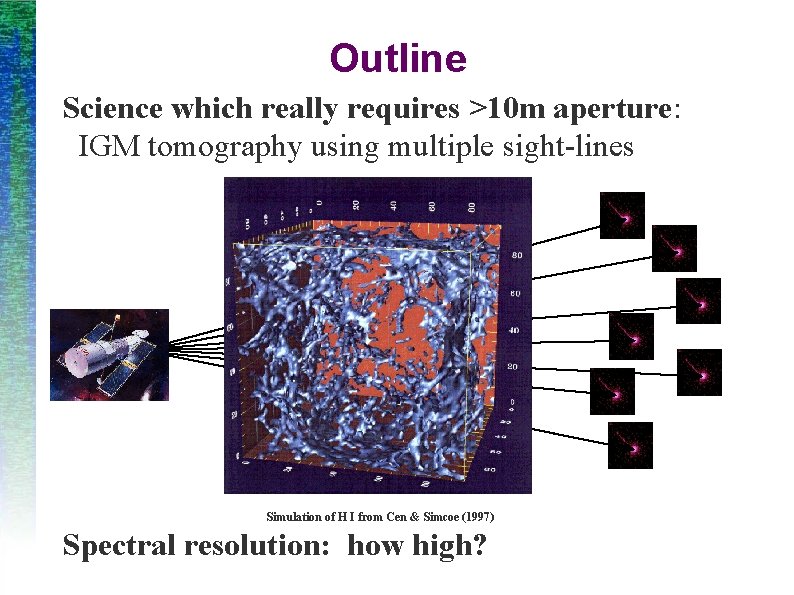
Outline Science which really requires >10 m aperture: IGM tomography using multiple sight-lines Simulation of H I from Cen & Simcoe (1997) Spectral resolution: how high?
A 3 D map of Galaxies and Gas How does gas collapse to form galaxies? How do large-scale structures affect the formation of stars and galaxies? How do galaxies and AGN enrich the gas? What environmental processes effect the variety of morphological type, stellar populations, age and metallicity we see in present-day galaxies?
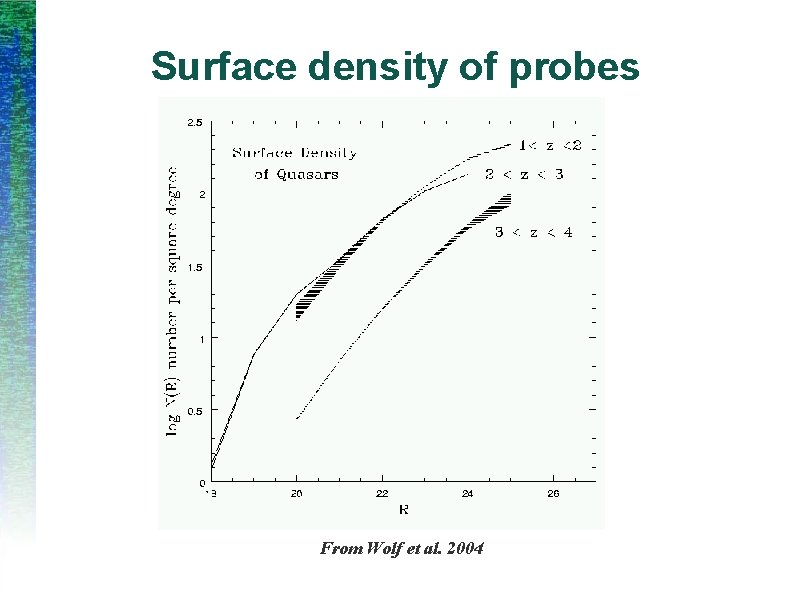
Key Measurement: Measure Lyman series, metals and H 2 absorption using multiple background AGN and correlate with galaxy redshift survey Need to sample a volume large enough to sample cosmic variance --> similar volume to 2 d. F or SDSS survey, so several hundred Mpc on a side --> 5 x 5 square degrees --> 100, 000 galaxy redshifts --> mean separation of background AGN needs to be 0. 1 arcmin^2 or few hundred per square degree
Surface density of probes From Wolf et al. 2004
Why do you need high spectral resolution? Resolve line widths, in order to fit profiles and derive temperatures and column densities ● Resolve velocity structure of profile into “components” ie physically distinct clouds of gas moving in the gravitational potential of the host galaxy ● Detect weak transitions of rare elements, to be on the linear part of the curve-of-growth, and to probe diagnostics of nucleosynthesis and depletion ●
Why do you need high spectral resolution? FOS: 280 km/s STIS: 12 km/s Jannuzi + 2004
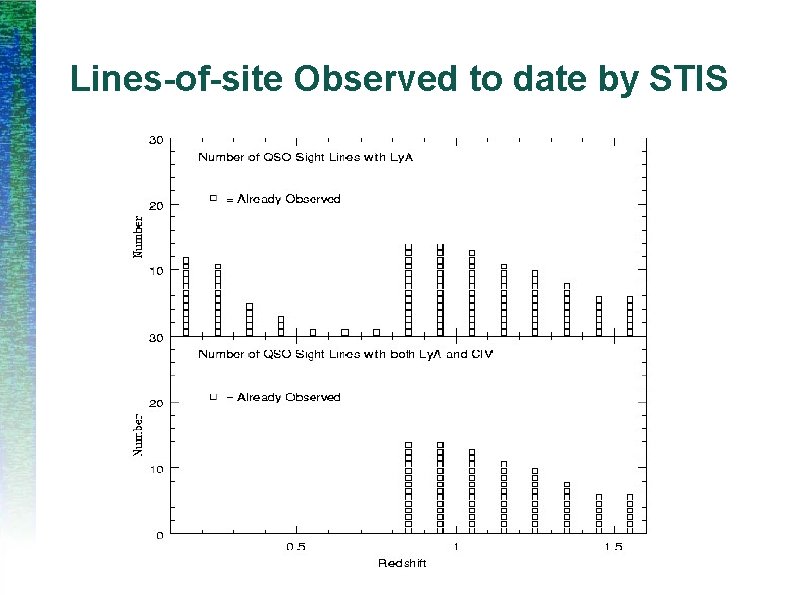
Lines-of-site Observed to date by STIS
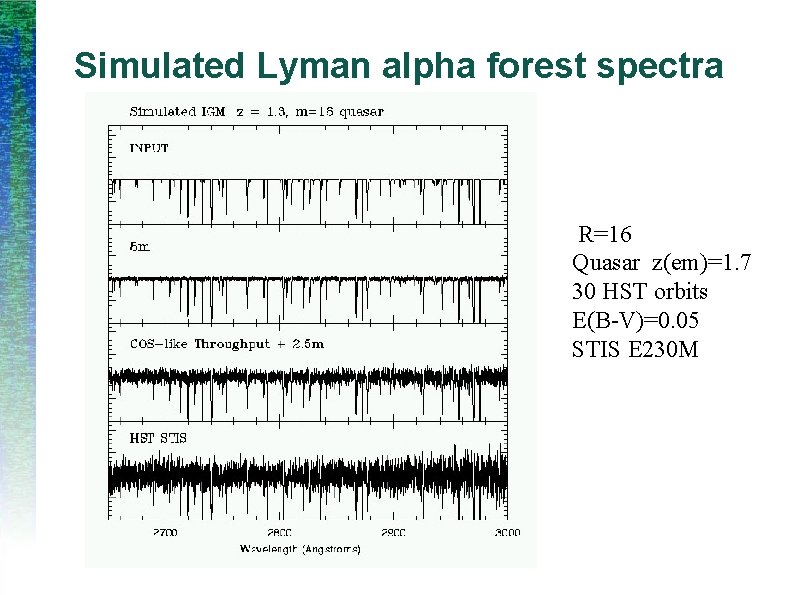
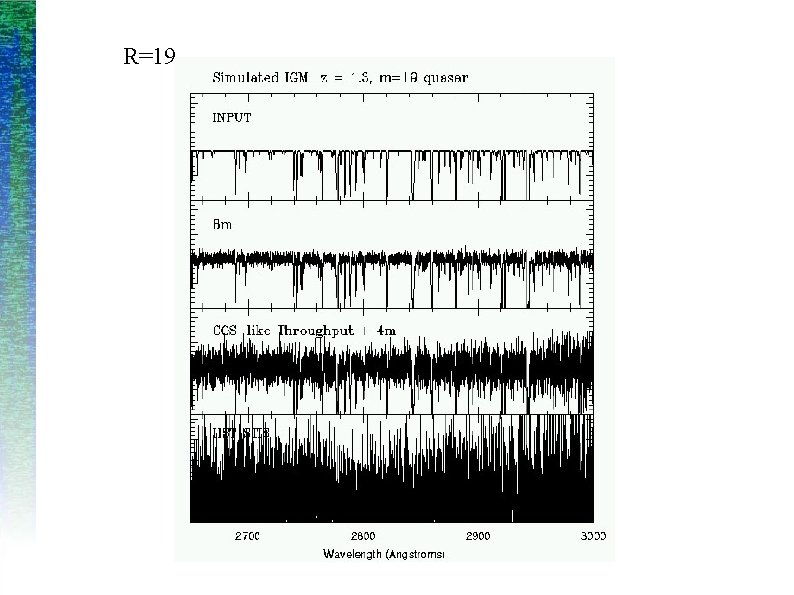
Simulated Lyman alpha forest spectra R=16 Quasar z(em)=1. 7 30 HST orbits E(B-V)=0. 05 STIS E 230 M
R=19
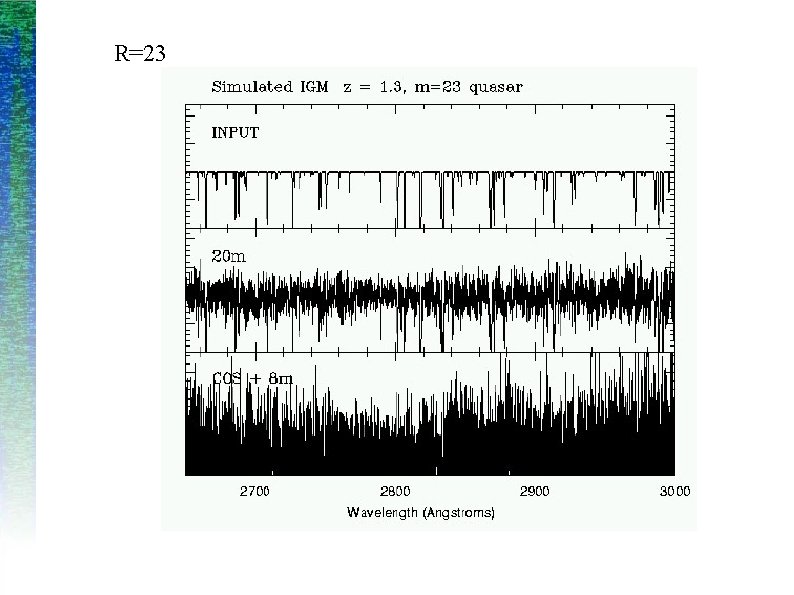
R=23
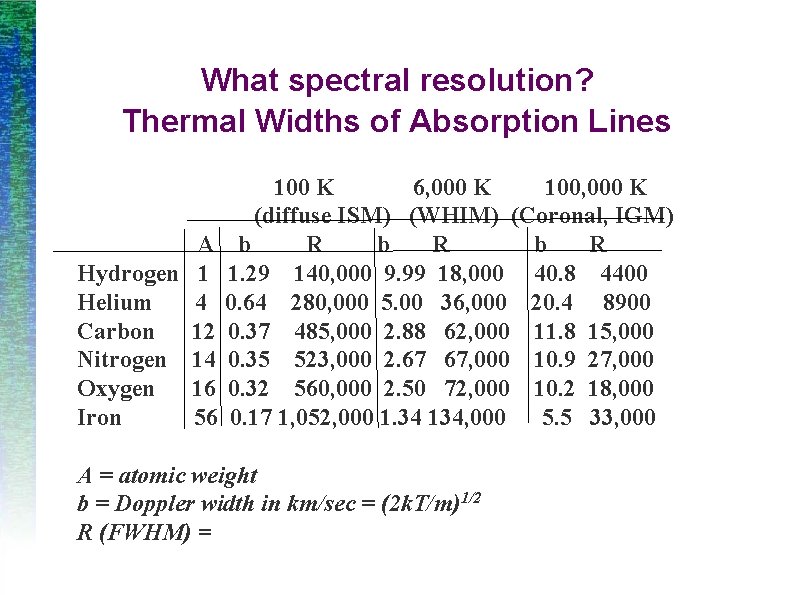
What spectral resolution? Thermal Widths of Absorption Lines 100 K 6, 000 K 100, 000 K (diffuse ISM) (WHIM) (Coronal, IGM) A b R b R Hydrogen 1 1. 29 140, 000 9. 99 18, 000 40. 8 4400 Helium 4 0. 64 280, 000 5. 00 36, 000 20. 4 8900 Carbon 12 0. 37 485, 000 2. 88 62, 000 11. 8 15, 000 Nitrogen 14 0. 35 523, 000 2. 67 67, 000 10. 9 27, 000 Oxygen 16 0. 32 560, 000 2. 50 72, 000 10. 2 18, 000 Iron 56 0. 17 1, 052, 000 1. 34 134, 000 5. 5 33, 000 A = atomic weight b = Doppler width in km/sec = (2 k. T/m)1/2 R (FWHM) =
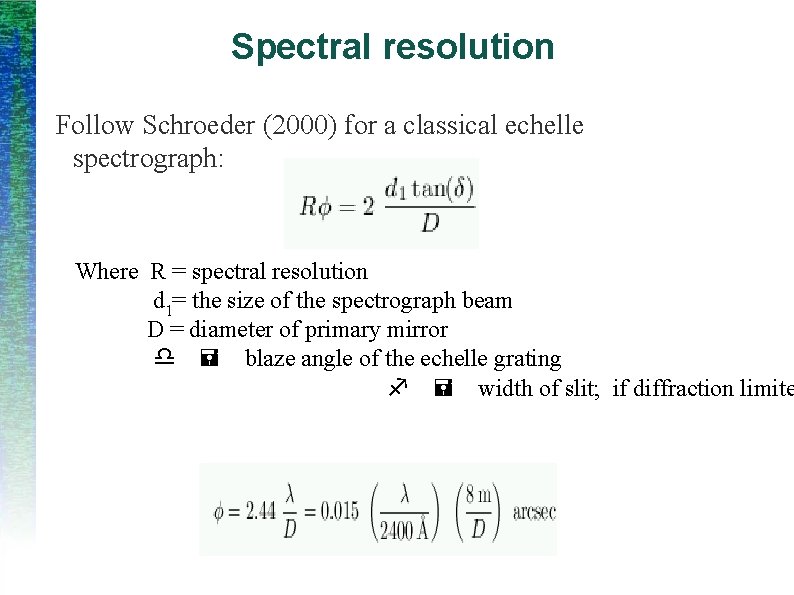
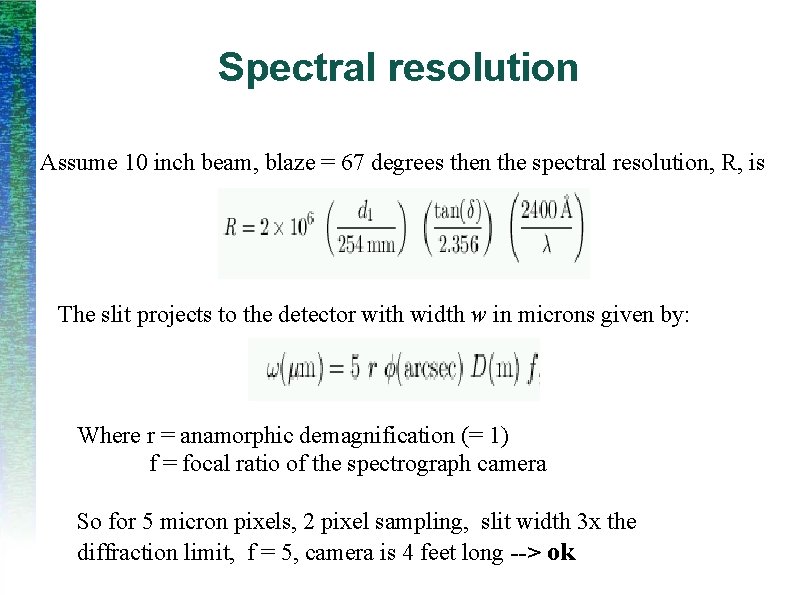
Spectral resolution Follow Schroeder (2000) for a classical echelle spectrograph: Where R = spectral resolution d 1= the size of the spectrograph beam D = diameter of primary mirror d = blaze angle of the echelle grating f = width of slit; if diffraction limite
Spectral resolution Assume 10 inch beam, blaze = 67 degrees then the spectral resolution, R, is The slit projects to the detector with width w in microns given by: Where r = anamorphic demagnification (= 1) f = focal ratio of the spectrograph camera So for 5 micron pixels, 2 pixel sampling, slit width 3 x the diffraction limit, f = 5, camera is 4 feet long --> ok
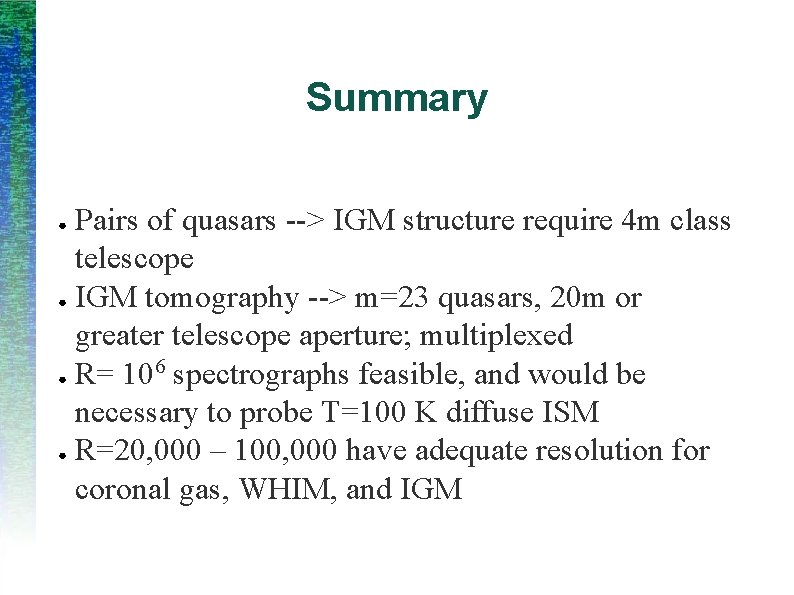
Summary Pairs of quasars --> IGM structure require 4 m class telescope ● IGM tomography --> m=23 quasars, 20 m or greater telescope aperture; multiplexed 6 ● R= 10 spectrographs feasible, and would be necessary to probe T=100 K diffuse ISM ● R=20, 000 – 100, 000 have adequate resolution for coronal gas, WHIM, and IGM ●