
High resolution radar data and products over the


- Slides: 19
High resolution radar data and products over the Continental United States Valliappa. Lakshmanan@noaa. gov National Severe Storms Laboratory Norman OK, USA http: //www. wdssii. org/ lakshman@ou. edu
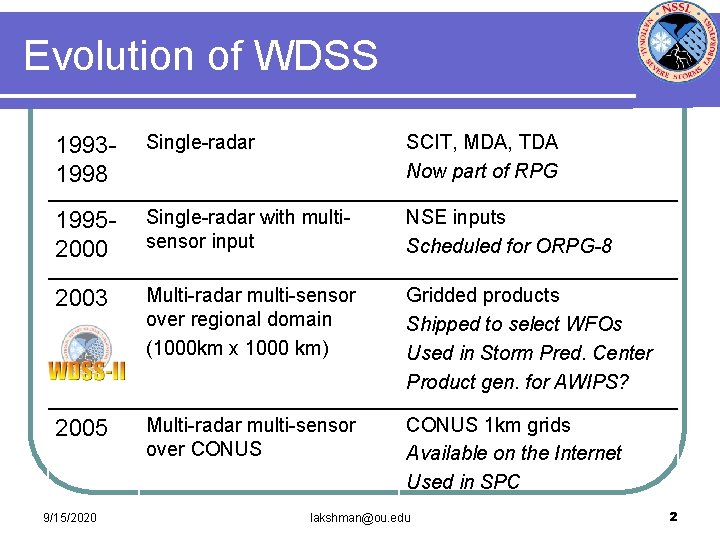
Evolution of WDSS 19931998 Single-radar SCIT, MDA, TDA Now part of RPG 19952000 Single-radar with multisensor input NSE inputs Scheduled for ORPG-8 2003 Multi-radar multi-sensor over regional domain (1000 km x 1000 km) Gridded products Shipped to select WFOs Used in Storm Pred. Center Product gen. for AWIPS? 2005 Multi-radar multi-sensor over CONUS 1 km grids Available on the Internet Used in SPC 9/15/2020 lakshman@ou. edu 2
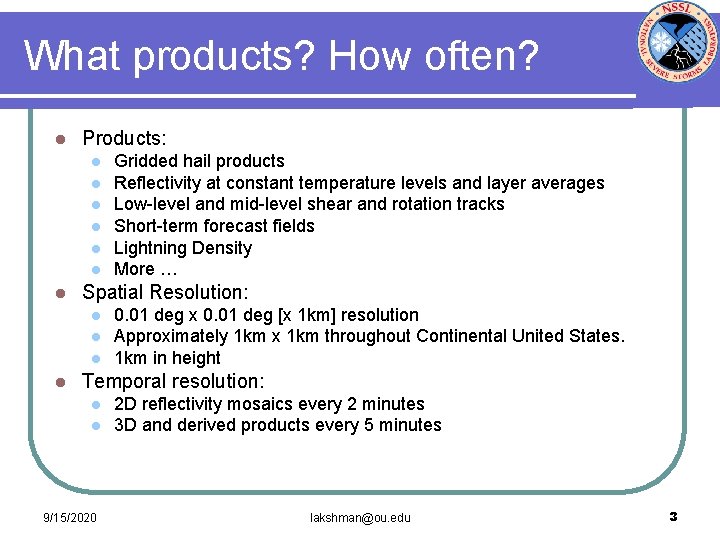
What products? How often? l Products: l l l l Spatial Resolution: l l Gridded hail products Reflectivity at constant temperature levels and layer averages Low-level and mid-level shear and rotation tracks Short-term forecast fields Lightning Density More … 0. 01 deg x 0. 01 deg [x 1 km] resolution Approximately 1 km x 1 km throughout Continental United States. 1 km in height Temporal resolution: l l 9/15/2020 2 D reflectivity mosaics every 2 minutes 3 D and derived products every 5 minutes lakshman@ou. edu 3
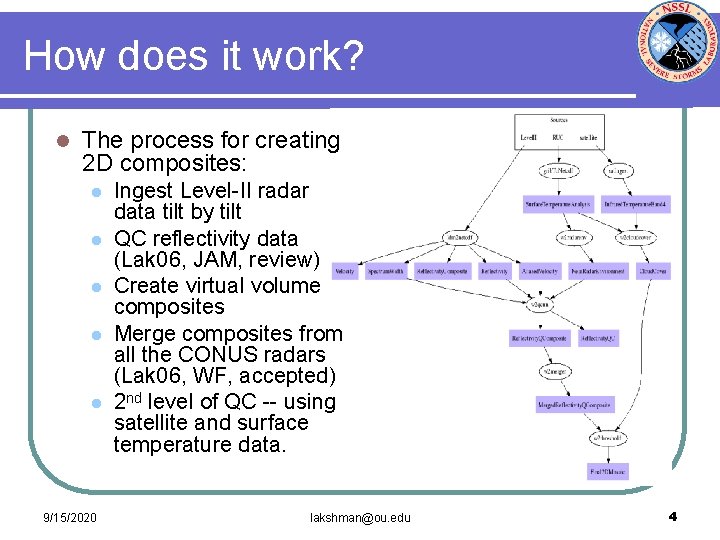
How does it work? l The process for creating 2 D composites: l l l 9/15/2020 Ingest Level-II radar data tilt by tilt QC reflectivity data (Lak 06, JAM, review) Create virtual volume composites Merge composites from all the CONUS radars (Lak 06, WF, accepted) 2 nd level of QC -- using satellite and surface temperature data. lakshman@ou. edu 4
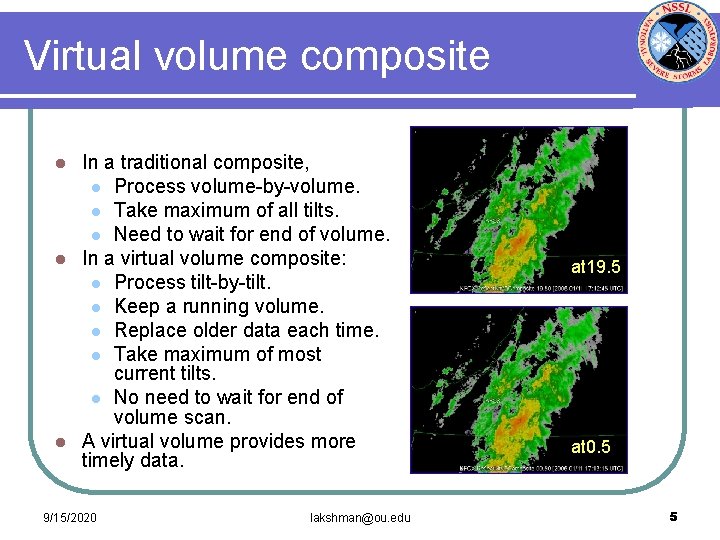
Virtual volume composite In a traditional composite, l Process volume-by-volume. l Take maximum of all tilts. l Need to wait for end of volume. l In a virtual volume composite: l Process tilt-by-tilt. l Keep a running volume. l Replace older data each time. l Take maximum of most current tilts. l No need to wait for end of volume scan. l A virtual volume provides more timely data. l 9/15/2020 lakshman@ou. edu at 19. 5 at 0. 5 5
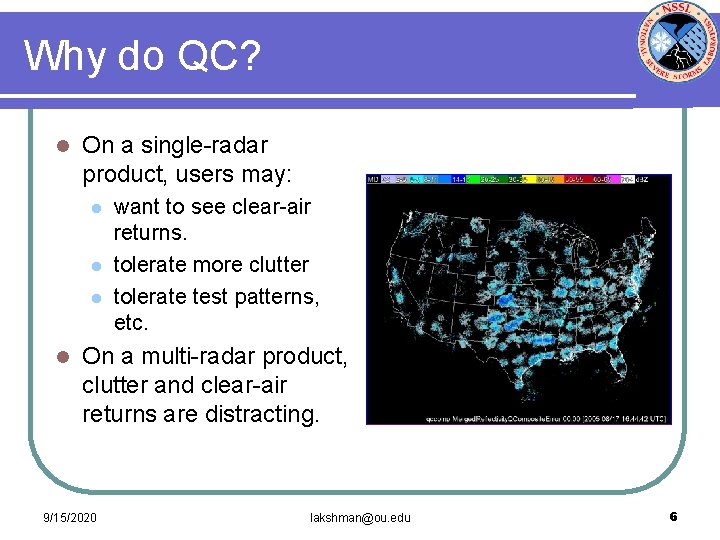
Why do QC? l On a single-radar product, users may: l l want to see clear-air returns. tolerate more clutter tolerate test patterns, etc. On a multi-radar product, clutter and clear-air returns are distracting. 9/15/2020 lakshman@ou. edu 6
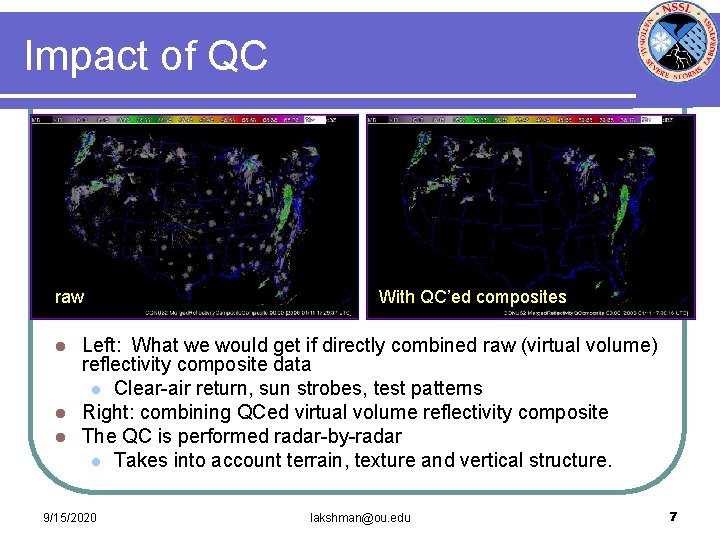
Impact of QC raw With QC’ed composites Left: What we would get if directly combined raw (virtual volume) reflectivity composite data l Clear-air return, sun strobes, test patterns l Right: combining QCed virtual volume reflectivity composite l The QC is performed radar-by-radar l Takes into account terrain, texture and vertical structure. l 9/15/2020 lakshman@ou. edu 7
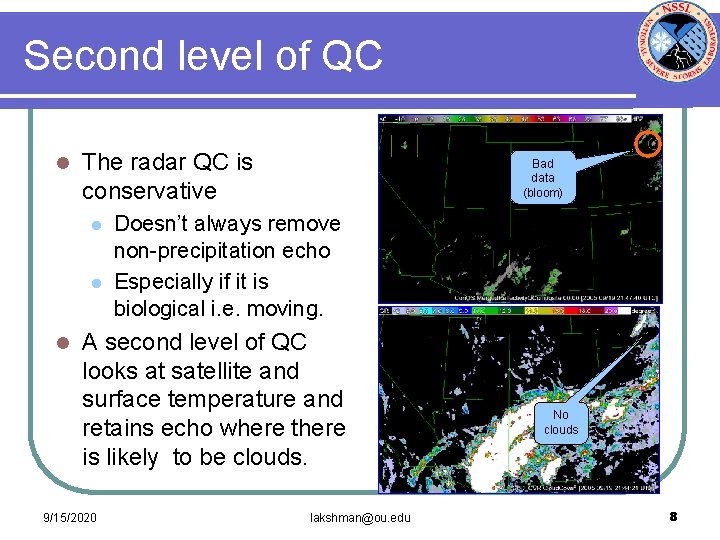
Second level of QC l The radar QC is conservative l l l Bad data (bloom) Doesn’t always remove non-precipitation echo Especially if it is biological i. e. moving. A second level of QC looks at satellite and surface temperature and retains echo where there is likely to be clouds. 9/15/2020 lakshman@ou. edu No clouds 8
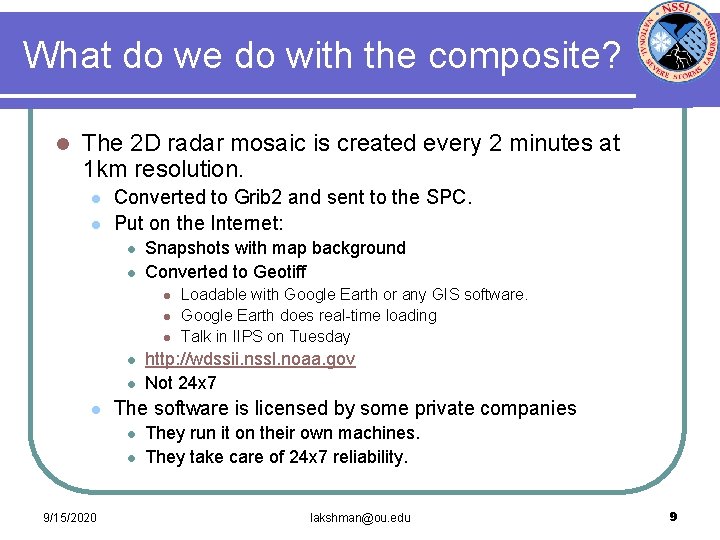
What do we do with the composite? l The 2 D radar mosaic is created every 2 minutes at 1 km resolution. l l Converted to Grib 2 and sent to the SPC. Put on the Internet: l l Snapshots with map background Converted to Geotiff l l l http: //wdssii. nssl. noaa. gov Not 24 x 7 The software is licensed by some private companies l l 9/15/2020 Loadable with Google Earth or any GIS software. Google Earth does real-time loading Talk in IIPS on Tuesday They run it on their own machines. They take care of 24 x 7 reliability. lakshman@ou. edu 9
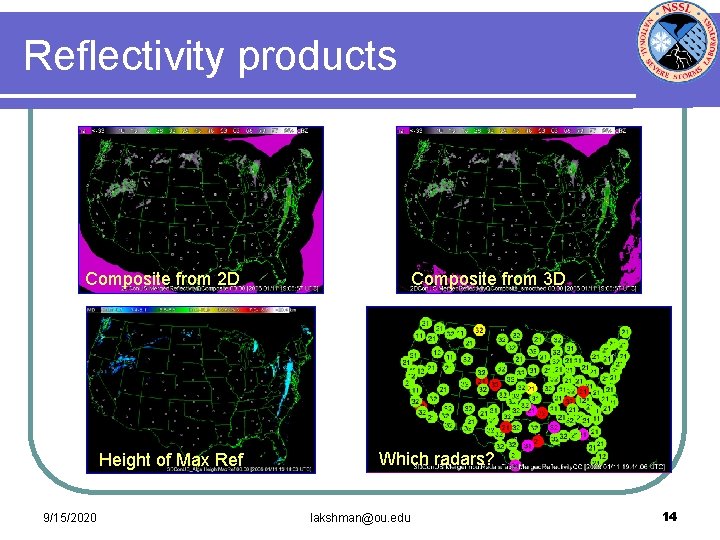
2 D vs 3 D l The 2 D composite is cheap to create l l l Need to compute in 3 D l l 5 dual-Xeon machines with 6 GB RAM But always provides an underestimate of true values. Height of d. BZ value important! Can incorporate NSE information by height A lot more products! The 3 D products need: l l l 5 dual-Xeon with 6 GB RAM 2 dual-Xeon with 16 GB RAM 64 -bit architecture l composite from 2 D: l composite from 3 D: 9/15/2020 lakshman@ou. edu 45 d. BZ 50 d. BZ 10
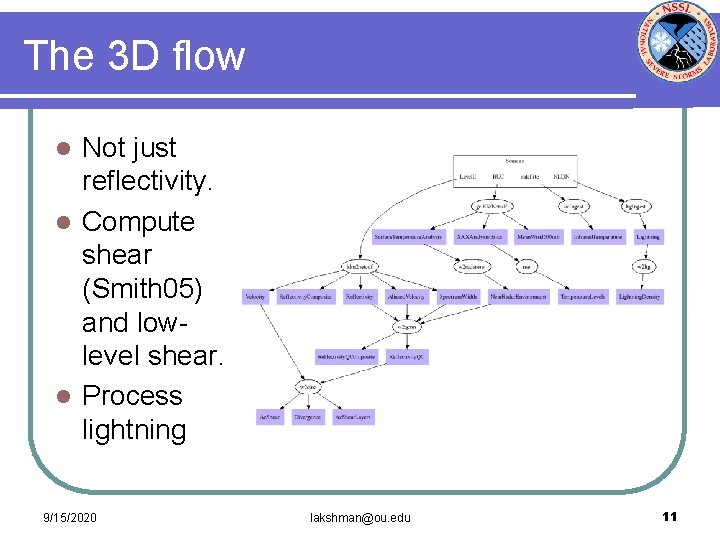
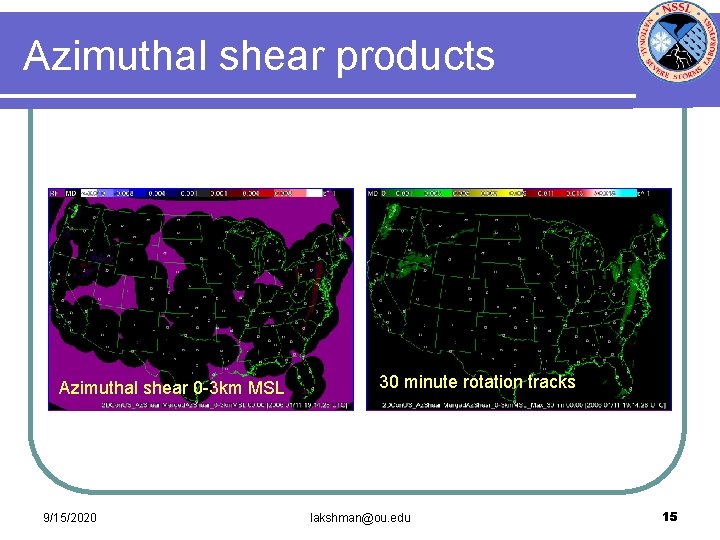
The 3 D flow Not just reflectivity. l Compute shear (Smith 05) and lowlevel shear. l Process lightning l 9/15/2020 lakshman@ou. edu 11
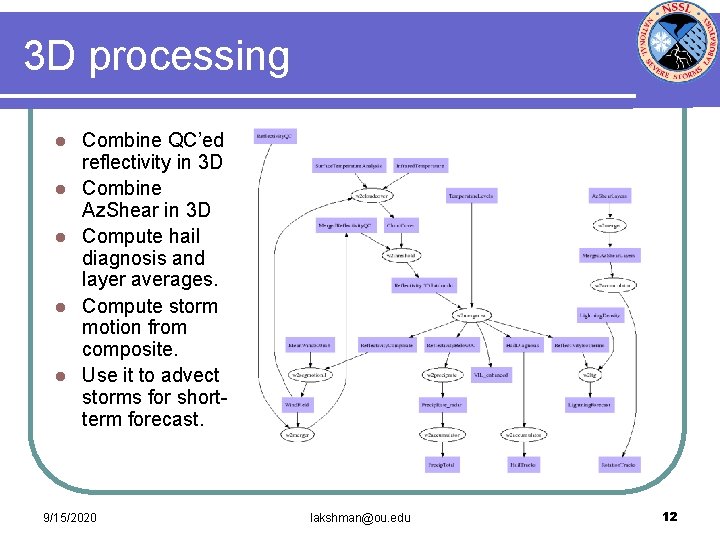
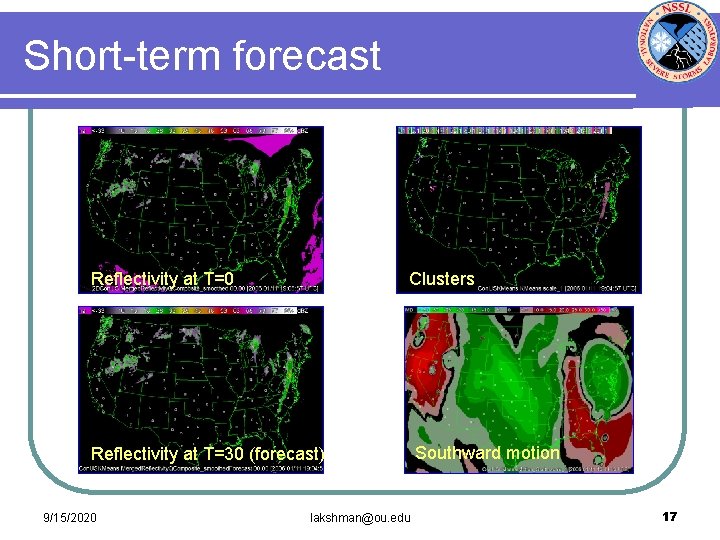
3 D processing l l l Combine QC’ed reflectivity in 3 D Combine Az. Shear in 3 D Compute hail diagnosis and layer averages. Compute storm motion from composite. Use it to advect storms for shortterm forecast. 9/15/2020 lakshman@ou. edu 12
Example products l Extracted from the real-time generation on Jan. 11, 2006 The day I created this presentation! l We haven’t run the CONUS system in Spring yet, so the severe weather products may be underwhelming. l 9/15/2020 lakshman@ou. edu 13
Reflectivity products Composite from 2 D Height of Max Ref 9/15/2020 Composite from 3 D Which radars? lakshman@ou. edu 14
Azimuthal shear products Azimuthal shear 0 -3 km MSL 9/15/2020 30 minute rotation tracks lakshman@ou. edu 15
Severe weather diagnosis Also: l. Probability of Severe Hail Reflectivity at temp. levels VIL l. Maximum Expected Hail Size l. VIL_Density l. VIL_of_the_ day l. Other echo top d. BZ levels Convection Echo top (18 d. BZ) 9/15/2020 lakshman@ou. edu 16
Short-term forecast Reflectivity at T=0 Clusters Reflectivity at T=30 (forecast) 9/15/2020 lakshman@ou. edu Southward motion 17
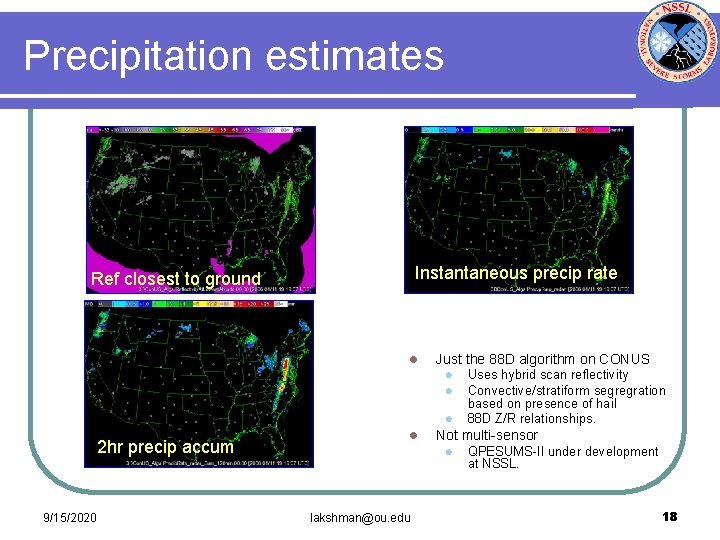
Precipitation estimates Instantaneous precip rate Ref closest to ground l Just the 88 D algorithm on CONUS l l l 2 hr precip accum 9/15/2020 l Not multi-sensor l lakshman@ou. edu Uses hybrid scan reflectivity Convective/stratiform segregration based on presence of hail 88 D Z/R relationships. QPESUMS-II under development at NSSL. 18
What do we do with these products? l The 3 D products are created every 5 minutes l l l 1 km resolution (0. 01 deg x 1 km) Converted to Grib 2 and sent to the SPC. Put on the Internet (not all of them): l l Snapshots with map background Converted to Geotiff l l l Loadable with Google Earth or any GIS software. Google Earth does real-time loading Talk in IIPS on Tuesday http: //wdssii. nssl. noaa. gov Looking for the NWS to pick this up! 9/15/2020 lakshman@ou. edu 19