
High Resolution Echelle Spectrograph for Chinese Weihai 1

- Slides: 21
High Resolution Echelle Spectrograph for Chinese Weihai 1 m Telescope. Leiwang, Yongtian Zhu, Zhongwen Hu Nanjing institute of Astronomical Optics Technology National Astronomical Observatories, CAS
Outline • Background • Spectrograph design • Expected performance • Status and planning
Background • WHRS, a high-resolution fiber-fed echelle spectrograph • • is currently under development for Chinese Weihai 1 m telescope at Weihai observatory of Shandong university. To complement the current photometric work of the Chinese Weihai 1 m telescope, the Nanjing institute of astronomical optics technology and Weihai observatory of Shandong university, started the WHRS project in the end of 2008. The design of WHRS was guided by the scientific need for a high-resolution spectrograph with a high optical efficiency and very high wavelength stability. This instrument will significantly enlarge the scientific potential of Chinese Weihai 1 m telescope.
Spectrograph design-design goal • Wavelength coverage: 380 nm-880 nm • Resolving power: 38000 -55000 • Image quality : within 2 x 2 pixels (E 80) • Optical efficiency: >30%@500 -600 nm • (without telescope and fiber) With high wavelength calibration accuracy and stability
Spectrograph design-optical design • • Probably , white-pupil is one of the best solution for high resolution spectrograph. Benefit: 1) can be freed easily from scattered light produced at the echelle, avoids vignetting 2) with smaller cross-disperser size
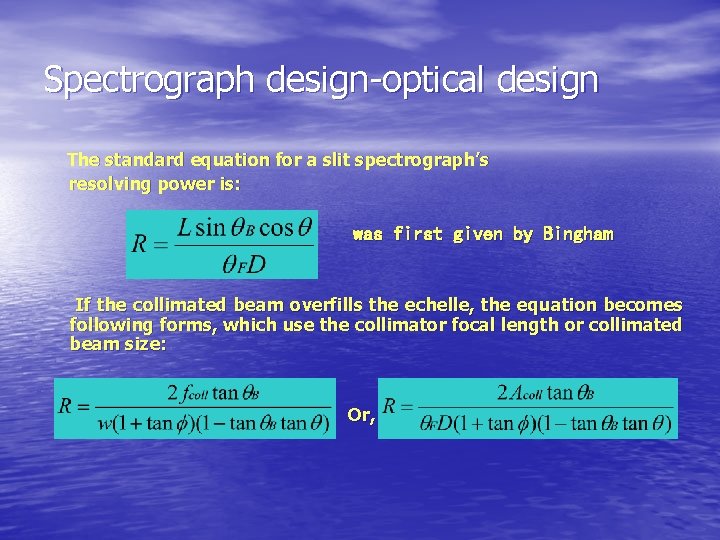
Spectrograph design-optical design The standard equation for a slit spectrograph’s resolving power is: was first given by Bingham If the collimated beam overfills the echelle, the equation becomes following forms, which use the collimator focal length or collimated beam size: Or,
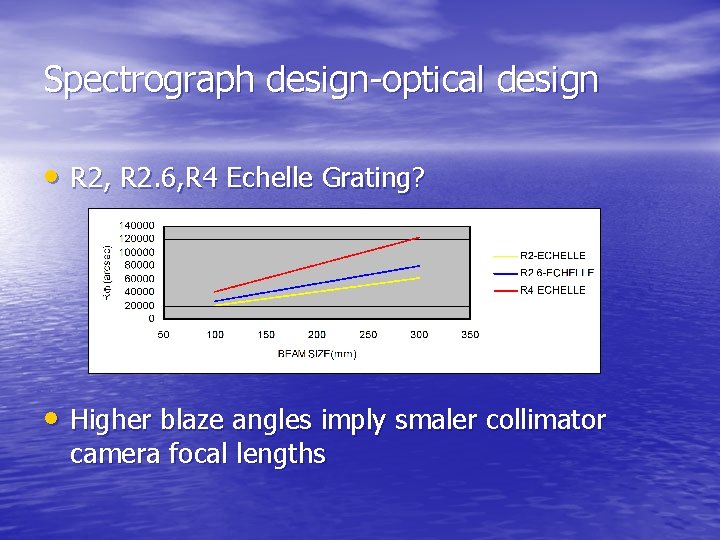
Spectrograph design-optical design • R 2, R 2. 6, R 4 Echelle Grating? • Higher blaze angles imply smaler collimator camera focal lengths
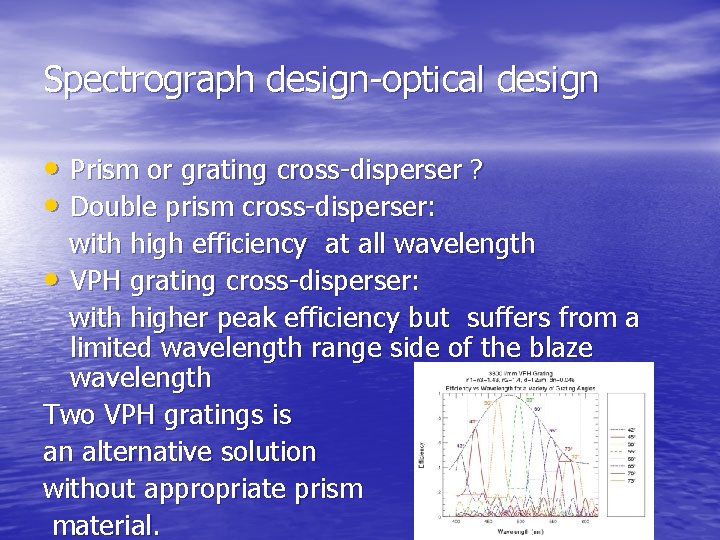
Spectrograph design-optical design • Prism or grating cross-disperser ? • Double prism cross-disperser: with high efficiency at all wavelength • VPH grating cross-disperser: with higher peak efficiency but suffers from a limited wavelength range side of the blaze wavelength Two VPH gratings is an alternative solution without appropriate prism material.
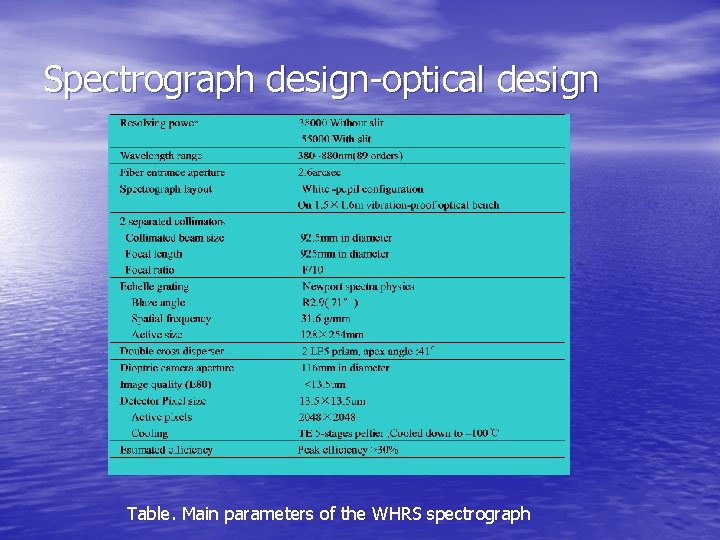
Spectrograph design-optical design Table. Main parameters of the WHRS spectrograph
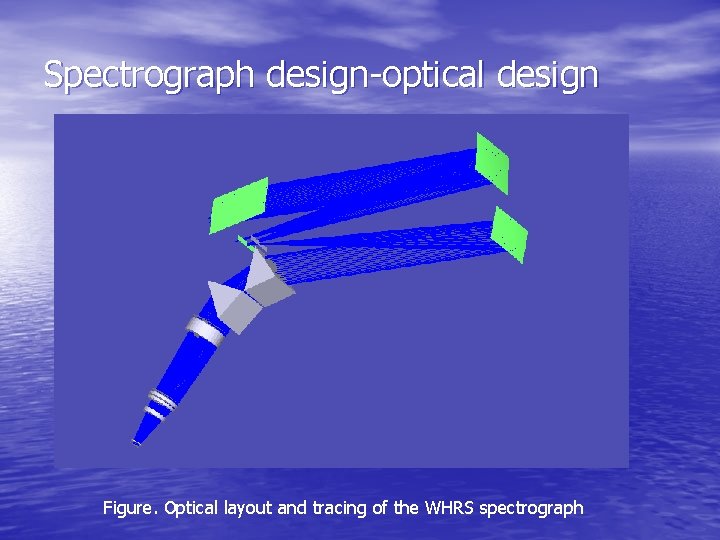
Spectrograph design-optical design Figure. Optical layout and tracing of the WHRS spectrograph
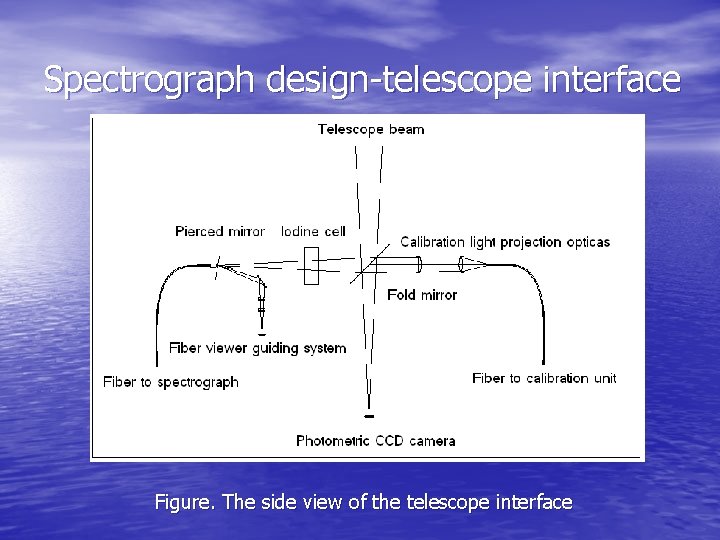
Spectrograph design-telescope interface • • The telescope interface links the spectrograph through optical fiber to the telescope. It is installed at the Carssegrain focus of the 1 m Telescope. It allows flexible combinations of WHRS with photometric CCD camera. optics and calibration sources. Calibration sources: --Tungsten lamp to provide a continuum spectrum for flat fielding --Thorium-Argon lamp for wavelength calibration --Iodine cell for wavelength standard
Spectrograph design-telescope interface Figure. The side view of the telescope interface
Spectrograph design-mechanical baseline • Highly stabilized environment is a key point for precision RV measurement. It include: --high degree of thermal stability --high mechanical stability --there are no moving parts on the bench apart of the CCD shutter. -- The shutter will operate as bi-stable (no power is need to remains in open or closed position)
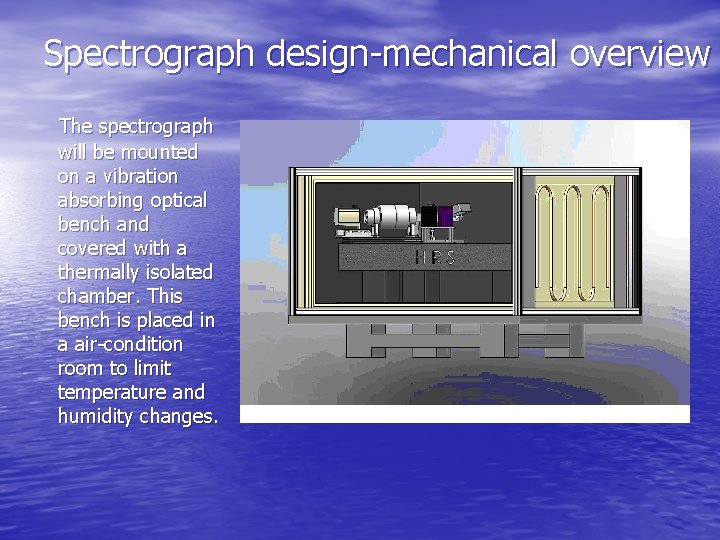
Spectrograph design-mechanical overview The spectrograph will be mounted on a vibration absorbing optical bench and covered with a thermally isolated chamber. This bench is placed in a air-condition room to limit temperature and humidity changes.
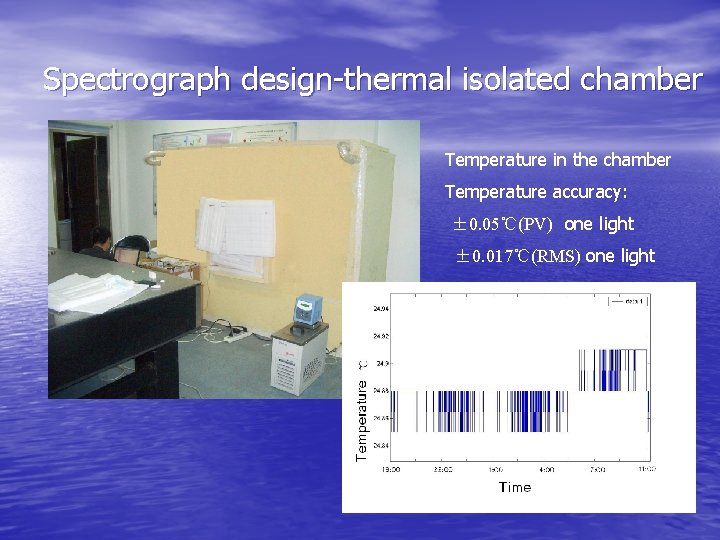
Spectrograph design-thermal isolated chamber Temperature in the chamber Temperature accuracy: ± 0. 05℃(PV) one light ± 0. 017℃(RMS) one light
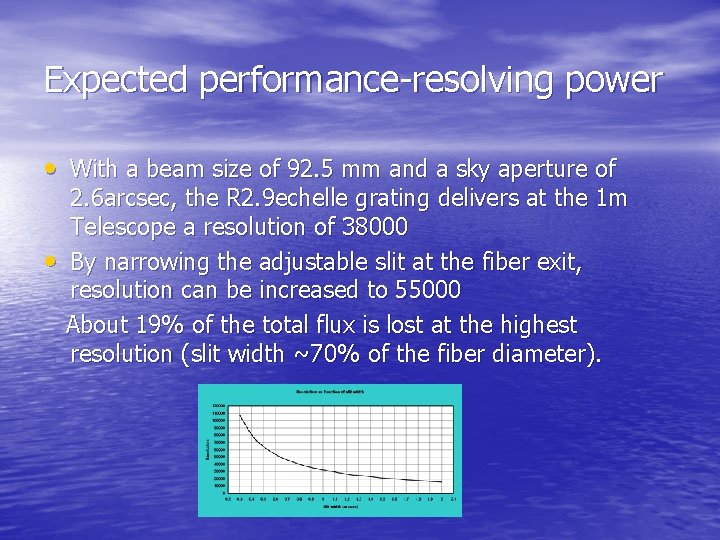
Expected performance-resolving power • With a beam size of 92. 5 mm and a sky aperture of • 2. 6 arcsec, the R 2. 9 echelle grating delivers at the 1 m Telescope a resolution of 38000 By narrowing the adjustable slit at the fiber exit, resolution can be increased to 55000 About 19% of the total flux is lost at the highest resolution (slit width ~70% of the fiber diameter).
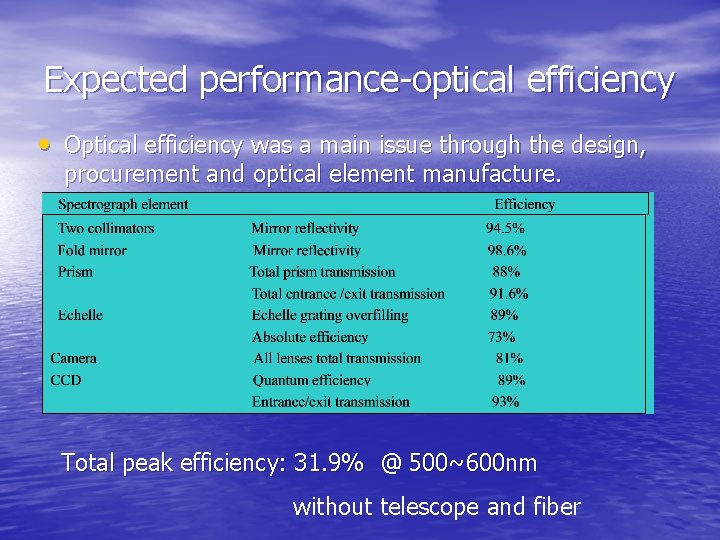
Expected performance-optical efficiency • Optical efficiency was a main issue through the design, procurement and optical element manufacture. Total peak efficiency: 31. 9% @ 500~600 nm without telescope and fiber
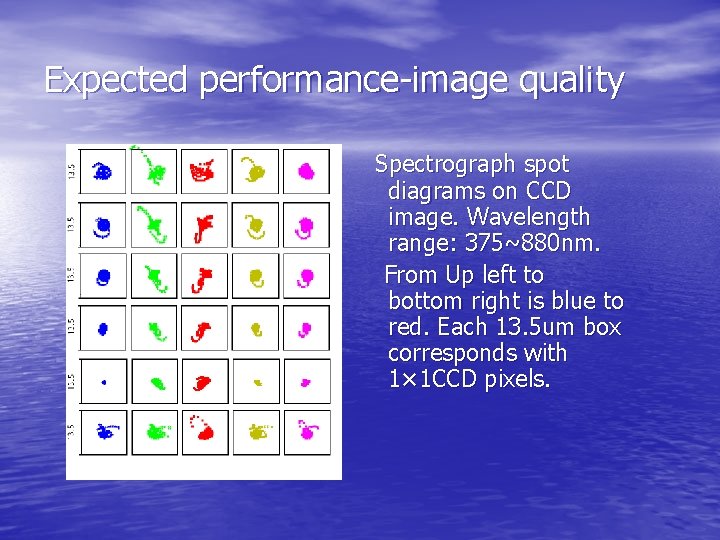
Expected performance-image quality Spectrograph spot diagrams on CCD image. Wavelength range: 375~880 nm. From Up left to bottom right is blue to red. Each 13. 5 um box corresponds with 1× 1 CCD pixels.
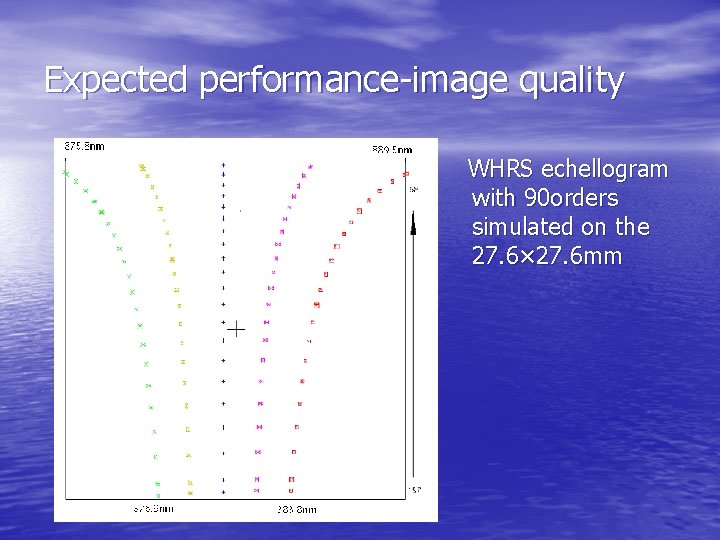
Expected performance-image quality WHRS echellogram with 90 orders simulated on the 27. 6× 27. 6 mm
Status and planning • Now, the design of WHRS has been finished, the • optical element are being polished by Nanjing institute of Astronomical Optics Technology. And plan to start integration at Weihai observatory of Shandong University in Dec. 2009.
Thanks